Sunday, December 06, 2020

FAIR AND BALANCED; THE RUSSIAN VIEW
‘Havana syndrome’: ‘Directed radio frequency energy’ made US diplomats feel sick in Cuba & China, scientists find

6 Dec, 2020
Follow RT Get short URL
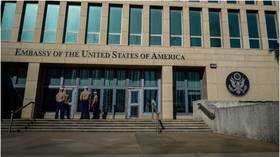
US embassy in Havana, Cuba. February 2018. © AFP / Adalberto Roqu

A study commissioned by the US government has found that “directed” microwave energy appears to be the main cause of the mysterious symptoms reported by American personnel stationed in Cuba and China.

The study by the National Academies of Sciences, Engineering, and Medicine (NASEM) was commissioned by the US State Department.

In its report, a NASEM expert panel concluded that symptoms like dizziness, headache, fatigue, nausea, anxiety and memory loss that were experienced by American diplomats were “consistent with the effects of directed, pulsed radio frequency (RF) energy.”

Overall, directed pulsed RF energy, especially in those with the distinct early manifestations, appears to be the most plausible mechanism in explaining these cases.

Vestibular disorder called persistent postural-perceptional dizziness (PPPD) was named as a “secondary reinforcing mechanism” in some patients with chronic symptoms.

The experts did not rule out other possible reasons as well, saying that the illness in some cases could have been caused by “a multiplicity of factors.” They, however, found “no convincing evidence” that diplomats were suffering from pesticides sprayed in Havana, and it was “highly unlikely” that they had fallen victims to the Zika virus.

Pesticides were described as a primary source of the symptoms experienced by US and Canadian diplomats in Havana in a 2019 study commissioned by the Canadian government, and a separate Israeli study from the same year.

“We are pleased this report is now out and can add to the data and analyses that may help us come to an eventual conclusion as to what transpired,” the State Department said in a statement to the media about the NASEM study.

‘Pure psyop’: Indian Army denies report that China used ‘microwave weapons’ to chase off its soldiers from disputed border

The US government personnel and their families began reporting symptoms like dizziness, ear pain and visual problems while stationed in Havana in late 2016 and in the American consulate in Guangzhou in southern China in early 2017. The mysterious illness dubbed ‘Havana syndrome’ spurred numerous theories, ranging from the use of sonic and electromagnetic weapons to an unknown infection and mass hysteria.

PROPAGANDA FAKE TRAIN 

Turkish export train to China returns to Istanbul station hours after departure - union

Dec 05 2020 

http://ahval.co/en-102060

Turkey’s first China-bound export train, which departed from an Istanbul station on Friday, has returned to another station in the city, hours after its departure, the United Trade Union of Transport Employees said on Saturday.

The train which took off from Istanbul’s Kazlicesme train station in a ceremony with the participation of Turkish Transport and Infrastructure Minister Adil Karaismailoğlu, has returned to the Halkalı station after its banners were removed at the station located in Maltepe district, the union said.


The Transportation Ministry on Friday said the train would carry 42 containers of household appliances across the Trans Caspian East-West Middle Corridor via Baku-Tbilisi-Kars railway, before arriving in China in 12 days.

Moreover, the China-bound train resulted in wide scale railway transportation disruptions, with nine trains being cancelled, shorted routes in 10 trains and delays in nine others, the union said.


The union also called on the Transportation of Ministry to take action against State Railways of the Republic of Turkey (TCDD) officials involved in the incident, for causing disruption in railway travels, putting citizens lives at risk during the pandemic and damaging the reputation of the railways.


Basına ve Kamuoyuna; Çin’e Giderken Kaybolan ilk İhracat Treni…
Toplamda 42 konteyner içinde beyaz eşya taşıyan ilk ihracat trenini 04.12.2020 tarihinde saat 14.00 da Kazlıçeşme istasyonundan Çin’in Xi’an şehrine Ulaştırma ve Altyapı Bakanı Adil Karais

Trump administration failed to pursue suspicious death of American journalist in Istanbul


Nov 18 2020 

The Trump administration has failed to pursue an investigation into the death of Syrian-American journalist Halla Barakat who was murdered along with her mother in Istanbul in 2017, according to the Centre for Investigative Reporting.

Halla, who was 23, and her mother Orouba, 62, were found with their throats cut in their apartment in Istanbul in September 2017. Their bodies were covered in blankets and the apartment had been sprinkled with laundry detergent to delay their discovery. U.S. Sen. Thom Tillis and Rep. David Price, from North Carolina, where Halla was born, called for an investigation into whether the crime was a professional assassination.

Turkish authorities then arrested Ahmed Barakat, a distant relative, who had arrived in Istanbul six months previously and had been in the Free Syrian Army. Ahmed had confessed to the murders in front of a judge, saying Orouba owed him money. After a brief trial, he was given two life sentences and the investigation was closed. But Ahmed then went back on his confession in his next court appearance, saying that his translator had pressured him to cooperate with prosecutors in exchange for a reduced sentence.

Turkish authorities “did not respond to multiple requests for comment on the case made directly to the police and prosecutors and submitted through the Turkish Interior Ministry in Ankara and the Turkish Embassy in Washington”, according to the report on the investigation.

Meanwhile, the FBI also decided not to pursue the case. “Upon review into the deaths of Halla and Orouba Barakat, the FBI is confident that the Turkish legal system and their law enforcement conducted a thorough investigation and identified, interviewed and received a confession from the subject,” Tina Jagerson, an FBI spokesperson said. “The FBI is not in receipt of any further relevant information that would dispute the investigative findings or legal outcome. Additionally, the FBI has recently been in contact with the victim’s family and has communicated the FBI’s decision.”

The Barakat family in the United States, and particularly Suzanne Barakat, has not given up on the investigation. They believe that while Ahmed was involved in the murders, he probably did not act alone, and they doubt the motive he gave prosecutors. Suzanne urged North Carolina Representative David Price to seek answers from the government, and he was briefed by the FBI and State Department in September 2019.

Price left the meeting feeling that the case had become “a diplomatic matter” between the U.S. and Turkey. “But the diplomatic answer was not an adequate one… the diplomacy says we don’t get involved here,” Price said. He was given the impression that Turkey was happy to settle the investigation quickly, and that the U.S. had little appetite to pursue it. “It gives one reason to particularly question this kind of deference to Turkish authorities. Especially in a case that involves an American citizen,” Price said.

However, Agnes Callamard, the United Nations’ special rapporteur on extrajudicial executions, told ABC News that her office had received information and was in contact with Turkish authorities about the case. Callamard previously investigated the killing of Jamal Kashoggi in the Saudi consulate in Istanbul, determining that Saudi Arabia was responsible for the murder.

Callamard said that she wanted to make sure governments “do not stop at identifying the hit men, but look as well to identify those that have ordered the crime.”

She further commented that “my objective is to determine whether the investigation has met the standard it should meet under international law. Was it effective? Was it impartial? Was it independent? And importantly and most specifically, in the case of a journalist, did it consider all the possible motivations behind the killings? It is, in my view, absolutely crucial that as a society, we are prepared to do everything we can to go to the bottom of the killing of a journalist,” she said. “When we dig into such a crime, when we go beyond the surface of such a killing, what we find usually are deep-seated corruption, criminal activities within the core of the state, or injustice and the impunity that have become part of the system.”


What motivates Trump to shelter Halkbank and protect Erdoğan?

David Phillips
Last Updated On: Nov 03 2020 

http://ahval.co/en-98587

The Trump Organization received $14 million in royalty fees for use of Trump’s name on the Trump Towers in Istanbul. Azerbaijani oligarchs also paid millions to the Trump organization for a beauty pageant in Baku. A recent investigation by MSNBC concluded that the Trump Organization has ownership positions in 119 Turkish companies.

Trump’s efforts to dissuade the Justice Department from prosecuting the state-owned HalkBank are unprecedented. Prosecutors have already determined that HalkBank helped evade US sanctions on Iran.

What motivates Trump to shelter HalkBank?

The Trump Organization owes $431 million, which Trump personally guaranteed. When Trump's taxes are finally released, don't be surprised to learn that HalkBank or Turkish businessmen close to Erdogan financed the Trump Organization.

Trump's conflict of interest has real ramifications for US national security. He invited Turkish armed forces and their jihadist proxies into Northern Syria where they committed heinous crimes against Kurds, Armenians and Syriac Christians. He turns a blind eye as Turkish-backed Islamists slaughtered ethnic Armenians in Nagorno-Karabakh. He's also silent as Turkish war ships challenge Greece, Cyprus and Israel in the Eastern Mediterranean.

Trump puts his personal interest above US national interests when it comes to US-Turkey relations. Investigators should determine if Trump's actions are unethical – or criminal.


Iraqi Kurds seek to diversify economy away from oil


Iraqi Kurds are returning to agricultural production with world oil prices continuing to be dampened by reduced demand linked to the COVID-19 pandemic, according to French news site 24Matins.

Civil servants in the Kurdistan Region of Iraq have not been receiving their salaries, and some are returning to previously abandoned farms in order to make money, 24Matins said.

Officials said that the Kurdistan Regional Government (KRG) “only pays wages every couple of months”, and so “it’s better for farmers to tend to their fields than wait for the payday or for charity.”

Before the United States’ invasion of Iraq in 2003, many in the Kurdish region had survived on farming due to sanctions imposed on the regime of Saddam Hussein.

With growing Kurdish autonomy and oil wealth, many people left the agricultural sector, and investments from multinational oil companies saw the regional capital of Erbil transformed with the construction of skyscrapers and hotels.

The World Bank painted a gloomy picture for the Iraqi economy, which is one of the most exposed to oil prices.

“Faced with this multifaceted crisis, growth is expected to contract by 9.5% in 2020, Iraq’s worst annual performance since 2003. Oil-GDP is expected to contract by 12% (capped by the OPEC+ agreement) while non-oil-GDP is expected to contract by 5% with sectors like religious tourism affected by COVID-19 measures”, the World Bank reported.

Kurdish economist Bilal Saeed told AFP the KRG had not made enough effort to diversify its economy away from oil.

“Instead of using that revenue to develop the agriculture, health and tourism sectors, the government of Kurdistan has focused mostly on developing its oil sector and ignored the rest,” he said.

This over reliance on oil also fueled corruption. Iraq’s patronage network, controlled by the two main parties, the Kurdish Democratic Party (KDP) and the Patriotic Union of Kurdistan (PUK), had failed to distribute the oil wealth equitably, according to the World Bank.

This has created a bloated public sector with over 1.2 million staff, with around 40 percent of them in the military and security sectors, out of a regional population of five million, according to 24Matins.


Turkey’s visible corruption is a measure of unaccountable politicians and undemocratic institutions


John Lubbock
Last Updated On: Dec 05 2020 

http://ahval.co/en-101833

British people used to like to think that corruption was something that happened in backwater parts of the southern Mediterranean, where European Union funds were stolen by shady mafia figures. It wasn’t something that honest British people did. But when governments stay in power for a long time, they tend to build up patronage networks that have spent a lot of money helping the party, and expect something in return.

At the start of the COVID-19 pandemic, the UK government needed to get lots of medical supplies quickly and so abandoned normal public sector procurement practices. This resulted in the government turning to companies that had never made medical supplies before, but nevertheless were awarded huge contracts to supply materials which in some cases were unusable. Some of these companies turned out to have links to the UK government.

This will not be an unfamiliar story to many Turkish people. It is well known in Turkey that if you want to get government contracts, you need to be friendly with the Turkish government. And in many cases, friendly companies are overpaid for work they have done.

Economist Emin Çapa recently asked on Twitter: “Remember the Ovid Tunnel scandal? You know, 17 million lira was paid to Cengiz Construction for 19 thousand lira of work. It turned out that 21.5 million lira were paid for the lighting of the tunnel for what should have been about 6 million lira payment. Doesn't anyone care about the Court of Accounts reports in this country anymore? Isn't there a prosecutor?”

The Court of Accounts is Turkey’s supreme auditing institution, which “performs audits on behalf of the parliament with the aim of ensuring the power of the purse and has judicial authority”.

In another recent case, a company hired by the Ministry of Transport was found to have been overpaid by 752 million lira. One of the partners of the company was Yasemin Açık, who had been a Justice and Development Party (AKP) parliamentary candidate for Elazığ in 2018.

Turkish news site Gerçek Gündem said: “Auditors of the Court of Accounts, who examined the financial accounts of the Ministry of Transport and Infrastructure, found irregularities in the tender for the construction of infrastructure for the railway connection of Adapazarı-Karasu ports and industrial facilities. Five different audit findings documented that payments were made to the contractor firm well above the tender price.”

These kinds of stories are becoming so common in Turkey that they are no longer surprising.

Yeniçağ reported the Court of Accounts had found 532 million lira unaccounted for in the budget of the Ministry of Commerce, and companies that received contracts were secretly buying vehicles which were not subject to auditing by the Court of Accounts.

Journalist Murat Ağirel said in the report: “The Court of Accounts summed up the scandal in a single sentence: ‘In total, 562,130,000 lira worth of errors were caused in the balance sheet and footnotes for 2019 and in the operating results table.’ It is not known where this money was spent, where it was given to!”

Corruption in the Turkish construction industry has been particularly noted in the past 10 years, with the Turkish government building close relations with some big building companies as it aims to complete more of the monumental construction projects which have symbolised the AKP’s success to many Turks.

Economist Bahadır Özgür compared the value of construction project tenders which had been won by four well-known construction companies to their stated income and the tax they had paid.

“Four famous builders; Received 56.7 billion lira tender in four years. The income they declare in four years is 2.8 billion lira. Corporate tax is 451 million lira accrued in four years Of course, we do not know if they even paid this…”

A January 2020 GAN report found: “Corruption is widespread in Turkey’s public and private sectors. Public procurement and construction projects are particularly prone to corruption, and bribes are often demanded.”

The build-operate-transfer model, a public-private partnership scheme for infrastructure development, has come under particular scrutiny as being vulnerable to corruption. A private company builds infrastructure, like a hospital, which is then rented by the state from the company for a certain period of time. But a lack of any anti-corruption strategy or proper judicial recourse was identified by the EU in its latest report on corruption in Turkey.

SoL newspaper recently reported: “In the first 10 months of 2020, the hospitals built with the ‘build - rent transfer model’ were paid 5,381,914,630 lira as the rental price and 2,606,251,633 lira as the service price.”

Meanwhile, billions of lira in loans have been awarded to AKP-friendly companies for work on mega projects which may have little economic justification.

“Loans from three public banks for 7 mega projects amount to $10 billion. These are just what we know. Payments started from last year. Well, if any instalments have been paid, we do not know that,” Özgür said.

And now, of course, you have the sight of Devlet Bahçeli, head of the government’s minority coalition partner, the Nationalist Movement Party (MHP), calling the famous mob boss Alaatin Çakıcı “my friend” and a “comrade”. Turkey’s government was always suspected of using mafia-like organisations to do some of its dirty work, but rarely have senior government figures openly called crime bosses their friends.

These open signs of corruption are the mark of a government in decline, whose creation of patronage networks to maintain power has led to corrupt practices that are increasingly hard to hide. Turkey dropped from 78th to 91st in Transparency International’s Corruption 
Perceptions Index report for 2020.

source: tradingeconomics.com

Turkey cannot be seen as a country to safely invest in when the perception of the state’s corruption is getting worse. The Turkish public also loses trust in the government when they perceive big construction projects as a way to launder public money to friends of the state, often for projects like the failed Ankapark theme park, which recently closed after costing $750 million.

As in the UK, Turkey’s problems with corruption are an indication of a government that has been in power too long, that has become used to the trappings of power and the patronage that government confers. Erdoğan relies on these patronage networks of powerful corporate figures to support his party, which makes any serious attempt at tackling corruption in the construction industry difficult for him to achieve.

French philosopher Camus once said: “The slave begins by demanding justice and ends by wanting to wear a crown.” In the case of the AKP, which has long claimed to be the champion of ordinary, poor, conservative Anatolians, the slave may still occasionally pretend to care about economic justice, but its real priority seems to be building a large c


Turkey’s clandestine networks and Erdoğan’s authoritarianism: purges as a dynamic of co-opting

Hakan Demiray
Nov 28 2020 Last Updated On: Dec 01 2020
http://ahval.co/en-101358

In the post-July 15 era, political loyalty to President Recep Tayyip Erdoğan became a top priority in the recruitment policy of Turkish bureaucracy. This was most visible in the promotion of some officers, many of whom were convicted in the Ergenekon/Sledgehammer cases. Their verdicts were regarded as a symbol that disproved any affiliation with Gülenists.

In the re-design of the bureaucracy, the AKP government has relied on several divergent groups: loyalists of Erdoğan from the party’s youth branch; nationalists who are ideologically closer to the far-right Nationalist Action Party (MHP), and members of several Islamic communities and pragmatists with no clear ideological or political identity.

More significantly, a number of ultra-nationalists and Eurasianists associated with Doğu Perinçek’s Patriotic Party (VP) have been finding their way back to the state’s security apparatus. The Eurasianist camp, which has members in various segments of Turkish society, military and media, has become particularly influential since the failed coup. Members of this school are accepted to be pro-Russian, at times pro-China and pro-Iran agreed with the notion of curtailing the U.S. military presence in the region.

But the prerequisite for this policy was to cleanse the existing undesirable elements from the bureaucratic strata through purges. These, in fact, were part of the post-coup suppression, which was “legalised’’ with Erdoğan’s declaration of the state of emergency. Since 2016, the scale of the purges executed after the coup reached unprecedented levels including approximately 50 percent of all admirals and generals in the military, about 18,000 other officers, 4000 judges and prosecutors, more than 10,000 police officers, more than 8000 academics, around 28,000 teachers, and about 145,000 public servants in total. It must be noted that these purges were not only a tool of repression against dissenter groups that included Gülenists, but they also functioned as a reward for the co-opted factions.

In tailoring the purge lists, the regime needed a system of intelligence and information support about “who is who,” so as to decide who to dismiss and who to keep. The VP and its intelligence network provided the necessary feedback in this regard. A closer look at the names of the party members shows clearly the intelligence-intensive nature of the party. Former intelligence heads of the Turkish General Staff HQs, of the navy and also of the gendarmerie are the members of the party.

The intelligence capacity of Perinçek’s party provided indispensable data for Erdoğan to enable his purge of dissenting cadres from the state apparatus before restructuring it. Two months after the coup, Perinçek safely stated that “his colleagues in the party” checked and compared the new appointment lists of the military’s high posts with the list they have, and that they are glad to find out that “they match around 90-100 percent.”

However, it is important to note that Erdoğan’s co-opting of the Eurasianist network was not an irrevocable and unconditional occurrence as he is a savvy politician, who is not one to leave himself defenceless against new recruits.

After having successfully purged tens of thousands of people based on the rosters mainly drafted by his ultra-nationalist ally and filling this vacuum with Eurasianists and ultra-nationalists, Erdoğan became well aware that he was exposed to potential threats against his executive power and position, which may come from the new insiders who were, after all, his former foes turned friends.

To avoid any potential threats coming from them, Erdoğan started from 2018 onwards to implement a smaller, yet selective purge campaign to sustain repression this time against the Eurasianists/ultra-nationalists.

In this regard, the demotion of the powerful commanderof the 2nd Army during Operation Euphrates Shield, Gen. Metin Temel, in Dec. 2018 by Erdoğan (and possibly also by the initiative of Defence Minister Hulusi Akar) was an alarm bell for ultra-nationalists. What followed was the dismissal of several flag officers in the 2018 and 2019 Supreme Military Council meetings.

Interestingly, almost all these dismissed high-ranking officers had been convicted and given sentences in the Ergenekon or Sledgehammer cases. Among them was, for example, one-star general Nerim Bitlislioğlu, who was known for drafting the General Staff’s expert report for the post 2016 coup trials. Also of note, Perinçek-owned publishing house, Kaynak, published his report as a book and named it “Today’s Ideological Line of the Turkish Armed Forces”. Bitlislioğlu was promoted to brigadier general in 2016 in the aftermath of the coup.

A retired colonel Mustafa Önsel, who is a loyal Perinçek follower, said on pro-Perinçek Oda TV after these dismissals that he personally knew all these generals and that none of them would betray republican values”. By dismissing those patriotic generals, Önsel demanded to know who were now being made a target of the Gülen movement and to whom President Erdoğan was “blowing a kiss to?” More recently, Erdoğan’s demotion of powerful admiral Cihat Yaycı in May 2020, who was known to be one of the champions of anti-Gülenist purges and fiercely supported by the pro-Perinçek network, boosted anxiety in Eurasianist circles.

However, the repression of these cadres is also a risky strategy, as it may cause a counter reaction.

(The opinions expressed in this column are those of the author and do not necessarily reflect those of Ahval.)

POLITICAL THOUGHT POLICE

Turkey to employ religion officers in army again


Dec 05 2020 

The Turkish Armed Forces (TSK) will start to recruit religion officers once again, after the position was outlawed in 1967, pro-government conservative Yeni Akit newspaper reported on Thursday.

Religion officers will be employed in ground forces, the air force and the navy, Akit said.

The position was outlawed in the aftermath of the military coup of May 27, 1960, but religion officers were used in Turkey’s Cyprus incursion in 1974 one last time.

The TSK will recruit the officers as part of 2020’s applications for outsourced active duty officers, which will continue until Dec. 10.

A religion officer’s duties are listed as “giving spiritual guidance so personnel morale, social welfare and happiness can reach a desired level, handling religious education, worship activities and religious ceremonies, coordinating relevant authorities for needs regarding places of worship, and administers religious affairs,” on the Air Force’s website.

Akit has campaigned for the return of religion officers for a long time, and maintains that all developed armies have a similar position.

According to the conservative newspaper, the United States has had chaplains since 1775, while “a cadre for religion officer has remained open in secular France since 1905.” There are 1,200 chaplains in the U.S. army, while France has 419, and many European countries have chaplains ranging from 85 in the Belgian army to 700 in the Spanish.

Imams were removed from the army during the early years of the republic, Akit said, and the system was reinstated in 1948.

Opposition daily Cumhuriyet cited retired Lieutenant General Erdoğan Karakuş as saying modern Turkey’s founder Mustafa Kemal Atatürk had imam officers in the army, picked from people who had completed academic studies on their specialty subject. “They were soldiers first, and imam officers second. Atatürk’s order was different, it was based on exalting the soldier’s spirituality from a standpoint that separated politics and religion.”

During the time it was legal under the Turkish republic, the position of religion officer was only utilized during wartime, Cumhuriyet said.


Does 'imperialism' want us to develop?


Eser Karakaş
Dec 03 2020 

The old-fashioned saying “imperialism wouldn’t want us to get stronger” has entered our visual and print media once again, uttered by those I never would have guessed. I truly struggle to understand the thought process behind this utterly meaningless expression that is not based on any economics or politics – and probably, there is no real need to try and figure it out.

It is a well-known principle that, under certain circumstances (or political-economic infrastructure, if you will), certain clichés develop, and are encouraged to develop. They may even be imposed. But let us not forget, such clichés are also circumstantial in the end.

These clichés, these ways of thinking, are very stubborn.

The infrastructure will change, but the clichés resist. That is why they inevitably end up as funny remnants, making those who defend them ridiculous antique fighters against time.

“Imperialism wouldn’t want us to get stronger” is one such cliché. It is the product of the Cold War era, and probably was true at some point, but time has changed its circumstances.

The most fundamental characteristic for the cold war era was that great industrial complexes in the West would see countries like Turkey as “client states,” and the target was not the citizens but the state budgets, because they would mostly manufacture goods that would be better consumed by states themselves.

Industrial complexes don’t care about citizens, because it is important for countries like Turkey to have armies that could hold up against the Soviet Union for a while, and thus are sold weapons to that end – becoming client states.

Even in that era this old saying was not truly meaningful, and Western industrial nations were not primarily concerned with it. However, strong states would come from tax-paying citizens, and the West’s attempt to circumvent that problem involved lending money and giving out loans to client states.

By the late 20th century, as the result of a great revolution that has remained largely unexplained in terms of how it came to be, the industrial complexes faded away to be replaced with technology giants. And there is no Soviet Union anymore. (Well, there’s Putin.)

The most important economic-political transformation of the last century happened in a sleight of hand, and the client state gave way to the client citizen.

The American giants of today are not merchants of weapons, but of laptops, tablets and phones, in line with the United States’ interests.

“What is good for General Motors is good for America,” many believe GM CEO Charles Wilson to have said in 1953. It is a misquote, but today if we were to say what is good for Amazon is good for the United States, we wouldn’t be wrong.

U.S. President Donald Trump seemingly wanted to reverse this historic course of events, but was put in his place by the voters and lost to Joe Biden.

Client states are not working for the biggest companies in the West anymore, the goal now is to increase the purchasing power of the client citizen.

Perhaps for the first time in history, the United States’ interests coincide with those of a peasant in Egypt.

In other words, imperialism now wants development in countries like Turkey, it wants ordinary citizens to have more purchasing power, because that’s where its interests lie.

Populist, authoritarian governments are the biggest obstacle to this very increase.

That is why under President Biden, populist, authoritarian governments that are not open to the universal principles of law (like property rights) are about to face great troubles.

I don’t know yet whether we should rejoice or lament this right now.


Canadian gold mining company subject to lawsuit in Turkey

Dec 05 2020 

Locals in Avanos in Turkey’s central Nevşehir province are suing Canadian mining company Centerra Gold’s for what they believe are unlawful drilling activities in the area’s forest lands-, Bianet reported on Friday.

Centerra Gold has launched exploration drills in forest lands, cutting down trees in the region, Ankara Chamber of Architects (TMMOB Ankara) said in a statement, adding that the mining site was only 20 km away from the Cappadocia World Heritage Site.

Mining would severely damage the environment, as drilling activities include cutting down thousands of trees, TMMOB Ankara Chairman Tezcan Karakuş Candan said in the statement. “The region was afforested in 2015 by locals and has cultural and touristic importance,” Candan said.

Avanos mayor Celal Alper İbaş told reporters that drilling might contaminate the region’s drinking and irrigation water.

After Turkey’s government issued a licence to another Canada-based company, Alamos Gold, to mine for gold in the northwestern province of Çanakkale last year, many trees were felled to clear the ground in Mount Ida (Kaz Mountains), which stirred many protests alongside the fact that cyanide method used by the companies in can be deadly for people, animals and plants and contaminate underground water reservoirs for decades.


Is geography destiny?


Nurcan Baysal
Nov 29 2020 / Dec 02 2020 

http://ahval.co/en-101379

My grandmother Ayşe lived a long life. Sometimes she used to talk about the past, she used to tell about the soldiers coming to their village and when the soldiers had come, how they fled to the mountains. As some soldiers were spending the whole winter in their villages, she told us how they were frightened and couldn’t come back to their homes and every winter, how children had died in the mountains because of cold weather. Some were caught by the wolves, some starved to death and some had died because of freezing cold… There was a big fear of soldiers because according to grandma Ayşe, one of the main reasons for fear of the soldiers was the hanging of sheikhs living in the whole region, after the Sheikh Said rebellion.

Some of those sheikhs were hung from a tree in the garden of my grandfather’s house, who was also a sheikh. My grandmother shed tears for those sheikhs for years: “some were recently married, their hands were still hennaed” she wailed for the dead.

“We were in turbans and chadors. When they came to the village we would run away from the soldiers, we were afraid they would cut off our heads” she used to tell me.

My grandmother was persecuted a lot in her 104-year long life, she witnessed too much cruelty. She also passed away in a time of persecution, in the days of the Kobane events. There was a ban, we couldn’t attend her funeral.

My mother took over that vigil of persecution from my grandmother. Some of her brothers, who were imams, spent years in prison for “giving bread to the members of the outlawed Kurdistan Workers’ Party (PKK) who came to the village”. “They were starving, whoever comes to my door in that situation, I would give them that bread,” my uncle said, but neither law nor conscience heard his voice.

In the late 80’s, early 90’s, us, her children took over that vigil of persecution from my mother. In late 80’s, our neighbourhood began to change with the declaration of the state of emergency (OHAL), men with Kalashnikovs and white Tauruses (cars commonly used by paramilitary forces in Turkey in those years) appeared. These “uninvited guests” were abducting and killing people in broad daylight. House raids and unsolved murders became a nightly routine in our province. 

With the end of the peace process in 2015, this time my children started to live the vigil of persecution with me. Long-lasting curfews, destruction of our cities, funerals on the ground, endless house raids, detentions, investigations, sleepless nights…


Millions of Kurds, rich and poor, educated and uneducated, peasant and urban, were persecuted in this country. Some lost their children, some spent their lives in prison, others at the prison gates. Some could not be appointed because they were Kurds. Some lost their jobs, because they were Kurds. Some of their villages were burned, some had to migrate to other lands as refugees. But this cycle of persecution flowed from generation to generation, it never stopped.
I think all about these while watching the documentary “Geography is Destiny” made by 140journos with jailed Kurdish politician Selahattin Demirtaş’s wife, Başak Demirtaş.

During the interview, Başak Demirtaş said; “I never thought that my daughters would live the same as I did 38 years ago”. These words of hers branded my heart. 

I think, “Geography is Destiny” is just a symbolic definition, because neither Selahattin Demirtaş and his family nor millions of Kurds accept this as their “destiny” and for a century, Kurds have been struggling to change this “destiny” imposed on them.


They established political parties dozens of times but then, their parties have been shut down. They were elected to the parliament, they were elected as mayors but then they found themselves in prison. They have been dying for decades, longing for their children, but they do not accept this destiny.

There are different forms of struggle. Some are resisting in politics, some by writing, some are resisting injustice in their daily lives, some by keeping their language alive, some by working, producing… They all struggle in different ways.

Everyone is trying to fight as much as they can and resist this “destiny”. Just like Başak Demirtaş. Every week she travels 1,700 km to visit her jailed husband. Of course above all, she travels all the way long to see her loved one but it is also a message to those who imprisoned her husband unjustly and unlawfully, it is a form, a way of resistance. Indeed, at one point in the documentary, she says: “Even if he is surrounded by wire fences, I would go to see Selahattin.”

The “destiny” imposed on us Kurds does not hold back, but the persecution does not end as well.

For a century, first, our grandmothers, then our mothers and now us and our children have been suffering this persecution but at the same time, for a century, we have been resisting. We are not accepting this as a “destiny” which is imposed on us.

Yesterday morning my son said, "Mummy, I’m waiting but this year they haven’t come yet”. “Who?” I asked and “once a year they come and break the door to get you” he replied. I stopped and thought a while, “what would be the answer to my son?”, but today, I’m thinking to tell him. To tell him that both our destinies are moulded by cruelty and our resistance to this “destiny”.

(The opinions expressed in this column are those of the author and do not necessarily reflect those of Ahval.)