
Saturday, November 11, 2023

India's Hindu nationalist BJP seeks Muslim 'friends' for 2024 election

Thu, November 9, 2023 


Muslim women display their inked fingers after casting their votes during the third phase of West Bengal Assembly elections in Kolkata

By YP Rajesh

NEW DELHI (Reuters) - Nafis Ansari, a school principal who is Muslim, was enlisted this year by the ruling Hindu nationalist Bharatiya Janata Party (BJP) as a "Modi Mitr", or friend of Indian Prime Minister Narendra Modi.

The resident of the central state of Madhya Pradesh promotes the party to neighbours and relatives at events such as weddings and tea sessions at friends' homes. He speaks about how the BJP's welfare policies benefit all communities, and talks up India's status as a rising global power under Modi.

Ansari is one of more than 25,000 Muslims who is volunteering to help Modi win a third term in elections due by May, BJP officials told Reuters. The party looks for community leaders like educators, entrepreneurs, clerics and retired government employees willing to "objectively" assess Modi, said Jamal Siddiqui, head of the BJP's minorities unit.

Reuters interviewed five Modi Mitrs and six BJP officials responsible for election strategy, who said the party hopes to use its economic record and its plans to introduce religion-agnostic laws on inheritance and gender rights to win over underprivileged Muslim voters, including women, in 65 key seats.

Specifics of the BJP's Muslim outreach strategy, such as the messaging it is using to target voters in these seats, have not been previously reported.

The campaign is part of a larger push to woo India's 200 million Muslims, with whom the BJP and Modi have a long and fraught history.

Muslims and rights groups allege some BJP members and affiliates have promoted anti-Islamic hate speech and violent vigilantism, targeted non-profits run by other religions with regulatory action, and demolished Muslim-owned properties.

Modi denies religious discrimination exists in India. Violence between Muslims and the Hindu majority is "deep-rooted" but only makes headlines now because political rivals use it to target the party when it holds power, said senior BJP leader Syed Zafar Islam, who is Muslim.

The prime minister leads in the polls, but a newly unified opposition alliance and a recent loss in a key state election have left party leaders worried about an anti-incumbent vote and fearful the BJP has maximised support in its Hindu nationalist base, analysts and opposition leaders said.

"Until you know us, you won't recognise us. Until you recognise us, (we) won't become friends," said Siddiqui of the party's Muslim outreach.

ECONOMY-FIRST AND MUSLIM VOTERS

The BJP's website states that secularism in India has become "minority appeasement ... at the cost of majority". Some analysts say the party has politicised faultlines between Hindus and Muslims to such an extent that Modi's cabinet doesn't have a single Muslim minister.

The party sporadically sought Muslim support in past regional polls, but this national campaign is the first and most widespread of its kind, according to Siddiqui and Hilal Ahmed, an expert on Muslim politics at the Centre for the Study of Developing Societies, a Delhi-based think tank.

The BJP, which won about 9% of the Muslim vote in the past two national elections, is targeting between 16% and 17% next year, said Yasser Jilani, spokesperson for its minorities unit.

Two officials told Reuters the BJP is focused on 65 seats in the 543-member lower house of parliament that have a Muslim voter population of at least 30%, roughly double their share of the national population. They shared details of internal party strategy on condition of anonymity.

The BJP currently holds about two dozen of the seats, according to party officials, who declined to provide specific details on the exact seats being targeted.

Modi Mitr outreach focuses on spreading the BJP's economic message especially to "Pasmanda" Muslims, an Urdu term for marginalised members that make up a majority of that religious community.

Ansari, who is Pasmanda, talks to Muslim friends and neighbours at gatherings about new programmes such as a 1,250 rupee ($15) monthly handout for underprivileged women from BJP-run state authorities and a 150,000 rupee housing subsidy launched by the central government.

"BJP's welfare schemes are helping everyone, including Muslims," he said.

Ujir Hossain, a Modi Mitr businessman in West Bengal, also spreads an economy-focused message when he visits his neighbour Mohammed Qasim's grocery shop. Hossain said he was attracted to the BJP because there is a "sky and earth difference" between Modi's accomplishments and those of the previous centre-left government.

"Of course, Muslims don't like Modi's party but Hossain Dada tells us at least we should listen to what BJP has to offer too," said Qasim, using a Bengali honorific for "elder brother".

"The BJP has never respected and addressed the concerns of this section of society and instead marginalized them systematically," said K.C. Venugopal, a senior lawmaker with the opposition Congress party that held power immediately before Modi.

Asked about the allegations of minority appeasement, he said that Congress doesn't pursue a strategy of divide and rule: "Elections should be fought on economic and development issues not on the basis of religion and identity."

BJP leaders such as Islam, a former India head of Deutsche bank, said the opposition has taken Muslim votes for granted and neglected their welfare.

"We have a long way to go, the gap is too steep but it's getting bridged," he said.

Among Muslim women, the BJP promotes its pledge to reform personal laws. Supporters of the plan, including some Muslim women's rights groups, say it will end religious practices on marriage age, polygamy and inheritance that are discriminatory toward women.

"You can criticise BJP for a lot of other things but I don't think anyone apart from this government has the willingness to reform personal laws," said Amana Begam Ansari, a female Pasmanda writer and political analyst, who is not related to Nafis Ansari.

"EXTREMISTS EVERYWHERE'

Violent clashes between Hindus and Muslims have become less frequent since the BJP took power, according to government data, but tensions remain high. In government, the BJP has frequently used enforcement powers to try and prevent inter-communal tensions from spilling into outright violence due to concerns about its law-and-order message and India's international reputation, some analysts say.

Many Muslims say they live in fear of Hindu activists emboldened by the BJP's politics of cultural nationalism, according to community leaders and foreign researchers. Critics consider such nationalism a euphemism for Hindu supremacy.

Opposition leaders and analysts such as Ahmed, the politics expert, said the BJP is likely to make gains with Muslims next year unless it is countered by the opposition.

The BJP has a dual strategy of "demonising Muslims" for its hardline base and wooing sections of the Muslim population, said Ahmed.

"The demonisation of Muslim men will continue but a soft corner will be shown to Muslim women," he said. "Similarly ... (there will be) some positivity shown to Pasmandas."

Ghanshyam Tiwari, spokesperson of the opposition Samajwadi Party, which has a large Muslim base, said the BJP's position as the ruling party gives it the ability to make policies that can win over some Muslims.

"But no matter what BJP does, it doesn't change its core colours, core elements, which remain an anti-Muslim, anti-minority approach," Tiwari said.

Ansari, the Modi Mitr educator, said the BJP should control extremist activists who "ruin" its image but still backs the party.

"There are extremists everywhere," he said.

($1 = 83.2014 Indian rupees)

(Additional reporting by Rupam Jain; Editing by Katerina Ang)

Mexico's Acapulco hit by garbage pile-up after deadly hurricane

Sat, November 11, 2023 

Aftermath of Hurricane Otis, in Acapulco

By Troy Merida

ACAPULCO, Mexico (Reuters) - Residents of Acapulco stunned by a devastating hurricane are now battling with another blight trailing in the storm's wake: garbage piling up in streets, fanning concern about the spread of disease in the Mexican beach resort.

Hurricane Otis, which roared through Acapulco in the early hours of Oct. 25, was the most powerful storm on record to strike Mexico's Pacific coast, killing dozens of people and wrecking thousands of homes in the city of nearly 900,000.

Its 165 miles per hour (266 km per hour) winds caused major flooding, destroying furnishings, bedding and household appliances that were dumped outside homes alongside bags of rotting organic waste that have fed putrid smells in the city.

The government has sent in thousands of soldiers to help clean up Acapulco, but residents say rubbish has engulfed some areas so quickly that even traffic is being held up.

"They need to come and get the trash because there's too much of it," said Rosa Pacheco from the La Mira neighborhood in the west of the city, where some locals have had to remove rubbish from roads to allow cars to get through.

"There's almost no way through, because there's more and more trash every day," the 46-year-old homemaker added.

Mexico's Civil Protection authority did not reply to a request for comment, but the government said getting Acapulco cleared up is a top priority.

When questioned about the garbage this week, President Andres Manuel Lopez Obrador said authorities are fumigating the city to prevent disease, and would deal with the problem.

"Everything is going to be cleaned up," he said.

Food, water and other basic necessities ran low after shops were ransacked and power and communications went down in the wake of Otis, so the government has directed much of its energy toward ensuring residents receive essential supplies.

However, experts on the spread of disease have warned that mosquito-borne illnesses such as dengue could begin cropping up if the city allows waste to block drainage and harm the water supply. Mosquitoes breed in standing water.

"Let's say getting drinking water and power up and running again is the top priority, then removal of waste, ensuring drainage is working and sorting out stagnant water," said Alejandro Macias, a leading Mexican epidemiologist.

If not, he said, conditions could be ripe for yellow fever mosquitoes. "When you've got large numbers of yellow fever mosquitoes, dengue outbreaks are only a matter of time."

(Reporting by Troy Merida; Writing by Dave Graham; Editing by Bill Berkrot)

Opinion: Hurricane Otis is a deadly warning of what warming oceans do to storms

Andra Garner
Fri, November 10, 2023 

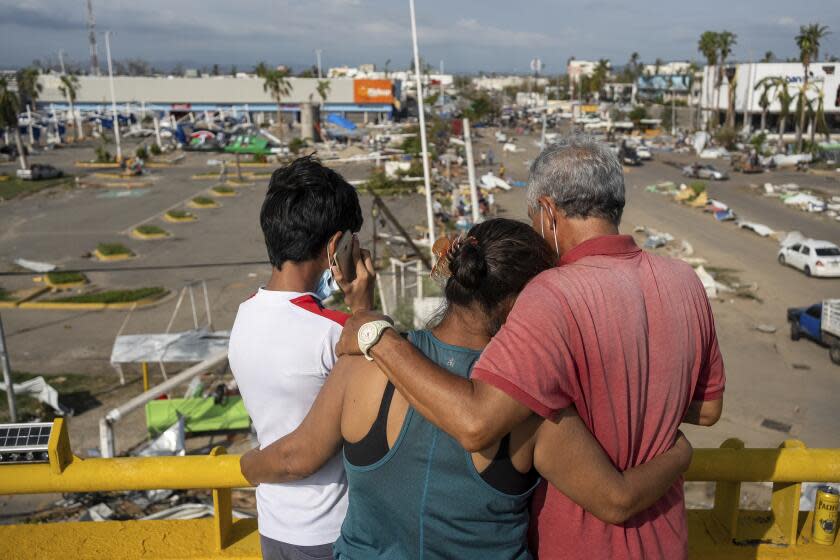
Residents, standing on an overpass, look at some of the damage wrought by Hurricane Otis in Acapulco. (Felix Marquez / Associated Press)

Hurricane Otis — which killed at least 48 people after hitting Mexico’s southern coast in October — adds to a destructive hurricane season that battered the Atlantic and the Eastern Pacific basins. The Atlantic has had a particularly busy year. It’s seen the likes of not only Idalia and Lee but also 17 other named storms thus far, bringing the total well above the average of 14 named storms in the season, which typically lasts from June through November.

Four of the year’s biggest storms hit a wide variety of locations: Hilary made landfall in the Baja peninsula before traversing California and Nevada; Otis landed in Acapulco; Idalia affected the U.S. Southeast; and Lee reached New England and Canada. Runoff from Hilary temporarily formed a salt lake in Death Valley, and winds from Idalia brought flamingos as far north as Ohio and Pennsylvania. But all these storms also had one glaring similarity — they strengthened unusually quickly as they traveled over exceptionally warm waters.

Read more: Stunning satellite images show the damage to Acapulco from Category 5 Hurricane Otis

Hurricanes require certain conditions to form and thrive. One of the most important conditions is warm ocean waters, which are a critical source of fuel for strengthening hurricanes. They allow warm, moist air to rise rapidly through the atmosphere, where that energy translates into violent thunderstorm activity. Hurricanes need water temperatures of at least 78.8 degrees Farenheit; the ocean waters Hilary, Idalia, Lee and Otis traveled over as they strengthened fastest were much warmer — about 86 degrees Fahrenheit.

As humans have warmed the planet by burning fossil fuels, we have made it more likely for those extra-warm ocean waters to occur: About 90% of the excess heating from human activity has gone into our oceans. The rate at which our oceans warm has also accelerated — on average, ocean surface temperatures increased by about 1.6 degrees Fahrenheit in 2011-20 compared with 1850-1900. About two-thirds of that warming happened in just the last four decades.

Warm ocean waters are like caffeine for a storm: When temperatures are extra toasty, it’s like adding an extra shot of caffeine to your morning espresso. So with ocean surface temperatures becoming warmer, it stands to reason that hurricanes strengthen more quickly.

Read more: What put Hurricane Hilary on a collision course with California?

In a paper published last month, my research shows that over the last 50 years, this is exactly what we see in the Atlantic. The fastest rates at which Atlantic hurricanes strengthen — such as Hurricane Lee’s peak winds increasing by more than 90 mph in just 24 hours — rose significantly in the modern era of 2001-20 compared with the earlier era of 1971-90. On average, the fastest pace at which Atlantic hurricanes strengthen has increased by more than 25% in the modern era compared with the historical era. It has also become about as likely for a hurricane to intensify by at least 57 mph within just 24 hours as it would have been for a historical hurricane to intensify by this much in 36 hours.

I also found that the probability of modern Atlantic hurricanes intensifying from a minor storm (Category 1 or weaker) into a potentially destructive major hurricane (Category 3 or stronger) in 24 hours has more than doubled compared with the same historical era. The chance of a storm making this kind of jump in a mere 12 hours is more than three times as likely. Statistics show that it would have been impossible for these changes to occur if environmental conditions had not changed from historical times.

Although my research focused on the Atlantic, it’s not unreasonable to expect similar changes elsewhere. In fact, these findings turned out to be tragically prophetic when, six days after their publication, Hurricane Otis shocked almost everyone by intensifying from a tropical storm into a Category 5 hurricane in just over 12 hours before making landfall in Acapulco.

Read more: Op-Ed: There's one big climate fight that California is losing

The hurricanes that strengthened so dramatically along the Atlantic and Eastern Pacific coastlines this year, combined with evidence that this kind of strengthening has become more common, should serve as a vital warning.

We are already seeing storms intensify at accelerated rates looking at the data and at events like Lee and Otis, which nearly broke records with the speeds at which they strengthened. As we saw all too well with Otis, hurricanes that intensify this quickly are often difficult to forecast and plan for. Sudden changes may require different protective measures, such as evacuation of certain neighborhoods. That means we already have to start improving preparation and planning in coastal communities that are at risk.

We also know that the rate at which hurricanes strengthen has already increased in just the last 50 years — over a period of substantial increases in ocean temperatures because of human-caused warming. Without major changes to our behavior, including a rapid transition away from fossil fuels, this trend is likely to continue, or even worsen, in the future.

When it comes to a warming planet, we know that we are the cause — which means we can also be the solution. It is up to us to ensure a sustainable future for coastal communities already under threat.

Andra Garner is an assistant professor and climate scientist in the department of environmental science at Rowan University in New Jersey.

Pope forcibly removes leading US conservative, Texas bishop Strickland

NICOLE WINFIELD
Sat, November 11, 2023 

Bishop Joseph Strickland walks in front of a reliquary bearing the bones of Saint Maria Goretti, dubbed "The Little Saint of Great Mercy," into the sanctuary at Cathedral of the Immaculate Conception on Monday, Nov. 2, 2015, in Tyler, Texas. Pope Francis on Saturday, Nov. 11, 2023 forcibly removed from office the bishop of Tyler, Texas, a conservative active on social media who has been a fierce critic of the pontiff and some of his priorities.
(Andrew D. Brosig/Tyler Morning Telegraph via AP, File)


ROME (AP) — Pope Francis on Saturday forcibly removed from office the bishop of Tyler, Texas, a conservative active on social media who has been a fierce critic of the pontiff and some of his priorities.

A one-line statement from the Vatican said Francis had “relieved” Bishop Joseph Strickland of the pastoral governance of Tyler and appointed the bishop of Austin as the temporary administrator.

Strickland, 65, has emerged as a critic of Francis, accusing him in a tweet earlier this year of “undermining the deposit of faith.” He has been particularly critical of Francis' recent meeting on the future of the Catholic Church during which hot-button issues were discussed, including ways to better welcome LGBTQ+ Catholics.

The Vatican earlier this year sent in investigators to look into his governance of the diocese, amid reports he was making doctrinally unorthodox claims.

The Vatican has not released the findings of the investigation, and Strickland had insisted he wouldn't resign voluntarily. He had said in media interviews that he was given a mandate to serve by the late Pope Benedict XVI and couldn't abdicate that responsibility, and had complained that he hadn't been told what the pope's investigators were looking into.

It is rare for the pope to forcibly remove a bishop from office. Bishops are required to offer to resign when they reach 75. When the Vatican uncovers issues with governance or other problems that require a bishop to leave office before then, the Vatican usually seeks to pressure him to resign for the good of his diocese and the church.

That was the case when another U.S. bishop was forced out earlier this year following a Vatican investigation. Knoxville, Tenn. Bishop Richard Stika resigned voluntarily, albeit under pressure, following allegations he mishandled sex abuse allegations, and his priests complained about his leadership and behavior.

But with Strickland, the Vatican statement made clear he had not offered to resign, and that Francis had instead "relieved" him from his job.

Most recently, Strickland had criticized Francis’ monthlong closed-door debate on making the church more welcoming and responsive to the needs of Catholics today. The meeting debated a host of previously taboo issues, including women in governance roles and welcoming LGBTQ+ Catholics, but in the end, its final document didn’t veer from established doctrine.

Ahead of the meeting, Strickland said it was a “travesty” that such things were even on the table for discussion.

”Regrettably, it may be that some will label as schismatics those who disagree with the changes being proposed,” Strickland wrote in a public letter in August. “Instead, those who would propose changes to that which cannot be changed seek to commandeer Christ’s Church, and they are indeed the true schismatics.”

There was no immediate comment from the diocese, and the U.S. Conference of Catholic Bishops merely posted an English translation of the Vatican statement with data about the size of the diocese.

In a social media post sent a few hours before the Vatican’s noon announcement, Strickland wrote a prayer about Christ being the “way, the truth and the life, yesterday, today and forever.”

Pope on collision course with US bishops after saying trans people can be baptised

James Crisp
Thu, November 9, 2023 

The Pontiff has welcomed LGBT people to the Church without changing religious teachings - GUGLIELMO MANGIAPANE/REUTERS

Transgender people can be baptised into the Catholic Church and be godparents and witnesses at weddings, Pope Francis has said, putting himself on a collision course with US bishops.

The Vatican decreed that a transgender person could be baptised as long as there was “no risk of causing a public scandal or disorientation among the faithful”.

The pontiff, 86, has tried to make the Church more welcoming to LGBT people without changing religious teachings, including one saying that same-sex attraction is not sinful but same-sex acts are.

“Even if we are sinners, He draws near to help us. The Lord loves us as we are, this is God’s crazy love,” he told a transgender person in July.

A same-sex couple could have an adopted child or one obtained through a surrogate mother baptised if there was “a well-founded hope that it would be educated in the Catholic religion”, the Vatican said.

Transgender people could be godparents at a baptism as well as a witness at a Church wedding, at the discretion of the local priest, who should exercise “pastoral prudence” in his decision.

The decree contradicts a 2015 Vatican ruling, which barred a transgender man in Spain from becoming a godparent.

Asked if a person in a same-sex relationship could be a godparent, the Vatican said that person had to “lead a life that conforms to the faith”.

The doctrinal office said a person in a same-sex relationship could also be a witness at a Catholic wedding, citing current Church legislation which contained no prohibition against it.
Rejected concept of gender transition

The decree could prove controversial in the United States, where the national conference of Catholic bishops has rejected the concept of gender transition.

The bishops issued guidelines to stop Catholic hospitals from providing gender-affirming care.

Some US dioceses have policies banning the use of pronouns matching transgender identities at Catholic institutions and transgender teachers have been fired from Catholic schools.

Pope Francis has previously said it was an “honour” to be attacked by US Conservatives. In August, he attacked the “backwardness” of some “reactionary” US Catholics.

He accused them of replacing faith with ideology in August and said doctrine was allowed to change over time.

Bishop Jose Negri of Santo Amaro in Brazil had sent the Vatican’s Dicastery of the Doctrine of the Faith six questions in July regarding LGBT people and their participation in baptism and matrimony.

The Pope approved the answers on Oct 31, which were published online on Wednesday.

“This is an important step forward in the Church seeing transgender people not only as people (in a Church where some say they don’t really exist) but as Catholics,” said Father James Martin, a prominent Jesuit priest and supporter of LGBT rights in the Church.

“It is a major step for trans inclusion … it is big and good news,” said Francis DeBernardo, executive director of Maryland-based New Ways Ministry, which advocates for greater LGBT inclusion.

Most Catholics are baptised as children so the practical impact of the decree will be limited because of the smaller transgender community and smaller numbers of baptism later in life.
EPA detected "forever chemicals" in water systems serving 46 million. Is yours on our map?

Austin Fast, Cecilia Garzella and Abraham Kenmore, USA TODAY
Updated Sat, November 11, 2023 

Toxic “forever chemicals” have been found in more than one in four public drinking water systems this year in concentrations at or above the Environmental Protection Agency’s minimum reporting levels.

That’s according to new EPA data released Thursday, showing hundreds of water systems have detected PFAS. Together, these systems provide drinking water to about 46 million people.

Per- and polyfluorinated alkyl substances, or PFAS, are a group of nearly indestructible chemicals that build up in the human body over time. They’ve been used widely for decades in nonstick and water-repellent household products, as well as industrial products.

One system included in the EPA’s data for the first time is in Augusta, Georgia, which detected six distinct PFAS contaminants. With industrial manufacturing, a major military base and a downtown factory that makes fire-retardant bricks, Augusta has multiple PFAS sources.

“There’s definitely things that do need to be improved, but there’s not, in our opinion, a health threat,” said Wes Byne, Augusta’s director of utilities. “Depending on who you talk to, the industry has tried to consider this (detection level) like a drop of water in the Rose Bowl.”

However, most of the PFAS detections in Augusta were well above the minimum levels at which the EPA requires communities to report. Georgia does not have binding maximum contaminant levels for the chemicals, and there are currently no enforceable national drinking water standards for PFAS. The technology needed to remove and destroy forever chemicals is costly – a major barrier for local water systems.

PFAS exposure has been linked to increased risk of cancer, as well as effects on the liver, immune system, cardiovascular system and human development, according to the EPA.

“When you look at that laundry list of health effects that have been linked to PFAS, it doesn’t mean you’re going to get that,” said Courtney Carignan, an exposure scientist and environmental epidemiologist at Michigan State University. “Everyone’s risk factors are different. But you can reduce your risk by reducing your exposure and getting your drinking water tested.”

Map: Where the EPA found pollutants

This map shows water systems included in the EPA's records, as of Nov. 9. It’s based on boundaries developed by SimpleLab, a water-testing company. Click on a system to see the number of pollutants detected at or above the EPA's minimum reporting levels and how much the most concentrated pollutant exceeded those levels. If you don't see a map, click here.

Yoonserk Pyun | USA TODAY


Of about 3,200 systems included so far, 854 measured at least one PFAS compound above the EPA’s reporting levels, according to a USA TODAY analysis of the data. That’s almost 27%, an increase from August’s update of the data.

USA TODAY’s analysis shows the chemicals have turned up in nearly every state, affecting water systems large and small.

Every five years, the EPA requires water systems to monitor for several unregulated pollutants. The current effort focuses on forever chemicals, and the EPA describes it as its most comprehensive PFAS monitoring initiative ever. Thursday's data release represents a small portion of the additional sample results that the agency expects to collect and publish over the next few years from every large and mid-size public water system in America, as well as hundreds of small systems.

“I think the more testing that will be done, the more contaminated water systems will be uncovered,” said Jamie DeWitt, director of the Environmental Health Sciences Center at Oregon State University.

Many of the systems that have already detected PFAS provide water to over a million customers each, including Atlanta, Houston, San Antonio, Dallas, Phoenix, Silver Spring, Maryland, San Jose, California, and Long Island, New York.

The new data show WSSC Water, which serves nearly 2 million Marylanders just outside Washington, D.C., discovered in June two types of PFAS exceeding the EPA’s reporting levels.

“The health impacts of the two detected PFAS compounds, PFHxA and PFPeA, are currently unknown and they are not included in the EPA's proposed regulation," wrote Lyn Riggins, WSSC Water spokesperson, in an emailed statement. “At this time, we have no information that suggests a concern related to these compounds.”
High costs hinder PFAS treatment upgrades

Riggins said WSSC Water would upgrade its treatment process to meet any new regulations on PFAS, but she added that the substantial cost of treatment upgrades should not be passed on to customers.

“We need to hold the entities causing PFAS to enter the environment financially responsible for removing their substances from water and wastewater,” Riggins wrote, noting that WSSC Water recently filed a lawsuit against 20 companies, including 3M and Dupont. “We must hold the polluters accountable.”

Byne, the utilities director in Augusta, said they’ve been weighing the costs versus the benefits of various options, from blending contaminated water with PFAS-free water to relocating wells to multimillion-dollar advanced treatment upgrades.

“We're trying to figure out, you know, what is the true risk? And then what does it mean for treatment in the long run?” Byne said.

Tonya Bonitatibus, a local riverkeeper and executive director for Savannah Riverkeeper, said residue from Augusta’s sewage treatment plant is also spread on farm fields as fertilizer. The wastewater treatment process doesn’t break down forever chemicals, leading to contaminated food crops and water supplies.

“Even today there isn’t any penalty for any of this,” Bonitatibus said.

How can you reduce PFAS exposure?

The EPA recommends that anyone concerned about their drinking water quality contact their local provider to learn what efforts they’re taking to mitigate PFAS contamination. They also say people may want to consider installing in-home filtration systems that have been proven to remove the chemicals, including activated carbon and reverse osmosis systems.

“Try to find out if the water in your town has been tested,” Carignan said. “If you have a private well, try to get it tested. It can be difficult to know whether there’s a source of PFAS near you without testing.”

If cost is a barrier to that testing, some activists and companies offer free or low-cost in-home filtration systems for low-income households. There are also programs through court-enforceable orders in some affected communities that provide sampling for impacted residents. Those relying on private wells, which are not regulated in the U.S, should contact their state health department for testing options.

“People who live on wells tend to be those who aren’t as wealthy or might not be part of a majority population, so it raises some very real environmental justice concerns about who’s going to be carrying the burden of pollution,” DeWitt said.

Switching to bottled water might help reduce exposure, but it’s not a cure-all because bottled water isn’t regulated and might also contain PFAS, Carignan said. Some other ways to avoid exposure include not using nonstick cookware; purchasing water-resistant clothing instead of waterproof; and steering clear of grease-resistant food wrappers and containers, according to the D.C. Water and Sewer Authority.

Avoiding PFAS in products isn’t always easy, however, since labeling can be limited or misleading, Carignan said. But consumers can support companies that have pledged to go PFAS-free. The Green Science Policy Institute and the Environmental Working Group publish lists of products without harmful chemicals.

“This does give people at least leverage to make decisions,” DeWitt said. “Whereas if you don’t have the information, you can’t make decisions. Ignorance isn’t going to reduce your health risks.”

Forever chemicals: New report claims PFAS are sprayed onto fields and food in pesticides

Euronews Green
Thu, November 9, 2023 

Forever chemicals: New report claims PFAS are sprayed onto fields and food in pesticides

Dozens of substances used in pesticides in Europe are ‘forever chemicals’, a new investigation reveals.

The stable door is slowly closing on PFAS - man-made per- or poly-fluorinated alkyl substances which persist in the environment for an incredibly long time.

The EU is set to restrict their use and phase them out with a review of its REACH regulation that governs chemicals. It is part of a promised ‘great detox’ on dangerous substances.

But this won’t apply to pesticides - and that’s a big problem, according to the NGOs Générations Futures and Pesticide Action Network (PAN) Europe.

“It is shocking to find that PFAS, with their long-lasting environmental impacts, are intentionally sprayed on fields and food,” says Angeliki Lysimachou, head of science and policy at PAN Europe. “Given all the identified risks, their use should stop immediately.”

A new joint report from the two NGOs has found that 37 active substances currently approved for use in pesticides are PFAS. That equates to 12 per cent of all approved synthetic substances.


Why are PFAS in pesticides a problem?

PFAS are a growing cause for public concern. Recent research has revealed shocking findings - such as the news that rainwater almost everywhere on Earth has unsafe levels of forever chemicals.

This pollution has many potential sources, from chemical manufacturing plants to firefighting foams.

Pesticides, however, appear to have gone under the radar. Many people are unaware that active ingredients in pesticides can be PFAS where they are used to keep them effective for longer.

The investigation dug deep into their use in France, where it found that 30 active substances currently authorised for use in pesticides were PFAS. The sales of these substances have more than tripled since 2008, reaching 2,332 tonnes in 2021.

Analysing authorisation documents for the 10 best-selling pesticides containing PFAS, the researchers found that the vast majority of these chemicals stick around in the environment.

Flufenacet and Diflufenican from Bayer are the top-selling substances, says PAN Europe, with German data from the Federal Office of Consumer Protection and Food Safety (BVL) suggesting the same dramatic growth in Germany.

There are concerns that they are contaminating groundwater in France. The NGOs are also sounding the alarm about possible ‘cocktail effects’ of mixing chemicals, which they claim are not being assessed - even though marketed products sometimes contain several different PFAS.

Will the EU ban PFAS in pesticides?

The EU is planning to restrict the use of so called forever chemicals in Europe, but PFAS pesticides have been excluded from the scope of this restriction. The main argument is that these substances are already covered and sufficiently regulated under the Pesticides Regulation, the NGOs say.

According to this regulation, pesticides authorised in the EU should cause no adverse effects to humans and no unacceptable effects on the environment. Despite this, the report reveals that harmful pesticides continue to get approved for use in the production of food.

“It is urgent to ban this source of PFAS pollution. These pesticides should be included in the PFAS restriction currently being prepared at European level,” argues Salomé Roynel, policy officer at PAN Europe.

“That will take time, so we immediately need a better implementation of the pesticide regulation. We propose to apply the precautionary principle required by law and ban all PFAS pesticides now.”

"The aim is to stop people and the environment being exposed to these forever pollutants. There should be no exception for pesticides," adds Pauline Cervan, toxicologist and project leader of Générations Futures.

The European Chemicals Agency (ECHA) and European Food Safety Association (EFSA) have been contacted for comment.

Wausau is doing the work to counter lead and PFAS. The Biden administration says others should do the same

Laura Schulte, Milwaukee Journal Sentinel
Updated Thu, November 9, 2023 

WAUSAU - Biden Administration officials praised Wausau this week as an example of how to quickly and aggressively tackle water quality issues, after its work to remove lead pipes and filter "forever chemicals" from its water.

Wausau, under Mayor Katie Rosenberg, has spent several years aggressively seeking federal and state funding and grants to help finance the replacement of lead laterals running into homes and to install a nearly $17 million treatment plant to remove PFAS from the municipal water system.

Tom Perez, a senior advisor to President Joe Biden, visited the city Thursday to see the new water treatment facility and watch as a family turned on their water for the first time after having their lead pipes removed.

"I really think that mayors across not just Wisconsin, but across the country, are going to be calling the mayor of Wausau," Perez said. "To ask her how she did this and how can they can copy you."

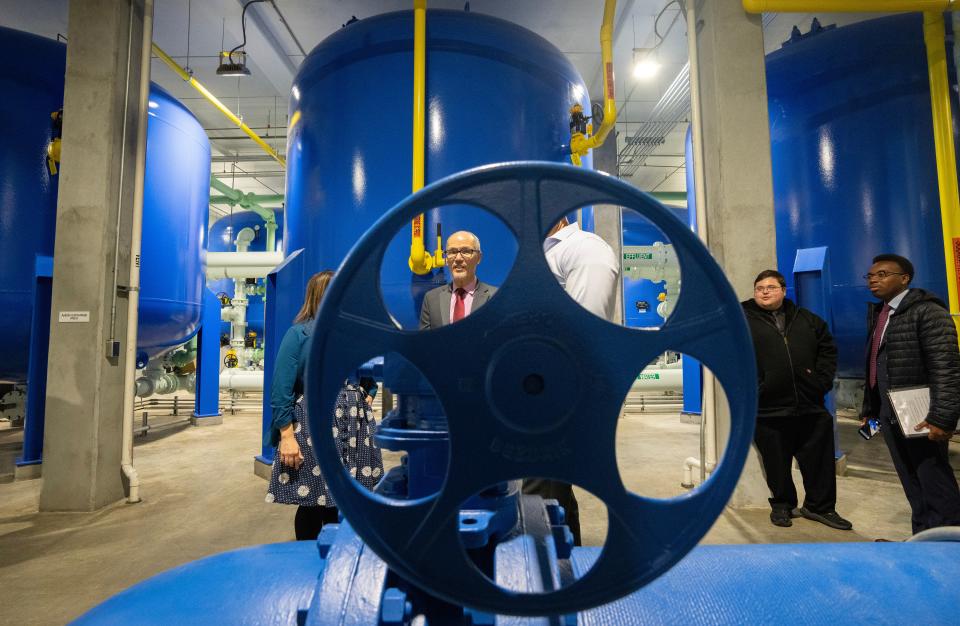
Tom Perez, an advisor to President Joe Biden, center, tours the drinking water treatment facility in Wausau, Wis., on Thursday, Nov. 9, 2023. The city is building a new water treatment system to address PFAS and other “forever chemicals.” The $16.8 million treatment system will allow the city to run its drinking water through a series of carbon filters — known as granulated activated carbon, or GAC — effectively removing not only PFAS, but many other contaminants, according to Eric Lindman, the city's public works director.More

Wausau is set to receive about $5.8 million for lead service line replacements, which will speed up the replacement of the remaining 8,000 lead service lines. Instead of taking about 15 years, it will take six or seven.

Wisconsin is also one of four states participating in a federal lead accelerator program, giving Wausau access to greater resources through the program.

More: Wausau has 'forever chemicals' throughout its water system. What the city does next could set a blueprint for other cities

The program provides targeted technical assistance services to help communities better understand the grant application process when seeking money from the federal government to address lead laterals. The program is being run by the Environmental Protection Agency and the Department of Labor and will provide assistance to 40 communities across the country, including 10 in Wisconsin, including Wausau and Milwaukee.

Tom Perez, an advisor to President Joe Biden, joins Wausau Mayor Katie Rosenberg and Miles Guerrero, 3, during a media event Thursday, November 9, 2023 to turn on the water at the home of Miles’ great-grandmother. The home’s old water service line was replaced with a lead-free connection in Wausau, Wisconsin. Perez was in town to highlight actions taken by President Biden’s administration for clean drinking water.More

Lead poisoning can bring lifelong consequences, especially for young children. The Wisconsin Department of Health Services reported in 2018 that 9.2% of children age 5 or younger in Milwaukee have elevated blood lead levels.

That's why it's so important to address, Perez said.

"People take water for granted, and they shouldn't, because it should be a fundamental right that you move into a house or apartment or wherever you're living and turn on the water and you're not doing harm to yourself or your loved ones," Perez, the former chairman of the Democratic National Committee, said during a roundtable of water quality leaders in Wausau.

He said the funding secured for water infrastructure in particular has been huge, the largest since at least whewn Dwight D. Eisenhower was president in the 1950s.

"If you are in local government, the last two years and the coming two years are going to be the biggest moments of opportunity in your political lifetime," he said. "You will never have more opportunity because this president has invested more."
'We just need to keep this up'

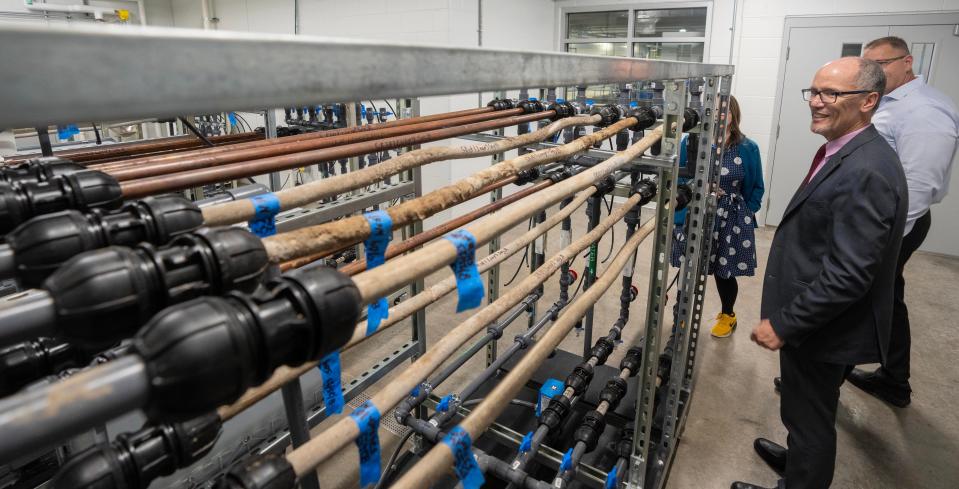
Tom Perez, an advisor to President Joe Biden, center, examines corrosion control treatment testing while touring the drinking water treatment facility Thursday, November 9, 2023 in Wausau, Wisconsin. The city is building a new water treatment system to address PFAS and other “forever chemicals.” The $16.8 million treatment system will allow the city run its drinking water through a series of carbon filters — known as granulated activated carbon, or GAC — effectively removing not only PFAS, but many other contaminants, according to Eric Lindman, the city's public works director.More

Wausau has one of the most extensive PFAS contaminations in the state, with all of its drinking water wells impacted by the chemicals. To combat the issue, the city is working to install a granulated carbon filtration system, which is currently the best way to extract PFAS from water.

But that system comes at a steep cost to the city.

The city council recently approved borrowing $17.5 million to finance a treatment system that will be installed over the course of the next year. The city also distributed hundreds of thousands of dollars of bottled water and filtration pitchers to residents after the contamination was found in January 2022.

The city is set to receive more than $17 million in Emerging Contaminant funding from the federal government to address PFAS, which is greatly cutting down the amount that will fall to the city's taxpayers and water users.

Rosenberg has courted lawmakers at the state and federal level to help lock in funding so that ratepayers in Wausau didn't end up fronting the entire cost of the PFAS filtration system. That's helped the city secure the funding it needed, Perez said.

"Here in Wausau, the commitment has been made, and I'm confident they will reach it to eliminate PFAS here by October of 24." Perez said. "That's less than a year from now. That is a remarkable pace. But frankly, we need to make sure we were doing this everywhere."

More: Milwaukee to receive $30 million for lead service line replacement as part of statewide clean water push

Laura Schulte can be reached at leschulte@jrn.com and on X at @SchulteLaura.

This article originally appeared on Milwaukee Journal Sentinel: Biden advisor visit highlights Wausau to tout efforts on water quality


Opinion

Honoring Our Pact Act will help numerous Florida veterans exposed to chemicals 

Stan Gottfredson
Florida Today
Fri, November 10, 2023

While service members face countless risks while serving their country, from permanent hearing loss to serious combat injuries, toxic exposure is a more insidious health threat for these brave people.

Today, over 700 military bases across the country are contaminated with perfluoroalky and polyfluoroalkyl substances, often dubbed PFAS or "forever chemicals" due to their ability to persist in the environment and the human body for a long time. Exposure to these dangerous agents is responsible for terrible health problems, including kidney and testicular cancer. Furthermore, PFAS exposure can result in high cholesterol, fertility issues, liver damage, thyroid disease, altered immune function, kidney disease, and preeclampsia in pregnant women.

The source of PFAS on military bases is firefighters and trainees using the fire suppressant AFFF, which contains between 50% and 98% of "forever chemicals."

Florida is home to 21 military bases, some from every branch of the military, and has a veteran population of 1,430,000. Two of these military bases with high levels of "forever chemicals" are right her in Brevard Coubnty. The first is Cape Canaveral. Founded in 1949 as Joint Long Range Proving Ground, the military installation has a PFAS concentration of 337,100 parts per trillion, exceeding the EPA's new safe exposure limit by 84,275 times. Because other toxic chemicals might have been used at Cape Canaveral in the past, the drinking water supply of North Brevard County now contains various contaminants over the safe exposure limit, including PFAS, but also trihalomethanes and arsenic.

Another military base in Florida with a tremendous "forever chemicals" level is Patrick Space Force Base.

Firefighting foam used for decades by the U.S. military, and still allowed for use today, is now known to contain dangerous “forever chemicals” that have leached into groundwater and municipal water systems across the U.S.

Established in 1940, the military facility has a PFAS concentration in the environment of 4,338,000 parts per trillion, eclipsing the safe exposure limit by a whopping 1,084,500 times. Until recently, veterans injured by toxic exposure at military bases had limited options when it came to accessing VA benefits such as healthcare and disability compensation. However, on August 10, 2022, the Honoring Our PACT Act was signed into law by President Joe Biden, enabling over five million service members and veterans whose health was impacted by toxic exposure to access the VA benefits they deserve with more ease.

More: New data shows 'forever chemicals' in Mims, Titusville drinking water

"For the millions of veterans who may have been exposed to harmful toxins, this bill means quicker access to health care services and other benefits. This could be the difference between life and death for many suffering from toxic related illnesses," President Biden said.

The Honoring Our PACT Act is perhaps the largest healthcare and benefit expansion in VA history. It expands and extends the eligibility requirements for veterans exposed to toxic agents during active duty, adds over 20 new presumptive conditions for these veterans, and requires the VA to provide a toxic exposure screening to each veteran enrolled in its healthcare system.


Stan Gottfredson is President and CEO at Atraxia Law, a paralegal firm assisting veterans affected by toxic exposure at military bases nationwide so they can file a claim to obtain compensation.

The presumptive diagnoses for which veterans can now apply for VA benefits include brain cancer, pulmonary fibrosis, emphysema, kidney cancer, and interstitial lung disease. Moreover, the new legislative package will help the VA improve research, staff education, and treatment related to toxic exposure impacting service members and veterans. By virtue of the Honoring Our PACT Act, we might witness a decrease in the rate of premature deaths among veterans, who often cannot afford the treatment they need for diseases related to toxic exposure.

Stan Gottfredson is President and CEO at Atraxia Law, a paralegal firm assisting veterans affected by toxic exposure at military bases nationwide so they can file a claim to obtain compensation.

This article originally appeared on Florida Today: Honoring Our Pact Act helps Florida veterans exposed to chemicals
'They're clearing out the homeless people': San Francisco gets ready for arrival of world leaders

Queenie Wong
Fri, November 10, 2023 

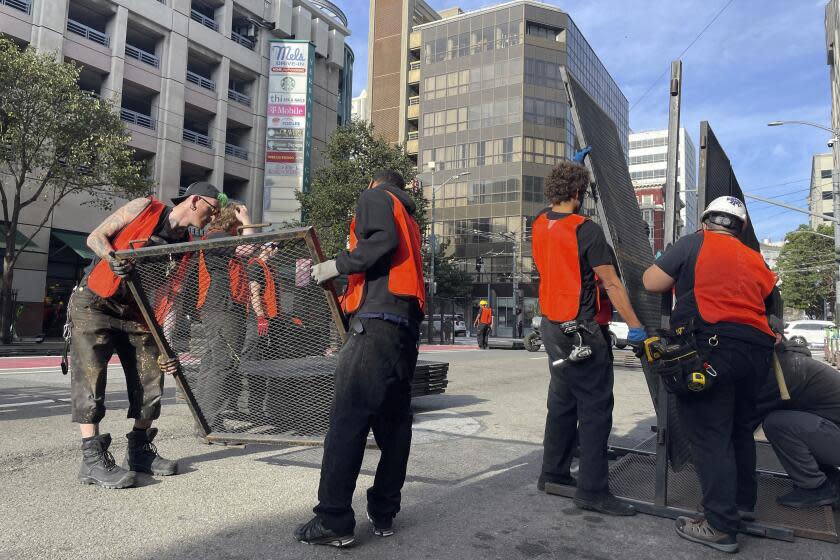
Barricades are placed on a street in preparation for the APEC summit in San Francisco. Leaders from the 21 member states of the Asia-Pacific Economic Cooperation conference will hold their annual get-together with the goal of promoting trade and investment. (Haven Daley / Associated Press)

Crouching at the entrance of San Francisco City Hall, Jason Jacobs brushed gold paint onto the ornate doorway of the Beaux-Arts building.

“Whether I paint the gates or not, they're gonna get their breath taken away,” said Jacobs, a San Francisco native who often marvels at the stunning architecture.

Fresh paint. Street cleanings. Homeless sweeps. Colorful art. Workers like Jacobs beautified the city, days before politicians, executives and journalists from around the world descend on San Francisco for the Asia-Pacific Economic Cooperation conference. From Saturday to Nov. 17, the international event is expected to bring more than 20,000 people to the city and attract thousands of protesters.


APEC is made up of 21 member economies, including the U.S., China, Japan, Russia and Canada. The members account for nearly 50% of global trade and 40% of the global population, giving the U.S. a big platform to promote policies that advance free and open trade in the Asia-Pacific region.

A highly anticipated meeting between President Biden and Chinese President Xi Jinping during the summit could also help ease tensions between the two countries.

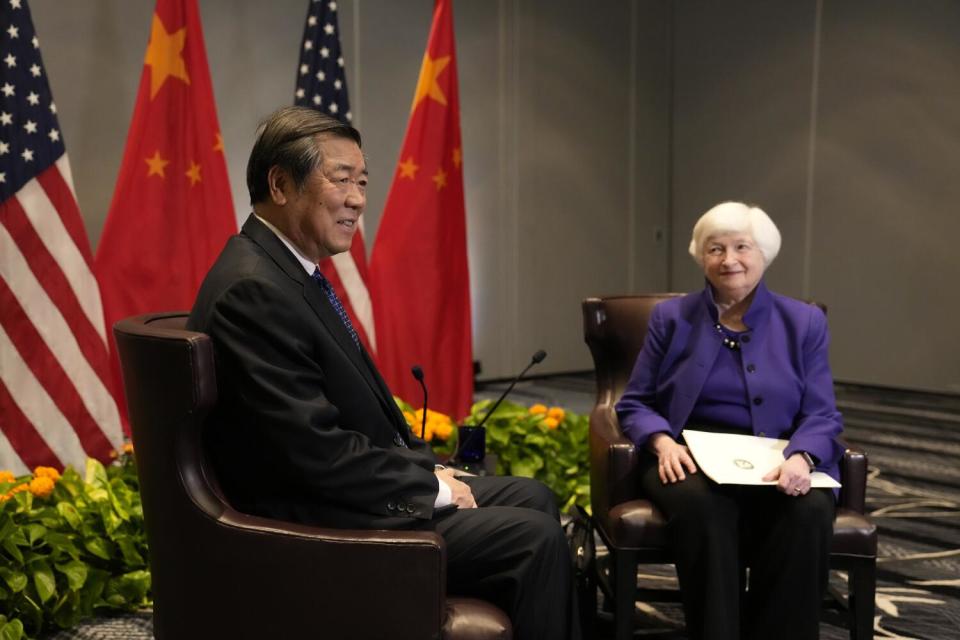
Treasury Secretary Janet Yellen, right, sits next to Chinese Vice Premier He Lifeng Friday, Nov. 10, 2023, in San Francisco. Yellen and Lifeng met on Thursday in the San Francisco, the latest in a string of senior level engagements between the nations in recent months aimed at easing tensions. (Eric Risberg / Associated Press)More

Though the wide-ranging meeting is not expected to produce any major breakthroughs, White House officials say it will cover a host of economic and security issues underlying U.S.-Chinese tensions, including trade, technology exports, human rights and Chinese aggression in the South China Sea and near Taiwan, the self-governing island that Beijing claims as its own. The president will also raise areas of cooperation — including climate change and countering narcotics trafficking — as well as Beijing’s role in the Israel-Hamas conflict and Russia’s invasion of Ukraine.

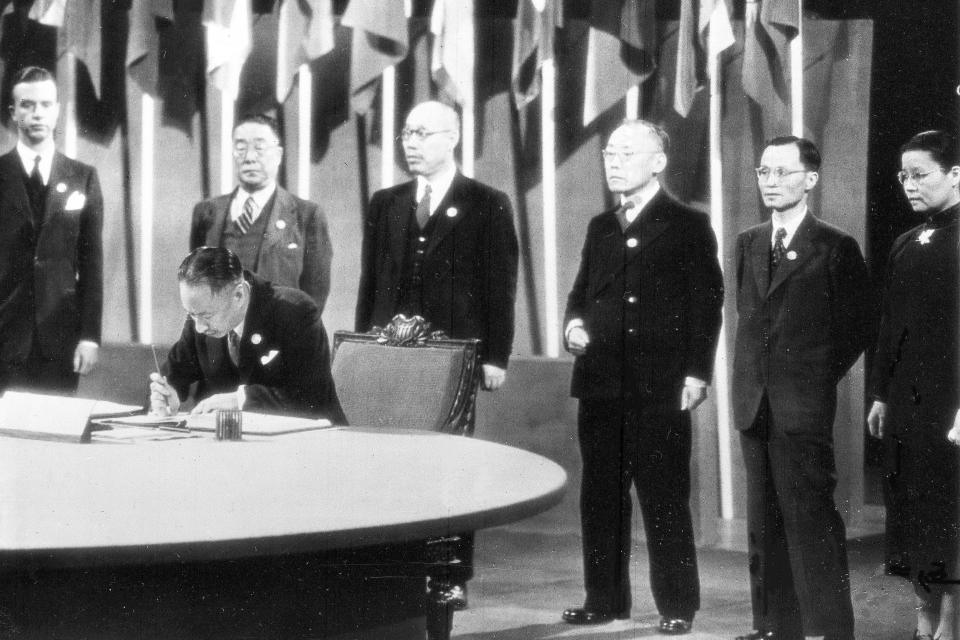
The stakes are high for the U.S. but also for San Francisco, which is hosting the APEC summit for the first time. It’s the biggest gathering of world leaders in San Francisco since 1945, when representatives from 50 nations signed a charter that established the United Nations.

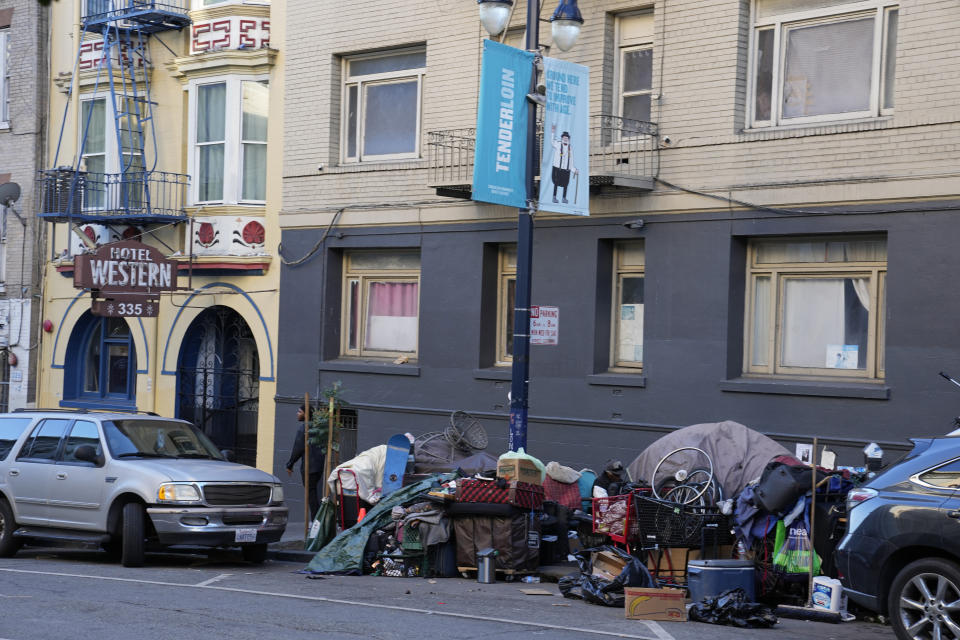
The global spotlight will shine on a city filled with stark contrasts — home to billion-dollar tech companies and streets lined with homeless encampments.

“You can go to the deepest, darkest parts of the Tenderloin or you can go to the top of the Hyatt Regency,” said Jacobs, a painter at City Hall.

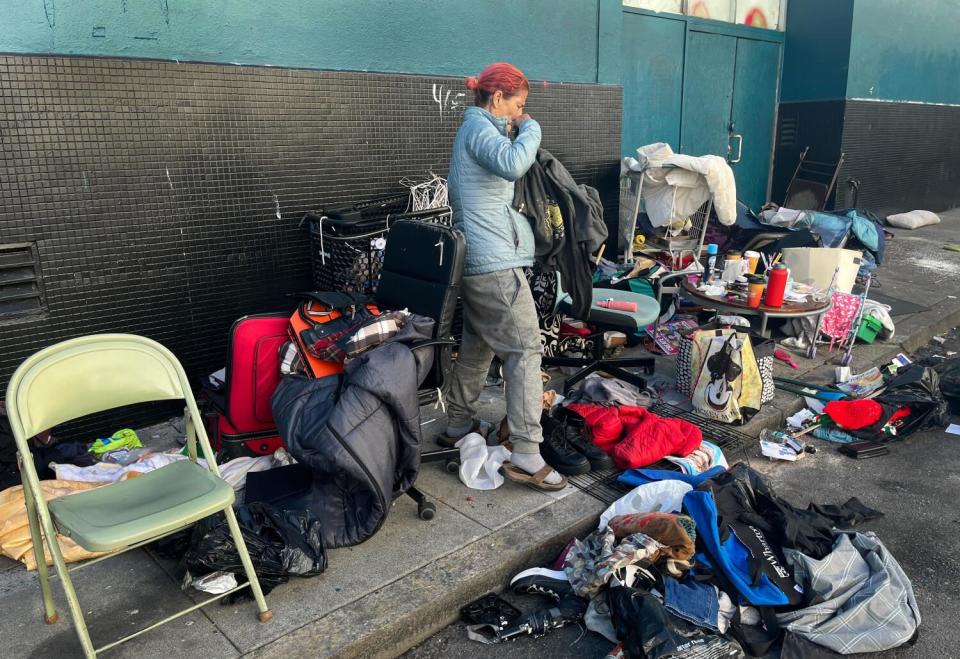
Blocks away from the Moscone Center, where the summit's main events will be held, Christie Palominos sorted through her belongings. Palominos said she’s trying to figure out what she wants to keep before she moves into permanent housing. Piles of clothing, a shopping cart, bags, coloring books and a variety of objects surround her.

Christie Palominos, 47, sorts through her belongings blocks away from the Moscone Center, where the main events of the APEC summit are scheduled to be held. (Queenie Wong / Los Angeles Times)

Palominos, 47, didn’t know world leaders would be in town, but she said one of her homeless friends has been asked by the same police officer to move multiple times.

“They’re clearing out the homeless people because they don’t want them to see this,” she said.

Grappling with family issues, drug addiction and mental health problems, Palominos said she’s been hopping among San Francisco homeless shelters for more than a year. It’s not easy for homeless people to find a spot in a shelter.

“Usually I stay as long as I can, but it's kind of hard because there are certain people who pick on you. They think they're better than you,” said Palominos, who has a bruise under her eye and a bandage wrapped around a bloody finger.

On the streets, Palominos said she’s seen traumatic acts of violence like a shooting and stabbing. Struggling with addiction to crystal meth, Palominos said she’s been clean for five days.

“Walk a day in my shoes,” she said. “I guarantee that some of these rich people who walk around in these high-rises wouldn’t survive.”

Jennifer Friedenbach, executive director of the Coalition for Homelessness, said her organization has been hearing about more homeless encampment sweeps ahead of the international conference. With shelters seeing spaces already filling up or limiting openings, Friedenbach said it’s “really frustrating” because the city is just displacing groups of homeless people when they’re moved around. Instead, advocacy groups were hoping for more temporary housing for the homeless during the conference.

“They want to clean up the city's image and use this conference as a way to draw back tourism,” she said. “These efforts never work because folks don't have disappearing power. People are out there because there's not enough housing. There's not enough shelter.”

In 2022, 7,754 people experienced homelessness in San Francisco. About 43% or 3,357 were staying in shelters, according to city data.

A homeless encampment is seen along Leavenworth Street in the Tenderloin district of San Francisco, Wednesday, Nov. 8, 2023. (Eric Risberg / Associated Press)

Homelessness has been a contentious issue in San Francisco. In December, a federal judge temporarily blocked the city from clearing certain homeless encampments without offering shelter. The court order stemmed from a 2022 lawsuit the Coalition on Homelessness filed against San Francisco, alleging that city workers are trying to drive homeless people out of town and are seizing and destroying their property "with the express purpose of removing visible signs of homelessness from San Francisco’s street." The city is still allowed to clear streets for emergencies, health and safety reasons and to temporarily clean.

Emily Cohen, deputy director for communications and legislative affairs at the San Francisco Department of Homelessness and Supportive Housing, said in an email the city isn’t expanding shelter capacity just for the summit but did set aside funding to add roughly 300 shelter beds as winter approaches.

The Interfaith Winter Shelter, which has a site at Natoma and 8th streets, is scheduled to be open during the summit and the city is expanding shelter capacity at three adult congregate shelters, she said.

“When our community hosts events, like APEC, we want to put our best foot forward,” she said.

That hasn't stopped Republicans from holding up San Francisco as an example for what happens when Democratic politicians are in charge. In June, Republican presidential candidate Ron DeSantis, the governor of Florida, shot a campaign ad that portrayed San Francisco as city that has "collapsed because of leftist policies."

“We came in here, and we saw people defecating on the street,” said DeSantis, standing next to a graffiti-sprayed buildings. “We saw people using heroin. We saw people smoking crack cocaine, and you look around, the city is not vibrant anymore. It’s really collapsed because of leftist policies.”

The city has been struggling to recover from the aftermath of the COVID-19 pandemic, when San Francisco grappled with office and business closures partly due to government-mandated shutdowns that affected a vibrant downtown filled with retailers, restaurants and bars.

San Francisco Mayor London Breed said in a press conference Thursday that the tattered urban images people see on social media about San Francisco capture a snapshot in time in certain neighborhoods, ignoring the rest of the picturesque city.

“I see a lot of beauty all over San Francisco…,” she said. “My hope is that people will have the opportunity to experience San Francisco for themselves and tell the whole story.”

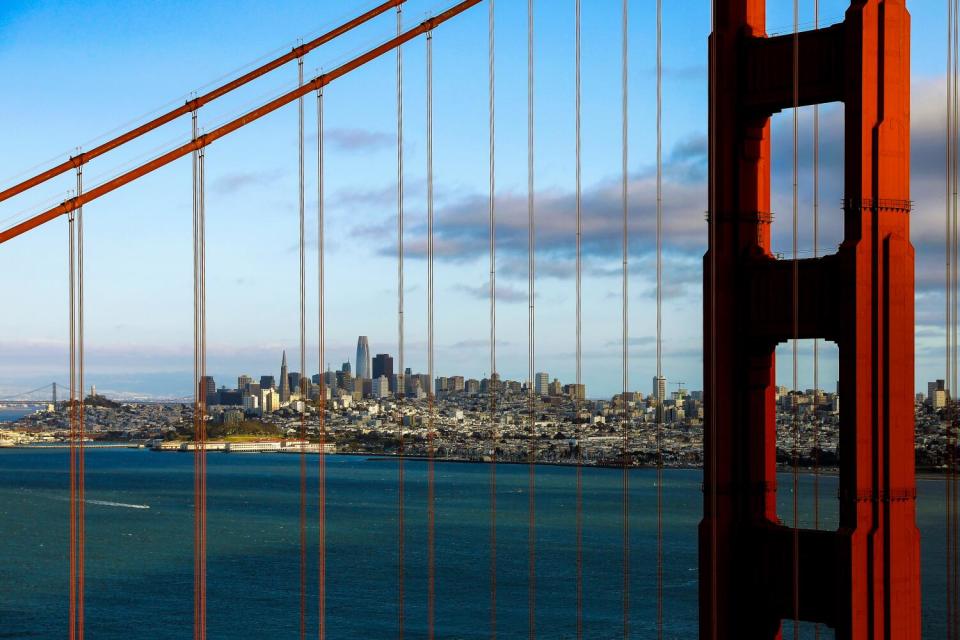
The skyline of downtown San Francisco with the Golden Gate bridge. (Gary Coronado/Los Angeles Times)

Later in the day, Breed and Gov. Gavin Newsom unveiled a new plant nursery and education center in the Soma neighborhood.

Newsom, who met China's president last month, said before a big event like the APEC summit everything’s got to “get dialed up” just like when people clean up their house before they have visitors.

“This place is beloved and its best days are in front of it, not behind it,” he said. “And all those doomsdayers. All those negative folks. You know what? They haven’t offered anything.”

Still, business closings have also heightened fears about the future of downtown San Francisco. Major retailers including Nordstrom, T-Mobile, Whole Foods and Anthropologie have left amid concerns about less foot traffic, sluggish sales and safety. The pandemic also fueled more online shopping, which meant people didn't feel the need to visit stores as often. Still, businesses such as Ikea, are also opening new stores in San Francisco and artificial-intelligence startups have been flocking to the city.

Read more: Is there a retail exodus in San Francisco? Some say Union Square is 'beating strong'

San Francisco Chamber of Commerce President and CEO Rodney Fong said cities are re-imagining what their urban centers feel like as technology changes the way people work. With APEC expected to generate $53 million for the local economy, according to the San Francisco Travel Assn., businesses throughout the city also have an opportunity to rope in more sales.

"This is a really important moment for San Francisco and we're really looking forward to showcasing all the innovations," Fong said.

Ahead of the conference, the Webster Street pedestrian bridge, which was once light gray, is now freshly painted red in Japantown. Two new decorative crosswalks were being installed in Chinatown and North Beach. The green grime that once covered the San Francisco Museum of Modern Art, located near the conference, is gone.

On a sunny day before the summit, workers washed the streets and placed new grass at the Yerba Buena Gardens because of heavy use over the summer. A green fence, scheduled to be removed Tuesday, wrapped around the park with a sign that read “Improvements in Progress.”

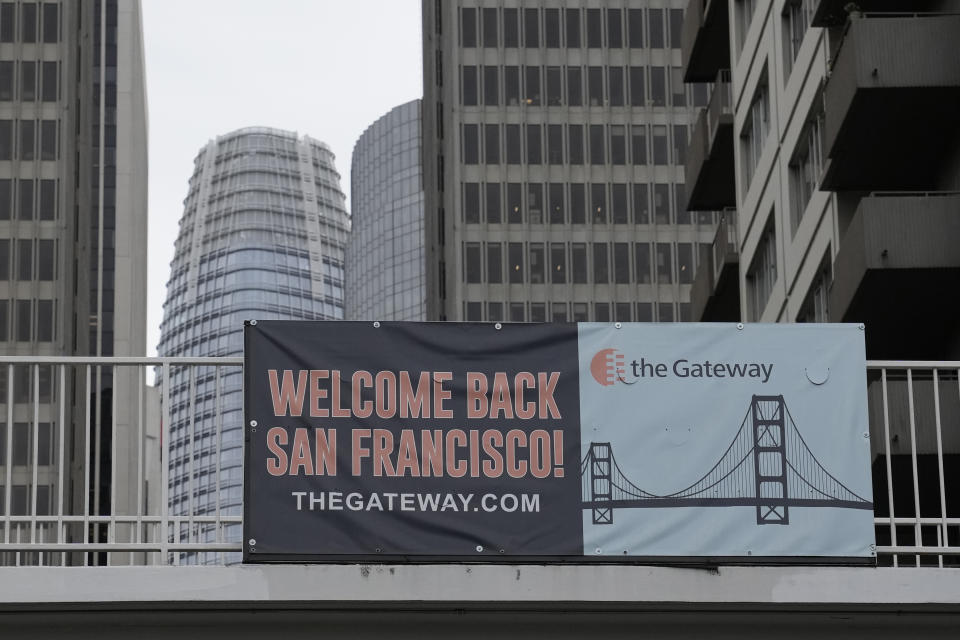
At the Moscone Center, some of the city's most picturesque spots are on signs about the event. The Palace of Fine Arts. City Hall. The Golden Gate Bridge, next to blue water and a sandy beach. “APEC is going to be EPIC,” one sign reads.

Longtime San Francisco natives like Jacobs can’t envision living anywhere else.

Times staff writer Courtney Subramanian contributed to this report.

This story originally appeared in Los Angeles Times.

San Francisco bidding to reverse image of a city in decline as host of APEC trade summit

JANIE HAR
Thu, November 9, 2023

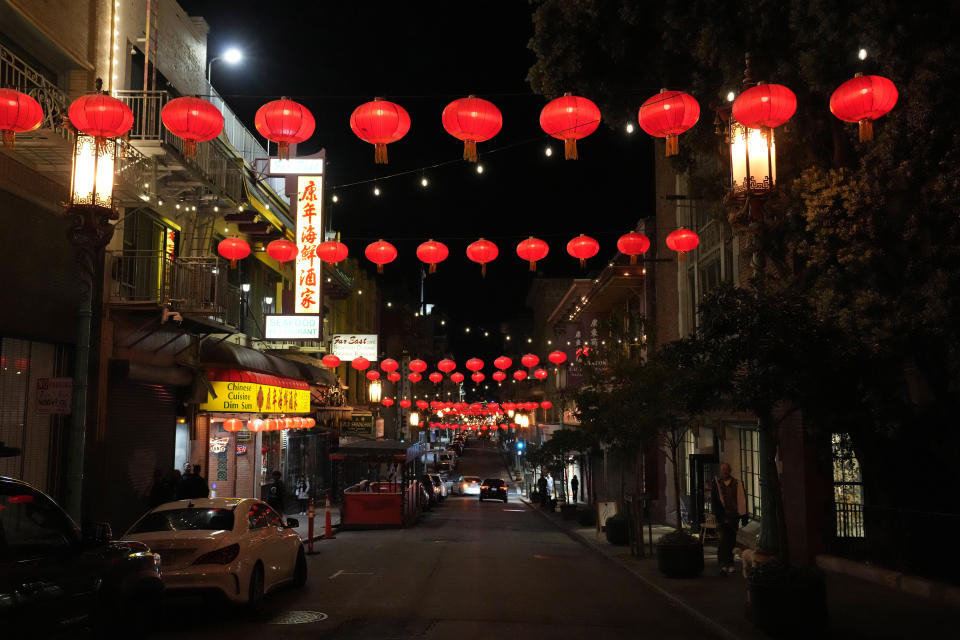
Lanterns illuminate Chinatown along Grant Avenue in San Francisco, Wednesday, Nov. 8, 2023. San Francisco's Chinatown was hit hard by the pandemic as tourism dried up. Leaders in the community hope to use next week's Asia-Pacific Economic Cooperation leaders' summit to declare that Chinatown is back and ready for business. (AP Photo/Eric Risberg)

SAN FRANCISCO (AP) — World leaders, CEOs, protesters and thousands of others will soon descend on San Francisco for a global trade summit that could give the battered city a chance to reverse its image of an economic powerhouse now in decline.

The annual Asia-Pacific Economic Cooperation leaders’ summit will be San Francisco's largest international gathering since dignitaries gathered in 1945 to sign the charter creating the United Nations.

The summit opens Saturday and runs through Friday, drawing an expected 20,000 people. Of particular note this year is a planned tete-a-tete between President Joe Biden and Chinese counterpart Xi Jinping on the sidelines of the summit — their first direct engagement in a tension-filled year between the world’s two biggest economic powers.

As host, San Francisco and the city's partners are polishing sidewalks, scrubbing away graffiti and moving homeless people to accommodations indoors. Separately, Mayor London Breed has been promoting pop-up shops, new destinations and restaurants in a downtown struggling to regain foot traffic post-pandemic.

Breed has repeatedly said she wants summit visitors to return home with memories of a San Francisco that is safe, vibrant and open for business — not the image of grime, crime and homelessness so often reflected in media coverage.

“Not to suggest that we don’t have challenges like any other major city, but we think that because we’re expecting thousands of press from around the world, that will give them a chance to experience San Francisco,” she told The Associated Press.

California Gov. Gavin Newsom joined Breed on Thursday in touting the state’s work to build a tree nursery near a homeless shelter and along Interstate 80. Newsom, a former San Francisco mayor, said the project shows the city’s resilience.

“I’m so excited about showing this off to 21 fancy foreign leaders from around the world -– tens of thousands of people that are going to come in and wonder what the hell Fox News has been talking about all these years,” he said.

As the summit looms, Chinese state media has focused on talks like Thursday’s meeting here between U.S. Treasury Secretary Janet Yellen and Chinese Vice Premier He Lifeng.

But searches for San Francisco on Douyin — Tiktok’s original Chinese version — showed dozens of videos of homeless people sleeping in the city's streets.

Besides world leaders, APEC finance ministers and foreign press, the summit is also expected to draw an array of people protesting human rights abuses, authoritarian regimes, the Israel-Hamas war and the fossil fuel industry.

Some critics complain events like APEC prioritize corporate profits over everyday people. APEC is a regional economic forum established in 1989 and has 21 member countries.

“I think it’s very cynical to be using it like an Instagram moment, basically to sell real estate in the city,” said Karl Kramer, campaign co-director for the San Francisco Living Wage Coalition.

The pandemic decimated the city's main economic drivers of tourism and tech. Major retailers closed downtown outlets last summer, leaving more empty storefronts in a district that once bustled with tourists and office workers. Businesses complained of vandalism, shoplifting, break-ins and unresponsive police.

San Francisco boosters, however, say the “doom-loop” narrative is not only unfair but false.

San Francisco tech public relations firm LaunchSquad was hired with private summit funds to pitch journalists on stories setting the record straight. And a civic business group co-headed by the president of the San Francisco Giants launched a $4 million marketing campaign touting the city as a place for creative dreamers.

Kenya-based public relations CEO Gilbert Manirakiza was among interviews obtained through LaunchSquad to share his experience in the city during a conference last month. He said a person processing his visa warned him to be careful. But he loved his visit, seeing the Golden Gate Bridge, walking to Chinatown for late-night food, and taking a robo-taxi back to his hotel.

“The general theme there," he said, "was a sense of ‘I can dream anything and make it happen somehow.’"

San Francisco promoters point to furniture giant IKEA, which opened on a troubled downtown block in August, and to the city's emerging AI industry. They also herald the arrival of Chotto Matte, a high-end global restaurant chain, now serving Japanese Peruvian food from a stunning rooftop perch above a former Macy's store.

Chotto Matte Founder Kurt Zdesar said 3,000 reservation requests poured in within the first half hour of opening last month. “It shows that San Francisco isn’t dead,” he said, adding he believes “there's an appetite for things to change” despite negative media narratives.

But Azalina Eusope says no amount of positive press will fill her 32-seat Malaysian restaurant blocks away in the Tenderloin District, an area filled with children and immigrants like herself as well as drugs and homelessness. She said diners often cancel reservations once they find out the location.

Eusope, an entrepreneur also suggested by public relations firm LaunchSquad, opened Azalina's last year with hopes of helping change the neighborhood. Besides serving high-end, four-course dinners, she offers deeply subsidized meals to neighborhood children and weekend cooking classes.

But already she sees more unfamiliar homeless residents camped out near her restaurant when she arrives each day, likely pushed out of their regular downtown spots ahead of the summit.

“So already I’m a little nervous. People just come inside the restaurant, we can’t lock the door, they throw a tantrum. One guy had a knife. We called 911 and they didn’t show,” Eusope said of police.

Meanwhile, Jennifer Friedenbach, executive director of the Coalition on Homelessness, said she fears a repeat of what happened when San Francisco hosted the 2016 Super Bowl. Then, people were booted out of shelter lines to make way for those who normally reside downtown and had to be moved.

“It’s rough out there,” she said. “Folks want to get off the streets, but there’s not capacity for everybody.”

The city is not opening special homeless shelters specifically for the summit. However, a group shelter opens Friday and roughly 300 new beds will be available this month and next, said Emily Cohen with the city's Department of Homelessness and Supportive Housing.

Meanwhile, city boosters see grounds for optimism.

This month, Air China resumed direct flights between San Francisco and Beijing after suspending flights just before the pandemic.

Tourism from Asia, and China in particular, fuels San Francisco's Chinatown, says Malcolm Yeung, executive director of the Chinatown Community Development Center. He hopes the city will facilitate visits to the neighborhood and use the summit to declare that Chinatown is back, along with all the city's other vibrant Asian American merchant communities.

“APEC really is a moment to say, ‘Hey, we’re open for business, we’re open for business, Asia,’" he said.

—-

Associated Press journalists Haven Daley in San Francisco and Huizhong Wu in Bangkok contributed to this report.


What is APEC?: summit brings global politics to San Francisco

Greg Lee
Fri, November 10, 2023 


SAN FRANCISCO, Calif. - The eyes of the world will be on San Francisco as the city hosts the Asia-Pacific Economic Cooperation meeting or APEC. This will be the largest gathering of world leaders in San Francisco since the founding of the United Nations in 1945.

"APEC was founded in 1989 because the Asia-Pacific economic trade was increasing," said Chris Tang, faculty director of UCLA’s Center for Global Management. "They needed to find an inter-governmental forum to discuss how to actually work together to facilitate, stronger trades within these countries."

There are now 21 APEC member economies, including the United States. The group accounts for nearly 40% of the global population, nearly 50% of global trade and more than 60% of U.S. good exports.

"As of 2021, APEC members are the source of $1.7 trillion in foreign direct investment into the United States," said Matt Murray, U.S. ambassador to APEC. "Investment that provides jobs to 2.3 million American workers."

The U.S. is the 2023 APEC chair. Meetings this year have been held in Honolulu, Palm Springs, Detroit and Seattle.

San Francisco is the site for both the "Economic Leaders Week," a gathering of world leaders like President Biden and Chinese president Xi Jinping; and the CEO summit, a meeting of business leaders.

"This year – 2023 – is the 30th anniversary of the first-ever leaders’ meeting that took place in 1993," said Murray. "During that time we’ve now seen lots of challenges in the global economy, whether those were brought on by the Asian financial crisis or the global financial crisis or most recently COVID, and so – and certainly war and conflict around the region as well. And APEC has still been a place where it could – economies could work together to advance economic partnerships."

APEC members have discussed a wide range of issues this year including sustainability, food security, trade, healthcare and regional economic issues. The theme for the US host year is "creating a resilient and sustainable future for all, with a focus on issues of climate change, supply chain resilience and connectivity.

MORE: APEC, where world leaders will meet face to face, gets underway Saturday

"In terms of inclusion, we need to be aware of the developments of AI in China and US," said Tang. "It’s very advanced here, but some less-developed countries, they need to catch up. There’s a digital divide."

Expect road closures, commute impacts, protests and tight security, especially around the Moscone Center.

San Francisco cleaned up ahead of APEC summit

Crystal Bailey
Thu, November 9, 2023 

SAN FRANCISCO - San Francisco is undergoing a cleanup in preparation for the Asia-Pacific Economic Conference, where 20,000 high-profile CEOs and Heads of State are expected to gather in the city.

Mayor London Breed said this could revitalize the local economy by bringing in nearly $53 million dollars.

With San Francisco in the international spotlight, leaders are making sure the city shines.

"Tourism is our business here in San Francisco, and we need to focus on making sure that the tourist dollars still come back," said resident Patrick Rylee.

Caltrans is repaving major roadways like the Harrison Street off-ramp from Interstate 80.

BART will have extra personnel at four downtown SF stations for APEC and has begun overnight deep cleaning more frequently.

"Those deep cleans include scrubbing and power washing the entire station. We’ve also increased the frequency of how often we deep clean our train cars," said BART spokesperson Chris Filippi.

"The city had gotten a little bit dingy over time," said Rylee.

Scrubbing and power washing is happening all over the city, especially where APEC attendees may walk through.

"The bottom of my shoes look clean," joked Marc Savino, who works in San Francisco.

It’s noticeable how clear the streets look and how few homeless encampments there are on major thoroughfares.

"Having been a longtime resident of the Bay Area, you just naturally start to wonder about houseless folks being displaced," said Savino.

Public Works is installing decorative crosswalks in North Beach and Chinatown. The Webster St pedestrian bridge in Japantown was recently repainted. APEC attendees are expected to visit these locations.

The Yerba Buena Gardens at the Moscone Convention Center are decked out with new colorful landscaping and murals, paid for by the "Clean California" grant.

All of this was done just in time for the 20,000 high profile attendees come into town next week.

Some residents said this should be how it’s always done.

"What about the people who are here year round, local hardworking working class Bay Area folks," said Savino.

Other residents welcome the clean-up.

"Anything that brings a positive look on the city of San Francisco is great," said Rylee.

At a press conference highlighting the Clean California beautification project with Governor Newsom on Thursday, Mayor Breed said, "Just to be clear, we clean up the city every day… We will continue to do everything we can to maintain cleanliness in our streets."

City officials said no additional funds have been allocated for beautification. City departments involved are using their standard operating budgets, with a focus on the locations in the city where APEC is taking place.

The summit begins on Wednesday, but visitors will probably start arriving over the weekend and early next week.


APEC security causing transportation constraints for residents

Christien Kafton
Thu, November 9, 2023 

SAN FRANCISCO - San Francisco is preparing for the Asia Pacific Economic Cooperation summit and work is underway to secure venues and manage how people move around the city.

We are now getting an idea of what the so-called red zone around Moscone Center will look like the week of APEC. Workers are building an 8-foot fence around the center, one of the primary sites to host APEC.

The event is expected to draw more than 20,000 visitors and an estimated $53 million, but it's also expected to create some inconveniences for those living, working or traveling near the venues set to host.

The city says it is following guidelines from the U.S. Secret Service to keep the event safe.

"Street closures, and roadblocks and a number of motorcades," said San Francisco Mayor London Breed. "We know that those are things we need to make adjustments for."

Moscone is one of the so-called red security zones where everyone will have to go through security to enter, and immediately surrounding it, a green zone where traffic will be restricted and vehicles searched, will create traffic congestion throughout the event.

The head of the SFMTA is urging people to check the agency's website for updates on how APEC is impacting travel through the city; everything from parking restrictions to road closures.

"When you're in the city it's also going to be challenging to drive in some locations as well, so we encourage everyone to walk, bike or take Muni," said Jeffrey Tumlin from SFMTA.

Rudolph Mason lives in a building for seniors just across the street from Moscone Center and relies on Paratransit to get around. He's already rearranged his schedule since he says he learned that getting around will be a challenge.

"Well the thing is, I canceled my doctor's appointment next week for the fact that it's going to be barricaded," said Mason.

In fact, Mason says he will likely be spending a lot of time indoors during APEC.

"I'm just going to stay in," said Mason. "I live right there in the building. So, I'm just going to stay in. Got plenty of foodstuffs and everything to sustain me, and just let it happen."

San Francisco's Police Chief Bill Scott also said all officers will be on 10 to 12-hour shifts to make sure there are enough officers to handle the city's daily policing needs as well as address security around APEC and the daily protests it's expected to draw.

"We respect people exercising their First Amendment rights," said Scott. "But, we will not tolerate violence and we will not tolerate property destruction."

What we're seeing now is just the beginning. Federal and local officials say the bulk of the work to secure the venues around the city will start Monday night and is expected to impact the area around Moscone, The Embarcadero, Nob Hill and other destinations in the city, like Lincoln Park.