Amid Legacies of Colonial and Anti-Trans Harm, Two-Spirits Struggle for Safety
This Trans Day of Remembrance, we are holding Nex Benedict and all Two-Spirit people in our hearts.
By Desiree Kane & Jen Byers ,

Op-Ed |
LGBTQ Rights
Our Mourning for Nex Benedict Calls Us to Action Against Transphobia and Fascism
Nex Benedict, a gender-expansive teen in Oklahoma, died the day after enduring a beating in their high school bathroom.
By Kelly Hayes , TruthoutFebruary 23, 2024
In the immediate wake of his passing, a discourse erupted about anti-trans legislation, social neglect and health care inequity. But, in order to fully understand Nex’s death by bulling, this present history needs to be analyzed alongside histories ofthe boarding school system and the Indian Removal Act — policies that resulted in land theft, warfare, cultural genocide and widespread propaganda campaigns that stoked fear, dehumanization and colonial violence against Indigenous and Two-Spirit peoples.
Both the anti-trans campaigns and the boarding school system share a key component: the attempt of the far right United States political body to enforce a heteronormative, Christian identity on the public. And both the boarding school system and the anti-trans campaigns have yielded lethal results.
Since the introduction of anti-trans bathroom bills in 2015, anti-trans rhetoric and policy have been on the rise throughout the U.S. The increased vitriol against trans people has resulted in over 650 anti-2SLGBTQ+ (Two-Spirit, lesbian, gay, bisexual, transgender, queer/questioning, and additional sexual orientations and gender identities) policies being introduced in 2024 alone. As a high political watermark, the Heritage Foundation’s Christian nationalist Project 2025 paints a picture of the U.S. where transgender ideas are codified as “pornographic” and are thus minimized, if not eradicated, from public life.
Despite the majority of the U.S. population believing that trans people should be protected from discrimination, trans identities, culture and medical care have been used by the far right as an effective wedge issue in U.S. politics. This tactic of engaging a “hot-button” or controversial topic to drum up political fervor often includes pushing bigotry against a perceived mortal threat of “the other.”
This bigotry, often stoked by moral panic and misinformation, has been used to create support for policies that marginalize members of the public and restrict basic bodily autonomy. When enacted, othering policies limit, or even remove, the demonized community’s ability to get their basic needs (like gender-affirming care or a safe abortion) met above ground. Thus, these life-supporting services become less and less publicly available — especially to poor, Black, Indigenous, undocumented and/or rural communities.
This pattern (of social and political othering that results in the denial of material resources)is a key tactic of the violence that underpins settler colonialism in the U.S., and public institutions (like schools) are key enforcers of settler values. Thus, the history and impact of the settler-led school system on LGBTQ and Indigenous communities must be understood in order to fully unpack the broader circumstances surrounding Nex Benedict’s death.
Just Because It’s Legal Doesn’t Make It Right
Starting in 1819, the U.S. government instituted a sprawling schooling system consisting of 408 federal Indian boarding schools meant to “Kill the Indian, save the man.” Made possible by legislation such as the Indian Removal Act, these schools aimed to assimilate Native children into settler society by forcibly removing them from their families and raising them in group homes.
These schools were often run by abusive, state-funded Protestant, Catholic or Orthodox Christian religious groups, and they operated for over 150 years. Shortly after this, many of the religious schools became state-run. Structurally, these schools enforced cultural genocide via the tactic of assimilation, which continues to severely and negatively affect young people — especially (but not exclusively) Native children.
“This suppression … is linked to the claiming and the colonization of space. I see a direct link,” said Taté Walker, a citizen of the Cheyenne River Sioux Tribe, a Two-Spirit storyteller and co-founder of the Phoenix Two Spirit Community group. Walker is a well-respected Two-Spirit teacher and parent who educates on tribal issues, including how the modern U.S. school system is built on tactics from the boarding school era.
“Everyone who attends these schools is not receiving community wellness teachings, elder care, lessons about protecting the air and water,” Walker told Truthout. “We are not receiving information about how our past continually cycles itself. We’re not given information on how to prevent violent events from recurring — such as a kid [whose death] is deemed a suicide. It’s left at that ridiculously simplistic reasoning, when in fact it’s hundreds and hundreds of years of stochastic terrorism, transphobia, homophobia — all set up to make a violent environment for someone like Nex Benedict.”

Indigenous residential schools, whether run by the state or religious groups, were quite literally designed to strip away the languages, cultures and community structures of non-Christian peoples in order to make them more like European settlers. Children were forced to speak English, follow the Bible and live in church-sanctioned, cis-hetero, nuclear families. This forced assimilation is a key component of cultural genocide, and it is a clear violation of international law.
“It benefits the folks in power to keep down people with their own sense of power and medicine. They see beyond the status quo. They’re fighting for a society that recognizes justice and fights injustice, that all classes are able to exist,” Walker explained.
According to Native scholars, an estimated 40,000 Native children died in the boarding schools. In these schools, the administrators subjected children to consistent abuse, malnutrition, sexual assault, manual labor, beatings and neglect. Many children’s bodies were never returned to their families and were instead buried in unmarked, sometimes mass, graves. Hundreds, potentially thousands, of deaths were never reported at all, and innumerable family records were lost or destroyed. These graveyards can be visited all over the continent openly today.
In a 2022 report, the Bureau of Indian Affairs acknowledged that there is “inconsistent Federal reporting of child deaths, including the number and cause or circumstances of death, and burial sites.” Burial grounds at the boarding schools epitomize this deadly system. The bureau describes “The intentional targeting […] of American Indian, Alaska Native, and Native Hawaiian children to achieve the goal of forced assimilation of Indian people” as “both traumatic and violent.”
A recent 2024 Department of the Interior report confirmed that at least 973 Indigenous children died at the boarding schools in the United States and were buried in one of at least 74 mass graves. The schools cost the public the equivalent of $23 billion in today’s dollars.
This report, and a similar investigation in Canada, highlight the scale at which settler governments and religious groups used these institutions as tools of cultural genocide and violent relocation efforts. Through assimilation-centered education and punishment, paid for by public funding and encouraged by federal policy, school officials enforced settler culture. All of this happened at the expense of Indigenous children’s lives and safety.
President Joe Biden acknowledged the scale of these harms in October 2024 when he issued a formal apology on behalf of the U.S. government for the violence of the schools.
Many survivors of these schools argue that, historically, there has truly never been a culture of care and commitment to the survival of Indigenous, especially Two-Spirit, youth in settler-led schools. Many believe the violence of the boarding school era still resonates today.

A Living History of Violence
Nex Benedict was an Indigenous trans youth, and the settler system appears to have not changed much since 1819. Oklahoma, where Nex Benedict lived, had 95 Indigenous boarding schools — the most known of any state in the U.S. There were at least five in the Tulsa area near where he lived.
So, when the public asks, “How did this happen?” The answer is that lawlessness, forced assimilation and Indigenous death have always been critical facets of the settler school system.
In Nex’s case, this history manifested in 2024 through neglect and legislation-backed prejudice. Administrators failed to step in during the year of bullying Nex suffered. Anti-trans politics created a moral panic around bathroom use. The demonization of LGBTQ-inclusive educational materials stoked ignorance and a devaluation of lives like Nex’s. Collectively, the far right policies in the Oklahoma education system and all the adults who uphold them are responsible for the hostile environment that killed Nex.
Shortly before Nex’s death, a 12-year-old named Eli, a gay child from Oklahoma, also died by suicide following extensive bullying that his school repeatedly failed to address.
“We are told, ‘If you are bullied so badly, why don’t you fight back?’ and in the next breath, ‘If you wouldn’t have fought back, this never would have happened.’ We are forced to play a rigged game,” said an Owassa High alum at a school board meeting in mid-March. “Let me be very clear, we will not allow this to continue.”
In Oklahoma, advocacy groups like Freedom Oklahoma and the ACLU continue to offer educational, social and legal opposition to anti-trans policies and social bigotry. They offer community support groups, volunteer training and gatherings in order to build collective power and solidarity among LGBTQ folks and their allies. But they have their work cut out for them.
In the week immediately following Nex’s death, the national youth crisis line Rainbow Youth Project reported receiving a surge of at least 1,000 calls — with a 200 percent increase specifically from Oklahoma. Many callers reported that they, too, were being bullied.
Going Forward
“The history of how Oklahoma was founded in lawlessness is important. The violence in how the state itself was created is critical in understanding why and how the current climate is adversarial when it comes to the State of Oklahoma and the Tribes, Tribal people,” explained Rebecca Nagle, Two-Spirit Cherokee author of By the Fire We Carry. “The Tribal schools the Indigenous kids were taken out of taught literature, art and global languages. The government put [Indigenous children] into the state-run school system that the kids exist within today. The state was started with ruthless lawlessness, not arts and collaboration, at its beginning.”
The modern-day attacks on trans health care have, similarly, influenced public policy, despite ample scientific and social research supporting trans rights. This disparity — between known, proven research and the lawlessness of anti-trans hatred — reflects a deeper political misinformation crisis that seeks to further reduce the autonomy and freedoms of marginalized people. Similar to the forced assimilation of Indigenous children in the boarding schools, the current anti-trans push is an attempt to lethally enforce a culturally-specific political structure onto a group of people that, simply, does not agree with or wish to live within it.
From 2023-2024, the Trans Legislation Tracker shows that, in Oklahoma, anti-trans bills have increased 46.3 percent — from 41 to 60. Oklahoma is a major node of the national anti-trans campaign, with 4.5 times more anti-trans bills than the average state and 8.8 percent of all anti-trans bills introduced this year. These bills restrict health care, access to education, sports, medical care and other aspects of public life — and, in many ways, seem to be a clear attempt to eliminate a people as a people, a core component of the UN definition of genocide.
When asked what Indigenous Two-Spirit youth in Oklahoma should do — be visible or remain in the closet — Nagle reckons with a difficult reply.
“Coming out and being visible is a very personal decision. There’s no telling young people what to do when it’s something so personal,” Nagle explains. “It can be very dangerous. I also know from my own experience that it can also be very dangerous to stay in the closet. It’s a very personal and important decision, and the stakes are just so very high in Oklahoma.”

Desiree Kane
Desiree Kane is a Miwok descendant and multimedia journalist focused on producing stories with a conscience at the intersection of Indigenous peoples and the environment. Follow Desiree on Bluesky.

Jen Byers
Jen Byers (they/she) is a visual and investigative journalist. Their work has appeared in Al Jazeera, The Guardian, Showtime, CalMatters and elsewhere. Follow Jen on Bluesky.
This Trans Day of Remembrance, we are holding Nex Benedict and all Two-Spirit people in our hearts.
By Desiree Kane & Jen Byers ,
November 20, 2024
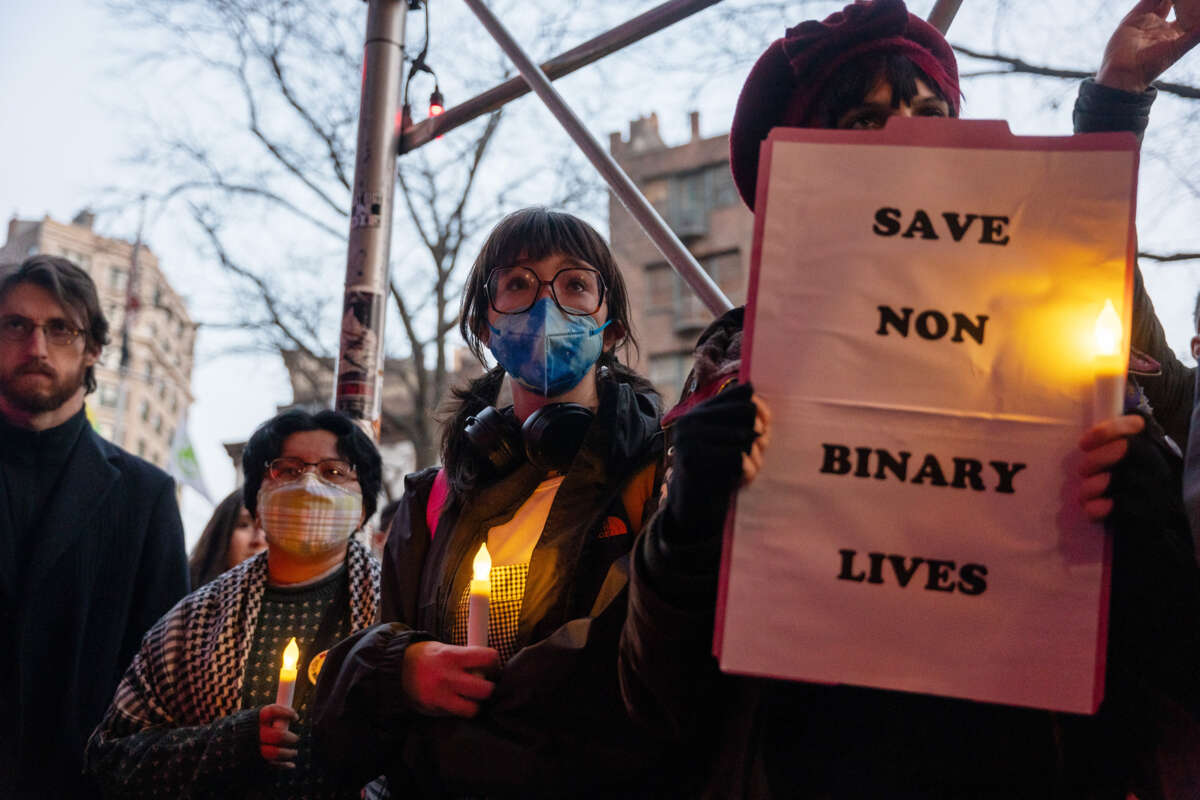
People gather outside the Stonewall Inn for a memorial and vigil for Oklahoma teenager, Nex Benedict, who died after being bullied in a high school bathroom, on February 26, 2024, in New York City.
Spencer Platt / Getty Images
Nex Benedict was a Tulsa-area teen of Choctaw descent. His friends described him as an “adventurous little thing” who had a flair for creating art with a sense of ease. They called him “Roachie,” and he was loved.
After Nex’s death in February 2024, his portrait splayed across international news, vigils and social media posts. The picture shows Nex with deep brown eyes, short, loose brown curls grown out a little bit and a gentle smile. Nex has a crisp white shirt and black vest on. He looks like he’s dressed up for a dance or recital, at that cusp age of 16, when pre-teen clothes are out and quality vintage clothes become of interest.
On February 8, 2024, Nex collapsed and died at his home. The day before, he sustained a head injury during severe bullying at his school, Owasso High. The medical examiner ruled Nex’s passing a suicide after finding an antidepressant and an allergy medication in his system. This finding has been questioned repeatedly by local community members and national organizers.
“Regardless if it was caused by the fight or suicide, Nex died from bullying. Period,” said Olivia Carter, administrative coordinator for Oklahomans for Equality.
Nex’s death did not happen in a vacuum.
Related Story
Nex Benedict was a Tulsa-area teen of Choctaw descent. His friends described him as an “adventurous little thing” who had a flair for creating art with a sense of ease. They called him “Roachie,” and he was loved.
After Nex’s death in February 2024, his portrait splayed across international news, vigils and social media posts. The picture shows Nex with deep brown eyes, short, loose brown curls grown out a little bit and a gentle smile. Nex has a crisp white shirt and black vest on. He looks like he’s dressed up for a dance or recital, at that cusp age of 16, when pre-teen clothes are out and quality vintage clothes become of interest.
On February 8, 2024, Nex collapsed and died at his home. The day before, he sustained a head injury during severe bullying at his school, Owasso High. The medical examiner ruled Nex’s passing a suicide after finding an antidepressant and an allergy medication in his system. This finding has been questioned repeatedly by local community members and national organizers.
“Regardless if it was caused by the fight or suicide, Nex died from bullying. Period,” said Olivia Carter, administrative coordinator for Oklahomans for Equality.
Nex’s death did not happen in a vacuum.
Related Story
Op-Ed |
LGBTQ Rights
Our Mourning for Nex Benedict Calls Us to Action Against Transphobia and Fascism
Nex Benedict, a gender-expansive teen in Oklahoma, died the day after enduring a beating in their high school bathroom.
By Kelly Hayes , TruthoutFebruary 23, 2024
In the immediate wake of his passing, a discourse erupted about anti-trans legislation, social neglect and health care inequity. But, in order to fully understand Nex’s death by bulling, this present history needs to be analyzed alongside histories ofthe boarding school system and the Indian Removal Act — policies that resulted in land theft, warfare, cultural genocide and widespread propaganda campaigns that stoked fear, dehumanization and colonial violence against Indigenous and Two-Spirit peoples.
Both the anti-trans campaigns and the boarding school system share a key component: the attempt of the far right United States political body to enforce a heteronormative, Christian identity on the public. And both the boarding school system and the anti-trans campaigns have yielded lethal results.
Since the introduction of anti-trans bathroom bills in 2015, anti-trans rhetoric and policy have been on the rise throughout the U.S. The increased vitriol against trans people has resulted in over 650 anti-2SLGBTQ+ (Two-Spirit, lesbian, gay, bisexual, transgender, queer/questioning, and additional sexual orientations and gender identities) policies being introduced in 2024 alone. As a high political watermark, the Heritage Foundation’s Christian nationalist Project 2025 paints a picture of the U.S. where transgender ideas are codified as “pornographic” and are thus minimized, if not eradicated, from public life.
Despite the majority of the U.S. population believing that trans people should be protected from discrimination, trans identities, culture and medical care have been used by the far right as an effective wedge issue in U.S. politics. This tactic of engaging a “hot-button” or controversial topic to drum up political fervor often includes pushing bigotry against a perceived mortal threat of “the other.”
This bigotry, often stoked by moral panic and misinformation, has been used to create support for policies that marginalize members of the public and restrict basic bodily autonomy. When enacted, othering policies limit, or even remove, the demonized community’s ability to get their basic needs (like gender-affirming care or a safe abortion) met above ground. Thus, these life-supporting services become less and less publicly available — especially to poor, Black, Indigenous, undocumented and/or rural communities.
This pattern (of social and political othering that results in the denial of material resources)is a key tactic of the violence that underpins settler colonialism in the U.S., and public institutions (like schools) are key enforcers of settler values. Thus, the history and impact of the settler-led school system on LGBTQ and Indigenous communities must be understood in order to fully unpack the broader circumstances surrounding Nex Benedict’s death.
Just Because It’s Legal Doesn’t Make It Right
Starting in 1819, the U.S. government instituted a sprawling schooling system consisting of 408 federal Indian boarding schools meant to “Kill the Indian, save the man.” Made possible by legislation such as the Indian Removal Act, these schools aimed to assimilate Native children into settler society by forcibly removing them from their families and raising them in group homes.
These schools were often run by abusive, state-funded Protestant, Catholic or Orthodox Christian religious groups, and they operated for over 150 years. Shortly after this, many of the religious schools became state-run. Structurally, these schools enforced cultural genocide via the tactic of assimilation, which continues to severely and negatively affect young people — especially (but not exclusively) Native children.
“This suppression … is linked to the claiming and the colonization of space. I see a direct link,” said Taté Walker, a citizen of the Cheyenne River Sioux Tribe, a Two-Spirit storyteller and co-founder of the Phoenix Two Spirit Community group. Walker is a well-respected Two-Spirit teacher and parent who educates on tribal issues, including how the modern U.S. school system is built on tactics from the boarding school era.
“Everyone who attends these schools is not receiving community wellness teachings, elder care, lessons about protecting the air and water,” Walker told Truthout. “We are not receiving information about how our past continually cycles itself. We’re not given information on how to prevent violent events from recurring — such as a kid [whose death] is deemed a suicide. It’s left at that ridiculously simplistic reasoning, when in fact it’s hundreds and hundreds of years of stochastic terrorism, transphobia, homophobia — all set up to make a violent environment for someone like Nex Benedict.”

Indigenous residential schools, whether run by the state or religious groups, were quite literally designed to strip away the languages, cultures and community structures of non-Christian peoples in order to make them more like European settlers. Children were forced to speak English, follow the Bible and live in church-sanctioned, cis-hetero, nuclear families. This forced assimilation is a key component of cultural genocide, and it is a clear violation of international law.
“It benefits the folks in power to keep down people with their own sense of power and medicine. They see beyond the status quo. They’re fighting for a society that recognizes justice and fights injustice, that all classes are able to exist,” Walker explained.
According to Native scholars, an estimated 40,000 Native children died in the boarding schools. In these schools, the administrators subjected children to consistent abuse, malnutrition, sexual assault, manual labor, beatings and neglect. Many children’s bodies were never returned to their families and were instead buried in unmarked, sometimes mass, graves. Hundreds, potentially thousands, of deaths were never reported at all, and innumerable family records were lost or destroyed. These graveyards can be visited all over the continent openly today.
In a 2022 report, the Bureau of Indian Affairs acknowledged that there is “inconsistent Federal reporting of child deaths, including the number and cause or circumstances of death, and burial sites.” Burial grounds at the boarding schools epitomize this deadly system. The bureau describes “The intentional targeting […] of American Indian, Alaska Native, and Native Hawaiian children to achieve the goal of forced assimilation of Indian people” as “both traumatic and violent.”
A recent 2024 Department of the Interior report confirmed that at least 973 Indigenous children died at the boarding schools in the United States and were buried in one of at least 74 mass graves. The schools cost the public the equivalent of $23 billion in today’s dollars.
This report, and a similar investigation in Canada, highlight the scale at which settler governments and religious groups used these institutions as tools of cultural genocide and violent relocation efforts. Through assimilation-centered education and punishment, paid for by public funding and encouraged by federal policy, school officials enforced settler culture. All of this happened at the expense of Indigenous children’s lives and safety.
President Joe Biden acknowledged the scale of these harms in October 2024 when he issued a formal apology on behalf of the U.S. government for the violence of the schools.
Many survivors of these schools argue that, historically, there has truly never been a culture of care and commitment to the survival of Indigenous, especially Two-Spirit, youth in settler-led schools. Many believe the violence of the boarding school era still resonates today.

A Living History of Violence
Nex Benedict was an Indigenous trans youth, and the settler system appears to have not changed much since 1819. Oklahoma, where Nex Benedict lived, had 95 Indigenous boarding schools — the most known of any state in the U.S. There were at least five in the Tulsa area near where he lived.
So, when the public asks, “How did this happen?” The answer is that lawlessness, forced assimilation and Indigenous death have always been critical facets of the settler school system.
In Nex’s case, this history manifested in 2024 through neglect and legislation-backed prejudice. Administrators failed to step in during the year of bullying Nex suffered. Anti-trans politics created a moral panic around bathroom use. The demonization of LGBTQ-inclusive educational materials stoked ignorance and a devaluation of lives like Nex’s. Collectively, the far right policies in the Oklahoma education system and all the adults who uphold them are responsible for the hostile environment that killed Nex.
Shortly before Nex’s death, a 12-year-old named Eli, a gay child from Oklahoma, also died by suicide following extensive bullying that his school repeatedly failed to address.
“We are told, ‘If you are bullied so badly, why don’t you fight back?’ and in the next breath, ‘If you wouldn’t have fought back, this never would have happened.’ We are forced to play a rigged game,” said an Owassa High alum at a school board meeting in mid-March. “Let me be very clear, we will not allow this to continue.”
In Oklahoma, advocacy groups like Freedom Oklahoma and the ACLU continue to offer educational, social and legal opposition to anti-trans policies and social bigotry. They offer community support groups, volunteer training and gatherings in order to build collective power and solidarity among LGBTQ folks and their allies. But they have their work cut out for them.
In the week immediately following Nex’s death, the national youth crisis line Rainbow Youth Project reported receiving a surge of at least 1,000 calls — with a 200 percent increase specifically from Oklahoma. Many callers reported that they, too, were being bullied.
Going Forward
“The history of how Oklahoma was founded in lawlessness is important. The violence in how the state itself was created is critical in understanding why and how the current climate is adversarial when it comes to the State of Oklahoma and the Tribes, Tribal people,” explained Rebecca Nagle, Two-Spirit Cherokee author of By the Fire We Carry. “The Tribal schools the Indigenous kids were taken out of taught literature, art and global languages. The government put [Indigenous children] into the state-run school system that the kids exist within today. The state was started with ruthless lawlessness, not arts and collaboration, at its beginning.”
The modern-day attacks on trans health care have, similarly, influenced public policy, despite ample scientific and social research supporting trans rights. This disparity — between known, proven research and the lawlessness of anti-trans hatred — reflects a deeper political misinformation crisis that seeks to further reduce the autonomy and freedoms of marginalized people. Similar to the forced assimilation of Indigenous children in the boarding schools, the current anti-trans push is an attempt to lethally enforce a culturally-specific political structure onto a group of people that, simply, does not agree with or wish to live within it.
From 2023-2024, the Trans Legislation Tracker shows that, in Oklahoma, anti-trans bills have increased 46.3 percent — from 41 to 60. Oklahoma is a major node of the national anti-trans campaign, with 4.5 times more anti-trans bills than the average state and 8.8 percent of all anti-trans bills introduced this year. These bills restrict health care, access to education, sports, medical care and other aspects of public life — and, in many ways, seem to be a clear attempt to eliminate a people as a people, a core component of the UN definition of genocide.
When asked what Indigenous Two-Spirit youth in Oklahoma should do — be visible or remain in the closet — Nagle reckons with a difficult reply.
“Coming out and being visible is a very personal decision. There’s no telling young people what to do when it’s something so personal,” Nagle explains. “It can be very dangerous. I also know from my own experience that it can also be very dangerous to stay in the closet. It’s a very personal and important decision, and the stakes are just so very high in Oklahoma.”
Desiree Kane
Desiree Kane is a Miwok descendant and multimedia journalist focused on producing stories with a conscience at the intersection of Indigenous peoples and the environment. Follow Desiree on Bluesky.
Jen Byers
Jen Byers (they/she) is a visual and investigative journalist. Their work has appeared in Al Jazeera, The Guardian, Showtime, CalMatters and elsewhere. Follow Jen on Bluesky.
WOMENS BATHROOMS HAVE CUBICLES FOR PRIVACY
MENS HAVE URINALS AND 2 - 3 CUBICLES

Sarah McBride, Delaware state senator and candidate for United States Representative, is interviewed by Reuters in Wilmington, Delaware, U.S., October 26, 2024. REUTERS/Rachel Wisniewski
November 20, 2024
U.S. Congresswoman-elect Sarah McBride (D-DE) says she will “follow the rules” after Republican Speaker of the House Mike Johnson issued a ban on transgender women using women’s restrooms in the U.S. Capitol, a direct reaction to McBride becoming the first transgender member of Congress.
“I’m not here to fight about bathrooms. I’m here to fight for Delawareans and to bring down costs facing families,” McBride (photo, center), 34, a member of the Delaware state Senate, said in a statement. “Like all members, I will follow the rules as outlined by Speaker Johnson, even if I disagree with them.”
“This effort to distract from the real issues facing this country hasn’t distracted me over the last several days, as l’ve remained hard at work preparing to represent the greatest state in the union come January. Serving in the 119th Congress will be the honor of a lifetime – and I continue to look forward to getting to know my future colleagues on both sides of the aisle.”
U.S. Congresswoman-elect Sarah McBride (D-DE) says she will “follow the rules” after Republican Speaker of the House Mike Johnson issued a ban on transgender women using women’s restrooms in the U.S. Capitol, a direct reaction to McBride becoming the first transgender member of Congress.
“I’m not here to fight about bathrooms. I’m here to fight for Delawareans and to bring down costs facing families,” McBride (photo, center), 34, a member of the Delaware state Senate, said in a statement. “Like all members, I will follow the rules as outlined by Speaker Johnson, even if I disagree with them.”
“This effort to distract from the real issues facing this country hasn’t distracted me over the last several days, as l’ve remained hard at work preparing to represent the greatest state in the union come January. Serving in the 119th Congress will be the honor of a lifetime – and I continue to look forward to getting to know my future colleagues on both sides of the aisle.”
“Each of us were sent here because voters saw something in us that they value. I have loved getting to see those qualities in the future colleagues that I’ve met and I look forward to seeing those qualities in every member come January. I hope all of my colleagues will seek to do the same with me.”
McBride’s comments followed a wave of targeted attacks on social media and in the news by U.S. Representative Nancy Mace (R-SC). Reports indicate that Mace posted over 260 messages on social media within 36 hours, specifically targeting McBride and transgender women more broadly.
Among them, a video in which Mace declared she will file legislation to make the ban on transgender women using women’s restrooms a national ban for all federal properties.
Speaker Johnson on Tuesday had insisted he was not interested in implementing any new rules, and was “not going to engage in this.”
“We don’t look down upon anyone,” he proudly told reporters, before adding, “a man is a man and a woman is a woman, and a man cannot become a woman.”
Twenty-four hours later Johnson issued his ban.
“All single-sex facilities in the Capitol and House Office Buildings – such as restrooms, changing rooms, and locker rooms – are reserved for individuals of that biological sex,” Johnson’s statement reads. “It is important to note that each Member office has its own private restroom, and unisex restrooms are available throughout the Capitol.”
“Women deserve women’s only spaces,” he concluded, not offering the same claim for men.
While Mace led the attacks against McBride and transgender people in general, Huffpostreports, “Rep. Marjorie Taylor Greene (R-Ga.) even suggested she would physically fight McBride for using the ladies’ room.”
“All single-sex facilities in the Capitol and House Office Buildings – such as restrooms, changing rooms, and locker rooms – are reserved for individuals of that biological sex,” Johnson’s statement reads. “It is important to note that each Member office has its own private restroom, and unisex restrooms are available throughout the Capitol.”
“Women deserve women’s only spaces,” he concluded, not offering the same claim for men.
While Mace led the attacks against McBride and transgender people in general, Huffpostreports, “Rep. Marjorie Taylor Greene (R-Ga.) even suggested she would physically fight McBride for using the ladies’ room.”
Mace also waged her campaign against McBride in the news media, telling Forbes that the Congresswoman-elect was “absolutely” a “threat” to her personally. She claimed, “any man who wants to force his junk into the bathroom stall next to me or in a dressing room watching me, that is an assault on women.”
Forbes also notes, “McBride has never been accused of sexual misconduct or any kind of threatening behavior.”
The South Carolina Republican’s baseless allegations against McBride come just a few years after Mace began her congressional career by claiming to be pro-LGBTQ.
“I strongly support LGBTQ rights and equality,” Mace said in 2021. “No one should be discriminated against.”
“I have friends and family that identify as LGBTQ,” she added. “Understanding how they feel and how they’ve been treated is important. Having been around gay, lesbian, and transgender people has informed my opinion over my lifetime.”
Mace, as Punchbowl News co-founder Jake Sherman reports, is also fundraising off her attacks.
Watch the video above or at this link.