Tuesday, March 25, 2025


The Economist Magazine’s Massive China FAIL!


The Economist is an influential weekly magazine that was founded way back in 1843. But its age hasn’t lent it much ability at all to analyze China’s economy, making embarrassingly bad predictions about this country over the last few decades that show us crystal clear: if you want to understand China and its economy, DO NOT read The Economist.

The magazine has got it wrong on so many major subjects, most recently being China’s huge successes in the AI sector.

Just yesterday they were forced to admit that success, with an article calling China’s AI boom “astonishing,” but just a few years ago they told readers not to hold their breath about the country’s chances in AI.

And their predictions over the decades that China was about to collapse even put serial self-loathing China-hater Gordon Chang to shame, and they were once hilariously even against China’s high speed rail!

Today we’ll take a closer look at some of The Economist’s embarrassing bad China takes.

This is Reports on China, I’m Andy Boreham in Shanghai. Let’s get reporting!

Reports on China, which analyzes Western reports on China is created and hosted by Andy Boreham, a columnist and video producer with Shanghai DailyRead other articles by Reports on China, or visit Reports on China's website.

Senator Whitehouse’s Climate Crisis

Property Insurance-RE Collapse Scenario


Real estate has become climate change’s biggest victim. Climate change is attacking America’s most valuable, biggest asset class. For the first time in history there are regions of the country where major property insurers have dropped coverage altogether as elsewhere rates are on the climb, pricing some buyers out of the market.

America’s politicians punted on tackling climate change decades ago, except for Senator Sheldon Whitehouse, who has masterfully delivered more than 290 “Time to Wake Up” climate speeches to the Senate, calling out deniers and demanding bold action. If Congress had been composed of “Whitehouse intellect,” the world climate system would be in much better shape today. And not threatening the American Dream of Homeownership.

At a Senate confirmation hearing for Trump appointee Michael Faulkender as Deputy Treasury Secretary, Senator Whitehouse opened up all firing cylinders, blasting away like there’s no tomorrow, which may be where we’re headed after listening to the senator’s scolding rendition of how Congress has failed climate change impacting the financial system and US economy. In short, climate change is raising hell with the financial system as US property insurance goes up in flames.

In his opening remarks, the senator referenced “very dark economic storm clouds on the horizon,” because of climate change which the administration cannot seriously address because massive political funding has made it “an article of faith to deny climate change,” in fact, claiming “it’s a hoax.” This perverse attitude is now holding America’s homeowner’s hostage.

Interestingly, over past decades, scientists have gotten it right, even the Exxon scientists got it right, meaning, fossil fuel emissions (CO2) cause climate change. Nevertheless, Congress has failed to act because of pressure by fossil fuel interests, including the “largest campaign of disinformation that America has ever seen,” as dark money spills out all over the place. As a result, all serious bipartisan efforts on The Hill on climate change have been squelched. Poof!

Disinformation, disinformation, disinformation has been the guiding light of climate denialism. It’s a hoax; it’s a hoax; it’s a hoax; it’s fake news; it’s fake news, repetition creates fact.

As the senator and the Trump appointee discussed in a meeting beforehand in the senator’s office, the consequences of climate change are severe based upon professional risk judgement where fiduciary responsibly is considered. For example, the chief economist of Freddie Mac told committee hearings we are headed for a “property insurance collapse” that will cascade into a crash in coastal property values that will be so significant that it will cascade into the entire economy, same as 2008. That’s the warning on coastal properties. Additionally, wildfires have now added new property insurance risks that are far removed from coastal property. Climate change knows no boundaries as congressional ineptness and timidity to challenge it clobbers American homeownership.

Senator Whitehouse offered one example after another of how climate change is undermining the financial system of America.  In a recent Senate banking committee hearing, the Fed Chairman said there will be “areas of the country where you can’t get a mortgage any longer” because of climate change; a very stern warning that something has to change.

Also, as related by the senator, the Financial Stability Board, the entity that warns the international banking system of impending issues gives the same warning that “property insurance has become a major risk to the survival of the economic system.”

And even closer to home base, meaning Congress itself, a recent bipartisan CBO (Congressional Budget Office) report identified fires, floods and climate change in toto, threatening to undermine our financial system. Yet, Congress ignores its own warnings.

And The Economist magazine cover story in April 2024 depicted climate damage undermining insurance markets and threatening the biggest asset class in the world, RE. predicting a 25 trillion dollar hit to RE because of climate change.

Senator Whitehouse: “The lie that climate change is a hoax is no longer just an act of political malfeasance. It is now an act of economic malfeasance.” Climate change is hitting America’s pocketbooks throughout the country like an early summer thunderstorm crackling in the sky.

The financial-Wall Street-economic impending upside down collapse due to radical climate change should be item number one on Congress’s docket to do whatever is necessary, but it’s not even given a glancing look. Yet, the insurance industry is feeling the heat; homeowners are feeling the heat. Mortgage companies are feeling the heat. And Wall Street is starting to feel the heat. Can the Trump climate hoax syndrome, “ignore it, it’s not real… it’s fake news” hold up in the face of extremely severe financial strain impacting the world’s largest asset class, real estate?

“President Trump issued an executive order aimed at dismantling many of the key actions that have been undertaken at the federal level to address climate change. The order, ‘Promoting Energy Independence and Economic Growth.” (“Trump Issues Executive Order on Climate Change,” Sabin Center for Climate Change Law, Columbia Law School)

“Nobody’s Insurance Rates Are Safe From Climate Change,” Yale Climate Connections, January 14, 2025.

“Property Values to Crater Up to 60% Due to Climate Change,” Business Insider, Aug. 9, 2024.

“U.S. Department of the Treasury Report: Homeowners Insurance Costs Rising, Availability Declining as Climate-Related Events Take Their Toll,” U.S. Department of the Treasury, January 16, 2025.

“Next to Fall: The Climate-driven Insurance Crisis is Here – And Getting Worse,” Senate Budget Committee, Dec. 18, 2024.

“Climate Risk Will Take Trillion-dollar Bite Out of America’s Real Estate, Report Finds,” USA Today, Feb. 7, 2025.

“Homeowners Insurance Sector Slammed by Climate Impacts,” Insurance Business America, May 14, 2024.

“Climate Change Is Coming for U.S. Property Prices,” Heatmap News, Feb. 3, 2025.

“Insurers Are Deserting Homeowners as Climate Shocks Worsen,” New York Times, Dec. 18, 2024.

“Climate Resiliency Flips the Housing Market Upside Down,” Forbes, Feb. 20, 2025.

“Climate Change Set to Lower Home Prices,” Business Insider, Feb. 4, 2025.

“How Climate Change Could Upend the American Dream,” Propublica, Feb. 3, 2025.

“Climate Change to Wipe Away $1.5 Trillion in U.S. Home Values, Study Says,” Wall Street Journal, Feb. 3, 2025.

“Opinion: That Giant Sucking Sound? It’s Climate Change Devouring Your Home’s Value,” New York Times, Feb. 3, 2025.

“How and Where Climate Change Will Lower U.S, Home Values,” Context News, Feb. 10, 2025.

“Climate Change Is Driving an Insurance Crisis,” The Equation – Union of Concerned Scientists, June 19, 2024.

“Real Estate: How Climate Risk is Changing Prices,” Medium, March 3, 2025.

“At Least 20% of U.S. Homes Will be De-Valued Due to Climate Change, Says DeltaTerra CEO Dave Burt,” CNBC, Feb. 19, 2025.

“Climate Change is Fueling the US Insurance Problem,” BBC, March 18, 2024.

“US Housing Market May Face Losses Due to Climate Change,” Realty, Feb. 21, 2025.

“Nearly Half of U.S. Homes Face Severe Threat from Climate Change, Study Finds,” CBS News, March 13, 2024.

“The Possible Collapse of the U.S. Home Insurance System,” New York Times, May 15, 2024.

“The Climate Crisis Will End Home Ownership as We Know It and Eventually Crash the Economy,” Splinter, Jan. 8, 2025.

Fake news?

The big question going forward is whether climate change’s real estate devaluation, which impacts every American household, will take MAGA down to its knees, drowning its lameness in a sea of turbulent financial chaos followed by a massive irrepressible political tsunami payback event that cleanses the nation of lies?

Robert Hunziker (MA, economic history, DePaul University) is a freelance writer and environmental journalist whose articles have been translated into foreign languages and appeared in over 50 journals, magazines, and sites worldwide. He can be contacted at: rlhunziker@gmail.comRead other articles by Robert.


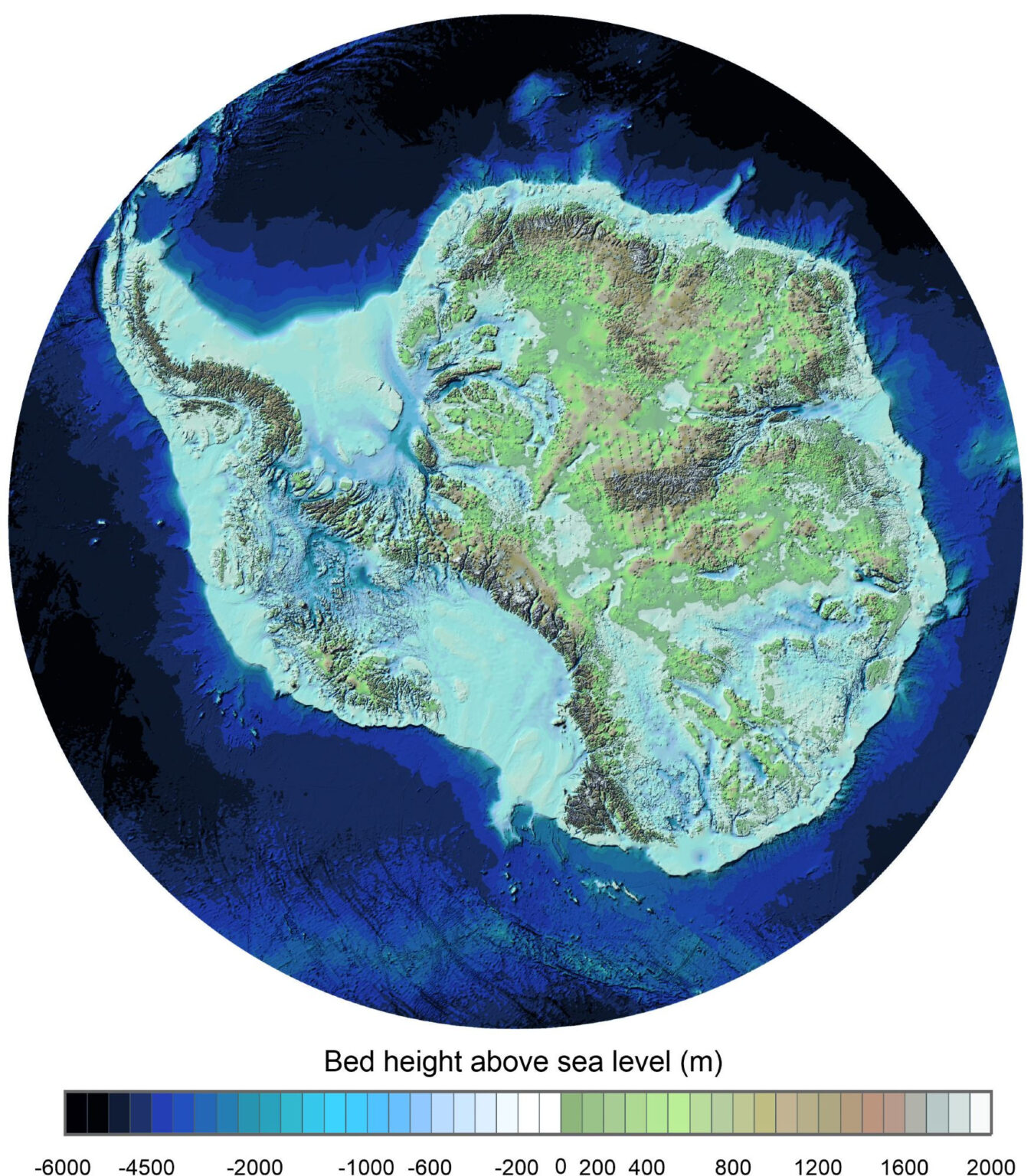
Discovery of Immense Methane Leaks in Antarctica


A new discovery of methane leaks in Antarctica could be a game-changer and potential near-term threat that’s difficult to characterize without sounding overly negative. Of course, situations like this that appear threatening to civilization, or life as we know it, are difficult to believe and accept as something the will really happen, which is understandable because nothing in human history compares to the risk attendant to the dreaded runaway greenhouse effect. So, there’s nothing in human history to compare it to.

Nevertheless, there are scientists who believe we are living on borrowed time because of massive changes happening at the top and at the bottom of the planet where only scientists and indigenous people hang out. Now, this new discovery serves to emphasize their concerns of a climate monster capable of altering everything, lurking in the background.

The threat is explained in a YouTube video: Immense Methane Leaks in Antarctica: A Hidden Climate Theat Unveiled by Phantom Ecology, which is headed by Milton Muldrow, Ph.D. asst. professor at Wilmington University and Chair/College of Arts & Sciences.

As a prelude to this new information, it’s important to note that Russian scientists have been monitoring the risks of methane breakouts in the High Arctic for a couple of decades and have voiced concern about the risks of a sudden burst as undersea methane clathrates increasingly melt, bubbling to surface in ever-larger diameters, which they have measured. As it happens, methane (CH4) is many times more potent than CO2 at trapping excessive global heat.

Additionally, the risk of a methane breakout is mentioned by Peter Wadhams, emeritus professor, Ocean Physics, University of Cambridge, in his celebrated, brilliant interview: The Future of Sea Level Rise: “Russian scientists working the region believe a huge pulse of methane could erupt.” This could crank up global temperatures to ultra-dangerous levels in as little as 2-3 years. The consequences would be unspeakable. And with Antarctica joining, the game changes.

As a science researcher/writer of over 400 articles, this new development is extraordinarily spooky and difficult to accept because the consequences feel way too close for comfort. Stated at the opening of the Phantom Ecology video: “Deep beneath the icy plains of Antarctica, a slumbering giant is beginning to stir. Scientists have made a startling discovery. Vast reservoirs of methane hydrates locked away for millennia are showing signs of instability.”

The finding sent ripples of concern throughout the world of science. The consequences for the planet could be quite dangerous, maybe sooner rather than later. Rising plumes of methane (CH4) near the Antarctic Peninsula raises a major concern that trapped methane will be released into the atmosphere, exacerbating an already dire situation of accelerating global temperatures. The Intergovernmental Panel on Climate Change (IPCC) Maginot line of 1.5C above pre-industrial not to be exceeded as framed at the Paris 2015 climate conference by nearly all the nations of the world is kaput. To date, global temperatures have been exceeding that level for nearly two years running.

Meanwhile, world famous climate scientist James Hansen (Earth Institute, Columbia University) says 2C is on the horizon. “The pace of global heating has been significantly underestimated, according to renowned climate scientist Prof James Hansen, who said the international 2C target is “dead” (“Climate Change Target of 2C is ‘Dead’ Says Renonwed Climate Scientist,” Guardian, Feb. 4, 2025). It’s a huge understatement to say this would be horrendous for Antarctic methane leaks, Arctic methane leaks, including Siberian methane leaks and Alaskan methane leaks, as well as Glacial methane leaks (see below “Methane Double Trouble” for another disturbing new discovery).

The volume of methane locked away in Antarctic ice is estimated to be more carbon than all other fuel deposits combined for the planet. A small fraction of this escaping into the atmosphere could have catastrophic consequences for the climate system “in the not-too-distant future.” (Muldrow)

A Climate Time Bomb

Methane hydrates consist of methane molecules trapped within a crystalline lattice of water molecules. This forms an ice substance that can ignite if brought to surface and lit with a match. According to the video: “Release of methane from these hydrates is a frightening prospect. Such a release could trigger a runaway greenhouse effect leading to rapid and catastrophic climate change.” Rapid onset of methane would bring sea levels rising at unprecedented rates, extreme weather events more frequently, and widespread disruptions/destruction to global ecosystems.

Muldrow’s analysis of the first time that large-scale CH4 emissions have been detected in Antarctica is confirmed by Polar Journal, March 2025: “Large Methane Leaks Discovered in Antarctica”:

A research team led by the Institut de Ciències del Mar (ICM-CSIC) and the Spanish Geological and Mining Institute (IGME-CSIC) undertook an expedition to the Antarctic Peninsula as part of the ICEFLAME project. The researchers returned on February 17 and have now reported the discovery of large methane leaks on the sea floor in an ICM publication. For the first time, they were able to observe that large quantities of methane are released from the seabed in a gaseous state where methane hydrates occur.

Additionally, according to an article in Rapusia.org, March 14, 2025, “Massive Methane Leaks Detected in Antarctica, Posing Serious Climate Risks”: “A team aboard the Sarmiento de Gamboa research vessel observed large columns of gas escaping from the ocean floor, with some extending up to 700 meters (2,300 feet) long and 70 meters (230 feet) wide.”

Methane Double Trouble

In addition to massive CH4 leaks discovered in Antarctica, up north in the Arctic scientists recently discovered Arctic glaciers leaking “significant amounts of methane,” revealed for the first time. As explained: “Glacial melt rivers and groundwater springs are transporting large volumes of methane from beneath the ice to the atmosphere. This previously unrecognized process could contribute to Arctic climate feedback, accelerating global warming.” (“‘Glacial Fracking’: A Hidden Source of Arctic Greenhouse Gas Emissions,” ScienceDaily, Feb. 19, 2025)

As a result, scientists now need to reassess methane budgets, incorporating glacial emissions alongside permafrost thaw and wetland methane fluxes. The complexities of multiple dangers of global warming continue to expand and merge in time. It now appears that both ends of the planet have turned dicey, risky, subject to sudden change all too soon for comfort and all together at the same time.  This could get very ugly; an article in Space.com deals with the issue of runaway global warming: “How The Runaway Greenhouse Gas Effect Can Destroy a Planet’s Habitability — Including Earth’s,” Space.com, December 19, 2023. Here’s the storyline: “Using advanced computer simulations, scientists have shown how easily a runaway greenhouse effect can rapidly transform a habitable planet into a hellish world inhospitable to life.”

Alas, as explained many times in prior articles, corporations, oil and gas operations, countries are all failing to honor commitments to mitigate climate change even before the U.S. reversed course on combating climate change under the Trump administration. This becomes infectious as Germany recently announced an intention to lessen its commitments. The timing could not be worse. The WMO State of the Climate 2024 Update once again issued a Red Alert at the sheer pace of climate change in a single generation, turbo-charged by ever-increasing greenhouse gas levels in the atmosphere. 2015-2024 will be the warmest ten years on record; the loss of ice from glaciers, sea-level rise and ocean heating are accelerating; and extreme weather is wreaking havoc on communities and economies across the world. (World Meteorological Organization)

Making matters more unnerving yet, according to Copernicus Global Climate Highlights 2024: “Each month from January to June 2024 was warmer than the corresponding month in any previous year. August 2024 equaled the record warmth of August 2023 and the remaining months from July to December were each the second warmest for the time of year, after the corresponding months in 2023.”

With a strong dose of humility, it’s suggested that the world’s leadership undertake all available efforts to confront this real, already started, threat to life on the planet via a super-duper Marshall Plan for the world. Alas, it’s almost assured that this suggestion will go unheeded, especially with consideration of the following headline in the prestigious science publication Nature, Feb. 25, 2025: “Trump 2.0: An Assault on Science Anywhere is an Assault on Science Everywhere.”

The climate system is not going to ring a bell before all hell breaks loose. It’ll happen out of the blue, temperatures relentlessly climbing month by month by month to intolerable levels, possibly already started, observed by Copernicus as stated above. Nobody has ever theorized, or even suggested, that it’s impossible for humanity to exterminate itself.

Robert Hunziker (MA, economic history, DePaul University) is a freelance writer and environmental journalist whose articles have been translated into foreign languages and appeared in over 50 journals, magazines, and sites worldwide. He can be contacted at: rlhunziker@gmail.comRead other articles by Robert.

A Guide to Seeing in the Dark in the New Dark Ages


Darkness (invisible) "The world is full of magic things, patiently waiting for our senses to grow sharper."


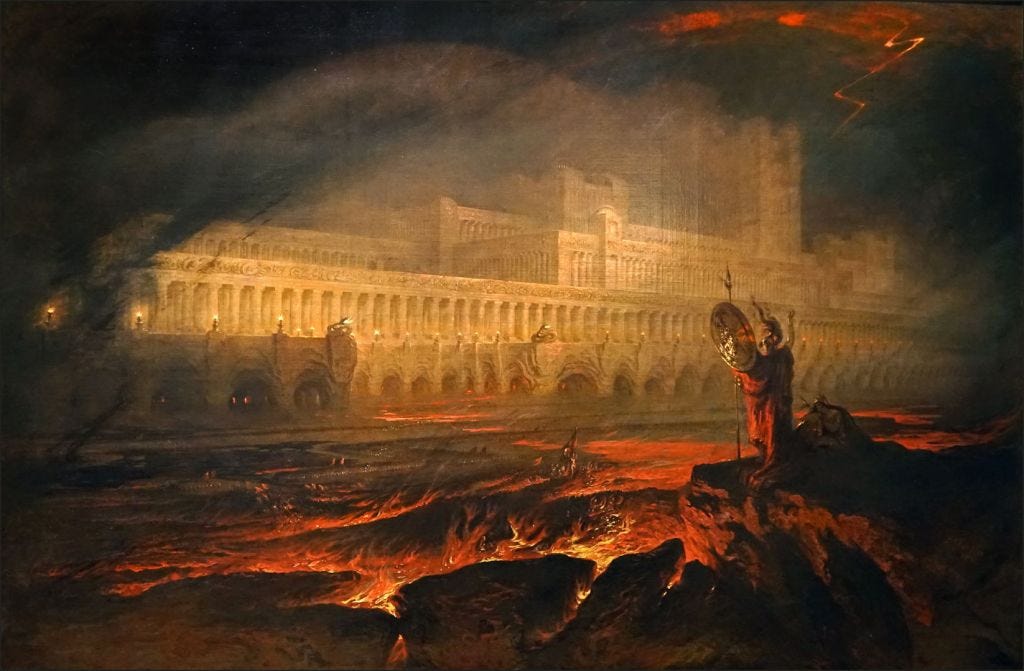
John Martin (1789-1854), Pandemonium (1823-27)

No light, but rather darkness visible
Served only to discover sights of woe
— John Milton, Paradise Lost

I wrote the following shortly after the birth of my son, now age 12:

When questioned by the youth of future generations, those born into the world created by our myopic choices, about how you responded when the earth was burning, will you reply that you went to the mall, sat in public places staring at a glowing electronic box, engaged in cretinous palaver about the private lives of sub-cretinous celebrities and the dim machinations of reality show jerk-rockets?” [One of whom is in his second term as president of the US.]

“At this critical juncture, one’s individual calling will be interwoven with the fate of the earth and the collective destiny of all of humankind. The age of elitist narcissists is drawing to a close. [Man o’ man, that declaration was a humbling display of wishful thinking.] The time for dreamers, visionaries and activists has arrived, and their time of arrival is long past due.” [I know, we are still waiting.]

While we wait, in the dimming light of a dark age, as Yeats’ averred in verse:

The world is full of magic things,
patiently waiting for our senses to grow sharper.
— W.B. Yeats

One’s eyes will adjust to a dimming of light; the phenomenon presents an option: to go nocturnal in mindset. The much and wrongly maligned wolf sees in the dark and displays fierceness regarding love for its pack. The archetypal story goes, a wolf will raise a cast out child. The orphaned soul of our troubled, dark times is in desperate need of a nurturing based fierceness of the heart. Dark times can become the ally of those bold in imagination.

We grow accustomed to the Dark –
When Light is put away –
As when the Neighbor holds the Lamp
To witness her Goodbye […]
— Emily Dickinson, “We Grow Accustomed to the Dark”

Yet: It is always darkest, right before…it goes completely black. Sometimes, it takes total darkness for certain individuals to search within for an internal source of illumination.

If not, primal fears, rooted in the archaic subregions of mind, rise as mindless animus when political and economic dynamics devolve into ossified structures, noxious to the common good. As their structures of self-interest decay from corruption, the elite beneficiaries of the system engage in campaigns deploying demagogic fear-mongering with the agenda of blame-shifting the reasons for the rising miseries of the many. As a result, dark, dangerous energies borne of the stress-fragmented collective mind surge through the culture. There is a darkness (invisible) propelling event in a tragic trajectory.

I had a dream, which was not all a dream.The bright sun was extinguish’d, and the stars
Did wander darkling in the eternal space,
Rayless, and pathless, and the icy earth
Swung blind and blackening in the moonless air;
Morn came and went—and came, and brought no day
— “Darkness,” Lord Bryon

Vincent Van Gogh - Skull of a Skeleton with Burning Cigarette, 1885–86
Vincent Van Gogh, “Skull of a Skeleton with Burning Cigarette,” 1885

The darkest places in hell are reserved for those who maintain their neutrality in times of moral crisis.
— Dante Alighieri, “The Inferno”

Hence, seeing through into the depths of hidden regions of the psyche, personal and collective, becomes crucial; the gaining of political intelligence, rooted in soul-making, must be in place for those choosing to act as a force of resistance.

Moreover, political intelligence involves more than recognizing, then citing unwelcome facts to the willfully and belligerently obtuse fuckwits, and more is required than, cathartic as it is, positing outrage based on honest feelings. Accurate apprehensions and probing insights also must be freighted with the rigorous imagination attendant to descent into, and contemplation of, the dark regions of the self. (How else is it possible to understand the darkness within others?) Thus a transforming element has been delivered to the psyche, a type of soul-making alchemy arriving from the thoughts of the heart, even as it suffers anguish witnessing the noxious inanity of the times.

Dismal, painful times can create an opening — a pathway to inner, revitalizing reservoirs of vital imagination, even, and in particular, as the trajectory of the world careens through a drought-stricken wasteland of the collective heart. In these times, avoid retreating, by reflex, into the bland tyranny of comfort zones. Yes, viewing the prevailing abomination is mortifying. Yet mortification can transmute into a type of desperation known as courage.

One is greater than one’s comfort zones. So is the imagination. Rigorous imagination does not shut out the world; it gathers the world inside, gathers and alchemizes life’s laughter and tears, love and hatred, darkness and light, grandeur and everyday yearning, thus transforming one’s worldview.

We are not dealing in self-involved, self-reinforcing vanities and banal agendas. The imagination reveals, it is not all personal. There is more to you and to me than we know; therefore, there is more to the world than we are allowing ourselves to apprehend.

As the old order falls away, a new world is brooding within. True, bad news is the order of the day. The good news: You carry within you seeds of a new perspective on the world.

“Sometimes you have to play a long time to be able to play like yourself.”
— Miles Davis

Long before there came into existence a materialist view of the world, there was the image-rich mind, withal, the thoughts of the soul, a perspective that apprehended all things in the world and the heavens to be alive.

Why, in our time, as opposed to previous eras, does wisdom not come with age? Instead, for example, insofar as the US political class aging begets regression – flat out childishness — as all the while, under the class stratification inherent to capitalism, the citizenry lapses into bitterness due to a lack of opportunity to not only live fulfilling lives but the constant and pummeling angst of losing everything. Wisdom arriving with age is not possible when the individuals in question are ego-driven tools or the powerless mass in the thrall of the pathologies of a greed-rancid system that only proffers palliatives of rage displacement and depth-devoid distractions.

Beneath the disorder of the current political structure seethes pathology needing to be examined and untangled. Its sick institutions reflect pathos suppressed from the collective mind of capitalist imperium, and, as a result, has festered into societal afflictions.

As a politically aware, critically thinking person, you have evolved past, for example, reactionary shitwits, authority-worshipping ambulatory head wounds, and humor-deficient dogmatists. Now the crucial question becomes, and it is a dilemma of heart, mind and soul, one in which I, for one, am engaged in near constant struggle: Can you evolve past yourself?

One must take in and recognize and respect the immensity of it all. Embrace — try not to shrink before — the unfathomable hugeness extant in life. In this way we grow by becoming part of what is immense as opposed to being stricken and paralyzed by the fact of our smallness before the inexorable movement of events.

A collapse is coming to pass. Decay is a chorus of warning; collapse is a dark angel devoid of mercy. The question reveals itself: How do we navigate such a dark, forbidden terrain? We listen to our heart, mind, and gut about who can be our allies in struggle. What viewpoints can act as midwives of rebirth? We connect our pain with the pain of our besieged and exploited planet. We engaged in the act of soul-making hence there comes the possibility the furies (Erinyes) of the age will be transformed into kindly protectors (Eumenides) of polis and republic.

20. Wisdom shouts in the streets.
21. She cries out in the public square.
She calls to the crowds along the main street, to those gathered in front of the city gate:
22. How long, you simpletons, will you insist on being simpleminded?
How long will you mockers relish your mocking?
How long will you fools hate knowledge?
— Proverbs 1:20-22

Cruelty, blithe indifference, and witnessing the worst among us prosper by means of heartless agendas can pummel the spirit, can wound the soul, can shatter the mind. A sense of dislocation grips consciousness; perception becomes a heap of fragmented images.

blakethomas01
William Blake (1757–1827), “Satan Arousing the Rebel Angels”

Yet the spirit has wings. The soul is deathless. And the mind, once the understanding is internalized, becomes focused because a new but ancient state of being is glimpsed in the hope and healing attendant to larger, more imaginative order arriving upon the ruins of the failed and fallen system. Descend within as you rise on the integrity of your wings: you are more resilient than you know for you are contained within the soul of the world’s immense order.

How does it come to be? In an era of manic acceleration, stage a personal protest movement by the act of slowing down. When everything is in the thrall of mindless motion, it becomes urgent to think things through, to see past the recklessness of the age and take in and bask in the treeline at the edge of the mind.

Why the extant surge of cultural mania? The capitalist order is fraying; its structures, as well as the collective psyches of its beneficiaries, are coming undone. They are desperately attempting to hold it all together. They are looting the contents of the national treasury and shunting the loot into their private concerns because the old order is sinking under the weight of its own excess. We are bearing witness to a duck tape economy. Yet mania cannot be sustained. Mania engenders collapse. Beneath the surface, all concerned long for its end. Even the economic and political elite, lifelong denizens of corruption, cannot abide the emptiness howling from the location within where their soul should be located.

O dark dark dark. They all go into the dark,
The vacant interstellar spaces, the vacant into the vacant,
The captains, merchant bankers, eminent men of letters,
The generous patrons of art, the statesmen and the rulers,
Distinguished civil servants, chairmen of many committees,
Industrial lords and petty contractors, all go into the dark,
And dark the Sun and Moon, and the Almanach de Gotha
And the Stock Exchange Gazette, the Directory of Directors,
And cold the sense and lost the motive of action.
And we all go with them, into the silent funeral,
Nobody’s funeral, for there is no one to bury.
— T.S. Eliot, Four Quartets, East Coker

Remember this: Nothing turns to dung as quickly as the past’s insistence as to what the future should be.

There can be a type of joy in navigating grim times. Have you noticed: Those who have lied, crawled, clamored, and clawed their way to the top of the capitalist order have ascended to a collapsing tower constructed of dried dung – and they reek of it? The thought occurs to me: We can stand on the green hills of the heart and witness their dung heap of the lying mind collapse.


The Dung Heap, Charles Gogin

As noted, throughout this musing, we are shambling through a dark age. Therefore individuals with whom it is possible to engage with depth and resonance appear to be scattered and far flung. Yet when I engage in discourse with others, I try to remain open to the possibility of the occurrence of: the unfolding of everyday speech bearing the sublime.

The seeds of indomitable imagination brood in the compost of this dark age. Cultivate them within and then you, and then the world, have the possibility of being transformed.

The stirring up of conflict is a Luciferian virtue in the true sense of the word. Conflict engenders fire, the fire of affects and emotions, and like every other fire it has two aspects, that of combustion and that of creating light. On the one hand, emotion is the alchemical fire whose warmth brings everything into existence and whose heat burns all superfluities to ashes. But on the other hand, emotion is the moment when steel meets flint and a spark is struck forth, for emotion is the chief source of consciousness. There is no change from darkness to light or from inertia to movement without emotion.
— C.G. Jung, Four Archetypes: Mother, Rebirth, Spirit, and Trickster

Théodore Géricault, Raft of the Medusa, 1818–19, oil on canvas, 4.91 x 7.16m (Musée du Louvre, Paris)
Théodore Géricault, Raft of the Medusa, 1818–19

Phil Rockstroh is a poet, lyricist, and essayist. His poems, short fiction, poetry and essays have been published in numerous print publications and anthologies; his political essays have been widely posted on the progressive/left side of the internet. Visit and subscribe to  Phil’s Substack newsletter at https://substack.com/@philrockstrohRead other articles by Phil.
SpaceX rocket fuel makes stunning swirl in European sky


By AFP
March 25, 2025


An image of the spiral caused by the SpaceX rocket taken in Sweden 
- Copyright AFP ROBERTO SCHMIDT


Daniel Lawler

A stunning blue and white spiral spotted in skies across Europe late Monday was created by frozen fuel tumbling from a SpaceX rocket, according to weather forecasters and scientists.

The UK’s Met Office said on X it had received many reports of an “illuminated swirl” in the sky on Monday evening likely caused by a rocket that had blasted off earlier from Cape Canaveral in Florida.

“Don’t panic! No, it wasn’t a UFO but the degassing of a SpaceX Falcon 9 rocket,” said the French state weather forecaster Meteo France in the country’s central Loire Valley.

Pictures of the vivid swirl were also posted by social media users in countries including Sweden, Poland, Hungary and Croatia.

People across Europe may have had the chance to see the phenomenon — as long as it was not obscured by clouds, planetary scientist James O’Donoghue of the UK’s University of Reading told AFP.

The spiral was created after the rocket’s first-stage booster, which blasted it off the ground, separated and the upper stage took over, he said.

As the booster fell back to Earth, it vented leftover fuel, which froze into reflective crystals.

“These crystals caught the sunlight, creating the bright spiral pattern in the sky,” O’Donoghue said.

“The spiral shape happened because the tumbling rocket was spinning as it released the fuel.”

– Spy satellite? –

The swirl was created by the launch of SpaceX’s NROL-69 mission. Exactly what it was carrying into space was classified.

But the mission was conducted for the National Reconnaissance Office, which manages the US military’s spy satellites.

“The Falcon 9 reusable rocket booster returned safely to Landing Zone 1 after delivering the national security payload to orbit,” the office said in a statement.

A similar spiral was spotted above New Zealand in 2022, also from the workhorse Falcon 9 rocket, according to reports at the time.

The venting of the gas that creates these spirals is not dangerous, O’Donoghue said. It can happen to other rockets, but the sheer number of Falcon 9 launches makes it a likely suspect.

The timing of this launch — during the European twilight — as well as the season, cloud cover and other factors affect whether people on the ground can see such spirals, O’Donoghue said.

Billionaire Elon Musk’s SpaceX has taken a “fail fast, learn fast” approach that has helped it become the world’s dominant launch services provider.

The company’s massive Starship rocket exploded during its latest test flight this month, with social media footage showing red-hot debris raining down over the Bahamas.

Musk’s status as one of President Donald Trump’s closest advisors, and his influence over federal regulators, have raised concerns about potential conflicts of interest.

Eric Lagadec, an astrophysicist at the Cote d’Azur Observatory in France, reposted a video on the social media platform Bluesky that was apparently taken in Poland of the spiral rising in the sky.

Along with a gif of Musk dancing, Lagadec said: “I have a feeling this is a guy who likes to mess things up on Earth and above!”


Chewing gum releases microplastics into mouth: researchers


By AFP
March 25, 2025


Gum gets some of its chewiness from polymers similar to those used in car tyres - Copyright GETTY IMAGES NORTH AMERICA/AFP/File Ethan Miller
Daniel Lawler

Chewing gum releases hundreds of tiny plastic pieces straight into people’s mouths, researchers said on Tuesday, also warning of the pollution created by the rubber-based sweet.

The small study comes as researchers have increasingly been discovering small shards of plastic called microplastics throughout the world, from the tops of mountains to the bottom of the ocean — and even in the air we breathe.

They have also been discovered microplastics riddled throughout human bodies — including inside our lungs, blood and brains — sparking fears about the potential effect this could be having on health.

“I don’t want to alarm people,” Sanjay Mohanty, the lead researcher behind the new study, told AFP.

There is no evidence directly showing that microplastics are harmful to human health, said Mohanty of the University of California, Los Angeles (UCLA).

The new pilot study instead sought to illustrate yet another little-researched way that these mostly invisible plastic pieces enter our bodies — chewing gum.

Lisa Lowe, a PhD student at UCLA, chewed seven pieces each of 10 brands of gum; Then the researchers ran a chemical analysis on her saliva.

They found that a gramme of gum (0.04 ounces) released an average of 100 microplastic fragments, though some shed more than 600. The average weight of a stick of gum is around 1.5 grammes.

People who chew around 180 pieces of gum a year could be ingesting roughly 30,000 microplastics, the researchers said.

This pales in comparison to the many other ways that humans ingest microplastics, Mohanty emphasised.

For example, other researchers estimated last year that a litre (34 fluid ounces) of water in a plastic bottle contained an average of 240,000 microplastics.

– ‘Tyres, plastic bags and bottles’ –

The most common chewing gum sold in supermarkets is called synthetic gum, which contains petroleum-based polymers to get that chewy effect, the researchers said.

However packaging does not list any plastics in the ingredients, simply using the words “gum-based”.

“Nobody will tell you the ingredients,” Mohanty said.

The researchers tested five brands of synthetic gum and five of natural gum, which use plant-based polymers such as tree sap.

“It was surprising that we found microplastics were abundant in both,” Lowe told AFP.

The gum shed almost all of the microplastics during the first eight minutes of chewing, she added.

David Jones, a researcher at the UK’s University of Portsmouth not involved in the study, told AFP that manufacturers should be forced to give more specific ingredients than just “gum-based”.

Jones said he was surprised that the researchers found certain plastics not known to be in gum, suggesting they could have possibly come from another source.

But the overall findings were “not at all surprising”, he added.

People tend to “freak out a little bit” when told that the building blocks of chewing gum were similar to what is found “in car tyres, plastic bags and bottles”, Jones said.

Lowe also warned about the plastic pollution from chewing gum — particularly when people “spit it out onto the sidewalk”.

The study, which has been submitted to a peer-reviewed journal but not yet published, was presented at a meeting of the American Chemical Society in San Diego.

The world’s biggest chewing gum manufacturer, Wrigley, did not respond to AFP’s request for comment.

New plastics health issue: How nanoplastics disrupt blood cell development

EVEN SMALLER THAN MICROPLASTICS


By Dr. Tim Sandle
DIGITAL JOURNAL
March 24, 2025


Europe produced 58.8 million tonnes of plastics in 2022. — © AFP JOSH EDELSON

Could plastic nanoparticles be interfering with oxygen transport in living organisms? A new study from Pusan National University reveals that polystyrene nanoplastics—commonly found in packaging—disrupt red blood cell maturation in zebrafish embryos, potentially impacting aquatic life.

Polystyrene nanoparticles are widely used in consumer products. The researchers found that nanoparticle exposure alters RBC maturation, increasing immature cells while reducing mature RBCs. The study also reveals interference with heme synthesis, a process critical for oxygen transport, emphasizing the need for further research into nanoplastics’ ecological and health effects.

This was revealed using cutting-edge single-cell RNA sequencing, researchers found that these nanoparticles alter gene expression, disrupt heme synthesis, and reduce mature RBCs, raising concerns about their ecological and health effects.Negotiators hope to agree the world’s first binding treaty on plastic pollution this year – Copyright AFP/File TIMUR MATAHARI

Red blood cells are essential for carrying oxygen throughout the body. In this study, zebrafish embryos exposed to polystyrene nanoparticles showed an increase in immature RBCs and a decrease in mature RBCs. This suggests that the nanoparticles disrupt normal blood cell maturation.

The research team used single-cell RNA sequencing to study changes in gene expression linked to RBC development. They found that exposure to polystyrene nanoparticles interfered with the process by which immature blood cells mature into functional RBCs. Specifically, there was an accumulation of common myeloid progenitors (CMPs), which are early-stage blood cells.

Further investigations revealed that polystyrene nanoparticles disrupt heme synthesis by down-regulating key genes, thereby reducing RBCs’ oxygen-carrying capacity. This was confirmed by mass spectrometry, which detected a significant decrease in hemin levels in exposed embryos.

The research also showed that polystyrene nanoparticles affected overall protein production in RBCs, particularly reducing the expression of rps7, a gene involved in protein synthesis. To confirm the role of rps7, the team conducted knockdown experiments, which led to facial malformations and a reduction in RBCs in zebrafish embryos. These results indicate that nanoparticles impair the protein synthesis machinery necessary for RBC development.

The study’s findings have critical environmental implications. The tested concentrations of polystyrene nanoparticles (0.1–10 µg/mL) are comparable to levels detected in natural water sources, suggesting that aquatic organisms may already be experiencing similar disruptions.

With nanoplastics already in our ecosystems, this study raises urgent questions about their broader effects on aquatic life and human health and the need for further investigation and regulation.

The research appears in the journal Zoological Research, titled “Deciphering the toxic effects of polystyrene nanoparticles on erythropoiesis at single-cell resolution.”