Friday, July 03, 2026

Israel Is an Apartheid State – and Its Weird Marriage Laws Show Us How

Israel is the only country in the world that does not recognise its own nationality. Why? Because a common national identity would sabotage Israel’s carefully veiled system of segregation


by | Jul 3, 2026

Israel’s supporters have gone apoplectic over a short post on X from the journalist Mehdi Hasan, highlighting Israel’s peculiar marriage laws.

Hasan asks: “Did you know that you can’t have a civil or secular marriage in Israel?”

He’s not wrong. Israel has banned civil marriage. You can wed only in a ceremony strictly controlled by religious authorities. If you want a civil marriage, you have to travel to another country.

Why, you might reasonably wonder. Isn’t Israel a modern, secular, western-style liberal democracy? After all, that’s what our politicians and media keep telling us.

The most popular rejoinder to Hasan from Israel’s apologists – that the situation is no better in Saudi Arabia – is not quite the flex they seem to imagine. So Israel offers the same human rights protections as Saudi Arabia? Impressive.

Others have pointed out that Israel inherited the so-called “millet” system from the Ottoman empire, which gave the leaders of each confessional group across the Middle East autonomous control over their community’s religious affairs.

Doubtless, 150 years ago the system worked relatively well in reducing communal tensions in religiously diverse parts of a large empire. It prevented officials in Constantinople – modern-day Istanbul – from getting dragged deeply into the day-to-day affairs of its often distant subjects.

But 150 years ago, Britain sent children up chimneys to sweep them. The law was changed around that time to stop this abusive and dangerous practice.

Israel was established nearly eight decades ago, supposedly as a secular, western-style liberal democracy. It has had 78 years to change those archaic Ottoman marriage laws.

Why hasn’t it done so?

All the bluster decrying Hasan’s post is a desperate attempt to deflect attention away from the fact that Israel’s antiquated marriage laws survive because they are useful to Israel.

In fact, they are more than that. They are a core component of Israel’s version of apartheid – a racist system of segregation Israel has successfully shielded from the view of western publics with the help of western politicians and media.

‘Demographic threat’

Israel’s ban on civil marriage is central to its efforts to prevent what past racist societies, such as apartheid South Africa and the American Deep South, termed “miscegenation” – that is, sexual relations between different ethnic groups. You might remember that the Nazis had unpleasant views on this subject too.

Here is the current finance minister, Bezalel Smotrich, opposing miscegenation in 2016:

Preventing assimilation in the Jewish state is completely legitimate and not at all racist. You are assuming as a basis for the discussion that preventing intermarriage is wrong, while ignoring the fact that most [Jewish] girls who go with Arabs are poor girls who are being used.

Former education minister Rafi Peretz called mixed marriages involving Jews a “second Holocaust”.

In Israel, such views are entirely mainstream. In 2018, Yitzhak Herzog, Israel’s current president and the former leader of an ostensible leftwing Israeli party, described mixed marriages among American Jews as a “plague” for which a “solution” had to be found – presumably by copying Israel’s approach.

In Israel, the chief concern is not about marriages between Jews and the Palestinians under occupation – which Israel and its supporters like to present, bogusly, as a straightforward “security” matter.

In the occupied territories, Israel uses far blunter methods than laws to prevent any kind of intimate relations developing between Jews and a captive Palestinian population. It prefers physical containment and violence.

Palestinians under occupation are forcibly separated from Israeli Jews. They are hemmed into their own tightly confined ghettoes by Israel’s network of steel and concrete barriers; by the Israeli army; by checkpoints; by separate, apartheid roads in the West Bank; and by Jewish militias living on stolen lands in so-called “settlements”.

There is little chance of interaction, let alone intermarriage, in such circumstances – except when Israeli soldiers or armed Jewish settlers come rampaging into Palestinian communities to destroy crops, kill livestock, poison wells, torch homes and cars, and beat up – and sometimes kill – the inhabitants.

Nonetheless, there is still a potential vulnerability in Israel’s system of segregation.

In 1948, Israel expelled 80 per cent of the Palestinian population from their homes and lands in an area that was henceforth to be called, not Palestine, but the “Jewish” state of Israel.

A few Palestinians remained, however, inside those borders – mostly from oversight or error. Despite covert efforts by Israel for several years after the 1948 war to force them out of the state, its officials soon came under international pressure to give these stranded Palestinians citizenship – even if in practice, as we shall see, this conferred on them very inferior rights.

Even today, Israel is extremely worried about a supposed threat from its third-class Palestinian “citizens” – officially termed “Israel’s Arabs”. Given a higher birth rate, their numbers have grown exponentially over eight decades. They now comprise a fifth of Israel’s population.

Israeli journalists, academics and politicians, including prime minister Benjamin Netanyahu, regularly call the country’s Palestinian citizens a “demographic threat”, and endlessly worry about the “Palestinian womb”.

No state of all its citizens

But Israel faces a countervailing pressure. If it makes its treatment of Palestinian citizens too obviously racist and oppressive, some outsiders might start to realise it is not the secular western-style liberal democracy it claims to be.

You will hear the pro-Israel lobby in the West tell you that so-called “Israeli Arabs” have exactly the same rights as Israel’s Jewish population, guaranteed by Israel’s Declaration of Independence. That is not even remotely true.

Adalah, a leading legal rights group in Israel, has a database showing more than 70 laws that explicitly discriminate between Jewish citizens and Palestinian citizens. These laws form the core of Israel’s apartheid system.

Israel’s Basic Laws, a sort of constitution, explicitly exclude any principle of civic equality. Every attempt by a Palestinian party in Israel to get a debate in the parliament on Israel becoming a “state of all its citizens” – that is, a liberal democracy – is barred from discussion. And in 2018 the Israeli government passed a Nation-State Law declaring that Israel belongs exclusively to the Jewish people, not to all citizens who live there.

As with Palestinians under occupation, Israel has almost entirely confined its Palestinian citizens to their own segregated, underfunded, under-resourced communities (townships) on less then 3 per cent of the country’s territory.

A small minority of Palestinian citizens inside Israel live in segregated, deprived neighborhoods of what are misleadingly termed “mixed” cities. Other Palestinian citizens, the most oppressed of all, live in communities inhabited by their families for centuries but which have been criminalized by an Israeli state that refuses to recognise them.

Many hundreds of Jewish rural communities, by contrast, operate effectively as exclusive membership clubs. They have the power to exclude Palestinian citizens – a right they take full advantage of.

Separate planning structures ensure massively overcrowded Palestinian communities inside Israel are unable to build new homes and expand. Palestinian children are schooled in a separate and much inferior education system.

For the who wish to dig deeper, I have written a lengthy essay setting out the details of Israel’s apartheid system here.

The ban on civil marriage inside Israel’s borders is not usually cited, even by critics, as an example of its apartheid system of rule. But the ban persists because it is the ideal way to conceal segregation under the veneer of equal treatment.

Israel’s Palestinian citizens must marry in ceremonies conducted by their religious community’s leaders: by Muslim clerics, or by various Christian churches, or by the Druze clergy.

It is the same for Jews in israel. They must be married by an Orthodox rabbi.

So everyone faces the same restrictions. But the point is this: the equality of treatment ensures very unequal outcomes. It is designed that way.

Fascist thugs

Inside Israel, intermarriage is only possible if one party can convert to their partner’s religion.

Israel’s Orthodox rabbinate makes it impossible for Palestinians under occupation to convert to Judaism in Israel, with the head of its conversion authority stating in 2016 that any such applicants are rejected “without review because of their ethnic origin”.

Meanwhile, Israel makes it almost as difficult for anyone else considered a non-Jew to convert to Judaism, most especially Palestinian citizens. Over decades, there have been only a handful of such cases.

In practice, this means that in any relationship between a Palestinian citizen of Israel and an Israeli Jew, it almost always falls to the Israeli Jew to convert to the religion of the Palestinian citizen, whether a Muslim, Christian or Druze. That entails the Jewish partner losing their Jewish status and the many consequential privileges inside Israel that derive from that status.

Israel has found this is a much better solution than apartheid South Africa’s, where blacks and whites were explicitly barred by law from marrying. Israel can achieve the same result more quietly.

Given the entirely segregated structure of Israeli society, and the strong social taboos among Israeli Jews on “miscegenation”, the number of intermarriages in Israel between Jews and Palestinian citizens barely reaches double digits each year.

There are even groups like Lehava – Israel’s version of the Ku Klux Klan – that go around beating up Palestinians caught anywhere near the Jewish neighbourhoods of Jerusalem and terrorising any young Jewish women suspected of being romantically involved with a Palestinian. Lehava hold noisy and disruptive protests to shame the odd Jewish woman who converts and marries a Palestinian citizen.

All of this happens with a quiet wink from the authorities. The current police minister, Itamar Ben Gvir, has long been a patron of the fascist, Jewish supremacist thugs of Lehava.

In the rare cases of a Jew converting and marrying a Palestinian citizen, the Palestinian partner faces innumerable legal and social obstacles to integrating into a Jewish community to which they do not belong.

Instead, the Jewish partner moves to a Palestinian community – an Israeli version of a township like Soweto – and educates their children inside the vastly inferior “Arab” school system. The former Jew loses most of the ethnic privileges they previously enjoyed inside the world’s only “Jewish” state.

Faced with this as their future, such couples often seize the opportunity for neither to convert and instead marry and live abroad.

Unwelcome guests

None of these difficulties are accidental. It is exactly how you would expect an apartheid system that prefers to obscure its apartheid character to structure its laws – and thereby help its lobby in the West, including the western political and media class, to claim that Israel is “the only democracy in the Middle East”.

Israel learnt from the mistakes of the old South Africa. It mastered the modern arts of public relations – or at least it did until Benjamin Netanyahu tore up the script by erasing Gaza.

Inside Israel, the apartheid system extends far beyond marriage laws to touch all areas of life.

Here is another way Israel has obscured its apartheid system – again not in the occupied territories, but inside Israel itself.

The same system that denies Israelis the possibility of a civil or secular marriage also refuses to recognise that they have any kind of civil or secular identity, simply as Israelis. By law, everyone in Israel must belong to a confessional group, identified as a Jew, Muslim, Christian or Druze.

Which makes sense of another little-known fact about Israel: Israel is the only country in the world that does not recognise its own – in this case, Israeli – nationality. Why? For the simple reason that, were Israelis to share a common national identity, it would be much harder for the Israeli state to operate its apartheid system.

Israeli nationality exists only as a fiction on Israeli passports to allow the population to travel internationally. Inside Israel, everyone is identified by their confessional group.

In Israel, “Jewish” is treated as a nationality. Remember the 2018 Nation State Law. What it declared is that the state of Israel belongs exclusively to the “nation” of Jews – that is, to every Jew around the globe, not just those living in Israel.

Muslims and Christians are lumped together into a similarly artificial “Arab” nationality, while the Druze have their own, different nationality. The same Nation State Law makes clear that the state of Israel does not belong to these other, non-Jewish “nations”, despite their families having lived on the same lands for centuries. Palestinian citizens are nothing more than guests – and unwelcome ones at that.

This segregation carries through to Israel’s ID cards. These cards, which must be carried at all times, used to include a section that expressly showed the “nationality” of each Israeli. But this section attracted uncomfortable scrutiny during a lengthy and ultimately unsuccessful legal battle by a group of dissident Israelis seeking recognition of an Israeli nationality. Officials removed the category from the card. However, Israel’s population register still includes a nationality classification.

In addition to Jew, Arab and Druze, there are more than 120 other categories to deal with all the anomalies. I was just one such anomaly after I married a Palestinian Christian and entered a lengthy and difficult naturalisation process. My nationality was classed as “British”.

Why all this complexity? Why all this unique weirdness?

Because Israel needs to conceal its system of apartheid. The old South Africa simply said: one law for whites and another for blacks.

Israel knows this no longer plays well. So it has devised a convoluted, baffling system that few understand as a way to avoid attracting attention and criticism.

Special Jewish rights

So let’s end with just one example of how Israel’s apartheid system works in practice.

Notionally, Israel confers on all its citizens – Jews, Muslims, Christians, Druze – equal rights as citizens. But with a sleight of hand, it then undermines those equal rights by conferring superior “national” rights on one group only, Jews. If there is a conflict between a citizenship right and a Jewish “national” right, you’ve probably already guessed that the Jewish national right takes precedence.

Education is a good illustration. All Israeli citizens enjoy a right to have their children educated, because education is a citizenship right. But lots of veiled manoeuvres – like extra budgets for National Priority Areas, special subsidies for Jewish religious schools, funding from the diaspora, and bigger tax disbursements from central government for Jewish local authorities – mean Jewish schools are far better funded than “Arab” schools.

Education for Israel’s Palestinian citizens has been underfunded for eight decades. So even though Israel’s apologists will claim the funding gaps are slowly narrowing, the continuing shortfall simply compounds a decades-long historical injustice. Arab schools are so far behind they can never catch up without aggressive additional funding Israel clearly has no intention of ever providing them with.

There are massive shortages of classrooms and staff in dilapidated school buildings. Old books are often grossly outdated and poorly translated into Arabic by the state. Palestinian educational leaders have no input into the curriculum the community’s children are taught. There are strict controls by Jewish (usually racist) officials over what can be taught and who can teach. And on top of all this, huge cultural biases in qualifying tests make it far harder for Palestinian citizens to gain entry to universities in Israel.

There are many other problems in education. For example, nearly one in 10 Palestinian children in Israel live in historic communities built on lands that the Israeli state now wishes to “Judaise” – reserve for the Jewish population – and are therefore denied all recognition.

Treated like criminals, these children rarely have schools in their communities because no permanent buildings are allowed. What buildings there are cannot be connected to the electricity or water grids. Even children of kindergarten age must typically travel long distances – sometimes close to 60 km a day – to get to a licensed school.

The forms of discrimination in education alone are endless. But they do not stop there. The discrimination is replicated in all major facets of life for Israel’s more than 2 million Palestinian citizens through these conceptual and legal contortions over religion, citizenship and nationality.

None of this should be a surprise. It is exactly what you would expect in an apartheid state like Israel.

Originally appeared on Jonathan Cook’s Substack.

Jonathan Cook is the author of three books on the Israeli-Palestinian conflict, and a winner of the Martha Gellhorn Special Prize for Journalism. His website and blog can be found at www.jonathan-cook.net.

The Salesman in the Oval Office

Mark Rutte brought a whiteboard to Washington. A German general had already set the date.

by | Jul 3, 2026

On June 24, in the Oval Office, the secretary general of NATO stood up from his chair, walked over to a pair of presentation boards, and began a sales pitch. Mark Rutte had brought charts. He pointed at the first one and gave it a brand name. He called it the “Trump Trillion,” the extra money Europeans and Canadians have poured into defense since Donald Trump first took office in 2017 – $1.2 trillion all told, with more than $250 billion of it in the past two years alone. Then he turned to the president and delivered the line a salesman saves for the close. “This,” he said, pointing at the boards, “is your evidence.”

It is worth pausing on the spectacle. A man who governed the Netherlands for fourteen years, the longest-serving prime minister in his country’s history, was doing flip-chart duty in another man’s house, naming the product after the customer the way you name a hospital wing after the donor who paid for it. This is the same Mark Rutte who, at last year’s summit, called Trump “daddy.” The performance in June was of a piece: gratitude as theater, flattery as policy. “For me,” he told the room, “you are first of all the leader of the free world.”

There was something the charts did not show, and the German military had already put it in writing. On its own website, the Bundeswehr states that it assumes Russia could be capable of a large-scale attack on NATO territory from 2029. This is not loose talk from a podium; it is the premise of Germany’s first comprehensive military defense concept, a document that for the first time translates the country’s National Security Strategy into concrete operational planning. The country’s highest-ranking soldier, Chief of Defence General Carsten Breuer, lays out a three-tier timeline around the date: ready to “fight tonight” now, grown by 2029 to withstand a major assault, and able by 2039 to deter one outright. “It has never been this serious,” he says. The head of the German army, Lieutenant General Christian Freuding, has put the same year more bluntly, telling reporters at an air show in Berlin that “2029 is not a German timeline” but NATO-agreed intelligence, on which all 32 members concur, and that Russia might move sooner. “We must be ready to fight.”

So this is the arithmetic an American taxpayer is being asked to fund. While the secretary general was in Washington congratulating the president on a trillion dollars, the German military was telling the public that the money buys a conventional war on the European continent inside of four years. The charts and the countdown belong to the same project. One is the invoice; the other is what it pays for. It is a strange way to celebrate. Rutte presented as a triumph the same rearmament that the alliance’s own commanders treat as preparation for a war they expect within four years.

The date itself deserves more scrutiny than it gets. It is not the product of an intercepted Russian war plan. It is an extrapolation – a projection of Russian rearmament trajectories, troop counts, and tank production, run forward and rounded to a year. That a forecast can be assembled does not make it a prophecy, and a Russia grinding through its fifth year in Ukraine, having taken more than a million casualties to move the front a few miles, is not obviously a Russia poised to overrun nuclear-armed NATO. But the number works, and it works precisely because it is frightening. A date does what an argument cannot: it forecloses debate and starts a clock.

The consensus is also less unanimous than the word implies. At that same Berlin air show, NATO’s own Supreme Allied Commander Europe, the American general Alexus Grynkewich, told reporters he had “watched the intelligence very closely” and reached the opposite conclusion: Russia, he said, is not looking for a conflict with the alliance, because it understands that NATO is a defensive bloc with decisive asymmetric advantages. The man responsible for actually fighting the war the German generals are dating does not appear to believe it is coming. That disagreement, between the alliance’s top commander and the capital doing the loudest warning, is the part the whiteboard leaves off.

Rutte reached for history in the Oval Office, and he reached badly. The trillion-dollar surge, he told Trump, achieved “something which since Eisenhower has not been achieved” – Europeans equalizing their defense spending with the United States. It is hard to imagine a more self-defeating name to invoke. Dwight Eisenhower’s most enduring words were not about getting allies to spend more. They were a warning. In his farewell address from this same White House in 1961, the general who had commanded the largest war machine in history told Americans to “guard against the acquisition of unwarranted influence, whether sought or unsought, by the military-industrial complex.”

That is the irony at the center of the whole performance. The “Trump Trillion” is the unwarranted influence Eisenhower named, rebranded as an achievement and propped on an easel. Rutte even itemized the spoils: by his own count at the boards, the spending has created roughly 112,000 jobs in American defense plants, with a $300 billion order backlog already on the books. He offered these numbers as good news, and for the contractors they are. A war economy is, among other things, a jobs program – and it was being sold to a president who likes his name on buildings by a man who had just put it on the war.

To understand how Rutte became one of Europe’s most enthusiastic evangelist for rearmament, it helps to remember what he did when the politics ran the other way. In April 2011, Prime Minister Mark Rutte took an axe to his own country’s military. His government cut 12,000 jobs from the Dutch armed forces – more than one in six uniformed personnel – sold off nineteen F-16s, scrapped seventeen transport helicopters and a fleet of minehunters, and decommissioned every last one of the Netherlands’ sixty tanks. The army that emerged was hollowed out to the point where, by 2016, Dutch defense spending had fallen to 1.17 percent of GDP, well below even the European average.

This is the man now touring Western capitals to demand that all of Europe rearm to five percent of GDP for a war with Russia. The contradiction is not hypocrisy for its own sake; it is the tell. When austerity was the fashion and the budget needed balancing, Rutte found the Russian threat invisible enough to gut his own army. Now that rearmament is the fashion, he finds the same threat existential enough to reorder the entire continent’s economy around it.

This conviction tracks the career, not the intelligence. A man who scrapped his nation’s last tank does not, fifteen years later, rediscover the Russian menace by reading a new cable. He rediscovers it because a larger chair came open.

And the larger chair was a gift. The record of how Rutte got the job of NATO secretary general is not hidden in a back room; the principals narrated it themselves. At their first Oval Office meeting after Trump’s reelection, the president recalled the appointment: “We had to support him, and we supported him as soon as I heard the name.” Rutte, for his part, addressed the president as “dear Donald” and credited him personally with the European spending surge. A hawkish posture, a record of Atlanticist loyalty, a willingness to flatter – and then the most powerful military office on the continent. One need not allege a secret transaction to see the shape of the thing. The services were rendered in public, and so was the reward.

There is a blunt word for a public official who performs gratitude this lavishly for a foreign patron while steering his own continent toward a war, and readers can supply it themselves. What can be said without embellishment is that a war between Russia and Europe serves no Dutch interest anyone has been able to articulate. The man pushing hardest for the confrontation is the same one who decided, when it suited his budget, that the Netherlands scarcely needed an army at all. Whoever he is now serving, it is not the country he used to run.

Here is where the spectacle turns from farce to something colder, and where it should matter most to Americans. While Rutte thanked Trump for securing Europe’s defense, Trump’s own Pentagon was quietly dismantling it. On June 12 – the day after the German general set his 2029 date, twelve days before the whiteboard – the New York Times reported that the United States plans to sharply reduce the aircraft and warships it makes available to NATO in Europe: the number of F-16 and F-15E fighter jets cut from roughly 150 to 100, maritime reconnaissance aircraft cut from 26 to 15, all eight aerial refueling tankers withdrawn, and a missile submarine, an aircraft carrier, several warships, and a bomber task force reassigned to other theaters.

The Pentagon’s own European commander put the policy bluntly, calling the alliance’s reliance on American forces an “unhealthy codependence” that “needs to change, and it will change.” Read the two events side by side. The man being credited in the Oval Office with Europe’s security is, in the same fortnight, documented withdrawing it. Rutte is locking Europe into a war economy and a war date at the precise moment the guarantor he is flattering heads for the exits. The Europeans get the bill, the militarized society, and the 2029 countdown. The Americans whose president’s name is on the chart are quietly packing up the carriers.

That is the trap, and it is worth naming for what it is. An American is being asked to watch a foreign official flatter the president into branding a continental war machine, and to feel good about the jobs it creates, while the American military walks away from the obligation to defend the place that machine is being built to fight over. The “Trump Trillion” is not a gift to the United States. It is a European war economy with an American label, sold by a man who gutted his own army when it was convenient and rediscovered the Russian threat at the exact moment a bigger office opened up.

Eisenhower told Americans, from that same room, to stay alert to exactly this: the slow capture of a free society by the machinery of permanent war, and the men who profit from calling it security. Sixty-five years later, a Dutch politician stood in the Oval Office, pointed at a chart, and thanked another president for ignoring him. The applause in Washington was real. So is the date the generals have circled. Somebody should ask who pays when the clock runs out – and why the country whose name is on the war is already heading for the door.

Thomas Karat writes investigative work published at karat.substack.com and the Libertarian Institute, drawing on a corporate career and academic training as a behavior analyst to examine how institutions manufacture consent and influence.

Opinion

The man America forgot to invite to its 250th birthday party

(RNS) — This man didn’t set foot in North America. He never signed a founding document. But there is a compelling case that our country’s great story would look very different without him.


William Tyndale, Protestant reformer and Bible translator. (Image from Foxe's Book of Martyrs/Wikimedia/Creative Commons)


Dirk Smith
July 2, 2026
RNS

(RNS) — George Washington, Benjamin Franklin, Thomas Jefferson and John Adams will be some of the names that will rightly dominate the tributes as America turns 250 in the next few days.

Block parties, fireworks and patriotic speeches will give honor to these men for the leadership, courage and vision that helped birth and shape a nation unlike any the world had seen before.

Yet standing in London beside a book twice the age of the United States, I find myself wondering whether somebody is missing from America’s 250th birthday party guest list.


This man didn’t set foot in North America. He never signed a founding document. He actually died almost 250 years before the Declaration of Independence. But there is a compelling case that our country’s great story would look very different without him.

Let me introduce you to William Tyndale, the man who, 500 years ago, translated the New Testament from the original Greek into English for the very first time.

The book I have just been staring at is one of only three surviving copies of Tyndale’s 1526 New Testament. Printed in Germany, it was smuggled into England and was already ancient when America declared independence. Today it sits safely preserved behind glass at London’s iconic St. Paul’s Cathedral. I am here in Britain filming a mini-documentary series, following Tyndale’s footsteps and learning more of his amazing story.

In the early 16th century, only priests had access to the Bible, but Tyndale became convinced that ordinary people should be able to read Scripture in their own languages. Church authorities fiercely opposed English translations, fearing they would undermine established authority and spread heresy.

Tyndale disagreed. His ambition was simple but dangerous. He famously declared that if God spared his life, he would ensure that a plowboy knew more Scripture than the religious leaders opposing him.

Unable to complete his work in England, he fled to Germany. Working in exile, he launched a movement that would change history. Backed by a team of wealthy businessmen and transporters, copies of his New Testament were printed in 1526 and then secretly smuggled into England hidden among cargo shipments.


The pocket Bible we know today was effectively born not from convenience but necessity. Its size made it easier to conceal and smuggle.

Authorities searched for the books, and church leaders publicly burned them. But the demand proved unstoppable. Historians estimate that up to 18,000 English New Testaments made their way into London.
RELATED: 500 years ago, the first New Testament in English was published – and stirred up a hornet’s nest

Tyndale’s mission eventually cost him his life. In 1536, he was strangled and burned at the stake in Belgium after a year in jail.


William Tyndale is burned at the stake in Belgium. (Image from Foxe’s Book of Martyrs/Wikimedia/Creative Commons)

“Lord, open the King of England’s eyes,” were reportedly the famous last words he shouted before his death.

Remarkably, less than a year later, every church in England was required to have a copy of the Bible chained to its pulpit. And not long after that, English Bibles were printed with royal approval and were made accessible — to everyone. Tyndale’s prayer was answered. The man was dead; the mission lived on.

But that was just the beginning. Tyndale’s masterpiece was on the move and would travel much further than he ever imagined.

As President of EEM, a ministry that delivers more than 2 million Bibles every year to people who have requested them, I know firsthand how Scripture continues to transform lives. We are just one organization carrying Tyndale’s mission forward across the world today.

Most people know Tyndale as a Bible translator, but he was also one of the architects of the English language itself.

“The powers that be,” “fight the good fight,” “the signs of the times” and “the spirit is willing, but the flesh is weak,” are just a few phrases that first appeared in his writings.

He translated Scripture into English that was clear, memorable and beautiful. Five centuries later, these sayings still feel natural because they helped shape the English language itself.

That influence would prove particularly significant across the Atlantic. When the first settlers arrived in North America, they brought more than hopes and dreams — they brought Bibles. And those Bibles carried William Tyndale’s words.

The King James Bible relied heavily on Tyndale’s earlier work. Scholars estimate that roughly 80% to 90% of its New Testament draws directly from his translation.

It’s quite incredible that the book that would shape the moral compass of a nation and become its rock, backbone and manual was translated by a man who remains unknown to most Americans.

George Washington famously said that it is impossible to rightly govern a country without God and the Bible. As I stood before this 500-year-old New Testament, I began to wonder where America would be today without it. How much biblical language and Scripture has formed the fabric of American life? Where would families and communities be without the word of God?

As America celebrates 250 years of freedom, it will rightly honor the soldiers, statesmen and founders who built our great nation. But perhaps it should also remember the British translator who helped shape the world long before 1776.

William Tyndale never lived to see America. He never knew the Founding Fathers. Yet five centuries after his New Testament first appeared and 250 years after America’s birth, his words still echo across the nation today.

For a man most Americans have never heard of, that is quite a legacy.

He may just be the most influential figure absent from the celebration.

(Dirk Smith is President of EEM, a Christian ministry that publishes and delivers approximately 2 million Bibles free every year across 35 countries in more than 30 languages. See www.eem.org for more. The views expressed in this commentary do not necessarily reflect those of Religion News Service.)
As US turns 250, Pope Leo says liberty is represented through life, immigrants and faith

VATICAN CITY (RNS) – The first US-born pope marked America’s 250th anniversary by urging the country to recommit to its founding ideals. Speaking 'as a son of this great country,' Pope Leo highlighted a moral duty to protect life, welcome immigrants, defend religious freedom and seek peace through interfaith cooperation.


Pope Leo XIV waves during the Angelus noon prayer from the window of his studio overlooking St.Peter's Square, at the Vatican, Monday, June 29, 2026. (AP Photo/Alessandra Tarantino)


Claire Giangravè
July 3, 2026 
RNS


VATICAN CITY (RNS) – Pope Leo XIV marked the United States’ 250th anniversary by calling his home country back to its founding ideals, during a speech in which he defined liberty through protecting human life, welcoming immigrants and supporting religious freedom and interfaith cooperation — themes that cut across some of the country’s most divisive debates.

The pope delivered a pro-life and pro-immigrant message, stating that the strength of a country “is deeply tied to the value it affords to human life in every form and condition,” during his live virtual remarks to the National Constitution Center in Philadelphia on Friday (July 3).

The first U.S.-born pontiff, born in the suburbs of Chicago, acknowledged his roots “as a son of this great country.” He earned his bachelor’s degree in mathematics at Villanova University, about 12 miles west of Philadelphia.


Leo, who spoke from the Vatican, was honored at the event with the annual Liberty Medal, in recognition of his work in advancing religious liberty and freedom of conscience. He addressed the gathering alongside figures including Philadelphia Archbishop Nelson J. Pérez and some of the city’s Muslim, Jewish, Black Protestant and Latino Christian leaders.
RELATED: Pope Leo applies Catholic social teaching to artificial intelligence

In his speech, he said the right to life was the first to be enshrined by the U.S. founders and must continue to be cultivated today. Leo said that reverence for God’s gift of life is what “sways the hearts of individuals and inspires laws that recognize and safeguard this gift from the moment of conception to natural death.”

Leo’s remarks come four years after the U.S. Supreme Court overturned Roe v. Wade, ending the federal constitutional right to abortion and returning the issue to the states. Abortion is currently banned in 13 states and remains a contested political and moral debate.

But the pope offered a vision for the respect and protection of life wherever it is vulnerable, which he said includes unborn babies as well as migrants, refugees and elderly, sick and disabled people.

“The moral greatness of a nation is manifested, above all, in its capacity to support, protect and cherish the lives of all, especially the most vulnerable and those whose worth is questioned,” he said.

A descendant of immigrant families, the pope spoke of the U.S. as a nation shaped by successive waves of immigration. In his speech, Leo tied the country’s love of freedom to it becoming a destination for immigrants from all over the world and its defense of freedom abroad.


As of 2025 data, about 51.9 million immigrants live in the U.S., representing nearly 15.4% of the population, according to Pew Research Center. Migration remains one of the most polarizing debates in the U.S. Days before Leo’s address, the Supreme Court rejected President Donald Trump’s effort to restrict birthright citizenship, which sought to add new exceptions to citizenship for children born in the U.S. to undocumented immigrant parents.

The U.S. has long championed religious freedom, the pope said, and enshrined it in its First Amendment. “It is this freedom that holds sacred the inner sphere of the person where convictions are formed and where conscience can guide the decisions made in the intimacy of the human heart,” he said. “This same freedom also ensures the right of every person to worship according to one’s own belief, and of individuals, communities and associations to give public expression to their faith.”

Leo praised the American tradition of interfaith dialogue and interreligious cooperation, which has led to “enriching the debates on the great moral and ethical issues that have faced the nation and shaped the course of its history.”

He said he hopes this will continue in the future, calling for a “public discourse marked by moderation, respect for the views of others and an ongoing effort to find common ground in promoting the cause of peace and reconciliation, at home and abroad.”

Leo’s remarks also came amid renewed debate over Islam and religious liberty in the U.S. In June, 119 congressional Democrats condemned the newly formed GOP Sharia-Free America Caucus as discriminatory toward Muslims. The caucus, launched last December, claims that Islamic religious law poses a growing threat in the U.S., and has backed bills critics say could infringe on Muslims’ rights to free speech and religious freedom.
RELATED: Reeling from Venezuela’s earthquakes, churches rush to inspect buildings, distribute supplies

The pope acknowledged that building a society based on protecting life, religious freedom and the pursuit of happiness “was not always easy and, in many respects, is still a work in progress.”


Drawing from the principle of unity — which has defined his young pontificate so far — Pope Leo reminded his native country that “to flourish, it must be truly united” and urged Americans to see the country’s 250th anniversary not merely as a celebration of the past, but as a recommitment to its founding ideals.
‘God commands us not to kill’: Faith leaders protest 50 years of executions

WASHINGTON (RNS) — On the anniversary of a Supreme Court ruling reinstating the US death penalty, faith leaders, those affected by murder and activists organize to call for an end to the death penalty. But religion has also been present in support for capital punishment.


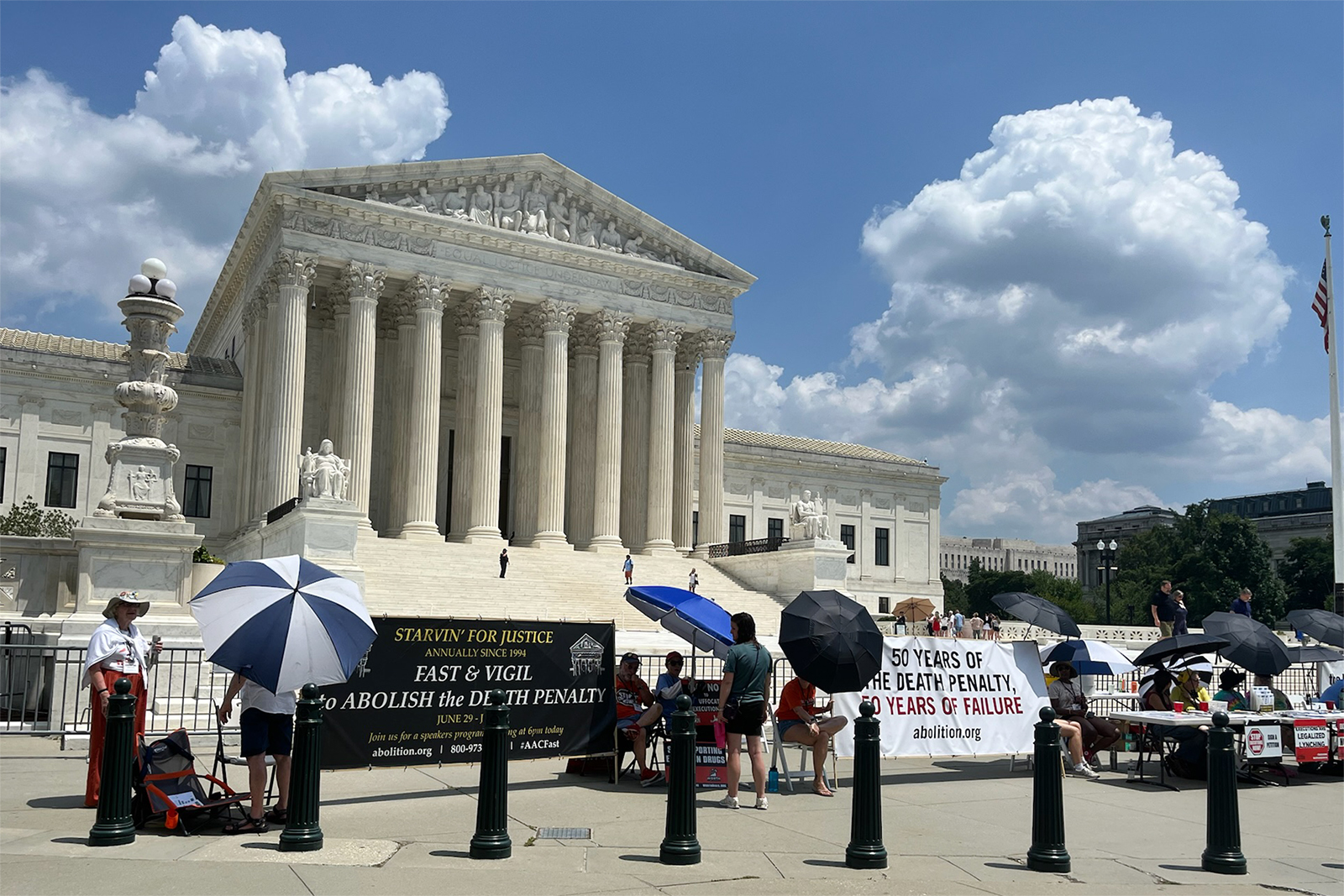
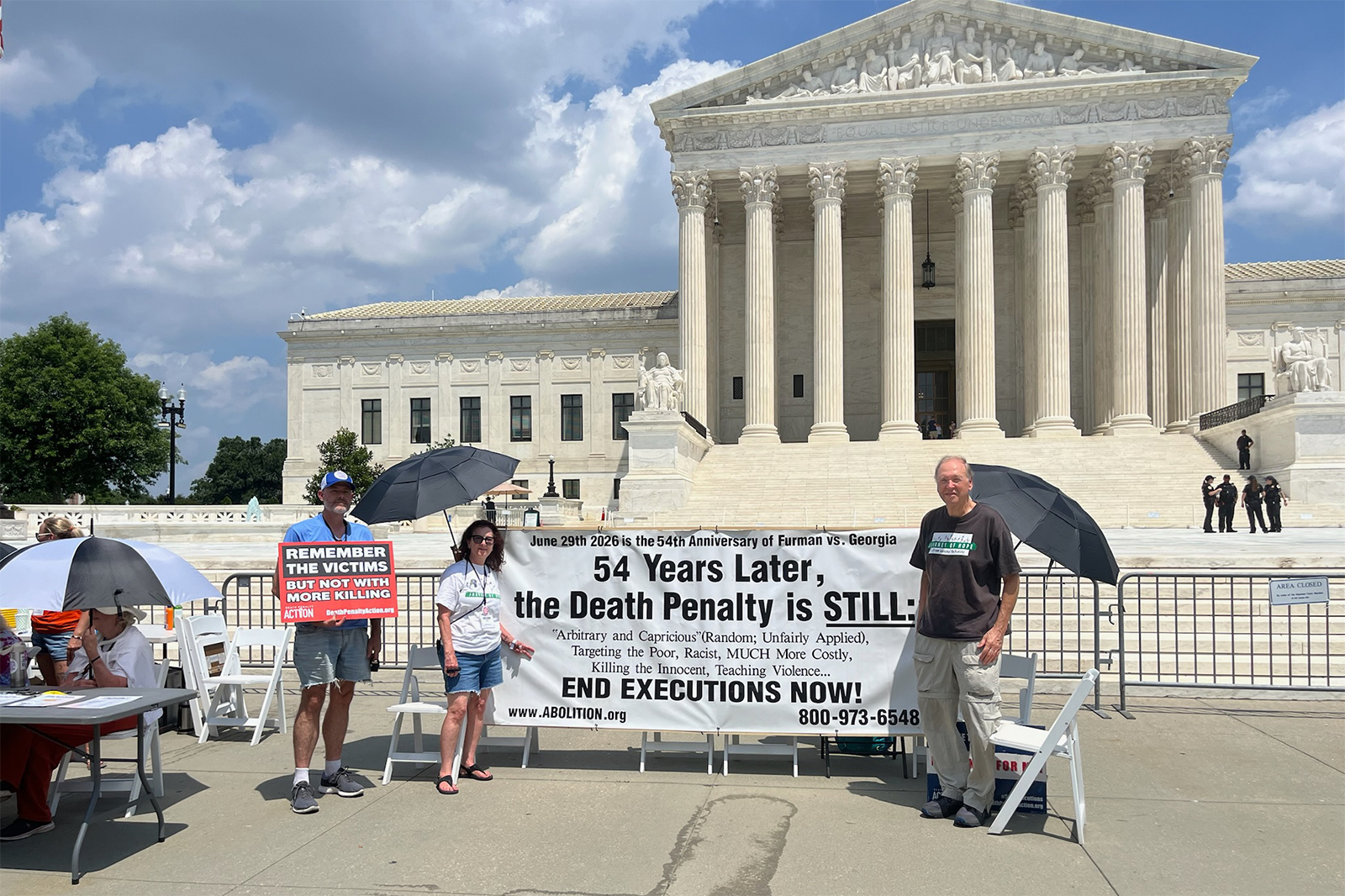
Activists participate in an annual “Starvin’ for Justice” demonstration against the death penalty outside the Supreme Court, in Washington, Wednesday, July 1, 2026. (RNS photo/Aleja Hertzler-McCain)
RNS

WASHINGTON (RNS) — In her first years attending a fast marking the anniversary of the Supreme Court decision that resumed the modern-day death penalty in the United States, SueZann Bosler was still on medication to treat the effects of being stabbed in the head by the same man who murdered her father, the Rev. Bill Bosler, in 1986.

To honor the wishes of her father — a Church of the Brethren minister in Florida who was against the death penalty — Bosler worked for a decade to commute the death sentence of the man who killed her father and injured her, despite initially struggling to forgive him. “ It saved my life, forgiveness,” she said.

On Thursday (July 2), the 50th anniversary of the 1976 Gregg v. Georgia decision that reignited the modern era of the death penalty in the country, Bosler is on her fourth day of fasting. She has been taking shifts as part of the “Starvin’ for Justice” anti-capital punishment protest outside the U.S. Supreme Court to try to convince passersby to join her in opposition as temperatures climb above 100 degrees.


But the solidarity of about 85 protesters involved makes the time joyful, Bosler told RNS, because she’s often the sole person protesting outside the Florida Supreme Court.

In the 50 years since the Gregg decision, faith-based opposition to the death penalty has been a cornerstone of successful abolition and commutation campaigns — even as religious Americans as a whole tend to support the death penalty, data suggests.

“Faith leaders have been instrumental” in death penalty abolition in New Jersey, New Mexico, Connecticut, Virginia and several other states, according to Abraham Bonowitz, the executive director of Death Penalty Action and co-founder of L’chaim! Jews Against the Death Penalty.


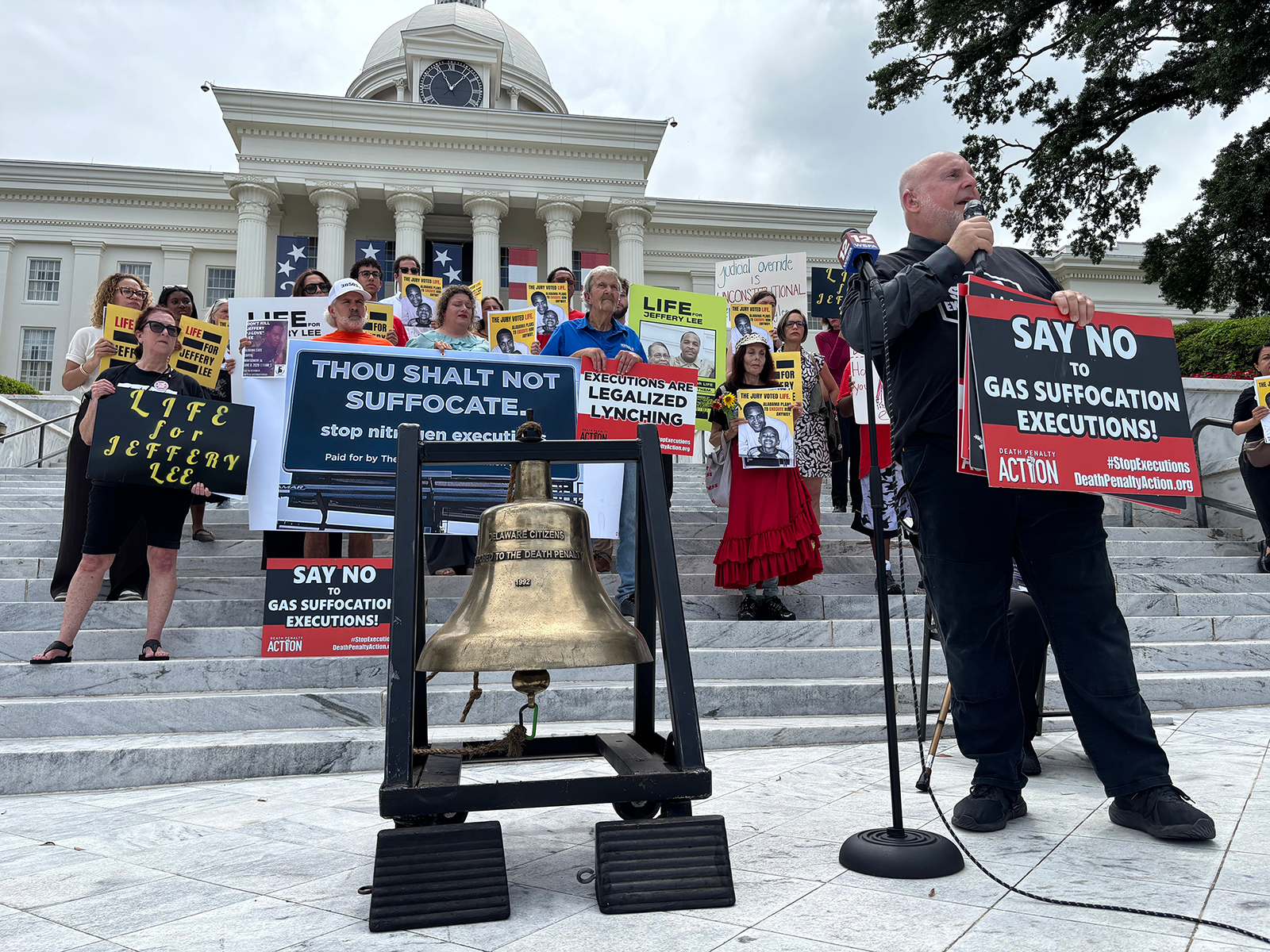
Abraham Bonowitz, of the group Death Penalty Action, leads a demonstration outside the Capitol in Montgomery, Ala., on Monday, June 8, 2026, to oppose an upcoming execution in Alabama. (AP Photo/Kim Chandler)

Bonowitz also credited faith leaders like the Rev. Sharon Risher, whose family members were murdered at Mother Emanuel AME Church in Charleston, South Carolina, in 2015, with successfully pressuring President Joe Biden to commute the sentences of 37 people on death row in the last days of his presidency. Emanuel’s shooter was not among those commutations.

“God commands us not to kill,” said Art Laffin, an organizer of the Starvin’ for Justice protest and member of the Dorothy Day Catholic Worker community. “It’s not an option, it’s a command.”


Laffin, who has publicly prayed for the man who murdered his brother, Paul, said that on the cross Jesus was “given the death penalty of his day” but put “into practice the command to love your enemies” by asking God to forgive his killers. “The best way to honor my brother is to work for the prevention of violence,” he said.
RELATED: Faith groups join other death penalty opponents in new campaign

Executions in the U.S. surged last year, largely driven by an increase in Florida, and religious death penalty abolitionists are feeling renewed energy and searching for any openings they can find to prevent executions.

The death sentence remains a legal punishment in 27 states. Of those, four states — California, Pennsylvania, Oregon and Ohio — have instated execution moratoriums in the last few years. In the 23 states where the death penalty remains, it continues to emerge as a topic of vociferous debate, especially amid criticism over botched executions.


Protesters against the death penalty gather in Terre Haute, Ind., July 15, 2020. (AP Photo/Michael Conroy)

Currently, the federal death penalty applies to all 50 states but is rarely used. Since 1988, there have been 16 fed­er­al exe­cu­tions, 13 of which occur­red in a six-month peri­od between July 2020 and January 2021.

In Sacramento on Tuesday, faith leaders and activists delivered petitions from more than 25,000 people urging California Gov. Gavin Newsom to commute the sentences of all those on death row in the state, alongside 565 LED candles representing their lives.


Faith-based activists are also ramping up pressure on Ohio Gov. Mike DeWine to commute sentences as his term ends this year. Bonowitz said DeWine sometimes attends Mass at the same Columbus parish as his wife, Bonowitz said. The church, St. Catherine, prays for the abolition of the death penalty at every Mass. A spokesperson for the Diocese of Columbus did not confirm or deny those prayers when reached by email.

Last month, DeWine, who had earlier in his career sponsored a bill to reinstate the death penalty in Ohio, called for state lawmakers to abolish the death penalty. Despite pressure, he has commuted only one of the state’s more than 100 death penalty sentences to life in prison without parole.

In Florida, Catholic bishops have written repeatedly to Gov. Ron DeSantis, who is Catholic, asking him to stay the executions of 22 people in the last year. They recently urged DeSantis to prevent the execution of Dusty Ray Spencer, 74, who last week became the oldest person executed in Florida’s modern history. Faith-based activists have also elevated the voice of Ron McAndrew, a former Florida prison warden who says he is haunted by men he executed.


SueZann Bosler, center left, and Art Laffin, right, pose at a “Starvin’ for Justice” demonstration against the death penalty outside the Supreme Court, in Washington, Wednesday, July 1, 2026. (RNS photo/Aleja Hertzler-McCain)

In the nation’s capital, the activists hope to mark the 50th anniversary of the Supreme Court decision by appealing to passersby and the consciences of the justices inside, many of whom are Catholics and have issued decisions advancing the death penalty.

The Rev. Jack Sullivan, Jr., a Disciples of Christ pastor and the brother of a murder victim, Jennifer, told RNS the anniversary “confronts people of goodwill across the country, and particularly people of faith, who believe in the powers of hope and life and love and redemption.”

Like Bosler and Laffin, Sullivan is part of Journey of Hope, a national anti-death penalty organization led by family members of murder victims.

Among the advocates fasting are also those who minister to those on death row. Maureen Bibby, a Catholic from Tennessee, said she’s “become best friends” with the man she visits on death row.

“It’s the only place in the world where you are known only by the worst thing you’ve ever done,” Bibby said. “These are human beings.”
RELATED: Supreme Court stops execution of inmate who became a ministry leader on death row

On July 2, 1976, in a 7-to-2 decision, the Supreme Court ruled capital punishment did not violate the Eighth and Fourteenth Amendments. The decision was a dramatic reversal of the court’s 1972 ruling in Furman v. Georgia, which had halted executions nationwide.

Since Gregg v. Georgia, “1670 people made in God’s image and likeness have been executed,” Krisanne Vaillancourt Murphy, executive director of Catholic Mobilizing Network, an anti-death penalty organization, said in a statement to RNS.

Vaillancourt Murphy added that more than 200 people on death row have been exonerated since 1973 — “a sobering reminder that our criminal legal system is fallible, and that the death penalty is irreversible.” Perjury, false accusations and official misconduct are the leading causes of wrongful convictions, the advocacy group Equal Justice Initiative has found.


In the history of capital punishment, Black Americans have been disproportionately sentenced to death, especially when the crime involves white victims. The majority of state executions since 1976 have occurred in the U.S. South. As a result, several scholars and activists have deemed capital punishment “a direct descendant of lynching” and racial oppression.

“The country has had and continues to have racism flowing in the groundwaters of our land,” Sullivan said, “and it certainly affects the criminal justice system and the handing down of sentences, including and especially death sentences.”

Religion has also been present in support for capital punishment. A 2021 Pew Research Center report found that a majority of religiously affiliated U.S. adults, especially Protestants, favor the death penalty for people convicted of murder — as do a majority of all Americans, per the survey.

NEW: Bring more puzzles and play to your week with RNS Games

In advocating for death sentences, some prosecutors have delivered closing remarks including scriptural quotes such as Leviticus 24:17, Genesis 9:6 and Exodus 21:12 that call for the death penalty as punishment for murder.

Yet Bonowitz, who is Jewish, said those who base their support for the death penalty on Hebrew Scripture must look at rabbinic interpretations, which argue “the death penalty exists” but humans “cannot be trusted with this power to execute.”

Shane Claiborne, the author of “Executing Grace: How the Death Penalty Killed Jesus and Why It’s Killing Us,” told RNS, “The death penalty wouldn’t stand a chance in America without the support of Christians.”


Claiborne, co-founder of Christian social justice group Red Letter Christians and a key figure in the religious left, said he saw opportunities to work with conservatives on the issue. “There’s something deeper that should connect us, which is this profound sense that no one’s beyond redemption and that our government is not infallible, so we shouldn’t entrust it with this power,” he said.

Sister Helen Prejean, part of the congregation of St. Joseph and an anti-death penalty advocate, said in a recent video reflecting on the 50th anniversary of the Gregg decision, “I think it is the most terrible decision the Supreme Court has made after Dred Scott,” which ruled enslaved people were not U.S. citizens.

Prejean is known globally for her decades-long crusade against capital punishment. Her campaign has included making personal appeals to both Pope John Paul II and Pope Francis.

Francis ordered a change to the catechism of the Catholic Church in 2018, which positioned capital punishment as “inadmissible” and “an attack on the inviolability and dignity” of people.

Sullivan, the Disciples of Christ pastor, also acknowledged that central biblical figures such as Moses, David and Saul “committed murder” but “were transformed by the power of God” and became pillars of the Chrisitan faith. “How do we know that on death row, there isn’t another Moses or Esther or David, or Mary or Saul?” he asked.

The 50th anniversary of Gregg falls just days before America celebrates its 250th birthday. For Sullivan, the close proximity of the two milestones gives the nation the opportunity to reflect.


“I expect the state to rise above homicide,” Sullivan said. “I expect the state to adopt non-lethal methods of holding people accountable.”
Globalization isn’t dead, just ‘transformed,’ says IMF chief economist

AFP
June 26, 2026
Image by © AFP/File STR


While the global economy has faced shocks and trade turmoil, globalization is not dead — it is simply being “transformed,” the International Monetary Fund’s chief economist told AFP Friday in an exclusive interview.

The world’s lender of last resort will release an update to its World Economic Outlook on July 8, with all eyes on whether — or how far — it revises down growth estimates from its April update due to the economic fallout of the US-Israeli war on Iran.

By then, however, Chief Economist Pierre-Olivier Gourinchas will have moved on after completing a four-and-a-half year tenure that saw the IMF grapple with the economic fallout from the Covid-19 pandemic, Russia’s invasion of Ukraine, Washington’s upending of global trade through tariffs and the recent war on Iran.

Reflecting on a tumultuous time for the world economy, Gourinchas remains confident that recent upheaval in global trade caused by US President Donald Trump’s tariffs are not necessarily ending globalization — just adjusting certain bilateral relationships.

“Well, it’s certainly not dead,” he told AFP in his office at the IMF’s headquarters in Washington, pointing to solid global trade-to-GDP ratios.

“We haven’t experienced de-globalization,” he said. “We have experienced (that) it’s being transformed.”

IMF Chief Economist Pierre-Olivier Gourinchas believes that globalization is not dead — it is simply being “transformed” – Copyright AFP SAUL LOEB

Gourinchas, a 57-year-old Frenchman, said the latest movements should be seen mainly as “a desire to reduce the bilateral level of trade between the US and China. I don’t think that is something that is a mystery for anyone.”

Since returning to office for a second term, Trump has targeted US friends and foes alike with punishing tariffs, saying he intends to rebase manufacturing to the homeland and to address what he terms unfair trade practices.

Treasury Secretary Scott Bessent and US Trade Representative Jamieson Greer have described globalization as having taken economic integration too far, causing economic pain for American households while benefiting those abroad.

For Gourinchas, however, the latest trade turmoil — which has seen major US trading partners retaliate with tariffs of their own — has provided opportunities, too.

“Other actors have stepped in,” he said. “The supply chains have adapted, the Mexico’s, the Vietnam’s of the world have stepped in… the connector countries that have been able to grow on the back of this.”

Still, it depends on how far Washington and other advanced economies push this fragmentation of the global economy, he said.

“If the strategy is not just to disengage from China, but it’s to disengage more globally — which I don’t think it is, by the way — I don’t think it’s sustainable,” he said.

He is skeptical, too, on whether the drive to move industries to the United States will end up boosting employment, saying it is “very, very hard” to see that happening. New factories in advanced economies are expected to rely heavily on technology and employ fewer workers.

– ‘Middle-income trap’ –

For the world’s emerging market countries, there is another challenge in a fragmenting world economy: What will drive their own growth, if not demand from larger economies?

The last decade has seen growth in developing countries stall, with the World Bank’s Chief Economist Indermit Gill referring to it as a “lost decade” for many.

Gourinchas said that emerging economies had shown remarkable resilience through the shocks of the last five years, mainly due to greater supply-chain integration — but that resilience was not infinite.

“There is this concern about potentially having a middle-income trap for many emerging market economies,” he said, pointing to limited sources of growth in a world where advanced economies were turning inwards.

Since the 1990s, China has been seen as a shining example to be emulated by developing nations — an economy that capitalized on cost disparities to create an export-oriented growth model that it rode to vast success.

But in a world where advanced economies are potentially “closing up,” while China continues to provide cut-throat competition on manufacturing costs, can any of these emerging economies use the same path Beijing did?

“That leaves a very narrow space for them to actually enter into an export-led growth model, which has been the recipe for development and success for many, many countries,” Gourinchas said.

“A country like India, for instance, is very unsure whether it can follow in the footsteps of China,” he said.

After the IMF, Gourinchas will be headed back to a career in academia at the University of California, Berkeley.
World’s largest particle smasher halts for upgrade to boost hunt for dark matter

AFP
June 27, 2026
Some of the 1232 dipole magnets that bend the path of accelerated protons are pictured in the Large Hadron Collider (LHC), which will be shut down for four years of renovations – Copyright AFP/File VALENTIN FLAURAUD

The world’s most powerful particle accelerator will shutter operations on Monday for four years of renovations to dramatically boost its collision-capacity and the potential for unlocking one of the greatest mysteries of the Universe: dark matter.

The Large Hadron Collider (LHC) is a 27-kilometre proton-smashing circular tunnel at the heart of Europe’s physics lab CERN near Geneva. It has most famously been used to prove the existence of the Higgs boson, dubbed “the God particle.”

In the tunnel, running about 100 metres below the French-Swiss border area, superconducting magnets and accelerating structures propel particles to extreme energies and then smash them together at phenomenal speeds.

But from Monday, activity will stop, as the extraordinary device undergoes upgrades aimed to further increase the precision and intensity of particle collisions.

Once completed, the enhanced particle smasher, donning the enhanced name of High Luminosity LHC (HL-LHC), is scheduled to begin operations in June 2030, and to run for about a decade.

“This is a very important moment. From Monday, we will be entering a new phase,” HL-LHC project chief Markus Zerlauth told reporters.

“We still have lots of physics questions without answers. There are still many discoveries to be made.”

The goal is to increase the “luminosity” (the total number of collisions produced over a given period) by a factor of 10 compared to the LHC.

The total cost of the upgrade is expected to tick in at 1.2 billion Swiss francs ($1.5 billion USD).

That will be covered by CERN membership fees, along with in-kind contributions, making up 10-15% of the total, including from the United States, Japan, Canada and China.

The upgrade will require fully replacing the components in 1.2 kilometres of the 27-kilometre tunnel.

New superconducting magnets, capable of further concentrating the particle beams, will be installed to increase the number of collisions.

Once operational, between 140 and 200 collisions will occur each time two packets of particles meet inside detectors in the tunnel, up from 60 currently.

Overall, “the increased number of collisions will allow us to collect up to 100 times more data”, Zerlauth said.

The number of collisions will be so high (several billion per second) that it will be impossible to store all the data produced.

Which collisions should be recorded will need to be selected in real time — a task that will be entrusted to artificial intelligence systems capable of identifying the most promising events.

But “AI does not replace physicists”, insisted Nedaa-Alexandra Asbah, a research physicist at CERN’s ATLAS experiment, which helped discover the Higgs Boson using the LHC.

“It is a powerful tool that helps us make better use of the data.”

The HL-LHC aims to deepen fundamental knowledge, which is CERN’s primary mission.

“We want to look for new particles,” said Filip Moortgat, the operations coordinator for CMS — and the LHC detector designed to explore a wide range of physics fields, including the search for other dimensions and the quest for dark matter particles.

Scientists believe that ordinary matter such as stars, gases, dust, planets and everything on them accounts for just 5% of the universe.

The rest is believed to consist of dark matter (27%) and dark energy (68%), which are two invisible components that scientists have yet to detect or directly observe.

The 2012 discovery of the Higgs boson provided an important piece of the puzzle: it broadened science’s understanding of how particles acquire mass and earned physicists Peter Higgs and Francois Englert the 2013 Nobel Prize for Physics.

Once the upgrade is completed, CERN hopes to dramatically expand its understanding of how the “God particle” works, with the HL-HLC expected to produce around 380 million Higgs bosons over its lifetime, compared to 55 million found since LHC operations began in 2008.

The lab’s main hope meanwhile is to produce two Higgs Bosons simultaneously, which would be a first, and see them interact, Asbah said.

This, she said, “may provide clues about how our Universe evolved shortly after the Big Bang.”