Tuesday, August 25, 2026


Canada walked away from Trump. Could the EU ever do the same?
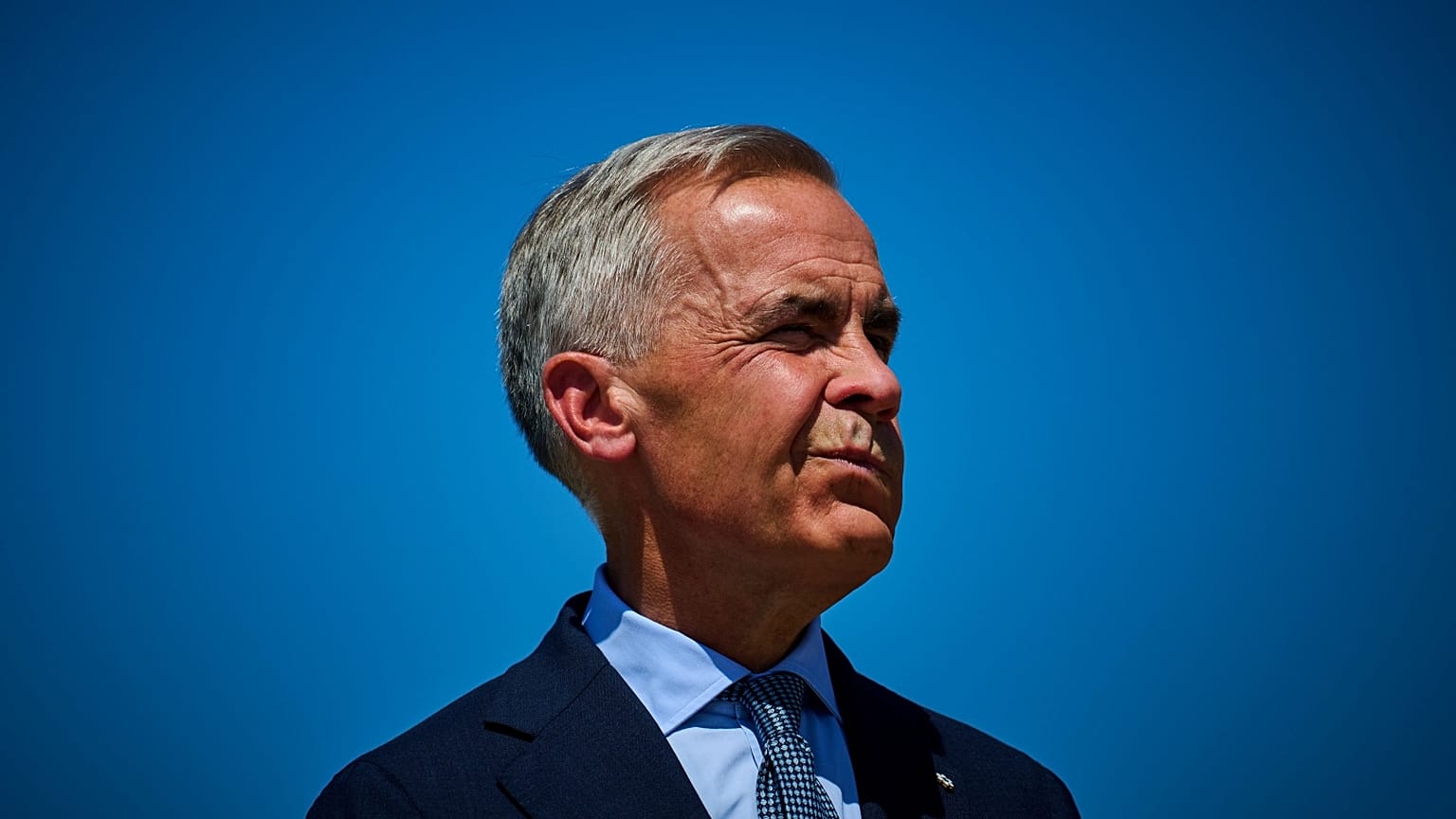
Canadian Prime Minister Mark Carney.
Copyright Sammy Kogan/The Canadian Press

By Jorge Liboreiro & Peggy Corlin
Published on

Canada's Mark Carney has shown the EU what walking away from Trump could look like. But would Brussels dare call out the US president and reject his demands that allies play by his rules? For Europe, it's complicated.

Mark Carney said enough.

In a stunning decision, the Canadian prime minister has walked away from trade negotiations with the United States, his country's one-time closest ally. While the economic ramifications remain uncertain and could be severe, the former central banker has made clear that sovereignty is not a price Canada is willing to pay.

Carney denounced Washington's proposed terms as a "bad deal" that would have infringed on Canada's use of the French language, which is constitutionally protected, and its ability to sign trade deals with other nations.

"You're at war when you're attacked, and we got attacked," Carney said, promising to retaliate "dollar for dollar" against his neighbour.

The fallout is set to be painful: steep tariffs on $20 billion in Canadian goods and roughly 87,000 direct and indirect jobs put at risk, according to initial estimates.

And it could soon get worse. US President Donald Trump has already announced a new round of tariffs against Canada, fuelling the cycle of retaliation.

The spectacular fallout has drawn parallels with the European Union, which has also been on the receiving end of the White House's ever-expansive demands and negotiating tactics from a Trump administration fixated on trade deficits and determined to use every weapon to put America first, even before friends.

For over a year, Brussels has been struggling to stave off American pressure to dismantle environmental, sustainability and digital regulations, while trying to keep alive the lopsided EU-US trade deal struck last year in Turnberry, Scotland.

In July, Trump vowed that the EU would pay a "very big price" after the European Commission imposed an €890 million fine on Google for alleged self-preferencing practices and unfair treatment of app developers.

"We anticipate a substantial TARIFF to be placed on them at the earliest possible moment," Trump said. (The duty is yet to be introduced.)

As Brussels and Washington continue to negotiate tariff relief, particularly on steel and aluminium, a new question arises: Could the EU ever walk away?

Yes, it could walk away

The main reason the EU could be tempted into pulling a Carney-like move is its determination to protect its right to regulate and enforce rules within its jurisdiction, which Brussels sees as an absolute red line.

Europeans believe they have made more than enough concessions to placate Trump, most notably a 15% tariff on EU goods, and refuse to bend any further. Amending laws on Washington's whim would be tantamount to capitulation.

EU diplomats note that Trump backing down from a failed bid over Greenland and his decision to unilaterally launch a war against Iran, roiling energy markets along the way, have strengthened the collective resolve to speak up and push back.

Another reason that could embolden the EU to walk away is its vast size as the world's second-largest economy. The 27-member bloc's GDP is €18.8 trillion compared to Canada's $2.32 trillion (€1.99 trillion), making it almost ten times larger.

Last year, EU-US trade (goods and services) reached €1.77 billion, double the $872.3 billion (€748 billion) in Canada-US trade. Both Canada and the EU have a long-standing goods surplus and a services deficit with the US.

What changes is the dependency. Due to its geographic location, Canada is structurally reliant on the American market: Canada exports about 75% of its goods to the US. For the EU, whose trade links are much more diversified, the share falls to 21%.

This, in principle, gives the EU greater leverage and a stronger cushion to weather a trade war with the US should it ever feel it necessary to go down that road.
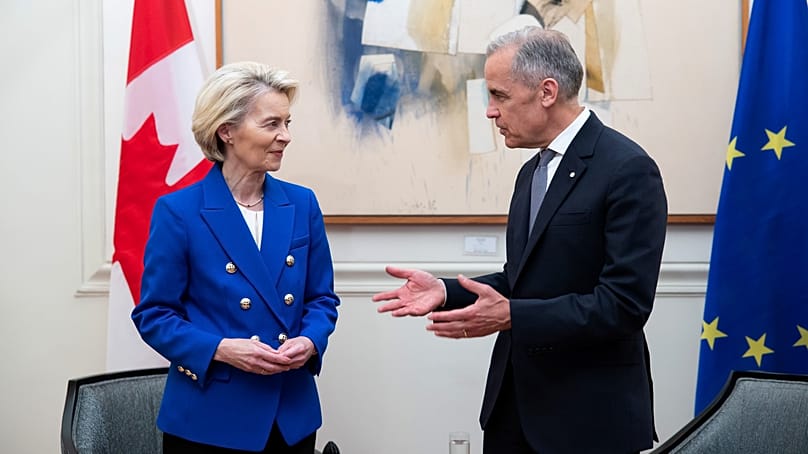
Ursula von der Leyen and Mark Carney.
Ursula von der Leyen and Mark Carney. aurore martignoni/CCE

During the negotiations that preceded the Turnberry deal, the European Commission prepared a list of €93 billion worth of American goods to be targeted in a hypothetical tit-for-tat. The list, which remains valid, would be the first line of defence.

EU officials have also raised the prospect of triggering the Anti-Coercion Instrument (ACI), which allows countermeasures beyond traditional tariffs, such as excluding foreign companies from public tenders or partially suspending IP rights protection.

The instrument gained new significance when Trump doubled down on his threats against Greenland and the bloc's green and digital regulations. Both cases were seen as textbook examples of coercion for political aims.

"If Washington follows through with new tariffs over European digital taxes or regulation, it would very much reopen Turnberry and put Europe in a similar position to Canada's. European governments could well conclude that there is no stable deal to preserve and walking away is the better tactical play," Tobias Gehrke, a senior policy fellow at the European Council on Foreign Relations, told Euronews.

But the reaction would be moulded not just by the US but also by China, Gehrke noted. Trade tensions between the EU and China have soared ahead of an October deadline.

"There is a growing view in Europe that China represents the more systemic economic security challenge, and few want to fight simultaneous trade wars with Washington and Beijing," he said. "If the Trump administration pressures Europe precisely when Brussels is trying to manage a confrontation with China, Washington may calculate that Europe has limited escalation options."

No, it could not walk away

Though the EU has strong arguments and tools at its disposal to walk away, it is far from clear whether it could muster Carney's courage to do so.

Since Trump unveiled his sweeping tariffs, the 27 member states have scrambled to close ranks behind the European Commission, which negotiates on their behalf.

Some, including France, Spain and the Nordic countries, urged Brussels to stand firm and retaliate against unfair terms. Others, including Germany, Italy and Ireland, publicly pushed for a compromise, whatever the cost, to avoid a damaging all-out confrontation.

The cacophony and competing national interests tied the Commission's hands and ultimately produced a deal that satisfied no one. The EU still lacks a common strategy for dealing with Trump — a weakness the White House has sought to exploit.

While US threats on key issues like Greenland have indeed brought EU member states closer, and even ideologically aligned leaders like Italy's Giorgia Meloni have clashed with the US president, the fact that the Anti-Coercion Instrument has never been triggered illustrates just how difficult it is for member states to reach consensus and accept the economic pain that would follow an all-out confrontation with Washington.

By contrast, Carney rallied Canada behind him.

Following the collapse of the talks, Canada's provinces swiftly backed Carney. Ontario Premier Doug Ford, whose manufacturing sector stands to lose from the clash, expressed "full support for a strong response – tariff for tariff, dollar for dollar".

A new pollshows that 76% of Canadians believe Carney made the right call.

For the Canadian prime minister, picking a fight with Trump makes sense politically as it builds on the widespread antipathy that Canadians feel towards the US president, who has repeatedly floated the idea of making Canada the 51st US state.
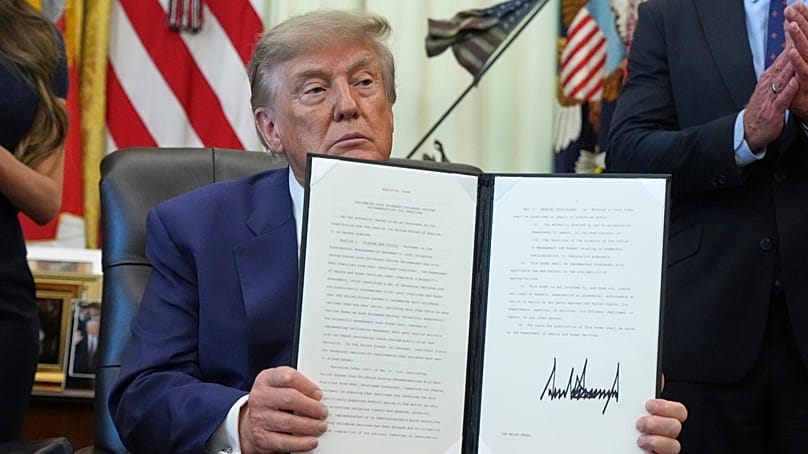
Donald Trump.
Donald Trump. Copyright 2026 The Associated Press. All rights reserved.

There is another pivotal factor that could make the EU think twice: Ukraine.

Brussels has acknowledged that the EU-US trade deal was partly driven by a desire to keep Trump engaged in efforts to end Russia's war. The US president's stance on the conflict has shifted dramatically, fuelling anxiety among Europeans who know they cannot replace US intelligence or American-made air defence systems.

"It's not only about the trade. It's about security. It is about Ukraine. It is about current geopolitical volatility," European Commissioner for Trade Maroš Šefčovič said last year. "I believe from now on, we can go only for the better."

Although Canada is a staunch supporter of Ukraine, its role in the conflict is limited.

A European walk-out, by contrast, could give Trump a convenient excuse to retaliate by fully disengaging from Ukraine. (Some officials and diplomats in Brussels believe Trump has already done so, for all intents and purposes.)

"The Turnberry agreement is not a great deal. It's not a balanced deal. But it did not imply any compromise on the sovereignty of the European Union. There's no element that compromises the capacity of the European Union to regulate on digital, on climate, and so on," Ignacio García Bercero, a senior fellow at Bruegel, told Euronews.

Retaliation is also more complicated for the EU than for Canada, he added.

"Canada is a federal state and can impose countermeasures without securing the approval of its provinces," García Bercero said. "The EU is not a federal state, meaning retaliatory measures require a qualified majority of member states. So far, European capitals have shown little appetite for – or tolerance of – a trade war the Canadian way."

 

Canadian PM Carney says new US tariffs are 'designed to hurt us and divide us'

WE ARE A BILINGUAL MULTICULTURAL NATION STATE , 
SO FUCK OFF
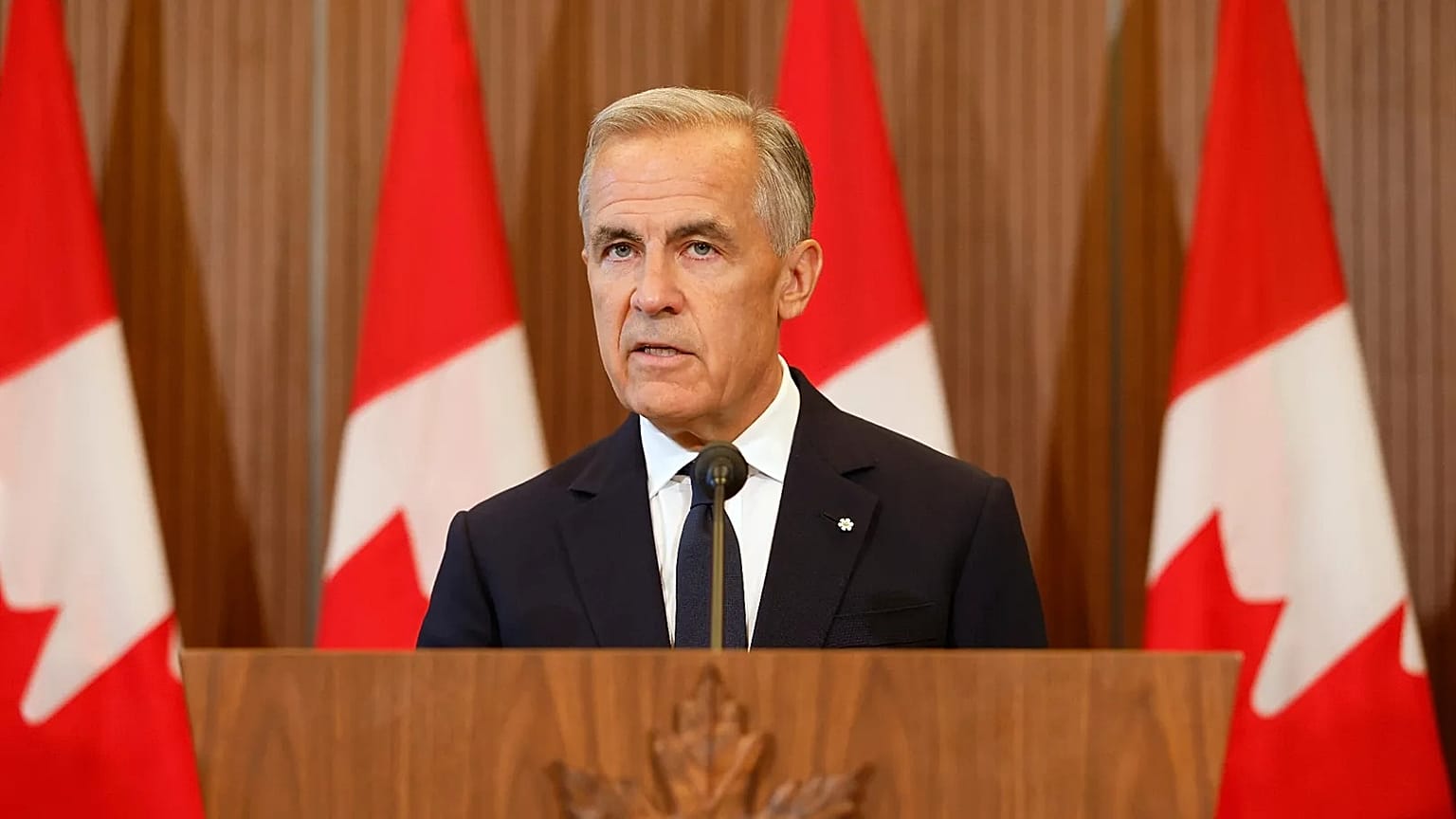
Prime Minister Mark Carney speaks about Canada's response to new U.S. tariffs during a news conference on Parliament Hill in Ottawa on Saturday, Aug. 22, 2026.
Copyright The Canadian Press

By Nathan Rennolds
Published on

"We cannot accept what they've offered, and we will not give what they've asked," Carney said during a speech outlining Canada's position on the trade dispute with the US.

Canadian Prime Minister Mark Carney has hit out at new US tariffs on Canada, saying they were "designed to hurt us and divide us" after talks between Ottawa and Washington broke down on Friday.

Sharing further details on why Canada walked away from what he called a "bad deal," Carney said: "We cannot accept what they've offered, and we will not give what they've asked."

New 50% duties impacting around $20 billion worth of Canadian goods took effect on Saturday after the two countries failed to come to an agreement on a trade deal, with both sides accusing each other of trying to implement last-minute changes.

In a statement on Friday, Carney labelled alleged late changes to the terms of the deal proposed by the US "unfair" and "uneconomic" and said they "called into question the reliability of any deal."

He also warned that Ottawa would match US tariffs "dollar for dollar to protect our workers and businesses."

"Our response will be concentrated in sectors such as steel, dairy, appliances, agricultural equipment, pulp and paper, and electronics," Carney said in a speech on Saturday.

The Office of the United States Trade Representative has described it as a "missed opportunity" for Canada, which it said was maintaining a "prolonged retaliation" against the US.

"Despite the U.S. offer to Canada to receive the best treatment of any major exporter to our market, new demands and walk backs of other commitments by Canada have upended the careful balance reached in the past days," it added in a statement posted on social media.

The breakdown in talks came despite optimism from US President Donald Trump that a deal could be reached. Trump had postponed the initial planned start date of the tariffs from Wednesday as an agreement appeared near.

Trump, who has repeatedly suggested that Canada should become the US' "51st state," said early on Sunday that Ottawa wanted "the benefits of being a State, without being one."

"They have also charged our great farmers, for many years, massive amounts of Tariffs. No more!!!," he added.

Trump has pursued an aggressive tariff policy since his return to the White House in January 2025, ramping up levies on partners across the world. The administration argues that tariffs will boost US manufacturing and encourage domestic job growth while addressing what it sees as unfair trade rates.

Critics, however, say increasing duties are making life more expensive for American consumers and businesses while fostering widespread uncertainty among companies planning investments and supply chains. 


‘We don’t need Canada’: Trump threatens to double auto tariffs after trade talks collapse

US tariffs ​on all Canadian cars and trucks, automotive parts and steel will be increased to 50% starting January 1, 2027, President Donald Trump said Monday, adding that the US does not “need” Canada after the collapse of trade talks. Canadian Prime Minister Mark Carney said his administration had been “patient” during negotiations, but Canada would not do a deal “at any price”.


Issued on: 24/08/2026 - 
By: FRANCE 24
Video by: Bryan QUINN

Cover image: US President Donald Trump salutes while the national anthem is played at the start of the NTT INDYCAR Series on August 23, 2026 in Washington, DC. © AFP via pool
01:57


US President Donald Trump said Monday that he would double tariffs on Canadian vehicles beginning in 2027, as the neighbouring countries spiral towards an escalating trade war.

"On January First, 2027, Tariffs on all Cars, Trucks, both large and small, Automotive Parts, and Steel, will be increased to 50%," he wrote on his Truth Social platform.

US tariffs ​on all autos and automotive parts and steel will be increased to 50% starting January 1, 2027, President Donald Trump said ​in a Truth Social post on August 24, 2026. social ‌post on Monday © @realDonaldTrump screengrab

The current US tariff on autos stands at 25% for non-US content, while imported steel to the United States generally faces a 50% duty.

Trump's latest threat comes after the North American neighbours failed Friday to reach a deal to avert new 50% tariffs imposed by the Trump administration on select Canadian goods.

The White House had alleged "discriminatory treatment" by Canada against US alcohol, automobile and dairy products in rolling out the duties.

Trump delayed their implementation by three days last week as Washington and Ottawa stepped up negotiations towards a trade pact.
Canada won't pay 'any price' for deal, Carney says

Canadian Prime Minister Mark Carney on Monday said Canada has been "pragmatic, patient and persevering" in an effort to reach an agreement with the US, but his priority was to get the best deal for his country, not a deal "at any price or any time frame".

"The goal of our trade negotiations with the United States has always been to get the best deal for Canadians, never a deal at any price or on any time frame," Carney told an event on investments in Canada's shipbuilding industry.

Following the collapse of trade talks, Carney announced retaliatory tariffs on the US.

Carney accused Washington of using “economic integration as a weapon” and said “its signature was written in pencil”.

Resorting to the language of battle, he said his country had been “attacked” by the new American tariffs. “You’re at war when you get attacked,” he said, adding that Canada had the reserves, resilience and plan to respond.

But to Trump’s chief trade negotiator, Jamieson Greer, the US was compelled to act after a year of retaliation by its longtime partner.

“We’ve said enough, and so we’ve taken countermeasures. Our interest is in protecting American workers and protecting American supply chains,” the US trade representative told “Fox & Friends Weekend”.

Carney said Canada had been willing to drop remaining retaliatory tariffs on steel, aluminum and autos if the US substantially lowered its own, and to encourage provinces to restore US alcohol sales. But he said Washington’s final demands went too far. “They asked too much and offered too little,” Carney said.

Greer said the Republican administration was offering to cut tariffs on steel, autos and lumber, “things that are sensitive for them. And they’ve always had the best deal, and they still would have an even better deal, but they didn’t want that.”

As a result, he said, “We’re moving forward with measures that respond to Canadian retaliation.”

Carney said the US added last-minute terms that would have reduced tariff relief for Canadian-made vehicles, restricted Canada’s ability to strike trade deals with other countries and weakened protections for language, culture and sovereignty.

He said such demands were “unacceptable”.

The breakdown in negotiations marked a sharp reversal from two days earlier, when officials from the two countries sounded as if they were headed toward a compromise.

Ontario Premier Doug Ford, who leads Canada’s most populous province, praised Carney for rejecting the deal, saying it would have hurt Ontario’s auto, steel and manufacturing sectors. Ford urged Canada to use “every tool in our toolbox” to fight the US tariffs.

The moves also call into question the future of a North American trade agreement covering the United States, Canada and Mexico that is crucial to industry in all three countries.

Carney said the breakdown was “certainly not good news” for the review of that agreement and that the failed negotiations had given Canada “a new perspective” on what Washington wants from the broader economic relationship.

The political impact will likely be even bigger than the economic fallout. The countries sold each other $880 billion worth of goods and services last year.

The US and Canada have wrangled for decades over trade, poking each other over sore spots such as Canadian softwood lumber imports and US access to Canada’s protected dairy market.

Somehow, they still managed to remain friends, allies and trading partners. Canadian soldiers fought alongside Americans in Afghanistan after 9/11. The 5,525-mile US-Canada border is undefended, and nearly 330,000 people and $2 billion worth of goods cross it every day; 800,000 Canadians live in the United States.

Trump’s approach to dealing with Canada marks an extraordinary departure from the traditionally cooperative relationship between the two countries. Trump has imposed tariffs on Canadian goods in a push to bring manufacturing back to the United States and made inflammatory comments about turning Canada into America’s 51st state.

Carney said Canada had recognised that “America has changed” and that the two countries would “not return to our old relationship”.

(FRANCE 24 with AFP and AP)
What to know about Trump's Canada tariffs and the escalating trade war

Canada plans to respond to US President Donald Trump's new tariffs on Tuesday, as the once close neighbouring allies spiral into a trade war. Ottawa and Washington failed to reach a deal on Friday to avert new 50 percent US tariffs on select Canadian goods after weeks of talks.


Issued on: 25/08/2026 - 

By: FRANCE 24

Video by: Charles PELLEGRIN

Cover image: Coils of steel are seen at an ArcelorMittal Dofasco facility in Hamilton, Ontario, on August 24, 2026. © Cole Burston, AFP
02:36


Canada will announce retaliatory tariffs against the United States on Tuesday after US President Donald Trump told Canadian leaders on Monday to “fall in line” or face consequences “far worse” than existing tariffs and Canada's Prime Minister Mark Carney accused Washington of trying to subordinate Canada.

After trade negotiations crumbled at the eleventh hour, Trump's 50 percent tariffs on scores of Canadian imports kicked in over the weekend.

The new levies, which took effect Saturday, are set to impact about 5 percent of Canada's annual exports to the US – or $20 billion in goods ranging from hockey sticks to agricultural products. Carney quickly promised that his government would roll out retaliatory measures “dollar for dollar” starting September 8.

Additional threats have piled up in the meantime. Ontario Premier Doug Ford told The Associated Press on Monday that “everything is on the table," noting his province would be ready to cut off electricity and critical minerals to the US if the trade war worsens. Meanwhile, Trump suggested his administration could also increase taxes on Canadian automobiles next year.

The US and Canada once held one of the world's most durable trade alliances, but the latest escalation plunges the North American neighbours deeper into a rupture that has kept both sides of the border on edge throughout Trump's second term in office. Steeper tariffs raise costs for businesses – and almost always trickle down to households in the form of higher prices.

US-Canada trade war deepens as Trump threatens additional tariffs
Cover image: Prime Minister Mark Carney speaks about Canada's response to new US tariffs during a news conference on Parliament Hill in Ottawa on Saturday, Aug. 22, 2026. © Patrick Doyle, The Canadian Press
01:57


Here's what we know.

The 50 percent tariffs from the US are set to affect $20 billion of Canadian goods.

Canada sends the vast majority of its goods exports to the US (72 percent last year), and the Trump administration says the new taxes will be levied on products ranging from hockey sticks to wine and cement. The list is long. According to documents published by the White House, other goods subject to the tax include honey, seeds and agricultural products – as well as select makeup, perfumes, clothing, jewellery, furniture, cameras, fabric and more.

The 50 percent levy also applies to some products that were previously protected under the US-Mexico-Canada Agreement (USMCA), a trade pact from Trump's first term. This marks a shift from past levies – and further underlines questions around the future of the USMCA overall.

Trump reinstated a long-dormant Great Depression-era law: Section 338 of the Tariff Act of 1930.

When the US and world economies were in collapse nearly a century ago, Congress passed the 1930 law as part of broader Smoot-Hawley legislation (named after its congressional sponsors). But Section 338 – which authorises the president to slap import taxes of up to 50 percent on imports from countries that have discriminated against US businesses – has never been used specifically to raise tariffs until now.

No investigation is required to justify the levies. Nor is there any limit on how long they can stay in place. Since there's no precedent however, the latest tariffs may also see legal challenge.

Trump has claimed that Canada unfairly discriminates against US exports of automobiles, alcohol and dairy products. The president expressed anger over Canada's retaliation against his own tariffs in 2025 – noting how Canadian imports of American alcohol and cars started to fall last spring.


US-Canada trade dispute escalates after Carney announces retaliatory tariffs

Cover image: © France 24
01:39


On Saturday, Carney quickly promised to match the new levies “dollar for dollar” – later announcing that those countermeasures would begin September 8. He noted Canada would target US steel, dairy, appliances, agricultural equipment, pulp and paper and electronics.

In the meantime, provincial leaders like Ford have reiterated Canadians' willingness to endure economic pain rather than give in to US pressure.

Trump "underestimates Canada. We’re all in,” Ford said Monday. Beyond potentially cutting off electricity and critical minerals from Ontario, he also called for Canada to consider using oil and potash as leverage.

Meanwhile, Trump made new threats on social media. He threatened to increase tariffs on Canadian cars, trucks, automotive parts and steel to 50 percent starting January 1, 2027. Like other countries, Canada currently faces a broader 25 percent tariff on autos. A 50 percent sectoral tariff on most steel imports is already in effect.

“WE DON’T NEED CANADA, THEY NEED US!” Trump wrote Monday.

Carney on Monday said Washington’s auto-sector proposals would “gradually dismantle” Canadian production. He also questioned what Trump’s latest move would mean for workers in US states who depend on Canadian demand.

The prime minister added that Canada remained willing to negotiate, but only if the US approached the talks as a partnership between sovereign countries. He said “an attitude at the negotiation table that Canada is a subsidiary of the United States” is “not something we’re going to accept.”

Tariffs are taxes paid by importers or businesses that buy goods from abroad. Their impact typically trickles down to consumers through higher prices – and, as seen over the last year, they can also create uncertainty for workers across affected sectors.

“Nearly all industries and professions are likely to see downstream effects from this spiraling trade dispute,” Augustine Lo, of law firm Dorsey & Whitney, which advises clients on international trade, said Saturday.

The 50 percent tariffs come on top of previously imposed levies, including a 10 percent rate that Trump slapped on Canada just last month – ostensibly for failing to do enough to prevent imports produced by forced labour and separate sectoral levies globally.

The growing trade war underscores Trump’s willingness to risk breaking established alliances. And Canada’s reluctance to accept a deal may reflect recent experience.

Trump has threatened tariffs in response to everything from a TV ad criticising his trade policies (later pulled by Ontario's government) to Canadian wildfires that blackened skies across North America.

Steeper tariffs have already contributed to higher inflation, but have appeared to level off in recent months, according to researchers at the Federal Reserve Bank of St. Louis – most notably after the Supreme Court struck down some of Trump's most sweeping levies in February.

Still, the weekend's escalation with Canada marks the latest instance of Trump turning to other laws to impose tariffs. And Washington’s ongoing war with Iran has driven prices even higher. With the cost of living at the center of many voters' minds in a midterm election year, political ramifications could mount for the Republican president in the coming months.

(FRANCE 24 with AP)


Five charts explaining America’s $40 trillion debt

US flag, file photo
Copyright Canva

By Doloresz Katanich
Published on

The US debt crossed the $40 trillion threshold after adding $1 trillion in just five months. The total amount is equivalent to what an average US worker would earn in a whopping 615 million years.

The gross national debt of the United States officially reached $40 trillion for the first time in history this week, according to the US Treasury. This comes as the government continues to spend more than it earns, including on defence, Social Security and interest on the debt.

The latter alone now costs the government more than $1 trillion a year.

The milestone came as long-term US Treasury yields reached multi-year highs at the beginning of the week, reflecting investor concerns about inflation, global tensions and the country’s ballooning debt.

The more interest a country pays, the faster its debt grows.

The national debt has risen as the US borrows to cover repeated budget deficits. Higher interest costs add to spending, requiring further borrowing and risking a vicious cycle of rising debt.

Interest is paid from federal revenues, principally taxes. When revenues are insufficient, the government borrows more, passing part of the cost to future budgets and taxpayers.

“Based on average salaries, it would take a US worker more than 615 million years to earn the equivalent of America’s $40 trillion national debt, which itself has doubled in a decade,” says Dan Coatsworth, head of markets at AJ Bell.

Maya MacGuineas, president of the Committee for a Responsible Federal Budget, said in a statement: “$40 trillion of debt doesn’t exist solely on the government’s ledgers; it is felt throughout the economy and finds its way to the pocketbooks of people one way or another”.

She warned that “the more we borrow, the more we exacerbate inflation, squeeze out other priorities in the budget, and leave ourselves vulnerable to emergencies at home and turmoil abroad.”

1. Does the US really have the world’s biggest debt?

Yes, the US debt stock in absolute terms dwarfs that of every other major economy in nominal terms.

However, it is not the country with the heaviest debt burden. The enormous debt of the world’s biggest economy appears less alarming when looked at from the perspective of the strength of the economy behind it. This shows the size of the burden relative to the country’s total economic output and is therefore considered a better indicator of its fiscal position than the headline debt figure alone.

The IMF projects that US general government gross debt will reach $40.7 trillion in 2026, compared with a nominal GDP of $32.4 trillion. That would put debt at 125.8% of GDP, up from 103.7% in 2012, showing that government debt has grown faster than the economy over the period. The figures come from the IMF’s April 2026 World Economic Outlook database.

2. How did US debt reach $40 trillion?

Wars, recessions and the COVID-19 pandemic pushed US debt sharply higher in recent years. However, recently the pace at which it has increased has accelerated. Gross debt reached its previous milestone of $39 trillion in March 2026, less than five months ago.

“The gross national debt has doubled in the last ten years; in less than twenty years, it has quadrupled,” said MacGuineas, adding that it took nearly 200 years for America’s gross debt to reach $1 trillion for the first time in 1981.

“At that time, President Reagan told the nation in a televised address, “If we as a nation needed a warning, let that be it.” Jumping to America’s 250th year, we are spending more than that just on interest payments on our debt,” she added.

3. What does the $40 trillion actually include — and who is owed the money?

The $40 trillion figure, known as gross federal debt, includes debt held by the public and debt held by the government itself, known as intragovernmental debt. It does not include debts carried by state and local governments or personal debt owed by individuals

Debt held by the public is the portion owed to investors outside the federal government, including individuals, banks, pension and mutual funds, foreign investors, state and local governments and the Federal Reserve.

It is the largest component of the $40 trillion total, standing at more than $32 trillion, according to the Committee for a Responsible Federal Budget.

MacGuineas said in a statement: “The debt held by the public recently exceeding the size of our economy, the deficit-to-GDP ratio running twice as high as where it should be, and interest costs exceeding our national defence budget.”

It may be somewhat reassuring that most US government debt is held domestically.

Those investors include the Federal Reserve and government accounts, US banks, pension and mutual funds, insurance companies, state and local governments, households and other investors.

Together, they held about 76% of federal debt at the end of June 2026, according to the US Treasury.

Foreign and international investors were the next-largest group, holding $9.27 trillion, or 24.1%, in June 2026.

Japan held $1.12 trillion in Treasury securities in June 2026, accounting for 12% of foreign holdings. Countries outside the 20 largest foreign holders accounted for a combined 19.9%.

4. Why does the government keep borrowing?

The government borrows because it spends more than it collects.

The federal budget deficit is projected to reach $1.9 trillion in 2026, equivalent to 5.8% of GDP. However, an August update shows that the deficit had already reached $1.8 trillion in the first 10 months of fiscal 2026, which runs from 1 October 2025 to 30 September 2026.

The Congressional Budget Office (CBO) expects federal expenditure, including defence, Social Security and net interest, to total about $7.4 trillion in the 2026 fiscal year, compared with revenues of $5.6 trillion.

Total spending includes $1.67 trillion for Social Security, about $1.9 trillion for major healthcare programmes, $918 billion for defence, $1.04 trillion for net interest and approximately $1.9 trillion for all other federal programmes.

The final category includes income support, veterans’ programmes, education, transport, law enforcement, government administration and other federal activities.

5. How much further could US debt rise?

The CBO warned in February 2026 that the US fiscal trajectory is unsustainable, as persistent deficits push debt and interest costs higher.

This means that the government must raise taxes, cut spending or borrow more to meet its obligations. According to their forecast, gross federal debt will reach approximately $64 trillion by the end of 2036. Financing that debt is becoming increasingly expensive.

This week, government debt, inflation concerns and geopolitical risks helped push long-term Treasury yields to multi-year highs. The 30-year yield reached almost 5.34% on Tuesday, its highest level since 2007, before falling after the Treasury expanded its bond buybacks.

The bond sell-off has already pushed corporate borrowing costs higher, while mortgage rates could follow if yields remain elevated.

In the long run, high borrowing costs are adding to the future bill facing the US federal government.

According to official forecasts, interest on the debt is becoming one of Washington’s largest expenses.

The increased costs will coincide with relatively modest economic growth. The CBO expects real GDP growth to average 1.8% a year from 2027 to 2036, following stronger growth in 2026. The IMF’s latest forecast puts US growth at 2.3% in 2026.

While investors do not currently expect the US to default on its debt, the Treasury has expanded its repurchases of long-term bonds amid elevated yields. The move has drawn criticism from some market watchers.

JPMorgan strategists Jay Barry and Jason Hunter told MarketWatch this week that the move only addresses the symptoms, rather than the root cause of a budget deficit equivalent to about 6% of GDP. They also questioned the long-term impact of the repurchases. They warned that without “real fiscal consolidation” markets could “view this action as lacking credibility.”

“The US national debt reaching such eye-watering levels will concentrate minds on deficit risks in the world’s largest economy,” said Coatsworth from AJ Bell.

The Committee for a Responsible Federal Budget called for drastic measures, including committing to “No New Borrowing” and targeting a deficit of 3% of GDP, which it said already has bipartisan support.

MacGuineas said: “Whatever motivation our elected officials need to find to finally take action — whether the worries of their constituents back home, the alarm signalled by financial markets, competition from abroad, or the consequences of failing to act — they ought to find it soon. No one knows how many more of these milestones America can take.”

Looking up: Hunting stars and nebulae from the peaks of the French Alps

French astronaut Sophie Adenot made history this month as the first French woman to perform a spacewalk. Back on Earth, space enthusiasts across France are finding their own ways to reach for the stars. In a five-part series this week, RFI meets some of them. First up is astrophotographer Aude Nowak, who climbs high into the French Alps to capture stars, nebulae and the Milky Way.


Issued on: 24/08/2026 - RFI

Nowak has moved out of photographing property and into 
the higher ground of mountains and stars. © Baptiste Coulon / RFI

Nowak has been an astrophotographer for eight years. She began by photographing property before gradually swapping apartments for mountains and stars.

RFI joined Nowak in Chamonix, between Mont Blanc and the Aiguille du Midi, as she prepared to spend another night under the stars.

“Bring good shoes and warm clothes,” Nowak had told RFI several days earlier.

Getting the pictures she wants means travelling far and, above all, climbing high. The destination for this trip was Brévent, an imposing rocky summit 2,500 metres above sea level.

Reaching it required two cable-car rides followed by a good hour's walk along a winding, rocky and sometimes slippery route. Patches of snow were still lingering in June, while a marmot and three ibex appeared untroubled by the group's presence.

Hunting light in darkness

Nowak had scouted the location the day before and knew exactly where she wanted to pitch her tent. It faced Mont Blanc, which she calls “the king”, although its summit was still hidden in cloud.

“I’m going to sleep before and after taking the pictures,” she said.

At 11pm, after three hours of sleep, her alarm sounded as the night sky came into view. The sky had cleared completely, revealing the Great Bear constellation as well as Venus and Jupiter to the naked eye.

Nowak sets up camp facing Mont Blanc, where she spent the night photographing stars, nebulae and the Milky Way. © Baptiste Coulon / RFI

Nowak had other targets in mind. She wanted to photograph the Lagoon Nebula and the Milky Way between the Aiguille du Midi, Mont Maudit and Mont Blanc.

Wearing a down jacket and head torch, she set up her tripod and camera. The nebula is invisible to the naked eye from there, but the camera can capture its colours in the dark. An app on her phone showed her where to point the lens.

After a few minutes, the Lagoon Nebula appeared behind the mountain. Around 20 shots were needed to produce the image she wanted of the red cloud of dust and gas.

“It’s magnificent,” Nowak murmured.

Capturing such colourful images requires a modified camera and a long exposure, usually around 30 seconds, to collect as much light as possible in the dark.

But with the Earth turning, just 30 seconds is enough to shift the image, leaving the stars blurred.

To counter this, Nowak placed an equatorial mount beneath her camera. “It’s a small motorised device that rotates the camera to follow the Earth’s rotation exactly,” she explained.

The device allows her to keep the stars sharp in her images.


In complete darkness, Aude Nowak uses specialised apps and test shots to pinpoint the celestial objects she wants to photograph. © Baptiste Coulon / RFI

Astrophotography requires both persistence and luck. Spending several nights in a row high in the mountains, in temperatures of only a few degrees, takes determination. The weather also has to be on your side.

“That’s the real challenge of astrophotography,” Nowak said.

Some images can be captured on only a few days each year. “If the weather is bad, you have to wait until the following year or the year after that,” she said.

Nowak had waited two years to take the photographs she captured that night.

“The first time I tried, the weather was too bad, unlike what the weather app forecast. Coming back down from the mountain with nothing is heartbreaking.”

'Mountains are my world'

Another challenge is light in the sky from objects other than stars.

“Satellites in particular leave trails on the images,” Nowak said, adding that she had seen their numbers increase in recent years.

Image-processing software can remove the trails fairly easily, but it does not always work. And yet “removing them manually on the computer is painstaking work".

Aude Nowak's photograph “Wonderful Life” shows the heart of the Milky Way above Mont Blanc, with the Lagoon and Trifid nebulae visible at the top left. © Aude Nowak

Despite the difficult climbs, unpredictable weather and cost of cable cars and parking, Nowak is attached to her working environment.

“Mountains are my world. I know the history of mountaineering. So when I see peaks, I see routes, stories of mountaineers. Combining that with the sky speaks to me. I find it moving,” she said.

Seeking out difficult-to-reach places is part of the attraction.

“I like going after things that aren’t easily accessible. It’s part of my personality. I like bringing back a little piece of the beauty of the universe for people who don’t all have access to these places.”

Although every month is different and climbing into the mountains costs money, Nowak said she makes a living from her passion. Her photographs rarely remain on her camera's memory card for long. They are printed in large formats, exhibited and, in some cases, sold.

She also values meeting and talking to the people who see her work.

“What motivates me is understanding why they buy my work and how my images make them feel. I think that’s wonderful,” she said.
Cette seconde capture, nommée par Aude Nowak « Wonderful life », montre le cœur de la Voie lactée au-dessus du Mont-Blanc, ainsi que la nébuleuse de la Lagune et la nébuleuse Trifide en haut à gauche de l'image. © Aude Nowak


Halfway to 82 peaks


Nowak does not believe she will tire of photographing mountains and stars, partly because she has yet to complete the challenge she set herself.

Her goal is to photograph celestial objects from every Alpine summit above 4,000 metres. There are exactly 82 of them across France, Switzerland and Italy.

“I must have done about half of them,” she said with a laugh.

This article has been adpated from the original version in French by Baptiste Coulon
French astronaut Sophie Adenot to make second spacewalk to finish repairs

French astronaut Sophie Adenot is to leave the International Space Station again on Tuesday for a second time, a week after she became the first French woman to perform a spacewalk.


Issued on: 25/08/2026 - RFI

French astronaut Sophie Adenot performs a spacewalk to replace a space-to-ground antenna, assisted by US astronaut Anil Menon, outside the International Space Station, 18 August 2026. © NASA via Reuters

Along with US astronaut Anil Menon, Adenot will continue work on replacing the ISS’s faulty Space-to-Ground Antenna (SGANT), which they were unable to complete after spending more than six hours last week.

"What a day," Adenot said when she returned to the ISS after being out in space for six hours and 23 minutes last Tuesday.

"My deepest gratitude goes to everyone who made this possible, pioneers who came before us, but also the incredible teams working behind the scenes today."

Flight engineer Jack Hathaway and station commander Jessica Meir remained inside the ISS while Adenot and Menon successfully removed the defective SGANT, a critical communications system they use to transmit data and enable high-speed communications with Mission Control in Houston.

Difficult conditions

They did not have enough time to install its replacement - a delay NASA said had been anticipated.

The astronauts had trouble removing the electrical connectors and bolts securing the faulty antenna. The vacuum and extreme temperature variations in space make them particularly difficult to loosen, and removing them is made more difficult by the necessity to work in bulky spacesuits.

The second spacewalk, to be broadcast live, like the first, is to begin around 2:35pm Paris time and is expected to last approximately six and a half hours.

To distinguish the two astronauts, Adenot will wear a white spacesuit, while Menon will wear one with red stripes.

(with newswires)

African nations ramp up their space programmes in a bid to reduce reliance on the West

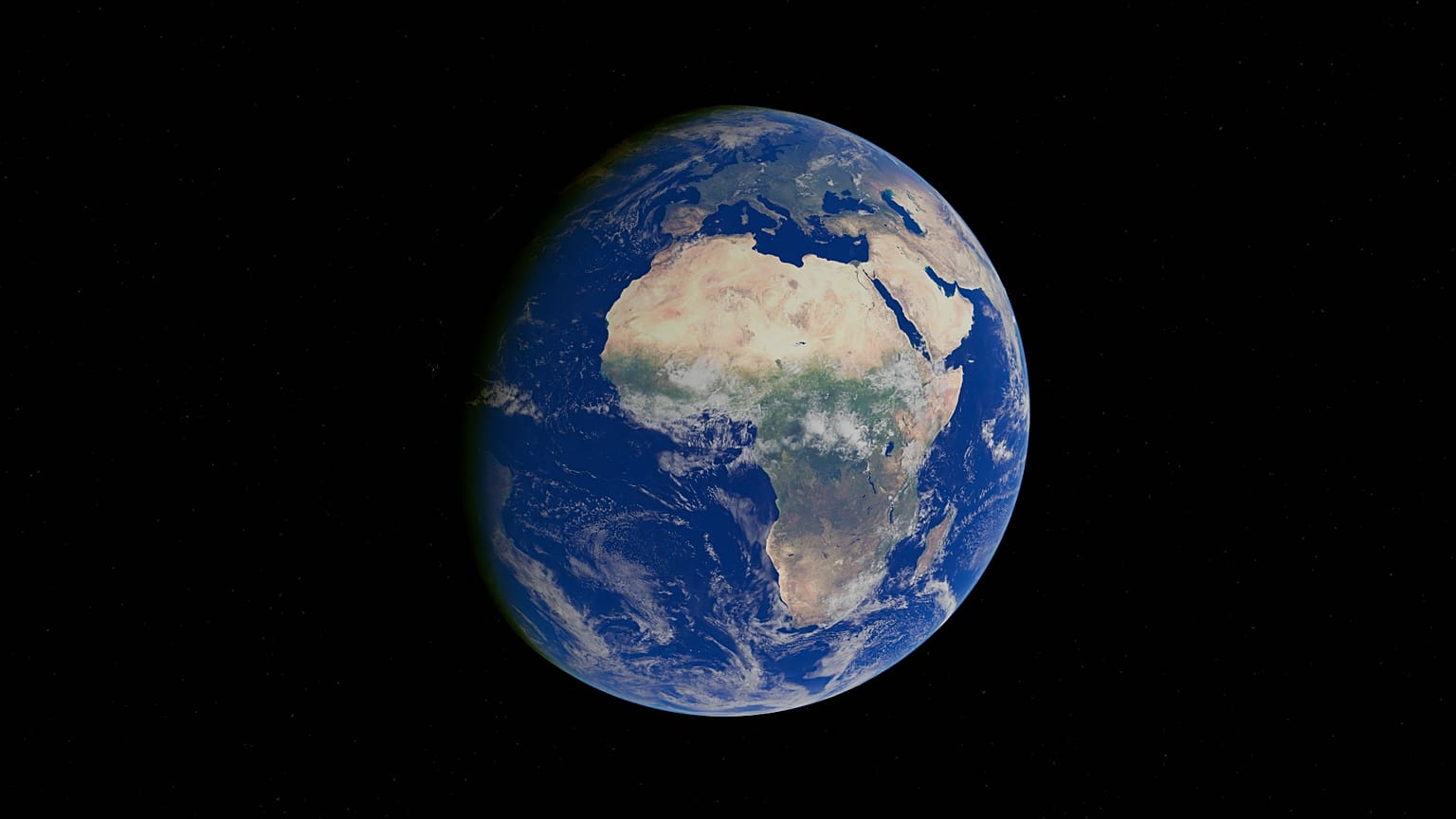
Stunning image of Earth showcasing Africa and Europe against the black void of space
Copyright Zelch Csaba/Pexels

By Indrabati Lahiri
Published on

Eighteen African countries have now launched satellites, as the continent builds its own space sector and looks to cut reliance on foreign, Western powers.

The global space race has intensified in recent years, driven by geopolitical rivalry between major powers like the US and China for commercial dominance and resource control.

The Moon's south pole, prized for its water ice deposits, is the current battleground, with several countries racing to build permanent lunar bases before the decade is out.

Cheaper, reusable rockets from private providers like SpaceX and Blue Origin have driven down the cost of reaching orbit, fuelling the race further.

Now African nations are entering the fray too, crowding an already competitive field and reshaping what global space ambition looks like.

Which African countries have entered the space race?

Eighteen African countries have already launched at least one satellite, up from just a handful a decade ago, with more than 21 now running dedicated space programmes, according to the Africa Center for Strategic Studies.

Egypt, South Africa, Algeria, Nigeria and Morocco lead the pack in satellite infrastructure and technology, with major domestic labs for assembling, integrating and testing satellites.

Egypt also hosts the headquarters of the newly launched African Space Agency.

Many of these countries are nurturing private tech firms and aerospace startups, building a research-driven ecosystem from the ground up.

In recent years, Senegal, Rwanda, Djibouti and Zimbabwe have also launched their first satellites.

Tracking resources and building domestic resilience

Sovereignty is the driving force. African nations want to cut their dependence on foreign and Western powers, particularly for geographical and environmental data.

Buying high-resolution satellite imagery and communication bandwidth from abroad is expensive, and requests can be delayed or denied outright. Senegal, Egypt and South Africa are especially keen to control their own data.

African satellites now track crop health, manage water resources and predict floods and droughts. They also monitor illegal fishing, border security, piracy, illegal mining and deforestation, and are increasingly vital for bridging rural telecommunications gaps that terrestrial infrastructure cannot reach.

The African Space Agency helps coordinate cross-border space policy and pool resources, while new aerospace engineering and data science programmes aim to keep young technical talent on the continent.

What does this mean for Europe?

Africa's space rise could push Europe to shed its role as paternalistic aid provider and become more of an equal partner.

That shift is already under way. The Africa-EU Space Partnership Programme, worth €100 million, shares infrastructure and data, with further tie-ups expected in climate monitoring and agriculture.

European firms could also gain a foothold in Africa's fast-growing commercial space economy, unlocking opportunities beyond saturated Western markets, while systems like Galileo and Copernicus could help tackle local African challenges.

But Africa's space ambitions also sharpen the need for Europe to deepen its diplomatic and geopolitical ties on the continent, as rivals China and Russia expand their own space partnerships there.

The challenges that remain

Despite the progress, obstacles persist. Public budgets for space development remain far lower than in the West, leaving many programmes reliant on external loans and donor-tied packages.

Weak local venture capital markets mean startups often struggle to raise funds while facing high operational costs, according to the International Bar Association.

Many rockets still launch from foreign soil due to a shortage of local spaceports, while limited ground stations restrict the download and processing of real-time satellite data.

And despite growing investment in local talent, skills gaps and brain drain remain stubborn problems that could take years to fix.

FASCIST FRIENDS OF A FEATHER

New Colombian president orders immigration raids, vowing deporations of migrants without legal status

FILE - Colombia's President Abelardo de la Espriella salutes after taking the oath of office in Cali, Colombia, Aug. 7, 2026.
Copyright AP Photo/Matias Delacroix, File

By Evelyn Ann-Marie Dom
Published on

The far-right leader, a close ally of Donald Trump, seemed to echo the rhetoric of the Trump administration. 'Colombians first, Colombians second, Colombians third, may that be clear to everyone,' de la Espriella said.

Colombia's new president Abelardo de la Espriella announced a crackdown on thousands of migrants who are in the country without residence permits.

The far-right president said he would make significant changes to the country's immigration policy that he said would reduce crime and confront criminal groups.

“I will not accept any illegal immigrants, no matter where they come from,” de la Espriella said in a video released on X on Sunday night while chairing a security meeting in Barranquilla.

"The order to Immigration (authorities) is clear: first those who are committing crimes, second those who have not regularised their status and who will have to be deported in due course," he added.

During the meeting on Sunday, the new president seemed to echo the "America first" rhetoric of US President Donald Trump, which whom he is closely aligned.

"Colombians first, Colombians second, Colombians third, may that be clear to everyone," De la Espriella said.

The Colombian president said deportation procedures would start this week by presidential order.

The crackdown will largely affect Venezuelans who, over the past decade, have fled the country’s repressive regime and an economic crisis. Overall, roughly one-fifth of Venezuela’s population has left the country over this period.

Colombia is home to a major Venezuelan diaspora. According to the United Nations, around 2.8 million Venezuelans were living in Colombia as of August, of which over 527,000 are undocumented.

De La Espriella’s move represents a significant departure from Colombia’s previous approach to migration. The country had long sought to welcome and protect Venezuelan migrants, offering them a pathway to permanent residency.

As recently as July, Colombia’s national immigration service said it had granted temporary residence permits to roughly 2.3 million undocumented Venezuelans in the country.

The measure was intended to help migrants and refugees obtain legal status while facilitating access to health care and legal employment. It was part of a scheme introduced in 2021 by then-President Iván Duque at the peak of Venezuela's immigration crisis.

“We understand that the president wants to protect Colombians,” Ana Karina García, director of Juntos Se Puede, an organization that helps Venezuelan migrants in Colombia, said. “But there is no need to protect them from migrants. It has been proven that foreigners do not commit crimes at greater rates".