Wednesday, September 09, 2026

Germany

Eastern elections and Die Linke: anything but an all-party government

Fascism at the gates? – Ahead of the 2026 state elections

Tuesday 8 September 2026, by Thies Gleiss
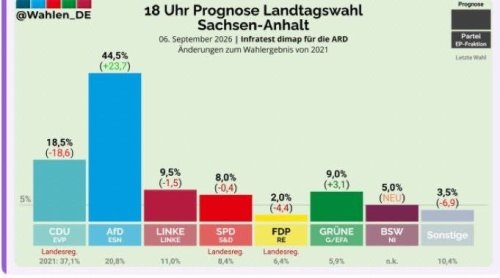


After the results of the Saxony-Anhalt elections on 6 September the discussion on perspectives for the German left is even more important. In this prescient analysis, written shortly before the election, Thies Gleiss outlines the roots of the crisis."

Only a few days now until the Landtag elections in Saxony-Anhalt (6 September) and Mecklenburg-West Pomerania (20 September), and the debates about how the party Die Linke should conduct itself towards the apparently unstoppable rise of the AfD are sharpening by the day.

For one part of the party establishment, led by the Bundestag vice-president Bodo Ramelow but solidly anchored in the party executive and in the parliamentary groups in the Bundestag and in the Land parliaments, it is entirely clear that what is at stake here is a crisis of "democracy" in its struggle against "authoritarianism". Die Linke must therefore live up to its overall responsibility for the endangered democratic state. In practice this means: incorporation into an all-party alliance of the "democratic parties" against the AfD, including possible arrangements with the CDU about governing together in the Länder.

The numbers

In Saxony-Anhalt the AfD has 3,500 members. In the polls among the 1.7 million people entitled to vote it takes 42.1 per cent; at the 2025 Bundestag elections it actually received 498,100 votes, 37.1 per cent. On the current polling, as of 25 August, the AfD would occupy 41 of the 83 seats in the Magdeburg Landtag. In Mecklenburg-West Pomerania the AfD has 2,700 members and reaches 36 per cent in the polls among 1.3 million voters; at the last Bundestag elections it actually brought in 357,356 votes, 35 per cent. If the polling result is reached, the AfD would take 28 of the 71 seats in the Schwerin Landtag. In Saxony-Anhalt it is expected that only the CDU, on 22.9 per cent in the polls, Die Linke on 13 per cent and perhaps the SPD on 6.6 per cent will win seats in the Landtag. Considered purely arithmetically, an AfD takeover of government can be prevented only by a governing alliance of CDU, Die Linke and SPD. In Mecklenburg-West Pomerania the SPD, on 29 per cent in the polls, Die Linke on 11 per cent and the CDU on 10 per cent, and perhaps the Greens on 5 per cent, will be represented in parliament. If the Greens enter the Landtag, coalitions with the SPD and the CDU or with the SPD and Die Linke would be possible; if they do not get in, then here too only an alliance of SPD, CDU and Die Linke would prevent an AfD participation in government.

There is no parliamentary solution, but let’s use that route anyway

The federal party congress of Die Linke has unfortunately given the Land organisations in Mecklenburg-West Pomerania and Saxony-Anhalt a free hand to embark on any parliamentary adventure. Motions to maintain the old tradition of left and workers’ parties, and to enter into no governing alliance and no toleration agreement with the bourgeois parties, found no majority. Now those responsible in both Land organisations are signalling that they would enter into arrangements with the CDU and, if need be, support a government under CDU leadership. Such a decision would be fatal for Die Linke and a step backwards from the successful phase, under way since 2024, of building the party as a left, independent class party.

The success of the AfD and its broad support, both of them still a long way from reaching a level of votes and above all of anchoring in society comparable to that of the NSDAP in its model Land of Saxony-Anhalt in 1932, cannot be separated from the actual politics that the CDU, SPD and Greens have been conducting for years at federal and at Land level. It is a politics carried on the backs of wage-earners and especially of migrants; of the smashing of welfare-state structures in health, care, pensions and education; of the refusal of real solutions to the crises of rents, of the climate and of transport; and of the structural neglect of the east German Länder. All of that constitutes the driving forces behind the rise of the parties of the right and above all of the AfD. Added to this is the permanent crisis of the EU, which is miles away from its promise to create a flourishing future for European capitalism, and the war orientation of the governing parties, which has not only revived old fears of war and destruction but has led directly to an enormous rise in the cost of daily life. A survey has just found that anxiety about this inflation is the population’s principal fear in east Germany.

Minority government with shifting majorities

The rise of the AfD is not only a result of these policies and of the fears of social decline bound up with them. The party has also managed to turn both of them into the basis of a broad anchoring in society. That can be reversed only if, first, the concrete policy of governments changes, and second, the broad left, together with the party Die Linke itself, sets about building a broad societal front against the right and advancing its own anchoring in society as a socialist alternative.

With an alliance with the CDU and the SPD in government, however it were arranged, the concrete policy will of course not change. The tiny concessions that Die Linke could obtain in return for a coalition, or for tolerating a CDU or SPD minister-president, would be nothing set against the concessions that would have to be made to bourgeois politics, and a death blow to any credibility of the left. A coalition with the CDU, or toleration of it, would above all be a kowtow to the federal government, would be a further building programme for the AfD, and would surrender the whole role of opposition to that same AfD.

Parliamentarily there is no "solution" to the AfD problem. In parliament only a minority government is conceivable, one in which Die Linke supports only those things that are socially acceptable. An all-party government, like a party-independent "government of experts", must be prevented. For Die Linke there is no alternative to the construction of a politically independent class party.

27 August 2026

Translated by International Viewpoint from Sozialistische Zeitung.


Global Empire as Domestic Policy


by | Sep 4, 2026

While many mainstream commentators blanch at the characterization of the United States as an empire, the hard data show that it is today impossible to seriously dispute. The U.S. military operates between 750 and 800 bases around the world, located in around 80 foreign countries and territories. Because there is no fixed or standard definition of “base” for these purposes, there is no accepted number, and some estimates place the figure at closer to 900. The U.S. is also known to operate dozens of secret military bases and black sites, further complicating attempts to settle upon an exact and definitive number.

Just as the number of military bases is disputed, experts have continued longstanding disagreements about how best to tally up total military spending. As the Peter G. Peterson Foundation observed earlier this year, “The United States continues to lead the world in defense spending by a wide margin. In 2025, defense spending by the United States accounted for 33 percent of all military expenditures by countries around the world,” with its nearly trillion-dollar outlay that year exceeding the combined spending of the other six biggest military spenders. This number is down from 2025’s value of nine to six largely because several other countries dramatically increased their military spending (Germany, for example, upped its spending by 24 percent). Breaking Defense reports, “The Pentagon is betting big on a $1.15 trillion discretionary budget request with a further $350 billion coming from the reconciliation process — together adding up to a historic $1.5 trillion defense budget.” The Trump administration’s discretionary funding request of $1.15 trillion marks the first time in history that a discretionary defense request has exceeded $1 trillion on its own. In the previous budget, for FY 2026, the total number hit the $1 trillion mark with a combination of  $848 billion in discretionary spending and $113.3 billion in mandatory reconciliation spending.

The Project on Government Oversight (POGO) notes that many “obvious examples of programs many would consider ‘military spending’” under commonsense definitions are not a part of the Pentagon budget, including spending for veteran benefits, the Coast Guard, and even nuclear weapons. Looking at five different methodologies, a POGO report published in June points out that all five share at least one conclusion: “Military spending in the United States has long been radically underestimated.” (Not unrelated to this slippery accounting is that fact that the Pentagon hasn’t passed an audit in years, failing its eighth in a row at the end of last year.) This recent POGO report finds that “the true total military budget for the last fiscal year (FY 2025) was significantly higher than $1 trillion: It was likely between $1.5 trillion and $1.8 trillion.” If we count interest payments associated with debts for military spending, then “the range is between $1.7 trillion and $2.3 trillion.”

We rarely consider the domestic political implications of Washington’s globe-spanning empire, yet government spending on war and empire functions as the de facto national industrial policy of the United States, largely determining which cutting-edge technologies receive the most investment, which companies will enjoy massive state-guaranteed markets, and which physical objects will be the focus of the country’s industrial production capacity. Through the military empire, the state becomes both the architect of and primary consumer for a huge industrial sector. And while it has grabbed more headlines this year due to the parlous speculative bubble surrounding AI, the political consequences of the connection between the global military empire and the private sector tech industry remain woefully under-discussed in the mainstream discourse. The federal government is funneling billions to AI companies willing to work directly with the military, overpowering objections from employees and the investor market.

Just this week it was reported that “Palantir’s Maven Smart System, an artificial intelligence-powered military platform, is now an official program of record for the Pentagon.” The executive and strategic leadership of major technology companies also increasingly connects and overlaps with the military and national security establishment, often through the Pentagon’s Defense Innovation Unit and liaisons dedicated to recruiting talent and procuring products from the tech sector. As we have already witnessed for decades, cutting-edge technologies developed for the war and empire inevitably end up being deployed domestically against Americans inside the country. Now more than 50 years ago, the Senator Frank Church Committee showed that the intelligence agencies used programs originally designed for foreign surveillance to monitor Americans here at home without warrants. We still have not seriously reckoned with this connection between the policies and technologies of the empire and the ways our own government sees us and governs us.

Since classical antiquity, astute observers have understood that this kind of worldwide military empire is fundamentally incompatible with the rule of law, constitutional government, and even the thinnest definitions of democracy. The administration of such an empire demands secret and centralized forms of decision-making and thus necessarily precludes transparency, accountability, and popular sovereignty. Contemporary political language has managed to disguise what is patently a system of permanent war and empire in the terminology of a liberal and rules-based order of international law and free trade. We have consigned terms like imperialism and colonialism to the history books even as we continue these systems in different forms today. Even the liberal side of our mainstream discourse no longer seriously questions the political system of war and empire that actually governs the country. We will not understand the form of domestic politics we have in the U.S. today until we stop trying to separate it from the imperatives of empire.

Reprinted with permission from CounterPunch.

David S. D’Amato is an attorney, businessman, and independent researcher. He is a Policy Advisor to the Future of Freedom Foundation and a regular opinion contributor to The Hill. His writing has appeared in Forbes, Newsweek, Investor’s Business Daily, RealClearPolitics, The Washington Examiner, and many other publications, both popular and scholarly. His work has been cited by the ACLU and Human Rights Watch, among others.

America’s War on Iran Has Always Been a Bipartisan Effort


The bombing of Iran is the culmination of decades of bipartisan policy that systematically normalized and institutionalized gradual escalation

by | Sep 7, 2026


American bombs are now falling on Tehran, and while Donald Trump ultimately pulled the trigger, administrations before him—Republican and Democrat alike—constructed the gun, and even loaded it.

In 1995, US president Bill Clinton issued executive orders banning US investment tied to Iran’s petroleum sector and, soon after, most US trade with and investment in Iran. His administration justified the sanctions with an accusation that would later be used against Saddam Hussein’s Iraq not even a decade later: “Iran’s efforts to acquire weapons of mass destruction” and their alleged support for terrorism.

The International Atomic Energy Agency, which had visited Iran a few years prior to inspect their nuclear activity, reported no evidence of nuclear weapons.

In 1996, Congress followed up with the Iran and Libya Sanctions Act, which passed 415-0 in the House, and by unanimous consent in the Senate,targeting foreign and US companies investing more than $20 million a year in Iran’s energy sector.

Much like embargoes on Iraq, which were linked to catastrophic civilian deaths, over time, American sanctions on Iran decimated the economy and its people by devaluing currency, shrinking living standards, and limiting access to food and medicine.

In 2000, a report by a neoconservative think-tank called Project for the New American Century warned that even if Saddam Hussein were removed, “the need for a substantial American force presence” in the region would remain because “Iran may well prove as large a threat to US interests in the Gulf” as Iraq has.

Several prominent figures involved with the think-tank later joined the Bush administration, including Donald Rumsfeld, Paul Wolfowitz, and John Bolton.

In 2001, shortly after 9/11, Iran offered counter-terrorism assistance to the US, but instead, President Bush lumped them in with Iraq and North Korea under an umbrella he termed the “Axis of Evil”. Clinton-era sanctions were kept in place, new ones were added, and covert measures began to undermine the Iranian establishment.

That same year, Congress passed the Authorization for Use of Military Force by a vote of 420-1 in the House and 98-0 in the Senate, granting the president sweeping authority to use military action against those connected to the 9/11 attacks. Although Iran had no connection to 9/11, the deliberately broad language of the bill created a permanent legal framework for military action across the Middle East without requiring new congressional approval.

Towards the end of Bush’s final term in office, a 2007 US National Intelligence Estimate (a comprehensive report involving all US intelligence agencies) concluded with “high confidence” that Iran was not currently building a nuclear weapon.

Still, Barack Obama’s policies continued beating the drums of war.

In 2010, he significantly expanded financial sanctions on Iran’s oil, gas, and banking sectors, measures that severely restricted access to essential medicines in Iran, which passed the House 408–8 and the Senate 99–0.

At the same time, his administration intensified Bush-era cyber operations against Iranian nuclear facilities. The Stuxnet computer worm, reportedly developed by the US and Israel, was credited with disabling hundreds of centrifuges and delaying enrichment efforts, even though the nuclear program continued to show no signs of weaponization.

In 2015, Obama concluded a nuclear deal that imposed strict limits on Iran’s nuclear program in exchange for sanctions relief. But its premise was a masterclass in propaganda that worked to build further consensus for war, first by painting Iran as an aggressor, and second by continuing to perpetuate a narrative that it was interested in pursuing nuclear weapons, despite continued evidence to the contrary.

Meanwhile, far more aggressive American allies in the region—namely Israel—were exempt from such scrutiny, with their own nuclear stockpile shrouded in secrecy and tucked away from international oversight of any kind.

After the nuclear deal lifted certain sanctions in 2016, Iran’s economy rebounded. And yet at the same time, US and Israeli hawks continued to fret, alternating their fearmongering and moving the goalpost away from Iran’s nonexistent nuclear weapons and instead towards their regional influence and ballistic missile program.

Republicans and Democrats joined together the following year to pass new sanctions on Iran’s missile program, along with entities tied to the Revolutionary Guard. These measures were approved with a vote of 419-3 in the House, 98-2 in the Senate.

Fortunately for the many warmongers adorning both major political parties, the arrangement with Iran had been signed late into Obama’s second term, paving the way for a new president to conveniently overturn it.

In 2018, Donald Trump did exactly that. His administration unilaterally withdrew from the deal and reimposed sanctions. In April 2019, the US designated the Islamic Revolutionary Guard Corps, Iran’s most powerful military and political force, as a foreign terrorist organization. The following year, Trump ordered a drone strike that killed Qassem Soleimani, head of the Guard Corps’ Quds Force, a dramatic escalation.

Taking office in January 2021, the administration of Joe Biden largely maintained Trump’s “maximum pressure” framework, leaving existing sanctions in place, along with Trump’s designation of Iran’s Revolutionary Guard.

And while Biden campaigned on rejoining the nuclear deal, once in office, he demanded Iranian compliance as a prelude to sanction relief, which effectively made it impossible given growing Iranian distrust for the US.

In late 2022, after being asked about the nuclear deal by a woman appearing to wear a hair ribbon in Iran’s flag colors, Biden reportedly responded that the deal was “dead”, adding, “I know they don’t represent you, but they will have a nuclear weapon.”

Two years later, an assessment from the Office of the Director of National Intelligence found that Iran “has undertaken activities that better position it to produce one, if it so chooses” but added that “the Intelligence Community continues to assess that Iran is not building a nuclear weapon.”

Even so, in October 2024, when asked who she thought America’s “greatest adversary” was, Democratic presidential candidate Kamala Harris replied: “I think there’s an obvious one in mind, which is Iran.”

Harris, like Trump, repeated the lie that Iran was in the business of pursuing nukes, saying the US “will not allow Iran to obtain a nuclear weapon. Period.” And like Trump, she maintained that “all options” remained on the table to keep them from obtaining nuclear weapons, including military force.

In 2025, a majority of Democrats voted with Republicans to hand the Trump administration $900 billion in military spending, which provided funding for Pentagon operations, weapons procurement, overseas deployments, and military readiness programs for the upcoming fiscal year.

At nearly every stage, Republicans and Democrats in Congress, along with presidents from both major parties, have laid the foundation for a war on Iran.

The Bush administration lied its way into an invasion of Iraq, but nobody was held accountable. The Obama administration expanded the Bush-era Authorization for Use of Military Force to include drone-bombings in at least seven different countries, along with the targeting of US citizens accused of terrorism, and again, nobody was held accountable. Trump built on these precedents during his first term not only by amping up Obama’s drone strikes, but also by assassinating an Iranian commander. Again, no accountability. The Biden administration funded Israel’s flattening of the Gaza Strip while also shielding it from repercussions at the United Nations and International Criminal Court, effectively demonstrating that the so-called rules of international law were never fair, but instead, selectively applied.

Over time, escalation itself became normalized.

Economic warfare became cyber sabotage. Cyber sabotage became targeted assassinations. What were once extraordinary war powers became permanent executive authorities. By the time Trump entered the White House for his second term, the framework for America’s long-awaited war on Iran was already in place.

All he had to do was pull the trigger.


How Britain Tried To Rig the Trial of a Genocide Opponent – and Lost

by | Sep 7, 2026

The jury took just two hours. Tony Greenstein – Jewish socialist, anti-Zionist – had faced fourteen years under the Terrorism Act for three social media posts and a blog article opposing Israel’s genocide in Gaza. The Crown called it “inviting support for Hamas.” The jury called it something else.

Section 12 of the Terrorism Act makes it an offense to invite support for a proscribed organization. Greenstein’s reference to a “Gaza ghetto uprising”, it argued, amounted to support for Hamas. Three social media posts and a blog article. The bill the State was demanding for those words – fourteen years.

Judge Sarah Plaschkes repeatedly objected when Greenstein brought the wider historical-political context of Palestine/Israel into the courtroom – warning him against treating the proceedings as a political forum. When the closing speech came, Greenstein was by now so concerned about what might happen to his barrister that he decided to address the jury himself (no doubt considering what had happened to Barrister Rajiv Menon KC – more of whom later). For thirty minutes he examined the prosecution case and the context in which his posts had been written. The jury wasn’t asked to lay aside the offending words; instead, he guided the jurors in an articulate reading (see his address to the jury, here) in which the world in which they’d been written was made clear (full trial coverage at the Canary, here).

But this court was rigged and thus determined to keep all context out of the courtroom. Nevertheless, despite Judge Plaschkes’ hostile interruptions, Greenstein’s speech laid bare the realities the prosecution had no interest in facing: his opposition to Hamas evident in dozens of articles he’d penned and published on his platform over the years; and Israel’s genocide in Gaza after October 2023. He spelled out the difference between supporting Hamas and defending the right of Palestinians to resist Israeli oppression, and the obvious point that the posts in contention clearly did not express support for Hamas.

Greenstein recounted to the jury how his grandparents fled Poland before the War, and most of those left behind perished in Treblinka. To him, Greenstein told the jury, the Holocaust was not history, but inheritance. He invoked the story of the 1943 Warsaw Ghetto uprising as a parallel of Gaza: young Jewish men and women rising up against the SS with smuggled pistols against tanks, knowing it was hopeless yet choosing resistance anyway. October 7th was Gaza’s uprising. The judge objected.

Once Greenstein had finished speaking (to a round of applause from the public gallery), Judge Plaschkes addressed the court to say that she had considered referring Greenstein for contempt of court. She then dismissed his address as a “rambling speech delivered by an old man”. An extraordinary turn of phrase in a criminal trial in which Greenstein was about to find out whether he was to be sentenced to 14 years in prison.

Home Secretary Yvette Cooper added Palestine Action to the UK’s list of proscribed organizations in July 2025, under section 3 of the Terrorism Act 2000. But proscription criminalizes more than membership. Up to fourteen years in prison can follow under section 12, which makes it an offence to “invite support for a proscribed organization” or to “express an opinion or belief that is supportive of a proscribed organization…” That was the provision the Crown used to prosecute Tony Greenstein, and it applies right now to public expressions of support for Palestine Action. Serious concerns over freedom of expression and peaceful assembly were raised by a group of five UN Special Rapporteurs over proscribing a group for property destruction.

On 6 August 2024 activists from Palestine Action staged a break-in at Elbit Systems, in Filton, near Bristol.  It’s an Israeli defense company with British operations supplying equipment to the IDF. They entered facilities, sabotaged machinery and hindered production they regarded as part of Israel’s war-making infrastructure. During the parliamentary debate on the proscription order, it was argued that Palestine Action had targeted only industrial facilities, and not civilians. The government went ahead with proscription anyway.

Rajiv Menon KC represented one of the six defendants in the February 2026 Filton Trial. All six were acquitted of aggravated burglary but the jury failed to agree on criminal damage. At the May retrial, four were convicted. Menon’s closing speech was a masterclass and invoked the 1670 Bushell case – a landmark ruling on jury independence from judicial interference, arguing that the judge could not direct a conviction. Judge Jeremy Johnson then referred Menon for contempt, a referral the Court of Appeal overturned on procedural grounds in May before Johnson referred to it correctly in June.

The Filton defendants were acquitted of the most serious charge – the barrister who defended them is now facing contempt proceedings for the way he did it.

So what lies behind all this courtroom drama is a routine machinery. Proscription – the government’s designation of an organization as terrorist – takes effect by order of the Home Secretary. It falls to the barrister to gauge how far a closing speech can go before crossing the line into contempt, while the judge cautions against political argument. Indeed, the evidence shows that judges are increasingly directing what juries are allowed to hear before threatening barristers with contempt. To an outside observer there is little sign of a conflict – yet behind these routine procedures is something damning: what the jury doesn’t get to hear – could mean years in prison.

And, of course, the elephant in the room is that Britain is directly implicated in Israel’s genocide in Gaza. In September 2024, as the government suspended thirty arms export licenses to Israel, Foreign Secretary David Lammy told Parliament that “there exists a clear risk that they might be used to commit or facilitate a serious violation of international humanitarian law”. Thirty licenses suspended out of three hundred and fifty. Britain would also continue to supply F-35 components through the global parts pool serving Israel, with the government arguing that withdrawal would undermine allied security. British weapons armed a state committing a genocide despite their supposed withdrawal.

The state that arms Israel prosecutes those who oppose it.

The Crown had brought three posts, a blog article and an accusation of terrorism before the jury. But Greenstein stood on that essential context – despite the hostile judge’s interjections. And a mere two hours after retiring – the jurors returned with a unanimous verdict of not guilty.

Richard Edain is a teacher and writer based in the UK and Vietnam. Opposed to imperialism, his work focuses on tracing today’s global headlines back to their historical roots. His work appears on Substack as the Ulysses Files. Contact: edainrichard@gmail.com

A Homeland on Canvas: Sliman Mansour and the Rise of Revolutionary Palestinian Art

by | Sep 8, 2026

The death of Palestinian artist Sliman Anis Mansour stirred powerful memories.

He passed away at Al-Makassed Hospital in occupied East Jerusalem on August 24, at the age of 79, bringing to a close a legacy that cannot truly be described, but only experienced.

His life almost exactly spanned the age of the Palestinian Nakba. He was born mere months before the mass expulsion of the Palestinian people from their homeland. Yet his death in an occupied city tells us that the story of Mansour, his art and the Palestinian struggle for freedom is far from over.

Oddly, for years, I knew Mansour through a single painting: Jamal al-Mahamel (The Camel Carrier of Hardships).

The title itself requires a pause. The phrase is rooted in Palestinian and Levantine popular culture. It describes one who shoulders the collective struggles, pain and responsibilities of others.

In Mansour’s post-Nakba world, that person is an elderly Palestinian porter, a barefoot worker carrying the burden of an entire homeland on his back. That homeland is represented by Jerusalem, with the Dome of the Rock, one of Islam’s holiest sites, rising above it.

Mansour, however, was not a Muslim. He belonged to the once-thriving, though sadly shrinking, Palestinian Christian community and came from the town of Birzeit, near Ramallah in the West Bank.

Let that sink in. One of the most iconic Palestinian paintings of the modern era, celebrating the centrality of Jerusalem and one of its most recognizable historic Islamic sites, was painted by a Christian man.

In the age of Israeli extremists like National Security Minister Itamar Ben-Gvir and his “religious wars,” this may appear unusual. For Palestinians, it is anything but. Though deeply spiritual, Palestinians have historically transcended religious divides in their long struggle for freedom.

A mosque is never just a mosque, and a church is never just a church. They are powerful symbols of history, culture, roots, spirituality and continuity. Mansour entrusted the Camel of Hardships with carrying all of that alone, as the world watched an old man bent beneath an unbearable weight, yet fierce and unbroken in his resolve.

Though the painting was created in 1973, it exploded in popularity during the First Intifada, the popular uprising that unified Palestinians everywhere. It took on a renewed meaning: we Palestinians may be standing alone, exhausted by time and the betrayal of others, but we remain as steadfast as ever.

The last time I saw that painting hanging in the living room of my old house in the Nuseirat refugee camp in Gaza was also the last time I saw my father, most of my brothers and many of my childhood friends.

My father died years later. The house was bombed. The painting no longer hangs where it once did, at the heart of our old refugee home.

Ironically, it was only after I left Palestine that I discovered that Sliman Mansour was far more than the creator of a single painting. He belonged to an artistic movement that taught visual sumud, steadfastness, to an entire generation.

My lack of knowledge was not a fault of my own. Artists such as Mansour, Ismail Shammout, Fathi Ghaben, Vera Tamari, Tayseer Barakat and Nabil Anani, among others, were simply forbidden by Israeli military ordinances.

Israel is afraid of Palestinian art, particularly art that preserves memory, asserts steadfastness and speaks of revolution. During the Intifada, the Israeli army would storm Palestinian refugee camps almost daily, particularly before dawn, to ensure that artistic expressions on the walls were painted over.

The soldiers did not paint over the walls themselves, of course. They dragged weary refugees from their sleep and forced them to erase every piece of graffiti, every image and every word. The soldiers may have thought they were carrying out a military duty, somehow protecting Israel’s national security. In reality, they were trying to erase evidence of a people whose roots in the land ran far deeper than the occupation itself.

But the evidence was never erased. It could not simply be painted over, even when the artist himself disappeared, because true art is more than an arrangement of colors on canvas. It is one of the deepest forms of documenting one’s own existence.

Fathi Ghaben, who became a close friend of my family, had, like most Gazans, more than his share of suffering. He was a refugee from a once-serene village called Hirbiya, north of Gaza. His family sought refuge in Gaza during the Nakba.

Ghaben had no memories of the village he lost as a child, yet its colors filled his paintings. For him, Palestine was a beautiful woman, powerful in her determination yet gentle in her gaze. Her eyes, always sharply defined, embodied the beauty of a homeland that never abandoned him. She was the worker, the farmer, the student, the protester, the fighter.

Ghaben was repeatedly imprisoned by Israel for emphasizing the colors of the Palestinian flag in his art, accused of “incitement through his paintings.” The occupation army killed his young nephew in 1982, and many of his relatives were killed in the genocide.

Ghaben himself died during the genocide, in February 2024, after being displaced from his home.

For me, and dare I say for many of my generation, it is difficult to process art that does not carry this kind of weight – art that goes beyond mere “expression” and becomes an experience of blood, sweat, tears and the burden of memories that can only be put to rest when justice in Palestine finally prevails.

I think back to the Camel of Hardships, and I am convinced that Mansour’s figure represented more than Palestine and the Palestinian. Perhaps unknowingly, he was also painting the Palestinian artist himself.

They, too, carried an immense responsibility on their shoulders. Without them, several generations might never have truly appreciated the colors of Palestine, smelled the powder of revolution, or understood the true meaning of losing a homeland.

Dr. Ramzy Baroud is a journalist, author and the Editor of The Palestine Chronicle. He is the author of six books. His forthcoming book,Before the Flood,’ will be published by Seven Stories Press. His other books include ‘Our Vision for Liberation’, ‘My Father was a Freedom Fighter’ and ‘The Last Earth’. Baroud is a Non-resident Senior Research Fellow at the Center for Islam and Global Affairs (CIGA). His website is www.ramzybaroud.net