Sunday 6 September 2026, by Ivan Drury Zarin, Mikhail Lobanov
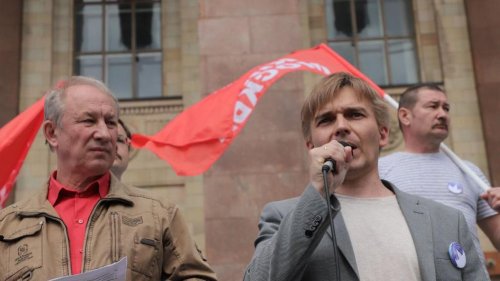
IVAN DRURY ZARIN conducted this interview for Against the Current with Mikhail Lobanov, Russian democratic socialist politician in exile and one of the organizers of Radical Democracy, at the international anti-fascist conference in Porto Alegre, Brazil in March 2026. [1]
In 2018, Mikhail Lobanov won a seat in Russia’s parliament, soundly defeating one of Putin’s most well-funded candidates in an upheaval reminiscent of some of the recent democratic socialist wins in U.S. races. But rather than take this seat to uphold independent, democratic socialist, and anti-war politics in the Russian government, his seat was stolen through electoral fraud, and police harassed, arrested and beat him and raided his home, driving him out of the country.
Unbowed, Lobanov, along with many other coordinators, is now busy organizing the infrastructure and consolidating the politics for tomorrow’s left in Russia. Radical Democracy is rooted in the leftist diaspora that he has been forced to join abroad.
But unlike liberal Russian opposition groups headquartered in European cities, Radical Democracy is focused on strengthening and formalizing the network of young leftists and progressives that he says are strong, but living with their heads down throughout Russia.
Radical Democracy has recently launched a Substack newsletter about post-Soviet politics, with writing by Russian speaking scholars, activists, and journalists.
Against the Current: Let’s begin with an introduction about yourself, your organization, and your background in the Russian left.
Mikhail Lobanov: I’m a Russian mathematician, but also a left politician, a leftwing activist from Russia, now in exile.
I have organized a lot of campaigns in universities because I was, for many years, a student, postgraduate student and professor of mathematician at Moscow State University, the most ancient and biggest university in Russia.
Together with my comrades at MSU, we created the Initiative Group, a kind of underground party. There are a lot of successful stories of our activities.
It was a unique experience for Russian universities because during the Soviet Union, it was impossible to organize without repression in the universities. I saw a new generation of students that wanted to participate, to use collective action, to have influence in the life of their universities.
We organized Occupy Rectorate, which was like Occupy Wall Street, but occupying the university administration building, bringing petitions with thousands of signatures against the administration’s bad decisions.
After four or five hours, the president of the university would say, yes, I can speak with you, with your delegates, and at times we succeeded, after some struggle.
This new political movement became more visible before the invasion of Ukraine. For more than 10 years, we had many successes with this strategy, and we were able to unite students and professors behind these campaigns.
Also, we protected the university. From time to time, the government wanted to do something bad for the university and we defended the university. And we also protected our university against development corporations, because around Moscow State University there is a huge green zone, a lot of parks where developers want to build towers.
Every two years, we needed to make a new campaign to protect these parks. It was a very powerful experience. It is also one of the reasons why my comrades and I have good communication with local activists in the districts around our university.
Around the same time, I was a co-founder, a co-president of an independent trade union of university workers at different universities in Russia. Called University Solidarity, it still exists and continues its work, but it’s a small union. This experience is also rather important for the future.
Crushing Independent Unionism
ATC: Was it more possible to form an independent union in the academic sector compared to other sectors?
ML: It was a very difficult, extremely difficult task. We created this trade union and had some small successes in different universities around salaries, and protecting a professor when the administration wanted to fire him. But we were unable to create a big trade union.
There are different reasons, but the basic reason is the politics of Vladimir Putin. When he was prime minister, Putin was well connected with the previous president, Boris Yeltsin, and the oligarchs, who then chose him as a rather young person from security services, to become president and help to save their powerful regime and its property.
It worked. Putin understood when he was a prime minister and before, when he was a chief of security services, that the main threat to the oligarchs was independent democracy and an independent trade union movement.
One of the first things Putin did was change the law for the trade unions and introduced measures to destroy the roots and perspective of trade unions.
He changed the Trudovoy Code, Russia’s labor acts, in order to destroy the perspectives of independent trade unions. And at the same time, security services worked to destroy unions.
ATC: You’re saying that one of the first developments of Putin’s style of repression was to cut the legs out from the trade unions?
ML: When human rights defenders outside of Russia, in Europe and the USA talk about repression in Russia, they always talk about mass media; about Putin’s destruction of the freedom of mass media. They say he corrupted judges and the courts.
What nobody talks about is the basic, fundamental way that this regime destroyed all perspectives for people in Russia through attacking unions in multiple ways, and why for many years, before the invasion of Ukraine, most people in Russia hated their lives.
How could this regime continue? How could they present themselves as a very successful regime? At the very base of this problem is Putin’s destruction of the perspectives of independent trade unions.
And now we see in the war in Ukraine that the base of Putin’s army is low salaries. Most of the men who live in small towns in the country cannot find a good job with a decent salary. They are very poor, and the only possible way they can buy an apartment or car is to go to the front.
ATC: So there’s sort of this double effect of the attack on trade unions: First, to eliminate the base of working-class power that people could use to resist the other reforms that were going to come. Second, lower wages, to create an economic draft, so poor people had to join the army because there’s no other work.
ML: The basis of Putin’s regime is a neoliberal practice: the degradation of life. Putin and his managers brought neoliberal techniques from Western governments and corporations. Putin destroyed the fundamentals of solidarity and collective action in Russia so Russian businesses, oligarchs, can implement neoliberal policies without resistance; without problems.
And after 25 years of these neoliberal technologies, big business in the West says oh, it’s a very effective regime! In our countries, in order to do something, we need many years to fight the trade unions, the workers’ movement and student movements. Putin is a very efficient, effective manager! His neoliberal practices are better than ours, we need to learn from his experiences!
I see that in some countries in Western Europe and some conservative Republican politicians in USA say — in public — that they are anti-Putin. But in their practice, they see, oh, it’s a good experience! And they try to support Putin’s regime and try to use this experience in their countries.
Stolen Election and Arrest
ATC: What was your experience after the Initiative Group, the student movement, University Solidarity, and Putin’s new attack on labor unions?
ML: After these years of different struggle in universities and trade unions, in 2021, the last big Russian parliamentary election before the invasion of Ukraine, I was a candidate of the opposition.
I was a candidate for a district in the western part of Moscow, where my university campus was situated, and we built my campaign as a real opposition. It was a very interesting and unique electoral campaign for Russia.
My campaign was like the Bernie Sanders campaign, though in just one district. My campaign was similar to Bernie’s because we did not take money from corporations. We used donations only from common people. I received about 73,00 votes, and several thousand votes were transferred to the ruling party’s candidate through electoral fraud
.
We united a network of activists: university activists, ecology activists, local activists, trade union activists, leftist groups, and it worked. It was a visible and successful campaign.
Five months before the invasion of Ukraine, we won this election. We won 40% for me, against less than 30% for the most visible and famous candidate of Putin’s party, Evgeny Popov, a tele-propagandist.
Everyone in Russia knows this person, because he has a daily political TV show. He has taught people in Russia, over many years, that we need to hate Ukrainian people, that we need to hate people in Western Europe, in the USA, that we need to hate. He had a lot of money for this campaign, but we won.
However, after the polls closed, the government used the electronic voting machines to change the results. The fact is that in reality I should be a deputy in the Russian parliament. I would be an antiwar oppositionist in Russia’s parliament. And it would be terrible for the Kremlin.
Regardless, it was an extremely important experience for Russian leftists. We continued to run candidates after this election and after the invasion. We supported and made a platform for an independent antiwar candidate in a local Moscow election in 2022 we created the VyDvizhenie (Nomination) platform to support independent antiwar candidates in the Moscow municipal elections.
We also organized different projects, not only election campaigns. Because we have a left agenda we know that elections are important, but our objective is not only to run in and win elections: our objective is to see deep social change in our country and in all the world.
After one year of problems with security services and police, I was arrested twice. I was beaten by police. They searched my apartment two different times. They gave me “foreign agent” status, and I was fired from the university. This was at the same time as the Prigozhin (Wagner Group — ed.) revolt.
I understood that they were trying to pressure me to leave Russia and decided that I needed to leave Russia and continue my activities in exile — or soon they would send me to prison.
At the beginning of July in 2023, I left Russia. But I don’t consider it exile. It’s a temporary political business trip.
Building Movement Infrastructure
Now, outside of Russia we need, within a few years, to create an infrastructure for a strong movement in the future. We see that after some years, we don’t know exactly the moment, there will be an economic and political crisis. Maybe after Putin, maybe with Putin.
In the active parts of Russian society, the anti-Putin, antiwar part of Russian society, there are people with very good experience: good independent media, good journalists, good human rights defenders, good IT infrastructure for civil society, many, many young activists, but no political structures.
Figures outside Russia with a liberal agenda, like Vladimir Kara-Murza, Maksim Katz, and Garry Kasparov don’t have any connection with people inside Russia. There is a huge gap between them and the hundreds of thousands of activists.
The majority of Russian society are not interested in politics now; they think that it’s impossible to do anything with Putin, or to do anything about the war. The majority are anti-Putin and antiwar. Yet they think that Putin and the war are like the weather. The weather is very bad: I don’t like this weather, but I cannot do anything about it. These people support a social democratic politics.
ATC: That’s what you said in your talk at this conference that stood out to me, just that there is a general social democratic consensus in the popular classes, and that in the middle class there’s a general socially progressive sentiment?
ML: Not in the middle class –– amongst activists. Amongst the Russian population generally, there’s a social democratic consensus; amongst activists, there’s a social progressivism.
Today the active parts of Russian society are the younger generation, who are 20-30 years old. For these young activists, a progressive agenda, a progressive point of view, a leftist point of view, is the mainstream.
Old liberal politicians don’t do anything useful for Russian society, don’t have a connection to people in Russia, and don’t have perspectives for the future. There is a gap between this liberal opposition and today’s activists. There is also a great gap between them and the millions of people inside Russia.
Both of these gaps are very important. In the future, in the moment of crisis, we will need to create an effective structure very quickly. Activists will be the ones who will create this movement and its infrastructure.
That’s why we need now to unite these hundreds and thousands of young activists so that they can be prepared. A political project with a left social agenda, in the moment of crisis, will mobilize these millions and millions of people.
Common people can see they don’t have money like the oligarchs, but they can create their movement, they can act rather well and they have perspectives.
ATC: Is it possible to unite those activists in discussion when it’s not legal, when you can’t form organizations or create infrastructure?
ML: Yes, we do this step by step. It’s a very hard task.
If anyone in the world knows how to make the revolution in this situation, invite us. We need to make a Zoom call and we need to learn from your experience.
In our situation, we need to experiment. Over the last year, we have started a project platform called Radical Democracy. It’s not a party, it’s a project to create an infrastructure for a future movement.
We invite activists to one-on-one discussions. Usually those who participate are key participants from different left milieus: left media, independent NGOs, human rights defenders. The person we invite to communicate with weekly is a key participant in one, two, or three such initiatives.
Altogether we see a huge number of initiatives and can understand what we can do and what infrastructure we need in order to help these initiatives grow. In doing this we help activist and researcher groups survive and develop their activities. We are creating an infrastructure for the future.
Most left and feminist activists are still living inside Russia, but the most visible and experienced activists left Russia in order to avoid repression. We bring the resources, expertise and solidarity from those in exile to our comrades inside in Russia. And it is working.
That’s the first step of our strategy. It’s an efficient structure always seeking to connect, connect, connect, connect.
The second step, which we will begin this year, is to build a membership organization. It’s not a political party. It will be an organization for people to help each other in order for our new generations to have the experience of a membership organization steeped in political discussion.
The third step will be to unite these two efforts and make a big organization out of these activists and Radical Democracy’s working groups. This effective structure will be controlled by its members. It will be a democratic organization and, we hope at the moment of crisis, will be a center of a huge democratic mobilization in Russia.
When that mobilization comes it will be a chance for us to realize our left program. And it will be a chance for Russian society to change authoritarianism to something better. Such a deep, healthy, revolutionary transformation in Russia will be good news for many countries near Russia and in other parts of the world.
ATC: Well, and to smash this fascist laboratory that is Putin’s Russia would be a gift to the world as well.
ML: Yes, yes, yes, yes, yes, yes.
ATC: My last question is what can socialists outside of Russia, especially the United States, do to help with this process?
ML: To the leftists in these countries and left-wing activists, we need your experience.
For example, now I’m in Porto Alegre at the anti-fascist conference, and I’ve found that the experiences of Brazilian comrades important for us.
In the 20th century, Brazil was a military dictatorship (1964-85 — ed.), and the activists during this period tried to do something. And it was a success story that the Brazilian people won a democratic transformation with a huge left movement, a huge movement of trade unions, and they changed their own country and they continue.
In January, we organized a conference in Copenhagen, Denmark where one of our comrades has lived and worked. He connected up with left activists and they asked trade unions in Denmark to donate resources to invite 15 coordinators of Radical Democracy for a one-day, closed conference.
We had about 50 political activists from different organizations and parties, deputies, trade union activists, journalists, and the active participants the Russian-speaking diaspora in Copenhagen.
We discussed the situation in Russia, strategies and tactics of leftists, of trade union activists, and our perspectives. There was a report about the conference in Jacobin the following month. (See “In Search of Russia’s Lost Opposition,” by Morton Hammeken, February 6, 2026.) You can also invite our comrades to participate in discussions and conferences you organize.
And you can ask Russian leftist journalists to write articles in English. Russian activists and journalists often have significant expertise not only on Russia but also on other post-Soviet countries.
It would be helpful for us if your leftist publications and independent media would use our expertise, because exile for independent leftist journalists is not an easy life.
We think and talk about the situation in Russia, but there’s an international agenda at the base of our politics. In Radical Democracy, we participate not only in the politics in Russia, but also, for example, in political projects with people from Armenia, Kazakhstan, Moldova, and other post-Soviet countries.
We think of our strategy as an international strategy with a focus on the situation in Russia, because Russian politics is rather important for many countries. We need to change all the world.
ATC: Thank you for your time and for all of your work. Let’s find a way to continue to work together.
ML: Yes. Thank you.
Source: September-October 2026, ATC 244.
Footnotes
[1] Photo: Mikhail Lobanov speaking at a rally in Moscow. Links.