Showing posts sorted by relevance for query PRESS GANG. Sort by date Show all posts

Saturday, February 04, 2023

El Salvador opens 40,000-person prison as arrests soar in gang crackdown

El Salvador opens one of Latin America's largest prisons

The 40,000-capacity Terrorism Confinement Center was inaugurated as President Nayib Bukele's crackdown on criminal gangs has caused the prison population to soar.
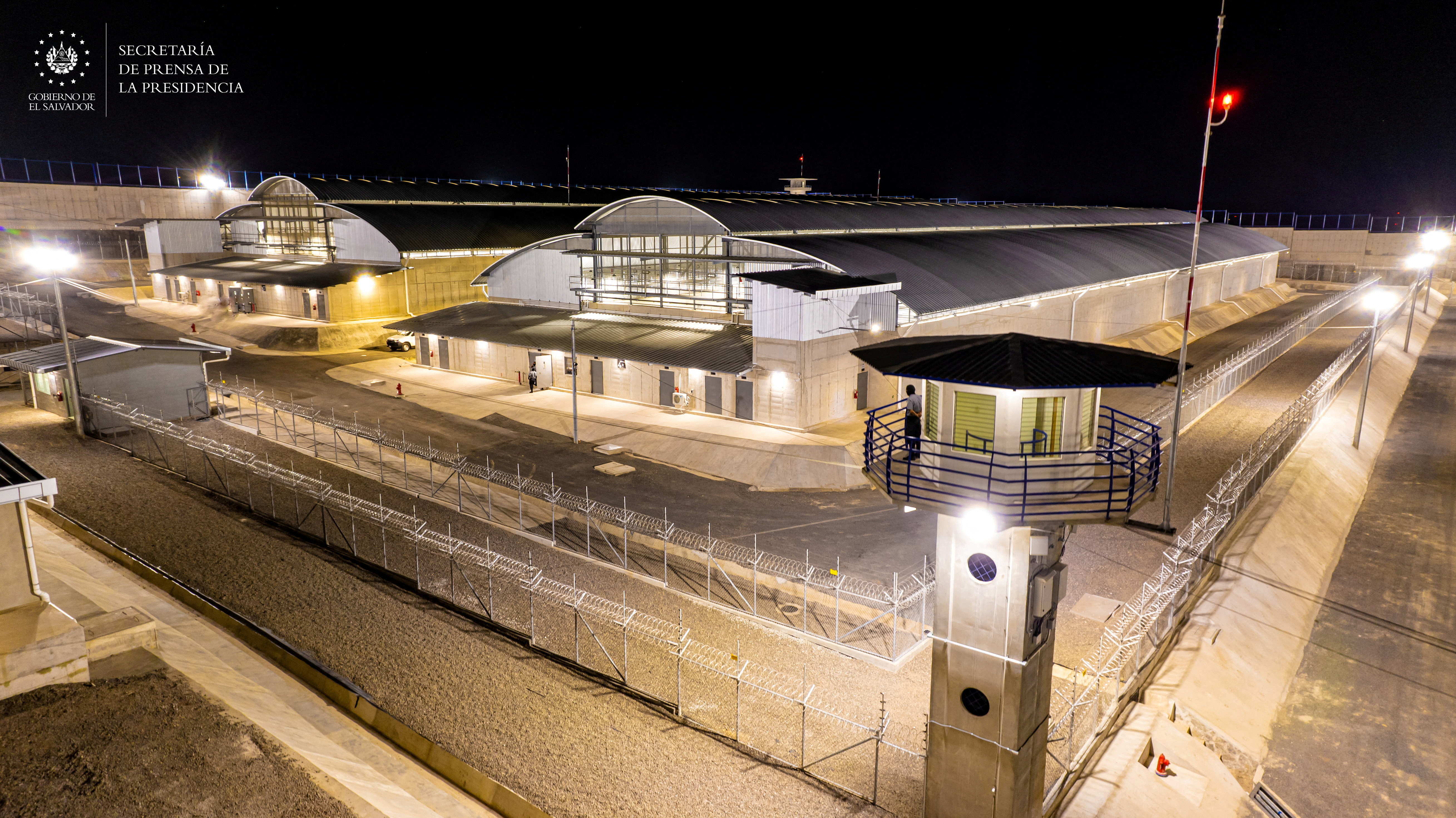
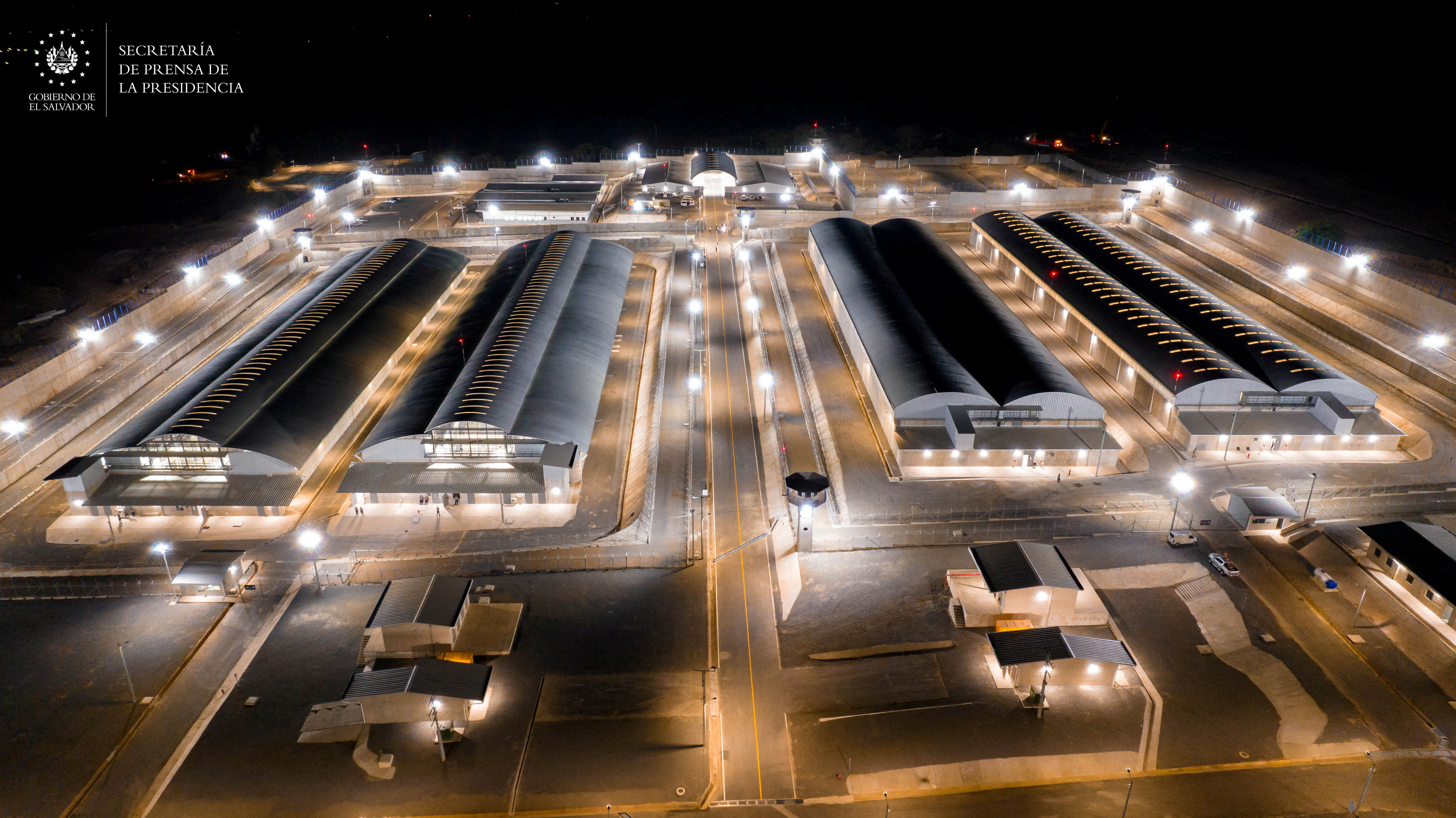


A general view shows the Terrorism Confinement Center in Tecoluca, El Salvador in a handout distributed to Reuters on February 1, 2023. Secretaria de Prensa de la Presidencia/Handout via REUTERS
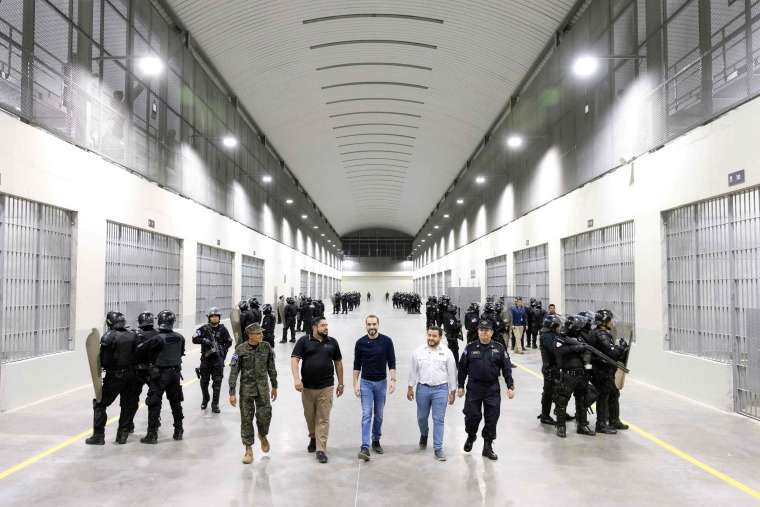

President Nayib Bukele, center, visits a newly inaugurated prison in an isolated rural area in a valley near Tecoluca, El Salvador, on Wednesday.El Salvador's Presidency Press Office/AFP via Getty Images


Feb. 2, 2023, 
By Reuters

SAN SALVADOR, El Salvador — Authorities in El Salvador have opened one of Latin America’s largest prisons, more than doubling the country’s incarceration capacity, as a government crackdown on criminal gangs is causing the prison population to soar.

The 40,000-capacity Terrorism Confinement Center was inaugurated on Tuesday to help relieve some of the overpopulation in the country’s prison system.

Since President Nayib Bukele asked the country’s congress to approve a state of exception in March, the police and army have arrested more than 62,000 suspected gang members and their collaborators.
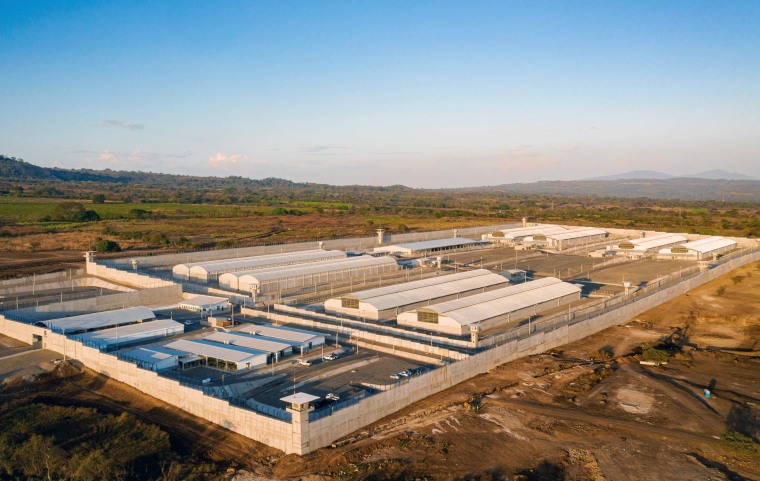
A newly inaugurated prison near Tecoluca, El Salvador, on Wednesday. 
El Salvador's Presidency Press Office/AFP via Getty Images

Under the measure some constitutional rights have been suspended, including allowing authorities to make arrests without a warrant and giving the government access to citizens’ communication.

With nearly two percent of its adult population behind bars, El Salvador has the highest incarceration rate in the world.

The rising inmate population as a result of the anti-gang measures, which the vast majority of the population supports, has stretched the country’s already overwhelmed prison system. El Salvador’s largest prison, La Esperanza, currently holds 33,000 people despite having a capacity of 10,000.

Recommended

El Salvador’s Prisons Director Osiris Luna said the new prison will span over 410 acres, while 600 troops and 250 police officers will secure it.

“All those home boys, those terrorists in the organization that made our beloved Salvadoran people suffer, will be house and subjected to a severe regimen,” Luna said on state television.

By 2021, El Salvador’s prison system had 20 penal centers with a capacity for 30,000 holding 35,976 prisoners.
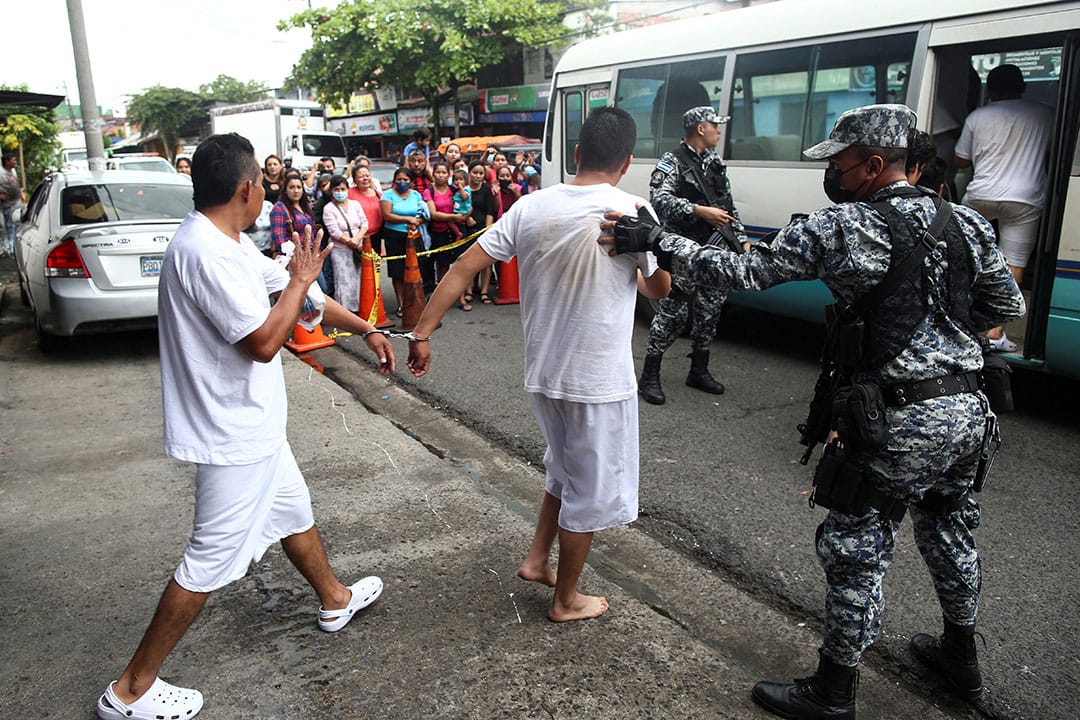
A Remedy for El Salvador’s Prison Fever


Detainees are moved to a prison by police officers as more than 37,000 people were detained during the state of emergency, according to the Ministry of Justice and Public Security, in San Salvador, El Salvador, June 7, 2022. REUTERS / Jose Cabezas
05 OCTOBER 2022

Following a spate of murders, the Salvadoran government ordered mass roundups of suspected criminal gang members, throwing more than 53,000 in jail. The clampdown is popular but unsustainable. Authorities should develop a path out of gang life that members can choose.


GENDER AND CONFLICT
EL SALVADOR


What’s new? A sudden uptick of violence in March, caused by the breakdown of talks between the government and criminal gangs, has sparked a ruthless six-month law enforcement campaign in El Salvador, anchored in unprecedented mass arrests and restriction of legal rights.

Why does it matter? Fed up with gang violence, most Salvadorans have applauded the crackdown. But it has also drawn criticism from human rights organisations and could boomerang. Having more than doubled the prison population, the country is headed for a humanitarian crisis in its jails, while gangs, though now in disarray, could strike back.

What should be done? Rather than commit to strong-arm tactics for the long term, the government should provide an off-ramp for the thousands of gang members willing to build new lives in law-abiding society. The country’s main foreign partners should support these efforts and revive their cooperation with San Salvador.

Executive Summary


To a chorus of popular support, El Salvador’s President Nayib Bukele has embarked on the largest dragnet of suspected gang members ever seen in Central America. Under a “state of exception” declared in March, the government has lengthened the period of detention without charge and lowered the age of prosecution to twelve. Police and troops have mounted checkpoints around and raids on poor districts overrun by gangs. Some 53,000 alleged criminals have been jailed on the basis of often dubious proof, many in overcrowded, unhygienic and dangerous conditions. The prison population now stands proportionally as the world’s highest, prompting authorities to break ground for a massive new facility. But although murder rates are touching new lows, with many gang members either jailed or on the run, the draconian policy raises other concerns that require attention. Gangs could regroup to retaliate while a humanitarian and human rights crisis festers in the country’s jails. For the country’s long-term benefit, authorities should develop a way for gang members to return to society as law-abiding citizens.

The crackdown’s severity is all the more startling in light of Bukele’s reported overtures to the criminal gangs that have tormented El Salvador for over two decades. Elected in 2019 as an outsider intent on supplanting a discredited two-party system, the extroverted young president boosted public services in places plagued by poverty and violence, where gangs find many of their recruits. According to media reports and first-hand testimony gathered by Crisis Group, his government also entered discreet talks with jailed and free gang leaders, spurring a steep reduction in homicide rates. In return, the authorities reportedly granted these leaders a number of concessions, including expedited release for some of them. During this period, the police and military reported fewer clashes with gangs and arrests of their members.

A shocking killing spree late in March, including the murder of 62 people on one day – the bloodiest 24 hours in recent Salvadoran history – provided the backdrop for Bukele’s abrupt change of tack. Yet even before this flare-up, there were reasons to doubt the government’s commitment to a negotiated demobilisation of gangs. The president has always denied that talks with gangs were happening, suggesting that negotiation was unlikely to be a pathway to a permanent settlement. As soon as his party won an absolute majority of seats in the legislature in 2021 elections, he worked with deputies to bury any evidence of talks by replacing the attorney general and shelving his predecessor’s investigation into the reported negotiations. The MS-13 gang has suggested it carried out the March killings because it felt betrayed by the government’s disavowal of the previous engagement, hinting that the president’s interest even in secretive talks had waned by then.
Bukele’s government has turned to heavy-handed tactics to respond to surges of gang violence in the past, but none compares to the present crackdown.

Bukele’s government has turned to heavy-handed tactics to respond to surges of gang violence in the past, but none compares to the present crackdown in either intensity or duration. With public support for the state of exception sky-high, Bukele seems convinced he is sounding the death knell for the country’s three main gangs. He fiercely rejects criticism of his methods.

But there are grounds for wondering whether Bukele will succeed. Although murder rates have reached historical lows, clashes between gangs and security personnel are on the rise. Gangs have leaked statements threatening to hit back harder if the government does not return to dialogue. The campaign to arrest anyone who has, has had or may have had a link with gangs could force former members back into crime if they see no hope of anything else. Mass arrests of former gang members who have converted to Christianity in order to quit gang life are troubling. Dire overcrowding, combined with the government’s refusal to take responsibility for what has gone wrong – from custodial deaths to wrongful arrests – could fuel tensions in jails, leading to mutinies and escapes. El Salvador’s experience in 2015 after its gang truce broke down, when the murder rate rose to the world’s highest, hints at the risks that may lie ahead. Adverse financial conditions, the threat of debt default and strained ties with the West make it all the more vital that Bukele shift to a security policy that is resilient, durable and internationally reputable.

El Salvador needs a more humane and sustainable approach to solving its gang problem. A crucial plank of such a policy would be the creation of a clear pathway out of gang life for jailed and free members. Even as they seek to profit politically from fighting crime, Bukele and his senior officials should be mindful of the innate dangers of a huge prison population, which must be fed and housed, and begin looking for ways to release jailed suspects and convicts subject to their monitored participation in rehabilitation programs. Various bills to create a national rehabilitation scheme have been tabled in the country’s Legislative Assembly over recent years, but none has prospered; these should be revived. A rehabilitation and reintegration initiative should include measures that promote employment for former gang members, with support from churches and civil society. To help communities accept the gang members who may come to live among them, San Salvador should also promote restorative justice for victims of violence. Support from large donors, including the U.S. and European Union, will likely be key to making this initiative a reality.

Bukele has so far shown little interest in slowing his pursuit of gangs’ unconditional surrender. But the humanitarian and reputational costs as well as the risks of a return to extremes of lethal violence make it imperative that the government prepare an alternative way out for the jailed population. Force may put the gangs on the run for a period of time, but it will take much more to begin dismantling them for good.

KEEP READING


PDF DOWNLOAD


MEANWHILE IN PRISON NATION U$A

Mass Incarceration: The Whole Pie 

2022 | Prison Policy Initiative

Can it really be true that most people in jail are legally innocent? How much of mass incarceration is a result of the war on drugs, or the profit motives of private prisons? How has the COVID-19 pandemic changed decisions about how people are punished when they break the law? These essential questions are harder to answer than you might expect. The various government agencies involved in the criminal legal system collect a lot of data, but very little is designed to help policymakers or the public understand what’s going on. As public support for criminal justice reform continues to build — and as the pandemic raises the stakes higher — it’s more important than ever that we get the facts straight and understand the big picture.

Further complicating matters is the fact that the U.S. doesn’t have one “criminal justice system;” instead, we have thousands of federal, state, local, and tribal systems. Together, these systems hold almost 2 million people in 1,566 state prisons, 102 federal prisons, 2,850 local jails, 1,510 juvenile correctional facilities, 186 immigration detention facilities, and 82 Indian country jails, as well as in military prisons, civil commitment centers, state psychiatric hospitals, and prisons in the U.S. territories. 

This report offers some much-needed clarity by piecing together the data about this country’s disparate systems of confinement. It provides a detailed look at where and why people are locked up in the U.S., and dispels some modern myths to focus attention on the real drivers of mass incarceration and overlooked issues that call for reform.




Thursday, June 19, 2025

El Salvador in “darkest moment” for press freedom since civil war, rights groups say

El Salvador in “darkest moment” for press freedom since civil war, rights groups say
The media freedom deterioration has unfolded under President Nayib Bukele, a darling of US President Trump who gained popularity for his successful crackdown on gang violence but has faced growing criticism from human rights groups.
By bnl editorial staff June 19, 2025

Seventeen international press freedom organisations have issued a joint statement expressing "deep alarm" at what they describe as an accelerated deterioration of press freedom in El Salvador, with at least 40 journalists forced to flee the country in recent weeks.

The Association of Journalists of El Salvador (APES) documented the departures, which it attributed to "a sustained pattern of harassment, intimidation, and arbitrary restrictions on journalistic work," according to the statement released on June 18.

The journalists who have left the country come from various media outlets and had conducted investigations into human rights abuses, corruption, and government transparency issues, the organisations said. The exodus has "triggered a profound crisis of freedom of expression and created a climate of widespread fear," affecting even the families of exiled journalists.

APES has raised concerns about alleged watchlists and threats of arrest targeting journalists and human rights defenders, including those from the investigative outlet El Faro, the statement said.

The situation has been compounded by the recent passage of El Salvador's Foreign Agents Law, which the organisations described as posing "a direct threat to press freedom and the work of independent organisations." The legislation "imposes severe restrictions and could be used as a tool of persecution against those who practice journalism or defend fundamental rights," they warned.

Recent fact-finding missions by international press freedom organisations concluded that El Salvador is experiencing "one of its darkest moments for press freedom since the end of the armed conflict," characterised by high levels of self-censorship and forced exile.

The signatories, which include the Committee to Protect Journalists, Reporters Without Borders, and the Inter American Press Association, called on the Salvadoran government to "guarantee the physical integrity and freedom of all journalists and immediately cease any form of persecution, surveillance, or intimidation."

They demanded that the Salvadoran state "publicly clarify reports of watchlists and threats of arrests and to ensure that critical voices are not being criminalised."

The organisations also called for security guarantees to allow journalists who have been forced to flee to return without fear of persecution or legal action.

"The international community is closely monitoring the situation and demands the unrestricted respect for freedom of the press and expression in El Salvador," the statement said.

The joint statement was signed by 17 organisations from across the Americas and Europe, including regional press associations from Mexico, Colombia, Argentina, Chile, Brazil, and Peru, as well as global bodies such as the World Association of News Publishers and PEN International.

The media freedom deterioration has unfolded under President Nayib Bukele, who won re-election in February 2024 despite constitutional questions over consecutive terms.

"I don't care if they call me a dictator. I'd rather be called a dictator than see Salvadorans killed in the streets," Bukele publicly stated earlier this month. The 44-year-old flamboyant president, a darling of US President Donald Trump who was first elected in 2019 and returned to office in a landslide last year, accused NGOs of defending criminals and suggested the press was participating in an "organised attack" led by international groups. Since then, his administration has tightened regulations on NGOs’ activities following a playbook seen in some Eastern European countries such as Russia and Georgia, which have adopted controversial "foreign agents laws."

Bukele's second term has been marked by closer cooperation with the Trump administration on deportations and what critics characterise as increasing pressure on human rights. Under emergency laws bypassing judicial review, El Salvador has accepted over 200 migrants, mostly Venezuelans and some Salvadorans, deported from the United States since March, with many housed at the Cecot megaprison on allegations of links to criminal organisations, including MS-13 and Tren de Aragua.

Bukele has gained popularity for his successful crackdown on gang violence through a state of emergency declared in 2022, but has faced growing criticism from human rights groups over perceived authoritarian tendencies and restrictions on civil liberties.

Saturday, July 16, 2022

CANADA'S FORGOTTEN COLONY
At least 234 dead or hurt in Haiti gang violence from July 8-12: UN


Christophe VOGT
Sat, July 16, 2022


Gang violence killed or injured at least 234 people from July 8-12 in Haiti's Cite Soleil, an impoverished and densely populated neighbourhood of the capital Port-au-Prince, the United Nations said on Saturday.

The unrest erupted between two rival factions and the city's ill-equipped and understaffed police failed to intervene, trapping residents in their homes, unable to go out for even food and water.

With many houses in the slums made of sheet metal, residents fell victim to stray bullets. Ambulances were unable to reach those in need.

"Most of the victims were not directly involved in gangs and were directly targeted by gang elements. We have also received new reports of sexual violence," said UN human rights office spokesperson Jeremy Laurence.


Earlier this week, the National Human Rights Defense Network, a Haitian organisation, had put the toll at 89 people killed, 16 unaccounted for and 74 wounded.


For the six months from January to June, the UN human rights office put the death toll at 934, with 684 more people wounded. A total of 680 kidnappings also occurred during that period, it said.

"We are deeply concerned by the worsening of violence in Port-au-Prince and the rise in human rights abuses committed by heavily armed gangs against the local population," Laurence said.

"We urge the authorities to ensure that all human rights are protected and placed at the front and centre of their responses to the crisis."

The bloodshed in Haiti has come alongside soaring food prices and chronic fuel shortages -- a toxic mix that has accelerated a brutal downward spiral in the security situation in Port-au-Prince.
- 'Desist'-

Aid agencies say many areas are impossible to access due to the dangerous conditions.


"We call on those responsible and supporting this armed violence to immediately desist, and to respect the lives and livelihoods of all Haitians, most of whom live in extreme poverty," Laurence said.

Mumuza Muhindo, head of the local mission of Doctors Without Borders, told AFP that his group had operated on an average of 15 patients a day during the spike in violence.

"It's a real battlefield," Muhindo said. "It's impossible to estimate how many people have been killed."

Cite Soleil is home to an oil terminal that supplies the capital and all of northern Haiti, so the clashes have had a devastating effect on the region's economy and people's daily lives.

Petrol stations in Port-au-Prince have no petrol to sell, causing prices on the black market to skyrocket.

"We are seeing a significant increase in hunger in the capital and in the south of the country, with Port-au-Prince hit the hardest," Jean-Martin Bauer, director of the World Food Programme, said on Tuesday.

For the past several years, Haiti has seen a wave of mass kidnappings, as gangs snatch people of all walks of life, including foreigners, off the streets.

Emboldened by police inaction, gangs have become increasingly brazen.

Haiti announced a rare seizure of weapons in cargo containers late Thursday: 18 military grade weapons, four 9mm handguns, 14,646 rounds of ammunition and $50,000 in counterfeit money.

The following day, the UN Security Council called on member states to ban the transfer of small arms to the Caribbean nation but stopped short of a full embargo requested by China.

UN Council urges halt to small arms reaching Haiti gangs

The U.N. Security Council has unanimously approved a resolution that calls on all countries to stop the transfer of small arms, light weapons and ammunition to any party in crisis-torn Haiti supporting gang violence and criminal activity

ByEDITH M. LEDERER Associated Press
July 15, 2022


Police drive their car over a barricade set up by taxi drivers to protest fuel shortages in Port-au-Prince, Haiti, Thursday, July 14, 2022. (AP Photo/Odelyn Joseph)
The Associated Press

UNITED NATIONS -- The U.N. Security Council unanimously approved a resolution Friday that calls on all countries to stop the transfer of small arms, light weapons and ammunition to any party in crisis-torn Haiti supporting gang violence and criminal activity.

Haiti is experiencing escalating bloodshed and kidnappings by criminal gangs, and China had proposed a rival text that would have authorized a U.N. arms embargo on the Western Hemisphere’s poorest country. But other council members said an embargo would be unenforceable.

The resolution drafted by the United States and Mexico that was approved on a 15-0 vote Friday does demand an immediate cessation of gang violence and criminal activities, as China wanted.

It also expresses the council’s readiness to impose sanctions that could include travel bans and assets freezes “as necessary” on individuals engaged in or supporting gang violence, criminal activity or human rights violations in Haiti within 90 days of the resolution’s adoption. That language is weaker than China’s proposal, which called for action within 30 days.

The back and forth came in negotiations over a resolution to extend the mandate for the U.N. political mission in Haiti. The council’s previous authorization for the mission expired Friday.

The U.S.-Mexico resolution extends the mission, known as BINUH, until July 15, 2023. China wanted an extension until Oct. 15, 2023.

U.S. deputy ambassador Richard Mills said the resolution sponsored with Mexico will allow the U.N. mission to “continue its critical advisory efforts in support of facilitating political dialogue, enhancing the capacity of the Haitian National Police to address gang violence and protecting human rights.”

China’s U.N. ambassador, Zhang Jun, said the resolution could have been stronger, but called it “a right step in the right direction” in warning Haiti's gangs.

“The gangsters must immediately stop violence and criminal activities and the occupation of public facilities and roads, and seas, all acts of human rights violations,” Zhang added.

The adopted resolution, put in final form late Thursday, makes no mention of China’s call for Secretary-General Antonio Guterres to discuss with various parties possibly establishing “a multinational police unit” to help Haitian police tackle gang violence.

Instead, it asks Guterres to consult with Haiti’s government, “relevant countries” and regional organizations on “possible options for enhanced security support … to combat high levels of gang violence” and to submit a report by Oct. 15.

The resolution adopted Friday retained the original U.S.-Mexico draft's call for beefing up the U.N. mission to include up to 42 police and corrections department advisers, led by a U.N. police commissioner, and staff to ensure that sexual and gender-based violence are addressed.

When the current resolution extending the U.N. mission was adopted in October, Haiti had been contending with the assassination of President Jovenel Moïse last July, a magnitude 7.2 earthquake that killed over 2,200 people in August, and escalating gang-related killings, kidnappings and turf wars.

A year after Moïse’s assassination, gang violence is even worse, and Haiti has gone into a freefall that has seen the economy tumble and many Haitians flee the country to escape the turmoil. At the same time, attempts to form a coalition government have faltered, and efforts to hold general elections have stalled.

This week, officials in Haiti’s capital reported that dozens of people had died as a result of days of fighting between rival gangs in the violent Cite Soleil neighborhood. Doctors Without Borders said thousands of people were trapped in the district without drinking water, food and medical care.

The resolution approved Friday expresses “grave concern about the extremely high levels of gang violence and other criminal activities, including kidnappings and homicides, and sexual and gender-based violence, as well as ongoing impunity for perpetrators, and the implications of Haiti’s situation in the region.”

It notes “with deep concern the protracted and deteriorating political, economic, security, human rights and food security crisis in Haiti.”

The resolution urges the government to strengthen the rule of law, tackle social and economic problems, initiate violence reduction programs, singling out the need to target sexual violence and manage weapons and ammunition. It also calls for the illicit trafficking and diversion of arms and illicit financial flows to be urgently addressed.

The United Nations has been involved in Haiti on and off since 1990, and the last U.N. peacekeeping mission was in the country from 2004 until October 2017. The political mission now there advises Haiti’s government on “promoting and strengthening political stability and good governance,” including the implementing the rule of law, inclusive national dialogue and protecting and protection of human rights.

Saturday, May 25, 2024

US MISSIONARIES KILLED BY HAITI GANGS

WILL THIS BE USED TO JUSTIFY INVASION?!

DW

A US missionary couple were among three people killed in gang violence in Haiti. Violence and political turmoil has gripped the country for months.

Haitian gang killed three missionaries, including a married couple from the United States,  in Port-au-Prince, the capital of Haiti.

Missions in Haiti, an Oklahoma-based nonprofit founded in 2000, said Davy and Natalie Lloyd and the local director of the mission group, Jude Montis, were killed by armed men on Thursday evening.

Missouri State Senator's children among the dead

Natalie's father is Missouri State Senator Ben Baker , and Davy is the son of David and Alicia Lloyd, who started the organization Missions in Haiti in 2000.

"My heart is broken in a thousand pieces. I've never felt this kind of pain," Baker said in a Facebook post. He later posted that their bodies had been retrieved, and they are working to repatriate them to the US.

Missions in Haiti said the couple was leaving a church when they were ambushed by three trucks full of gang members. They took David to a house and assaulted and robbed him.

As people were helping untie Davy Lloyd, another group of gunmen showed up and "went into full attack mode." 

The couple and Montis fled to a house connected to the mission. "They tried to take cover in there, but the gang shot up the house."

The missionary group later confirmed that all three were dead.

Security situation in Haiti

A spokesman for UN Secretary-General Antonio Guterres said it was "just another example of the violence that spares no one in Haiti."

Haiti has seen months of unrest and violence under an unstable political situation. US Secretary of State Antony Blinken said the country is close to becoming a failed state.

Haiti finally reopened its international airport in the capital, Port-au-Prince, after months of closure due to gang violence. But gangs are still in control of many parts of the country.

The gangs' biggest demand was the resignation of Prime Minister Ariel Henry, who has since stepped down from his position. Haiti has not had a sitting president since the assassination of Jovenel Moise in 2021 and has no sitting parliament.

transitional council has been appointed to hold elections, the country's first since 2016. Meanwhile, food scarcity, a collapse of the healthcare system and violence has forced thousands to flee their homes.

Responding to the deaths, the White House called for the swift deployment of a Kenyan-led multinational force in Haiti to tackle rampant gang violence.

"The security situation in Haiti cannot wait," said a National Security Council spokesperson, stressing that President Joe Biden had pledged to support the "expedited deployment" of the force in talks with Kenya's president on Thursday.


A young couple from the U.S. were among 3 missionaries killed in Haiti violence


MAY 25, 2024
The Associated Press

Davy and Natalie Lloyd were among three missionaries killed in Haiti after being ambushed at the Port-au-Prince, officials with the mission organization said Friday, May 24, 2024. The third victim was Jude Montis, who was the country's director of Missions In Haiti Inc.
Brad Searcy Photography/via AP

PORT-AU-PRINCE, Haiti — A U.S. missionary couple and a Haitian man who worked with them were shot and killed by gang members in Haiti's capital after they were attacked while leaving a youth group activity held at a local church, a family member said Friday.

The attack happened Thursday evening in the community of Lizon in northern Port-au-Prince, Lionel Lazarre, head of a Haitian police union, told The Associated Press.

The slayings occurred as the capital crumbles under the relentless assault of violent gangs that control 80% of Port-au-Prince while authorities await the arrival of a police force from Kenya as part of a U.N.-backed deployment aimed at quelling gang violence in the troubled Caribbean country.

Two of the victims were a young married couple, Davy and Natalie Lloyd, according to a Facebook posting from Natalie Lloyd's father, Missouri state Rep. Ben Baker. The third victim was Jude Montis, who was the country's director of Missions In Haiti Inc.


Haiti's notorious gang leader, Barbecue, says his forces are ready for a long fight

"My heart is broken in a thousand pieces," Baker wrote on Facebook on Thursday. "I've never felt this kind of pain. Most of you know my daughter and son-in-law Davy and Natalie Lloyd are full time missionaries in Haiti. They were attacked by gangs this evening and were both killed. They went to Heaven together."

Hannah Cornett, Davy Lloyd's sister, told the AP that her brother was 23 years old and Natalie Lloyd was 21. They were going to celebrate their two-year anniversary in June and his birthday in early July.

Cornett said her parents are full-time missionaries in Haiti, and that she and her two brothers grew up there.

"Davy spoke Creole before he spoke English. It was home," she said in a phone interview. "Haiti was all we knew."

Cornett, 22, said her parents run an orphanage, school and church in Haiti, and that she and her brothers grew up with the orphans: "It was just one big happy family there."

The announcement of a new prime minister divides Haiti's transitional council

She said her older brother was outgoing, had built a garden and raised a lot of animals. While he went back to the U.S. for Bible college and then got married, he returned to Haiti with Natalie Lloyd to do more humanitarian work.

"They just had a lot of love for Haiti, and they just wanted to help the people there," Cornett said. "That's their calling."

Cornett noted that Montis worked with her parents for 20 years and left behind two children, ages 2 and 6.
Sponsor Message


She said the night of the attack, three vehicles carrying gang members stopped the Lloyds and Montis as they crossed the street, hitting her brother in the head with the barrel of a gun. They forced him upstairs, stole their belongings and left him tied up. As people were helping untie Davy Lloyd, another group of armed gunmen showed up.

"Nobody knows what happened," she said.

An unidentified person got shot and the gunmen opened fire as the Lloyds and Montis fled to the house where her parents live, Cornett said.


A portrait of Haitians trying to survive without a government

"They tried to take cover in there, but the gang shot up the house," she said, adding that they were killed and their bodies set on fire.

Cornett said her mother flew back from Haiti about a month ago, and that her father and younger brother flew out Wednesday because things had been so calm in the neighborhood.

"Nobody expected this to happen," she said between tears.

On Friday afternoon, Baker posted on Facebook that the bodies of Davy and Natalie Lloyd were safely transported to the U.S. Embassy.

The couple worked for Missions In Haiti Inc. The Claremore, Oklahoma, organization was founded by David and Alicia Lloyd, Davy Lloyd's parents. Natalie Lloyd's Facebook page said the couple married on June 18, 2022, and she began working with the missionary organization in August 2022. She frequently posted photos of Haitian children on her page.

A Facebook posting on the Missions In Haiti page late Thursday read: "Around midnight: Davy and Natalie and Jude were shot and killed by the gang about 9 o'clock this evening. We all are devastated."

Alicia Lloyd, mother of Davy Lloyd, told the Oklahoma-based Claremore Daily Progress newspaper that her son "was one of these people who could do anything."

"I hope something good can come out of this. We don't see it now, but we don't want (their lives) to be in vain," she was quoted as saying.

U.S. Department of State spokesman Matthew Miller said the ambassador in Haiti was in touch with the families "who we know are experiencing unimaginable grief."

"Unfortunately, this serves as a reminder that the security situation in Haiti cannot wait – too many innocent lives are being lost," he said in a statement as he noted the U.S. government's commitment for a swift deployment of the Kenyan-led mission.

It wasn't immediately clear which gang or gangs were responsible for the fatal shootings.

However, a gang leader called Chyen Mechan, which means "mean dog" in Haitian Creole, controls the area where the shooting occurred. His real name is Claudy Célestin, and he is a dismissed civil servant from Haiti's Ministry of the Interior.

The leader of another gang known as General Jeff also controls territory near the neighborhood where the couple was killed. Both gangs are part of a coalition known as Viv Ansanm, which means "Live Together."

The coalition is responsible for launching large-scale attacks on key government infrastructure starting Feb. 29. Gunmen have attacked police stations, opened fire on the main international airport that remained closed for nearly three months before opening earlier this week and stormed Haiti's two biggest prisons, releasing more than 4,000 inmates.

Gangs also are blamed for killing or injuring more than 2,500 people across Haiti from January to March, a 50% increase compared with the same period last year, according to the United Nations. In addition, more than 360,000 people have been forced to flee their homes by gangs who control 80% of Port-au-Prince.

Kidnappings also are rampant, with targets including U.S. missionaries.

In October 2021, gang members kidnapped 17 missionaries, the majority U.S. citizens. Many in the group, which included five children, were held captive for more than two months before escaping.

Then in July 2023, gangs kidnapped a U.S. nurse and her daughter from the campus of a Christian-run school near Port-au-Prince. They were released nearly two weeks later.
Sponsor Message

The U.S. Department of State has long had a "do not travel" advisory for Haiti and urges any U.S. citizens in the country to depart as soon as possible.

On the Missions In Haiti website, the founders wrote that the organization was founded in 2000. It said it aimed to help with "the country's biggest need — its children."

A May 2023 newsletter posted on the mission website said Natalie "has been helping with the kids at the House of Compassion and assisting in our ACE school. Davy has been working on a lot of badly needed projects around our compound," including building a laundry room and repairing bathrooms.

Monday, October 28, 2024

GOVERNMENT OF THE STREETS

Gang coalition in Haiti spreads violence to Port-au-Prince neighborhood, setting fire to homes

PIERRE-RICHARD LUXAMA and EVENS SANON
Sat, October 26, 2024 

A resident, with a dresser attached to the back of his motorbike, flees his home escaping gang violence in the Solino neighborhood of Port-au-Prince, Haiti, Saturday, Oct. 26, 2024. 

Residents pack up their belongings to flee their homes to escape gang violence in the Solino neighborhood of Port-au-Prince, Haiti, Saturday, Oct. 26, 2024.

Cars are used as barricades to prevent entry of gang members into the Nazon neighborhood of Port-au-Prince, Haiti, Saturday, Oct. 26, 2024.

A residents flee their home escaping gang violence in the Solino neighborhood of Port-au-Prince, Haiti, Saturday, Oct. 26, 2024. 
(AP Photo/Odelyn Joseph)


PORT-AU-PRINCE, Haiti (AP) — A gang coalition on Saturday reinforced its attacks on one of the few communities in the Haitian capital not under the control of criminal groups, seeking to take it over.

After a week of clashes with the police in the Solino neighborhood in Port-au-Prince, members of the gang coalition, Viv Ansanm, attacked once again, setting fire to several homes, as the national police union warned that the area was almost under total control of the gunmen.

As morning broke on Saturday, images from social media showed the neighborhood engulfed in smoke and flames. Many people were seen leaving the area with whatever they could carry. Security forces and armed individuals exchanged fire not far from Solino’s police base.

“Solino and Nazon almost lost!” said SPNH-17, a national police union, on X Saturday morning. It also demanded the resignation of authorities. Nazon, another neighborhood right by Solino, also came under attack.

Viv Ansanm, which means “Living Together,” formed in September 2023 as a coalition of two gang federations that were previously enemies. It was responsible for several attacks on critical government infrastructure in February which eventually led to the resignation of Prime Minister Ariel Henry.

On Thursday, the gangs also opened fire and hit a U.N. helicopter, forcing it to make an emergency landing in Port-au-Prince, with one U.S. airline Friday temporarily cancelling flights to the capital. Since last week, residents in Solino have been calling radio stations pleading for help as they fled their homes.

In Solino, Garry Jean-Joseph, 33, blamed the police for the ongoing violence. “I left with nothing,” he said. “The people of Solino do not understand last night, the conspiracy of the policemen and the Live Together (Viv Ansanm) soldiers."

The resident described how at 2 a.m., a policeman in an armored car told residents to go home and that they would secure the neighborhood. However, shortly afterward residents could hear gangs invading. “The police delivered Solino,” he added.

Some officers with Haiti's National Police have been long accused of corruption and working with gangs.

The attacks have displaced more than 10,000 people in the capital in just one week, according to a report released Thursday by the U.N.’s International Organization for Migration. More than half of those left homeless crowded into 14 makeshift shelters, including schools. The remainder are temporarily staying with relatives.

Gangs control 80% of Port-au-Prince, although communities like Solino have been fighting attempts by gunmen to seize control. As gang violence surges across Haiti’s capital and beyond in recent days, concerns have been raise that a U.N.-backed mission led by Kenyan police is struggling to contain the unrest. Thousands of people have been killed or injured this year, and more than 700,000 have been left homeless in recent years.

U.S. and Haitian officials including interim President of Haiti Leslie Voltaire have said the Kenyan mission lacks personnel and funding and have requested that it be replaced by a U.N. peacekeeping mission.


Residents in Haiti's capital flee homes as gangs expand control
Reuters
Sat, October 26, 2024 


Haitians flee homes from gang violence, in Port-au-Prince

Haitians flee homes from gang violence, in Port-au-Prince
Yahoo is using AI to generate takeaways from this article. This means the info may not always match what's in the article. Reporting mistakes helps us improve the experience.Generate Key Takeaways


PORT-AU-PRINCE (Reuters) - A gang attack in Port-au-Prince forced residents to flee their homes on Saturday as the gangs operating in and around the Haitian capital ramp up attacks on areas they do not yet control.

Smoke from gunfights billowed above the capital's Solino neighborhood, where fleeing residents strapped mattresses, furniture, cooking supplies and other possessions to trucks.

Others fled on foot carrying what belongings they could.

Gangs have been escalating their attacks on a number of towns in and around the capital, where much of the city and its suburbs are under the control of various violent armed groups united under a common alliance known as Viv Ansanm.

In Solino, thousands of residents have been displaced in recent days, including people who had previously been displaced from other neighborhoods, the U.N.'s World Food Programme (WFP) said in a press conference on Friday.

The total number of displaced people in Haiti has doubled in the past three months to almost 700,000, the WFP said.

"I can't count the number of times I've left my house ... Every time I arrive in a new area, I run away," said one man who did not wish to be identified.

Exasperated Solino resident Kettelie Morose, who said she suffers from hypertension and other illnesses, said that "bandits" had kicked her out of her home.

"I'm responsible for several children and I don't know what to do," she said.

Haiti's security crisis continues to fuel the Caribbean nation's humanitarian disaster. The World Food Programme said on Friday that 5.4 million Haitians, or roughly half of the population, is suffering from acute hunger, with pockets of famine-level hunger being reported among internally displaced people.

A U.N. helicopter aiding humanitarian efforts was hit by gunfire on Thursday while flying over Port-au-Prince, later landing safely, the WFP said.

While the U.N. authorized an international force to help Haiti's police take back control from the gangs, the mission has been poorly resourced and has produced scant results.


More than 10,000 Haitians flee gang attacks in past week, UN says

Reuters
Updated Thu, October 24, 2024 

Haitians flee homes from gang violence, in Port-au-Prince

FILE PHOTO: Haitians flee homes from gang violence, in Port-au-Prince

Haitians flee homes from gang violence, in Port-au-Prince

Haitians flee homes from gang violence, in Port-au-Prince

PORT-AU-PRINCE (Reuters) - More than 10,000 people in Haiti have been internally displaced in the last week as armed gangs operating in and around the capital Port-au-Prince ramp up attacks on areas they do not yet control, according U.N. migration agency estimates on Thursday.

The agency had said at the start of September that more than 700,000 people were internally displaced across the Caribbean nation, nearly double the figure six months earlier.

Gangs have in the last week been ramping up attacks on a number of towns outside the capital, where much of the city and its suburbs is under the control of various violent armed groups united under a common alliance known as Viv Ansanm.

The conflict is fueling famine-level hunger in parts of the population as gangs take over farmlands and block off transport routes, while people forced to flee their homes - often to host families or makeshift camps - can no longer depend on steady income to afford food.

While the U.N. authorized an international force to help Haiti's police take back control from the gangs, the mission has been poorly resourced and has produced scant results.

Haiti's leadership has requested the force be converted to a formal peacekeeping mission in order to shore up resources, an initiative that was blocked last month by China and Russia.

Gangs who previously targeted national police, civilian self-defense groups and state infrastructure have also began targeting foreign vehicles.

The U.S. embassy in Haiti told Reuters that on Monday, two of its armored vehicles had been targeted by gang gunfire. One was hit by multiple rounds though no one was hurt or injured.

A marked U.N. helicopter with 18 people aboard was also hit by gunfire on Thursday while flying over Port-au-Prince, the U.N.'s World Food Programme said in a statement to Reuters.

No one was injured and the helicopter landed safely, according to the WFP.

(Reporting by Sarah Morland and Harold Isaac; Editing by Brendan O'Boyle and Christopher Cushing)


Gangs in Haiti open fire and hit a UN helicopter midair as violence surges

DÁNICA COTO and EVENS SANON
Updated Thu, October 24, 2024 

Soldiers patrol amid the sound of gunshots heard in the distance, in Port-au-Prince, Haiti, Thursday, Oct. 17, 2024. (AP Photo/Odelyn Joseph)

PORT-AU-PRINCE, Haiti (AP) — Gangs on Thursday opened fire and hit a U.N. helicopter, forcing it to land in Port-au-Prince in the latest attack in Haiti's capital as violence surges once again.

No one was injured as several rounds of gunfire hit the helicopter that was carrying three crew members and 15 passengers, according to a U.N. source who was not authorized to confirm the incident. The helicopter, which had departed from Port-au-Prince before it was attacked, landed safely, the source said.

The attack comes five months after Haiti's main international airport reopened following coordinated gang attacks that forced it to close for nearly three months.

The violence has spilled to nearby areas including Arcahaie, where some 50 suspected gang members died this week after attacking the coastal town located just northwest of the capital. Among the dead are at least a dozen gunmen who drowned after their boat capsized, a government official said Thursday.

While the majority were killed by police, a group of gunmen drowned on Wednesday after their boat hit the reef as they ferried ammunition to gangs attacking the town of Arcahaie, said Wilner Réné from Haiti’s Civil Protection Agency.

He told Radio Caraïbes that the attack began on Monday, with gunmen burning homes and cars across Arcahaie.

When the gangs ran out of ammunition, they hid in nearby areas and were ferreted out by residents and police, he said.

The attack is still ongoing, and Réné warned that officers on the scene urgently need reinforcements from soldiers and special police units.

The attack is blamed on a gang coalition called Viv Ansanm, which also has targeted communities in Port-au-Prince in recent days. Those attacks have displaced more than 10,000 people in the capital in just one week, according to a report released Thursday by the U.N.'s International Organization for Migration. More than half of those left homeless crowded into 14 makeshift shelters, including schools. The remainder are temporarily staying with relatives.

The spike in gang violence comes just months after a U.N.-backed mission led by Kenyan police began with the aim of quelling a surge in violence from gangs, who control more than 80% of Port-au-Prince. More than 700,000 people have been left homeless, and thousands have been killed.

The U.S. government and top Haitian officials have warned that the Kenyan-led mission lacks personnel and funding and have asked that it be replaced with a U.N.-peacekeeping mission.

___

Coto reported from San Juan, Puerto Rico

Monday, November 11, 2024


Spirit Airlines flight hit by gunfire as gang violence shuts down Haiti's main airport

Violence comes on same day that a new interim prime minister was sworn in

A police officer looks on during an exchange of gunfire between gangs and police in Haiti
A police officer looks on during an exchange of gunfire between gangs and police in Port-au-Prince, Haiti, on Monday. Firefights between gangs and police broke out in parts of Haiti's capital, the same day a new interim prime minister was expected to take over. (Odelyn Joseph/The Associated Press)

Haiti's international airport shut down on Monday after gangs opened fire at a commercial flight landing in Port-au-Prince, prompting some airlines to temporarily suspend operations as the country swore in a new interim prime minister who promised to restore peace.

The Spirit Airlines flight headed from Fort Lauderdale, Fla., to Port-Au-Prince was close to landing in Haiti's capital when gangs shot at the plane, striking a flight attendant, who suffered minor injuries, according to the airline, the U.S. Embassy and flight tracking data. The flight was diverted and landed in the Dominican Republic.

Photos and videos obtained by The Associated Press show bullet holes dotting the interior of a plane.

The shooting appeared to be part of what the U.S. Embassy called "gang-led efforts to block travel to and from Port-au-Prince, which may include armed violence and disruptions to roads, ports and airports."

Spirit, JetBlue and American Airlines said Monday they were cancelling flights to and from Haiti. Air Transat also said in a statement it has cancelled its Nov. 13 flights between Montreal and Port-au-Prince.

A man lays on the sidewalk while another man crouches above him with a gun as they hide behind a car avoiding gunfire.
Journalists take cover from the exchange of gunfire between gangs and police in Port-au-Prince on Monday. (Odelyn Joseph/The Associated Press)

JetBlue Airways said late on Monday it will extend a halt to all flights to and from Haiti through Dec. 2 after damage from a bullet to a plane returning from Port-au-Prince was discovered.

Earlier, the U.S. Embassy in Haiti issued a travel warning saying that the city's airport was shut down due to "gang-led efforts to block travel to and from Port-au-Prince, which may include armed violence and disruptions to roads, ports and airports."

"The U.S. Embassy is aware of a temporary pause in operations at [Toussiant Louverture International Airport] as of Nov. 11," the embassy's statement said. "The security situation in Haiti is unpredictable and dangerous."

In other parts of Haiti's capital, firefights between gangs and police broke out. Rounds of gunfire echoed through the streets as heavily armed officers ducked behind walls and civilians ran in terror. In other upper-class areas, gangs set fire to homes. Schools closed as panic spread in a number of areas.

New PM sworn in Monday

The turmoil comes a day after a council meant to re-establish democratic order in the Caribbean country fired the interim prime minister, Garry Conille, replacing him with businessman Alix Didier Fils-Aimé. The council has been marked by infighting and three members were recently accused of corruption.

As he was sworn in, Fils-Aimé said his top priorities were to restore peace to the crisis-stricken country and hold elections, which haven't been held in Haiti since 2016.

A man gives the thumbs-up during a ceremony.
Haiti's new interim prime minister, Alix Didier Fils-Aimé, centre, reacts after his inauguration ceremony in Port-au-Prince on Monday. (Odelyn Joseph/The Associated Press)

"There is a lot to be done to bring back hope," he said before a room of suit-clad diplomats and security officials. "I'm deeply sorry for the people ... that have been victimized, forced to leave everything they own."

The country has seen weeks of political chaos, which observers warned could result in even more violence in a place where bloodshed has become the new normal. The country's slate of gangs have long capitalized on political turmoil to make power grabs, shutting down airports, shipping ports and stirring chaos.

Prime Minister Justin Trudeau and Haiti Prime Minister Garry Conille shake hands. Both men are wearing suits and are shown standing in front of two arm chairs.
Prime Minister Justin Trudeau, right, meets with Garry Conille, then the Haitian prime minister, at United Nations headquarters in New York on Sept. 23. (Sean Kilpatrick/The Canadian Press)

The United Nations estimates that gangs control 85 per of the capital of Port-au-Prince, while a UN-backed mission led by Kenyan police to quell gang violence struggles with a lack of funding and personnel, prompting calls for a UN peacekeeping mission.

Louis-Henri Mars, executive director of Lakou Lape, an organization working on peace building in violent areas of Haiti, said the political fighting has "allowed the gangs to have more freedom to attack more neighbourhoods in the city and expand their control of Port-au-Prince. Civilians, he fears, will suffer the consequences.

"There will be more lives lost, more internal displacement and more hunger in a country where half the population is on the brink of starvation," he said.

The transitional council was established in April, tasked with choosing Haiti's next prime minister and cabinet, with the hope that it would help quell violence, which exploded after Haitian President Jovenel Moise was assassinated in 2021.

Transitional council plagued by infighting

The council was meant to pave the way to democratic elections. Gangs have capitalized on that power vacuum to make their own power grabs.

Conille railed against the council's decision to fire him, calling it an illegal overreach of its powers.

"This resolution, taken outside of any legal and constitutional framework, raises serious concerns about its legitimacy and its repercussions on the future of our country," he wrote in a letter.

WATCH | Flight attendant was grazed by bullet: 
Haiti’s international airport closed Monday after a passenger plane was hit by gunfire, reportedly injuring a Spirit Airlines crew member.

Organizations, including the Organization of American States, tried and failed last week to mediate disagreements in an attempt to save the fragile transition.

On Monday, UN spokesperson Stéphane Dujarric urged all involved in Haiti's democratic transition "to work constructively together," although he stopped short of offering an opinion on the move to oust Conille.

"Overcoming their differences and putting the country first remains critical," he said. "What is important is that Haitian political leaders put the interests of Haiti first and foremost."

With files from CBC News and Reuters


Flight from Florida to Haiti diverted after gunfire hits plane over Port-au-Prince


Travellers walk in front of the Toussaint Louverture International Airport in Port-au-Prince in May 2024. (Orlando Barria/EPA-EFE/Shutterstock/File via CNN Newsource)

Caitlin Stephen Hu, Michael Rios and Ivana Kottasová
CNN
Digital
Updated Nov. 11, 2024 


Haiti swore in a new prime minister on Monday after a Spirit Airlines plane was hit by gunfire over the country’s capital Port-au-Prince, according to a diplomatic source in the country. The incident resulted in what the airline described as “minor injuries” to one of its crew members.

Spirit said Monday that its flight 951 from Fort Lauderdale in Florida to Port-au-Prince was diverted and landed in Santiago in the Dominican Republic, where “an inspection revealed evidence of damage to the aircraft consistent with gunfire.”The information you need to know, sent directly to you: Download the CTV News App

The airline said one of its flight attendants reported minor injuries and was being evaluated by medical personnel and that no other injuries were reported. It added that the aircraft has been taken out of service, and Spirit services to Port-au-Prince and Cap-Haitien have been suspended.

RELATED STORIES
Another town in Haiti comes under attack a week after gangs killed at least 115 people
Dominican Republic starts mass deportations of Haitians and expels nearly 11,000 in a week
Haiti sees a rise in killings and police executions with children targeted, UN says

Data reviewed by CNN from FlightRadar24 showed the plane descending to an altitude of 550 feet over Port-au-Prince’s Tabarre neighborhood, just east of the airport, before pulling up quickly and bypassing the runway.

Toussaint Louverture International Airport in Port-au-Prince, Haiti’s main international airport, has since paused operations following the incident, the diplomatic source told CNN.

The Haitian-based commercial airline Sunrise Airways told CNN that it has suspended flights until further notice. US-based carriers JetBlue and American Airlines have also cancelled flights to and from Haiti until Thursday.

Haiti has been ridden with widespread gang activity and political chaos for nearly a year, with international actors also impacted by direct violence in recent weeks. Last month, a United Nations helicopter was also hit by bullets while flying over Port-au-Prince. And in a separate incident in October, gangs targeted US embassy vehicles with gunfire, later prompting the evacuation of 20 embassy staffers.

In late February and early March, coordinated gang attacks forced the closure of both the airport and main seaport in the Haitian capital, choking off vital supplies of food and humanitarian aid to the Caribbean nation.

Police officers patrol the area during an exchange of gunfire between gangs and police in Port-au-Prince, Haiti, Monday, Nov. 11, 2024. (AP Photo/Odelyn Joseph)
New prime minister

The latest incident comes amid escalating political turmoil, following a vote by Haiti’s Transitional Presidential Council to replace Prime Minister Garry Conille after less than half a year in office.

Businessman Alix Didier Fils-Aimé was formally sworn in as Haiti’s new prime minister on Monday at a ceremony attended by various government officials in Port-au-Prince.

He pledged to restore democracy and security across the country, which has been plagued by deadly gang violence for years. “We are in a transition, an immense project. Of course, the essential first project — and one necessary to the success of the transition — is the reestablishment of security!” he declared, drawing applause from those in attendance.


Haiti's new Prime Minister Alix Didier Fils-Aimé, right, shakes hands with Transition Council President Leslie Voltaire during his swearing-in ceremony in Port-au-Prince, Haiti, Monday, Nov. 11, 2024. (AP Photo/Odelyn Joseph)

The transitional council tapped Didier Fils-Aimé for the job after eight of its nine voting members signed a declaration on November 8 to replace Conille, who had been in office for less than a year.Read more of the latest international headlines(opens in a new tab)

Copies of the signed declaration were leaked over the weekend and published on the country’s official gazette early Monday.

In a statement shared with CNN on Sunday, council member Fritz Jean said the council reached its decision after considering several issues with Conille’s tenure as prime minister. Among them, Jean said Conille had made decisions without informing the council and took on the duties of the president, such as engaging in diplomatic affairs.

Conille has not yet publicly commented on the resolution. CNN has reached out to the prime minister’s office for comment.

Conille’s predecessor Ariel Henry stepped down earlier this year amid spiraling gang violence.

Journalists take cover from the exchange of gunfire between gangs and police in Port-au-Prince, Haiti, Monday, Nov. 11, 2024. (AP Photo/Odelyn Joseph)