It’s possible that I shall make an ass of myself. But in that case one can always get out of it with a little dialectic. I have, of course, so worded my proposition as to be right either way (K.Marx, Letter to F.Engels on the Indian Mutiny)
Saturday, September 21, 2024
Human Rights Concerns Loom Over Germany-Central Asia Summit
German Chancellor Olaf Scholz emphasized the strategic importance of closer cooperation with Central Asian countries, particularly in light of global uncertainty.
The leaders discussed economic partnerships and the potential for Central Asia to become a hub for technology and production.
Human rights concerns in Central Asia and the situation in Afghanistan were also addressed during the summit, with Scholz calling for improvements in human rights and expressing concern over the Taliban's rule.
German Chancellor Olaf Scholz on September 17 told the leaders of the five Central Asian states that the development of cooperation with their countries was "a strategic goal" for Germany.
"Never before has the exchange between our societies been so close -- and it is constantly increasing: politically, economically, and culturally," Scholz said, adding that Berlin wants "to continue and further intensify this."
Speaking in Astana at the second summit of the Central Asian states and Germany, Scholz said that "especially in times of global uncertainty, we need close, trusting international partners."
Scholz last met with the Central Asian leaders at their first summit with Germany held in Berlin in September 2023 amid efforts to counter Russian influence in the region.
The host of the second summit, Kazakh President Qasym-Zhomart Toqaev, expressed gratitude to German entities that have established cooperation between "one of the world's leading nations in terms of economic and technological innovations" and the countries of Central Asia.
Central Asia is a "dynamically developing region with an enormous potential for development and wide opportunities for mutually profitable partnership," Toqaev said at the summit.
"By uniting east and west, north and south, Central Asia can become a center of attraction of technologies, localization of production, and producing outputs with a high added value," he said, adding that the region was "open for cooperation in different spheres."
Presidents Sadyr Japarov of Kyrgyzstan, Emomali Rahmon of Tajikistan, Serdar Berdymukhammedov of Turkmenistan, and Shavkat Mirziyoev of Uzbekistan also stressed the importance of cooperation with Germany, but not all agree with Scholz on recognition of the Taliban-led government in Afghanistan, which he said came to power "illegally."
Scholz also called ongoing developments in Afghanistan "depressing" and stressed that the situation faced by Afghan women under Taliban rule was "intolerable."
Human Rights Watch (HRW) last week issued a statement calling on Scholz to focus on human rights in the five tightly controlled Central Asian nations during this year's summit.
"Serious human rights concerns across the region include suppression of the rights to protest and express opinions, including online, jailing of activists, torture in detention, crackdowns on civil society, violence against women, impunity for abusive security forces, and a lack of free and fair elections," the HRW statement said.
"The German government cannot pretend closer ties with Central Asia are possible without a significant improvement in human rights in the region. The upcoming summit offers a chance to make this clear," it added.
By RFE/RL
Chinese Company Busted Showing Off Humanoid Robots That Actually Have Humans Inside
THIS ARTICLE HELD UP BY GOOGLE
Victor Tangermann Sat 31 August 2024
Robotplay
Footage making the rounds on social media shows what appear to be astonishingly lifelike humanoid robots posing at the World Robot Conference in Beijing last week.
But instead of showing off the latest and greatest in humanoid robotics, two of the "robots" turned out to be human women cosplaying as futuristic gynoids, presumably hired by animatronics company Ex-Robots.
"Many people think these are all robots without realizing they’re actually two human beings cosplayed as robots among the animatronics," reporter Byron Wan tweeted.
While somewhat uncanny at first glimpse, the illusion was shattered once an image of one of the hired women having lunch at the event started circulating online. Even humanoid robot cosplayers have to eat, it turns out.
It's not the first time we've come across humans dressed as robots on stage. In 2022, Tesla was widely mocked for hiring a dancer in a tight spandex costume to masquerade as the company's newly-announced Optimus robot.
However, the cosplayers hired by Ex-robots proved far more convincing. Readers on X-formerly-Twitter had to step in once one particularly gullible user claimed the cosplayers were "straight out of sci-fi" humanoid robots.
"The original post, clearly says these are fake robot girls," a community note attached to the post reads. "Account owner is farming engagement."
Despite hiring human cosplayers for their booth at the conference, Ex-Robots has in fact developed (admittedly less convincing) humanoid robots, which can make various facial expressions to express ersatz emotions.
In June, Reuters reported on the company's progress, showing footage of silicone arms and feet littering tables.
"The model we're making is multi-modal and capable of emotional expression," Ex-Robots CEO Li Boyang told Reuters at the time. "It can perceive the surrounding environment and produce appropriate facial feedback."
Why the company chose to hire human cosplayers for last week's World Robot Conference remains unclear. Were they hired as "booth babes," an outdated and sexist form of promotion? Or were they purposefully there to trick attendees into thinking they were robots?
Given the reception of the videos on social media, it's possible it's a mix of both.
NETHERLANDS
BFC; BIG FUCKING CRANE
Mammoet launches world's biggest land-based crane
Wednesday, 11 September 2024
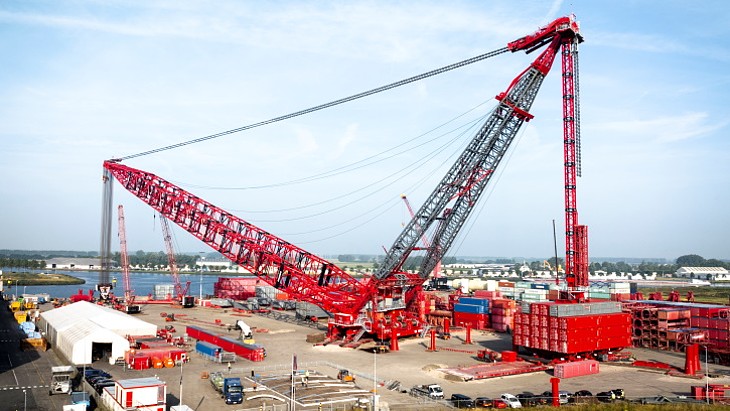
Dutch heavy lifting and transport specialist Mammoet has launched the world's strongest land-based crane, the SK6000, which it says "unlocks new modular construction options for nuclear facilities, with increased cost-effectiveness and safety".
The SK6000 crane (Image: Mammoet)
The company says the new crane "re-defines the scale of human construction, allowing large energy and infrastructure projects to build from bigger pieces, in parallel - reaching first power sooner, and more cost-effectively."
In addition to applications in offshore wind projects and in the oil and gas sector, Mammoet also envisages its use in nuclear new-build projects.
"As more new-build nuclear plants are greenlit, the SK6000 helps the sector to benefit from similar tried-and-tested construction methodologies - helping projects to reach completion sooner and deliver low carbon energy to communities," it said.
Nuclear power reactors, large and small, are increasingly being designed for modular construction, involving the off-site fabrication of large-scale complex systems, which are then transported to site for final installation and assembly. Such techniques can significantly reduce construction risk and help deliver new power plants to schedule and cost.
The SK6000 has a maximum capacity of 6000 tonnes, and is capable of lifting components up to 3000 tonnes to a height of 220 metres. The crane design uses containerisation techniques for ease of deployment, and can be transported using shipping containers to any location worldwide.
It also offers full electric power capability from battery or supply from the grid, allowing customers to reduce the carbon impact of projects significantly.
"This crane is truly a world record feat of engineering, with a production schedule to match," said Gavin Kerr, Director Global Services at Mammoet. "Hundreds of colleagues have been directly involved with its development across the business. There are very few companies on Earth - if any - that could have brought this crane into reality, and we are immensely proud to be able to do so."
The SK6000 is currently undergoing testing at Mammoet's Westdorpe facility in the Netherlands, ready for deployment to its first project later in the year.
UPDATE
Scale of microplastics in Antarctic revealed in preliminary survey results
By Alex Hunt
World Nuclear News, in Vienna
Wednesday, 18 September 2024
The first results of the pioneering scientific research project launched earlier this year have catalogued microplastic particles in the sea water, sediment and animals in Antarctica.
(Image: IAEA)
The preliminary results were outlined during an International Atomic Energy Agency (IAEA) General Conference session focusing on the study, which is supported by Argentina and forms part of the wider IAEA NUTEC plastics initiative, which aims to use nuclear technologies to tackle plastic pollution.
Nathalie Bernard, from the IAEA Marine Environment Laboratories and University of Buenos Aires, unveiling the results, said that "sadly we have found microplastics everywhere, on every sample, every matrix". She said that the concentrations of microplastics varied by location and by day.
More than 250 samples were collected from the Almirante Irizer icebreaker, which sailed 27,209 kilometres over 125 days covering 84 sampling stations. Over the course of a week 166 samples were collected from Argentina's Carlini research station base as part of what was described as the first study of microplastics pollution from South America to Antarctica.
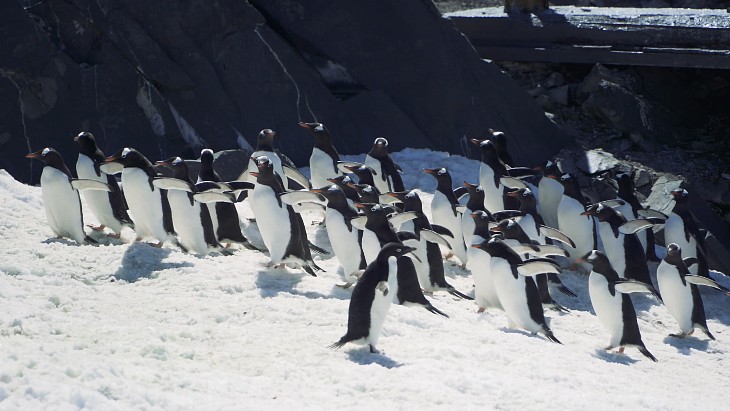
The samples were of water, of sediment and also of penguin droppings and shellfish. Bernard said: "All of these results were possible thanks to nuclear techniques, specifically vibrational microspectroscopy which allows us not only to count, but also identify polymers. We were able to analyse particles as small as 20 microns (WNN note: for comparison a human hair is about 100 microns) and this is important because we found out that almost 90% of the particles we analysed were smaller than 100 microns and ... most of the studies conducted before have focused on larger particles, larger than 300 microns, which clearly overlooks the larger majority."
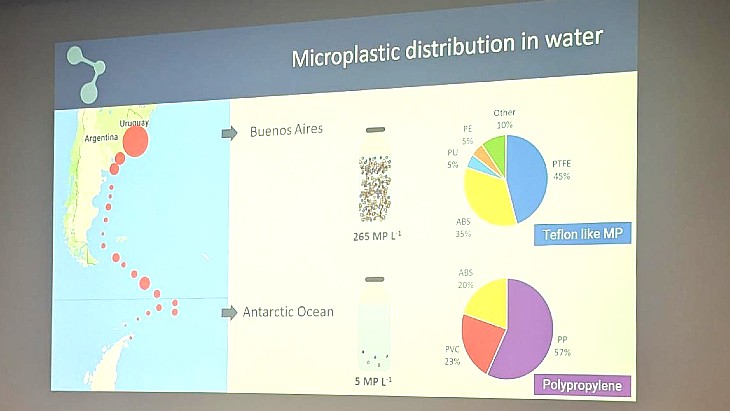
The preliminary results - with 30% of the samples analysed so far, found that in terms of distribution in water, in Buenos Aires it was 256 microplastic particles per litre, compared with 5 microplastics particles per litre in the Antarctic Ocean and 21 microplastics particles per litre at Carlini Station in the Antarctic.
The Carlini samples found 6000-15,000 microplastic particles per kilogramme of sediment, 15 microplastic particles per square metre of sand and 200-4000 microplastic particles per biological sample of shellfish or penguin droppings.
The prevalence and type of microplastics was shown to the session (Image: WNN photo/IAEA/Bernard slide)
There were 11 different types of plastics found in the samples, 62% were "Teflon-like microplastics" and 29% were polyethylene-like. Examples of the types of products using the types of plastics found included frying pans, PVC pipes and plastic drinks bottles.
The early theories about the possible sources of the pollution in Antarctica include fisheries, local human activities and global sources, via the atmosphere or ocean currents.
Bernard said that the conclusions of the preliminary study was that "we know now that microplastics are everywhere, that we can find different levels and types between the sites and that the levels in Antarctica are relatively low if we compare them with highly populated industrial zones - but they are far away from zero, which is what it was thought to be until recently in Antarctica.".
The next steps are to finalise the analysis and do extra checks before sharing the results globally and using the figures as a baseline for future surveys, to assess possible pollution sources and inform policy makers for local and global actions in line with the Antarctic Treaty.
The meeting also heard progress reports on the United Nations actions to end plastics pollution and how the NUTEC initiative can help with plastics upcycling using irradiation to allow plastic waste to not just be traditionally recycled, but also used in cement or in wood/plastic composits - one of the examples given was Argentina using radiation-modified railway sleepers from plastic waste.
Argentina's Foreign Affairs Minister Diana Mondino said that the country was one of the original signatories of the Antarctic Treaty and said: "There's growing concern in understanding the impact in the Antarctic ecosystem from plastics and microplastics." She said the results had prompted the creation of a regional group in Latin America led by Argentina to focus on the issue.
IAEA Director General Rafael Mariano Grossi said the NUTEC initiative had been well received because "we do have a serious problem with microplastics, nanoplastics and we did also have a scarcity of information, objective information". He said having the facts was important so people can take "informed decisions when it comes to the protection of this environment, which is so pristine and that we all care for".
"This is not a simple environmental endeavour that we take for the sake of knowing a little bit more - the idea is that we provide important information that is relevant for fisheries, relevant for very important economic activities in all our countries."
Australia's ambassador Ian Biggs said that Australia had a major stake in the international effort in Antarctica and he said that according to projections there could soon be a tonne of plastic in the ocean for every three tonnes of fish, saying this showed the necessity of action to tackle plastic pollution and he said Australia believed that the NUTEC programme was "making a real difference in helping countries address pressing global challenges on plastic pollution".
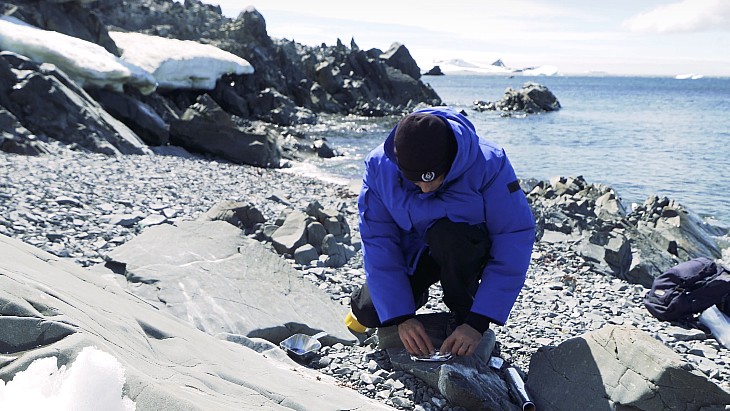
More than 400 samples were taken during the study (Image: Still from IAEA video)
The background
The IAEA's NUTEC plastics scheme was established in 2020 and uses a series of monitoring laboratories to use nuclear technology to sample and analyse microplastics - which are bits of plastic less than 5 millimetres in diameter - in the environment. There are more than 60 countries participating in monitoring of microplastics in the sea, and the goal is to equip more than 50 laboratories with the technology to form a global monitoring network.
The aim is to then be able to take action to bring in measures designed to reduce the sources of the pollution - at least 30 countries are involved in developing innovative recycling technology, including using irradiation to treat plastics and make them fit for reuse, or for a wider range of reuses. This process uses gamma and electron beam radiation technologies to modify certain types of plastic waste, breaking down plastic polymers judged not to be of sufficient quality into smaller components and then allowing them to be used to generate new plastic products.
The IAEA cites studies suggesting that only around 10% of plastic produced between 1950 and 2015 has been recycled, with the majority (about 60%) going to landfill, meaning action is imperative given estimates that there will be one tonne of plastic for every three tonnes of fish within a few years.
Grossi visited an IAEA mission in Antarctica in January with Argentina's president to see the start of work for the project, with the IAEA explaining that "there is still almost no information available on where and how much microplastics arrive in the Antarctic and how much is taken up by Antarctic organisms. There is also very little data existing on the types of microplastics reaching this pristine area through ocean currents, atmospheric deposition and the presence of humans in the Antarctic".
It also said the "presence of microplastics can contribute to accelerating the ice-loss in Antarctica by reducing ice reflectivity, altering surface roughness, promoting microbial activity, acting as thermal insulators, and contributing to mechanical weakening of the ice structure".
The 11th Scientific Committee on Antarctic Research conference was held in Pucón, Chile August 19-23, 2024. Fifteen-hundred academics, researchers, and scientists specializing in Antarctica met to share cutting-edge research. Reports at the conference exposed new dimensions of the Antarctic risk profile that should move the world’s leadership posthaste to mitigate society’s self-destructive dependence on fossil fuels.
Antarctica is starting to carry the brunt of too much CO2 leading to too much heat, leading to unstable ice sheets. And it’s happening much, much faster than anybody thought possible. This is a relatively new development that could have far-reaching consequences.
For example, Gino Casassa, glaciologist, head of Chilean Antarctica Institute commented: “Current estimates show sea levels rising by 4 meters (13 feet) by 2100 and more if emissions continue to grow.” (Source: Scientists in Chile Question if Antarctica Has Hit a Point of No Return, Reuters, August 28, 2024)
Thirteen feet higher won’t suddenly appear in 2100. It builds up over decades. Assuming emissions “continue to grow”, as warned by Dr. Casassa, you’ve gotta wonder, with 13 feet by 2100, what will 2035, or 2050, look like? That’s right around the corner.
Sea level rise is one of the most challenging fields in science and thus produces the most complex results. For example, in comparison to Casassa’s estimate of 13 feet by 2100, a recent study: What Are the Best – and Worst – Case Scenarios for Sea Level Rise? MIT Climate Portal, June 12, 2024: “By 2100, we could see as little as 8 inches of additional sea level rise, or over 6 feet—based partly on how much we continue to pollute the climate, and partly on how the oceans respond to climate change that’s already baked in… despite the enormous stakes for the future of humanity, it remains frustratingly difficult to know how much sea level rise is in store for us. All we know for sure is that taking strong and immediate action to control our greenhouse gas emissions gives us the best chance to avoid meters of sea level rise. ‘The difference between the low-end projections and the high-end projections is many trillions of dollars in infrastructure, and hundreds of millions of people losing their homes,’ Minchew says (Brent Minchew, MIT geophysicist) ‘But we don’t have a good answer to which one of those scenarios is more likely.”
The biggest concern echoed throughout the conference hall: “Antarctica is changing faster than expected.” For example: “Extreme weather events in the ice-covered continent were no longer hypothetical presentations, but first-hand accounts from researchers about heavy rainfall, intense heat waves and sudden Foehn (strong dry winds) events at research stations that led to mass melting, giant glacier breakoffs and dangerous weather conditions with global implications,” Ibid.
A hot topic was whether Antarctica has reached a tipping point, a point of accelerated, irreversible sea ice loss, especially West Antarctica where the Thwaites Doomsday Glacier is located. But scientists have yet to determine whether current observations indicate a ‘temporary blip” or a “downward plunge of sea ice.” Nevertheless, by all appearances, it’s advanced far enough for “plunging sea ice” to raise very serious concerns.
What is clear is the rate of change, unprecedented, nothing compares. According to Liz Keller, a paleoclimate specialist at Victoria University of Wellington/New Zealand; ‘”You might see the same rise in CO2 over thousands of years, and now it’s happened in 100 years,” Ibid. Which is a prime example of today’s human-generated climate change working >10 times faster than nature on its own.
That one factor is what confuses those who argue “oh yeah, the climate always changes, so what?” However, there’s regular climate change in nature, like they allude to, which takes centuries to develop and then, there’s turbo-charged climate change, like we’ve got now that takes decades, not centuries, thanks to human-generated excessive CO2 thrusts from burning fossil fuels.
Climate change has become a straight-forward function of human activity.
Hopefulness
According to some reports at the conference, “the worst-case scenarios can be avoided by dramatically reducing fossil fuel emissions.” Specifically, regarding mitigation, Mike Weber, a paleoceanographer, University of Bonn, who specializes in Antarctic ice sheet stability: “If we keep emissions low, we can stop this eventually. If we keep them high, we have a runaway situation and we cannot do anything.”
On the other hand, there is evidence that ecosystems may already be exceeding boundaries, e.g., Mathieu Casado, a paleoclimate and polar meteorologist at France’s Climate and Environment Sciences Laboratory claims dozens of ice core collected throughout the ice sheet have allowed him to reconstruct temperature patterns in Antarctica dating back 800,000 years. The last time the planet was as warm as today, 125,000 years ago, sea levels were 6-to-9 meters (20-to-30 feet) higher with a large contribution coming from West Antarctica. Ipso facto, with temperatures today as warm as 125,000 years ago causing seas to be 20-30 feet higher, then every coastal megacity should be/will be flooded, which begs the obvious question of “how long do these things take to playout?” And, more importantly, how do we get CO2 and temperatures back down?
Speakers at the conference made special note of the extraordinary speed and amount of carbon -CO2- being pumped into the atmosphere, unprecedented, causing rapid global warming. There’s no previous paleoclimate record of CO2 hitting the planet with such ferocity and large scale and so suddenly. This recalls Michael Mann’s Hockey Stick that famously said it all with one vertical image.
The hockey stick graph is a visualization of the average temperature of the Northern Hemisphere over the past 500 to 2000 years. Because of the spectacular hockey stick concept, Professor Mann became an overnight target of right-wing charlatans and fossil fuel attempts to destroy him. They failed: A Jury in February 2024 awarded Mann more than US$1 million in a lawsuit that accused two conservative commentators of defamation for challenging his research and comparing him to a convicted child molester.
“The Hockey Stick achieved prominence in a 2001 UN report on climate change and quickly became a central icon in the ‘climate wars.’ The real issue has never been the graph’s data but rather its implied threat to those who oppose governmental regulation and other restraints to protect the environment and planet.” (Foreword by Bill Nye, The Hockey Stick and The Climate Wars by Michael E. Mann)
In that regard, with parts of West Antarctica hanging by a very big thread, timing couldn’t be worse as the climate wars heat up once again: Bloomberg News headline: Right-Wing Populist Backlash Is Threatening Climate Fight d/d June 20, 2024: “The green revolution is in trouble. The rise of the nationalist right in much of the Western world has placed huge question marks over commitments to transition out of fossil fuels to fight climate change. Donald Trump in the US and other populist politicians have vowed to jettison low-carbon policies and downplayed the impact of global warming.”
Antarctica has rapidly become a dangerous climate change symbol of major concern and nail-biting as it serves to verify Mann’s early warnings. Global warming has become humanity’s number one challenge for survival of the species. Mann’s Hockey Stick is an amazing analog of 8 billion people sucking up oil from the planet, belching out CO2 in hockey stick fashion, vertically, up, up, and away into an increasingly overloaded CO2 atmosphere that weighs on planetary heat.
Reality
Meanwhile, as stated numerous times in articles like this one, the oil and gas industry has publicly brushed aside concerns about climate change. Looking ahead to the future, it’s full bore, full speed ahead with record-setting fossil fuel production and record-setting CO2 on a very full agenda of oil and gas production to 2030 and beyond.
“The world’s fossil-fuel producers are on track to nearly quadruple the amount of extracted oil and gas from newly approved projects by the end of this decade, with the US leading the way in a surge of activity that threatens to blow apart agreed climate goals.” (The Guardian, March 28, 2024). Questioning whether West Antarctica, especially the Doomsday Glacier, can survive the onslaught of fossil fuel interests looking the other way as right-wing interests threaten anything and everything green.
According to Mike Weber, paleoceanographer, University of Bonn, who specializes in Antarctic ice sheet stability, regarding fossil fuel CO2 emissions: “If we keep them high, we have a runaway situation, and we cannot do anything.”
Czech Republic selects Rolls-Royce SMR for small reactors project
Thursday, 19 September 2024
The Czech Republic has chosen UK firm Rolls-Royce SMR after assessing seven potential technology suppliers for its proposed small modular reactor programme.
A concept image of how a Rolls-Royce SMR might look (Image: Rolls-Royce SMR)
The Ministry of Trade said that the applicants were approached "on the basis of their potential suitability for placement in the Czech Republic ... Rolls-Royce SMR emerged as the best company with which ČEZ (the Czech nuclear power company) wants to establish a strategic partnership". The government will now carry out a "safety assessment of the British company" as was done for those who bid for the recent large nuclear units contracts - involving the Ministry of the Interior, Security Information Service, ÚZSI, Military Intelligence and other key institutions to ensure it complies with the state's security requirements.
The first small modular reactor (SMR) is planned by ČEZ at a site near the existing Temelin nuclear power plant in the 2030s, "before the start up of the new large Czech nuclear unit which is planned for before 2040", the ministry said. ČEZ is also looking at other sites suitable for SMRs, including Tušimice and Dětmarovice where survey and monitoring work is taking place to see if they are suitable nuclear sites.
Rolls-Royce SMR's selection by the Czech Republic comes as the company waits to hear whether it will be selected by the UK as one of the preferred suppliers for its own SMR programme. It is one of five in the running, with the expectation that two technologies will be selected to be taken forward by the UK government's arms-length Great British Nuclear body for deployment.
The Czech government says it would be an "advantage ... that Rolls-Royce SMR is just forming its supply chain, and Czech companies thus have a unique opportunity to stand at its birth and participate to the maximum extent possible. Thanks to this strategic cooperation, local companies will be able to participate not only in the development and implementation of the new small modular reactor, but also in the supply of SMR abroad".
Prime Minister Petr Fiala said: "Small modular reactors can be a key technology for ensuring energy security in the future. That is why from the beginning we try not only to build them, but also to participate in their global production and development. In addition, the establishment of a strategic partnership between ČEZ and Rolls-Royce SMR will be a great opportunity for Czech companies that have many years of experience in the nuclear industry."
Minister of Industry and Trade Jozef Síkela said: "This technology can not only provide enough electricity at affordable prices, but also support our efforts to decarbonise and safely transition to clean energy sources. In addition, this cooperation is also a great opportunity for Czech industry. Our companies can be part of the global supply chain from the very beginning and contribute to the development of this promising technology."
ČEZ CEO Daniel Beneš said: "The strategic partnership with Rolls-Royce SMR will allow us to use our long-term experience in the field of nuclear energy in combination with the high technological maturity of the British company." He said that ČEZ would now negotiate specific terms of the cooperation with the British company.
CEO of Rolls-Royce SMR, Chris Cholerton, welcomed the decision and said: "Discussions are ongoing to finalise contract terms and the final agreements are subject to customary regulatory clearances. Details of the agreement will be published at signing. This important strategic partnership further strengthens Rolls-Royce SMR’s position as Europe’s leading SMR technology, and will put ČEZ, Rolls-Royce SMR and its existing shareholders at the forefront of SMR deployment. Rolls-Royce SMRs will be a source of clean, affordable, reliable electricity for Czechia - creating jobs, enabling decarbonisation, reducing the reliance on imported energy and supporting the global effort to reach net zero."
Nuclear Power in the Czech Republic
The Czech Republic currently gets about one-third of its electricity from four VVER-440 units at Dukovany, which began operating between 1985 and 1987, and the two VVER-1000 units in operation at Temelín, which came into operation in 2000 and 2002. In July, Korea Hydro & Nuclear Power (KHNP) was named the preferred bidder for up to four new units at the two existing nuclear power plants, with the target of the first unit entering commercial operation in 2038.
The Czech SMR roadmap was published and approved last year setting out options for technology suppliers and identifying a range of potential sites - 45 in total - as well as investor models. Its vision is for "SMRs to complement large nuclear untis from 2030s-40s onwards".
The Rolls-Royce SMR
The Rolls-Royce SMR is a 470 MWe design based on a small pressurised water reactor. It will provide consistent baseload generation for at least 60 years. 90% of the SMR - measuring about 16 metres by 4 metres - will be built in factory conditions, limiting on-site activity primarily to assembly of pre-fabricated, pre-tested, modules which significantly reduces project risk and has the potential to drastically shorten build schedules.
Its capacity is larger than many of its SMR rivals - the general definition of an SMR is of a reactor unit with an output of up to 300 MWe. In July, it successfully completed Step 2 of the UK's Generic Design Assessment process and progressed to the third and final phase of the process which assesses the safety, security and environmental aspects of a nuclear power plant design that is intended to be deployed in the UK. The target date to complete that final stage is August 2026.
In July, the Nuclear Industry Association applied to the UK government for a justification decision for Rolls-Royce SMR's SMR, a decision required for the operation of a new nuclear technology in the country. It marks the first ever application for justification of a UK reactor design. If Rolls-Royce is successful in the UK's SMR selection contest, the aim is for a final investment decision to be taken in the UK in 2029.
MICHIGAN
Palisades on schedule for repowering, NRC considers restart regulations
Thursday, 19 September 2024
The programme to restart the Palisades nuclear power plant in Michigan is now in the inspections and maintenance phase and remains on schedule, Holtec International said in its latest update. Meanwhile, the US regulator has been petitioned to codify regulations for restarting shuttered nuclear power plants.
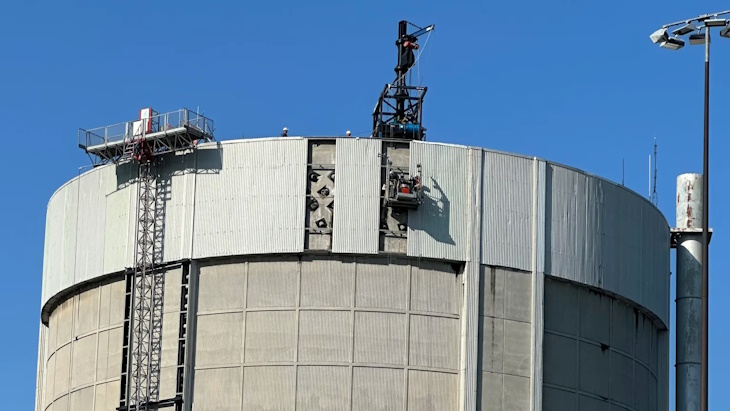
Inspection work is carried out on the containment building dome and structural tendon system at Palisades (Image: Holtec)
Recent progress at the plant, in Covert Township, has included initial accreditation for Holtec's operations and maintenance and technical training programmes, requalification of 26 former Palisades licensed operators, significant workforce growth, completion of chemical cleaning of the primary coolant system , and comprehensive reactor vessel internal inspections. The chemical cleaning has "had a dramatic effect on further improving the plant’s occupational radiation safety metrics", Holtec said.
The focus has now shifted to detailed inspections and maintenance of major systems, including the main turbine, containment building structure, high-voltage towers and transformers. Detailed inspections of the plant’s steam generators have been completed, during which the need for additional maintenance activities was identified, Holtec said: "Thorough and early inspections have allowed us to proactively identify and implement the needed refurbishments before Palisades returns to service. Palisades's owner’s engineer, Nuclear Consultants International (NCI, an autonomous Holtec affiliate), is working with experienced on-site and external experts to devise and implement industry-proven solutions."
Preparations are also nearly complete for a five-month campaign to transfer used fuel assemblies currently stored in the plant’s fuel pool to Hi-Storm FW dry fuel storage systems at a unified on-site storage facility, designed and built by Holtec’s Nuclear Power Division.
“As nuclear professionals, restoring the plant to its highest level of safety is our utmost priority. Our primary focus remains ensuring that Palisades returns to service safely and reliably, with all necessary repairs and maintenance completed to the highest standards,” said Holtec Chief Nuclear Officer Rich Burroni.
Palisades' single-unit 800 MWe pressurised water reactor was shut down in 2022, after more than 40 years of commercial operation, and was to be decommissioned. Holtec completed its acquisition of the reactor from then-owner and operator Entergy shortly after the reactor's closure, with plans to finish dismantling, decontamination, and remediation by 2041. The same month, the US Nuclear Regulatory Commission (NRC) transferred the plant's operating licence to Holtec for the purpose of decommissioning.
But Holtec then announced plans to apply for federal funding to enable it to reopen the plant, and in October 2023 submitted a filing with the NRC to formally begin the process of seeking reauthorisation of power operations at the plant. The company is aiming to repower the plant by the end of 2025. It would be the first nuclear power plant in the USA to return to commercial operations after being closed down, and current plans would see it provide baseload clean power until at least 2051.
Regulatory process
According to NRC information, Holtec will need to explain to the regulator how it will return plant components to a status that supports safe operation; restore the licensing basis of the plant to an operational status, and make any upgrades necessary to meet current NRC requirements. NRC staff will carefully review the regulatory and licensing documents for the plant, inspect new and restored components necessary to operate safely, and continue ongoing oversight to ensure sufficiency of all plant systems and programmes. The NRC has established the Palisades Nuclear Plant Restart Panel to provide oversight of the restart effort.
Palisades may not be the only shuttered US plant to return to service: earlier this year, NextEra Energy CEO John Ketchum told investors the company was considering the possibility of restarting the Duane Arnold boiling water reactor plant, which closed in 2020. Constellation Energy CEO Joe Dominguez has also, in comments to investors, not ruled out a restart of Three Mile Island unit 1 which closed in 2019.
Now, the US regulator has been petitioned to revise its regulations to include a Commission-approved process for returning a decommissioning plant to operational status. In an entry in the US Federal Register, the NRC said it has determined that the petition "meets the sufficiency requirements" for it to be documented, and is calling for public comment. The petition was submitted by a former engineering director of the plant and an investigative journalist, with community members near the plant adding their signatures.
"The petition states that the NRC staff lack a specific NRC Commission-approved and codified process for licensing, inspecting, and approving the return to service of a power reactor that has entered decommissioning. The petitioner requests that the NRC conduct rulemaking to include a codified process for returning a decommissioning plant to operational status," the NRC said.
The review of the petition is a separate process from the ongoing NRC consideration of requested actions related to the potential restart of the Palisades Nuclear Plant, the regulator added.