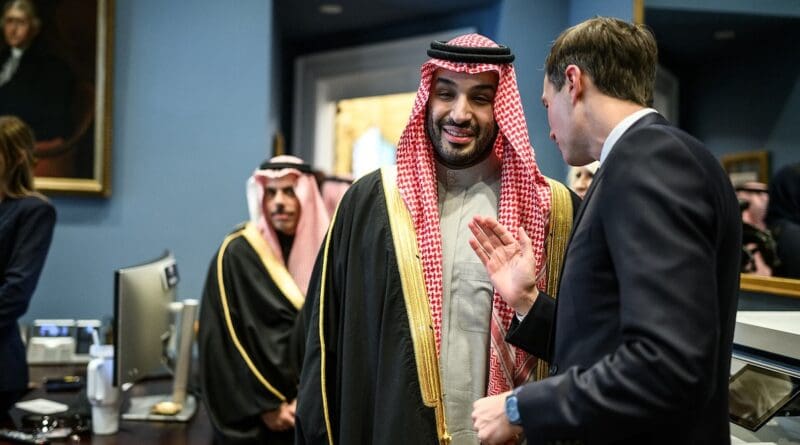
Jared Kushner speaks with Crown Prince and Prime Minister Mohammed bin Salman Al Saud of Saudi Arabia in the Outer Oval Office, Tuesday, November 18, 2025. (Official White House Photo by Daniel Torok)
August 16, 2026
Arab News
By Jonathan Gornall
Key Takeaways
Nearly 11 months after President Trump unveiled his 20-point Gaza peace plan in September 2025, core elements—including Hamas disarmament, Israeli withdrawal, large-scale reconstruction, and the deployment of a technocratic Palestinian administrative committee—have not been implemented.
Jared Kushner is preparing to lead a high-level team (including Board of Peace head Nickolay Mladenov and Tony Blair) to the region to re-energize the process amid a persistent stalemate in which Hamas refuses to disarm before an Israeli withdrawal and Israel refuses to withdraw before disarmament, compounded by Netanyahu’s recent outright rejection of a Palestinian state.
Additional complications include continued Israeli strikes in Gaza, rising settler violence in the West Bank (prompting unusually strong U.S. criticism), and limited political will on both sides, with observers noting that U.S. leverage remains the key potential driver of progress if clearly exercised.
It is almost 11 months since US President Donald Trump, standing alongside Israeli Prime Minister Benjamin Netanyahu at the White House on Sept. 29, 2025, unveiled his 20-point peace plan for Gaza.
It was, said the president, a “big day, a beautiful day, potentially one of the greatest days ever in civilization.” Hamas would disarm, Israel would withdraw, and President Trump’s Board of Peace could get to work.
Large quantities of aid would flow into Gaza, work would begin on restoring vital infrastructure, from water, electricity and sewage works to hospitals, roads and bakeries, and an apolitical “technocratic” Palestinian committee would be appointed to manage the day-to-day running of Gaza and its public services.
Almost a year later, none of that has happened.
Now, President Trump’s son-in-law and US Special Envoy for Peace Jared Kushner is poised to lead a high-level team to the region in an apparent attempt to re-energize a process that has become bogged down in disagreements.
“It’s going to be a flawed plan to begin with,” Yossi Mekelberg, a senior consulting fellow at the MENA Programme at Chatham House, told Arab News.
“If there is the political will, if there is determination, first of all by the sides but also by the mediators, then it is good enough, something that can work. And you fix it along the way, you make changes.
At the time, sources within the board suggested that several Arab countries had objected to Blair’s appointment to the role because of his association with the unpopular US invasion of Iraq in 2003.
The founding nation members of the board include Bahrain, Jordan, Kuwait, Qatar, Saudi Arabia and the UAE, but not Iraq.
“But I think you see how the agenda shifted, and then you move from one international relations issue to another.
“The conversations keep changing, while we know we have both sides there whose commitment to these agreements is, at best, limited, because both are fighting on the political echelons for relevance.”
In addition to Israel, Kushner is expected to visit mediators in Egypt, Qatar and Turkiye. He will be accompanied by Nickolay Mladenov, the head of the Trump-appointed Gaza Board of Peace, and Tony Blair, the former UK prime minister.
Blair, who was recruited by President Trump in January as a member of the Board of Peace, was bypassed for the role of high representative for Gaza in favor of Bulgarian diplomat Mladenov, a former UN envoy to Iraq.
Now, however, insiders say that although Kushner is a highly effective negotiator who has developed excellent relations with many leaders and governments in the region, his mission is expected to benefit from Blair’s diplomatic credentials and contacts throughout the Arab world.
“Kushner as such doesn’t have leverage, but the US has leverage,” Mekelberg said. “If Israel knows that it’s President Trump behind it, and the reason that he is there, the US has enough tools to make it happen.
“Leverage is there because it’s not Kushner, it’s the US. And if Trump sends Kushner to send a very clear message that he wants it to happen, then I think there is something in it. If not, I think there will be more procrastination.”
Kushner’s bid to revive the peace process faces significant challenges. It was on Jan. 14 that US envoy Steve Witkoff announced that stage 2 of the peace plan had commenced.
But seven months on, the transitional Palestinian National Committee for the Administration of Gaza, supervised by the Board of Peace and headed by former Palestinian minister Ali Shaath, has not entered Gaza and remains on standby in Cairo.
Despite a ceasefire that came into force in October, Israeli strikes on Gaza have continued, killing hundreds of people, according to local health officials.
On July 30, the Board of Peace raised hopes that a breakthrough had been made, declaring that a “historic agreement” had been reached “for the complete disarmament of Hamas and other armed groups in Gaza.”
Since then, however, a stalemate has prevailed. Hamas refuses to discuss giving up any weapons until Israel withdraws from Gaza, and Israel says it will not withdraw until Hamas disarms.
Then, during a televised cabinet meeting last week, Netanyahu announced he was rejecting the peace plan outright.
Perhaps with his right-wing coalition partners in mind ahead of elections in October, he added: “A Palestinian state will not arise in Gaza or in Judea and Samaria (the West Bank).”
This is the roadblock that Kushner and his team have been dispatched to clear.
It will likely require presenting Netanyahu with a solution that takes account of Israel’s internal politics, while at the same time reassuring Hamas that the peace deal is not about to be rewritten at their expense.
Tensions have been ramping up. On Wednesday, the day that news of Kushner’s visit emerged, was the third consecutive day that Israeli strikes had hit Gaza.
he delicacy of the situation is reflected in the cautiously crafted statements that have been coming out of the Board of Peace — not in the form of general press releases, but in remarks targeted at specific Israeli news media.
“In Israel, we will continue the constructive conversations that we are having on how to advance the president’s historic comprehensive 20-point peace plan,” an unnamed official was quoted as telling The Jerusalem Post.
The US and Israel agreed on the end state, he added, “a demilitarized Hamas” and “we will hear the concerns that have been raised and talk about next steps. What is critical is that we both agree on the desired outcome and are finding ways to accelerate progress.”
There is also growing concern within the Board of Peace and the US government about the impact on the Gaza peace prospects of the activities of settlers in the West Bank, who have been acting with impunity and, frequently, the apparent support of security forces.
On Thursday, Mike Huckabee, the US ambassador to Israel, unleashed an unprecedented attack on settlers who have been besieging Palestinian families, including an American citizen from Ohio, in the northern West Bank town of Qusra.
On X, Huckabee accused the settlers of a “horrific act of terror” and said the Israel Defense Forces and Israeli police had intervened “at our request … to remove the Israeli terrorists doing this.”
Reuters reported that Washington had called on Netanyahu to publicly condemn the actions of the settlers.
This toughening stance on settlers contrasts starkly with Washington’s apparent unwillingness to intervene as Israel has reintroduced a land registration process, suspended since the late 1960s, designed to allow Palestinian land to be claimed by the state.
Huckabee’s uncharacteristically strong intervention, issued even as planning for Kushner’s mission was under way, sends the message that Washington remains committed to President Trump’s peace plan.
About Arab News
Arab News is Saudi Arabia's first English-language newspaper. It was founded in 1975 by Hisham and Mohammed Ali Hafiz. Today, it is one of 29 publications produced by Saudi Research & Publishing Company (SRPC), a subsidiary of Saudi Research & Marketing Group (SRMG).
View all posts by Arab News →


No comments:
Post a Comment