Copper price holds near record as London warehouse bidding war looms
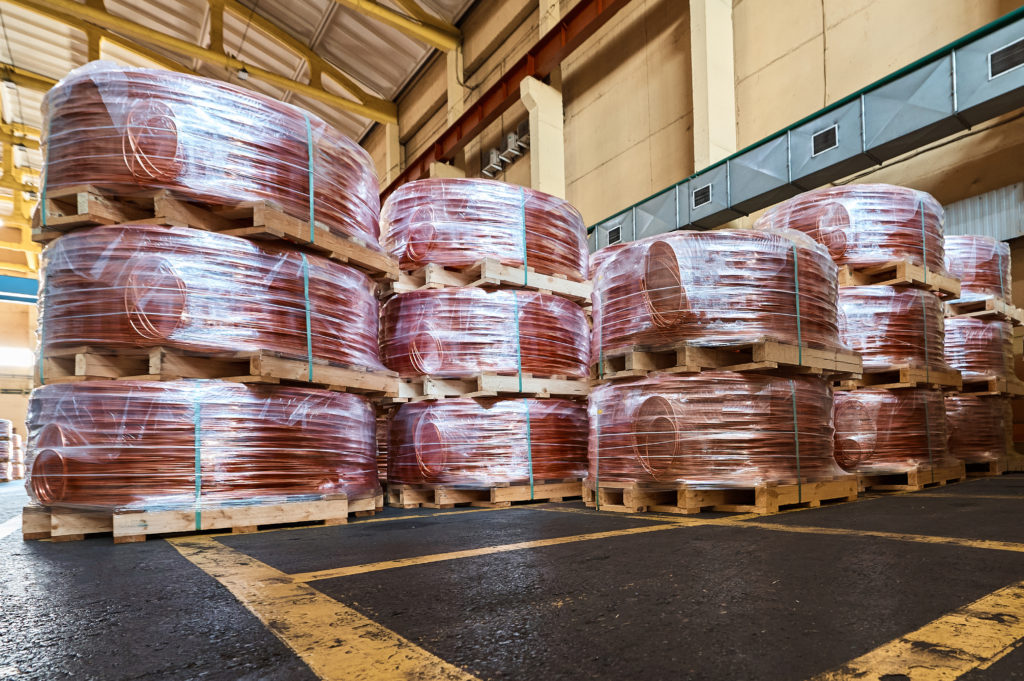
The squeeze in the London copper market intensified on Friday, with spot contracts commanding their steepest premiums over later-dated futures in five years as the metal available in exchange warehouses shrinks towards critical levels.

The August contract on the LME traded at a premium of as much as $370 a tonne over September futures, the widest one-month spread since the 2021 squeeze that forced the exchange into emergency intervention. The closely watched cash to three-month spread reached $434 a tonne, also a five-year high, with cash copper changing hands at a record near $14,500 a tonne.
The benchmark three-month contract traded above $14,100, up nearly 14% in 2026, after setting its all-time peak above $14,500 in January.
In New York, Comex copper for September delivery was little changed at $6.59 a pound (some $14,500 a tonne), roughly $400 over the LME three-month price and within sight of Wednesday’s record of $6.7140.

LME stockpiles fell for a 42nd straight day on Friday, the longest run of declines since 2014, to 204,975 tonnes, and nearly half of what remains is already earmarked for withdrawal. With warehouse metal a last-resort source of supply for the physical trade, “holders of short futures positions can be forced into a bidding war to compel holders of inventories and expiring long positions to sell,” Bloomberg reports, adding that some analysts and traders now predict fresh all-time highs above $14,500 a tonne.
Congo panic, tariff tremors
The drawdown reflects traders shipping metal to the US ahead of possible tariffs on refined copper and to China, where smelters are cutting output on tight feedstock supplies after the Democratic Republic of Congo banned concentrate exports.
Andy Home, writing for Reuters, said the scale of the market’s reaction to the Congo ban, which touches less than a fifth of the country’s copper output, says more about the metal than the ban itself: “The real news here is not Congo’s long-standing ambition to move down the value chain, but copper’s acute sensitivity to any sign of supply disruption.” If LME stocks keep draining both eastwards and westwards, he warned, “Doctor Copper’s panic attack is unlikely to be the last.”
BMI, which raised its 2026 forecast only last month, now sees the full-year average approaching $13,500 a tonne, versus $12,700 previously, “with strong upside risks.” Washington’s tariff decision remains the most immediate directional catalyst, the research house said in its weekly strategy note: a phased approach of 15% from 2027 and 30% from 2028 would lend further support into the second half, while another walk-back would pressure prices given record CME stocks of more than 700,000 short tons (about 635,000 tonnes). Either way, the outcome “does not materially alter our outlook, leaving copper’s longer-term supportive fundamentals largely intact.”
Chile’s road back to 6 million tonnes
Events in Chile this week showed just how difficult the top producer’s road back to 6 million tonnes a year is turning out to be. Antofagasta trimmed its production guidance about 5% despite a 72% jump in first-half profit, still counting the cost of July storms that forced Los Pelambres to halt operations, and Codelco said the stalled Andes Norte project at El Teniente will only reach production in 2029.
National output has been stuck around 5.5 million tonnes, 5.415 million last year against a 2018 peak of 5.831 million, held back by falling grades, weak exploration and permitting that averages 147 approvals per project and can take more than a decade. Santiago has now set up a public-private group to accelerate permits and help finance junior miners. Economy and mining minister Daniel Mas, who set his sights on 6 million tonnes on taking office in April, wants approval times cut by up to 70%, corporate tax lowered to 23% from 27% and 25-year stability contracts for strategic projects.
In Indonesia, PT Smelting’s Gresik plant, 66% owned by Freeport Indonesia, has been shut since August 8 after furnace damage. The smelter produces around 342,000 tonnes of cathode a year and Freeport expects repairs to be completed this quarter, with the restart of its new Manyar smelter nearby accelerated to the end of August.
Copper equities have cooled this week alongside the metal but remain comfortably higher this month. Through Friday morning in New York, over ten trading sessions, Ivanhoe Mines was up 15% in August, First Quantum 12%, Freeport-McMoRan 6.5% and Teck nearly 6%, against a 2.3% gain for the metal, while Antofagasta has slipped 3% since its guidance cut.
Faraday targets 18B-lb Arizona copper district

Faraday Copper (TSX: FDY; US-OTC: CPPKF) expects confirmation drilling at BHP’s (NYSE, LSE, ASX: BHP) former San Manuel mine to support a combined Arizona resource containing more than 18 billion lb. of copper.
The San Manuel acquisition is set to close this month, handing Faraday control of a past-producing copper mine, about 109 sq. km of prospective private land, a water-supply agreement and established infrastructure beside the former flagship Copper Creek next door. The assets lie about two hours by road southeast of Phoenix.
Faraday plans at least 23,000 metres of drilling at San Manual beginning in the fourth quarter before issuing a combined resource around mid-2027.
“We think it will be north of 18 billion lb. of copper,” CEO Paul Harbidge told The Northern Miner on a call this week. “That’s going to be one of the largest undeveloped copper resources in the entire U.S.”
The deal would turn Faraday from a single-project explorer into a district developer planning two open pits and two underground mines around shared infrastructure.
New drilling
It also leaves Faraday with work to do. San Manuel’s remaining copper estimate is historical, the old drill core was discarded and the combined mine plan hasn’t been studied yet. Faraday now has to confirm the resource with new drilling before it can fold San Manuel into a current technical study.
Faraday’s Toronto-listed shares have more than quadrupled over the past 12 months to close at $5.50 apiece on Aug. 11 as copper prices have surged. Shares have tested a range between $1.15 and $6.69 over the past 12 months. The company has a market capitalization of $1.6 billion (US$1.15 billion).
San Manuel started underground production in 1955 before adding open-pit and in-situ leaching. The operation processed about 800 million tonnes grading 0.66% copper and produced more than 4.5 million tonnes of the metal before low prices ended mining in 1999. BHP had rehabilitated the site by 2003.
Faraday holds the historical drilling, assay and geological records, including information from about 440,000 metres of drilling. But BHP discarded the core, forcing Faraday to drill new holes before it can classify the old estimate under current disclosure standards.
Copper Creek already holds 421.9 million measured and indicated tonnes grading 0.45% copper for 4.2 billion lb. of contained metal, according to a preliminary economic assessment issued in May 2023. Inferred resources add 83.6 million tonnes at 0.34% copper for 628 million contained pounds.
Faraday completed 88 holes totalling 22,510 metres in its latest Copper Creek program before pausing in June to account for the acquisition and Arizona’s summer storms. More assay results remain pending.
Staged build
The company plans to place shared facilities on the former San Manuel mine lands rather than duplicate infrastructure at Copper Creek. The acquisition is served by roads, rail, gas and power.
Harbidge wants to start with oxide material at San Manuel, then develop Copper Creek’s open pits and use cash flow to help fund a mill for sulphide ore. Underground production would follow from Copper Creek and the San Manuel-Kalamazoo system.
“It’s not like we’ve got to write a $5-billion cheque for initial capital,” Harbidge said.
He sees potential for more than four decades of production at about 150,000 tonnes of copper a year. That concept still requires confirmation drilling, a current resource and detailed engineering.
Funding runway
Faraday held $94.2 million in cash and $32 million in term deposits at June 30. Harbidge said the funds should carry the company into early 2028, covering the acquisition, San Manuel drilling, the combined resource and the first-stage study.
BHP would own 30% of Faraday on a fully diluted basis after closing and gain the right to nominate a director. The Lundin family trusts hold about 18%. Both investors participated in Faraday’s $100-million financing in March.
Haywood Securities has maintained its buy rating and $7 target, identifying the combined resource and mine study as Faraday’s main catalysts. The shares gained 34% during the second quarter, making Faraday one of the strongest developers in Haywood’s coverage as the broader group fell an average of 9%.
Faraday has no immediate appetite for another acquisition, Harbidge said. Its challenge now is to prove the scale it has assembled.
“We’ve caught the tiger by the tail in consolidating San Manuel with Copper Creek,” he said.

No comments:
Post a Comment