Mutual Aid Isn’t a Handout — It’s a Framework for Resistance

The co-directors of a new docuseries offer their theory of change for transcending capitalism and the state.
By Ella Fassler ,
August 16, 2026
After neighbors took care of neighbors during the COVID-19 pandemic, the concept of mutual aid suddenly catapulted into the national spotlight. The speed and nimbleness with which mutual aid projects emerged was a strength, but it also meant many participants did not have preexisting relationships, trust, or shared political commitments.
What has happened to the mutual aid movement since then? Maroon and Cassa, longtime organizers with Mutual Aid Disaster Relief, are well-positioned to tackle this difficult question. They are co-directors of a new four-part docuseries, The Elements of Mutual Aid. After conducting more than 60 interviews for the series and embarking on an ongoing six-month speaking tour, they’ve taken the time to reflect on what they’ve learned.
In the conversation that follows, they discuss the mutual aid movement’s trajectory in recent years, strategies for tackling burnout, and offer their theory of change for transcending capitalism and the state.
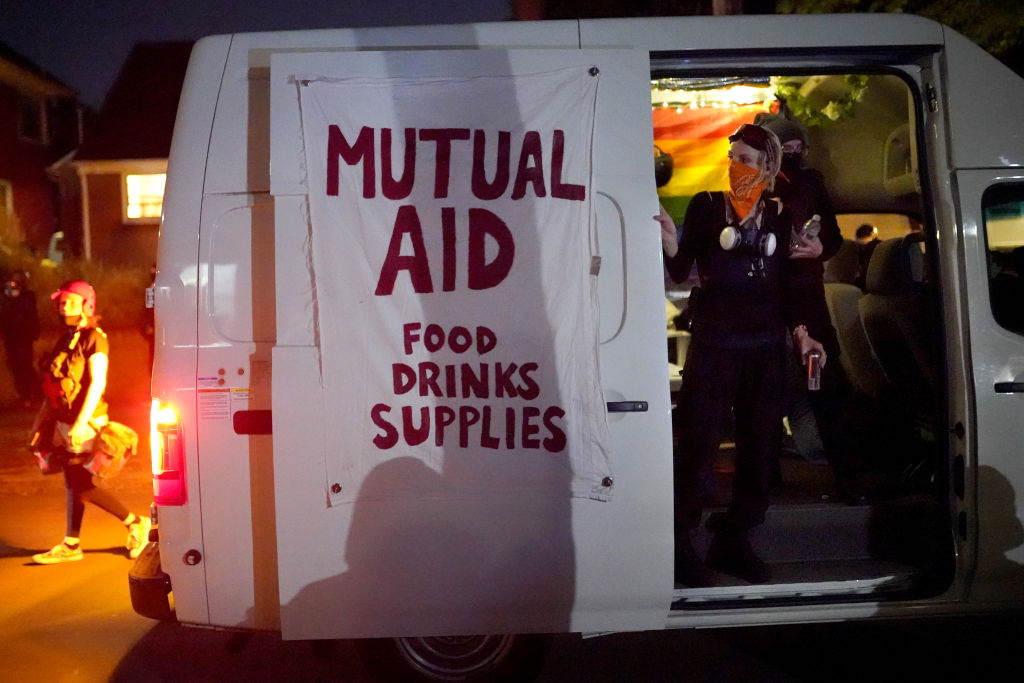
A volunteer watches protesters from a mutual aid van on August 14, 2020, in Portland, Oregon. Nathan Howard / Getty Images
The interview that follows has been lightly edited for clarity.
Ella Fassler: To start, could you tell the readers why you’re both using aliases for the interview?
Maroon: Yeah. We’re using aliases because, as anarchists, we’re more interested in promoting the work than our personal identities as filmmakers. We also know that this work is being highly surveilled by fascists, and so we also want to have some layer of illegibility to protect ourselves and our community.
So, in the first episode, you asked a lot of your interviewees to describe mutual aid in a few words. I figured I’d pass the baton to you. How would you describe it in brief?
Cassa: I would define mutual aid as a practice and value of meeting each other’s needs, caring for each other, and building power outside of the state.
Maroon: To add to that, mutual aid comes from our fungal, plant, and animal relatives, and Indigenous people have been practicing forms of mutual aid for tens of thousands of years.
Mutual aid as a concept and practice was popularized during the pandemic. Now democratic socialists are gaining momentum and popularity with platforms advocating for the state to provide people with basic necessities like health care and affordable housing. Why are you advocating for mutual aid rather than increased reliance on the state for getting our needs met?
Maroon: The nation-state model is a relatively new model of social organization that comes from European settler society. But there are many different forms of social organization that preexist and will outlast the state. It makes sense that people who live within states right now want the state to become more equitable, but we believe in a world beyond the state, and the experiments that we’re seeing right now that are the most exciting for us — led by Indigenous people — are those that are thinking far beyond state formations and thinking more about how to build territorial co-governance in ways that do not reproduce European social structure.
Mutual aid as a framework allows us to move in a way that’s horizontal rather than hierarchical or vertical, and it gives us a framework to be able to empower the agency of each other instead of creating these top-down formations. We want to create social structures from below and to the left — as the Zapatistas put it — where we take care of each other.
What are some of the experiments you mentioned that excite you most, particularly those covered in the series?
Maroon: One of the more exciting projects (or network of projects) that we got to interface with was the centers of mutual aid in Puerto Rico, where people — specifically Indigenous people — were taking territory from the state and reclaiming it for themselves, and building up a territorial analysis of self-reliance and self-governance.
It was really beautiful to be able to bring the film back to those communities four years later. To go back to Puerto Rico and get to see independent movements that are still thriving and still holding down the territory that they reclaimed after Hurricane Maria. They’ve been building up cooperative economic infrastructure, an Indigenous ideology and self-governance, and thinking about how they care for each other at a communal level rather than just giving people stuff.
While watching, I was curious about whether those networks in Puerto Rico survived. It seems like there’s a lot of turnover with mutual aid projects in the mainland United States. What do you think has allowed for networks to persist in Puerto Rico?
Cassa: The mutual aid centers’ initial tactic of occupying abandoned buildings in a moment of crisis is a huge reason why those projects have been able to sustain themselves and grow. In the mainland U.S., access to space is so expensive and scarce. So we’ve been talking with a number of groups here about the differences between Puerto Rico’s context and our context here and how to prepare for opportunities to take back space. When we do have physical space to hold that container for community, it really magnifies how much we’re able to do and what types of projects we’re able to take on.
The series also includes interviews with the Reclaiming Our Homes Movement, which occupied a number of homes in Los Angeles for several years, although those have since been taken away by the state.
We need to keep pushing for reclamation of buildings, housing, and land by and for communities because taking back resources is essential to our ability to take care of each other in the long term. It’s challenging under the thumb of empire, where private property is so highly policed. But we know different opportunities will emerge as crises continue to unfold.
Yeah, definitely. The reality of needing to sign a lease to rent space rather than occupying space centralizes power in groups that would have been more decentralized otherwise too.
Cassa: Yeah. I’ll also add that having a strong social fabric is essential to defending anything that we occupy. That’s something we’re tasked with rebuilding right now so that when opportunities do emerge, we have community identity with a stake in the places that we take back and the relational capacity to sustain those occupations.
Have you come to any new insights about the mutual aid landscape in the U.S. while filming and touring? What have you learned?
Maroon: So the two of us were able to be a part of Mutual Aid Disaster Relief’s workshop tour back in 2018, where we got to interface with dozens of communities around the country, learning from the way that they were responding to crisis and offering our theory of change. People back then were mobilized around the term a lot more deeply along the lines of anti-authoritarian and anti-fascist politics, and there was a lot more fresh energy at that time on the heels of Ferguson, Standing Rock, and Trump’s first presidency. The social shocks at that time also felt farther apart, and the state still had this veneer of decorum.
When there’s great need … how do we not allow our relational infrastructure to be compromised and our political edge dulled in the name of distributing goods?
In 2020, the term was popularized. There was an emphasis on the one-way distribution goods while the relational aspects and the fight back elements took more of a back seat.
So, the question we are asking right now is: When there’s great need — like [during] a natural disaster or global supply chain breakdown — how do we not allow our relational infrastructure to be compromised and our political edge dulled in the name of distributing goods?
We think that the low to the ground, long-term relational infrastructure is the sharpest part of mutual aid, rather than ideology as a driving force. People just “doing” — and I say doing with huge quotation marks around it — mutual aid on the weekends is far different than having communal infrastructure that builds resiliency, like neighborhood assemblies, tenants’ unions, collective housing, jail support, urban farms, radio networks, gun clubs, disaster hubs, etc. We’re seeing there’s a deep burnout with the concept of mutual aid right now because of this emphasis on distribution over the other critical elements of mutual aid.
How have those discussions been going on tour? When you’ve been bringing up that point, is it connecting with people?
Cassa: One of the main conversations we’re having with a lot of communities is how to break down the divide between givers and receivers of aid. How to be in real relationship and real community with people and understand our work as being actually mutual. A lot of communities are stuck on that question and it’s a hard one. It requires us to address power dynamics, think critically about how we’re showing up, and rebuild trust when there’s understandably a lack of it.
We need to be spending more time prioritizing these types of conversations. We need to be reflecting and strategizing together, and onboarding new people into these values. We can’t just show up at the food share, give away food, and then go home. It has to go deeper than that and be more strategic.
Yeah, for sure. In my experience with mutual aid projects over the years, there has been a lot of focus on day-to-day tasks at the expense of the bigger picture strategic questions. People may want to discuss and ask those questions, but there is a lot of burnout. There are issues with capacity. There’s a lack of affinity or trust. So, it’s this tricky chicken-or-egg situation where you want to ask those questions, but that takes extra capacity and your group is barely surviving.
Are there any projects or networks in the U.S. that you think are handling that problem well?
Cassa: We were just in Beacon Hill, Seattle, where they’re holding potlucks every month that also usually tackle a discussion question. They’re creating opportunities for people to be in real relationships with each other and reflecting on their conditions and how to address them. We think it’s really important to see more communities gathering, breaking bread together, and creating opportunities to process.
Maroon: Yeah, and relatedly, the popular gathering infrastructure is something that we really encourage people to lean into.
In 2020, in the wake of the murder of George Floyd, people in Minneapolis started to experiment with the popular assembly model of organizing in their neighborhoods. Over the last six years, they’ve built up relational and mutual support infrastructure — building out interconnected networks of care that allow for many working-class people to take care of each other, so that they can build up a collective analysis and power together.
Then when the ICE surge happened in their city, they were able to fight back. It wasn’t organizations that were taking the forefront of the defense of their communities. It wasn’t ideology either. It was these relationships and the practice that people had of shutting down their streets to throw block parties, of taking care of their neighbors’ kids. That’s how they were able to do the work of protecting their neighborhoods; because they have been practicing it on a day-to-day level and building up an ethic of mutual aid that had a “fight back” element to it.
I’d love to cover that growth trajectory in more depth. Sometimes popular assemblies kick off with a lot of energy and then wither away.
Cassa: I’m sure that there were definitely low points. Sometimes I bet it was just a few people holding it down, but it still plants seeds, and that’s worth something at those rupture points.
Definitely. So, you interviewed a couple former Black Panthers in the film. The Black Panther Party seems to have set up one of the most robust mutual aid networks in United States history. They were feeding 20,000 kids every day before school, for example. I wonder if you have thoughts about what made that possible? What lessons can we learn from them?
Maroon: Yeah, we interviewed two prominent former Panthers, Lorenzo Kom’boa Ervin and JoNina Abron-Ervin, who later became anarchists in their lives. They both reflect on the party with a sobering analysis. They don’t romanticize it. They’re willing to critique it.
It’s true that the Panther Party was able to coordinate not just the free food for kids program, but also bus rides to prisoners and cop watch. They were able to do medical support like sickle cell anemia testing. There were so many different elements to their survival programs, and we can remember it because it had a central party identity. There was the name, it had membership, and it was highly disciplined.
This was also a downfall, and this is what the comrades who are our elders are warning us about, is creating a party politic that centralizes charismatic individual leaders and can be decapitated. That’s precisely what happened with the Black Panther Party. Infighting, conspiracy, and repression led to the downfall of the leadership, which then led to the destruction of the organization.
Many of our Panther elders talk about decentralization as a winning strategy. Illegibility is a winning strategy for us because if the state is able to identify key independent leaders, and then decapitate them from the movement, the movement is lost. We see people who were part of the Black Liberation Army, such as Ashanti Alston, who was also a former Panther, coming to the same conclusions. Through that time period of heightened struggle, there had to be an underground element, a less-visible element that the state was not able to repress.
It’s impressive to talk about the Black Panther Party survival programs and all the mouths they were feeding every day. And at the same time, so many people are being fed by the movement for mutual aid right now, and it doesn’t have a single leader or a single party politic behind it. I think that diffusion of work is actually the winning strategy, rather than creating a single form that we should follow.
Thanks so much for that. I agree that it’s harder to decapitate less-legible decentralized movements, but I question whether disconnected nodes lacking a coherent and coordinated strategy can build the power necessary to challenge the massive forces of the state and capitalism. For example, Rojava — a territory in north and east Syria of millions practicing decentralized organizing — was initially set up by the political party the PYD. What do you think about that?
Maroon: Yeah, that’s a great question. We just read James Stout’s work Against the State, where he talks about anarchists that have gone to war in Spain, Myanmar, and Rojava. One of the main points that he focuses on is scale and the tension of the anarchist politic of decentralization and refusal of hierarchical power being at odds with the capabilities to contest formal military power, and also the maintaining of large-scale territory once liberated from the nation-state.
He talks about the escalation ladder of moving up from small guerrilla bands and rebel militias into more formalized structures that are able to maintain a decentralized command-and-control model that doesn’t reproduce a hierarchy upon people who are engaged in militant struggle — and certainly not upon the people. I think there’s a lot to be learned from his analysis, which is coming from direct relationship with people in Rojava and Myanmar. They are thinking about what it looks like to build a libertarian socialist society that has gender liberation, ecology, and decentralized decision-making from below and to the left at the core of it. And so we agree — we do believe in creating larger structures that are legible to the working class, but illegible to the state, and are responsible and mature enough to handle territory.
That makes a lot of sense. Thanks so much for your time. Is there anything else you want to discuss? Where can people find you and the series?
Maroon: Thank you once again for your thoughtful questions. One thing that we didn’t mention was that we created a discussion guide to go alongside the film. We designed it in a way so that groups can read it together and co-facilitate.
We’ve got our website and Instagram. The series is free on YouTube and the open-source platform Kolektiva.
This article is licensed under Creative Commons (CC BY-NC-ND 4.0), and you are free to share and republish under the terms of the license.
Ella Fassler
Ella Fassler is an independent journalist based in Providence, Rhode Island. Their work on social movements, labor, technology and the carceral system has been featured in Teen Vogue, The Boston Globe, The Nation, Vice, The Appeal, Slate, Mic, In These Times, and elsewhere. Follow them on Twitter or Bluesky.

No comments:
Post a Comment