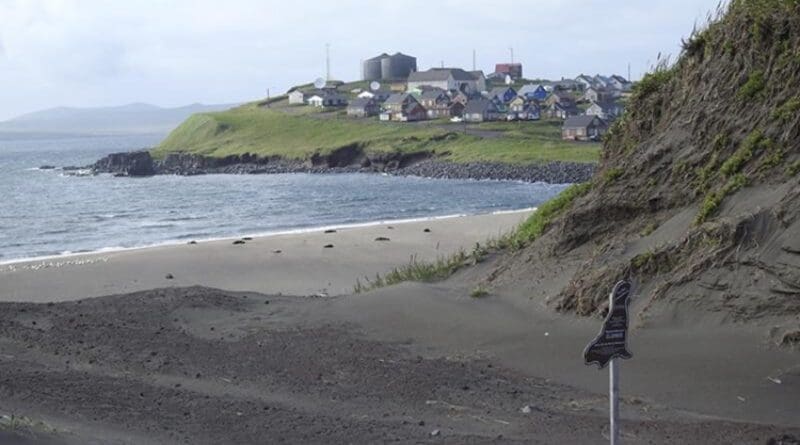
The community of St. Paul is seen from the island's beach. The Pribilof Island community has managed to fend off rat infestations. Residents are now allowed to enlist rat-hunting dogs to help with the efforts. Dogs have long been banned from the islands, but a new rule makes an exception for rat-prevention purposes.
(Photo by Jamie Musbach/National Oceanic and Atmospheric Administration)
August 16, 2026
By Alaska Beacon
By Yereth Rosen
Key Takeaways
The change aims to strengthen the islands’ long-standing rat-free status, which is critical for protecting the world’s largest northern fur seal colony and millions of seabirds, amid rising Arctic shipping traffic and past near-misses.
Local residents and managers emphasize prevention through vigilant trapping, native Arctic foxes, and the potential use of specialized dogs, while parallel rat-eradication efforts continue on other Alaska islands already heavily infested.
August 16, 2026
By Alaska Beacon
By Yereth Rosen
Key Takeaways
A new NOAA interim rule, effective August 6, 2026, creates a limited exception to the decades-old federal ban on dogs on the Pribilof Islands, allowing only trained and certified rat-detection dogs for stays of up to 180 days.
The change aims to strengthen the islands’ long-standing rat-free status, which is critical for protecting the world’s largest northern fur seal colony and millions of seabirds, amid rising Arctic shipping traffic and past near-misses.
Local residents and managers emphasize prevention through vigilant trapping, native Arctic foxes, and the potential use of specialized dogs, while parallel rat-eradication efforts continue on other Alaska islands already heavily infested.
(Alaska Beacon) — For decades, dogs have been verboten on the Pribilof Islands under a rule imposed by the federal government to protect the world’s largest concentration of northern fur seals.
Now, dogs are welcome — with important caveats.
Under a new interim rule enacted by the National Oceanic and Atmospheric Administration, dogs may be brought to the islands, but only for the specific purpose of hunting for rats. Dogs allowed on St. Paul Island or any other part of the five-island archipelago must be trained and certified as rat-detectors and catchers, and their stays are limited to 180 days. The general ban on dogs, in place since the 1980s, remains intact, but the new rule creates an exception for dogs enlisted in the anti-rat work.
The Pribilofs have managed to stay rat-free even as other Alaska islands and coastal areas have become infested with the non-native rodents.
Rat-sniffing dogs would help keep things that way, according to the residents of St. Paul Island, site of the main community in the archipelago.
“We work very, very hard to keep this a rat-free island. And we also recognize that shipping lanes are opening up right in the Arctic and there’s just potentially, if not already, going to be more vessel traffic in this part of the world,” said Chelsea Campbell, marine mammal programs manager for the Aleut Community of St. Paul Island, the local tribal government.
Allowing dogs to help is a bit of “forward thinking,” she said. The idea is that “maybe we should have some ability to get a rat sniffing dog out here, just in case,” she said.
Rats are not native to any part of Alaska. But, introduced by ships, they have infested several coastal regions and become one of the most destructive invasive species in the state.
Once established, they can devastate natural ecosystems, especially on islands where bird populations have evolved without exposure to or defenses against any land-based predators. It is a longstanding problem for islands around the world. Invasive rats are even believed to be partly to blame for the extinction of the Dodo.
On St. Paul, there have been a few isolated cases of rats escaping ships, but almost all of those were caught immediately in traps set up at the harbor. One rat escaped that gauntlet in 2018; it was found dead 10 months later.
A reported but unconfirmed rat sighting in 2024 was the main impetus for the new rule, said Mike Williams, NOAA’s Pribilof Islands program manager. No rat was ever found, so if there had been one that escaped from a ship, it apparently died, he said.
Another impetus, Campbell said, was a visit in recent years by a cruise ship that underreported its rat-infestation problem.
Compared to other vulnerable Alaska islands, the Pribilofs have some advantages in their fight against rats.
Community members have been vigilant in the anti-rat program, in coordination with the U.S. Fish and Wildlife Service, the Alaska Department of Fish and Game and other entities and organizations.
Additionally, ship traffic through the Pribilofs is not quite as heavy as that through the Aleutians, Wiliams said. And a “saving grace” for the archipelago, he said, is the native population of Arctic foxes.
The Pribilof foxes make up a genetically distinct population known for the blue tint that shows up in the animals’ fur. Williams said they do not bother the fur seals.
They have a varied diet that includes birds, eggs, marine resources and berries. And they are on hand to hunt and eat rats, Williams said.
One of the first rats ever seen on St. Paul, an event in the 1990s, was actually in the mouth of a passing fox, he said.
The new rule went into effect on Aug. 6. For now, Williams and Campbell said, there is no particular dog or dog trainer yet identified as a candidate for Pribilof work.
Williams said that if a rat-catching dog is sent to St. Paul, it might make the most sense to have it there in the winter, when any rats on the island would be concentrated in town rather than across a wider area where they may not be able to find food.
“You want a small, focused area to search rather than the whole entire island,” he said.
On the other hand, having a rat-sniffing dog on duty during the summer might be useful to ensure that ships that come to the island are safe, Campbell said.
Rat eradication
Although it is difficult to eject rats once they are established, it is not impossible.
Rat eradication has been successful at some islands, and possibly most famously at an Alaska site formerly called Rat Island. It got the name because it was the first place in Alaska to be invaded by rats; it is believed that the rodents swam ashore from a wrecked Japanese sailing ship in the late 1700s.
A cooperative effort between the U.S. Fish and Wildlife Service and two nonprofits, Island Conservation and the Nature Conservancy.
By 2012, the bird populations there had recovered, and the island was officially bestowed with its Unangan name: Hawadax.
The Fish and Wildlife Service is now planning for similar rat eradications on four other Aleutian islands: Kiska, Attu, Amchitka and Great Sitkin. Like Hawadax, all four islands are part of the Alaska Maritime National Wildlife Refuge. Different types of rat poison are being considered, along with genetic biocontrol technology, which is a process that uses genetic engineering to limit reproduction.
Kiska and Attu were occupied by the Japanese during World War II, and a brutal battle occurred on Attu in 1943. The rats there are war legacies. The threat is particularly ominous in Kiska because that rugged volcanic island is home to what is considered a “superflock” of seabirds, particularly auklets, but also an ever-expanding population of rats using the same rocky crevices to kill and stash their prey. Since Kiska is much bigger than the island now called Hawadax, rat eradication there would be more challenging, the Fish and Wildlife Service notes.
The rat eradication proposals for the four Aleutian sites are moving forward, though gradually.
Scoping, the initial phase that leads to an environmental impact statement, was conducted in 2024. A draft environmental impact statement is expected to be released later this year. A draft environmental impact statement is expected this fall, to be followed by a final EIS and a decision on action next year, according to the Fish and Wildlife Service.
About Alaska Beacon
Alaska Beacon is an independent, nonpartisan news organization focused on connecting Alaskans to their state government. Alaska, like many states, has seen a decline in the coverage of state news. We aim to reverse that.
View all posts by Alaska Beacon →
Now, dogs are welcome — with important caveats.
Under a new interim rule enacted by the National Oceanic and Atmospheric Administration, dogs may be brought to the islands, but only for the specific purpose of hunting for rats. Dogs allowed on St. Paul Island or any other part of the five-island archipelago must be trained and certified as rat-detectors and catchers, and their stays are limited to 180 days. The general ban on dogs, in place since the 1980s, remains intact, but the new rule creates an exception for dogs enlisted in the anti-rat work.
The Pribilofs have managed to stay rat-free even as other Alaska islands and coastal areas have become infested with the non-native rodents.
Rat-sniffing dogs would help keep things that way, according to the residents of St. Paul Island, site of the main community in the archipelago.
“We work very, very hard to keep this a rat-free island. And we also recognize that shipping lanes are opening up right in the Arctic and there’s just potentially, if not already, going to be more vessel traffic in this part of the world,” said Chelsea Campbell, marine mammal programs manager for the Aleut Community of St. Paul Island, the local tribal government.
Allowing dogs to help is a bit of “forward thinking,” she said. The idea is that “maybe we should have some ability to get a rat sniffing dog out here, just in case,” she said.
Rats are not native to any part of Alaska. But, introduced by ships, they have infested several coastal regions and become one of the most destructive invasive species in the state.
Once established, they can devastate natural ecosystems, especially on islands where bird populations have evolved without exposure to or defenses against any land-based predators. It is a longstanding problem for islands around the world. Invasive rats are even believed to be partly to blame for the extinction of the Dodo.
On St. Paul, there have been a few isolated cases of rats escaping ships, but almost all of those were caught immediately in traps set up at the harbor. One rat escaped that gauntlet in 2018; it was found dead 10 months later.
A reported but unconfirmed rat sighting in 2024 was the main impetus for the new rule, said Mike Williams, NOAA’s Pribilof Islands program manager. No rat was ever found, so if there had been one that escaped from a ship, it apparently died, he said.
Another impetus, Campbell said, was a visit in recent years by a cruise ship that underreported its rat-infestation problem.
Compared to other vulnerable Alaska islands, the Pribilofs have some advantages in their fight against rats.
Community members have been vigilant in the anti-rat program, in coordination with the U.S. Fish and Wildlife Service, the Alaska Department of Fish and Game and other entities and organizations.
Additionally, ship traffic through the Pribilofs is not quite as heavy as that through the Aleutians, Wiliams said. And a “saving grace” for the archipelago, he said, is the native population of Arctic foxes.
The Pribilof foxes make up a genetically distinct population known for the blue tint that shows up in the animals’ fur. Williams said they do not bother the fur seals.
They have a varied diet that includes birds, eggs, marine resources and berries. And they are on hand to hunt and eat rats, Williams said.
One of the first rats ever seen on St. Paul, an event in the 1990s, was actually in the mouth of a passing fox, he said.
The new rule went into effect on Aug. 6. For now, Williams and Campbell said, there is no particular dog or dog trainer yet identified as a candidate for Pribilof work.
Williams said that if a rat-catching dog is sent to St. Paul, it might make the most sense to have it there in the winter, when any rats on the island would be concentrated in town rather than across a wider area where they may not be able to find food.
“You want a small, focused area to search rather than the whole entire island,” he said.
On the other hand, having a rat-sniffing dog on duty during the summer might be useful to ensure that ships that come to the island are safe, Campbell said.
Rat eradication
Although it is difficult to eject rats once they are established, it is not impossible.
Rat eradication has been successful at some islands, and possibly most famously at an Alaska site formerly called Rat Island. It got the name because it was the first place in Alaska to be invaded by rats; it is believed that the rodents swam ashore from a wrecked Japanese sailing ship in the late 1700s.
A cooperative effort between the U.S. Fish and Wildlife Service and two nonprofits, Island Conservation and the Nature Conservancy.
By 2012, the bird populations there had recovered, and the island was officially bestowed with its Unangan name: Hawadax.
The Fish and Wildlife Service is now planning for similar rat eradications on four other Aleutian islands: Kiska, Attu, Amchitka and Great Sitkin. Like Hawadax, all four islands are part of the Alaska Maritime National Wildlife Refuge. Different types of rat poison are being considered, along with genetic biocontrol technology, which is a process that uses genetic engineering to limit reproduction.
Kiska and Attu were occupied by the Japanese during World War II, and a brutal battle occurred on Attu in 1943. The rats there are war legacies. The threat is particularly ominous in Kiska because that rugged volcanic island is home to what is considered a “superflock” of seabirds, particularly auklets, but also an ever-expanding population of rats using the same rocky crevices to kill and stash their prey. Since Kiska is much bigger than the island now called Hawadax, rat eradication there would be more challenging, the Fish and Wildlife Service notes.
The rat eradication proposals for the four Aleutian sites are moving forward, though gradually.
Scoping, the initial phase that leads to an environmental impact statement, was conducted in 2024. A draft environmental impact statement is expected to be released later this year. A draft environmental impact statement is expected this fall, to be followed by a final EIS and a decision on action next year, according to the Fish and Wildlife Service.
About Alaska Beacon
Alaska Beacon is an independent, nonpartisan news organization focused on connecting Alaskans to their state government. Alaska, like many states, has seen a decline in the coverage of state news. We aim to reverse that.
View all posts by Alaska Beacon →

No comments:
Post a Comment