'Nothing will happen to Elon': AG Pam Bondi warns Jasmine Crockett on Tesla protests
David Edwards
March 23, 2025
David Edwards
March 23, 2025
RAW STORY
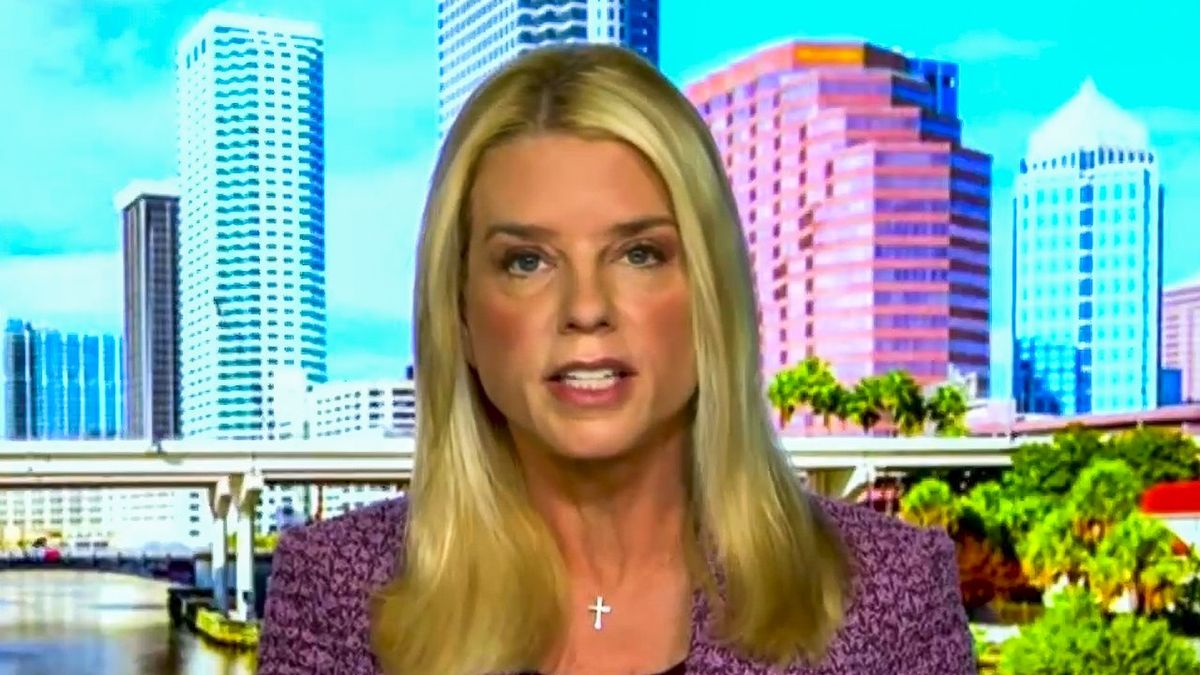
Fox News/screen grab
Attorney General Pam Bondi singled out Rep. Jasmine Crockett (D-TX) over protests and alleged "domestic terrorism" against billionaire Tesla CEO Elon Musk for his role in dismantling parts of the federal government.
"What about these vandals on Tesla vehicles and dealerships?" Fox News host Maria Bartiromo asked Bondi during a Sunday interview. "Why are they doing this?"
"We have a dedicated task force," Bondi revealed. "These are not isolated incidents, as you know, and these aren't vandals. These are Molotov cocktails."
"You know, that could be a weapon of mass destruction that they're throwing in Tesla dealerships, that they're lighting these Tesla charging stations on fire, that are in residential neighborhoods," she noted.
Bondi pledged not to go easy on people who vandalize Teslas.
"We are looking at everything, especially if this is a concerted effort," she vowed. "This is domestic terrorism."
"And Maria, now you have this congresswoman, Crockett, who is calling for attacks on Elon Musk on her birthday," she added. "Let's take him out on my birthday, she says. And yet she turns and says, oh, I'm not calling for violence."
"Well, she is an elected public official, and so she needs to tread very carefully, because nothing will happen to Elon Musk, and we're going to fight to protect all of the Tesla owners throughout this country, and it's basic safety, once again. Domestic terrorism is going to come to a stop in our country."
Watch the video below from Fox News or at the link..
Fox News/screen grab
Attorney General Pam Bondi singled out Rep. Jasmine Crockett (D-TX) over protests and alleged "domestic terrorism" against billionaire Tesla CEO Elon Musk for his role in dismantling parts of the federal government.
"What about these vandals on Tesla vehicles and dealerships?" Fox News host Maria Bartiromo asked Bondi during a Sunday interview. "Why are they doing this?"
"We have a dedicated task force," Bondi revealed. "These are not isolated incidents, as you know, and these aren't vandals. These are Molotov cocktails."
"You know, that could be a weapon of mass destruction that they're throwing in Tesla dealerships, that they're lighting these Tesla charging stations on fire, that are in residential neighborhoods," she noted.
Bondi pledged not to go easy on people who vandalize Teslas.
"We are looking at everything, especially if this is a concerted effort," she vowed. "This is domestic terrorism."
"And Maria, now you have this congresswoman, Crockett, who is calling for attacks on Elon Musk on her birthday," she added. "Let's take him out on my birthday, she says. And yet she turns and says, oh, I'm not calling for violence."
"Well, she is an elected public official, and so she needs to tread very carefully, because nothing will happen to Elon Musk, and we're going to fight to protect all of the Tesla owners throughout this country, and it's basic safety, once again. Domestic terrorism is going to come to a stop in our country."
Watch the video below from Fox News or at the link..
'Yell some more': Newsmax pundit goes berserk when Dem points out his Tesla stock losses
David Edwards
March 23, 2025
RAW STORY
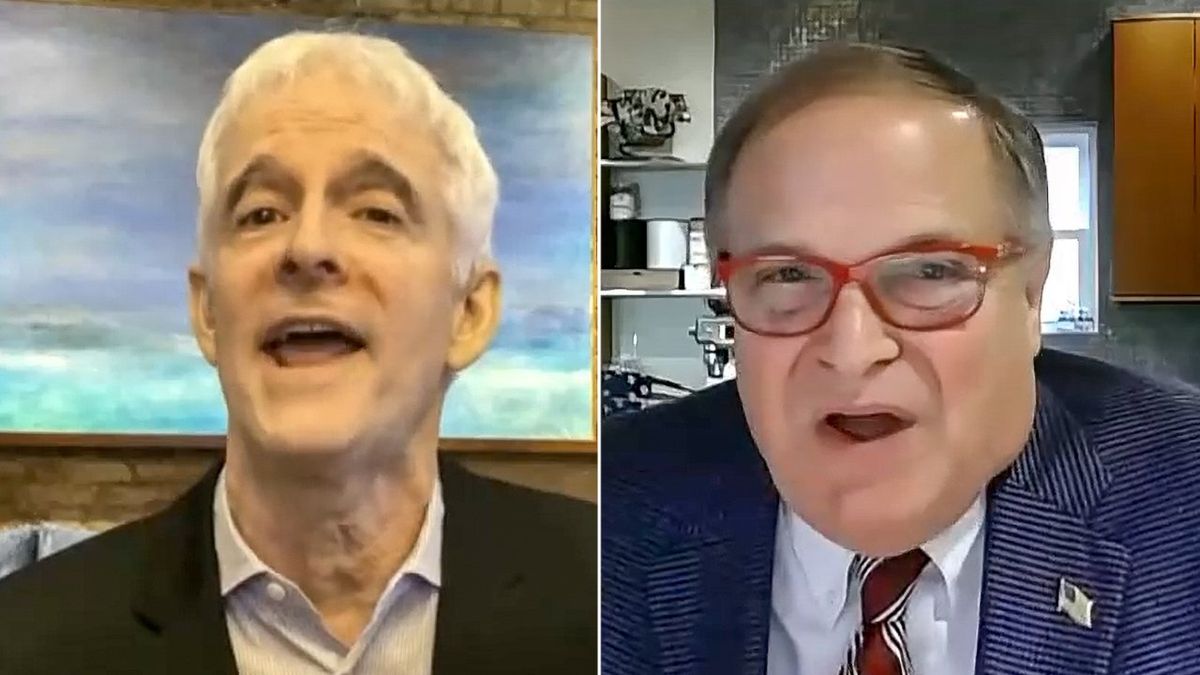
Newsmax/screen grab
Republican strategist Gene Valentino lost his cool with liberal writer Ellis Henican over the weekend during a clash about struggling Tesla stock prices.
In a panel discussion on Sunday, Henican jabbed Valentino after the GOP strategist recommended investing in Tesla.
"I'm very, very sorry about the Tesla stock," Henican said. "I know it's gone down, I think about 50% since the end of last year. So, boy, I'm glad I don't have any of that in my retirement."
"You worry about your stock, and I'll worry about mine!" Valentino exclaimed. "You're a master at overspeak, and it's not fair for you to judge my stock."
"Well, I can judge one of your stocks," Henican shot back. "The water went down about 50%."
"Trust me, you keep an eye on Tesla," Valentino insisted. "Mark this moment. The next six months, you watch where Tesla goes."
"My condolences, sir, on that," the Democratic pundit replied.
"Yeah, you pray for yourself," Valentino snapped. "Don't worry about me... We are a nation that was saved by Donald Trump."
"How dare you attempt to minimize his good efforts in a short period of time to try to fix this nation which has been under siege by a deep liberal left conspiracy orchestrated by George Soros and the likes of you that have had decades to fester the wrongdoing that's now he's trying to change in just 100 days?" he shouted.
"Are you finished?" Henican asked. "Are you finished, Gene? Do you want to yell some more?"
"Elon Musk is down around chiggers and jock itch in the ratings right now," he noted. "I guess, Gene, three other people may be the last people who actually like him because people don't want an unelected, world's richest oligarch and Trump's biggest financial supporter to be in monkeying around with their Social Security, to be undermining Medicare."
Watch the video below from Newsmax or at the link. .
Newsmax/screen grab
Republican strategist Gene Valentino lost his cool with liberal writer Ellis Henican over the weekend during a clash about struggling Tesla stock prices.
In a panel discussion on Sunday, Henican jabbed Valentino after the GOP strategist recommended investing in Tesla.
"I'm very, very sorry about the Tesla stock," Henican said. "I know it's gone down, I think about 50% since the end of last year. So, boy, I'm glad I don't have any of that in my retirement."
"You worry about your stock, and I'll worry about mine!" Valentino exclaimed. "You're a master at overspeak, and it's not fair for you to judge my stock."
"Well, I can judge one of your stocks," Henican shot back. "The water went down about 50%."
"Trust me, you keep an eye on Tesla," Valentino insisted. "Mark this moment. The next six months, you watch where Tesla goes."
"My condolences, sir, on that," the Democratic pundit replied.
"Yeah, you pray for yourself," Valentino snapped. "Don't worry about me... We are a nation that was saved by Donald Trump."
"How dare you attempt to minimize his good efforts in a short period of time to try to fix this nation which has been under siege by a deep liberal left conspiracy orchestrated by George Soros and the likes of you that have had decades to fester the wrongdoing that's now he's trying to change in just 100 days?" he shouted.
"Are you finished?" Henican asked. "Are you finished, Gene? Do you want to yell some more?"
"Elon Musk is down around chiggers and jock itch in the ratings right now," he noted. "I guess, Gene, three other people may be the last people who actually like him because people don't want an unelected, world's richest oligarch and Trump's biggest financial supporter to be in monkeying around with their Social Security, to be undermining Medicare."
Watch the video below from Newsmax or at the link. .
'A lot of abuse': Fear grows as Trump's FBI targets anti-Musk protesters
FBI CONTRACTED OUT AS TESLA SECURITY
REUTERS/Chris J Ratcliffe
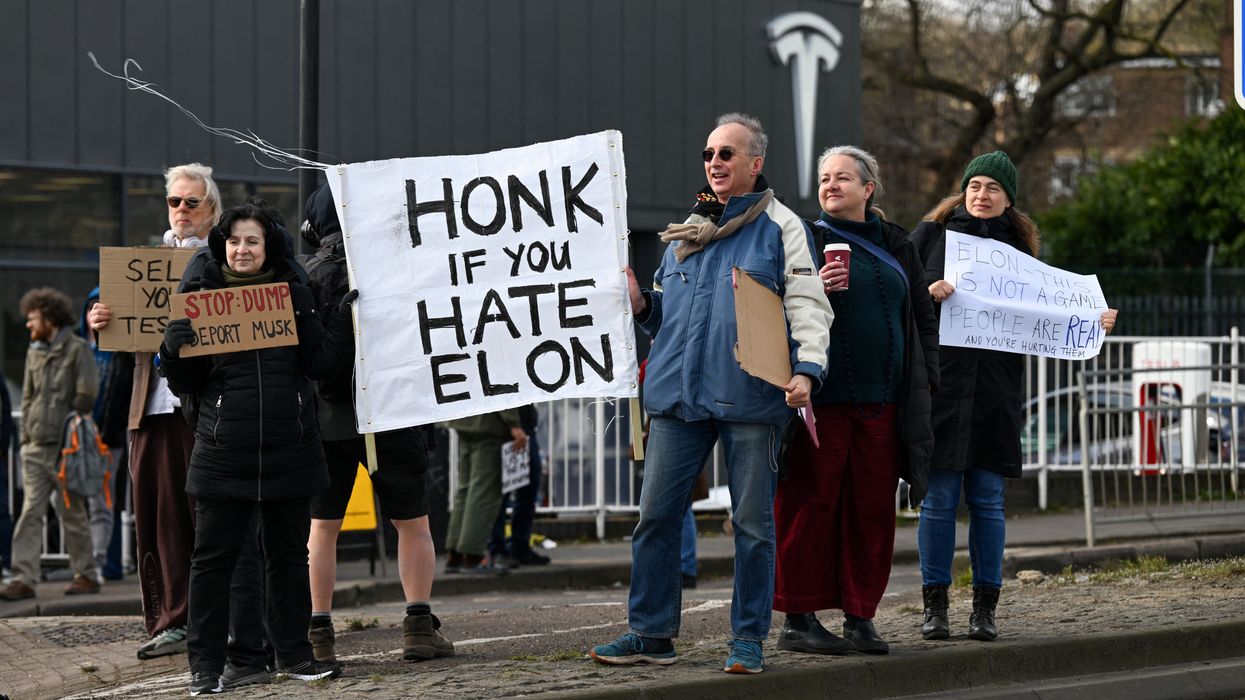
Demonstrators hold anti-Tesla posters during a protest encouraging people to boycott Tesla in opposition to Tesla CEO Elon Musk's political involvement in the U.S. government, outside the Tesla Centre Park Royal in London, Britain, March 15, 2025.
Demonstrators hold anti-Tesla posters during a protest encouraging people to boycott Tesla in opposition to Tesla CEO Elon Musk's political involvement in the U.S. government, outside the Tesla Centre Park Royal in London, Britain, March 15, 2025.
March 22, 2025
ALTERNET
Although the vast majority of anti-Elon Musk demonstrations in the United States and other countries have been peaceful, some critics of the Tesla/SpaceX/X.com leader and Donald Trump ally are resorting to destroying Teslas or committing acts of vandalism. U.S. Attorney General Pam Bondi is describing these incidents as acts of "domestic terrorism," but some civil libertarians fear that her approach could create problems for Musk opponents who are protesting in a nonviolent way.
In a U.S. Department of Justice (DOJ) press release published on Thursday, March 20, Bondi declared, "Let this be a warning: if you join this wave of domestic terrorism against Tesla properties, the Department of Justice will put you behind bars."
The U.S. attorney general and Trump loyalist discussed federal charges against three people accused of throwing Molotov cocktails at Tesla vehicles
READ MORE: Republicans have no moral authority to decide what 'domestic terrorism' is
Wired's Caroline Haskins, in an article published on March 22, reports, "Civil liberties experts claim treating alleged attacks against Tesla cars and infrastructure as terrorist activity could give federal and local law enforcement broad authority to surveil people protesting Elon Musk’s role in the government. The terrorism designation could also allow Musk and other Tesla executives to access information authorities uncover in their investigations."
Haskins notes that Bondi's statement "comes ahead of hundreds of grassroots 'Tesla Takedown' events protesting Musk and his influence in Washington that are scheduled to take place at Tesla facilities across the U.S. this weekend. The demonstrations have multiplied since they began in mid-February, with some attracting hundreds of people each."
President Trump put Musk in charge of an advisory group called the Department of Government Efficiency (DOGE), which is helping the Trump Administration with mass layoffs of federal government workers. And many Musk critics are arguing that Musk has way too much power for someone who was never elected to office.
"Most of the protests have been peaceful, and the organizers of some of them have said that they don't endorse property damage," Haskins explains. "But they are happening amid a string of alleged arson and vandalism cases targeting Tesla dealerships and charging stations, including one in Las Vegas Tuesday morning, (March 18), as well as others in Colorado and Boston. By labeling these and other incidents involving Tesla domestic terrorism, the FBI can file broader search warrants than in other types of cases."
Haskins continues, "Under the Patriot Act, law enforcement gets 'special authorities' while investigating terrorism, including 'single-jurisdiction search warrants' from magistrate judges that apply anywhere in the U.S. instead of a single geographic area, according to a 2023 report from the Government Accountability Office. With a court order, law enforcement can additionally get 'confidential education records' from any school or agency in the course of a terrorism investigation, the report notes."
Michael German, a former FBI special agent who is now with the Brennan Center for Justice at the New York University Law School, fears that instead of focusing on extremists who are actually committing acts of violence, a DOJ/FBI probe could end up targeting anyone peacefully expressing "anger or animosity towards Tesla or Elon Musk."
German told Wired, "We've seen a lot of abuse of FBI investigative authorities, particularly around domestic advocacy groups."
Read the full Wired article at this link.
Although the vast majority of anti-Elon Musk demonstrations in the United States and other countries have been peaceful, some critics of the Tesla/SpaceX/X.com leader and Donald Trump ally are resorting to destroying Teslas or committing acts of vandalism. U.S. Attorney General Pam Bondi is describing these incidents as acts of "domestic terrorism," but some civil libertarians fear that her approach could create problems for Musk opponents who are protesting in a nonviolent way.
In a U.S. Department of Justice (DOJ) press release published on Thursday, March 20, Bondi declared, "Let this be a warning: if you join this wave of domestic terrorism against Tesla properties, the Department of Justice will put you behind bars."
The U.S. attorney general and Trump loyalist discussed federal charges against three people accused of throwing Molotov cocktails at Tesla vehicles
READ MORE: Republicans have no moral authority to decide what 'domestic terrorism' is
Wired's Caroline Haskins, in an article published on March 22, reports, "Civil liberties experts claim treating alleged attacks against Tesla cars and infrastructure as terrorist activity could give federal and local law enforcement broad authority to surveil people protesting Elon Musk’s role in the government. The terrorism designation could also allow Musk and other Tesla executives to access information authorities uncover in their investigations."
Haskins notes that Bondi's statement "comes ahead of hundreds of grassroots 'Tesla Takedown' events protesting Musk and his influence in Washington that are scheduled to take place at Tesla facilities across the U.S. this weekend. The demonstrations have multiplied since they began in mid-February, with some attracting hundreds of people each."
President Trump put Musk in charge of an advisory group called the Department of Government Efficiency (DOGE), which is helping the Trump Administration with mass layoffs of federal government workers. And many Musk critics are arguing that Musk has way too much power for someone who was never elected to office.
"Most of the protests have been peaceful, and the organizers of some of them have said that they don't endorse property damage," Haskins explains. "But they are happening amid a string of alleged arson and vandalism cases targeting Tesla dealerships and charging stations, including one in Las Vegas Tuesday morning, (March 18), as well as others in Colorado and Boston. By labeling these and other incidents involving Tesla domestic terrorism, the FBI can file broader search warrants than in other types of cases."
Haskins continues, "Under the Patriot Act, law enforcement gets 'special authorities' while investigating terrorism, including 'single-jurisdiction search warrants' from magistrate judges that apply anywhere in the U.S. instead of a single geographic area, according to a 2023 report from the Government Accountability Office. With a court order, law enforcement can additionally get 'confidential education records' from any school or agency in the course of a terrorism investigation, the report notes."
Michael German, a former FBI special agent who is now with the Brennan Center for Justice at the New York University Law School, fears that instead of focusing on extremists who are actually committing acts of violence, a DOJ/FBI probe could end up targeting anyone peacefully expressing "anger or animosity towards Tesla or Elon Musk."
German told Wired, "We've seen a lot of abuse of FBI investigative authorities, particularly around domestic advocacy groups."
Read the full Wired article at this link.
Trump suggests Tesla vandals be jailed in El Salvador
By AFP
March 21, 2025

Several Tesla dealerships have been vandalized in apparent protest at Elon Musk's role in the US government - Copyright AFP Roslan RAHMAN
President Donald Trump suggested Friday that people who vandalize Tesla property — the car brand owned by his billionaire ally Elon Musk — could be deported to prisons in El Salvador.
“I look forward to watching the sick terrorist thugs get 20 year jail sentences for what they are doing to Elon Musk and Tesla,” Trump wrote on his Truth Social platform.
“Perhaps they could serve them in the prisons of El Salvador, which have become so recently famous for such lovely conditions!” he added, referencing the Central American nation known for its harsh treatment of criminals.
Trump’s remarks mark a further consolidation of his administration’s support for key advisor Musk, who has divided Americans as an unelected tycoon who has led a ruthless cost-cutting drive at the head of the Department of Government Efficiency (DOGE).
Several Tesla dealerships around the country have been vandalized in recent weeks and the company’s stock price has plummeted over the past month.
Attorney General Pam Bondi this week branded vandalism against property owned by Tesla as “domestic terrorism” in a public show of support for Musk.
On Thursday she announced that unspecified charges were being brought against three people accused of targeting Tesla cars, carrying between five and 20 years in prison.
The three defendants, who were not identified, “will face the full force of the law” for using Molotov cocktails to set fire to Tesla vehicles and charging stations in Oregon, Colorado and South Carolina, the Justice Department said.
Trump, in an unprecedented product endorsement by a sitting president, sought to boost Tesla sales earlier this month, briefly turning the White House into a showroom and announcing he was buying one of the electric cars.
His suggestion of jailing Tesla vandals in El Salvador is particularly pointed after US officials last weekend flew more than 200 alleged gang members to be jailed in the country.
The move caused uproar as it apparently defied a US court order halting the flights — though the Trump administration insists it was legal.
By AFP
March 21, 2025
Several Tesla dealerships have been vandalized in apparent protest at Elon Musk's role in the US government - Copyright AFP Roslan RAHMAN
President Donald Trump suggested Friday that people who vandalize Tesla property — the car brand owned by his billionaire ally Elon Musk — could be deported to prisons in El Salvador.
“I look forward to watching the sick terrorist thugs get 20 year jail sentences for what they are doing to Elon Musk and Tesla,” Trump wrote on his Truth Social platform.
“Perhaps they could serve them in the prisons of El Salvador, which have become so recently famous for such lovely conditions!” he added, referencing the Central American nation known for its harsh treatment of criminals.
Trump’s remarks mark a further consolidation of his administration’s support for key advisor Musk, who has divided Americans as an unelected tycoon who has led a ruthless cost-cutting drive at the head of the Department of Government Efficiency (DOGE).
Several Tesla dealerships around the country have been vandalized in recent weeks and the company’s stock price has plummeted over the past month.
Attorney General Pam Bondi this week branded vandalism against property owned by Tesla as “domestic terrorism” in a public show of support for Musk.
On Thursday she announced that unspecified charges were being brought against three people accused of targeting Tesla cars, carrying between five and 20 years in prison.
The three defendants, who were not identified, “will face the full force of the law” for using Molotov cocktails to set fire to Tesla vehicles and charging stations in Oregon, Colorado and South Carolina, the Justice Department said.
Trump, in an unprecedented product endorsement by a sitting president, sought to boost Tesla sales earlier this month, briefly turning the White House into a showroom and announcing he was buying one of the electric cars.
His suggestion of jailing Tesla vandals in El Salvador is particularly pointed after US officials last weekend flew more than 200 alleged gang members to be jailed in the country.
The move caused uproar as it apparently defied a US court order halting the flights — though the Trump administration insists it was legal.
In the end, despite major victories for the fossil fuel industry in recent days, Elon Musk's very bad week shows there's possibly a much brighter future ahead for the rest of us.
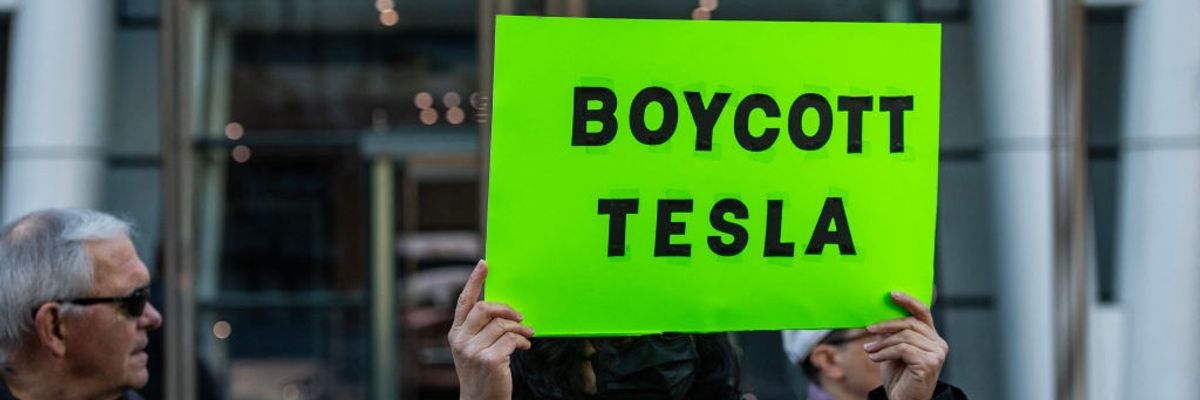
Protesters hold signs and sing chants during a protest against Elon Musk and his Tesla car company outside the Tesla dealership in Boston, Massachusetts on March 15, 2025.
(Photo by Joseph Prezioso / AFP via Getty Images)
Bill Mckibben
Mar 22, 2025
The Crucial Years
It must have seemed like a huge week for the fossil fuel industry: as the Wall Street Journal put it yesterday (and you could sense the headline writer’s glee), “The fossil fuel industry gets its revenge on green activists.”
It must have seemed like a huge week for the fossil fuel industry: as the Wall Street Journal put it yesterday (and you could sense the headline writer’s glee), “The fossil fuel industry gets its revenge on green activists.”
The oil-and-gas industry is landing blow after blow against climate activists.
The Trump administration has cranked out approvals of major projects to ship liquefied natural gas from the Gulf Coast and killed a host of climate-related initiatives.
Meanwhile, Texas billionaire Kelcy Warren has won a nearly $700 million verdict against Greenpeace that could spell the end of the group’s U.S. presence.
Hell, the Trump administration is trying to resurrect coal, and in what’s doubtless considered a back-slapping prank around the West Wing it just named a fracking executive to run the Department of Energy’s renewables office. Meanwhile, Musk’s vandals fired the quite brilliant chief scientist at NASA, doubtless because her work involved protecting the planet’s climate—Katherine Calvin was, among other things, the head of Working Group III of the Intergovernmental Panel on Climate Change, so good sport to Jackie Robinson her.
All of this is deeply stupid and damaging. And yet, despite all that, there must have been a few shivers that ran down the spines of both Elon Musk and oil executives last week when they read a piece of news from China.
Here’s the story, as told by Bloomberg. Chinese automaker BYD (their slogan, at least in English, is ‘Build Your Dreams”) announced on Tuesday that its new cars—available in April for $30,000 if you’re in a place where you can buy one—will recharge in five minutes. Or, roughly, the time it takes to fill your tank with gasoline.
From “more features for no more price” and “smart driving for all,” BYD can now add “charging as fast as refueling” to its marketing slogans, potentially helping it to capture more share from legacy automakers and more direct rivals like Elon Musk’s Tesla Inc.
How did they do this? Here are a bunch of words I don’t fully understand:
BYD cites its “all liquid-cooled megawatt flash charging terminal system.”
In addition, to match the ultra-high power charging, BYD has self-developed a next-generation automotive-grade silicon carbide power chip. The chip has a voltage rating of up to 1500V, the highest to date in the car industry.
In tandem, BYD on Monday launched its flash-charging battery. From the positive to the negative electrode, the cell contains ultra-fast ion channels, which BYD says reduces the battery’s internal resistance by 50%.
There’s also a mass-produced 30,000 RPM motor. Luo Hongbin, BYD senior vice president, said the motor “not only significantly boosts a vehicle’s speed, but also greatly reduces the motor’s weight and size, enhancing power density.”
But I can translate it into English. BYD did not waste its time giving Nazi salutes. It didn’t buy a social media platform so it could make obscure marijuana jokes and make fun of poor people. It didn’t devote itself to helping a nincompoop win the presidency and then decide it would be exhilarating fun to fire a bunch of government workers. Instead, BYD did, you know, engineering.
It’s gotten so bad that even true believers like Dan Ives, one of Tesla’s biggest shareholders, have suggested Musk might want to go back to, you know, work.
It must sting for Musk to watch that kind of progress, especially on a week when he had to recall all 46,000 cybertrucks (and thus disclose for the first time that he’d only sold 46,000 cybertrucks) in order to keep them from dropping parts on the road. It turns out they’d stuck the trim on the plug-ugly things with the wrong glue—now they’re going to replace it with an adhesive that is “not prone to environmental embrittlement.” When owners drive their sad vehicles back to the dealers for repairs (not during a rainstorm, because that apparently causes rusting), they’ll likely encounter one of the hundreds of protests that have broken out across the country. (I confess to being quite proud of my sign at our local demonstration last Saturday)
It’s gotten so bad that even true believers like Dan Ives, one of Tesla’s biggest shareholders, have suggested Musk might want to go back to, you know, work. I mean, Musk has cut the value of his company in half in the last couple of months. But never fear—last night he assembled the company’s workers for a pep talk. Robo-taxis coming soon! As they have been since 2016!
But if the BYD announcement was a reminder that Musk is a poseur, the deeper threat probably comes for Big Oil. Because if you can put 400 kilometers worth of juice in a car in five minutes, the last even slightly good reason for buying an internal combustion vehicle vanishes. Yeah, you still need a fast charger—and BYD is building 4,000 of them across China. But it feels like writing on the wall: Chinese demand for gasoline dropped in 2024, and analysts see it going down almost five percent a year between now and 2030. As the International Energy Agency explained last week,
Electric vehicles currently account for about half of car sales in China, undercutting 3.5% of new fuel demand in 2024... China has been providing subsidy support to purchases of so-called “new energy vehicles” (NEVs) since 2009, promoting its automotive manufacturing industry, and reducing air pollution. A trade-in policy, introduced in April 2024 and expanded in 2025, continues to drive growth in China’s EV sales. Meanwhile, highly competitive Chinese automakers are also making gains in international markets.
America’s oil companies decided they could make more money from fossil fuel than from embracing renewables—they’ve decided to let the Chinese win the solar energy battle, reckoning that they can use their political power to keep the world hooked on hydrocarbons. In some ways it’s working—they helped buy Trump his presidency and he’s giving them what they want. In particular, he’s been shaking down foreign countries to buy more of their Liquefied Natural Gas to avoid tariffs.
But oil is a global commodity, and the perfect example of marginal pricing. If China is going to be using less gasoline—well, the price of oil is going to drop. That’s bad news for American producers—as Trump’s biggest industry fundraiser Harold Hamm explained
U.S. shale needs much higher oil prices than $50 per barrel, and even higher than the current WTI Crude price in the high $60s, for a “drill, baby, drill” boom, oil tycoon and Trump campaign donor Harold Hamm told Bloomberg last week.
“There are a lot of fields that are getting to the point that’s real tough to keep that cost of supply down,” Hamm told Bloomberg Television in an interview.
The fracking revolution is wearing down—wells are sputtering towards empty faster than expected, and if prices are depressed it will make less economic sense to drill baby drill, no matter what our new king demands. As David Wethe and Alix Steel reported his week
Shale operators are slowing production growth after years of drilling up their best locations. At this week’s CERAWeek by S&P Global energy conference in Houston, executives for some of the largest US shale companies forecast US oil production will peak in the next three to five years.
I’m beginning to think you can imagine a world where the U.S. builds tariff walls around its borders, prevents the easy development and spread of technology like EVs and heat pumps, and manages to become an island of internal combustion on an increasingly electrified world. That’s a depressing vision, though nowhere near as depressing as the U.S. imposing that vision on the rest of the world, something that’s going to get harder: if you were any other country (Canada, say) would you tie yourself to the U.S. for any critical product? If you had a choice? And everyone has a choice, because the sun shines and the wind blows everywhere. As the economists at IEEFA said this week, even the expensive “just energy transition partnerships” with emerging Asian nations may survive Trump’s desertion.
Given the current U.S. administration’s priorities and ambitions to “drill, baby, drill” for oil and gas, the withdrawal from JETP can be viewed as favorable for the energy transition. The program’s complexities and transformative potential demand the involvement of a “coalition of the willing.” The original countries (including the European Union), private sector partners, and philanthropies still support JETP and want to realize the mechanism’s potential. In the case of Indonesia, Germany has quickly stepped in to fill the U.S.’s vacated leadership role. Japan has reaffirmed its co-leadership role and remains committed to Indonesia’s USD20 billion JETP. Despite the U.S. exit, critical financing and support for the program remains.
Here’s a great interactive map from the New York Times of what the solar and wind boom looks like from outer space. It shows the burst of development in China—but also Turkey. And it doesn’t even capture the small-scale home by home and factory by factory spread of solar that seems to be speeding up exponentially over the last year.
It may even be hard to stomp out all this goodness here at home. Case in point: the Utah (!) legislature this week became the first in the country to (unanimously!) pass a law enabling “balcony solar,” the small-scale arrays that brought solar power to a million and a half German apartments last year.
The legislation exempts these systems from several requirements:No technical interconnection requirements.
No technical interconnection agreement.
Utilities cannot mandate approval, charge fees, or require additional controls or equipment beyond what is integrated into the system.
Plug and play, baby!
Indeed, if you want a sign for the future, here’s one: Chinese authorities are pulling back on a plan to let BYD build a new car plant in Mexico. Why? Because they’re afraid that people like Musk—an unimaginative pol, not an engineering genius—will steal their cool new tech.
Those respective authorities in China fear that BYD’s advanced (and in many cases, leading) technology could more easily end up in the possession of US competitors through Mexico, as the US neighbors to the south would gain unrestricted access to the Chinese automaker’s technology and production practices. Those powers went as far as to suggest that Mexico could even assist the US in gaining access to BYD’s technology.
It’s bad news for America that our country has lost its technological edge. It may be good news for the planet, though.
© 2022 Bill McKibben
Bill Mckibben
Bill McKibben is the Schumann Distinguished Scholar at Middlebury College and co-founder of 350.org and ThirdAct.org. His most recent book is "Falter: Has the Human Game Begun to Play Itself Out?." He also authored "The End of Nature," "Eaarth: Making a Life on a Tough New Planet," and "Deep Economy: The Wealth of Communities and the Durable Future."
Full Bio >
Hell, the Trump administration is trying to resurrect coal, and in what’s doubtless considered a back-slapping prank around the West Wing it just named a fracking executive to run the Department of Energy’s renewables office. Meanwhile, Musk’s vandals fired the quite brilliant chief scientist at NASA, doubtless because her work involved protecting the planet’s climate—Katherine Calvin was, among other things, the head of Working Group III of the Intergovernmental Panel on Climate Change, so good sport to Jackie Robinson her.
All of this is deeply stupid and damaging. And yet, despite all that, there must have been a few shivers that ran down the spines of both Elon Musk and oil executives last week when they read a piece of news from China.
Here’s the story, as told by Bloomberg. Chinese automaker BYD (their slogan, at least in English, is ‘Build Your Dreams”) announced on Tuesday that its new cars—available in April for $30,000 if you’re in a place where you can buy one—will recharge in five minutes. Or, roughly, the time it takes to fill your tank with gasoline.
From “more features for no more price” and “smart driving for all,” BYD can now add “charging as fast as refueling” to its marketing slogans, potentially helping it to capture more share from legacy automakers and more direct rivals like Elon Musk’s Tesla Inc.
How did they do this? Here are a bunch of words I don’t fully understand:
BYD cites its “all liquid-cooled megawatt flash charging terminal system.”
In addition, to match the ultra-high power charging, BYD has self-developed a next-generation automotive-grade silicon carbide power chip. The chip has a voltage rating of up to 1500V, the highest to date in the car industry.
In tandem, BYD on Monday launched its flash-charging battery. From the positive to the negative electrode, the cell contains ultra-fast ion channels, which BYD says reduces the battery’s internal resistance by 50%.
There’s also a mass-produced 30,000 RPM motor. Luo Hongbin, BYD senior vice president, said the motor “not only significantly boosts a vehicle’s speed, but also greatly reduces the motor’s weight and size, enhancing power density.”
But I can translate it into English. BYD did not waste its time giving Nazi salutes. It didn’t buy a social media platform so it could make obscure marijuana jokes and make fun of poor people. It didn’t devote itself to helping a nincompoop win the presidency and then decide it would be exhilarating fun to fire a bunch of government workers. Instead, BYD did, you know, engineering.
It’s gotten so bad that even true believers like Dan Ives, one of Tesla’s biggest shareholders, have suggested Musk might want to go back to, you know, work.
It must sting for Musk to watch that kind of progress, especially on a week when he had to recall all 46,000 cybertrucks (and thus disclose for the first time that he’d only sold 46,000 cybertrucks) in order to keep them from dropping parts on the road. It turns out they’d stuck the trim on the plug-ugly things with the wrong glue—now they’re going to replace it with an adhesive that is “not prone to environmental embrittlement.” When owners drive their sad vehicles back to the dealers for repairs (not during a rainstorm, because that apparently causes rusting), they’ll likely encounter one of the hundreds of protests that have broken out across the country. (I confess to being quite proud of my sign at our local demonstration last Saturday)
It’s gotten so bad that even true believers like Dan Ives, one of Tesla’s biggest shareholders, have suggested Musk might want to go back to, you know, work. I mean, Musk has cut the value of his company in half in the last couple of months. But never fear—last night he assembled the company’s workers for a pep talk. Robo-taxis coming soon! As they have been since 2016!
But if the BYD announcement was a reminder that Musk is a poseur, the deeper threat probably comes for Big Oil. Because if you can put 400 kilometers worth of juice in a car in five minutes, the last even slightly good reason for buying an internal combustion vehicle vanishes. Yeah, you still need a fast charger—and BYD is building 4,000 of them across China. But it feels like writing on the wall: Chinese demand for gasoline dropped in 2024, and analysts see it going down almost five percent a year between now and 2030. As the International Energy Agency explained last week,
Electric vehicles currently account for about half of car sales in China, undercutting 3.5% of new fuel demand in 2024... China has been providing subsidy support to purchases of so-called “new energy vehicles” (NEVs) since 2009, promoting its automotive manufacturing industry, and reducing air pollution. A trade-in policy, introduced in April 2024 and expanded in 2025, continues to drive growth in China’s EV sales. Meanwhile, highly competitive Chinese automakers are also making gains in international markets.
America’s oil companies decided they could make more money from fossil fuel than from embracing renewables—they’ve decided to let the Chinese win the solar energy battle, reckoning that they can use their political power to keep the world hooked on hydrocarbons. In some ways it’s working—they helped buy Trump his presidency and he’s giving them what they want. In particular, he’s been shaking down foreign countries to buy more of their Liquefied Natural Gas to avoid tariffs.
But oil is a global commodity, and the perfect example of marginal pricing. If China is going to be using less gasoline—well, the price of oil is going to drop. That’s bad news for American producers—as Trump’s biggest industry fundraiser Harold Hamm explained
U.S. shale needs much higher oil prices than $50 per barrel, and even higher than the current WTI Crude price in the high $60s, for a “drill, baby, drill” boom, oil tycoon and Trump campaign donor Harold Hamm told Bloomberg last week.
“There are a lot of fields that are getting to the point that’s real tough to keep that cost of supply down,” Hamm told Bloomberg Television in an interview.
The fracking revolution is wearing down—wells are sputtering towards empty faster than expected, and if prices are depressed it will make less economic sense to drill baby drill, no matter what our new king demands. As David Wethe and Alix Steel reported his week
Shale operators are slowing production growth after years of drilling up their best locations. At this week’s CERAWeek by S&P Global energy conference in Houston, executives for some of the largest US shale companies forecast US oil production will peak in the next three to five years.
I’m beginning to think you can imagine a world where the U.S. builds tariff walls around its borders, prevents the easy development and spread of technology like EVs and heat pumps, and manages to become an island of internal combustion on an increasingly electrified world. That’s a depressing vision, though nowhere near as depressing as the U.S. imposing that vision on the rest of the world, something that’s going to get harder: if you were any other country (Canada, say) would you tie yourself to the U.S. for any critical product? If you had a choice? And everyone has a choice, because the sun shines and the wind blows everywhere. As the economists at IEEFA said this week, even the expensive “just energy transition partnerships” with emerging Asian nations may survive Trump’s desertion.
Given the current U.S. administration’s priorities and ambitions to “drill, baby, drill” for oil and gas, the withdrawal from JETP can be viewed as favorable for the energy transition. The program’s complexities and transformative potential demand the involvement of a “coalition of the willing.” The original countries (including the European Union), private sector partners, and philanthropies still support JETP and want to realize the mechanism’s potential. In the case of Indonesia, Germany has quickly stepped in to fill the U.S.’s vacated leadership role. Japan has reaffirmed its co-leadership role and remains committed to Indonesia’s USD20 billion JETP. Despite the U.S. exit, critical financing and support for the program remains.
Here’s a great interactive map from the New York Times of what the solar and wind boom looks like from outer space. It shows the burst of development in China—but also Turkey. And it doesn’t even capture the small-scale home by home and factory by factory spread of solar that seems to be speeding up exponentially over the last year.
It may even be hard to stomp out all this goodness here at home. Case in point: the Utah (!) legislature this week became the first in the country to (unanimously!) pass a law enabling “balcony solar,” the small-scale arrays that brought solar power to a million and a half German apartments last year.
The legislation exempts these systems from several requirements:No technical interconnection requirements.
No technical interconnection agreement.
Utilities cannot mandate approval, charge fees, or require additional controls or equipment beyond what is integrated into the system.
Plug and play, baby!
Indeed, if you want a sign for the future, here’s one: Chinese authorities are pulling back on a plan to let BYD build a new car plant in Mexico. Why? Because they’re afraid that people like Musk—an unimaginative pol, not an engineering genius—will steal their cool new tech.
Those respective authorities in China fear that BYD’s advanced (and in many cases, leading) technology could more easily end up in the possession of US competitors through Mexico, as the US neighbors to the south would gain unrestricted access to the Chinese automaker’s technology and production practices. Those powers went as far as to suggest that Mexico could even assist the US in gaining access to BYD’s technology.
It’s bad news for America that our country has lost its technological edge. It may be good news for the planet, though.
© 2022 Bill McKibben
Bill Mckibben
Bill McKibben is the Schumann Distinguished Scholar at Middlebury College and co-founder of 350.org and ThirdAct.org. His most recent book is "Falter: Has the Human Game Begun to Play Itself Out?." He also authored "The End of Nature," "Eaarth: Making a Life on a Tough New Planet," and "Deep Economy: The Wealth of Communities and the Durable Future."
Full Bio >


