Thursday, July 30, 2026

Trump, Elections and Democracy: How We Can Move Beyond Electoral Fetishism


 July 29, 2026

Photograph by Nathaniel St. Clair

Donald Trump’s much ballyhooed public address on July 16 – an attempt to pressure Congress to approve his “Save America” election legislation – turned out to be a pitiful bust.  Even Sean Hannity seemed embarrassed by a speech that claimed large‑scale “election vulnerabilities,” including hundreds of thousands of alleged non‑citizen votes and Chinese hacking of voter files but offered zero evidence of fraud in the 2020 presidential election.

Evidence or no evidence, Trump can’t stop alleging that the vote for Biden was rigged – a compulsive accusation that anti-Trumpers attribute to his inability to accept defeat, his delusional tendencies, and his intention to challenge the results of the upcoming federal midterm elections.  The president’s bad motives and psychological mischigas are undeniable.  Even so, his election denialism has significant causes that most Democrats avoid mentioning, since to do so could expose their own role in provoking the madness of King Donald.

Where the election of 2020 is concerned, the president is quite crazed – but what drove him around the bend?  Most critics seem determined to forget that the original trauma in this case – the first serious allegations of a rigged election casting doubt on the authenticity of the voting process – were the charges made by Democratic leaders and pursued by various “deep state” agencies under Joe Biden that Trump and his campaign had conspired with the Russians to defeat Hilary Clinton in 2016.

How could a vulgar upstart and political amateur like Trump defeat a seasoned professional like Hilary?  It must have been a Russian plot!  Few Democrats these days have much to say about “Russiagate.”  They seem to have difficulty remembering that during the 2016 campaign the DNC hired a former British spy to compile evidence of a Trump-Russia conspiracy (the “Steele Dossier”) while encouraging F.B.I. director James Comey to begin a major investigation of his own.  The Steele dossier turned out to be weakly sourced and unreliable.  After the election Democratic-controlled congressional committees held extensive hearings on the matter, also without significant results.  And after two years more of further investigation, Special Counsel Robert Mueller issued a report stating that Russian agencies had indeed attempted to interfere with the election, but that evidence of a conspiracy implicating the Trump campaign was lacking.

All that work to “explain” Trump’s election – and with such disappointing results!  Not only was the conspiracy unproved, but there was no evidence at all that Russian interference had had a measurable impact on the 2016 election.  In that year six key industrial states that had voted for Obama four years earlier went for Trump by substantial majorities – not because of Russian trolls or hacked Clinton emails, but because so many working people felt that the Democrats had abandoned them.  Even so, the losers could not resist charging, in effect, that the election had been “rigged” by Trump and the Russians.

It seems clear, in retrospect, that the Russiagate allegations were hardly more substantial than Trump’s subsequent insistence that the election of 2020 had been stolen.  But today’s Democratic leaders take no responsibility for attempting to delegitimize a winning presidential candidate by casting doubt on the validity of the electoral process.  Nor, even if “progressives,” will they admit that any of the criminal charges brought against Trump in the Biden era were hostile exercises of prosecutorial discretion.  Anti-Trumpers tend to attribute their nemesis’s obsessiveness and vengefulness exclusively to his own defects of character.  These defects, God knows, are plentiful.  But it’s U.S. political institutions, not just Donald J. Trump’s personality, that are deformed.  And most of his adversaries don’t seem to want to deal with that reality at all.

When Trump says that elections are rigged and proposes “reforms” that would suppress voter participation, one’s impulse is to spring to the defense of the current electoral system.  There is certainly reason to suspect that the president is an authoritarian operator who would happily rig an election himself rather than surrender power. His fake reforms should be strongly opposed, of course.  But electoral fetishism is not an effective response to his election denialism.  The system as it stands is rigged in favor of candidates and policies favored by the capitalist elite: the oligarchs and their political servitors.  It does need to be changed, although surely not in the ways Trump is proposing.  Three sources of electoral corruption deserve particular notice: U.S. constitutional and legal norms, an evenly divided electorate, and Big Money.

1) The U.S. Constitution is a document that was intended to consolidate the gains of the American Revolution while preventing power from falling into the hands of the “mob.” As a result, even after enfranchising women, former slaves, and poor people, we have inherited a presidential electoral system that makes it possible to win an election by millions of popular votes but still lose the presidency.  Our senatorial voting system gives equal representation to Wyoming’s half million residents and 34.5 million Californians, while the rules of apportionment approved by the U.S. Supreme Court permit the outrageously partisan (and racist) gerrymandering of legislative electoral districts by those in power.  Meanwhile, a “winner-take-all” norm in almost all U.S. elections assures that groups constituting a voting minority will be subject for years to the dictates of those constituting a majority – even if the election was decided by a few hundred or a few thousand votes bought or coerced by powerful interests.

2) In fact, when the electorate is evenly divided, a little fraud can go a long way. Donald Trump’s partisans are unable to prove that illegal voting played a significant role in any recent election – but the idea that a relative handful of illicit votes can swing a closely fought contest is far from a paranoid fantasy.  As Tracy Campbell shows in her richly documented study, Deliver the Vote (2005), serious electoral fraud has been “an American tradition” since colonial times.  One recalls the presidential election of 1960, when John Kennedy defeated Richard Nixon in Illinois by 8,858 votes out of almost 5 million cast.  That result was confirmed only after Chicago’s mayor Richard J. Daley, who had delayed reporting the city’s vote until the downstate (mainly Republican) vote had been calculated, announced it.  Some Republicans charged fraud both in Illinois and in Texas, where the Democratic machine was also very powerful, but post-election investigations were half-hearted, no “smoking gun” proving significant wrongdoing was discovered, and Nixon – unlike Trump – was not inclined to pursue the matter after his rival was inaugurated.

3) More important than this potential for electoral fraud, however, is the permeation of American elections by Big Money: a form of legalized corruption that gives the oligarchic elite and its political representatives decisive influence over the ideas and behavior of U.S. political parties, candidates for office, and voters. Private campaign contributions have always been an outsized influence on U.S. elections, but In Citizens United and subsequent legal cases, the U.S. Supreme Court confirmed the rights of wealthy individuals and corporations to engage in a range of practices that includes creating super-PACS and funneling “dark money” into political campaigns. The floodgates opened, and in 2024 Elon Musk alone contributed around $290 million in various forms to the campaigns of Trump and other Republican candidates.

In the same election the Harris campaign outspent that of Trump by almost half a billion dollars . . . and still lost.  The moral: U.S. elections are corrupted not so much by simple vote-buying as by a system that permits an elite to establish the political and ideological ground rules which limit the choices of “acceptable” candidates and policies available to voters.  A major purpose of these rules is to keep the oligarchs’ basic “rights” to own and control great accumulations of capital from being subjected to challenge by elected officials.

The current turmoil in the United States, with President Trump’s popularity declining and many Democrats moving somewhat to the left, provides an interesting test of how the system works.  Even though the Democratic Party’s self-declared “democratic socialists” are little more than outspoken liberals, Trump and the Heritage Foundation have started to call them communists.  So far, this name-calling has not been accompanied by much repression, probably because most oligarchs understand that Bernie Sanders or AOC-style progressivism does not seriously threaten their ownership or management privileges.  If these privileges are brought into question, however, a different line is likely to be drawn, and repressive measures initiated.

Many Democrats and some Republicans want to increase taxes on the rich, provide a wider range of public welfare services to working people, regulate big corporations more effectively, and shift resources from military to peacetime uses.  Since the New Deal, the corporate elite has considered such demands negotiable rather than taboo.  But if political organizers wish to go further, say, by capping or confiscating great wealth, advocating the public ownership of key resources, greatly reducing military-industrial expenditures, or redefining management rights (including the “right” to buy political candidates), the situation is likely to change.  An oligarchy feeling genuinely threatened will define such activists as unAmerican extremists and subject them to McCarthy-style repression, or worse.

Is a mass-based anti-capitalist mobilization possible?  I think so.  Especially if the world capitalist system has entered a period of crisis that some theorists believe can only get worse, moderate reforms of the sort favored by Democratic progressives are likely to prove ineffective, and organizers proposing more radical changes could find themselves leading a mass movement.  The fear that a genuine Left could emerge in the U.S. motivates fascistic representatives of the oligarchy like Stephen Miller to propose preemptive repression — including measures intended to “fix” the electoral rules.  But the answer to such threats is not just to condemn Miller, and certainly not to sacralize the pre-Trump voting system.

For now, elements of the old system such as mail-in ballots must be protected against Trumpian vote-suppressing tactics.  But the point of doing this is to lay the groundwork for a transformation that will break the power of the oligarchy and turn elections into a genuine method (among others) of self-rule.  Our guiding aim cannot be simply to “defend” a deeply compromised democracy.  It must be to create a real one.

Russia seeks arrest of Telegram chief Durov

AFP
July 29, 2026 

Telegram is widely used across Russia, both as a messaging app and as a social media platform – Copyright AFP/File –

Russia announced on Wednesday that it was seeking the arrest of Telegram founder Pavel Durov over accusations of “complicity in terrorism”, alleging he had let the platform be used for recruitment by Ukraine’s security services.

Russian-born Durov — a serial tech founder who has lived outside Russia for years and holds French and United Arab Emirates passports — has frequently clashed with the Russian authorities as Moscow has tightened its grip on the internet.

His Telegram messenger is one of the country’s main communications platforms and officials have repeatedly tried to block access or thwart its success in a bid to pressure Durov to hand over user data or push Russians to use an unencrypted state-backed alternative.

Russia has put Telegram founder Pavel Durov on its wanted list, accusing him of ‘complicity in terrorism’ – Copyright AFP/File Giuseppe CACACE

The FSB security service said it had launched international search proceedings for Durov, who is also Telegram’s CEO.

“An international wanted notice has been issued… for the head of the Telegram administration, P. Durov,” it said in a statement.

It was unclear what kind of wanted notice Russia had issued and whether other countries or law enforcement bodies would accept or comply with it.

Lawyers for Durov, 41, declined to comment when contacted by AFP.

– Social media war –

Moscow frequently targets political enemies with charges of supporting “terrorism” or “extremism”, including those who have left the country.

The FSB alleged Telegram had been used as a recruitment platform for Ukrainian security services looking to coerce Russians to commit sabotage acts and that Durov had not removed “prohibited information”.

Russia and Ukraine have accused each other of using social media to recruit people to support them in the four-and-a-half-year war.

Durov, 41, has lived in both Dubai and France.

In 2024, he was arrested by French police on charges related to the distribution of illegal content, but was later released on bail.

He left France after authorities there lifted a travel ban.

Born in Saint Petersburg — President Vladimir Putin’s home city — Durov founded VKontakte, a social media site widely known as “Russia’s Facebook”.

He was essentially forced out of the company as it came under pressure from the authorities in the mid 2010s and founded Telegram, a social media platform and private messenger.

Telegram quickly became one of the most used online services in Russia and easily thwarted a years-long attempt by Moscow’s internet authorities to block access inside the country.

Durov — who is active on Telegram — did not immediately comment on the FSB allegations.

This year, the VKontakte social network — now controlled by the state and known as VK — has been pushing government-backed messenger Max, urging Russians to switch from Telegram and WhatsApp.

Durov has criticsed the platform as “a state-controlled app built for surveillance and political censorship”.
Rheinmetall shares surge after armsmaker reports record profit

AFP
July 29, 2026

Rheinmetall shares have soared 13-fold since before Russia’s full-scale invasion of Ukraine in February 2022 as defence spending has surged across Europe 
– Copyright AFP/File Alexandra Beier

German weapons manufacturer Rheinmetall on Wednesday reported record second-quarter core profit, beating analyst expectations, sending shares in the firm up almost nine percent.

Core profit for the three months to June came in at 562 million euros ($639.5 million), Rheinmetall said, roughly double the amount this time last year and about 20 percent above analyst expectations in a poll by Vara Research.

Revenue at 3.3 billion euros was up almost 70 precent, Rheinmetall said, with growth broad-based across the company.

“All segments contributed to this year-on-year improvement,” the tank gun maker said. “Operating metrics have thus been significantly exceeded.”

Rheinmetall shares have soared 13-fold since before Russia’s full-scale invasion of Ukraine in February 2022 as defence spending has surged across Europe.

Germany’s defence budget is planned to rise 33 percent by next year to almost 110 billion euros as Berlin rearms to face the threat from Moscow and compensate for wavering American commitment to European security.
German sports carmaker Porsche to cut 5,000 jobs by 2035

AFP
July 27, 2026

An electric version of the Macan. — © Copyright AFP HECTOR RETAMAL/File

German luxury sports carmaker Porsche, a subsidiary of the Volkswagen Group, said Monday it would cut 5,000 jobs by 2035 as part of a strategic realignment to boost competitiveness.

The maker of the 911 sports car has seen profits collapse due to plunging sales in China, where home-made electric vehicles now dominate, as well as US tariffs and a costly decision to hit the brakes on its troubled electric transition.

The new plan includes the “socially responsible reduction of a further 5,000 jobs by 2035, largely through natural attrition, demographic effects, the expansion of the special partial retirement programme and voluntary severance agreements,” the company said.

With job cuts already announced last year, the firm therefore plans to reduce its workforce of over 30,000 by 8,900 people.

Announcing what it called its “future package”, the carmaker also said it would invest a cumulative of 2.1 billion euros ($2.4 billion) by 2035 in two plants, at Zuffenhausen and Weissach near Stuttgart.

Workers there would enjoy employment and site protection until 2035, it said after negotiations with the general works council and trade unions.

“The shared objective is to strengthen the competitiveness of the sports car manufacturer and secure as many jobs as possible in the long term,” the company said in a statement.

Other cost-cutting measures were also announced, such as deferring wage increases until 2035 and having senior executives forgo base salary increases in 2027 and 2028.

Porsche is among automakers which have recently taken a hefty hit after ploughing huge sums into the electric transition, only to find demand weaker than expected.

The manufacturer announced last year it was slowing its shift to EVs, a move that dented 10-brand Volkswagen’s profits by billions of euros.

Measures included delaying the introduction of some fully electric cars, and extending the life of some combustion engine and hybrid models.
'Incredible': Erin Burnett floored as China mocks Trump to his face

PULLING A PUTIN


Matthew Chapman
July 29, 2026 
RAW STORY

China is helping Iran and then turning around and denying it to President Donald Trump's face, CNN's Erin Burnett said on Wednesday — and it's an international humiliation.

She discussed the issue with Seth Jones of the Center for Strategic and International Studies on "OutFront."

"Let's just be blunt here," said Burnett. "What is China doing to help Iran, both when it comes to weapons shipments and also other things? For example, a lot of the targeting, the specific targeting of U.S. bases, which the reporting has been very clear that both Russia and China have helped with."

Jones confirmed that "the Chinese are clearly a problem right now."

If the People's Republic is indeed "providing shoulder-launched weapons systems to the Iranians" capable of shooting down U.S. or Israeli aircraft, Jones said, combined with the rocket fuel they are providing to Iran to launch their missiles, "this is a disturbing trend."

"It's not dissimilar from what we've seen the Chinese do to the Russians in the Ukraine war, where they are now essentially bankrolling the Russian industrial base," Jones continued. The bottom line, he said, is that it's critical for Trump to "recognize that the Chinese are undermining both theaters right now."

"Yeah," said Burnett. "It's pretty incredible that China will go and tell him that they're not doing it. And he says, 'I take them at their word.' They continue to do it. In a sense, it's a mockery of the U.S. president."


Fox News host caught 'mugging' at Fauci hearing forced to eat her own words

Nicole Charky-Chami
July 29, 2026 
RAW STORY


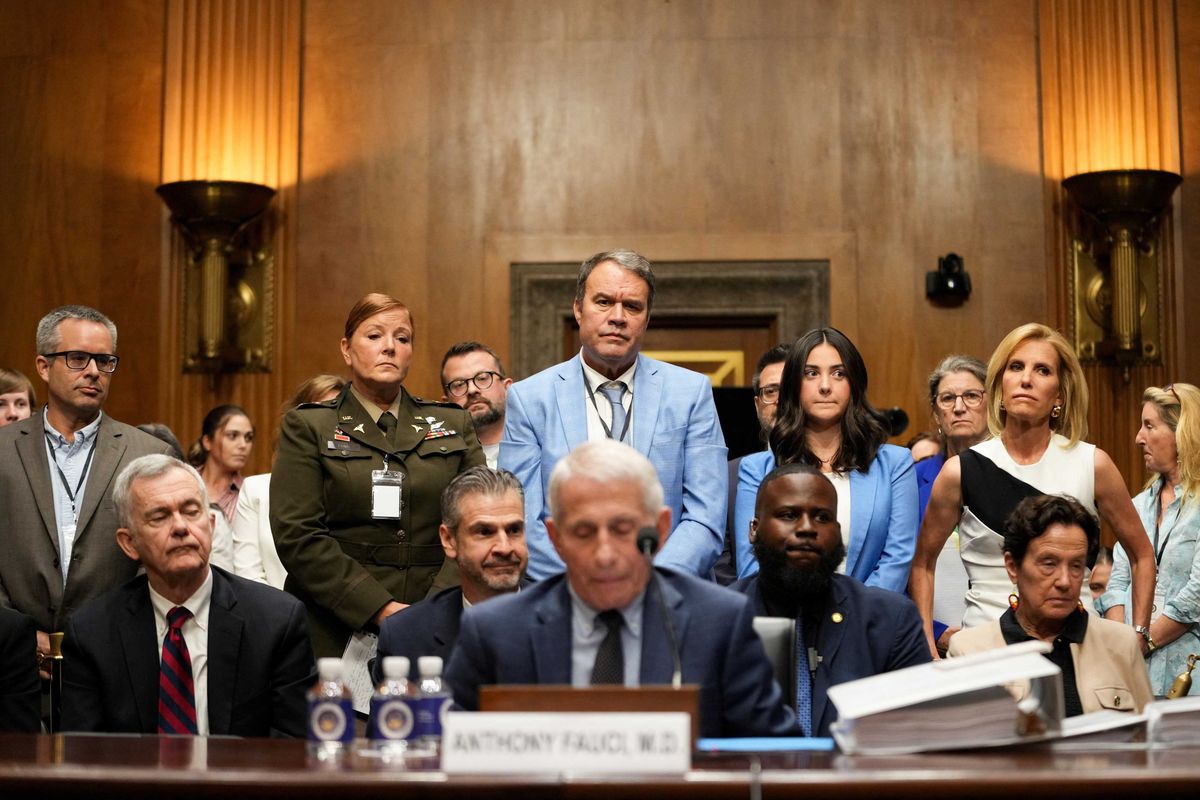
Members of the audience, who say they were negatively impacted by their skepticism to COVID-19 precautions, stand behind Anthony Fauci, the former Director of the National Institute of Allergy and Infectious Diseases and medical advisor to several U.S. presidents, at the urging of Sen. Bernie Moreno (R-OH) at a U.S. Senate Homeland Security and Governmental Affairs Committee on Capitol Hill in Washington, D.C., on July 29, 2026. REUTERS/Nathan Howard

"The Daily Show" delivered a hysterical response to Fox News host Laura Ingraham's expressions during the Senate hearing for Dr. Anthony Fauci on Wednesday.

Ingraham was sitting behind Fauci as Republicans unleashed attacks on the former director of the National Institute of Allergy and Infectious Diseases at the Senate Homeland Security and Government Affairs Committee hearing.

"The Daily Show" zoomed in on Ingraham, pairing her reactions with a montage of her own words.

"Watching Laura Ingraham make faces at Fauci's hearing while listening to Laura Ingraham complain about other people making faces," "The Daily Show" wrote on X.

In the video, Fauci responds to lawmakers and invokes the Fifth Amendment right against self-incrimination, while Ingraham appears to mock him.

"The smirking for the camera... the smirk she had on her face... shaking her... shaking her head...and she just kind of rolled her eyes, mugging for the cameras, and at certain points it almost seems like a competition for the camera," the audio played, showing footage of Ingraham shaking her head and rolling her eyes.

"Her little charade for the cameras isn't just an example of conduct that is boorish and rude, arrogant and rude, always performing for the cameras," the video continued.

"Taking a selfie like a junior high school girl" — then the video showed a shot of Ingraham taking a selfie during the hearing.

Ingraham was part of a group of people seated behind Fauci who Sen. Bernie Moreno (R-OH) referred to as "shamed" and asked to stand up if they believe they have faced backlash or negative impacts over the COVID-19 pandemic.


MAGA AG moves to investigate Fauci as Republicans vow revenge for invoking Fifth

Matthew Chapman
July 29, 2026 
RAW STORY


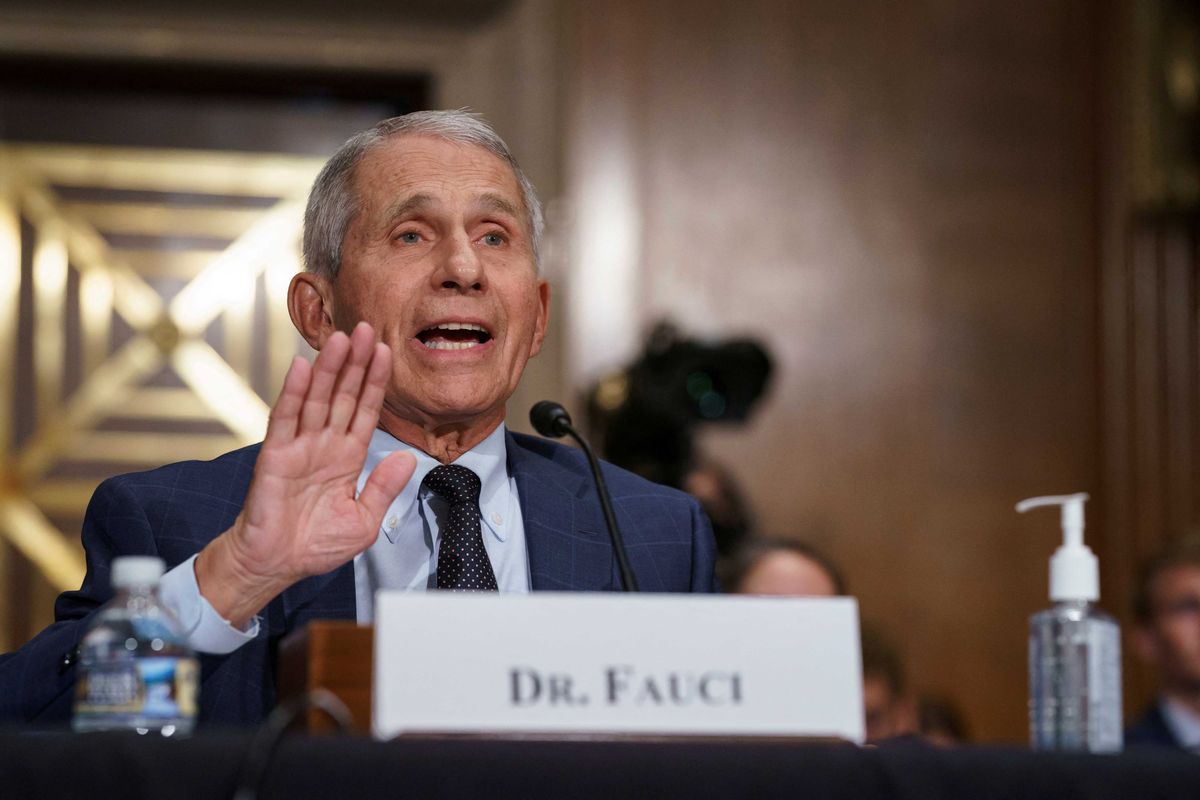
Anthony Fauci, the former Director of the National Institute of Allergy and Infectious Diseases (NIAID) and medical advisor to several U.S. presidents, attends a U.S. Senate Homeland Security and Governmental Affairs Committee on Capitol Hill in Washington, D.C., U.S., July 29, 2026. Anthony Fauci declined to answer questions, invoking his Fifth Amendment right against self-incrimination. REUTERS/Nathan Howard

Florida Attorney General James Uthmeier, a staunch supporter of President Donald Trump, is launching an investigation into former National Institutes of Health director Dr. Anthony Fauci.

According to Politico, Uthmeier's boss, Florida Gov. Ron DeSantis, has concocted a bizarre legal theory for why Fauci, who testified before a hostile GOP-dominated Senate committee on Wednesday, was not allowed to invoke his Fifth Amendment rights under questioning from Sen. Rand Paul (R-KY).

"Uthmeier has launched several investigations since he was appointed by DeSantis in February 2025, from suing health organizations over the state’s ban on transgender treatments for children to recruiting rules used by the NFL," noted the report. This follows DeSantis writing "in a Wednesday X post the former White House adviser cannot claim the Fifth Amendment since he received a preemptive pardon by Biden, and he should be held in contempt for not answering Kentucky GOP Sen. Rand Paul’s questions about U.S. funding going to a lab in a region of China where the first Covid cases were reported."

Paul has spent years pursuing the idea that Fauci-backed "gain of function" research was responsible for engineering the COVID virus, something that has never been substantiated, and has openly called for Fauci's arrest. In his testimony, Fauci explained that while he has not broken any laws, his lawyers advised him to remain silent due to Paul's eagerness for a pretext to prosecute him.

For his part, said the report, Paul "told Fauci he will face consequences for pleading the Fifth and has scheduled an Aug. 5 committee meeting to discuss whether to declare him in contempt of Congress," while Uthmeier said weeks before the hearing even took place "that he was losing sleep over thinking of ways to prosecute Fauci."

Florida became ground zero in 2020 for political leadership defiance against public health guidelines for required masking and social distancing, during the height of the pandemic. The state became a huge vector for the spread of COVID.


Wednesday, July 29, 2026

Vatican To Launch First Conference Of Christians And Confucians


July 29, 2026
EWTN News
By Ishmael Adibuah


Key Takeaways:

The Vatican’s Dicastery for Interreligious Dialogue will hold its first dedicated Christian–Confucian colloquium in Seoul, South Korea (Aug. 4–5, 2026), focused on contributions to an ideal society, universal fraternity, virtuous leadership, and ecological responsibility.

The event builds on earlier workshops and guidelines for Confucian–Catholic dialogue and is expected to include Cardinal George Jacob Koovakad, prefect of the Dicastery.

Organizers note that Confucian ethics (emphasizing moral self-cultivation, social harmony, and good citizenship) share common ground with Christian teachings and can enrich mutual understanding and coexistence.


The Vatican will launch its first conference of Christians and Confucians to expand the Catholic Church’s outreach to the Asian ethical tradition.

The Dicastery for Interreligious Dialogue will hold the colloquium “Dialogue on the Contribution of Christianity and Confucianism to an Ideal Society: New Heaven, New Earth, and Great Unity” in South Korea from Aug. 4–5. As reported by Union of Catholic Asian News, it will convene clergy and scholars at Sogang University in Seoul to discuss universal fraternity, virtuous leadership, and ecological responsibility.


Cardinal George Jacob Koovakad, prefect of the Dicastery for Interreligious Dialogue, is expected to attend along with other dicastery officials.

The event is also organized by the Catholic Bishops’ Conference of Korea.

The Dicastery for Interreligious Dialogue has participated in similar conferences, including the 2025 workshop “Christians Fostering Dialogue with Confucians: Guidelines and Prospects” in Taiwan and the 2024 study group that developed guidelines for Confucian-Catholic dialogue.

Confucianism developed from the ethical teachings of the Chinese philosopher Kong Qiu, known in the West as Confucius. He emphasized filial piety, ancestor veneration, moral self-cultivation, and harmonious social relationships rather than devotion to a creator god.

According to 2025 estimates from the World Religion Database, approximately 8.75 million Confucianists live worldwide. The largest populations are in South Korea, with 5,616,520 people; China, with 1,737,191; Myanmar, with 813,322; Thailand, with 261,330; and Japan, with 162,179.

According to Vatican News, at the 2025 workshop, Father Paulin Batairwa Kubuya, undersecretary of the Dicastery for Interreligious Dialogue, explained that certain Confucian teachings are already consistent with Christianity.

“Christianity and Confucianism are wisdom traditions,” Kubuya said. “Confucian ethics is very strong on how people should comport themselves, how to be good citizens, and how to organize their lives. We find that these aspects correspond to Christianity.”

Kubaya also expressed his hope that the future of Confucian-Christian dialogue would help Christians “look at our Confucian neighbors, look at how we can develop a better way of living together, [and] how we can enrich one another.”


About EWTN News

EWTN News is the rebranding of the Catholic News Agency (CNA), following the decision by EWTN — which was launched as a Catholic television network in 1981 by Mother Angelica, PCPA — that brings CNA and its affiliated ACI international outlets under a single, unified identity. Previous CNA articles may be foundby clicking here.


The Enlightenment’s Unfinished Battle: From French Revolutions To ‘MAGA’ And China – Analysis


Weimar's Courtyard of the Muses by Theobald von Oer, a tribute to The Enlightenment and the Weimar Classicism depicting German poets Schiller, Wieland, Herder, and Goethe


July 29, 2026
By Najmidin Qarluq

Key Takeaways:

Enlightenment values of human dignity, liberty, democracy, and the rule of law are not a settled European inheritance but an unfinished struggle that must still be actively defended, especially against authoritarian systems that subordinate individuals to the state.

Europe’s growing economic dependence on China (large and rising trade deficits, concentration in critical technologies) reduces its practical ability to uphold these values, resist extraterritorial coercion, and protect dissidents when political disagreements become costly.

To remain credible, Europe must rebuild industrial and technological capacity, treat transnational repression as a sovereignty issue, and refuse the temptation to trade principles for short-term economic or political convenience.


From Brussels, the Enlightenment can look like settled history.

It is written into treaties, invoked in speeches and built into the architecture of the European Union. The language of human dignity, liberty, democracy and the rule of law is so familiar that it can seem permanent. Europe often speaks of these values as though they were an inheritance safely stored away — something to be cited when convenient, not something that must still be defended.

For me, they are not abstract.


I live in Brussels, while members of my family and democratic-minded intellectuals from my homeland have been imprisoned by the Chinese state. Their alleged offence was not violence. It was independent thought: the belief that people have a right to speak, write, organise and preserve an identity without first asking the state for permission.

That experience makes the current European debate look different. When officials speak of “de-risking,” trade exposure or strategic autonomy, they are not discussing technical files alone. They are discussing whether Europe will retain the capacity to protect the principles on which its own political order rests — and the people who depend on those principles beyond its borders.

The Enlightenment’s battle, in other words, is unfinished.
A standard, not a monument

The French Revolution did not create a flawless political order. Its legacy included terror, war and profound contradictions. But it made a demand that could not be fully withdrawn: political authority must justify itself; law must not simply be the will of the powerful; and human beings cannot be treated merely as instruments of the state.


That demand became the moral core of modern European democracy. It was never universally fulfilled, including by Europe itself. But it created a standard against which power could be judged and challenged.

This is what is often lost when Europe treats the Enlightenment as cultural decoration. Its importance was never that Europeans had discovered a final answer to history. Its importance was that they accepted a permanent argument with power.

A government may claim national security. It may claim economic necessity. It may claim social order. But it must still face a question: what limits does it recognise? What rights does it leave untouched? Can an individual dissent without becoming an enemy?

The answer offered by the Chinese party-state is increasingly clear. The state does not merely govern society; it defines the political boundaries within which society, identity, history and speech may exist. A person, a community or a business becomes acceptable only insofar as it serves a state-defined national project.

That is not simply a Chinese domestic matter when the system begins to extend its claims beyond China’s borders.
When coercion travels

Europeans should take seriously the expanding use of extraterritorial national-security claims by Beijing and Hong Kong authorities. Article 38 of Hong Kong’s National Security Law asserts jurisdiction over certain alleged offences committed outside Hong Kong, including by people who are not Hong Kong residents. The EU itself condemned the July 2025 arrest warrants issued by Hong Kong police against overseas pro-democracy activists, noting that one of the people targeted was an EU citizen.[eeas.europa]


The immediate question is not whether Chinese authorities can lawfully enforce these claims on the streets of Brussels, Paris or Berlin. They cannot simply replace European law with their own. The deeper issue is that the claim is being made at all.

A state that declares political speech abroad punishable is stating that foreign sovereignty is secondary to its own security interests. It is testing whether democratic countries will treat such conduct as a serious intrusion or as an unfortunate detail to be managed around commercial relations.

For dissidents, journalists, exiles and members of targeted communities, this is not theoretical. It affects how freely they can speak, travel, contact relatives or participate in public life. It also creates a larger test for Europe: can it protect political freedom within its own borders when the pressure comes from a major economic partner?

This is where the Enlightenment’s old conflict returns. The issue is not merely whether Europe disapproves of repression. The issue is whether Europe is prepared to place legal limits on power when doing so carries a price.
The cost of dependence

That price is rising because Europe’s economic relationship with China has become increasingly asymmetric.

In 2025, the EU’s goods-trade deficit with China reached €359.9 billion, an increase of 2.7% from the previous year; the deficit was €98 billion in the first quarter of 2026 alone. A deficit is not, by itself, proof of decline. Countries can run deficits for many reasons. But in this case it reflects a deeper pattern: Europe buys growing volumes of industrial, technological and consumer goods from a country whose manufacturing scale, state support and supply-chain reach give it increasing leverage.[policy.trade.ec.europa]

The danger is not that a Chinese product crosses a European border. Open trade has benefited Europe, and Europe cannot build prosperity through permanent economic closure. The danger is that European leaders mistake dependence for interdependence.

Interdependence implies reciprocal vulnerability. Dependence means one side has fewer practical choices when a political disagreement becomes costly.

That distinction matters in sectors that will shape the next generation of prosperity: batteries, solar equipment, electric vehicles, critical-mineral processing, industrial machinery, digital infrastructure and low-cost consumer platforms. When production capacity, supplier networks and technological standards become concentrated elsewhere, Europe loses more than market share. It loses room for manoeuvre.

A continent that cannot supply key inputs, develop competitive technologies or protect its firms from unfairly subsidised competition will eventually find that its political choices have become expensive. Sanctions become harder. Human-rights conditionality becomes harder. Defending targeted communities becomes harder. Even a clear assertion of sovereignty becomes harder when policymakers fear retaliation against energy, industrial supply chains, exports or employment.


This is why economic power and political values cannot be separated. The former is not a substitute for the latter. It is one of the conditions that allows the latter to be defended.
The temptation to retreat

The same weakness appears inside Europe.

By “MAGA,” I do not mean only the American political movement. I mean the broader political instinct that treats immediate national or personal advantage as more real than shared commitments, institutions and long-term responsibility. It appears whenever leaders ask why they should bear a cost for Ukraine, for democratic solidarity, for labour rights or for a common European response to coercion.

This instinct is understandable in an age of stagnant wages, high housing costs, insecure employment and public frustration. People who feel economically exposed are more likely to distrust distant institutions and reject moral language that seems disconnected from daily life.

But this is precisely why Europe must not treat industrial decline as a separate economic problem.

If Europe’s productive base weakens, its citizens do not merely lose jobs in particular regions. They lose confidence that democratic politics can provide security, mobility and dignity. That vacuum will be filled by those who promise easy answers: close the border, blame an outsider, abandon common rules, make a deal with whichever power offers the cheapest goods or the quickest investment.

The most dangerous consequence of economic decline is therefore not only lower growth. It is political demoralisation. A society that no longer believes it can shape its own future becomes more willing to trade principles for apparent stability.

That is how values retreat: not necessarily through a dramatic defeat, but through small concessions that begin to feel practical.
Europe must not choose a new dependency

Europe does not need to choose dependence on Washington over dependence on Beijing. It needs to rebuild the capacity to act with the United States and other democratic partners where interests converge, while restoring the industrial and technological base that makes European autonomy credible.

That requires a more serious agenda than slogans about “strategic autonomy.”

First, Europe needs joint capacity in critical technologies: not only subsidies, but shared procurement, research investment, energy infrastructure, capital markets and standards-setting. A fragmented continent cannot compete effectively with continental-scale Chinese industrial policy or American capital markets.


Second, Europe must treat foreign coercion as a sovereignty issue. Extraterritorial intimidation, threats against diasporas and transnational repression should be met through coordinated law enforcement, diplomatic consequences and clear protection for those targeted. The European response cannot be limited to carefully worded statements after arrest warrants are issued.

Third, Europe must stop pretending that consumer welfare is served only by the lowest possible price. Cheap imports can help households under pressure. But if their long-term effect is to hollow out domestic productive capacity, weaken labour standards, erode tax bases and deepen strategic dependence, then the apparent bargain is not cost-free.

The purpose is not to imitate China’s political economy. Europe would lose its most important advantage if it answered authoritarian state capitalism with authoritarianism of its own. The task is harder: to show that democracy can still organise investment, innovation and security without abandoning legal restraint, public scrutiny or individual freedom.
The real unfinished battle

The Enlightenment is not a museum exhibit. It is a test that returns whenever power asks to be freed from limits.

China’s rise does not prove that Europe’s values have failed. Nor does China’s economic success prove that authoritarianism is a superior political system. A system should not be judged only by the speed at which it builds factories, infrastructure or export industries. It should also be judged by whether people can speak without fear, choose their lives freely, hold power accountable and correct public mistakes without becoming targets of the state.

But Europe has no right to assume that these values will defend themselves.

From Brussels, it is easy to see how the language of values can become routine. From the perspective of those who have watched family members disappear into prison systems because they exercised independent thought, routine language is not enough.

Europe’s values will remain credible only if Europe has the courage and capacity to make them real: in its laws, in its markets, in its alliances and in its willingness to defend sovereignty against coercion.

That is the Enlightenment’s unfinished battle. It is not between Europe and China alone. It is between two enduring ideas of political order: one in which power is accountable to the individual, and another in which the individual exists at the pleasure of power.


About Najmidin Qarluq

Najmidin Qarluq is a Brussels-based writer, policy analyst, and Principal Analyst at the EU Risk Analysis Institute. Drawing from his background as a former political prisoner, he specializes in EU-China relations, geopolitical risk, and the defense of open societies and Enlightenment values.
View all posts by Najmidin Qar
Indo-Russian Strategic Relationship Has Always Been Among Moscow’s Top Priorities: Interview With Gleb Makarevich


India's PM Narendra Modi and the President of Russia, Mr. Vladimir Putin witnessing the Exchange of MoUs between India and Russia in Hyderabad House, New Delhi on December 05, 2025. Photo Credit: India Prime Minister Office

July 29, 2026
By A. Jathindra

Gleb Makarevich is a Junior Research Fellow, Centre of the Indo-Pacific Region at the Primakov National Research Institute of World Economy and International Relations, Russian Academy of Sciences (IMEMO RAS) – Russia’s leading academic institute and think-tank in International Relations.

His academic interests cover Russian foreign policy towards South Asia, India-Pakistan confrontation, Pakistan’s external and internal affairs, its strategic culture, the interaction between the nation’s elites, namely, the political class, business circles and the military. Makarevich’s expertise in the analytical domain includes Indian foreign policy and Russia-India relations.

Let us begin with the Russia–Ukraine conflict. Russia is often described as a Pacific power, yet the war in Ukraine continues without resolution. It is notable that Ukraine, despite its relatively smaller size, has demonstrated remarkable military resilience, even conducting operations within Russian territory. In your view, what factors have enabled this resilience?
Gleb Makarevich

This resilience has been unabled by the following factors: unprecedented (military, economic, ideological) support by the West; Russia’s initial calculation to conduct a special military operation, rather than to be involved into a full-scale warfare – as a result, Russia initially had to confront a mobilized society and pursue its goals with means of peaceful time; as the conflict transformed into the war of attrition, Ukraine enjoys resources of the US, Europe and West-prone allies with Russia handling its issues based on its own resources.

In this context, many within the Western strategic community argue that while Russia is geographically a Pacific power, its ability and willingness to project influence in the region remain uncertain. How would you respond to this perspective?


It is fair to say that Russia does not invest enough efforts and resources into projecting its influence in the region, although it has some capacities and demonstrates its willingness. However, last 5-10 years saw tremendous rise in Russia’s activities in the region: gradual surge in trade dynamics, investments and launching joint ventures (bestly exemplified in oil and gas field – Nayara Energy brilliantly epitomizes that, expansion of Russian businesses in service sector – Yango as a primary example), joint initiatives in defense and security domain (regular military drills, development of technological cooperation in defense sector). To sum it up, Russia realizes that so far it has not accomplished all of its goals, but one should not ignore achievements in place and the fact that the work is still in progress.

Europe appears to be undergoing a process of rearmament. For example, Ukraine has sought a license to produce U.S. Patriot missile interceptors, which are widely regarded as among the most effective defenses against ballistic missiles. Does this development place Russia in a state of enduring strategic threat? How do you interpret this evolving dynamic?

Regarding Patriot missile interceptors, so far it is not clear whether Ukraine or its European allies will be able to deploy enough industrial capacities to produce this system. Discussing technological transfers to Ukraine in general, it is common understanding in Russian expert community that Russia is at war with the whole West and its cumulative resources, rather than with Ukraine itself. Consequently, this sort of escalation dynamic has been expected and Russia has enough capacities to respond to that properly.

Russian Foreign Minister Sergei Lavrov has repeatedly criticized the Indo-Pacific concept as an artificial construct advanced by the United States, Japan, and Australia—primarily aimed at deterring China and diminishing ASEAN’s central role. Western analysts contend that, beyond this critique, Russia has yet to establish itself as a credible third option in the Indo-Pacific, and that its engagement with the region increasingly depends on China. How do you respond to this assessment?


What concerns Foreign Minister’s statements, there are some opposite opinions here. For example, I personally believe that Russia should come up with its understanding of the Indo-Pacific or Indian Ocean Region framework, rather than neglecting the concept itself – and I am not alone in this regard. Coming to Russia’s dependence on China in the region, I would not agree with that. Moscow has multiple other significant partners – to name a few, India as a crucial partner in many dimensions; Singapore, Vietnam, Indonesia and Myanmar among ASEAN countries; Iran, UAE and Saudi Arabia in the Gulf. Even if one considers East Asia only, there is interesting dynamics with regard to South Korea (not mentioning North Korea) and even Japan. Hence, although one should not underestimate China’s significance in Russia’s foreign policy in Asia, Moscow has other important partners to rely on and demonstrates willingness to develop ties with new counterparts.

The second term of President Trump is widely regarded as a period of significant change. Unexpectedly, contradictions have emerged between the United States and its European allies. For instance, the U.S. Department of Defense was renamed the Department of War, and the Indo-Pacific Command reverted to its earlier designation as the Pacific Command. Some observers interpret these moves as signaling a return to a regional hegemonic posture reminiscent of the Monroe Doctrine. How does Russia, as a Pacific power, view these developments?

As you rightly mentioned, many developments in current US actions stem from personal features of President Trump and his second term. So, I would consider all this renaming and rebranding related moves to be of domestic politics. Regarding US international posture in the region, Russian general calculations seem to be the same: Moscow treats Washington as a global power that pursues continuation of its hegemony in multiple domains, even though it does not seem to have enough resources to substantiate it as it did in the past. With passage of time, it will have to reassess its policies and refrain from meddling into every issue, leaving the space for rising regional powers.

India and Russia have often characterized their ties as those of ‘dear friends,’ with roots extending deep into history. At the same time, the United States has voiced concern over this partnership and continues to apply pressure on New Delhi. In this context, how would you evaluate the Indo–Russian strategic relationship, and in your view, what role does India hold in Russia’s broader strategic calculus?

Indo–Russian strategic relationship has always been among Moscow’s top priorities and certain to be even more important in years and decades to come. Russian expert community is confident that if India considers its relations with Russia to be in line with its strategic interests, New Delhi is highly unlikely to give up to American pressure. In this context, our goal is to further imbue our bilateral partnership with something mutually beneficial and strategically significant to make it both dynamic and resilient to external manupulations.

Russia’s strategic posture is often interpreted as supportive of a strong China. At the same time, another perspective underscores the importance of a strong India as a counterbalance to China. From the Russian point of view, how do you assess the emergence of a “strong India” within this wider geopolitical equation?

Russia supports the right of any regional, middle or small power to be strong. Of course, when it comes to its strategic partners – be it China or India – Moscow supports this right even more: no wonder, it is in Russia’s political, economic and security interests to have strong allies. Regarding India’s posture, Moscow always welcomed New Delhi’s s intense development in many fields. Thus, this perception is highly unlikely to change, as the more successful and credible partners Russia has, the higher chances of its own gradual development.


This article was published at TCSS


About A. Jathindra

A.Jathindra is a geopolitical analyst and the founding director of the Trinco Centre for Strategic Studies, an independent think tank based in the port city of Trincomalee, Sri Lanka. His work focuses on Geopolitics and International Relations, with particular emphasis on China, South Asian security challenges, regional politics, and transnational terrorism.He is an alumnus of the U.S. Department of State’s International Visitor Leadership Program (IVLP), having participated in the regional initiative “U.S. Foreign Policy in the Indo-Pacific.”
View all posts by A. Jathindra →
Eurasia Review Interviews: Dr. ‘Lumpy’ Lumbaca On Cognitive Warfare, AI-Enabled Influence Operations, And The Future Of Military Decision-Making


July 29, 2026
By Aritra Banerjee


‘Cognitive Warfare’ has become one of the most debated concepts in contemporary security discourse. As artificial intelligence (AI), synthetic media, algorithmic amplification, and increasingly sophisticated influence operations reshape the global information environment, militaries, governments, and policymakers across regions, particularly in strategically contested environments such as the Indo-Pacific, are grappling with a fundamental question: does cognitive warfare represent a distinct form of strategic competition, or a new conceptual framework for understanding longstanding efforts to influence perceptions, beliefs, narratives, and decision-making?

The debate has also raised difficult questions around measurement, causality, ethics, and operational control. While advances in AI may significantly expand the speed, scale, and personalization of influence activities, questions remain about whether adversaries can reliably manipulate cognition in predictable ways, or whether the concept risks overstating what can currently be achieved.

In this conversation with Eurasia Review, Dr. Jeremiah “Lumpy” Lumbaca delves deep into the evolving debate surrounding cognitive warfare, its relationship with established disciplines such as Psychological Operations (PSYOP), Military Information Support Operations (MISO), Information Operations (IO), Information Warfare (IW), and Strategic Communication (StratCom), and the challenges involved in translating theoretical concepts into practical capabilities.

Lumpy Lumbaca, PhD, is a retired United States Army Special Forces officer and currently serves as a civilian professor of irregular warfare, resistance, counterterrorism, and special operations with the U.S. Department of War. He is also a Non-Resident Fellow with the Irregular Warfare Initiative (IWI). The views expressed in this interview are his own and do not reflect the official policy or position of the U.S. Government or the Department of War.


Drawing from his extensive body of work on cognitive warfare, Dr Lumbaca argues that the central distinction lies not simply in changing what people think, but in attempting to influence how individuals and groups form beliefs, interpret information, and make decisions. However, he cautions against assuming that cognitive effects can be easily measured, deliberately engineered, or predictably controlled in complex operational environments.

The conversation explores the role of artificial intelligence as a force multiplier for influence operations; the opportunities and limitations of AI-enabled persuasion; the challenges of assessing cognitive effects; the risks associated with offensive cognitive warfare; and the growing importance of cognitive resilience in contested information environments.

Dr Lumbaca also discusses why the defensive dimensions of cognitive security may currently offer a more practical path forward, highlighting the importance of resilience-building, prebunking, critical thinking, institutional credibility, and trusted communication systems in helping organisations and societies navigate an increasingly complex information landscape.


Q. In your recent Small Wars Journal essay, you reject both of the easy positions on cognitive warfare: that it is simply a recycled label for old practices, and that it is a wholly new domain with unique laws of action. What analytic threshold would have to be met before you would say a problem is genuinely “cognitive warfare” rather than better described as IO, MISO, PSYOP, IW, subversion, or StratCom?
Dr. Jeremiah “Lumpy” Lumbaca

A: First, thank you for the chance to talk here. I must state explicitly up front that everything I’m sharing here today is in my personal capacity and does not reflect the official policy or position of the U.S. Government or the Department of War.

The threshold question is a definitional one. It hinges on the word “process.” Dr Frank Hoffman provided a definition of cognitive warfare that addresses this: the key is whether an operation targets how an adversary forms beliefs and makes decisions, rather than what they believe at any given moment. If you are pushing a narrative, correcting a false impression, or discrediting a source, that is PSYOP. The goal is a change in content. If the operation is designed to degrade the cognitive process itself, to erode the reliability of the mechanisms by which a person evaluates truth, to induce something like epistemic closure through sustained information overload or psychographically targeted curation, then you are now talking about cognitive warfare.


The secondary threshold is the scale and technical mechanism. Traditional influence operations are limited in their simultaneity. An AI system that generates thousands of individually tailored influence products targeting individual psychographic profiles, delivered simultaneously across a population (or at an individual), is doing something structurally different from what any PSYOP unit can currently replicate. The combination of that technical capacity and the process-level target is the key. The term ‘cognitive warfare’ should be reserved for operations that aim to restructure how an adversary thinks, rather than what they conclude.

Q. U.S. doctrine already defines IO as influencing or disrupting adversary decision-making and MISO as influencing foreign audiences’ emotions, motives, reasoning, and behavior. If those definitions are already broad, where exactly do you think ‘cognitive warfare’ adds explanatory or operational value: target, mechanism, time horizon, technical enablers, or organizational design?

A: All five, but the mechanism and the time horizon are the most important and the most underappreciated. The doctrinal definitions of IO and MISO describe goals: influence adversary decision-making, shape foreign audience emotions, without specifying the pathway. A PSYOP unit generating a commercial and an AI system running a sustained psychographic targeting campaign are both ‘influencing decision-making’ in the doctrinal sense, but the pathways are different. Cognitive warfare, in its most theoretical form, posits a specific neurological mechanism: repeated exposure to algorithmically curated content can produce structural changes in how the brain processes information. This is not done through persuasion but through neuroplasticity. This is a different claim about causation.

The time factor follows. You cannot induce neuroplastic change in an adversary theater commander’s cognitive processes during an operation cycle. The theory requires sustained, repeated exposure. That implies a peacetime and competition-phase activity with long lead times, which has major implications for authorities, campaign planning, and resourcing.

Q. It has been recently argued that cognitive warfare may be “dead on arrival” inside the U.S. military unless it confronts the same unresolved problems that weakened earlier information and influence efforts: measurement, norms, politics, and organizational structure. This sentiment is also echoed in numerous Global South military organisations as well. Do you agree with that diagnosis, and if so, which of those four problems is most likely to determine whether cognitive warfare survives as a serious military concept?

A: Cole Livieratos makes this argument in a recent publication with the IWI, and I think his diagnosis is largely correct. I engage it directly in one of my recent Small Wars Journal essays as well. As Cole pointed out, PSYOP and IO lost 74 percent of their budget between 2009 and 2015. Not because they failed, but because no one could prove they succeeded.

Of the four problems, measurement is the one that determines the fate of the others. The normative problem is real. It is manageable if you can demonstrate value. The political problem is a downstream function of measurement: without provable results, there is no constituency and the budget gets traded away. The organizational problem is real, but organizations can be built if leadership commits.


Measurement, however, is structurally resistant. The variables involved in attributing adversary decision outcomes to specific cognitive operations are, as Livieratos correctly notes, so numerous and so tangled that establishing causality is effectively impossible. You cannot separate psychological, organizational, and exogenous variables in a commander’s decision with the precision required by oversight bodies. The instinct to propose better metrics, decision latency, and decision error is right, but these improvements will not solve the fundamental attribution problem.

Q. Your Joint Special Operations University (JSOU) paper pushed strongly for cognitive warfare capability development in Special Operations Forces (SOF), while your newer essay appears more cautious about offensive claims, validation, and controllability. How has your own thinking evolved between those two pieces, and what prompted that evolution?

A: The honest answer is that I wrote the JSOU paper and then had to defend it in front of people who have been doing influence operations for 20 years. SOF operators, Combatant Command staff, and senior officials who had watched rebranding cycles before pushed back in ways I had to take seriously. When I presented the case for offensive cognitive warfare, psychographic profiling of adversary commanders, AI-generated narrative superposition, and synthetic media targeting, experienced professionals pointed out that they had been doing versions of this for decades without the AI. The targeting logic was the same: profile the target, exploit the profile, deliver through trusted channels. The AI adds scale and precision, but the logic was not new.

Two specific objections reshaped my thinking. The first was about controllability. A senior operator asked: even if you successfully overload an adversary commander’s cognitive processes and induce the epistemic failure the theory predicts, what do you actually get? A commander in cognitive overload might freeze, delegate to a subordinate with different vulnerabilities, or choose to escalate as his capacity to evaluate risk degrades. You can introduce chaos into cognition, but chaos is not a course of action. The causal chain from cognitive disruption to controlled behavioral change is unproven. It may be structurally uncontrollable.

The second objection was the evidentiary gap between the clinical research and the military application. The neuroplasticity claims in the JSOU paper draw from legitimate research: repeated stimulation of neural pathways does produce structural changes. Prolonged exposure to emotionally manipulative content does correlate with epistemic closure. But that research was not conducted in adversarial military contexts. Extrapolating from “social media use changes adolescent brain development” to “we can deliberately induce epistemic failure in a theater commander” requires assumptions that the evidence does not currently support. I still believe the mechanism is real, but the application is not yet operationally validated.

Q. You draw attention to the difference between changing what people think and changing how they think. In practical terms, how would you distinguish influence over attitudes from influence over belief formation, attention, interpretation, or decision style, and which of those do you consider realistically targetable in operational settings?


A: The distinction matters more in theory than most planners acknowledge. Attitude change, moving someone from opposing to supporting a policy position, for example, is what PSYOP has always done and what most influence operations are actually designed to produce. It is finite. It is reversible. It also does not require a structural change in how the mind processes information. Belief formation is a step deeper: it concerns the habits of evidence evaluation, source trust, and epistemic standards that determine which new information gets accepted and which gets rejected. Attention shaping is more tractable and closer to what algorithmic curation actually does, not telling you what to think but determining what you are exposed to long enough to form impressions. Interpretation and decision style are further out. They describe the heuristics and biases that shape how someone processes ambiguous information under pressure.

Of these, attention shaping is the most realistically targetable in operational settings, and AI has already changed it. If you can influence the information environment that shapes an adversary’s attention before a crisis, you can narrow the range of interpretations and options that feel salient when the crisis arrives. That is not a dramatic epistemic intervention, and it does not require neuroplasticity, but it is real, and it compounds over time. Attitude change remains the workhorse of most operational influence work. Belief formation and decision style are legitimate research targets for the medium term. Claiming operational control over them now is premature, in my opinion. That doesn’t mean we won’t get there, though.

Q. The literature now suggests that AI can generate persuasive content, adapt arguments in conversation, automate message variation, and support microtargeting at scale, but it also suggests that its real-world influence may be more incremental than revolutionary. Which specific operational tasks do you think AI has already changed in influence competition, and which claims about AI-enabled persuasion remain overstated?

A: The tasks AI has genuinely changed: content generation at scale, psychographic segmentation and message calibration, message variation and testing across large target populations, synthetic media production for deception and narrative support, and the detection of adversary influence operations through pattern analysis. These are not theoretical. Adversaries are doing them now.

What is likely overstated at this point is the claim that AI-generated persuasion can reliably and predictably change deeply held beliefs at scale in the short term. The research on AI persuasion shows incremental effects in controlled settings. Real-world information environments are noisier, more redundant, and more resistant to single-source influence than laboratory conditions imply. The idea that an AI-generated influence campaign can produce measurable and predictable changes in the decision-making of a hardened adversary commander within an operational timeframe remains difficult.

Q. Your work touches on neuroplasticity, neuroscience, and the possibility of deeper cognitive intervention, but the evidence base for battlefield-relevant neurocognitive control still looks thin. Where do you currently draw the line between near-term military relevance, medium-term monitoring concern, and speculative futurism?


A: Near-term military relevance covers what we already know affects cognitive performance under stress: sleep deprivation, information overload, decision fatigue, and the compounding effects of sustained psychological pressure. These are not new discoveries, but AI-enabled adversaries can now deliver information overload at a scale and pace that earlier influence operations could not sustain. Defending our own forces against these performance degraders is immediately actionable and does not require the neuroplasticity argument.

Medium-term monitoring concern, over the next five to ten years, covers the accumulating evidence on how algorithmically curated information environments affect belief formation and epistemic standards over time. The clinical literature is growing. Its translation into adversarial military applications is not yet operationally validated, but it is credible enough to watch closely and to invest in understanding. Neurostimulation technologies that affect attentional focus or decision speed, currently in clinical and sports performance contexts, also belong here.

Speculative futurism is everything that requires capabilities that do not currently exist: real-time neural monitoring of adversary decision-makers, deliberate and reversible induction of specific cognitive states in hostile commanders, and implantable or ambient neuromodulation of large populations. These may become relevant in decades.

Q. If cognitive warfare claims to affect adversary decision-making, what evidence would you actually accept as operationally meaningful? Are proposed measures such as decision latency, decision error, behavioral change, or trust degradation useful enough for planning, or are cognitive effects destined to remain partly unmeasurable in real conflict?

A: Cognitive effects will remain partly unmeasurable in real conflict, and the field would be better served by accepting that rather than searching for the metric that will finally satisfy those with oversight. Decision latency and decision error are real improvements over social media impressions as measures of effectiveness, but they do not solve the attribution problem. In a complex operational environment, separating the latency introduced by cognitive operations from that introduced by kinetic pressure, communications degradation, leadership friction, and the fog of war is not analytically tractable.

What I would accept as operationally meaningful: repeated, documented patterns of adversary decision failure in situations where the information environment had been deliberately shaped; behavioral changes in target populations that correlate across multiple independent operations; adversary countermeasures that suggest they perceive our cognitive operations as effective enough to warrant resource expenditure in response. None of these constitutes proof of causation. They indicate that the activity is creating friction.

Q. For SOF specifically, which mission areas do you now believe are most appropriate for cognitive warfare-related activity, and which should remain outside SOF lead responsibility because they demand interagency, civilian, educational, platform, or diplomatic ownership?


A: SOF are well-suited to cognitive resilience training embedded in partner capacity building: teaching partner forces to recognize influence operations, build critical-thinking habits into unit culture, and understand how adversaries exploit information environments in their specific regional contexts. Special operators living with, advising, and training partner forces for extended periods are positioned to deliver this in ways a visiting lecturer or a training package cannot. SOF is also appropriate for limited, targeted influence operations against specific adversary decision-makers in support of an approved campaign, where the target is specific, the legal authorities are in place, and the activity supports a defined operational objective.

Q. You appear more persuaded by the defensive case than the offensive one. If you had to design a realistic defensive cognitive security architecture for military organizations and democratic societies, what would its core components be: prebunking, trusted crisis communication, bias recognition, resilience training, platform cooperation, legal tools, or something else?

A: The core would start with prebunking and bias recognition training embedded at the unit level. The research on prebunking, inoculating against manipulation by exposing people to weakened forms of influence tactics before they encounter the real thing, is among the more actionable findings in the influence literature. It does not require proving neuroplasticity. It requires only building into unit culture the habit of identifying manipulation techniques before they hit.

Trusted crisis communication is the second pillar. Much of what adversaries exploit is not the disinformation they introduce, but information vacuums that institutions create through secrecy, inconsistency, or slow response. A system that communicates consistently, acknowledges uncertainty honestly, and does not wait for perfect information before speaking gives adversaries far less to work with.

Platform cooperation belongs here, but it is the most politically fraught component and should not be treated as a substitute for the others. Legal tools matter for the most egregious foreign influence operations, but move too slowly for operational timelines. The foundation that actually holds is built on people who know how they are being manipulated before the manipulation starts, which means training, honest communication, and institutions that have earned enough trust to be believed when they push back against adversary narratives.

Q. Many Western institutions remain organized around separate categories such as cyber, intelligence, PSYOP, IO, MISO, StratCom, public affairs, and diplomacy. If cognitive security is everyone’s responsibility, it may become no one’s responsibility; but if assigned to one office or command, it may become too narrow. What kind of institutional model would make sense?

A: The model I find most defensible is a federated one with a designated integrating function rather than a single owner. No single office should own cognitive security because the problem spans domains that require different authorities, different relationships with civilian institutions, and different timelines. The integrating function should be responsible for three things: common concepts so that the people in cyber, public affairs, intelligence, PSYOP, and diplomacy share a working model of the cognitive threat; shared indicators so that each function can recognize and report patterns that only become visible when you aggregate across domains; and doctrine that assigns clear accountability for specific activities rather than leaving everyone responsible for everything and therefore no one responsible for anything.


Q. What are the most important research questions that still need to be answered before cognitive warfare deserves more formal institutionalization, especially on mechanism, measurement, escalation, ethics, and civil-military governance?

A: On mechanism: what is the actual dose-response relationship between AI-curated information environments and changes in belief formation? The clinical literature on neuroplasticity is genuine, but the extrapolation to adversarial contexts involves assumptions that need field testing in conditions as close to operational as ethics and authorities permit. What exposure duration, intensity, and targeting precision are required to produce measurable process-level cognitive effects rather than attitude-level effects? This is not answerable from the current literature.

On measurement: is there a proxy indicator for cognitive effect that is observable from outside the adversary’s decision process, reliable enough to serve as a planning metric, and specific enough to support after-action analysis? The field needs sustained methodological investment here, with realistic expectations about what level of precision is actually achievable.

On escalation: how do adversaries interpret cognitive operations, and at what point does a sustained cognitive campaign cross thresholds that produce kinetic responses? This is under-researched compared to cyber escalation, and the dynamics are likely different because cognitive operations are harder to attribute and to demonstrate in ways that justify a proportionate response.

On ethics and civil-military governance: what oversight mechanisms can make offensive cognitive warfare programs legally sustainable and publicly defensible? What is the appropriate role of civilian review, legislative oversight, and judicial authorization for different categories of cognitive operation? These questions need substantive legal and ethical development, beyond policy memos.

Q. Some scholars argue that cognitive warfare should be understood less as a new operational domain and more as a cross-domain condition affecting cyber, information, intelligence, public affairs, strategic communication, and kinetic operations. Do you see cognitive warfare as a domain, a layer across domains, or a planning consideration?

A: I think a layer across domains is the most accurate description, though I would not treat it as a planning consideration in the sense of something that gets addressed in its own annex and then set aside. The human cognitive dimension is the base on which every other domain operates. Cyber operations produce effects that matter because human beings interpret and act on the disruption. Kinetic effects are significant partly because of what they communicate to adversaries and audiences, as much as because of what they destroy. Public affairs exists because of how military actions are perceived and narrated. Treating cognitive warfare as a separate domain with its own authorities, capabilities, and operational logic risks creating another institutional silo, a new row in the effects matrix that competes for resources without integrating with the others.


The more useful question is not “is cognitive warfare a domain?” but “how does attention to cognitive effects change how we plan, execute, and assess operations across all domains?” That question applies to the kinetic planner asking whether a strike will produce the narrative environment we want, to the cyber operator asking what the target’s human interpreter will do with a degraded system, and to the public affairs officer asking whether our communication creates cognitive space that adversaries can fill.

Q. In contested information environments, tactical actions can be rapidly reframed into strategic narratives by adversaries, media ecosystems, or platform dynamics. How should military organizations train personnel to anticipate the narrative consequences of their actions without making them overly risk-averse?

A: The goal is not risk-aversion but narrative awareness. A soldier who hesitates to act because every action might be reframed is operationally degraded. A soldier who understands how adversaries reframe actions, what visual and verbal framing they use, and what information voids invite hostile narratives is better equipped to act and communicate effectively.

Training should focus on specific adversary narrative patterns, not abstract media literacy. Operators working in a specific region should know, from their area study and their PSYOP colleagues, the three or four narrative lines their adversary deploys routinely: which claims about friendly intent, which images, which incidents get amplified, and how. That knowledge changes how they document, communicate, and report. It also changes how they train partner forces, who are often the primary targets of reframing.

Most tactical actions get reframed into strategic narratives because there is a delay, a vacuum, or an inconsistency in how the military speaks about what happened. Training personnel to act with narrative awareness matters less than training senior leaders to communicate quickly, honestly, and with institutional confidence.

Q. Much of the cognitive warfare debate focuses on adversarial influence, but friendly institutions can also undermine resilience through poor communication, secrecy, inconsistency, or loss of public trust. How important is institutional credibility as a defensive cognitive-security asset?

A: It is probably the most important single asset and the one most consistently underinvested. Adversary cognitive operations work best in environments of pre-existing distrust. When a population trusts its institutions, adversary disinformation faces a credibility threshold that is hard to overcome. When trust has eroded through real institutional failures, inconsistent communication, or secrecy that invites conspiracy, adversary narratives need not be convincing on their own merits.

Q. Epistemic closure, polarization, distrust, and conspiracy thinking are often discussed as societal vulnerabilities. From a military and national-security perspective, should these be treated as pre-existing social conditions that adversaries exploit, or as operational effects that adversaries can deliberately create?


A: Both. Pre-existing social conditions are what adversaries exploit. Distrust in institutions has domestic sources, real policy failures, real communication breakdowns, real scandals, that adversary campaigns do not create but do accelerate and amplify. Treating polarization and distrust purely as adversary-created operational effects is analytically convenient but wrong. Adversaries can deliberately deepen these conditions with persistent, targeted operations that would not produce the same effect in a high-trust environment.

Q. Looking ahead five to ten years, what development would most change your assessment of cognitive warfare: more capable AI agents, improved behavioral targeting, neurotechnology, immersive media, social platform fragmentation, authoritarian information control, or democratic institutional adaptation?

A: Democratic institutional adaptation, because it is the variable with the most pull. Every other item on that list describes either a threat trajectory or a technical capability. AI agents will become more capable. Behavioral targeting will improve. Neurotechnology will develop. These are not questions of whether but of pace. The question that will determine whether cognitive warfare produces fundamentally different strategic outcomes in the next decade is whether democratic institutions adapt their communication practices, their trust-building behaviors, their oversight mechanisms, and their doctrinal flexibility fast enough to operate in the environment those technologies create.


About Aritra Banerjee

Aritra Banerjee is a Consulting Editor, South Asia at Eurasia Review with a focus on Defence, Strategic Affairs, and Indo-Pacific geopolitics. He is also the co-author of The Indian Navy @75: Reminiscing the Voyage. Having spent his formative years in the United States before returning to India, he brings a global perspective combined with on-the-ground insight to his reporting. He holds a Master's in International Relations, Security & Strategy from O.P. Jindal Global University, a Bachelor's in Mass Media from the University of Mumbai, and Professional Education in Strategic Communications from King's College London (King's Institute for Applied Security Studies).
View all posts by Aritra Banerjee