Tuesday, August 25, 2026


Radiant World lays off staff as lenders back away, sources say


Iron ore trader Radiant World has laid off some operations staff as banks and counterparties retreat, cutting off the credit the Singapore-based firm needs to fund its trades, according to two sources familiar with the matter.

Earlier this month, a handful of back-office staff were laid off at Radiant’s Dubai operation, the sources said, as the ramifications from a string of negative headlines around invoicing and document improprieties on its iron ore trades undermined the firm’s ability to trade. They did not know the exact number of layoffs.

Radiant has previously described those claims of wrongdoing as “inaccurate and unsubstantiated.”

The sources declined to be identified due to the sensitivity of the topic. Radiant employs more than 100 people, according to its website, via offices in Singapore, Dubai, Shanghai, London, Geneva, Connecticut and Mumbai.

A spokesperson for Radiant declined to comment on the job cuts.

Amid the scrutiny, the Singapore Police Force said on Thursday it had received reports about the company and was looking into the allegations.

Deutsche Bank and KBC Group NV have frozen some of Radiant’s Singapore bank accounts, while some other lenders have suspended credit lines, Bloomberg News reported earlier in August. Deutsche Bank and KBC Group declined to comment at the time.

Commodities broker Marex Group has frozen all Radiant World’s accounts following the allegations, according to two sources with knowledge of the matter. Marex also declined to comment.

To raise cash, Radiant World has sold a large chunk of its aluminium inventory to STG, a trading company funded by principals of the U.S. hedge fund Squarepoint, Reuters reported last week. Squarepoint declined to comment.

Radiant was founded by Pinkesh Nahar in the early 2000s, according to its website, which says the firm trades more than 80 million metric tons of iron ore annually. That would be worth more than $7.5 billion at current SGX prices SZZFU6.

That compares to 60 million to 70 million tons of iron ore traded annually at Cargill and the 95 million tons traded by Glencore’s marketing division last year.

Radiant World’s Head of Refined Metals Adhitya Sethaputra left the company, less than two years after joining, Reuters reported last month.

(Reporting by Solomon Cefai and Pratima Desai; Editing by Kate Mayberry)

Peru aims for $33 billion mining pipeline as Fujimori cuts red tape

ECO,HEALTH & SAFETY REGS

Keiko Fujimori. ( Screenshot from Euronews report.)

Peruvian President Keiko Fujimori’s government expects mining investments of at least $33 billion over its five-year term, the prime minister said on Thursday, as the major copper-producing nation aims to speed up project approvals.

Prime Minister Luis Galarreta told Congress that the government under Fujimori, who took office in July, plans to authorize 240 exploration and extraction projects this year.

Galarreta said private companies would drive the investment. The government’s role would be to ensure legal certainty, predictable permitting and timely decisions.

He said officials would focus on reducing delays and eliminating overlapping procedures without weakening environmental or social standards.

The government has framed the mining push as part of a broader effort to encourage responsible investment while improving execution of major projects.

On trade, Galarreta said Peru would keep open markets as state policy. As well, Fujimori’s government will work this year on a free-trade agreement with Hong Kong, while pursuing new agreements and promoting regional exports.

The treaty was signed in 2024 in Lima, but has yet to take effect. Galarreta said Peru’s longer-term goal was to strengthen its role for trade, investment and services linking South America with the Asia-Pacific region.

(Reporting by Marco Aquino; Writing by Kylie Madry; Editing by Daina Beth Solomon)


Op-Ed: Europe wants critical minerals, just not the mines

Protest against lithium mining in Belgrade, August 2024. (Image courtesy of Emilija Knezevic | WikiMedia Commons.)

Europe has spent years designing a strategy to secure critical minerals, but its hardest problem may be one Brussels cannot legislate away: finding communities willing to host the mines and processing plants needed to make that strategy work.

Opposition to Serbia’s Jadar lithium project rose from 55.5% in mid-2024 to 63.5% by March 2025, according to the EU Institute for Security Studies. Serbia isn’t an EU member, but Brussels has designated Jadar a strategic project because of its potential importance to Europe’s lithium supply chain. Many of the people who would live alongside it want it stopped.

The EU’s Critical Raw Materials Act already sets ambitious benchmarks for 2030: 10% of strategic raw materials extracted domestically, 40% processed in the bloc and 25% recycled, while limiting dependence on any single foreign supplier to 65%. Setting those targets was the straightforward part. Finding somewhere to put the mine, smelter or tailings facility is considerably harder.

The problem isn’t simply permitting. It is social licence — the continuing acceptance of a project by the communities affected by it. Europe can shorten administrative timelines and subsidize investment, but neither guarantees that people will accept an industrial operation next door.

Trust deficit

That resistance isn’t irrational. Mining consumes land and water, creates waste and can leave environmental damage long after production ends. Communities also have ample reason to scrutinize promises from mining companies rather than accept them on faith.

But that is precisely why treating Europe’s minerals problem primarily as an administrative bottleneck misses an important constraint.

Much of the debate about Europe’s materials gap focuses on slow permitting and decades of allowing extraction and processing to migrate to countries including Chile, the Democratic Republic of Congo, Indonesia and China. Both contributed to today’s dependence. Neither eliminates the political problem governments encounter when they try to bring those activities home.

China illustrates the contrast, although not as absolutely as it is sometimes portrayed. The country has experienced environmental protests and local opposition to industrial projects. The difference is institutional: China’s political system gives opponents fewer avenues to delay or stop projects the state considers strategically important.

Beijing spent decades building the mines, refineries and smelters that helped establish its dominant position in several critical-mineral supply chains. Europe shouldn’t want China’s political model, and removing a community’s ability to challenge a project isn’t a policy worth importing. But the difference in how much institutional friction local opposition can generate helps explain why China could build mineral-processing capacity much faster.

The US offers a more useful comparison. American mines also face lawsuits, environmental challenges and opposition from local and Indigenous communities. Washington has responded by using federal financing, strategic authorities and efforts to accelerate permitting rather than eliminating legal challenges altogether.

America also has advantages Europe cannot easily reproduce: more sparsely populated mining regions and communities where resource extraction remains part of the local economy. Nevada has space that Saxony doesn’t.

That makes social licence particularly important for Europe.

The term is well established across the global mining industry, including Europe, but obtaining that licence varies enormously between jurisdictions. Research into European lithium projects has found little major opposition to Finland’s Keliber development, for example, while projects in France and Portugal have attracted substantially more controversy.

Finland never abandoned mining to the same extent as much of Western Europe. Familiarity doesn’t guarantee acceptance, but it can influence how communities judge a new project. Trust is easier to establish where mining remains part of the economy than where the industry disappeared generations ago.

Mining companies also determine how much trust they deserve.

Rio Tinto’s destruction in 2020 of the 46,000-year-old Juukan Gorge rock shelters in Western Australia, despite their cultural significance to the Puutu Kunti Kurrama and Pinikura people, became a global example of how quickly an industry’s social licence can collapse. The fallout ultimately cost senior executives their jobs.

The lesson wasn’t that communities are unreasonable to distrust mining. It was that trust is an asset companies can build — and destroy.

Europe therefore faces something more complicated than an image problem. Modern mines can be automated, remotely monitored and subjected to environmental standards unimaginable to previous generations, but none of that makes mining impact-free. New operations still consume land, use water and generate waste.

The contradiction is that Europe’s energy transition requires enormous quantities of materials while many Europeans remain reluctant to accept the industrial activity required to produce them.

Europe wants the battery. It is much less comfortable with the mine behind it.

No substitute

Recycling won’t resolve that contradiction soon enough.

The International Energy Agency expects manufacturing scrap to account for about two-thirds of available battery-recycling feedstock in 2030. Large volumes of end-of-life EV batteries won’t become available until later as today’s vehicle fleet ages, leaving recycling plants competing for limited material in the meantime.

The financial consequences are already visible. Battery recycler Ascend Elements filed for Chapter 11 protection in April 2026 after raising substantial private and public funding. Li-Cycle also ran into severe financial trouble after securing a $375-million US Department of Energy loan facility for its Rochester recycling hub.

Those companies faced their own operational and financial problems, but the broader constraint remains: recycling capacity cannot recover metals from batteries that haven’t reached the end of their lives.

That makes the EU’s 25% recycling benchmark useful as a long-term objective, but recycling cannot substitute for primary mining quickly enough to solve Europe’s immediate supply problem.

Europe still faces permitting delays, skills shortages, high costs and difficult project economics. Social opposition isn’t the only constraint, but it may be the one industrial policy is least equipped to solve. A government can change a permitting deadline. Changing how a community thinks about a mine takes years of credibility, consultation and demonstrated environmental performance.

That means local consent shouldn’t be treated as an inconvenience standing in the way of industrial policy. It is what allows industrial policy to survive contact with reality.

Europe’s choice ultimately isn’t between mining and no mining. It is increasingly between mining more of the materials it consumes at home or relying on mines, refineries and communities somewhere else.

Europe will get its lithium, copper and rare earths either from projects such as Jadar, Barroso and Beauvoir or through supply chains controlled elsewhere, often on somebody else’s terms.

It can’t have both the mine it refuses and the independence it wants.


* Tobias Rossi is a founding partner of Atlas Strategy, a consulting firm specializing in geopolitics, business sustainability, and strategic intelligence. He has held prominent roles in the Office of the Secretary-General at the OECD, the Cabinet of UNESCO’s Assistant Director-General for Social and Human Sciences, and Forrester Research. He is a graduate of the London School of Economics.

ECOCIDE

Mariana, 18 more Brazil cities join Vale-BHP dam collapse compensation deal


Reuters | August 20, 2026 | 


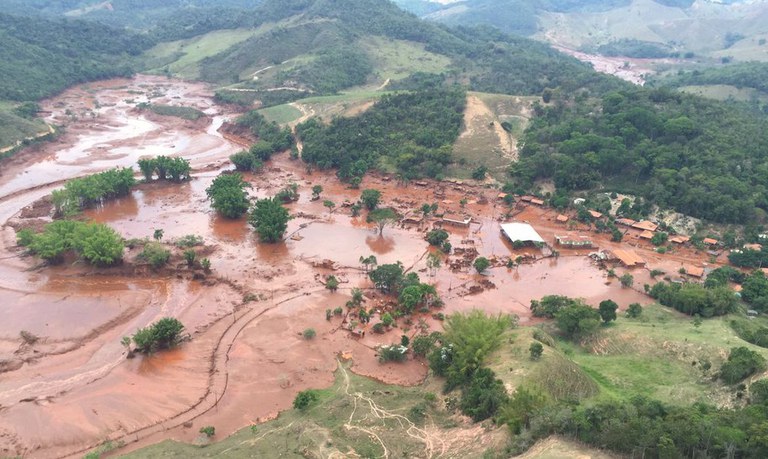
The November 2015 dam collapse at the Samarco iron ore mine near the town of Mariana, Minas Gerais state, caused a vast flow of mud and mining waste that buried a nearby village, killing 19 people. (Image: Corpo de Bombeiros/MG)

The compensation agreement with miners BHP BHP.AX, Vale VALE3.SA and Samarco for the Mariana dam collapse in 2015 has been joined by 19 new cities, including the one that was the epicenter of the disaster, a Brazilian court said on Thursday.

As a result, the deal, signed and ratified in October 2024, now has the support of 45 of the 49 municipalities eligible to receive funds.

The 2015 dam collapse in an iron ore mine owned by Samarco, a joint venture between Vale and BHP, near the city of Mariana in southeastern Brazil, killed 19 people, left hundreds homeless, flooded forests and polluted the length of the Doce River.


The agreement established the payment of 170 billion reais ($32.74 billion) in compensation and reparation for one of the country’s worst environmental disasters, with some 6 billion reais earmarked for affected cities.

But as of March 2025, only 26 cities had joined the deal, with many cities arguing the 170 billion-real amount was not enough to compensate for the vast damage. The initial resistance to signing it was also influenced by parallel legal action against BHP in London, which also seeks reparations for the collapse that could yield an even higher compensation amount.

In November, London’s High Court ruled BHP was responsible under Brazilian law for the dam collapse. A further trial to decide on any damages to be paid was expected to begin in April 2027.

The cities’ participation in the agreement is viewed as important for Samarco, as it seeks to move beyond uncertainties stemming from the collapse.

“We consider this a historic victory for the city,” Mariana Mayor Juliano Duarte said in a press conference. “We have several individuals and companies that are still involved in the UK lawsuit. We, as the city government, will continue to stand by these people.”

The court said it remains available to accept any future adherence by the four cities that have yet to join the agreement: Ouro Preto, Governador Valadares and Resplendor, in Minas Gerais state, and Colatina, in Espirito Santo state.

($1 = 5.1925 reais)

(Reporting by Marta Nogueira; Writing by Fernando Cardoso; Editing by Aurora Ellis)


US-backed group weighs $500 million Tanzania nickel investment


Kabanga nickel project in Tanzania. (Image courtesy of Lifezone Metals.)

A US government-backed consortium is negotiating a deal to invest more than $500 million in a large nickel project in Tanzania, as the Trump administration ramps up efforts to lock down supplies of key metals.

Bloomberg News reported this month that Lifezone Metals Ltd. has chosen Orion CMC as its preferred equity partner to develop the Kabanga nickel deposit in the East African country. That group was established in October with sovereign backing from the US International Development Finance Corp. and Abu Dhabi’s L’imad Holding.

Under the transaction being finalized, Orion CMC would acquire a stake in Kabanga Nickel Ltd., the Lifezone unit undertaking the project, according to people familiar with the matter, who asked not to be identified discussing confidential information. The people didn’t specify exactly how much Orion CMC intends to pay but one gave a range of $500 million to $600 million and another said the amount is nearer $500 million.

Tanzania owns 16% of Kabanga Nickel and Lifezone controls the rest of the firm. If the deal goes ahead, Lifezone plans to retain control of the subsidiary, while Orion CMC would take a sizable minority interest, some of the people said.

Lifezone, Orion Resource Partners and the DFC declined to comment.

The partnership is taking shape as various US government agencies work on a flurry of financing agreements to shore up access to critical minerals and reduce dependence on China. Bringing Kabanga into production would provide a significant new source of nickel, which is mainly used to manufacture stainless steel but also electric-vehicle batteries.

Indonesia accounts for about 60% of global nickel supply after a wave of investment by Chinese smelting firms that followed a ban on exports of raw ore in 2020.

Orion CMC was set up by its three founders with initial funding of $1.8 billion. The DFC recently approved an additional $900 million of financing to “support Orion CMC’s rapidly expanding pipeline of mining and minerals opportunities to help address China’s strategic chokehold,” Chief Executive Officer Ben Black said in July. The vehicle is led by Orion Resource Partners LP, a global investment firm specializing in metals and mining.

While Lifezone hasn’t publicly announced the selection of Orion CMC, CEO Chris Showalter said late last month that his firm had picked a favored partner out of multiple offers to make a “strategic equity investment” in Kabanga.  

The New York-listed firm has also said it’s hired Societe Generale SA to raise debt for the project and expects to reach a final investment decision early next year. The company estimates it will require $942 million to build the mine.

The DFC has been involved with Kabanga since at least 2024, when it began due diligence on providing political risk insurance and expressed interest in extending loans to the project.

British firm offers to restart mothballed Australian manganese smelter 


Natrium Redox Technologies, a green technology startup based in Britain, said on Monday it had made a firm proposal to the Tasmanian government to acquire and restart Australia’s only manganese smelter, to supply global battery and electric vehicle markets.

EY Parthenon said last month the Liberty Bell Bay (LBB) Smelter would close after a proposed sale fell through. The smelter, formerly owned by British industrialist Sanjeev Gupta’s GFG Alliance, entered voluntary administration in March and liquidation this month after suspending operations mid-last year.

“We have engaged with EY Parthenon and the Tasmanian government on this proposal for six months. We have also briefed the federal government,” Natrium Redox Technologies said in a statement.

“Our restart proposal seeks shared input of funds with government to the level of A$15 million ($10.75 million) for a 16-week restart period and a continuation of the existing electricity contract.”

The federal government has said previously it would consider offering a joint A$20 million startup package for the plant, alongside the Tasmanian government.

“Protecting these jobs and retaining specialist skills will provide certainty for employees and strengthen the future of the facility and the region,” Australia’s Industry Minister Tim Ayres said in a statement.

Tasmanian Business Minister Felix Ellis said potential pathways for the site had been put forward, but no transaction has been completed and no commitments were made.

“EY currently controls the site as liquidator, which includes decisions about its sale,” he said. EY Parthenon had no immediate comment.

Natrium Redox Technologies said it planned initially to use conventional smelting techniques to restart the smelter before building a pilot plant that would use new technology to produce high-purity, low-emissions manganese powder.

The process uses liquid sodium in place of coking coal to strip oxygen from manganese ore. It operates at lower temperatures than traditional smelting and does not produce carbon emissions.

The new technology would add 20% to 40% to the site’s production and lift the smelter up the value chain from being a conventional alloy smelter into one of the highest-value manganese operations in the world by producing battery-grade materials, the company said.

“Battery grade materials sell for a far higher price than conventional alloys, securing LBB’s financial future and ensuring it remains a strategically important critical minerals asset for Australia.”

Its proposal would provide more than 200 jobs previously linked with the smelter, as well as secure others during construction, Natrium Redox Technologies said.

It also has a proposal to reprocess a A$210 million environmental liability that has accumulated from decades of slag and waste, removing environmental liabilities from the government, it said.

The company emphasised that time was of the essence because the longer furnaces are idled, the harder and more expensive a restart would become.

($1 = 1.3953 Australian dollars)

(Reporting by Melanie Burton; Editing by Jamie Freed and Thomas Derpinghaus)


Russian sales bring gold reserves to their lowest since 2020

Moscow had stopped releasing official gold-mining data after its 2022 invasion of Ukraine. (Image from Vladimir Putin’s website)

The Bank of Russia continues to sell gold from its reserves, cutting its holdings at the end of July to the lowest level in more than six years.

Russia’s bullion holdings fell by 1.6 million ounces since the start of the year to 73.2 million ounces as of Aug. 1, according to data published Thursday by the central bank. That’s the smallest amount since January 2020.

The value of the bank’s gold reserves fell by $33.7 billion over the seven months, according to the data.


The Bank of Russia was once the world’s biggest sovereign buyer of gold, purchasing much of the country’s mined output before pausing acquisitions in early 2020. Two years later, its pledge to resume buying helped absorb part of the supply that the country struggled to export due to sanctions imposed over the February 2022 invasion of Ukraine, but the bank never resumed large-scale purchases.

The central bank began reducing its gold holdings last year as the Finance Ministry sold the precious metal and foreign currency from the National Wellbeing Fund to help cover budget shortfalls caused by weaker energy revenue.

Under a so-called mirror mechanism, the central bank carries out matching operations in the domestic market to offset the impact of those government transactions on the ruble and financial system.


Tharisa secures 25-year mining lease for Zimbabwe platinum project


Tharisa has chrome mines in South Africa. (Image courtesy of Tharisa)

Tharisa Plc THST.L said on Monday it signed a 25-year special mining lease agreement with the government of Zimbabwe for its Karo platinum group metal (PGM) venture, a key step in advancing the project.

Tharisa, an integrated PGM and chrome producer operating in South Africa, is developing the Karo project in Zimbabwe. The project is expected to produce 226,000 ounces of PGMs annually in the first phase.

First production from the Karo project is now expected in 2027, three years behind the initial schedule, following a sharp decline in PGM prices between 2023 and 2024.


PGM prices fell sharply as expectations of electric vehicle growth dampened the outlook for the metals, which are mainly used in catalytic converters that curb vehicle emissions, which pure battery EVs do not use.

PGM prices recovered mid-2025 after output in major producer South Africa continued to decline, while the growth of EVs proved slower than previously expected.

Tharisa CEO Phoevos Pouroulis said the signing of the special mining lease agreement provides the long-term security of tenure and fiscal certainty required to advance the Karo project.

(Reporting by Nelson BanyaEditing by Tomasz Janowski)

Hydro, Statkraft sign long-term power agreement

Norsk Hydro is one of the world’s largest aluminum producers.
(Image courtesy of Norsk Hydro.)


Norway’s Norsk Hydro and state-owned Statkraft have signed a new long-term power purchase agreement, securing 876 GWh between 2031 and 2040.

The total supply amounts to approximately 8.8 TWh over the nine years they agreed to, and it will be delivered in Norwegian electricity price area NO5.

The advantages of an agreement like this include predictable power prices, stable revenues and job and value creation in the industry. 

It will also help advance Hydro’s aluminum production and establish Statkraft as a leading power supplier for the Norwegian industry.

“Long-term and predictable power at competitive prices is vital for Hydro’s aluminium production in Norway and enables us to continue delivering low-carbon aluminium and solutions to our customers in Europe,” Hydro Energy executive vice president Kari Ekelund Thørud said. 

The news follows their April 2026 agreements that secured the delivery of 0.9 TWh per year in 2029 and 2030, and 1.3 TWh per year from 2031 to 2038. 

(With files from Reuters)

US expands search for critical minerals projects for defense gear

STATE CAPITALI$M BY ANY OTHER NAME

AI-generated stock image by hocine.

The Trump administration is seeking investment pitches from domestic producers of metals used in fighter jets, night-vision goggles and tank armor. 

The Defense Department’s Defense Industrial Base Consortium distributed a solicitation request to address gaps in homegrown production of indium, manganese, magnesium and titanium. The deadline for submissions is Sept. 17, according to the solicitation released Friday.

Eligible projects can include any part of the supply chain from mining, processing and refining to alloying and recycling. It’s the DIBC’s third investment solicitation involving critical minerals and advanced defense technologies since mid-2025. 

Companies and entrepreneurs have been asked to submit a one-page PowerPoint slide with four quadrants concisely outlining their proposal. Those that pass onto the next phase will be required to submit more in-depth details such as as project-execution plans.  

The solicitation didn’t disclose how much investment funding will be available. That is expected to become clearer as the fiscal 2027 defense budget is finalized, said Tripp Hornick, a government-funding specialist at Quince Street Strategy. 

The four metals are listed by the US Geological Survey’s as critical minerals, which means they’re essential to economic or national security, and have supply chains vulnerable to disruption. 

(By Grace Asenov)


Trump administration to back US minerals projects with $500 million in grants


US President Donald Trump. Credit: The White House | Flickr

The U.S. Department of Energy is awarding $500 million in grants to seven companies building domestic lithium, cobalt and other mineral and battery projects, the latest in ‌a string of investments aimed at bolstering American mining and processing, according to a document seen by ‌Reuters.

The funding comes weeks after President Donald Trump outlined a goal to make the U.S. the “minerals superpower of the world” and curb reliance on market ​leader China. The administration has used loans, grants, government investments and other tools to encourage new mining and processing projects, while seeking to build a more secure domestic supply chain for minerals considered essential to the economy and national security.

The war with Iran has added urgency to the effort, underscoring the strain that a major conflict can put on U.S. weapons inventories and ‌the industrial base needed to replenish them.


The ⁠Energy Department received hundreds of applications for this third round of funding from its Battery Materials Processing and Battery Manufacturing programs. Those chosen “were most promising and had the highest return for ⁠Americans in the most-needed areas of the battery ecosystem,” said Audrey Robertson, the department’s assistant secretary.

Lilac Solutions will receive $100 million for a direct lithium extraction processing facility on Utah’s Great Salt Lake. The company, which is backed by BMW, expects to open the facility ​by ​2028 and produce 5,000 metric tons per year of the metal.

Robertson ​said the Energy Department’s scientists “firmly believe (Lilac) will be ‌a beneficial resource of lithium carbonate to the nation.”

The Energy Department had previously announced funding for lithium projects from ioneer, Standard Lithium and Lithium Americas.

Jervois, which controls a large cobalt deposit in Idaho, will also receive $100 million to build the country’s only refinery for that metal, used to make batteries, electronics and a range of weapons.

The company was taken private last year as part of a pre-packaged bankruptcy caused by low market prices. Even so, cobalt is in demand from ‌various sectors and the Energy Department funding aims to boost domestic supplies, ​Robertson said, adding that the facility could in time process deep-sea nodules.

Nth ​Cycle, a battery recycler backed by Trafigura, is ​receiving $100 million for a facility to process battery metal scrap known as black mass.

Earlier this month, ‌the Trump administration blocked exports of black mass, which ​are filled with minerals that can ​be recycled. Robertson said the funding was not tied to the export block, but added that “the United States needs to and will build the ecosystem to fully recycle and process batteries and black mass here at ​home.”

The Energy Department is also giving $50 million ‌each to Princeton NuEnergy, which reprocesses cathode battery parts; Arcanum Ventures, which produces chemicals for battery electrolytes; and ​Coreshell Technologies, which is developing battery anodes made with silicon, rather than graphite, the longtime industry standard.