Tuesday, August 25, 2026

CANADA

Four provinces set different rules for data centres


Jennifer Friesen
August 21, 2026
DIGITAL JOURNAL

Photo by Geoffrey Moffett on Unsplash

Before anyone pours concrete, a Canadian data centre proposal comes with a bevy of local questions.

Can it get enough power? What will that power cost? Who controls the data? And who gets to say yes?

Ontario added its own on Aug. 13 with a draft Data Centre Playbook.

Alberta, Quebec, and B.C. already have their own rules, and they all look pretty different.

Ontario is proposing to charge new data centres a premium for electricity. Any data centre pulling more than one megawatt (MW) would pay more than the province’s largest factories.

Ontario isn’t offering subsidies, just faster permitting and what it calls white glove service.

Energy and Mines Minister Stephen Lecce said the plan makes data centres pay for “every single cent” of the power they use.

Paying up is only part of it. Projects would be judged on the benefit they bring the economy, the investment they make locally, and their plan to keep Canadians’ data in Canada, according to the government.

Ontario calls the playbook an early part of its coming AI strategy, and pitches that strategy as $122 billion in economic growth by 2035 and 17,000 jobs a year.

That last pillar puts the big U.S. cloud providers on watch, and it’s a harder promise than it sounds.

Data sitting on Canadian soil isn’t automatically beyond American reach.

Under the U.S. CLOUD Act, a U.S.-based provider can be compelled to hand over data it controls wherever that data physically sits. Who controls the provider matters more than where the building is.

All of this is still a proposal. Ontarians have until Sept. 12 to tell the province what they think.
Alberta, Quebec, and B.C. drew three different lines on power

A single large AI data centre can draw as much power as a city, and the requests are arriving faster than any province wants to approve them blindly.

Alberta, Quebec, and B.C. are each sorting them in different ways.

Alberta gives priority to data centres that bring their own power. Those projects move to the front of the line, and the developer pays for whatever grid upgrades their power needs.

Normally a data centre deals with the grid operator, the energy regulator, and the local municipality separately. Alberta’s concierge program, as the province calls it, gives them one provincial point of contact instead.

The largest project to break ground is Meta’s $13 billion campus in Sturgeon County, its first in Canada.

Bigger builds have been announced, including a $70 billion project near Grande Prairie, but many are still in the planning stage.

Meta’s first phase is expected to connect up to 970 MW to Alberta’s grid. Its dedicated gas plant, a 932 MW facility being developed by Pembina Pipeline and its partners, doesn’t open until the second half of 2030.

Alberta Technology and Innovation Minister Nate Glubish said the province used no grants, tax credits or incentives to land Meta.

“We did not want to be first and rush in blindly,” he said at the Calgary announcement in July. “We wanted to be smartest.”
Alberta Minister of Technology and Innovation Nate Glubish, speaks at The Princeton in Calgary on July 8, 2026. — Photo by Jennifer Friesen, Digital Journal

The Pembina Institute warns that Alberta’s reliance on natural gas could raise consumer electricity costs and make them more volatile. But the province points to a different line in the bill, saying Meta is covering its own transmission costs and could lower the transmission portion of other customers’ bills.

Quebec markets some of the lowest power rates in North America to data centres. Now it wants to charge the large ones more, roughly doubling the rate for any new data centre over 5 MW to about 13 cents a kilowatt-hour, so it can save that cheap power for the users it wants most.

Operators are already lining up to fight the increase at the province’s energy regulator this fall, since low-cost hydro has been one of Quebec’s main draws.

B.C. makes data centres compete for a limited slice of power, and it keeps its big resource industries out of the contest.

AI and data centre proposals are competing for a capped pool of about 400 MW over two years.

The province scores those bids partly on data sovereignty and First Nations participation. It says data centres deliver fewer jobs and less revenue than natural-resource projects, so traditional industries like mining, forestry, and LNG sit outside the competition altogether.

Energy Minister Adrian Dix said B.C. built it that way because the province “learned from other jurisdictions that have had an extremely negative economic effect.”

South of the border, some Americans are already paying more because of them.

Right now, everyone else gets stuck with the bill. The fight is over whether data centres ever do.

All four governments want data centres to cover their own power costs. They’re going about it differently, of course, with Alberta using its own-power priority, Quebec its pricing, B.C. its rationing, and Ontario a separate rate. Whether it holds at this scale is untested.

None of this is a sure thing, either.

Companies love to announce capacity they haven’t built yet. The industry even has a word for it, bragawatts, the megawatts that live in a press release and never get built.

In B.C., Conservative MLA David Williams, the party’s critic for BC Hydro and electricity self-sufficiency, calls the process rationing, one that in his words “avoids the root problem” of a province without enough power to go around.
Skipping consultation is what stops these projects

Even where a province says yes, a local council can still say no, and many residents are asking them to.

Oakville became the first Ontario municipality to pass a one-year moratorium on new data centres, two days before the province released its playbook. Hamilton said no to a similar freeze while Mississauga is preparing its own, and residents in Toronto are fighting two projects over water and noise.

Ontario now holds the final say on grid connections, but municipalities still control zoning and development approval. No project has yet tested what happens when the province says yes to the grid and a municipality says no to the site.

Communities fight these projects when they see the risks landing on them (the water, the power bills, the emissions) while the payoff goes somewhere else.

In Manitoba, Premier Wab Kinew said no to a gas-powered AI data centre near Île-des-Chênes, saying it threatened the environment with little economic upside, as a petition against it passed 13,500 signatures.

The energy sector spent 60 years learning this, and its veterans brought the lesson to the AI industry at Upper Bound in Edmonton earlier this year.

“The person who doesn’t get a cheque has the ability to disrupt the whole project,” said energy economist Peter Tertzakian. “It’s a big learning for AI.”

Peter Tertzakian, energy economist and founder of Studio.Energy, speaks at Upper Bound in Edmonton. — Photo by Jennifer Friesen, Digital Journal

The developers who get ahead of it build the community into the deal.

In Alberta, Woodland Cree First Nation holds 51% of a proposed data centre on its traditional territory that is planned to reach 650 MW, with revenue funding housing, education, and elder care. A few hundred kilometres away, Sturgeon Lake Cree Nation is in court challenging a water licence tied to Wonder Valley, arguing Alberta failed to consult it. The Nation also says it was not consulted on the land sale.

Same province, same technology, and a very different answer on who got a say.

The frameworks for doing it already exist. Canada spent a decade building them for pipelines and mines, through Indigenous equity ownership and community benefit agreements, and the First Nations Major Projects Coalition that advises on them now represents 186 First Nations.

The data centre industry can use that playbook or repeat the fights.

Burlington Mayor Marianne Meed Ward, who chairs Ontario’s Big City Mayors, wants consistent federal and provincial rules so individual councils aren’t writing data centre policy from scratch.

Ontario’s comment window closes Sept. 12, and the province says the final playbook will support its AI Industrial Strategy this fall.

Four provinces have staked out their terms. What no one can say yet is which of these projects gets poured, powered, and switched on.

Final shotsThe province a company builds in sets its power cost, its approval odds, and who can legally reach its data.

Data on Canadian soil can still fall un
der U.S. law. Provider ownership and control belong in the vendor contract.

Grid approval can still leave a project facing a municipal vote or a court challenge.


AI Companies Look to the Ocean as a Place to Put Data Centers

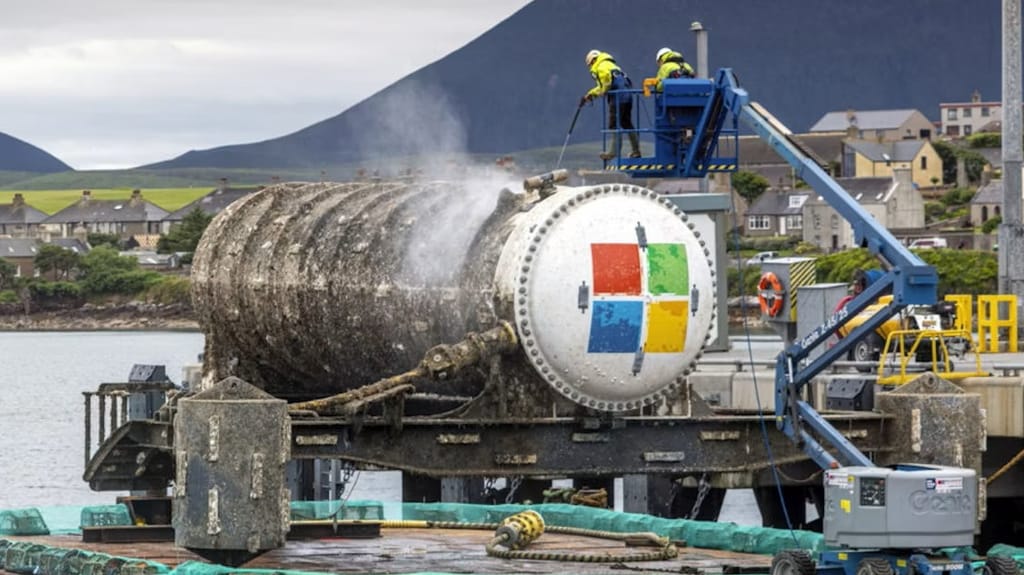
Press handout image courtesy Microsoft

Published Aug 23, 2026 2:34 PM by The Conversation


[By Nir Kshetri]

The artificial intelligence boom is driving unprecedented demand for data centers, raising concerns about their growing energy consumption, water use and carbon footprint. These challenges are making companies look beyond traditional land-based data centers.

Some developers are now exploring the ocean as a new location for AI infrastructure in the hopes that underwater data centers could improve energy use and cooling efficiency while using less fresh water and land area than onshore buildings.

My research focuses on the societal, organizational and environmental implications of emerging technologies, particularly artificial intelligence and the digital infrastructure – including data centers – that supports its development and deployment. I see underwater data centers as a promising new approach for supporting the growth of AI.

But moving servers into the ocean does not make other underlying environmental challenges such as energy consumption and carbon emissions disappear. And it creates new concerns about harm to the marine environment, as well as questions about how these data centers can be regulated – and how companies can maintain and expand them if needed. Whether underwater data centers can become sustainable alternatives to traditional data centers depends on solving these economic, technical and environmental problems.

The rise of ocean-based AI infrastructure

In 2015, Microsoft launched a research project to explore the feasibility, benefits and challenges of underwater data centers. Part of that effort included setting up a waterproof data center on the seafloor near Scotland’s Orkney Islands in 2018. It contained 864 servers and was connected to shore by an underwater cable.

After two years, Microsoft reported that the servers in the underwater data center failed at about one-eighth the rate of servers in comparable land-based data centers. The company is still studying the possible reasons but hypothesizes that in a sealed underwater environment the equipment is less exposed to oxygen, humidity and temperature fluctuations – as well as less jostling from people working to replace broken components.

However, Microsoft ended the project in 2024 and chose not to build more underwater data centers. The company didn’t say why, but others’ analyses suggest the reasons could include regulatory concerns, including the need for environmental permits, as well as a desire for faster upgrades and replacements for the computer equipment inside.

Instead the company has focused on land-based data centers, which can be larger and easier to expand, and also easier to access to repair or replace equipment.

Others have moved ahead, though. China built what may be the world’s first wind-powered underwater data center in Shanghai. The facility launched in June 2025 and began full commercial operations in May 2026.

The US$226 million project uses seawater as a coolant rather than have to refrigerate fresh water, reducing the electricity required to cool the computers. It uses at least 30% less electricity than traditional data centers, and offshore wind turbines reduce reliance on fossil fuels and cut the data center’s carbon emissions.

Japan is testing a different approach: Data centers housed in containers on floating platforms at sea can use seawater for cooling, have unobstructed conditions for solar panels and wind turbines, and reduce demand for land. In 2025, a data center in shipping containers opened on a floating platform near Yokohama. Its power comes from solar panels installed on the same floating platform, with batteries providing energy storage. The test will continue through March 2027.

Singapore is also moving toward commercial-scale floating data centers. In 2026, infrastructure company Keppel began building a four-story floating data center, scheduled to open in 2028. The project will use seawater for cooling, reducing reliance on treated water and improving cooling efficiency. And the fact that it floats means it won’t take up any of Singapore’s limited land availability.

In 2025, Ulsan, South Korea, began planning an underwater data center that could house more than 100,000 servers and use 30% less power than land-based centers by using seawater for cooling.

In Maine, DeepGreen Western Passage has proposed a submersible AI data center in the Bay of Fundy, powered by tidal turbines designed to harness the area’s strong tidal currents.

Land-based data centers could also take advantage of seawater cooling. In Portugal, the SIN01 AI data center in Sines uses seawater from the Atlantic to cool its servers before returning it to the ocean.

The promise of ocean-based data centers

These various approaches offer ways to reduce demand for grid-supplied electricity for powering data centers’ computers and cooling equipment, as well as using less fresh water.

The distance from people’s homes could also be an advantage for data centers in or on the ocean. A Gallup poll in March 2026 found that 70% of Americans oppose building AI data centers in their communities. However, more than half of the world’s population lives within 120 miles of a coast. Underwater could be another way to keep data centers physically close to users for speedy service.

Maintenance, though, is a major challenge. If a computer fails underwater, it cannot be repaired or replaced on site. The entire sealed data center module may need to be brought to the surface, even if just one computer needs work.

Can the ocean sustain AI?

The main environmental concern about ocean-based data centers involves the seawater used for cooling. Discharging warm or hot water can potentially affect oxygen levels, pH and marine life in the surrounding waters.

That heat is already apparent at the few seaborne data centers now operating. HiCloud, the engineering contractor for China’s Hainan underwater data center, has reported a temperature increase of less than 1 degree Celsius (1.8 degrees Fahrenheit) in the seawater near the facility. SIN01 in Sines, Portugal, also returns seawater about 1 C warmer.

Many marine species depend on stable water temperatures for breeding, feeding and migration, raising concerns that heat released by multiple underwater data centers could create localized thermal pollution and alter marine ecosystems. And the ocean is already under pressure. UNESCO, the United Nations agency for international cooperation, including in conservation, estimates that about 60% of marine ecosystems are already degraded or used unsustainably.

The ocean is already warming along with the atmosphere, without additional waste heat from data centers. That additional heat is already threatening coral reef and mangrove ecosystems, seagrasses and other aspects of the marine food web. As that warming continues, ocean waters will be less useful for cooling electronic equipment in some regions.

Underwater data centers could help AI grow while easing some of the pressure on land, energy and water. But the real test is whether the ocean can become AI’s next computing frontier without becoming its next environmental problem.

Nir Kshetri is the Charles A. Hayes Distinguished Professor at the University of North Carolina-Greensboro and a research fellow at Kobe University, Japan.

This article appears courtesy of The Conversation and may be found in its original form here

The Conversation

The opinions expressed herein are the author's and not necessarily those of The Maritime Executive.


ClassNK Launches 'Survey Compass,' AI Assistant for Surveys

ClassNK introduces an AI tool to enhance survey operations for shipowners and management companies.

ClassNK Launches 'Survey Compass,' an AI Assistant Supporting Survey-Related Operations

Published Aug 25, 2026 3:18 PM by The Maritime Executive

[By ClassNK]


ClassNK has launched ‘Survey Compass,’ an AI assistant that supports shipowners and ship management companies in their survey-related operations.

Survey Compass is an AI assistant that responds in natural language to questions on classification survey matters faced by shipowners and ship management companies. Users can quickly confirm the information they need together with its supporting sources, thereby improving the efficiency of survey preparation and response work and reducing their workload. This initial release marks the first step toward ClassNK’s vision of a digital service platform for ships in service. ClassNK will continue to expand and enhance Survey Compass together with our customers, incorporating feedback and requests gathered through its practical use.

Survey Compass is available on ‘ClassNK Customer Hub - Ship in Service -’ (hereinafter ‘CCH SiS’), a web portal service for shipowners and ship management companies.

In the maritime industry, regulations, particularly those related to environmental compliance, are becoming increasingly complex, requiring shipowners and ship management companies to manage a growing number of requirements and an ever-expanding volume of information. Against this backdrop, personnel responsible for survey-related matters are often required to identify the applicable requirements within a limited timeframe. To provide prompt and accurate responses to the classification survey-related inquiries received daily from shipowners and ship management companies, ClassNK has developed Survey Compass, an AI assistant specialized in classification survey support.

Survey Compass accepts questions in natural language, directly searches classification survey-related documents, and presents a concise summary together with links to the underlying information sources. Because information related to classification surveys and ship management is closely tied to the safe operation of vessels, a high level of accuracy and reliability is required.

For this reason, Survey Compass adopts a retrieval-based approach that generates answers based on relevant source documents, reducing the risk of AI-generated inaccuracies. Through this approach, it aims to serve as a trustworthy AI assistant that users can rely on with confidence.

By providing links to the source documents used to generate each answer, Survey Compass enables users to review the original references directly and make informed professional judgments. In the first version, the service will start by covering Part B of the Rules for the Survey and Construction of Steel Ships, the Guidance for Undergoing Surveys, and Technical Information.

Based on feedback and usage during the beta phase, ClassNK will continue to enhance Survey Compass by expanding the range of covered documents, including international conventions and flag State requirements, and by linking with vessel-specific data to provide more context-aware support. Through these enhancements, Survey Compass will evolve to better support users in their day-to-day operations. Going forward, ClassNK will continue to expand services through ClassNK Customer Hub to support the digitalization and operational efficiency of shipowners and ship management companies.

Customers using NK-SHIPS can log in to the web service portal on the ClassNK website with their existing account and access Survey Compass via the link to 'ClassNK web service portal.'

The products and services herein described in this press release are not endorsed by The Maritime Executive.


The Race to Power AI Is Reviving America's Nuclear Ambitions

  • Surging AI and data-center electricity demand is attracting billions of dollars to advanced nuclear technologies.

  • SMRs could offer a cheaper and more flexible alternative to traditional nuclear plants, but none are commercially operating in the United States yet.

  • Applied Atomics is reviving BWXT’s shelved mPower technology and Virginia test infrastructure in an effort to commercialize modular nuclear power.

The artificial intelligence boom is supercharging the development of next-gen nuclear energy technology. Big Tech and private equity are catalyzing the research and development of cutting-edge approaches to round-the-clock clean energy production as hyperscalers add power-hungry data centers to the grid at a blistering rate. 

“A single hyperscale data center can consume as much electricity as 50,000 homes,” writes the MIT Energy Initiative. “U.S. data centers consumed more than 4% of the country’s total electricity in 2023, and by 2030 that fraction could rise to 9%,” MIT goes on to warn. This means that the expansion of data centers to fuel the integration of AI into everything from your email provider to your electric toothbrush is seriously changing the way we consume – and therefore the way we produce – energy in the United States and beyond. Not only do we need to expand energy production capacity at a breakneck pace, but we also need to find a way to do so without throwing climate goals out the window. 

As a result, venture capital funding is going gangbusters for both nuclear fusion and fission startups. According to a recent report from Axios, global investment in both fission and fusion has topped USD $4.5 billion across 81 companies in 2026 so far. At this rate, projections show that 2026 will shatter the previous annual record of $6.2 billion for 93 companies in 2025.

Some of the biggest figures and deepest pockets in Silicon Valley are throwing their weight behind nuclear energy advancement as a silver bullet solution to the energy monster that AI is creating. Major investors include Microsoft’s Bill Gates and OpenAI’s Sam Altman. "There's no way to get there without a breakthrough," Altman said at the 2024 World Economic Forum in Davos, Switzerland. "It motivates us to go invest more in fusion."

In addition to nuclear fusion, there is a lot of buzz around the potential for small modular reactors (SMRs) to transform the aging and ailing nuclear power sector in the United States. These smaller and cheaper reactors hold considerable promise for overcoming some of the hurdles that have been causing nuclear energy to fall out of fashion in the last several decades. 

Traditional nuclear power plants are enormously expensive and time-consuming to develop. The United States’ newest traditional nuclear power plant, Georgia’s Plant Vogtle, finally came online in 2024, years late and billions of dollars over budget. While this has scared a lot of policymakers and investors away from large-scale nuclear power, there is hope that SMRs could allow for a more agile energy future at a time when carbon-free energy sources are sorely needed. 

However, SMRs have been slow to deliver on the considerable hype behind them. While billions of dollars have gone toward developing the technology, and the Nuclear Regulatory Commission only approved NuScale’s uprated SMR design last year, there are still zero commercial SMRs operating in the country. Some experts think that the buzz has turned to bust. But others, buoyed by the new wave of investment interest driven by the AI boom, think that the timing is finally right for the SMR revolution. 

For example, a duo of scientists with SpaceX pedigrees is taking advantage of an abandoned SMR test facility in Virginia, with the hopes of being the team to push the SMR revolution over the finish line and into commercial reality. “We’re standing on the shoulders of giants here, right?” Applied Atomics co-founder Ben Kellie recently told the Washington Post. “We’re starting with something that had $400 million in investment put into it, and significant time and effort. That’s a leg up.”

Whether this project is the one that will ultimately serve as a proof-of-concept for SMRs, it will at the very least provide more data in a nascent field where hard numbers are sorely needed. “It is not just about whether the technology is viable,” David Schlissel, a ‘longtime nuclear consultant to consumer and environmental groups,’ told the Washington Post. “It is also whether the cost is viable. … The industry is running around with all this hype trying to sell nuclear broadly. But they still have not fully tested and built any of these new reactors.”

By Charles Kennedy for Oilprice.com


Uranium Prices Surge as Nuclear Demand Accelerates

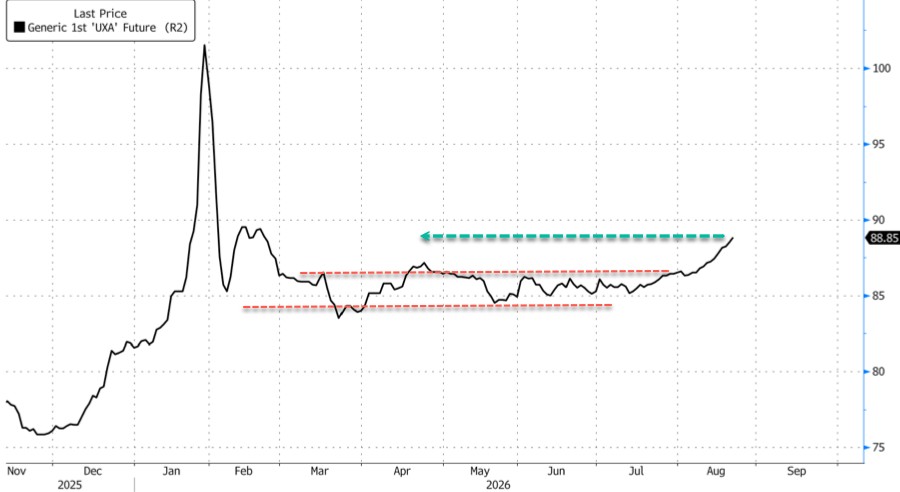
  • Uranium prices are gaining momentum again, approaching $89/lb in August after spending five months range-bound between $84 and $87.

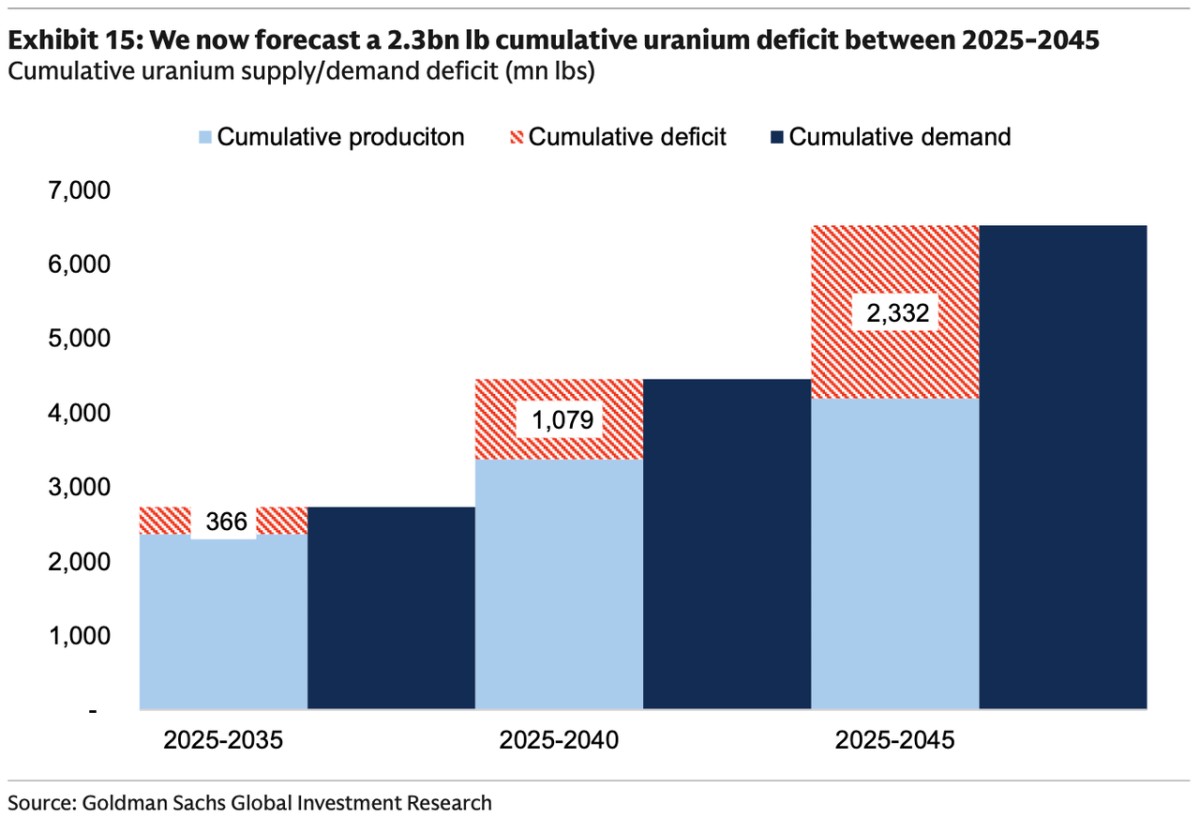
  • A structural supply deficit is driving the bullish outlook, as years of underinvestment and decade-long mine development timelines struggle to keep pace with expanding reactor demand.

  • AI, data centers and China’s nuclear buildout could tighten the market further, with utilities accelerating procurement as reliable baseload power becomes increasingly valuable.

Bloomberg's continuous front-month uranium futures contract (UXA1 Comdty) briefly surged above $100 a pound in late January, driven by tightening supplies, renewed government support for nuclear power, and rising electricity demand from the AI infrastructure boom.

Uranium futures then retreated and remained range-bound between $84 and $87 for five months. But momentum has returned in August, with prices approaching $89 a pound, the highest level since early February.

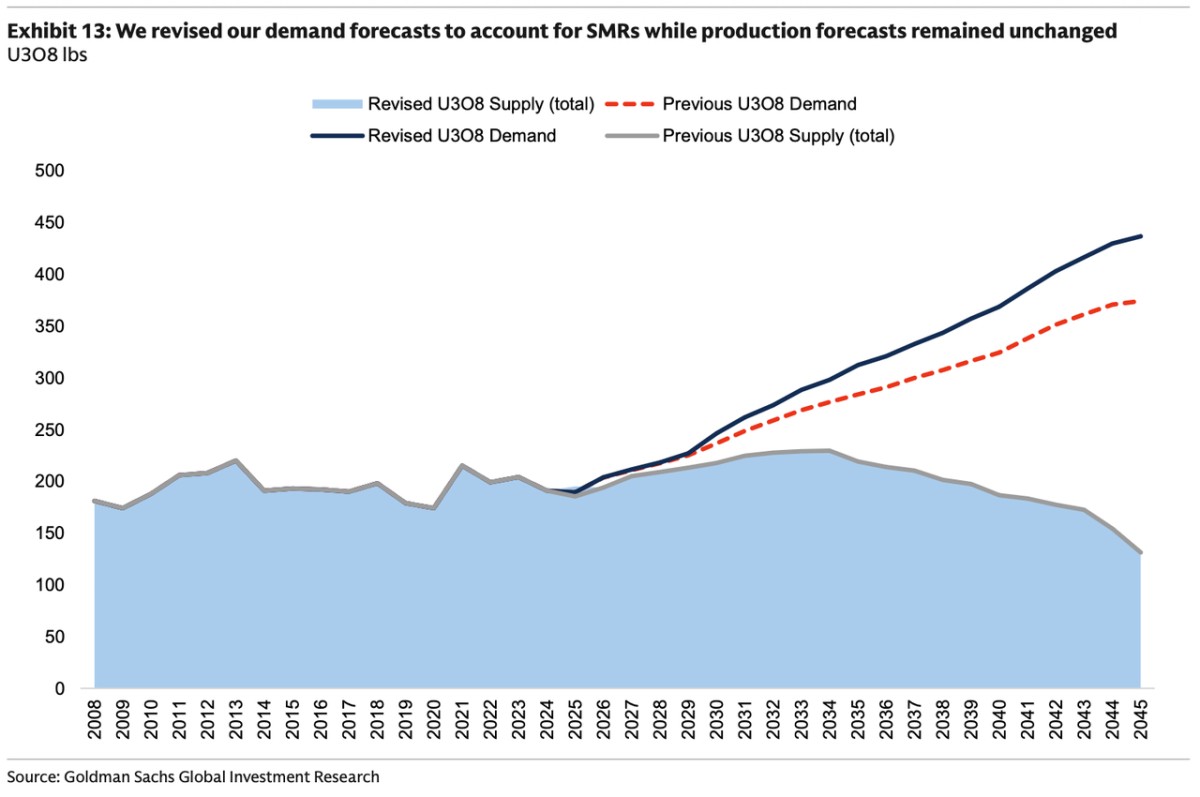
The ongoing theme is that years of underinvestment have limited mine supply growth despite rising reactor demand. New uranium projects can take a decade to develop, leaving producers unable to respond quickly to higher prices. Output is also concentrated among a handful of miners, such as Cameco. 

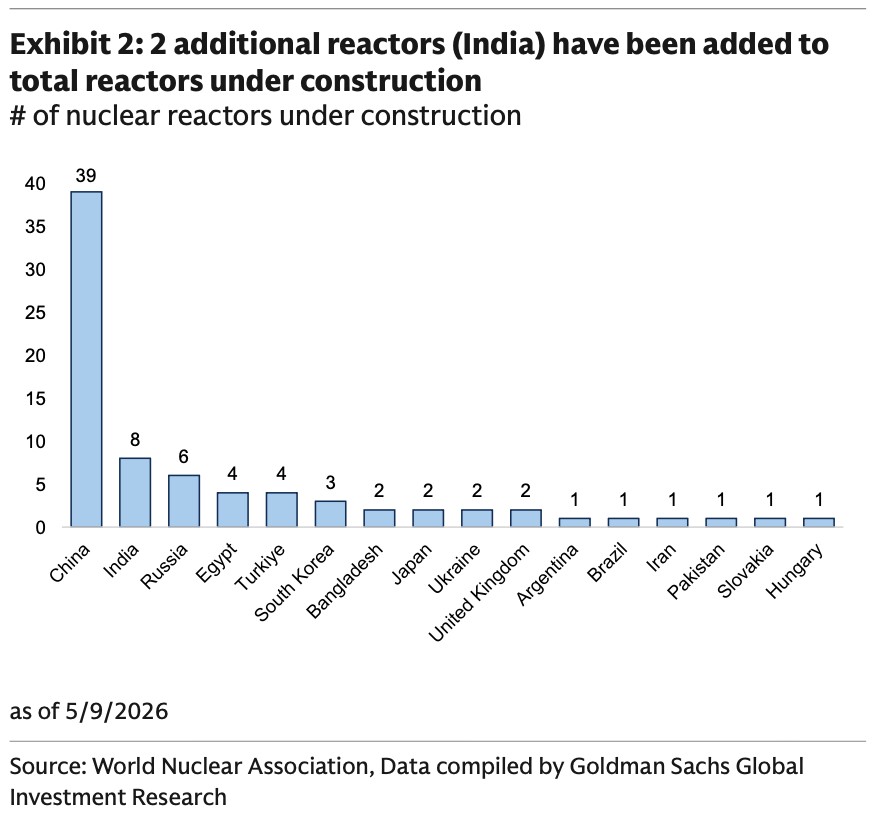
Goldman analysts have routinely pointed back to these charts, which show that the uranium market has entered a deficit and that the gap will only widen as new reactor demand comes online in the years ahead.

China is firmly leading the global expansion and is expected to become the world's largest nuclear power market by the end of the decade.

UBS analyst George Eadie noted earlier this month, "Continued strength in term pricing and signs of accelerating utility procurement offer further evidence that the uranium market is tightening structurally."

Regular readers know that nuclear power sits at the intersection of several of our highest-conviction themes: powering up America, reindustrializing the nation, and meeting the massive new electricity demands of the AI buildout.

As hyperscalers accelerate data-center construction, electricity availability is emerging as a critical bottleneck. Nuclear is the only scalable, low-carbon energy source capable of delivering reliable, around-the-clock baseload power, turning the nuclear renaissance into a theme that will last for years to come. 


Big Oil Is Betting Billions On Nuclear Fusion

  • Fusion is shifting from research toward commercialization, with private investment hitting a record $4.48 billion in 2025 and commercial plants targeted for the 2030s and 2040s.

  • Eni is making one of Big Oil’s biggest fusion bets, backing Commonwealth Fusion Systems, committing $1+ billion to its future electricity and developing critical tritium fuel-cycle technology.

  • Chevron, Equinor, Shell and Cenovus are also investing heavily, spreading bets across competing fusion technologies that could eventually transform global power generation.

After decades confined largely to laboratories, nuclear fusion is beginning to attract the kind of money and industrial planning normally reserved for technologies expected to make it onto the grid. Global private investment in fusion hit a record $4.48 billion in 2025, up 69% from a year earlier, while some of the world’s largest energy companies are moving beyond simply backing fusion startups.

Italian energy giant Eni S.p.A. (NYSE:E) now plans to deploy a commercial fusion power plant in Europe by the early 2040s or sooner, building on its investment in Commonwealth Fusion Systems and a more than $1 billion agreement to buy electricity from the startup’s first commercial U.S. plant. Eni is also looking beyond power generation, using decades of experience processing hydrocarbons and hydrogen to build a business around the fuel systems future fusion plants will need to operate.

Competition is growing in the fusion industry after the technology and expectations had changed significantly in the past 5-6 years,” Francesca Ferrazza Eni's head of magnetic fusion initiatives, told the Financial Times in an interview. “It was always considered research. Now we are considering it as an industry.” 

Commonwealth Fusion Systems raised another $1 billion in July, bringing its total funding to $4 billion as it targets the early 2030s for its first commercial power plant. The planned 400-MW ARC facility in Virginia became the first fusion project to apply for interconnection with PJM earlier this year, while Google has agreed to buy 200 MW of its output. Eni has committed more than $1 billion to buying electricity from the plant.

Eni also wants to build a business supplying the fuel systems necessary to keep commercial fusion reactors running. The company plans to use its experience processing hydrocarbons and hydrogen to recover, purify and recycle deuterium and tritium, the two hydrogen isotopes used as fuel by many fusion reactor designs. To that end, Eni has formed a JV with the UK Atomic Energy Authority to develop and sell those services globally, giving the Italian company a potential source of fusion revenue beyond owning plants or selling electricity.

Tritium is much harder to extract than deuterium. Deuterium is stable and abundant enough to be extracted from seawater, where roughly one in every 6,700 hydrogen atoms is deuterium. Tritium is radioactive, has a half-life of just 12.3 years and exists naturally only in tiny quantities. A 1-GW deuterium-tritium fusion plant could consume roughly 55 kilograms of tritium per year, far beyond what could be supplied from naturally occurring sources.

That means commercial reactors will need to produce much of their own tritium and continuously recover and recycle unused fuel. In turn, that requires closed-loop systems capable of extracting tritium from reactor breeding blankets and exhaust, purifying it and feeding it back into the reactor. Eni is developing a large-scale tritium fuel-cycle facility at the UKAEA Culham Campus in Oxfordshire to test those processes under conditions designed to replicate future fusion plants. The facility is scheduled for completion in 2028.

Fusion’s Other Big Oil Backers

Equinor, Chevron, Shell and Cenovus have spent years building positions across the fusion industry, backing competing reactor technologies before any of them have produced commercial electricity. 

Equinor Ventures first invested in Commonwealth Fusion Systems in 2020 and increased its stake the following year as part of CFS’s $1.8 billion Series B round, which Equinor described at the time as its largest venture investment.

Chevron has spread its investments across multiple fusion technologies. Chevron Technology Ventures has backed both TAE Technologies and Zap Energy, and participated alongside Google in TAE’s $150 million funding round in 2025, taking the startup’s total equity funding above $1.3 billion. TAE plans to build an initial 50-MW fusion power plant before scaling up to subsequent plants with 350 MW to 500 MW of capacity.

Shell Ventures joined Chevron and other investors in Zap Energy’s $130 million Series D round in 2024. Zap is pursuing a different route to fusion than CFS, using sheared-flow stabilization rather than large superconducting magnets to control plasma. The funding is supporting development of its next generation of fusion devices and the engineering systems needed to turn them into a commercial power plant.

Cenovus made one of Big Oil’s earliest bets on the sector, investing $4 million in Canada’s General Fusion in 2011 and participating in later funding rounds. General Fusion has since moved toward the public markets, agreeing in January to merge with a special-purpose acquisition company in a deal valuing it at roughly $1 billion and targeting a Nasdaq listing under the ticker GFUZ. The company is targeting its first commercial power plant for the mid-2030s.

By Alex Kimani for Oilprice.com

ICYMI

Colombia gold mine collapse kills 13 workers

Illegal mining camp in Colombia. (Image courtesy of the Colombian Military Forces | X.)

At least 13 workers have been killed and another seven injured in a landslide at an open pit gold mine in southwestern Colombia, in one of the country’s latest deadly mining accidents.

The incident happened on Wednesday night when a slope collapse at the mine located in a rural area of Policarpa, in Nariño department, according to local authorities. Firefighters, residents and emergency crews using excavators searched the site until about 2 a.m. Thursday, when officials said all those reported missing had been found.

Authorities initially received reports of an explosion, but later determined that a landslide had caused the disaster, according to Radio Caracol. The Nariño governor’s office has not said whether the gold operation held mining permits or was operating illegally, an important distinction in a region where authorities regularly target unauthorized mines linked to armed groups and environmental damage.

Witnesses said four of those killed belonged to the same Indigenous family. Residents said about 50 people, most of them members of the Quillacinga Indigenous group, regularly worked at the mine near Policarpa.

Informal mining

Deadly accidents are a recurring risk in Colombia’s mining sector, particularly at unlicensed operations where workers extract precious metals without formal oversight or safety controls. An estimated 200,000 to 400,000 people participate in artisanal mining across the country, with many families relying on sales of gold and gemstones for income.

Illegal gold production presents a broader challenge. Criminal organizations, including armed groups and drug cartels, have used gold mining as a source of revenue, moving production through intermediaries and disguising its origins with apparently legitimate documentation before it enters international supply chains.

The risks extend beyond mine sites. A recent New York Times investigation found that Colombian gold linked to criminal networks entered the supply chain of the US Mint, which under federal law must use US-mined gold for its investor-grade coins.

Previous investigations and enforcement actions have also traced Latin American gold, including supplies originating in Peru and Ecuador, to North American refiners and traders after illicit material was mixed with legitimate production or exported using falsified documents.


Japan proposes giving state body JOGMEC more freedom to invest in critical minerals

Deep-sea drilling vessel Chikyu. (Image courtesy of Japan Agency for Marine-Earth Science and Technology.)

The state-owned Japan Organization for Metals and Energy Security should be able to invest in critical mineral projects without needing Japanese companies to participate, the industry ministry proposed on Thursday.

Until now, JOGMEC has had either to invest jointly with a Japanese company or pledge to later transfer rights if it acquires them independently.

The Ministry of Economy, Trade and Industry’s proposed revision is designed to try to increase critical mineral supplies as Japanese companies have struggled with the impact of China’s decision to tighten export controls on some rare earths and metals.

The ministry also cited rising global competition as a reason for its proposal, including U.S. backing for a Brazilian rare earths miner.

Presented on Thursday to an expert panel on mining policy, the proposal would allow JOGMEC to invest alongside foreign resource holders if waiting for Japanese companies to commit would delay project development and heighten the risk of supply disruption.

It would apply to the 20 minerals designated as essential materials under the Economic Security Promotion Act and eligible for government funding.

The ministry will consider the details of the scheme, taking into account suggestions from panel members, an official said at the end of the meeting on Thursday.

(Reporting by Yuka Obayashi; Additional reporting by Kentaro Okasaka; editing by Barbara Lewis)


Ghana’s mineworkers demand release of $34.5 million in trapped savings


Stock image.

Ghana’s union of mineworkers delivered a petition to the central bank on Thursday to demand more than 380 million cedis ($34.55 million) they say they are owed and that have been frozen since a clean-up of the financial sector.

Under reforms begun in August 2017 and completed in 2019 to address widespread insolvency and weak governance, the central bank revoked the licences of over 400 financial institutions.

The Ghana Mine Workers’ Union, an affiliate of the largest trade union in the country said money in the form of provident funds, welfare savings and severance packages belonging to over 19,000 workers, was still frozen as a result.


General Secretary Abdul-Moomin Gbana said affected members include retirees, redundant workers, widows and dependents struggling to cover healthcare, education and housing costs.

The union said it has held back members from demonstrating since 2021, relying on repeated assurances from the central bank.

The International Monetary Fund flagged the unresolved legacy issues in both its 2023 and 2024 country reports.

The union threatened renewed industrial action and asked for a meeting with the governor of the Bank of Ghana and the finance minister.

Asked for comment, the finance ministry did not immediately respond.

($1 = 11.0000 Ghanaian cedi)

(Reporting by Emmanuel Bruce and Christian Akorlie; Editing by Anait Miridzhanian and Barbara Lewis)