Friday, August 28, 2026


AI Can Discover New Materials Faster Than Science Can Validate Them – Analysis


Image: ChatGPT

August 27, 2026

By Burak Oktenli

Key Takeaways:

Generative AI is turning materials discovery from scarcity into abundance—proposing vast numbers of candidate structures far faster than labs can synthesize, characterize, and manufacture them.

A computational prediction of stability is not the same as a usable technology; real materials must clear successive hurdles of synthesizability, reproducible manufacturing, and performance under operating conditions.

The author argues the next bottleneck is evidence infrastructure—such as a standardized “materials AI evidence passport” that tracks model uncertainty, synthesis, independent measurement, and qualification—so scarce experimental resources go to the candidates most worth proving.

Generative models are rapidly expanding the search for new batteries, semiconductors, catalysts, aerospace materials and defense technologies. The next bottleneck is no longer finding candidates. It is proving that a predicted material can actually be synthesized, manufactured and trusted in the real world.

Materials science has traditionally suffered from a scarcity problem. Researchers could explore only a small fraction of the almost unimaginable number of possible compounds, structures and compositions that might possess useful properties.

Artificial intelligence is beginning to reverse that problem.

The emerging challenge may be abundance.

Machine-learning systems can now screen enormous chemical spaces, predict properties and increasingly generate candidate materials designed around specified characteristics. What once required researchers to select a relatively small number of hypotheses can increasingly become a computational search across thousands, millions or even more possible structures.

That is a remarkable scientific advance.

It also creates a new question: What happens when artificial intelligence can propose promising materials much faster than laboratories can determine whether those materials are real, manufacturable and useful?

The answer matters far beyond materials science.

Advanced materials sit beneath many of the technologies governments now consider strategically important: batteries, semiconductors, solar cells, carbon capture, aerospace systems, nuclear technologies, medical devices and defense equipment. The countries and companies that learn to convert AI-generated candidates into reliable physical materials will possess an advantage that cannot be measured simply by the number of structures their algorithms produce.

The new race is therefore not only to discover materials faster.

It is to validate them faster without confusing prediction with proof.
From Scarcity to Abundance

The scale of the shift became visible with Google DeepMind’s GNoME project.

In a 2023 Nature paper, the researchers reported more than 2.2 million crystal structures stable relative to previously known materials, with approximately 381,000 appearing on an updated stability frontier. The study represented an extraordinary expansion of the computationally accessible materials landscape.

But the same work also illustrates the distinction between discovering a computational candidate and possessing a usable material.

The paper reported 736 structures that had been independently experimentally verified. Its authors also identified synthesizability, dynamic stability and phase behavior among the remaining challenges between computational discovery and real-world application.

That gap is not a weakness of the research. It is the next scientific problem.

The transition is already visible in practical materials research. AI-guided, high-throughput experiments have been used to search enormous molecular spaces for improved photovoltaic materials, combining computational selection with automated synthesis and direct measurement in working solar cells. The important part of that workflow is not AI alone. It is the closed loop between prediction, synthesis and experiment.

Microsoft’s MatterGen provides another indication of where the field is heading. Rather than merely screening existing candidates, MatterGen can generate inorganic materials conditioned on desired characteristics, including mechanical, electronic and magnetic properties.

Its researchers went an important step further: they experimentally synthesized one AI-designed material and found its measured property to be within roughly 20 percent of the intended target.

That experiment is significant precisely because it crossed the boundary from computational proposal to physical evidence.

As generative systems improve, however, the number of proposals could grow much faster than the number of candidates that can receive comparable experimental attention.

A model can create another structure almost instantly. A laboratory cannot create another characterization campaign almost instantly.

Synthesis requires equipment, expertise, raw materials and time. Characterization requires instruments. Manufacturing introduces defects and process variability. Environmental testing requires additional facilities. Component qualification may take months or years.

AI can compress one part of the scientific pipeline without automatically compressing the rest.
A Stable Crystal Is Not Yet a Technology

One source of confusion is that the word “discovery” can describe very different stages of evidence.

A machine-learning model may predict that a crystal structure is energetically stable. That is scientifically useful. But stability under a computational method does not automatically establish that the material can be synthesized economically, manufactured reproducibly or maintained under operating conditions.

Different layers of uncertainty enter at different stages.

First comes model uncertainty. A machine-learning system is most reliable in regions sufficiently represented by its training and validation data. Materials discovery is difficult precisely because genuinely interesting candidates may lie outside that familiar domain.

Then comes reference-physics uncertainty. Machine-learning models are often trained against calculations based on methods such as density functional theory. Those calculations are extraordinarily valuable, but they remain approximations whose accuracy can vary with chemistry, structure and the property being predicted.

Next comes physical and manufacturing uncertainty. A perfect computational crystal is not necessarily the material produced by an industrial process. Defects, grain boundaries, impurities, temperature histories and manufacturing tolerances can change behavior.


Finally comes application uncertainty.

A battery material must survive repeated electrochemical cycling. A turbine material must tolerate extreme heat and mechanical loading. A semiconductor must perform reliably at manufacturing scale. A space material may face radiation, vacuum and severe temperature cycling. A defense material may need to survive shock, vibration, corrosion, aging, extreme thermal conditions or other highly demanding environments.

No single confidence score from a discovery model can represent that entire chain.
The Missing Infrastructure Is Evidence

This suggests that the next important innovation in AI-enabled materials science may be less glamorous than another generative model.

The field needs a common way to record what has actually been demonstrated.

One approach would be a materials AI evidence passport: a standardized evidence record that follows an AI-generated candidate from computational discovery through experimental validation and, where appropriate, manufacturing and qualification.

The passport would not decide whether a material is “good” or “bad.” It would make the status of the evidence legible.

At the computational stage, it could record the model and version used, the relevant training-data domain, the reference calculation, the conditions under which the model was validated and an empirically tested estimate of uncertainty.

If a candidate lies substantially outside the model’s validated domain, that fact should travel with the candidate rather than disappearing behind a high prediction score.

Recent work on AI-assisted alloy discovery points in the same direction: useful discovery systems increasingly need to distinguish confidence from uncertainty and identify regions where the available evidence is insufficient, rather than merely rank candidates.

The next layer would document independent computational verification where appropriate.

After that would come the physical record: whether synthesis has been achieved, whether composition and structure have been confirmed, whether the predicted properties have been measured and whether results have been reproduced independently.

Later stages could record whether a manufacturing route has been demonstrated and whether the material has survived testing under conditions representative of its intended use.

A scientist, investor, manufacturer, government laboratory or program manager should be able to look at a candidate and immediately distinguish between three very different statements:


The model predicts this should work.

We have made it and measured the relevant property.

We can manufacture it reproducibly and it works in the environment for which it is intended.

All three statements are valuable. They are not equivalent.
Why This Would Accelerate Science Rather Than Slow It

Standardized evidence can sound bureaucratic, particularly in a field whose attraction lies partly in accelerating discovery. But the purpose would be the opposite.

As computational candidate generation becomes cheaper, experimental capacity becomes relatively more scarce.

The scientific problem becomes one of allocation.

Which candidates deserve expensive synthesis? Which deserve synchrotron time? Which should proceed to manufacturing experiments? Which require additional calculation first? Which apparently spectacular result is simply too far outside a model’s validated domain to justify immediate investment?

An evidence passport would allow laboratories to direct scarce physical resources toward candidates with the strongest combination of potential value and credible supporting evidence.

It could also make results more portable.

Different universities, national laboratories and companies do not need to use identical AI models or surrender proprietary datasets. But they could use a common grammar for describing what a model has established and what physical tests remain incomplete.

That distinction is important. Scientific standardization does not require methodological uniformity.

Researchers can disagree about models while still agreeing that provenance, uncertainty, synthesis and physical validation should be visible.

The same principle already operates throughout mature engineering disciplines. A component rarely becomes trustworthy because its designer announces a confidence score. Trust accumulates through documented testing, traceability, calibration, independent measurement and experience under increasingly representative conditions.

AI-generated materials should not be exempt from that logic simply because the front end of discovery has become computational.

The Strategic Implications Are Larger Than Defense

My original interest in this problem came from defense applications, where the consequences of weak validation can be unusually severe.

AI can help search for energetic compounds, thermal-protection materials, armor, radiation-tolerant components and materials designed for extreme environments. But a computational prediction cannot substitute for the destructive and environmental testing required before such materials enter operational systems.

Defense is therefore a useful stress test for the broader problem. It is not the only sector facing it.

The energy transition will depend on new battery chemistries, catalysts, photovoltaic materials and materials for electricity transmission and storage.

Semiconductor progress increasingly depends on materials with carefully controlled electrical and thermal characteristics.

Fusion systems require materials capable of surviving environments that are extraordinarily difficult to reproduce.

Space exploration requires lightweight structures, radiation tolerance and long-duration reliability.

Medical technologies introduce their own requirements for safety, biocompatibility and reproducibility.

Across all of these fields, AI can accelerate the search. Physics still decides whether the result works.
The Next Bottleneck

The history of technological development repeatedly shows that discovery and deployment operate at different speeds. Artificial intelligence may make that mismatch far more visible.

The computational side of materials science is entering an era in which proposing a new candidate can become extremely cheap. That does not make experimental science obsolete. It makes experimental science more valuable.

When millions of possible candidates compete for limited laboratory attention, the ability to determine which computational claims deserve physical verification becomes a strategic scientific capability in its own right.

The most successful AI-for-science systems will therefore not simply generate the largest number of new materials. They will create better loops between prediction and experiment.


Models will propose. Experiments will test. Failures will return information to the models. Manufacturing will reveal forms of uncertainty invisible in idealized calculations. Real operating environments will expose limits that neither simulation nor laboratory characterization could fully anticipate.

That closed loop – not generation alone – is where the real acceleration of materials science will occur.

AI may be able to propose tomorrow’s battery cathode, semiconductor, radiation shield, catalyst or armor material in hours.

The important question is whether science can tell, nearly as quickly, what has actually been proved.


NATO’s Next Supply-Chain Vulnerability Has No Factory Floor – Analysis


Credit: NATO


NATO’s post-Ankara industry strategy correctly stresses scalable, interoperable, and resilient physical production, but the same standards must now extend to the digital layer—AI models, cloud services, identity systems, and software dependencies—that modern military capability increasingly rests upon.

Vendor diversity does not equal dependency diversity: a portfolio can appear multinational while still containing single points of failure in models, clouds, authentication, updates, or jurisdictions; commercial digital services can become unavailable overnight due to export controls, outages, or policy changes even when hardware remains intact.

Critical AI-enabled systems should carry an explicit dependency budget and be stress-tested for substitution time rather than supplier count, so allies can practice controlled dependence—using the best available technology while ensuring rapid, operable fallbacks—before the October implementation plan is finalized.


Ankara’s new industry strategy is designed to make defense production more scalable, interoperable, and resilient. The same discipline should apply to the AI models, clouds, identity services, and software dependencies that can disappear without a factory shutting down.

A missile shortage is easy to see. A missing cloud service may not become visible until the capability depending on it stops working.

That difference matters as NATO turns the commitments made at its July summit in Ankara into an implementation plan for a stronger transatlantic defense industrial base. The Alliance’s new Strategy for Industry-NATO Cooperation is unusually concrete: it calls for modularity and open architectures, stronger interoperability, more resilient supply chains, and tabletop exercises that stress-test whether production can surge and endure under crisis conditions.


Ankara also produced two practical mechanisms. The NATO Front Door for Industry is intended to simplify how companies find procurement, innovation, testing, and engagement opportunities. The NATO Engine is meant to connect industrial demand with available manufacturing capacity across the Alliance. Both respond to the same strategic reality: deterrence depends not only on possessing capability, but on being able to scale, sustain, and replace it.

There is one layer of the industrial base that deserves the same treatment before the October implementation plan is completed: the digital infrastructure underneath AI-enabled military capability.

Modern military AI increasingly arrives as a stack rather than a box. A system may depend on one company for the model, another for cloud hosting, a third for identity and access management, proprietary interfaces for integration, external services for updates and evaluation, and data pipelines governed in yet another jurisdiction. The nationality of the prime contractor tells only part of the story.

A procurement portfolio can therefore look diversified while retaining a single digital point of failure.

Vendor Diversity Is Not Dependency Diversity

The problem became visible in June when a U.S. export-control directive required Anthropic to restrict access to its Fable 5 and Mythos 5 models for foreign nationals. Because the order took effect immediately and the company said it had no reliable way to verify nationality in real time, Anthropic suspended the models for all users. The controls were lifted on June 30, and access began returning the next day.


The point is not that NATO should avoid American AI services, nor that this particular episode predicts a future alliance crisis. The lesson is narrower and more useful: a commercially available digital capability can change availability because of a government order, export restriction, licensing decision, security incident, provider outage, contract dispute, or technical change even when every physical component remains intact.

Replacing the service may require much more than buying another subscription. A second model may expose different interfaces. Its outputs may need fresh validation. Security controls may have to be rebuilt. Data may need to move between jurisdictions. Operators may require retraining. Existing software may have been optimized around one provider’s architecture.

A replacement that exists commercially may therefore be unavailable operationally for weeks or months.

This is the digital equivalent of discovering that several weapon systems depend on the same scarce component. NATO already treats concentration risk in physical supply chains as a resilience problem. Digital concentration deserves the same precision.

Five contractors do not create resilience if all five ultimately rely on the same cloud, the same model provider, the same authentication layer, the same update service, or the same jurisdiction for a mission-critical function. A multinational supply chain can still contain a single switch.

Give Critical AI Capabilities a Dependency Budget

NATO’s implementation plan offers an opportunity to make that exposure measurable. Every critical AI-enabled capability should carry a dependency budget: an explicit account of how much operational capability rests on any single provider, technical service, interface, or jurisdiction, and how quickly that dependence can be substituted.


This does not require one universal percentage. A logistics-planning tool can tolerate a different dependency profile from cyber defense, intelligence analysis, air defense, or command-and-control support. What matters is that concentration becomes visible before a system is embedded deeply enough to make replacement prohibitively difficult.

For each critical capability, planners should map the model provider, compute environment, cloud operator, identity service, update authority, proprietary interfaces, data dependencies, evaluation services, cryptographic credentials, jurisdictional constraints, and fallback options.

Then ask operational questions. How much capability remains if the primary provider disappears for 24 hours? What remains after 30 days? Can an allied operator move to another model without rebuilding the surrounding software? How long would revalidation take? Can the system continue in a degraded local mode? Who controls the credentials, keys, updates, and interfaces required to make the transition?

Those questions turn digital sovereignty from a political slogan into an engineering property.

They also create a more useful measure than national origin alone. An American service may be entirely appropriate for a European military mission if substitution paths are credible and the conditions governing access are understood. A nominally European system may create greater vulnerability if its compute, software dependencies, or update chain ultimately converge on one external provider.
Stress-Test Substitution Time, Not Supplier Count

The Ankara strategy already calls for tabletop exercises that stress-test defense production under heightened demand and crisis conditions. Digital dependency should be added to those exercises.

One scenario could remove a major cloud or model provider from an allied workflow without warning. Another could impose a jurisdictional restriction on a critical software component. A third could assume that a commercial provider remains online but stops issuing trusted security updates.

The metric should be substitution time, not whether an alternative vendor exists on paper.

A fallback model that requires three months of integration and validation offers little resilience during the first week of a crisis. The same is true of an alternative cloud environment that cannot accept existing data, identities, credentials, or workloads without extensive reengineering.

This is where NATO’s emphasis on modularity, open architectures, digital standards, testing, verification, and lifecycle interoperability becomes strategically important. Open interfaces reduce switching costs. Common evaluation procedures make alternative models easier to qualify. Portable data and identity architectures reduce migration time. Contract terms can require providers to document critical dependencies and preserve workable exit paths.

Controlled Dependence, Not Digital Autarky


None of this requires NATO to abandon American technology or ask every ally to reproduce the frontier-AI ecosystem nationally. That would consume enormous resources and could fragment the Alliance technologically.


The more practical objective is controlled dependence.


Allies can continue using the best available models, clouds, and software while designing systems that remain operable when one layer changes. The United States benefits as well: allied confidence in American technology is stronger when reliance comes with tested continuity arrangements rather than an assumption of permanent availability.

The strategic issue is larger than procurement preference. Software services and AI infrastructure will increasingly determine whether physical military assets can be coordinated, maintained, upgraded, and used effectively. A defense industrial strategy that measures only factories, inventories, and production lines will miss part of the capability chain.

Ankara gave NATO a serious framework for strengthening the industrial base behind deterrence. The implementation plan due in October should recognize that part of that industrial base has no factory floor.

A missile shortage is visible in the warehouse. A digital dependency becomes visible when the mission stops. NATO should find it first.


Science Has Discovery Thresholds, It Also Needs Stop Rules – OpEd

Science Has Discovery Thresholds, It Also Needs Stop Rules - OpEd

Key Takeaways:

  • Science is skilled at defining what would count as a discovery but often fails to specify in advance what evidence would close, downgrade, or pause an extraordinary claim; historical cases such as OPERA and BICEP2 show that the disappearance of an anomaly is itself a scientific success.
  • AI makes anomaly hunting nearly limitless by generating unlimited candidates from vast datasets, which shifts the scarce resource from detection to adjudication and risks turning research programs into narratives that continually relocate rather than face decisive tests.
  • Critical AI-enabled or high-profile searches should therefore carry explicit exit conditions—discriminating observables, conventional alternatives, calibration failures, independent replication standards, and null-result sensitivity thresholds—so that closure, downgrade, or pause become recognized scientific outputs rather than after-the-fact improvisations.

AI can make anomaly hunting nearly limitless. Researchers should define in advance what would close, downgrade, or pause an extraordinary claim not only what would count as a discovery.

Science is very good at celebrating the moment a result becomes interesting. It is less practiced at deciding when continued pursuit is no longer justified.

When the OPERA experiment reported a neutrino timing result that appeared to challenge the speed of light, the scientific response was not to protect the anomaly. Researchers attacked the timing chain, checked the instrumentation, and sought independent measurements. Later measurements were consistent with neutrinos traveling at light speed. The disappearance of the anomaly was not a failure of science. It was the science.

The BICEP2 episode made the same point in a different way. An apparent B-mode polarization signal was widely discussed as possible evidence of primordial gravitational waves. A joint BICEP2/Keck and Planck analysis later found strong evidence for dust and no statistically significant evidence for tensor modes in the analyzed data. The valuable result was not simply that a spectacular interpretation weakened. Science had narrowed what the observation could responsibly mean.

These cases expose a missing half of falsifiability. Scientists spend enormous effort defining what would count as evidence for a claim. High-cost and high-profile searches should also define what would count as enough evidence to close, downgrade, or pause one.

Falsifiability Needs an Exit Condition

Before an extraordinary physical claim consumes years of attention, researchers should be able to answer uncomfortable questions in advance. What observation would materially weaken the hypothesis? What calibration failure would invalidate the signal? What conventional explanation would be sufficient to end the extraordinary interpretation? At what sensitivity would a null result close the parameter range being tested? How many genuinely independent failures to replicate would lower the priority of the claim?

“More data” is not a falsification criterion.

There are good reasons to resist rigid stopping rules. Premature termination can bury real discoveries. Instruments improve. Background models change. A null result at one sensitivity may become a detection at another. Some theories remain scientifically valuable even when the decisive experiment is not yet technically possible.

But the opposite failure is real as well: a research program can become structurally incapable of losing. An anomaly appears and a conventional explanation removes most of it, so attention moves to a residual. The residual disappears and the search moves to another dataset. A replication fails and the failure is attributed to different conditions. A predicted signature is absent and the parameter range moves. None of those moves is automatically illegitimate. Taken together without an exit condition, however, they can turn an empirical program into a narrative that changes faster than it can be decisively tested.

A scientific program that cannot say what would make it stop is in danger of protecting a claim rather than testing it.

Stopping also does not have to mean abandoning a field. It can mean changing the status of a claim. “Discovery” becomes “candidate.” “Candidate” becomes “calibrated anomaly.” “New physics” becomes “model preference under stated assumptions.” One parameter region can close while another remains open. A team can conclude that an instrument lacked sufficient sensitivity, that a proposed signature was not discriminating, or that a conventional mechanism explains the observation without meaningful residual structure.

Those are scientific outputs. Closure is not the opposite of discovery; it is one way evidence becomes useful.

AI Makes Anomalies Cheap

Particle physics already recognizes part of this problem through stringent significance conventions and corrections for the look-elsewhere effect. Searching many channels makes an apparently striking local fluctuation less surprising, which is why the scope of the search has to be part of the evidence rather than an afterthought.

Artificial intelligence makes the broader stopping problem more urgent because it changes the economics of anomaly hunting. A system can scan enormous collections of spectra, images, light curves, detector events, candidate materials, or simulated physical states and rank the strangest examples. That is useful. It also means the supply of interesting outliers can become effectively unlimited.

When finding candidates becomes cheap, adjudicating them becomes the scarce resource.

An AI system can always produce another unusual point, another model fit, another candidate cluster, or another corner of parameter space worth inspecting. If every failed lead merely authorizes the next search without changing the status of the underlying claim, automation can make an already weak scientific habit scale much faster.

Synthetic data sharpen the problem. Imagine a classifier trained to distinguish simulated wormholes from simulated black holes. It performs spectacularly on a synthetic test set and then flags a real astronomical observation as wormhole-like. That may justify follow-up. It does not establish that a wormhole was detected. There are no confirmed wormhole examples on which to validate the label. The classifier may have learned differences between simulation pipelines, omitted astrophysical effects, or artifacts of the generators. Its success proves that it can separate the synthetic worlds it was given. Nature has not promised to resemble either one.

This is why anomaly detection and claim authority should remain separate. A search system can help decide where scientists look next. It should not decide what the observation is called—or whether a search has earned unlimited continuation.

Make Stopping a Scientific Output

The practical discipline is straightforward. Before the result becomes institutionally or emotionally expensive to lose, a project should specify the discriminating observable, the serious conventional alternatives, the calibration failures that would invalidate the signal, the search scope that must be corrected for, what replication would count as independent, the sensitivity at which a null result closes the tested region, and what evidence would trigger a downgrade or pause.

For expensive or extraordinary-claim programs, funders and review panels could ask for those continuation and termination conditions alongside the discovery criteria. The purpose would not be to impose a bureaucratic kill switch on scientific curiosity. It would be to make it harder to invent a new survival condition only after the old one fails.

The same principle should shape publication. Null results should be treated as positive scientific products when they close a meaningful parameter range. A calibration failure can close an anomaly. A conventional explanation can close an extraordinary interpretation. A failed replication can identify which dependency mattered. A search that reaches its prespecified sensitivity without detecting the predicted effect has produced information even if it does not produce a headline.

This matters increasingly in AI-assisted science because search capacity is growing faster than the scientific community’s capacity to investigate every candidate. The bottleneck is shifting from finding unusual things to deciding which unusual things deserve continued belief, money, instrument time, and attention.

Discovery is one way science advances. Elimination is another.

A mature research program should know not only what would make it celebrate, but what would make it stop.


About Burak Oktenli

Burak Oktenli holds an MBA and a Master of Professional Studies in Applied Intelligence from Georgetown University. His research addresses the governance of authority in autonomous and AI-enabled systems, and his writing has appeared at the Modern War Institute at West Point, RUSI, RealClearDefense, RealClearMarkets, and Geopolitical Monitor. He is the author of Authority Architectures for Autonomous Systems, a ten-volume series on how authority in autonomous systems is delegated, monitored and recovered, at authority-architecture.me.
View all posts by Burak Oktenli


 

Senior US Democrat widens probe into Jared Kushner’ Albania development that sparked Flamingo Revolution

Senior US Democrat widens probe into Jared Kushner’s Albania development that sparked Flamingo Revolution
The planned development in a protected coastal area has sparked nightly protests in Tirana and other parts of Albania. / IntelliNewsFacebook
By Clare Nuttall in Glasgow August 27, 2026

The most senior Democrat on the US House Judiciary Committee has widened his investigation into Jared Kushner's business interests to include the disputed Albanian land where his investment firm plans to build a luxury resort.

The Albania investigation centres on land in a protected area near Zvernec, where Kushner's firm proposed the resort, a project that has sparked daily protests that have persisted for weeks.

Jamie Raskin, the committee's ranking member, wrote to Kushner on August 24 and published the letter a day later, demanding records and communications concerning his dealings with the Albanian government, the US government and the proposed real estate project.

Raskin, who represents Democrats on the Republican-controlled committee, asked for documents relating to real estate and business transactions in Albania, protests against Kushner-linked projects and any government involvement in the approval, financing or consideration of Albanian developments.

He also asked for information on the planned resort on the Albanian coast and whether Kushner or entities linked to him had received benefits from Albanian authorities.

The committee is examining whether the conduct could warrant scrutiny under the Foreign Corrupt Practices Act and whether federal rules covering bribery, conflicts of interest, foreign agents and special government employees need to be strengthened, Raskin said.

The letter does not carry subpoena power. Raskin is in the minority on the committee, whose chairman is Republican Jim Jordan, and the letter was copied to Jordan rather than issued jointly with him. But it establishes a formal congressional record of the concerns raised by Democrats and puts pressure on Kushner to respond.

Raskin said he had first contacted Kushner in April over what he described as conflicts created by his simultaneous role in private investment and involvement in US foreign policy.

"From the standpoint of the American people, your decision to act simultaneously in these two roles - one public for the government and one private for personal profit - has created a glaring and incurable conflict of interest," Raskin wrote in his April letter, pointing to the fact that 97% of Affinity Partners' funds came from foreign government sovereign funds, related commercial entities and foreign nationals.

Neither Kushner nor Affinity Partners responded, according to Raskin. Committee staff also contacted the firm's chief legal and compliance officer, Ian Brekke, on May 7 but received no response.

Raskin's latest letter says the committee's concerns have since expanded following developments in Albania.

"You may have been too busy causing a new foreign policy fiasco in Albania after your yachting foray in the Adriatic to get back to us," he wrote.

Kushner, President Donald Trump's son-in-law, continues to run Affinity Partners while also participating in diplomatic efforts involving international conflicts. That combination has drawn scrutiny because the investment firm has substantial foreign-backed funding and investments.

Kushner acquired the site for more than $120mn from Albanian businessman Artur Shehu, whom Albanian authorities and media have linked to organised crime and drug trafficking. Reporting cited by Raskin's letter has alleged that Shehu used falsified property documents and that local residents warned Kushner about questions surrounding his ownership of the land.

Albanian prosecutors have frozen assets connected with the transaction while investigating suspected fraud. Reuters reported in July that the businessman who sold the land was suspected of falsifying deeds. Kushner has said he was unaware of any fraudulent claim to ownership.

Raskin's letter also raises allegations that Kushner's private security personnel assaulted local residents who protested against the transaction. The allegation is based on media reports and has not resulted in a charge against Kushner or his company.

Flamingo protests

The proposed development has become a flashpoint for environmental and political protests in Albania.

Kushner and his family became interested in the Albanian coast while yachting in the Adriatic. His wife, Ivanka Trump, has described the discovery of the area, while the planned development has focused attention on Sazan Island and nearby protected coastal territory.

The protests have become known as the "Flamingo Revolution", a reference to migratory birds found along the Zvernec coastline.

The movement has already forced the Albanian government to reconsider elements of the project. Prime Minister Edi Rama's administration suspended the resort in June after European lawmakers warned that it could jeopardise Albania's European Union accession process. The government subsequently agreed in July to amend legislation governing protected areas, changes that critics said were linked to the project.

The protest movement takes its name from the migratory birds on the Zvernec coastline, and it has already forced a government retreat. Edi Rama's administration suspended the resort in June after EU lawmakers warned it put the accession process at risk, and agreed in July to amend the protected areas law the project had depended on.

The movement has since become an international cause. Dua Lipa, Albania's best-known export, backed the protests in July, and a pro-Palestinian flotilla arrived to support them on August 22. A Chatham House study in June read the demonstrations as a case of a problem common to developing countries - a government trading environmental protection for foreign political access.

Raskin's letter presents the Albanian government's actions in similar terms, suggesting that concessions to Kushner could have been influenced by his close relationship with Trump and his involvement in US foreign policy.

The controversy also echoes a separate Kushner-linked development in neighbouring Serbia, where Affinity Partners had secured a 99-year lease for the bomb-damaged former General Staff complex in central Belgrade.

The Serbian government had granted the lease free of charge for a planned hotel and residential development. The project required the site to lose its protected status and for its damaged buildings to be demolished.

The project collapsed after Serbian prosecutors indicted four officials over abuse of office and forgery in connection with the project, and within hours Kushner's firm dropped it. Serbian students had spent months protesting against it, at one point forming a living wall around the site. The two disputes differ in their legal and political circumstances, but both have raised questions about the advantages governments may offer to investors connected to the Trump family.

The pattern in both countries is the same: a government that wants something from Washington offers a Trump-family-linked investor terms no ordinary bidder would get, on a site the public considers its own, and the legal defect in the concession turns out to be the thing that kills the deal. IntelliNews’ survey of Trump-linked Balkan investments in April flagged the transparency problem.

In both cases, opponents have argued that valuable or historically significant public assets were being transferred on unusually favourable terms, while governments pursued closer political and economic ties with Washington.

Raskin's intervention gives the Albanian dispute a new US political dimension. As ranking member, he cannot compel Kushner to provide the documents he has requested without support from the committee majority. But his letter puts specific allegations, dates and documentary requests into the congressional record.


Russia's saboteurs have followed the arms industry east into NATO

Russia's saboteurs have followed the arms industry east into Nato
Slovakia, Estonia, Czechia and Germany have all had defence plants attacked or targeted this year. The recruits are hired online, paid in cryptocurrency and told to film the job. / bne IntelliNewsFacebook
By Ben Aris in Berlin August 27, 2026

Slovak police foiled an arson attack on a Ukrainian-owned drone factory near Presov this week, the first documented attempt of its kind in the country.

Officers from the anti-crime unit UBOK arrested three foreign nationals - two in Slovakia and one in Germany under a European arrest warrant - over a plot against a plant belonging to Skyeton, which builds the Raybird surveillance drone, Dennik N reported on August 25. They seized petrol thickened with polystyrene, tools, phones, an action camera and a hand-drawn map of the site. About 70 people were working in the building at the time.

"The recent attempted attack on our facility in Slovakia is further proof that Ukrainian defence manufacturers have become a real thorn in their side, and that we are on the right path," a Skyeton representative, whose identity was withheld for security reasons, told the Kyiv Independent. "The Russians regularly attempt to attack both our production facilities in Ukraine and our reputation."

Slovakia was the last of the Visegrad and Baltic states to be hit. It is not the last that will be, because what has changed is not Russian intent but the location of the target.

Four countries in six months

Russian-back partisans have been operating in Europe since hostilities broke out as far back as 2014, but now they appear to be scaling up as an asymmetric response to the mushrooming number of EU-Ukraine joint defence production projects as a result of Ukraine’s insatiable appetite for modern weapons.

In March, arsonists set fire to a plant in the Czech city of Pardubice belonging to Archer-LPP, a Ukrainian maker of thermal imaging equipment. This month three people were detained in Latvia over an arson attack on a building owned by Milrem Robotics, the Estonian firm that supplies unmanned ground vehicles to Ukraine. German investigators traced explosive drones found at an airport to the network behind the Lithuanian parcel bombs of 2025, and police a hidden weapons cache near Berlin to Russian intelligence on August 21.

Two more incidents this month were at munitions plants and neither has been attributed to anyone. An explosion at the EMCO plant at Belitsa, near Tryavna in Bulgaria, forced the evacuation of about 300 people on August 10; Bulgarian investigators assessed the cause as most likely internal, a truck fire that reached the warehouses. Three days later a fire and a large explosion hit the gunpowder unit at KNDS Ammo Italy's plant at Colleferro, near Rome, which makes 155mm shells for Ukraine. That cause is still under investigation.

The Bulgarian case is of note, as EMCO belongs to Emilian Gebrev, who was poisoned in 2015 in a case Bulgarian prosecutors linked to Russian military intelligence, and because Bulgaria has been here before: a series of arms depot explosions between 2011 and 2020 led Sofia to issue warrants for six Russian nationals.

Why here, and why now

The targets are consistently Ukrainian or Ukraine-supplying manufacturers operating inside Nato and EU countries, which is a cheaper way of degrading Kyiv's supply chain than trying to reach it inside Ukraine and a less politically charged way of striking the factories with Russian ICBMs.

It is also, increasingly, where the industry is. Ukrainian producers went looking for capacity and customers abroad as production scaled past 4mn drones a year; Skyeton announced its Slovak site at Haniska in spring 2024, put $3.5mn into it and expected up to 200 staff by the end of 2025. Last year it turned over €33mn, against just over €2mn in 2024, and made a net profit of €730,000 with about 100 employees.

European primes have moved the same way. Rheinmetall alone is building a €535mn ammunition powder factory in Romania, two plants in Bulgaria and more than €1.5bn of munitions capacity across the Balkans, plus a €400mn propellant powders joint venture in Romania. Central and Southeastern Europe has gone in three years from a place that bought weapons to a place that makes them, and the risk register has not caught up.

The method is disposable

Russian spies have a long history of operating on European soil from the Sergei Skripal poisoning case in the UK to the assassination of a Chechen rebel by Vadim Krasikov, a FSB hit man, in a Berlin park.

The action camera the Slovak police seized is the most informative item on the list. Arsonists working for themselves do not usually film the work. Filming it is how a recruited operative proves delivery to whoever is paying, and it is a recurring feature of the campaign that has run across the EU since 2022, in which Russian services have hired both foreign nationals and their own citizens through messaging apps and paid them in cryptocurrency to hit industrial and logistics sites.

And using freelancers is a cost effective and deniable way of sabotaging European defence establishments. A recruit costs a few thousand euros, has no prior intelligence connection, is often unaware who is paying, and is expendable if caught. The Slovak arrests followed a joint operation involving military intelligence; the German arrest came on a European warrant, which is the part of the system that works. What does not work is prevention: three people were stopped at Presov, and the state has no way of knowing how many others are being recruited this week.

The Skyeton plot also had a public-facing accompaniment. The destruction of the company was promoted on Facebook by the pro-Russian commentator Andrej Palko, though Dennik N noted there is no evidence linking his posts to the thwarted attack.

What it costs, and what it is meant to cost

Slovak police put the property at the Presov site in the tens of millions of euros. Set against the €1.5bn Rheinmetall is putting into the Balkans alone, one burned building is not a material blow to European production.

But the target was not the building per se. It is the insurance premium, the security cost, the board conversation about whether to put the next plant in Slovakia or Portugal, and the willingness of a Ukrainian company to keep manufacturing in a country where a jury may be asked to decide whether burning its factory down was sabotage or arson. Those costs land on every producer in the region, including the ones that have not been attacked.

In the meantime, Russia has been putting the conventional means to destroy European factories in place alongside the covert ones. The Kremlin suggested that a Wiltshire-based factory producing British-made Nyan drones that Ukraine has been using against Russian oil refiners is now a legitimate military target. Speculation has been swirling in the last weeks that Moscow is preparing to test Nato’s Article-5 resolve with attacks that is believed to have prompted an eight-hour visit to Moscow by CIA boss John Radcliffe this week to warn the Kremlin off.

Ten newly constructed drone bases on Russia’s boarder now put six Nato states within range, and US intelligence assessments reported this week hold that Moscow may try to test the alliance's collective defence commitment within the next few years - through sabotage, cyberattacks, unattributed armed groups or a limited local incursion. The first item on that list is the one already happening.

Missile War Monitor: two economies being taken apart, target by target

Missile War Monitor: two economies being taken apart, target by target
Ukraine goes after Russian refineries and warehouses. Russia goes after Ukrainian power and shops. A ledger of what has been hit since June, and how little of it is being stopped. / bne IntelliNews

By Ben Aris in Berlin August 27, 2026

Two target sets now define this war, and neither of them is military. Ukraine hits Russian oil refineries and the warehouses of its two big online retailers. Russia hits Ukraine's power system and its shops. Both sides describe the other's campaign as terrorism and their own as a legitimate military targets.

On the Russian side the refinery campaign has moved from raids that cost a plant a few days of repairs, to outages that last weeks. Ufa, Nizhnekamsk, Perm, Novokuybyshevsk, Afipsky, Novoshakhtinsk, Volgograd and now Kstovo have all been hit since mid-August, and the whole of Lukoil's major domestic refining is currently shut. Petrol, diesel and jet fuel exports are banned, motor oil prices are up 40%, a second wave of the fuel crisis is building and July crude output was the lowest in six years.

The retail campaign is the more expensive one. Between July 18 and August 24, the warehouse war got underway and drones hit 15 Wildberries logistics sites totalling about 1.8mn square metres, roughly a third of the company's entire warehouse estate, Kommersant calculates. Ozon has since been added to the target list, and its shares fell 28% in the last week.

Sellers on the two platforms now put their combined losses above RUB600bn ($7.1bn). Data Insight puts lost stock alone at between RUB517bn ($6.1bn) and RUB580bn ($6.9bn) for Wildberries sellers, and between RUB88.5bn ($1.05bn) and RUB107bn ($1.27bn) for Ozon's. Rebuilding the destroyed warehouses would cost a further RUB186bn ($2.2bn) to RUB344bn ($4.1bn) and RUB30bn ($356mn) to RUB62.5bn ($742mn) respectively.

On the Ukrainian side the power system is the constant target and the shops are the newer one. The Kryvyi Rih thermal power station can no longer generate at all after an August 18 strike; 90,000 customers lost supply in Kyiv on August 20; Kernel, the country's largest grain exporter, says it has lost about half its own generation. Two Epicentr megastores were hit in Odesa on August 24, three retail chains' Kyiv warehouses on August 20, and the largest shopping centre in Kryvyi Rih on August 21, killing 16 people.

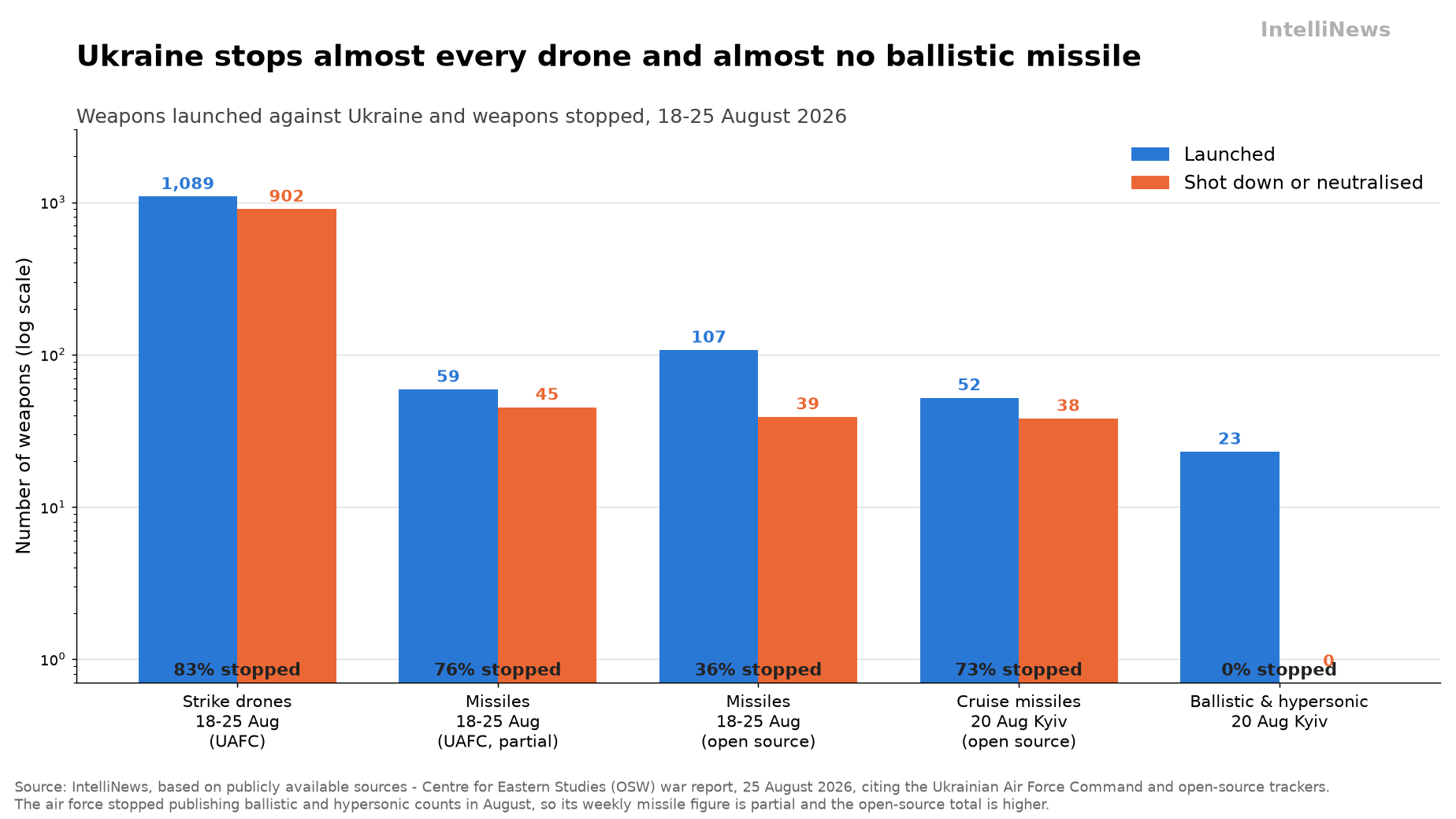
Interception rates for the week of 18-25 August 2026. The Ukrainian Air Force stopped publishing its ballistic and hypersonic counts during August, which is why its weekly missile figure is partial and the open-source total is higher. Source: IntelliNews, based on publicly available sources.

Drones are still being shot down at better than four in five. Missiles are not, and against the ballistic and hypersonic weapons that carry the heaviest warheads the rate on August 20 was zero out of 23, with only two Patriot interceptors fired in the capital's defence. That is not a failure of the system but the absence of ammunition for it, and it is the reason the interceptor shortage has become the single most consequential number in the war.

Russia's own claims run the other way and are not credible as counts: its defence ministry says it neutralised 1,671 fixed-wing drones in the 24 hours to August 18 and 1,504 on August 20. It also says it shot down all eight to 11 Flamingo cruise missiles Ukraine fired on August 24.

Major strikes & targets

Strikes on economic infrastructure since 1 June 2026. Compiled by IntelliNews based on publicly available sources, including our own reporting and the Centre for Eastern Studies' war reports. Dates are of the strike where known and of first report otherwise; the list is of significant strikes on economic targets and is not exhaustive.

The pattern in the dates is a conversation. The Tambov warehouse strike of July 18 killed seven people and was followed the next day by the heaviest Russian bombardment of the war to that point. The Novorossiysk grain terminals went down in mid-August; the Odesa ports and the Danube crossings were hit through the rest of the month. Each side is now answering the other inside 48 hours, and both are aiming at the part of the other's economy that generates foreign currency.

Neither campaign is winning in the sense either government uses the word. Russia's refining is being removed faster than it can be rebuilt and its crude cannot be exported instead, because the ports and the tankers are being hit too. Ukraine's grain cannot leave and its power stations cannot be replaced before winter. The monitor exists to keep count of a process that has no obvious stopping point.

Russia Steps Up Multi-Front Pressure On Ukraine With Drones, Decoys, Missiles, And North Korean Forces – Analysis


Drone factory in Russian Republic of Tatarstan. Photo Credit: 

Screenshot of Russian media

August 27, 2026
Hudson Institute
By Can KasapoÄŸlu


Key Takeaways:

Russia is intensifying mixed-vector pressure on Ukraine with large Shahed/Gerbera drone salvos, missiles, and decoys—including repeated strikes on Ukraine–Moldova border crossings—while North Korean personnel and drone/missile units expand Moscow’s capacity.

Ground fighting remains heavy, with more than 200 daily engagements focused on Kostiantynivka, Pokrovsk, and other eastern axes.

The UK authorized release of classified Storm Shadow/SCALP data so France and Ukraine can set up local assembly, shifting support toward Ukrainian production capacity; Moscow has already threatened UK arms factories in response.


1. Battlefield Assessment

Long-range salvos enabled by missile and drone warfare continued to shape the war. Overnight on August 25, a Russian Shahed drone struck the Vynohradivka international road crossing between Ukraine’s Odesa Oblast and Moldova. The strike damaged infrastructure, temporarily closing the checkpoint and redirecting traffic elsewhere.

The strike was Russia’s third attack in two weeks on a Ukraine–Moldova border crossing. This pattern suggests a coordinated Kremlin campaign rather than a series of isolated strikes. Moscow is likely targeting the connective tissue of Europe’s eastern frontier.

On the night of August 24–25, Russia also attacked Ukraine with 150 Shahed-Gerbera loitering munitions. Moscow launched Iskander-M and Kh-31 missiles, as well as Parodiya decoy drones, including jet-powered variants. Ukrainian aircraft, missile and electronic-warfare units, interceptor drones, and mobile teams neutralized 124 unmanned aerial vehicles involved in the attacks. Nonetheless, Russia struck 17 locations in Ukraine.

The barrage illustrated how Russia has organized its concept of operations around mixed-vector pressure designed to exhaust Ukraine’s layered defenses. In May 2026, Ukrainian intelligence services estimated that Russia intended for half of its Shahed drone-warfare deterrent to be jet-powered variants of the loitering munition. Russian planners aimed to produce 500 such jet-powered drones per month and launch 60,000 long-range attack drones and 50,000 decoy drones over the course of a year. Ukraine’s recently unveiled jet-powered Alexa Spatium interceptor is one part of Kyiv’s answer to Russia’s strategy.

Additionally, North Korea’s role in Russia’s war continued to expand into the robotic warfare domain. Major General Vadym Skibitskyi, the deputy head of Ukraine’s Defense Intelligence (GUR), reported that the Kremlin has deployed 8,500 North Korean personnel in Russia’s Kursk Oblast, including 400 drone operators assigned to reconnaissance and attack missions. A North Korean missile unit in Russia’s Voronezh Oblast could field six launchers and 120 ballistic missiles, supplementing the KN-23 and KN-24 missiles Pyongyang has already delivered.

The land-warfare segment of the conflict remained consistent with recent patterns. Combat activity remained elevated. Officials reported more than 200 tactical engagements daily. Kostiantynivka and Pokrovsk bore the brunt of the fighting. The axes of Lyman, Sloviansk, Kupiansk, and Huliaipole also remained highly active.

2. Ukraine’s Storm Shadow Moment


On August 24, UK Prime Minister Andy Burnham made a major announcement in Kyiv. He revealed that the United Kingdom had authorizedMBDA, a European multinational corporation that specializes in the design and production of missiles, to release classified data on the Storm Shadow/SCALP components. The decision enables France and Ukraine to establish local assembly lines to produce the missile, which to date has been produced primarily in the UK.

The UK first supplied Ukraine with the munition in 2023 and replenished its stocks in 2025. Storm Shadow, the UK variant of the joint Anglo-French cruise missile, has enabled Kyiv to strike command centers, air-defense positions, shipyards, logistics nodes, and hardened infrastructure beyond the front lines. Burnham’s announcement shifts British support for Ukraine from weapons transfers toward giving Kyiv greater control over its own strike capacity. The ability to manufacture the missile locally could reduce Ukraine’s dependence on European inventories and allow production to reflect Kyiv’s own adaptations and targeting priorities.

Moscow recognized the importance of Burnham’s announcement: Kremlin adviser Andrei Fedorov threatened British arms factories with “semi-military” attacks by “unknown sources.” This cryptic comment signaled Moscow’s potential willingness to expand the Ukraine conflict into Europe’s industrial rear through familiar methods of obscuring attribution, testing allied resolve, and raising the costs of supporting Kyiv. Russian strikes on UK manufacturing nodes could create production bottlenecks affecting engines, seekers, guidance systems, warheads, certification, financing, and launch aircraft.


Nonetheless, Russian threats only highlight the importance of the Storm Shadow/SCALP missile. MBDA describes the weapon as an air-launched deep-strike system for high-value fixed targets, including hardened bunkers and infrastructure. The missile operates in all weather, day or night, and combines inertial navigation, Global Positioning System capabilities, terrain referencing, low-altitude flight, and infrared image matching.

The munition provides Ukraine with precision, penetration, and survivability while allowing Kyiv to keep its launch aircraft beyond the reach of Russian air defenses. The missile’s dual-stage warhead can defeat hardened targets. Its principal limitation is that it is optimized for pre-planned fixed targets rather than mobile battlefield hunting. Regardless, domestic production of Storm Shadow/SCALP, previously available only in limited quantities, would allow Ukraine to sustain pressure on Russia’s operational depth.

3. What to Monitor in the Coming Weeks

Russia may intensify its shadow war against the UK in response to the transfer of Storm Shadow technology. Russian retaliation could include cyber intrusions, surveillance of MBDA-linked facilities, arson and sabotage carried out by criminal proxies, disruption of defense logistics, and attempted assassinations of senior British political, military, intelligence, or defense industry officials.


About the author: 
Can KasapoÄŸlu is a nonresident senior fellow at Hudson Institute. His work at Hudson focuses on political-military affairs in the Middle East, North Africa, and former Soviet regions. He specializes in open-source defense intelligence, geopolitical assessments, international weapons market trends, as well as emerging defense technologies and related concepts of operations.

Source: This article was published by the Hudson Institute

About Hudson Institute
Hudson Institute is a nonpartisan policy research organization dedicated to innovative research and analysis that promotes global security, prosperity, and freedom.
View all posts by Hudson Institute →


Sloviansk is declared a combat zone as Ukraine's air defence stops firing back

Sloviansk is declared a combat zone as Ukraine's air defence stops firing back
Not one of 23 ballistic and hypersonic missiles aimed at Kyiv on August 20 was shot down, and only two Patriot interceptors were launched. Zelenskiy puts the defence funding gap at $27bn. / bne IntelliNewsFacebook

By Ben Aris in Berlin August 27, 2026

Sloviansk, the anchor of Ukraine's Donbas fortress belt, has been designated an active combat zone by its own regional authorities.

The Donetsk Regional Military Administration made the designation on August 21, according to the Sloviansk has become a combat zone war report published on August 25 by Warsaw's Centre for Eastern Studies, or OSW.

It followed a heavy bombardment of Sloviansk and neighbouring Kramatorsk the day before, which killed one person and injured 24, and Russian troops pushing into the town of Mykolaivka, where the Sloviansk thermal power station sits idle.

The declaration is important after Kostiantynivka fell to the Armed Forces of Russia (AFR) earlier this month – the first of the three so-called Donbas Fortress cites to be captured by Russia. Sloviansk and Kramatorsk are the other two cities.

The change of status for Sloviansk triggers a mandatory evacuation planning (including monetary compensation for residents), for the withdrawal of civil services and for the emergency legal regime that has preceded the loss of every large Ukrainian town since Bakhmut. Kyiv has spent two and a half years insisting the fortress belt would hold, but the defences of the strategic important cities appear to be crumbling.

The shape of the attack

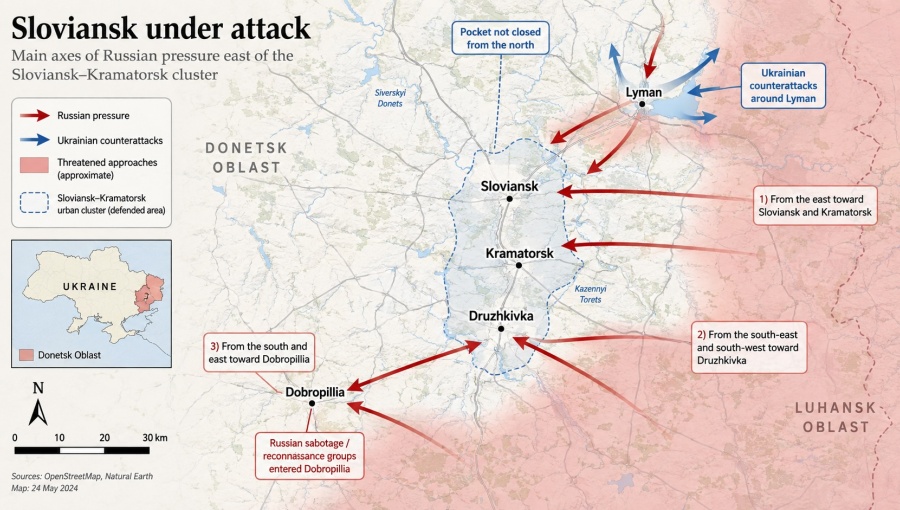
Russian forces have made further gains on a broad front east of both cities but cannot yet close the pocket from the north, where Ukrainian counterattacks around Lyman are working, OSW said.

Four lines of pressure have taken shape: from the east towards Sloviansk and Kramatorsk, from the south-east and south-west towards Druzhkivka, from the south and east towards Dobropillia, and from the north and east through Lyman. Russian sabotage and reconnaissance groups have entered Dobropillia itself.

Increased volumes of drone around these towns have moved the frontline. FPV drones attacking Dobropillia and its surroundings have reached 1,200 a day, and those hitting Druzhkivka and its supply routes 1,500 to 2,000 a day, according to Ukrainian sources cited in the report. At that density the roads into a defended town stop working before the town does.

In Zaporizhzhia region the fighting is around Orikhiv, where Ukrainian counterattacks have pushed Russian infiltrators back out of the eastern districts, though the Russians have advanced to the north-east and, by some accounts, crossed the Verkhnia Tersa river.


Polish Olympic chief detained as Zondacrypto probe widens

Polish Olympic chief detained as Zondacrypto probe widens
Investigators are examining whether Radosław Piesiewicz received a material benefit from Zondacrypto chief Przemysław Kral. / Polski Komitet Olimpijski via FacebookFacebook
By Wojciech Kosc in Warsaw August 28, 2026

Polish Olympic Committee (PKOl) president Radosław Piesiewicz was detained on August 27 as part of the ongoing investigation into the collapsed cryptocurrency exchange Zondacrypto, Justice Minister and Prosecutor General Waldemar Żurek said.

The detention is the most visible development since prosecutors announced a “significant breakthrough” two days earlier, citing new evidence

Investigators are examining whether Piesiewicz received a material benefit from Zondacrypto chief Przemysław Kral.

Kral bought a €40,000 Patek Philippe watch later received by Piesiewicz, while their messages discussed Piesiewicz’s possible help with the exchange’s problems at Poland’s competition authority, TVN24 and Wirtualna Polska reported. Piesiewicz said he paid Kral cash for the watch.

Kral appears to have reached a cooperation arrangement with prosecutors and is seeking a reduced sentence in return for evidence, Onet reported. Prosecutors have not confirmed Kral’s status.

Kral is now represented by Roman Giertych, a lawyer and a prominent MP for the ruling Civic Coalition (KO) party, and also a fierce opponent of the radical right Law and Justice (PiS) party, which ruled Poland between 2015 and 2023.

Polish media have speculated that the inquiry will now center on Zondacrypto's financing of entities linked to PiS, such as a foundation close to the fugitive former Justice Minister Zbigniew Ziobro (whose extraditon from the US Poland is seeking), the pro-PiS broadcaster TV Republika, and the CPAC conservative conference held in Poland last year that was effectively a campaign event for then-candidate Karol Nawrocki.

Nawrocki went on to win the presidency in June 2025 and has since vetoed the government-proposed bill to regulate the cryptoassets market three times, prompting Prime Minister Donald Tusk to hint that the president was too close to Zondacrypto.

The political strand of the Zondacrypto probe exists alongside the broader case, centred around the exchange's clients losing an estimated PLN2.4bn (€557mn).

The Polish government has also hinted that Russian organised-crime and intelligence money financed BitBay, Zondacrypto’s predecessor, but the supporting evidence remains undisclosed. 

The fraud investigation has been merged with a probe into the 2022 disappearance of BitBay founder Sylwester Suszek, who is feared dead by his family.