Sunday, September 13, 2026


New Shipbuilding Company Launches at the Former Kaiser Yard in Vancouver
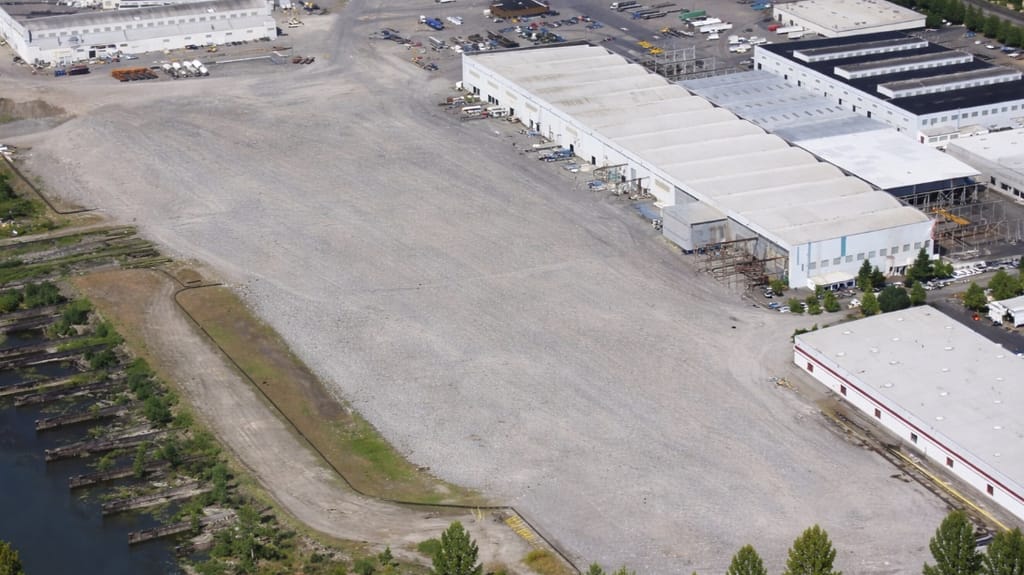
The original Kaiser assembly sheds, upper right, are home to New Pacific's operations. The old yard's slipways, far left, can still be discerned (New Pacific)
The original Kaiser assembly sheds, upper right, are home to New Pacific's operations. The WWII-era slipways, lower left, can still be discerned along the riverbank (New Pacific)

Published Sep 8, 2026 5:04 AM by The Maritime Executive


It's not every day that the U.S. shipbuilding industry gains a new entrant, especially one that builds civilian hulls, so the launch of a new facility in Vancouver, Washington this month is catching attention. 

New Pacific Industrial (NP) is a new venture helmed by experienced shipyard executives, and it is making its formal debut with a two-vessel contract for American Marine Corporation - the first time in AMC's 50-year history that it has ordered a newbuild tug. 

NP leverages the WWII-era infrastructure of Kaiser Shipbuilding's Vancouver Shipyard, now known as the Columbia Business Center on Vancouver's Columbia Way. The historic Kaiser yard's 80-year-old assembly bays are leased out to a variety of steel fabricators and suppliers, and NP now occupies about 180,000 square feet at the site. In addition to the high-bay fab spaces, the site has laydown areas, heavy lift cranes, and barge and rail access; NP describes it as "scalable infrastructure."
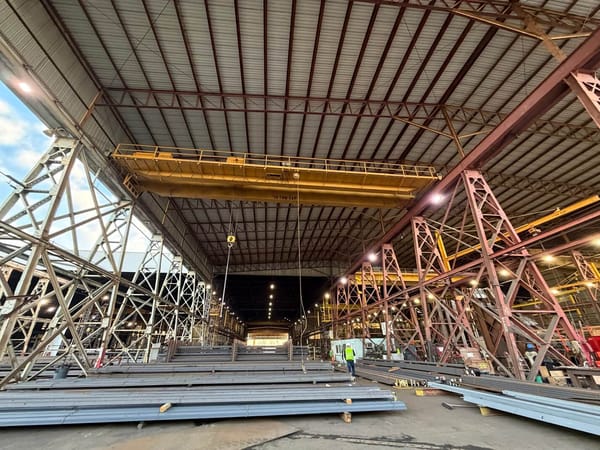
Courtesy New Pacific

Glosten provided the design for the yard's first vessel, a 122-foot, 6,000-HP, 85-TBP line haul tugboat built for AMC's ocean towing business. "It had to be a true ocean roamer—a capable, practical tug that’s comfortable to live and work on, and built to tow hard for decades," said Glosten business development principal Peter Soles. 

“New Pacific was founded around a straightforward idea: complex projects need experienced people, capable infrastructure, and an operating model that works for the customer,” said Joe Corvelli, CEO of New Pacific and an alumnus of Gunderson, Vigor and Gibdock. “Starting with a newbuild program alongside American Marine and Glosten puts that model into practice from day one.”
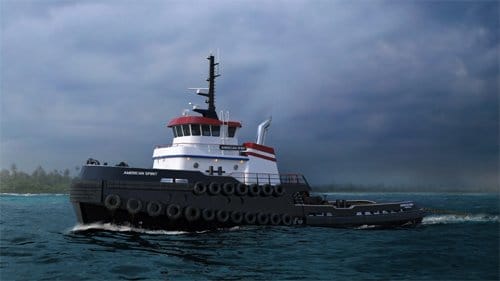
Courtesy Glosten


Potential U.S. Bidder Emerges to Challenge Hanwha for Austal USA
Austal USA shipbuilding
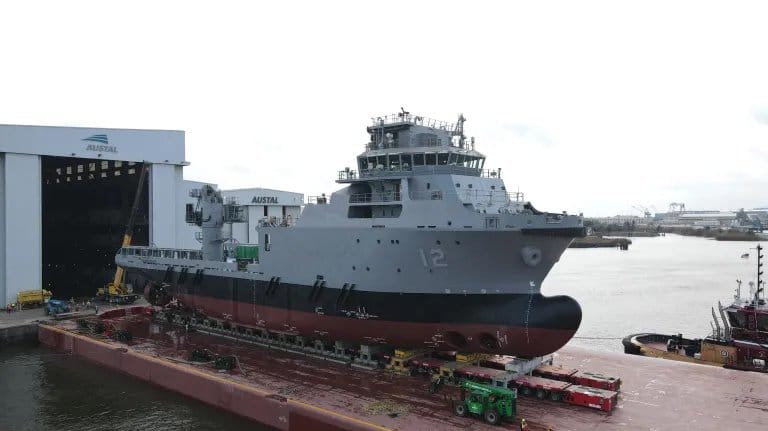
Austal USA rolls out its first Navy towing, salvage, and rescue ship (Austal)

Published Sep 7, 2026 2:42 PM by The Maritime Executive


Australia-based Austal confirmed in a brief stock exchange statement on Monday, September 7, that it has had initial, preliminary discussions with a U.S.-based investment firm, Wildcat Infrastructure, which is reported to be interested in the Austal USA operations. Austal said it has not received any proposal, but if the U.S.-based investor proceeds, it would be challenging Hanwha Group, which has approval to proceed with due diligence after it expressed interest in acquiring the U.S. operations of Austal.

Austal was responding to media reports in Western Australia that broke the news of the potential second bidder. The unconfirmed reports said Wildcat could place a competing bid for the U.S. operations as early as this week.

Wildcat Infrastructure has not commented but is listed online as being based in Florida and started in 2010. It says its strategy is focused on critical infrastructure, specifically energy (clean and renewable), information (5G), transport (bridge and roads), and water infrastructure (clean water and wastewater systems). Its website reports that it launched its defense business in 2026 in response to global events and increases in U.S. and allied defense spending. It is said to be targeting prime contracts and defense technologies. William Elischer, whose career includes senior roles in Australia's Department of Foreign Affairs and Trade, is listed as leading Wildcat's investment activities and strategic development across defense and national security. 

Speaking to investors during the company’s recent earnings report, Austal CEO Paddy Gregg said there was “great momentum” for the process with Hanwha. A U.S. division of the South Korean group in early August sent the Australian company an indicative, non-binding and conditional offer to acquire the operations of Austal USA for an indicative enterprise value of US$1.05 – 1.20 billion on a cash and debt-free basis. The Austal board and its advisers determined that the offer merited further evaluation, approving Hanwha to undertake due diligence.

Hanwha has expressed interest in buying Austal, making overtures in 2025, but Austal said it doubted a deal could gain regulatory approval. Hanwha acquired nearly 10 percent of Austal’s stock on the open market and received permission from Australia’s regulators to increase its stock position to 19.9 percent.

Austal reportedly is interested in focusing on its Australian shipbuilding operations and its satellite operations in the Philippines and Vietnam. It completed a Strategic Shipbuilding Agreement with Australia and has a current orderbook valued at US$4 billion in Australia.

The company established its U.S. operations in 1999 and has become a major contractor to the U.S. government, although it has had financial challenges in the U.S. On its website, it says it has delivered 34 ships to the U.S. Navy and has a nearly $10 billion contract backlog that includes Navy and Coast Guard surface ships and module production for submarines and aircraft carriers. Its primary yard is in Mobile, Alabama, with a repair operation that was started in 2021 in San Diego, California.

Any acquisition in the United States will require government approval, and the media reports indicate that the Pentagon has been stalling discussions with Hanwha for the Austal operations. The Trump administration has been receptive to South Korea’s planned investments in U.S. shipbuilding and to Hanwha, which acquired Philly Shipyard. However, there is speculation in the media that it might be more comfortable with a U.S. investor taking ownership of Austal USA.


Japan Announces First Tranche, $3.8B Investment in Shipbuilders
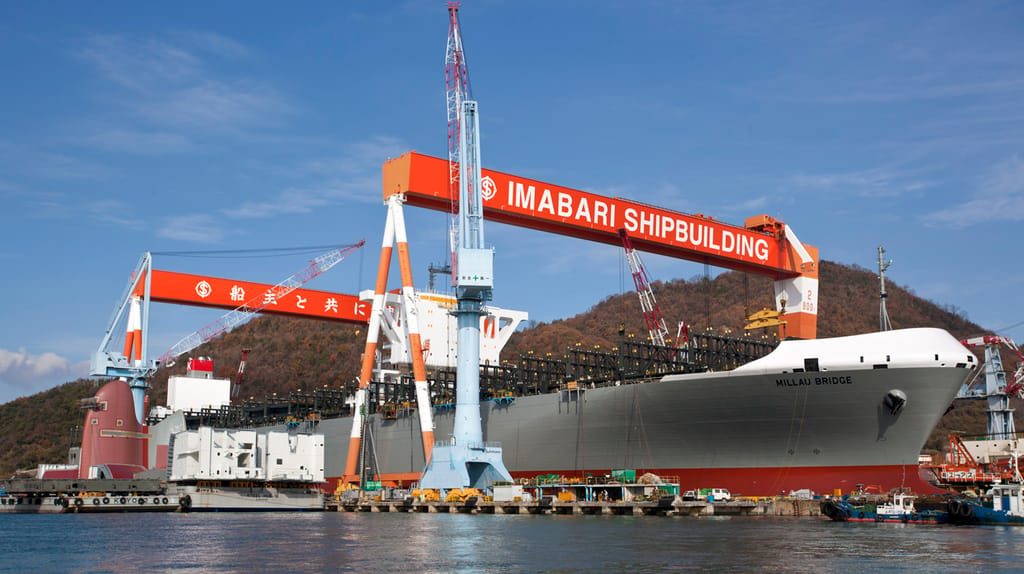
Japan's Imabari Shipbuilding
Imabari Shipbuilding is among the first shipbuilders to receive grants from the Japanese government as part of an effort to grow the industry (Imabari file photo)

Published Sep 4, 2026 6:56 PM by The Maritime Executive


Japan’s Minister of Transport unveiled the government’s first investments in the shipbuilding industry as part of an ambitious plan to dramatically expand the industry. Minister Yasuyuki Kaneko highlighted that shipbuilding is one of 17 priority areas in the government’s growth strategy.

Once one of the leaders in shipbuilding, Japan’s market share has declined dramatically as lower-cost competition emerged in South Korea and China. For 2025, the Japan Ship Exporters’ Association (JSEA) reported total orders of 186 ships totaling just under 9 million gross, which was down 16.5 percent versus 2024. It delivered 191 ships for export, totaling 8.32 million gross tons. Its market share was approximately 9 percent of the global orders.

“The revitalization of Japan's shipbuilding industry is finally getting underway,” said Kaneko speaking with the press on Friday. 

The government’s goal is to double Japan’s shipbuilding volume by 2035. He highlighted that the program will be rolled out in several phases with a total investment of approximately 1 trillion yen ($6.4 billion) coming from a combination of public and private partnerships. The Japanese shipbuilding industry had outlined to the government the critical need for investments, saying it would require government support to reclaim a portion of its lost business.

The first three investments are going to Imabari Shipbuilding, Japan Marine United Corp. and Namura Shipbuilding. The total value is 600 billion yen ($3.8 billion), with the government contributing nearly $1.4 billion.  Japan’s JiJi Press reports that Imabari and its subsidiary Tadotsu Shipyard will receive the largest portion, approximately 114 billion yen ($729 million) in government subsidies. JMU will receive a maximum of 49.4 billion yen ($316 million), while Namura and its subsidiary Hakodate Dock Co. will also get up to 49.9 billion yen.

The companies are meant to use the investment to expand and modernize their plants. One of the focuses is developing advanced technologies for the next generation of advanced ocean shipping.

“These three cases represent just a small portion of the numerous investment plans submitted by various businesses, essentially the first phase,” said Kaneko.

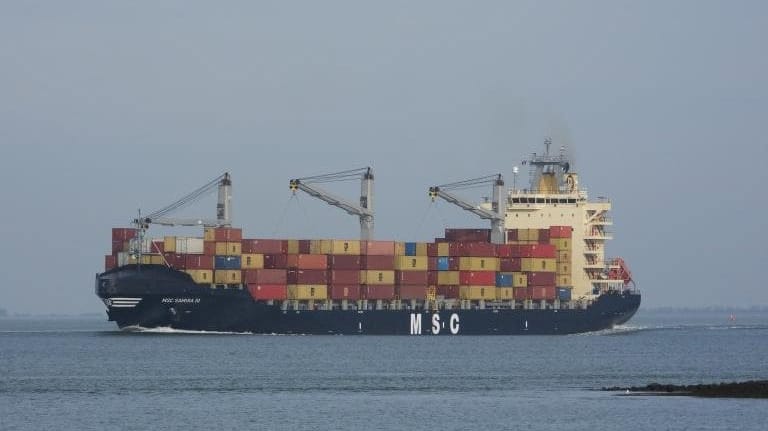
 

MSC Shipmanagement and HK Shipowner Plead Guilty in MARPOL Case

MSC containership
USCG discovered the oil discharge and record keeping issues when the MSC ship docked in Philadelphia in January 2025 (Peters Faas photo courtesy of VesselFinder)

Published Sep 8, 2026 5:26 PM by The Maritime Executive


The U.S. Department of Justice reported that MSC Shipmanagement and a Hong Kong shipowner each pleaded guilty to two counts in a MARPOL case in the Eastern District of Pennsylvania Court and were fined a total of $1.75 million. The second engineer of the vessel involved in the case has also pleaded guilty and is scheduled for sentencing on September 10.

“These companies repeatedly cut corners and covered it up, befouling the marine environment,” said U.S. Attorney David Metcalf for the Eastern District of Pennsylvania. “Their violations evidence both a disdain for our country’s laws and a clear case of greed. Shippers who illegally discharge pollutants and doctor their records will be prosecuted and held accountable.”

According to court documents, between June and September 2024, senior officers in the engine department of the MSC Samira III instructed lower-level crew members to pump oily bilge water from the vessel’s bilge holding tank to the sewage holding tank using portable pumps and hoses. The crew members then discharged the oily bilge water into the sea using the sewage holding tank’s overboard discharge valve. In doing so, they bypassed the oil water separator. 

In addition to these discharges of oily waste from the vessel’s sewage holding tank, on several occasions between September 2024 and January 2025, senior engine department crew members also tricked the oil water separator by running fresh water instead of oily bilge water through the equipment’s oil content monitor. Doing so allowed them to discharge oily bilge water directly into the sea through the oil water separator.

The MSC Samira III made two separate calls in the Port of Philadelphia, at which time the U.S. Coast Guard says they presented false oil record books. By U.S. and international law, all oil discharges must be recorded in a record book, but U.S. Coast Guard inspectors found that the officers in charge of these operations failed to do so.

Built in 2009, the containership has been operating for MSC since 2021. It is 38,000 dwt with a capacity for 2,578 TEU. USCG records indicate that the vessel was detained for three days on January 9, 2025, after an inspection found oil accumulation in the engine room, issues with the emergency generator, and maintenance issues with the ship and its equipment. On its return call in Philadelphia on January 27, 2025, the oil discharge issues were discovered, and the vessel was detained for 13 days.

The second engineer for the vessel at the time of the incident, Mikhail Tsurikov, previously pleaded guilty to violating the Act to Prevent Pollution from Ships and is awaiting sentencing. In addition to the combined fine of $1.75 million, MSC Shipmanagement and Hong Kong Spirit Shipping and Trading were also sentenced to serve four years of probation.
 

Top photo by Peter Faas - courtsey of VesselFinder


Putin Visits Zvezda Shipyard Building Arctic 2 LNG Tankers

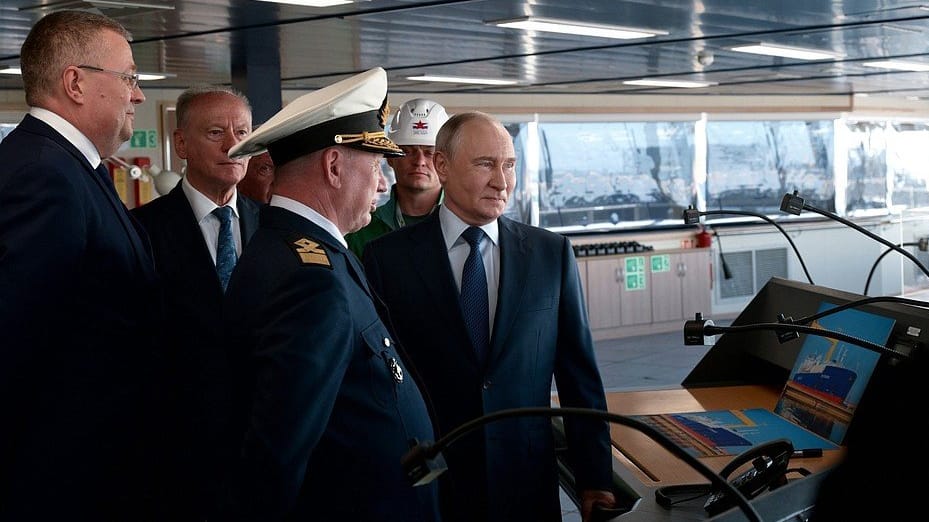
Inspecting LNG tanker at the Zvezda shipyard
Putin inspecting the Pyotr Stolypin LNG tanker at the Zvezda shipyard (Photo: Alexei Danichev, RIA Novosti)

Published Sep 3, 2026 5:48 PM by The Maritime Executive


Russian President Vladimir Putin has been spending a lot of time in recent weeks visiting the Russian Far East – an area where he probably feels safe from the Ukrainian long-range sanctions program. It is also an area in the strategic depth of a vast country that is as yet untouched by the war with Ukraine.

A visit on September 2 to the Zvezda shipyard in Bolshoy Kamen, across the Ussuriyskiy Zaliv from Vladivostok, was steeped with symbolism. It touches many of Russia’s pet projects and ones critical to its economy. Putin has been a supporter of the development of the Zvezda complex, which in turn is closely tied to Arctic shipping and the Northern Sea Route.

President Putin inspected the Arc7 Class icebreaking LNG carrier Pyotr Stolypin (IMO 9904675), which is designed to operate throughout the year through the ice-bound seas of the Northern Sea Route, the 3,000nm Arctic shipping corridor along Russia’s northern coast. The Northern Sea Route used to be navigable for only two months a year, but melting Arctic ice has extended the shipping season, and the route can now be kept open using Rosatom’s nuclear-powered icebreakers.  

The tanker is one of five Arc7 LNG tankers being built at the Zvezda shipyard, to service the Arctic LNG 2 project being developed by Novatek on the Gydan Peninsula in Western Siberia. The primary, and closest destination terminal will be Murmansk, but the tankers are also designed to be able to sail eastwards to a transshipment point in Kamchatka and onwards to China. The fleet will be Russian-flagged and operated by Sovcomflot.


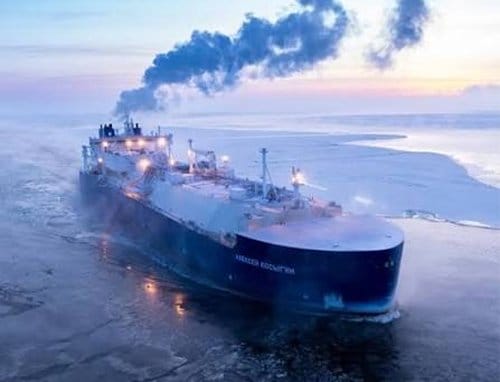
Arc7 Class icebreaking LNG carrier Aleksey Kosygin (Sovcomflot)


The ships, based on the Samsung 172 Yamalmax design, are designed to be able to operate through ice over 2m thick, along the length of the Northern Sea Route. The lead tanker in the class, the Aleksey Kosygin (IMO 9904546), made its first journey to Gydan in December 2025. Like the Pyotr Stolypin, the Kosygin is already OFAC-sanctioned by the U.S. and was last spotted offloading at the Jinhai Heavy Industry facility in Zhoushan, China, on August 25.

Originally, 15 tankers were to be built in the class, in cooperation with Samsung and the South Korean Hanwha Ocean shipyard, plus French sub-contractors. But when the project was sanctioned, the order was slimmed down and the work transferred to the Zvezda yard, and the technically challenging five-ship class is now being completed at Zvezda. The LNG project in Gydan has also been scaled down as a consequence of sanctions, and only one of three planned LNG trains was completed before foreign partners withdrew and exports of specialized equipment were halted, curtailing the scale of the project and the need, at least for now, for such a large number of Arc7 Class tankers. Completion of all the shipbuilding work at Zvezda has necessitated the construction of specialist plants nearby to produce the azimuth thrusters needed for the icebreakers to function, as well as a foundry to produce large-format steel sheets at Primorye.  


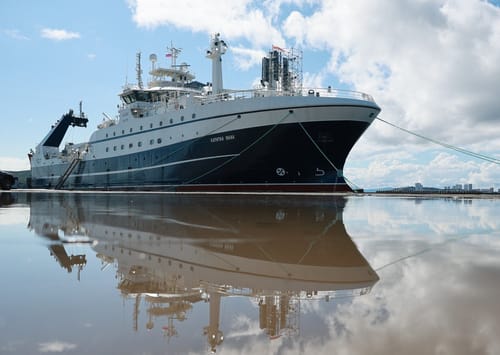
Freezer-fishing trawler Kapitan Yunak (Kremlin - Presidential Press Office)

Sanctions and the withdrawal of foreign partners have turned the Arctic LNG 2 project into an economic nightmare. But with the Ukrainian attacks on oil and gas infrastructure across Russia, this plant should at least be out of range and able to maintain production to counter shortages – that is, until the Ukrainians extend the range of their drones out to 3,000km. So far, the longest-range drone attack was the 2,500km raid on the Omsk refinery complex on July 6.

While he was in the Vladivostok area, President Putin also went aboard the newly-launched deep-sea long-range freezer-trawler, the Kapitan Yunak (IMO 9901178). With a gross tonnage of 9,055, the Kapitan Yunak is among the largest and probably most sophisticated of its type. Although not yet sanctioned, it is likely to range far and wide under the protection of its Russian flag. 


30 Reported Injured in USV Attack on Port of Sochi

Bystanders captured footage of the attack from the boardwalk (Russian social media)

Published Sep 10, 2026 6:07 PM by The Maritime Executive


A naval drone strike on the Black Sea tourist town of Sochi resulted in as many as 30 injuries, according to Russian officials. Ukraine is the most prolific operator of USVs in the region and has conducted multiple attacks nearby in recent days, but it has not claimed responsibility for the Sochi incident. 

Bystander video footage from the scene appears to show massive fires and a large explosion along the waterfront in Sochi. Air defenses were in operation, indicating a simultaneous UAV attack. 

At least one apparent blast site has been identified by open-source intelligence analysts: a beachfront  in front of the Portofino Hotel, a tourist boardwalk area about 1,000 yards southeast of the commercial port. Bystander footage shows that there was foot traffic in the area. At the time, '90s Russian pop star Tatiana Bulanova was performing at the Festival House of Culture, another 1,000 yards further southeast. The concert was canceled and the attendees sent home. 

The rationale for the targeting was not clear, but Sochi is both a small commercial seaport and a top vacation destination for Russian officials; Russian President Vladimir Putin maintains a residence nearby. Ukraine's secret services have gone to great lengths to target Russian military officers and intelligence operatives, both within occupied areas of Ukraine and deep within Russia. 

Ukraine has previously attempted to hit maritime targets within its harbor. Last week, Ukrainian USVs entered the port of Sochi and made an attack run on a Russian offshore support vessel, the Nefrit. One strike USV penetrated the perimeter and damaged Nefrit's port side; a second made an attempt but detonated before reaching target, likely hit by defensive fire. 


Russian state media interpreted Wednesday's strike as a terrorist attack. 

"Zelensky is carrying out acts of absolute terror. And there's no other way to read last night's strikes on the Sochi waterfront. The strike was carried out by unmanned surface craft. And we understand that Britain is behind it," alleged leading Russian state propagandist Vladimir Solovyov, who routinely calls for use of lethal force against Western targets. "And it's an absolute disgrace. We said yesterday: Europe should burn. Ukraine should burn. Do we not understand that the threats are growing?"


Report: Russia Develops Untraceable Method to Disable Subsea Cables

GUGI
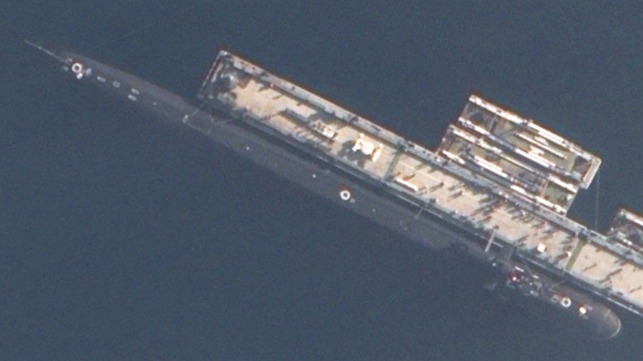
A submarine asset believed to be attached to Russia's Main Directorate of Deep Sea Research (GUGI) (UK government press handout)

Published Sep 10, 2026 4:06 PM by The Maritime Executive


A joint NATO military operation has uncovered evidence of a new sabotage method developed by Russia's top-secret subsea warfare institute for sabotaging fiber-optic cables on the seabed - a method that reportedly leaves no trace. A defining characteristic of Russian "hybrid warfare" is difficulty of attribution, creating threat and menace while preserving ambiguity, and a means of disabling cable communications without leaving any sign would be a significant leap ahead - far less attributable than physical cable-cutting or anchor-dragging. 

Two Western officials told Reuters that NATO forces had tracked Russian subs to a region off the coast of Svalbard. The vessels were associated with GUGI, the Main Directorate of Deep Sea Research, a spy-submarine outfit that reports directly to the Russian Ministry of Defense. 

According to the officials, the Russian operation was a trial run to "simulate" the use of a "destructive" technology. A NATO task force intercepted this exercise and prevented its completion. 

The report adds detail to a previous announcement from the British government dating back several months. In April, the UK claimed that it had disrupted Russian plans to conduct "nefarious" activity over critical subsea fiber optic cables. Like the event referenced by Western officials more recently, the plot described by Britain was attributed to GUGI assets supported by regular Russian Navy forces. 

The month-long operation started when British forces detected an Akula-class Russian attack sub in Arctic waters last month. Working with Norwegian partners, the UK military tracked the sub; further detections established that the Akula's mission was to distract from the movements of other Russian undersea assets belonging to GUGI.  The Type 23 frigate HMS St. Albans and oiler RFA Tidespring deployed to monitor the activity. Once it was clear that the advantage of secrecy was lost, the Russian subs headed for home, according to the UK. 

GUGI's activities are shrouded in secrecy; some of its submersible assets have never been seen by the public, only referenced in literature or photographed from a long distance. Its capabilities center on a small fleet of submarine-carried, deep-diving mini-subs that are purpose-built for subsea espionage and sabotage. 

The best-known of these vessels is the Losharik, a nuclear-powered sub built of spherical titanium pressure hulls with capability to reach 6,000-8,000 feet of depth. The vessel suffered a fire in 2019, prompting a rare public acknowledgement of its operations and a memorial for the fourteen crewmembers killed. 


Captain and Boatswain Go on Trial in Finland for Anchor Dragging Incident

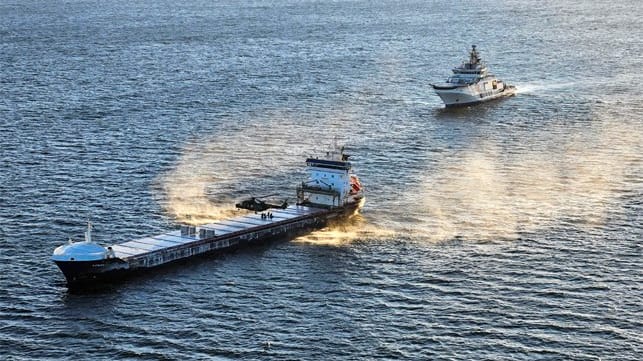
Finnish Coast Guard detaining cargo ship
Finland detaiend the cargo ship accusing it of causing damage by dragging its anchor (Finnish Border Guard)

Published Sep 9, 2026 3:50 PM by The Maritime Executive


Finnish prosecutors are back in court seeking to hold a captain and a boatswain from a cargo ship responsible for dragging the vessel’s anchor across the Gulf of Finland and damaging critical undersea cables and a gas pipeline. It is the second case Finland has prosecuted, asserting the crews were aware of their actions and denied it when confronted by the Finnish Border Guard.

This case involves a small, Turkish-owned cargo ship, Fitburg (9,800 dwt), which had departed Russia reportedly bound for Israel with a cargo of steel products. The general cargo ship is 132 meters (433 feet) in length and registered in St. Vincent and the Grenadines.

Early in the morning on December 31, 2025, Finnish telecommunications and technology company Elisa reported a fault on one of its lines between Estonia and Finland, followed a short time later by a similar report by another technology company, Arelion. The Border Guard quickly identified the Fitburg as the suspect and contacted the ship. The crew denied any problems, but the Border Guard then observed the ship from a helicopter and saw that it appeared that one of the anchors was down. It contacted the ship, instructing it to stop and raise its anchor, and then the vessel was boarded by the police. It was brought to Finnish waters and detained.

The investigation found drag marks on the seafloor consistent with the ship’s anchor and damage to a total of eight cables and pipelines, interrupting electric, gas, and telecommunications. Investigators said the vessel had dragged its anchors for at least 130 kilometers (80 miles).

The ship had a crew of 14 from Russia, Georgia, and Kazakhstan. Initially, prosecutors named four of the crewmembers as suspects, but so far have only charged the Russian captain, Andrei Maksimenko, and an unnamed Azerbaijani boatswain with aggravated sabotage and aggravated interference with telecommunications. Media reports say they each face up to two and a half years in prison if found guilty.

Making their first appearance in the Helsinki District Court on Tuesday, they asserted that they believed the anchor was secure. They cited bad weather and icy conditions on the deck of the ship, which made reaching the anchor controls difficult. 

Prosecutors are arguing that there were no mechanical faults found during the investigation. The defense, however, points out that the anchor equipment was covered in ice and mud.

The captain asserted that he had ordered additional securing wires for the anchors before they left St. Petersburg. He denies acting negligently or intentionally causing damage. The boatswain said he did not have the authority to lower the anchor on his own.

Lawyers for the defense have been questioning the court’s jurisdiction to hear the case after a similar case was dismissed by the court last year over jurisdictional issues. The court said under UNCLOS the authority to prosecute was with the ship’s flag state or the home country of the crew. The Court of Appeals in Helsinki recently overruled the lower court and ordered the case reopened, saying it ceased to be a maritime accident when the crew denied the anchor was dragging to the authorities and because the results of the damage were in Finland. The District Court on Tuesday said it believed it was competent to proceed with the Fitburg case.

Six hearing days have been scheduled for the court with two additional days in reserve. The ship was released by the Coast Guard after the investigation. Records show it was renamed Finex in March but continues to operate for the Turkish company and is registered in St. Vincent and the Grenadines.


China Grows Arctic Container Routes, Reaching England and Opening Murmansk

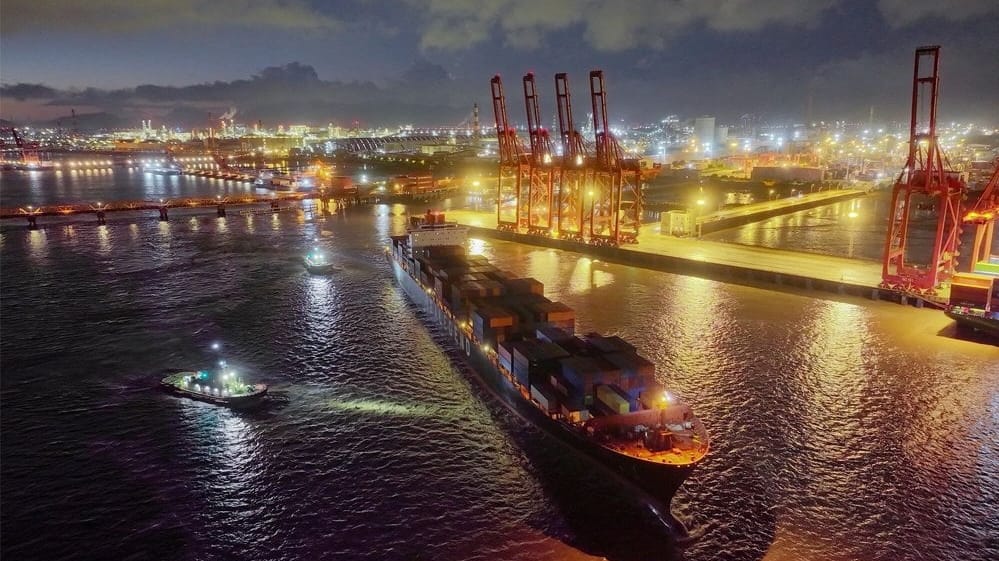
containership departing China for transit of the NSR to UK
Dubai Tower sailing from China last month for the first 2026 run across the NSR (Ningbo-Zhoushan Port Co.)

Published Sep 11, 2026 10:09 AM by The Maritime Executive


Chinese containerships are continuing in their efforts to expand operations along the Northern Sea Route through the Arctic. The first of their planned 2026 runs reached England today, while in the high Arctic at Murmansk, it opened a new export service for Central Russia.

The containership Dubai Tower arrived at Teesport in the north of the UK on September 9, completing its trip along the NSR that departed China on August 19. The reports are that the ship is carrying 1,300 TEU, hauling electric vehicles, batteries, and other renewable energy equipment from China.

The  23,338 dwt containership, which has a capacity for 1,740 TEU, appears to have had a mostly uneventful crossing, which was expected to take about 20 days. However, it was scheduled to go to Felixstowe, with no explanation for why it diverted to Teesport in the north. Teesport lists itself as the UK’s sixth-largest port and a gateway to the north, but it has limited container operations.

PD Ports, which operates at Teesport, however, did recently report that it had received one of the largest automotive vessel calls to Teesport in recent years. It was carrying 5,000 vehicles arriving at the beginning of the month from China as part of a major UK import operation. The shipment included vehicles from across the Chery Automotive portfolio, including Jaecoo and Chery models, alongside the first 1,300 Lepas plug-in hybrid cars to be imported into the UK market. Chery, a major Chinese manufacturer, reported that it looks forward to expanding its relationship with Teesport.

Sea Legend, which is operating the ship, published a schedule that shows the ship proceeding to Rotterdam, possibly Hamburg, and a stop at Gdynia, Poland, before starting back across the Arctic. The Chinese shipping company is billing it as the start of regularly scheduled NSR crossings, with a total of eight scheduled for 2026.

Other companies are following close behind. New New Shipping is expected to send voyages through to Europe, while South Korea’s PanStar’s trial voyage is well underway. The PanStar Arco is currently off the coast of Norway. It is scheduled to reach Felixstowe on Friday, September 11. While it was billed as a demonstration and opportunity to gather data, Alphaliner reports the vessel only has 737 laden containers aboard, while its full capacity is over 2,700 TEU. The company had said it was targeting approximately 1,200 TEU.

China’s New New Shipping this week also opened up a new service to Murmansk, Russia, along the NSR. One of the company’s vessels carried 502 containers from China to Murmansk, transporting car parts and other material for delivery via trains into Central Russia. The ship then loaded 26,400 tons of potash fertilizer.  It is a first for the port.

“We’re testing not just a single operation, but the entire logistics scheme,” said an official for the Murmansk Terminal company. “It is important for us to understand how sustainable, convenient, and economically viable this route is for the chain’s participants.”

Officials in Murmansk highlight the opportunities to open new trade avenues and build the region’s economy. They also said New New Shipping is discussing building a dedicated terminal at the port, while they are also in discussion with Indian companies about launching container service on the NSR.

The developments are in keeping with Russia’s plan to build up trade on the NSR.  Earlier this week, they opened a large new oil export operation on the NSR, and they are highlighting advancements as they move toward year-round transits. 


Russia Has Two Military Sealift Flotillas in the Mediterranean

<p><em>The Station 720 quay in Tartus on September 11, with the tanker General Skobelev moored on the open flank of what seems to be a warship (Sentinel-2)/CJRC)</em></p>

Published Sep 11, 2026 6:37 PM by The Maritime Executive


Three separate groups of Russian vessels carrying military cargoes are currently active in the Mediterranean.

Escorted by the Udaloy Class anti-submarine warfare destroyer RFS Admiral Levchenko (D605), the oil products tanker General Skobelev (IMO 9503304), the Ro-Ro cargo vessel Sparta (IMO 9268710) and the oiler Akademik Pashin (IMO 9778193) passed east through the Strait of Gibraltar late on August 27. They were followed through the English Channel by an abnormally large Royal Navy escort, consisting of the Daring-class destroyer HMS Duncan (D37), the frigate HMS St Albans (F83), OPV HMS Severn (P282 ), and with a Merlin helicopter in support.

As the Russian ships moved through the Channel, the permanent Russian piquet stationed in the Channel, the frigate RFS Neustrashimy (F722) kept company with the convoy as it transited. The Russian ships are believed to have arrived in Tartus on September 7, with the Sparta seen unloading on Pier 4, in the same position dockside which it used in January 2025.

In imagery taken on September 11, it appears that a warship is in the usual Station 720 position used by Russian frigates at Tartus, moored between the quayside and double-banked with the tanker General Skobelev tied up - possibly positioned protectively on its seaward side, but also potentially for a refueling operation.

The sanctioned Russia-flagged ro-ro cargo vessel Lady Mariia (IMO 9220641), which was attacked by multiple aerial drones in the central Mediterranean on September 7, seems to have survived its ordeal. Sailing independently, the Lady Mariia has made it to Port Said, and has been in the anchorage at the northern end of the Suez Canal since late on September 8, where ships normally wait as Canal convoys form up.

If the Lady Mariia sails through the Suez Canal into the Red Sea, there will be indication as to the current status of Russia’s relationship with the Houthis, now that the Houthis have occupied the southeastern coastline of Yemen and the islands which dominate navigation in the southern end of the Red Sea. The Russians have not previously sought to test a US naval blockade, so the ship is unlikely to be heading for Iran.

Another Russian convoy also appears to be making for Tartus. The lead ship for this convoy appears to be the Ropucha-class landing ship Aleksandr Shabalin (L110), escorting the cargo vessels Anastasiia (IMO 9349291) and Yuriy Arshenevskiy (IMO 8406705), also both sanctioned and with well-established histories of moving military cargoes. As well as carrying cargo on its vehicle deck, the Aleksandr Shabalin is well able to act as an escort, being equipped with a 76mm main gun and two 57mm AK-725 anti-aircraft weapons.

The convoy was under surveillance by the Italian Air Force ATR P-72A when spotted between Sicily and Tunisia on September 10, having passed along the Algerian coast the day before. If this convoy is continuing eastwards, it should now be cruising through the sea area between Crete and Libya where drone attacks have occurred before. As a precaution, all three ships are travelling with their AIS systems switched off.


Azerbaijan Issues Warning After Russian Attack Kills Two Seafarers

Greater port of Odesa
Russia continues to escalate its attacks against shipping in or near Ukraine (file photo)

Published Sep 10, 2026 6:36 PM by The Maritime Executive


Russia’s latest attack on commercial shipping killed and injured Azerbaijani citizens, prompting the country’s Ministry of Foreign Affairs to issue a warning. It comes as Russia’s Ministry of Defense continues to assert that it is attacking shipping and infrastructure used to support Ukraine’s military.

The offshore tug/supply ship Tedy (183 dwt) was reportedly attacked twice on September 9 and into the 10th. The Turkish-owned vessel was built in 1995 and was first struck during the daylight hours by a drone. Azerbaijani media is saying it was the second attack that came at night, as the tug was attempting to reach Constanta, Romania, that killed two of the country’s citizens and injured two others. The ministry, in its statement, said the two injured seafarers, however, were in a hospital in Chernomorsk, Ukraine.

The tug was reported to have a crew of 10, including the four from Azerbaijan as well as three from Turkey, two from Germany, and one from Ukraine. The tug is registered in Somalia.

The Azerbaijani Foreign Ministry said it was calling on citizens to refrain from traveling in regions where military operations are ongoing or the security situation is unstable. It also said citizens should avoid working in those areas, including ships operating on those routes.

Russia did not acknowledge the injured and killed crewmembers, but asserted the vessel was attacked off the Odesa port complex while it was accompanying two dry cargo ships that were delivering material to the Armed Forces of Ukraine. It reported that all three vessels were struck, along with attacks on a terminal used to store military cargo in Chernomorsk and a depot in Mykolaiv. Later, it also reported strikes on a dry cargo ship in the port of Chernomorsk that it asserted was delivering military cargo.

It was the latest in an escalation of attacks that have been ongoing all summer. Ukraine’s Ministry for Development of Communities said starting in July and into August, Russia attacked 52 civilian vessels. It says this has included 35 vessels in port waters and, in July, another 22 at sea. It said there had also been 67 attacks on Ukrainian ports.


Russia’s Arctic LNG 2 Files $1B Arbitration Claim for Canceled DSME Tankers

Arctic LNG tanker
DSME (later Hanwha Ocean) was contracted to build LNG tankers to support Russia's Arctic LNG 2 project (Sovcomflot file photo)

Published Sep 8, 2026 7:10 PM by The Maritime Executive


Disputes continue to mount related to the project for South Korean shipbuilders to build Russian LNG tankers supporting Russia’s Arctic LNG 2 project. Hanwha Ocean reported in a stock exchange filing that it has been hit with an approximately $1 billion arbitration claim by Arctic LNG 2 for damages related to the project, which was canceled due to the war in Ukraine and the subsequent sanctions. Hanwha Ocean is already defending itself against a prior approximately $850 million arbitration claim related to the same shipbuilding project.

Daewoo Shipbuilding and Marine Engineering (DSME) listed this same project among those that worsened its financial collapse that ultimately led to the sale of the company to Hanwha Group. DSME had reported in May, July, and November 2022 that it was canceling shipbuilding contracts for a total of three 172,500 cbm gas carriers, citing the inability of the shipowners to meet contractual payments due to the sanctions related to the war in Ukraine. 

The order had originally been placed in October 2020, calling for DSME to build the three vessels for three Russian shipowners, who would in turn lease the ships to Sovcomflot for operations. The vessels were tied to the Arctic LNG 2 project developed by Novatek, which began production in August 2024. The three vessels were due for delivery by July 31, 2023, and DSME ultimately had contracts to build a total of six LNG tankers tied to the project, with the other three to be delivered to Mitsui O.S.K. Lines. 

The three Russian shipowners initiated the first arbitration in Singapore in May 2023, claiming that the shipbuilder illegally terminated the contracts. They were seeking to force Hanwha Ocean, which had acquired DMSE, to fulfill the contracts. DSME and then Hanwha Ocean had completed building the vessels for Hanwha Ocean’s ownership. The shipowners are seeking $862 million in the ongoing arbitration.

Hanwha Ocean now reports Arctic LNG 2 filed a second arbitration claim, which it was notified of on September 1. The company, 60 percent owned by Novatek, is seeking approximately $1 billion in damages regarding the breach of “Step-in Agreements” that Arctic LNG 2 had for the vessels in case the owners failed to complete their contracts.

Hanwha Ocean says the amount of the claim was provided without detailed specification and is likely to exceed the $1 billion figure. It says it will respond to the arbitration proceedings filed at the Singapore International Arbitration Center and will continue to strive for an amicable resolution.