It’s possible that I shall make an ass of myself. But in that case one can always get out of it with a little dialectic. I have, of course, so worded my proposition as to be right either way (K.Marx, Letter to F.Engels on the Indian Mutiny)
Monday, September 14, 2026
Trump caves on tariff after chat with Irish Open winner: 'It was pretty unfair'
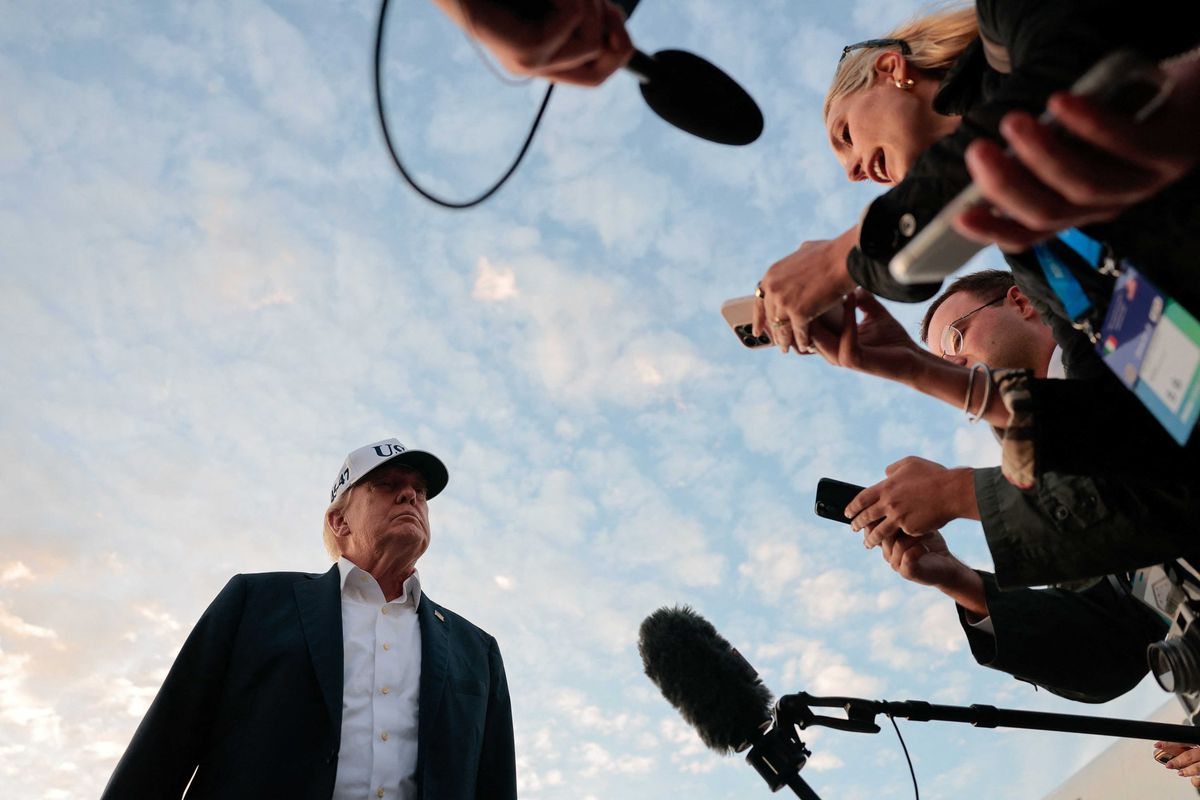
U.S. President Donald Trump speaks to the press, at Shannon Airport in Ireland, September 13, 2026. REUTERS/Kylie Cooper
President Donald Trump caved Sunday on one of the tariffs he implemented against one of America's key trading partners last year.
Trump announced during a press conference that he was removing the 15% tariff he placed on Irish whiskey in April 2025. The announcement came after Trump attended the Irish Open trophy ceremony, held at Trump International Golf Links & Hotel in Doonbeg, Ireland.
"It was very unfair because others have the relief, and they did. So, I thought I'd do it," Trump told reporters at Shannon Airport before he traveled back to the U.S.
Trump added that he talked about the tariff with professional golfer Shane Lowry, who won the Irish Open.
"Shane asked me about it; everyone has," Trump said. "It was pretty unfair, so I decided to do it."
Disgust as Trump tips Kennedy Center toward bankruptcy with 'mafia-like MAGA hit'
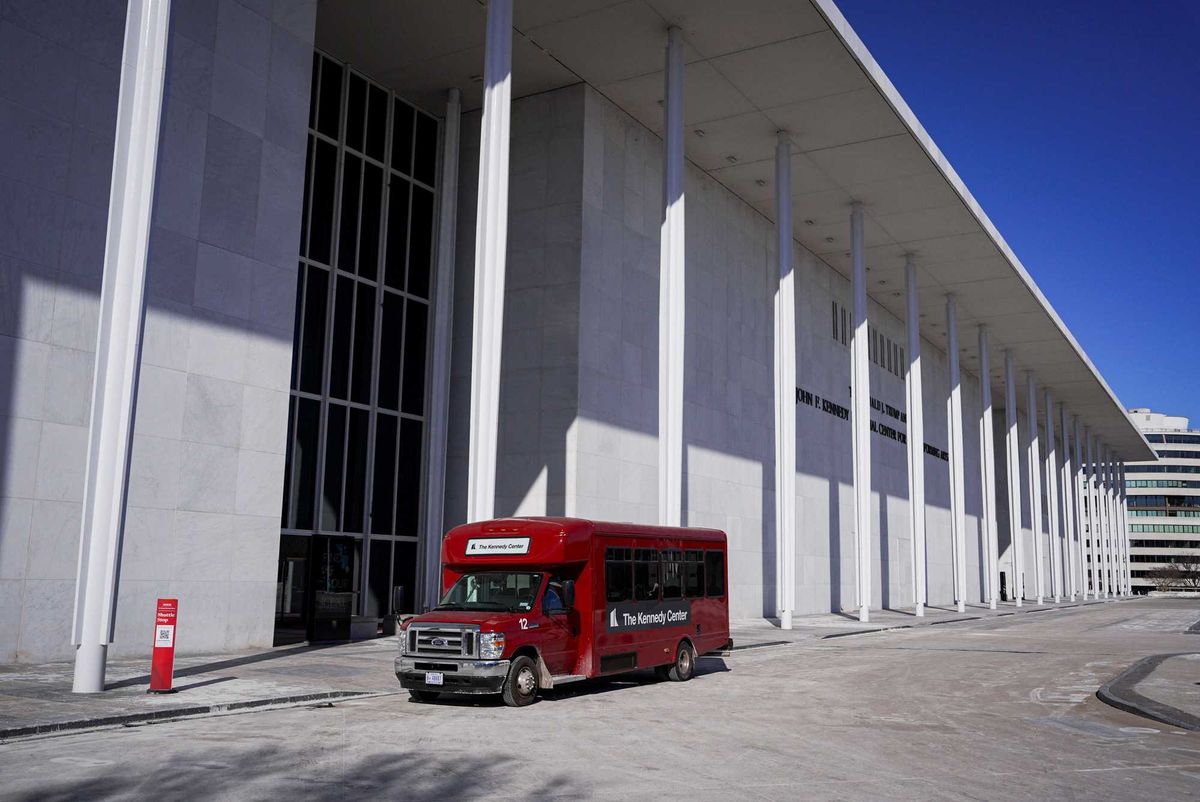
A shuttle bus is parked outside of The John F. Kennedy Memorial Center for the Performing Arts in Washington, D.C., renamed The Donald J. Trump and The John F. Kennedy Memorial Center for the Performing Arts, by the Trump administration, after President Donald Trump said he planned to close the Kennedy Center for two years for reconstruction starting in July, on Feb. 2, 2026. REUTERS/Al Drago
The Washington Post reported that the Kennedy Center could close as early as Tuesday because it cannot meet its payroll and maintenance obligations. The center said in a 57-page packet distributed to its board of trustees that affixing Trump's name to the building may be the only way to save it from closure.
"The presentation makes clear that Trump’s support hinges on getting public credit for his involvement," the report reads in part. "The financial resolution says Trump has offered to 'raise the necessary funds to keep the Center from bankruptcy' while the building undergoes a sweeping renovation. But it says Trump is unlikely to provide 'fundamental oversight' of that project or lead a financial rescue without 'appropriate recognition' of his role."
The report disgusted some political analysts, who shared their reactions on social media.
"Who knew that defacing the building, tearing up its trees, removing its sculptures, replacing the Board with political cronies, giving the finger to every performer who isn’t a Trump voter, and talking down its facilities daily would cause a revenue drop?" Seth Abramson, an attorney and Trump biographer, posted on X.
"Let’s be clear: this was a mafia-like MAGA *hit* on a congressionally controlled building honoring a slain Democratic POTUS," Abramson added.
"Nearly every institution Trump touches goes bankrupt," Dan Weiss, a clean energy advocacy expert, posted on X.
"Not to be forgotten is that the Trump people threw out the chairman of the board who also was the biggest donor," Kevin Kosar, a senior fellow at the American Enterprise Institute, posted on X.
"This is a dumb (sic)," Christina Henderson, a Washington, D.C. councilmember, posted on X. "Adding his name won’t bring back the artists nor the patrons."
Trump taunted with 'Simpsons' clip as war strikes smack Americans in the wallet
U.S. President Donald Trump walks to the first tee at the Amgen Irish Open 2026, at Trump International Golf Links in Doonbeg, County Clare, Ireland, September 13, 2026. REUTERS/Cathal McNaughton TPX IMAGES OF THE DAY
President Donald Trump was taunted Sunday with a clip from the popular TV show "The Simpsons" as strikes between the U.S. and Iran intensified.
Mohammad Bagher Ghalibaf, speaker of Iran's Islamic Consultative Assembly, posted a clip on X of Homer Simpson filling up his RV at a gas station. The total cost climbs past $999, and Homer cheers for "free gas" as the ticker turns over to triple zeros.
The post was also made at a time when Trump has predicted that the Iran skirmish will end quickly after the midterm elections in November. Trump has also touted the U.S. military's dominance in the fight as Iranian officials vow they won't surrender.
Iranian President Masoud Pezeshkian called on Trump Sunday in a post on X to send the military to face his "vacant forces."
“If they're human, why deny people access to water, food, and medicine? Our people can't be bullied into submission. Iran won't surrender,” the post reads.
The right's new war is being fought in high chairs — and daycares may not survive
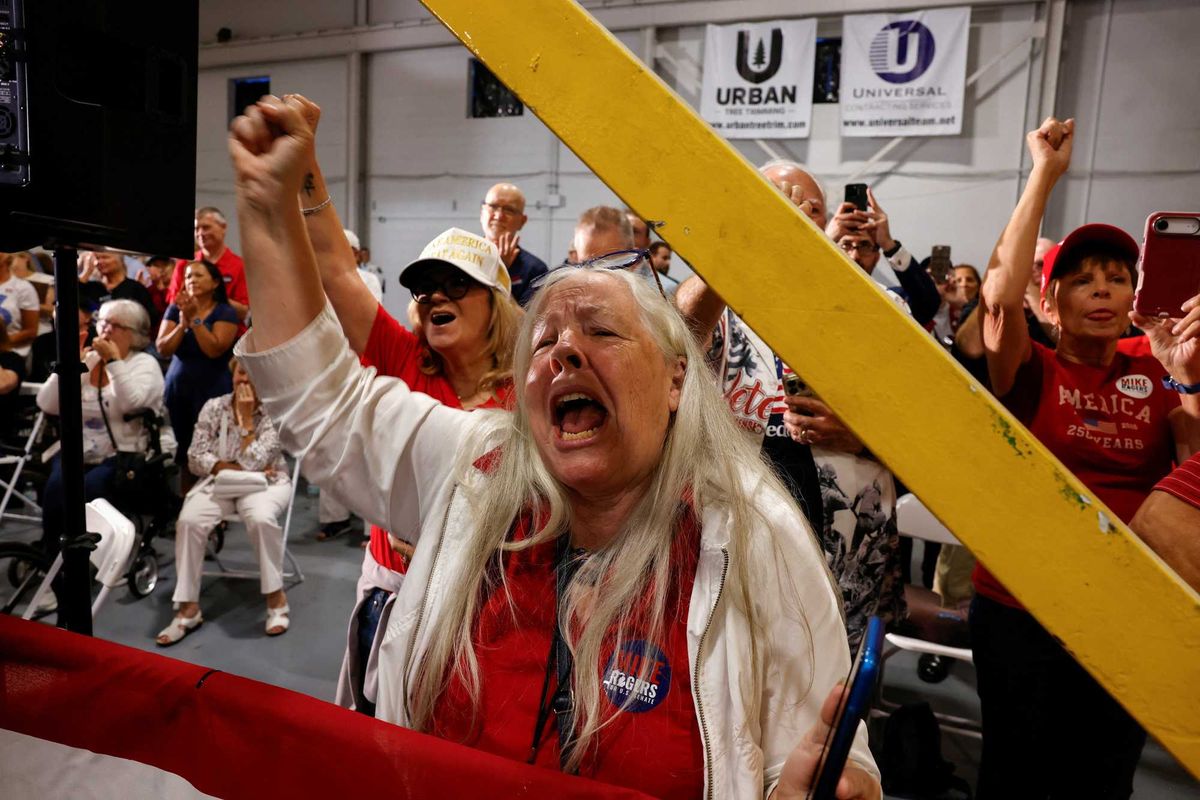
People cheer as U.S. Vice President JD Vance delivers remarks at a MAGA Inc. event in Sterling Heights, Michigan, US., August 31, 2026. REUTERS/Jeff Kowalsky
Vice President JD Vance is promoting a Trump administration plan to siphon off federal money that helps working parents afford childcare and use it to subsidize parents who stay at home. The man who ran for office mocking “childless cat ladies” is now trying to stir up a cat fight between working and stay-at-home moms. That’s not remarkable coming from a federal government run by social media trolls. But the main effect of the actual policy Vance is promoting will be to make the lives of already stressed working class families, especially in Wisconsin, even harder, more expensive and noticeably worse than before.
Childcare funding has been in crisis in Wisconsin ever since the pandemic relief money that briefly stabilized providers ran out. Without that money, which “prevented system collapse,” according to the Wisconsin Early Childhood Association, supporting more than 430,000 children in nearly 6,000 programs, parents are priced out of care and one in four providers say they will likely have to close their doors.
Unlike Massachusetts and Vermont, Wisconsin does not treat childcare as a state budget priority. Ours is one of only a handful of states, including Idaho, Indiana, Nevada, and Ohio, that failed to spend any money on childcare beyond what was required to draw down federal dollars, according to a 2025 report by the advocacy group ChildCare Aware. In 2026, the state created a new school readiness program for 4-year-olds. It was a first step toward acknowledging the needs of preschoolers and their parents. But it did nothing to address the massive shortage in care for infants and toddlers.
That’s all fine with JD Vance, who wrote on X that “normal Americans care more about their families than their jobs, and want a family policy that doesn’t shunt their kids into crap daycare so they can enjoy more ‘freedom’ in the paid labor force.”
But Vance is not offering to do anything about the fact that the U.S. is the only wealthy nation on Earth that doesn’t offer paid maternity leave, even though 68% of mothers with children under 6 are employed. Nor is he promoting the kind of high-quality early childhood education system that allows parents in Denmark, after their six months of paid parental leave, to enroll their preschoolers in beautiful, enriching childcare programs they don’t have to feel guilty about.
Instead, what Vance is proposing is to take an already paltry federal childcare subsidy and make working parents fight over crumbs with nonworking parents. Mainly, his aim seems to be to punish single parents. That’s not going to leave anyone in good shape — least of all children.
One of the saddest aspects of the attack on childcare is that very recently parents, educators, business leaders and politicians of both political parties were finally coming together around the idea that childcare is an essential public good that requires public support.
The “mommy wars” attack Vance wants to revive is long out of date. It has been decades since most American families had the luxury of subsisting on a single wage-earner’s income, trad wife fantasies notwithstanding.
Another major recent breakthrough is policymakers’ realization that the magic of the free market is not going to provide childcare parents can afford.
“It was the Biden administration that put a ton of money into childcare during COVID, and we learned from that,” says Ruth Schmidt, executive director of the Wisconsin Early Childhood Association. “The lesson was not just the importance of keeping childcare open so that essential workers could work, but the other piece that’s really interesting is that it demonstrated what can positively happen in childcare when you put a little more money into it.”
Thanks to direct payments to providers during the pandemic, center closures dropped off, the number of teachers leaving the workforce slowed down, tuition stopped climbing and, Schmidt says, “this industry for the first time was finally able to say, ‘Our work is important. It is essential to the functioning of our country. It’s worth investing in, because if you invest in it, these positive things can happen.”
Schmidt calls the rollout of Trump policies that slashed support for families “death by 1,000 cuts.” During the second Trump administration, cuts to food assistance, Medicaid and Head Start, along with the federal government’s move to loosen safety standards and increase staff ratios in childcare centers have taken a huge combined toll on Wisconsin families.
If it were just ideological — if the Trump administration were actually pursuing the kinds of pronatalist policies that make getting married and having children more attractive, as Vance likes to claim, it wouldn’t be as bad. But instead, while spouting rhetoric about valuing families, this administration is subjecting little kids and their parents to more and more misery.
Wisconsin could do more to protect vulnerable kids. Before leaving the Capitol to hit the campaign trail, state legislators failed to pass a bill that would have used state money to fill the gap after federal childcare stabilization funds lapsed. That set off a vicious cycle, says Paula Drew of the Wisconsin Early Childhood Association. Subsidies for families were cut and their out-of-pocket payments skyrocketed, so cash-strapped parents withdrew their kids from care. Under-enrollment meant less revenue for childcare centers, so they raised their rates. “It just sort of snowballed,” Drew says. “Programs said things like, ‘We’re gonna have to lower salaries for staff.’ … so I think we’re going to lose our educators, and in fact I think we’ve already lost a big percentage of our skilled, seasoned educators.”
An unintended consequence of the state’s investment in 4-year-old pre-K is that it creates a disincentive to provide care for infants and toddlers, which is already more expensive, Drew says. “Wisconsin serves very few infants and toddlers in regulated care,” she says. “And now, with additional funding going into the Get Kids Ready pre-K program, we expect that to be even lower a year from now.”
To make matters worse, the state no longer has a surplus of federal Temporary Assistance to Needy Families funds, which it has used to cover some childcare costs for low-income families.
Sooner or later, Wisconsin is going to have to start dedicating state revenue to childcare. Schmidt and Drew hope that, with a new governor and a new Legislature, Wisconsin will use the state surplus, payroll taxes or a tax on hemp products and gambling, as Louisiana has done, to subsidize childcare. Only then can Wisconsin reduce the astronomical tuition rates that parents pay ($13,000 for home care and $17,400 for center-based care, according to state data), give providers a better wage (currently $13.55 per hour), and stop the wave of childcare closures.
They especially want the state to shore up disappearing infant and toddler care and retain experienced teachers — not just by giving them a raise but also by allowing them to continue to get higher education “and make this a profession, not just a fleeting step to something else,” says Drew.
“We need supply of care; supply means educators that can work in programs. And then we want to help parents pay for care on the demand side. … You can’t do one and not the other, because it simply won’t work,” says Drew. “You can’t just help parents pay for care, but not tend to the supply of care available. And you can’t just tend to the supply of care available, but pretend you don’t see that parents are literally going into poverty to try to pay for childcare.”
“Childcare is infrastructure,” says Schmidt. “If we turned around and said to parents with 5-year-olds, you’ve got to start paying $17,000 a year for your child to be in school, we would see empty classrooms, right? We treat these as two very dramatically different concerns. But all of it is about families’ ability to work outside the home, impact the economy, all those kinds of things. “
It’s also about having a decent society that values families and takes good care of children. That’s the kind of society we need to come together and focus on, instead of being distracted by the rage-baiting bluster of internet trolls. Wisconsin Examiner is part of States Newsroom, a nonprofit news network supported by grants and a coalition of donors as a 501c(3) public charity. Wisconsin Examiner maintains editorial independence. Contact Editor Ruth Conniff for questions: info@wisconsinexaminer.com.
Fetterman kept his staff in the dark on jarring GOP-engineered convention cameo: report
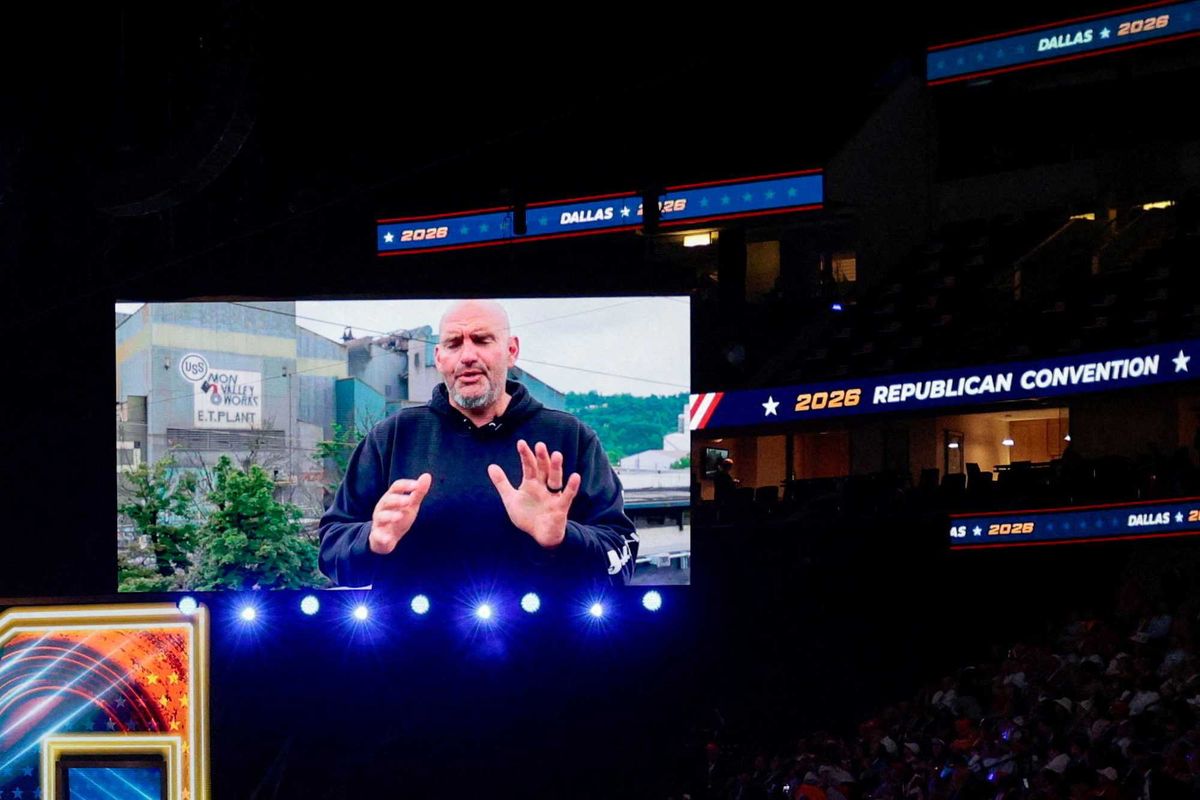
U.S. Senator John Fetterman (D-PA) appears via video to introduce U.S. Senator Dave McCormick (R-PA) during the Republican National Midterm Convention in Dallas, Texas, U.S., September 9, 2026. REUTERS/Brian Snyder TPX IMAGES OF THE DAY
Republicans engineered a jarring moment of their first-ever midterm convention by quietly recruiting a sitting Democrat, and the senator signed on without telling a single member of his own staff, according to a new Axios report
The account reveals how Sen. John Fetterman of Pennsylvania came to appear on the Dallas convention's big screen this month, praising Republican Sen. Dave McCormick and vowing to work with President Donald Trump to protect the state's steel industry. Organizers, Axios reported, were hunting for what they called an "Oh s---" moment to drive home their midterm message that Democrats have swung too far left.
GOP operative Tony Sayegh pushed the plan, Trump adviser Jason Miller backed it, and Fetterman topped their wish list. Sayegh, a friend of McCormick's, pitched it to him in July. McCormick, who has built a real friendship with Fetterman as the Democrat drifted from his party over its criticism of Israel, approached him carefully.
"I don't want you to do something that's not good for you," McCormick told him, according to a source cited by Axios. The pair hashed it out over calls and texts for days.
"I want to do it. I'm sure it will make people mad," Fetterman replied, per the same source. "But you're my friend, and I want to introduce you."
Fetterman reportedly floated flying to Dallas in person before opting to record the 64-second video outside a steel mill near his Braddock home. He used no script, and neither McCormick nor organizers touched his statement.
To guard the surprise, the circle stayed tiny, as Fetterman looped in none of his own staff.
U.S. Senate Commerce Committee Chairman Ted Cruz (R-TX) attends a Senate Commerce Committee hearing on broadcast media ownership rules, on Capitol Hill in Washington, D.C., U.S., February 10, 2026. REUTERS/Annabelle Gordon/File Photo
ESPN is dealing with an internal mess after handing Sen. Ted Cruz (R-TX) a chunk of "College GameDay" airtime Saturday — and staffers want answers about his appearance.
Cruz appeared on the show from the University of Texas campus ahead of the Longhorns' showdown with Ohio State, but the segment was drowned out by chants of "Ted, you suck!" from the notoriously raucous GameDay crowd. According to media watchdog newsletter Status, the fallout didn't stay outside the network — it ripped through ESPN's own staff.
"Who was that interview for? Because it wasn't the GameDay audience," one ESPN staffer complained to Natalie Korach of Status. Another staffer called the whole thing "just really embarrassing stuff."
"Cruz happened to be in Austin for the game and had expressed interest to ESPN about appearing to discuss his Protect College Sports Act before Congress a person familiar with the matter told Status, adding that given the legislation's relevance to college football, 'it was an easy decision to have him join, especially in his home state,'" Status reported.
One ESPN staffer disagreed when speaking with Korach, calling the Austin location itself an obvious "red flag" given how politically unfriendly the city is to Cruz.
According to the report, former ESPN host Jemele Hill piled on too, writing on X: "Did not know ESPN had become a political lobbying firm."
The NAACP publicly called out the network on X, writing it was "surprised ESPN so willing lent their platform to political performance today. But we'll play," and proposing that its president, Derrick Johnson, get equal time when GameDay heads to his home state of Mississippi next week "to express why the Protect College Sports Act is dangerous to Black Athletes and the Black community."
ESPN has not said whether it will take the NAACP up on the offer, Status reported.
‘Very thoughtful guy’: Mike Johnson runs cover for ‘Nazi imagery’ MAGA candidate
U.S. House Speaker Mike Johnson (R-LA) gives remarks to the media following a vote in the House of Representatives at the U.S. Capitol in Washington, D.C., U.S., September 1, 2026. REUTERS/Aaron Schwartz
House Speaker Mike Johnson (R-LA) doubled down Sunday on his support for a GOP candidate who has called children "c-- trophies" and embraced "Nazi imagery" online, claiming Brandon Herrara is the "common sense" choice.
Johnson brushed off questions from CNN's Jake Tapper on Sunday about his endorsement of Herrera by insisting the content was just "his persona online.”
Herrera is the GOP nominee in a race to represent Texas’ 23rd Congressional District, having narrowly lost the GOP primary in 2024 by just over 400 votes. Before entering politics, Herrera was a prominent online influencer known for controversial remarks, including joking about veteran suicide and voicing support for the Confederacy.
“Brandon Herrera, before he started becoming a congressional candidate, he’s a YouTuber, and he has said some offensive, sexually explicit, crude things about women and children,” Tapper said before playing a clip of Herrera calling children “c-- trophies.”
“He’s also in a video testing a Nazi-era sub-machine gun, he called it the ‘original ghetto blaster,’ you see him goose stepping to a Nazi marching song… I have to say, I know you’re not a voter in that district, you didn’t nominate this guy, but I was surprised to see you endorse him and fundraise for him.”
Johnson admitted that Herrera’s language was “detestable,” but fiercely defended the controversial candidate as being a “very thoughtful guy.”
“Brandon Herrera has been out running a very effective campaign. He has apologized for all that — he was a podcaster and a provocateur and tried to get attention,” Johnson said. “Now, he’s running as a very serious candidate for Congress and a very thoughtful guy.”
Johnson also argued Herrera was "far superior" to his Democratic opponent and described the race as a "contrast election between common sense and crazy."
'Will you condemn this?' Republican's post sparks national debate about GOP racismKathleen Culliton
September 13, 2026
RAW STORY
U.S. Senator John Cornyn (R-TX) speaks to reporters outside the Senate chamber in the wake of U.S. President Donald Trump saying he may temporarily drop the nomination of Todd Blanche to be U.S. attorney general, at the U.S. Capitol in Washington, D.C., U.S., July 30, 2026. REUTERS/Evelyn Hockstein TPX IMAGES OF THE DAY
A three-sentence tweet from a state-level candidate has sparked a nationwide uproar about racism in the Republican Party.
A conservative U.S. senator, an MS NOW panel, a rising star in the Democratic Party, and a host of local GOP politicians publicly spoke out against a comment from the Republican nominee for Texas Railroad Commissioner on Sunday.
"Are other Republican elected officials going to condemn the intolerance and racism, or look the other way while it becomes normalized?" asked Texas Sen. John Cornyn. "This is how great political parties self-destruct."
The comment in question came from Bo French, who shared a picture of what appears to be a screenshot of celebrating students at a Texas Longhorns football game.
"I heard UT graduation this year looked like this," Bo French wrote on X. "I didn’t believe it. The problem is now obviously far worse than anyone imagined."
French later replied to Cornyn's condemnation by doubling down on his race-based rhetoric.
"Generations of Texans have invested billions of dollars into UT," French wrote. "Today it is filled with foreign nationals and Leftists who boo Ted Cruz. John Cornyn says we should accept decline."
State Rep. James Talarico, running for the U.S. Senate in Texas, thanked Cornyn for speaking out against French and called on his competitor, Attorney General Ken Paxton, to do the same.
"Racism has no place in Texas," Talarico wrote. "Will you condemn this blatant racism or will you cower to extremists?"
Paxton's campaign did not immediately condemn the post online or respond to a request for comment from the Texas Tribune, which reported the Republican Senate nominee has supported French’s campaign and claimed he would make "a great Railroad Commissioner.”
Other local Republicans were outraged.
State Rep. Jared Patterson (R-TX) joined his colleague across the aisle in condemning French's remarks with a lengthy statement.
"This is racist. It is wrong. And I condemn it without reservation," he wrote. "There is absolutely nothing Christian or conservative about looking at a crowd of young Texans at a college football game, seeing the color of their skin, and declaring that they are a 'problem.'”
State Rep. Jeff Leach (R-TX) posted a picture of his son Brady at the game in question.
"Bo thinks it’s a 'problem' they don’t all look like and have the same skin color as Brady," Leach wrote. "I think that’s racist — and it makes me sick."
"Please delete this," begged state Rep. Lacey Hull (R-TX). "This post breaks my heart. I see college kids cheering on their football team. I see Texans."
Molly Jong Fast argued Cornyn was correct in his warning that the conservative party might self-destruct, calling it a "leopards-eating-faces scenario."
EU scrutiny of Anglo-MMG nickel deal tests China stance
Niquelândia processes both nickel and manganese from Codemin and Barro Alto sites. (Image courtesy of Anglo American.)
China-backed MMG is urging European regulators to approve its $500-million purchase of Anglo American’s Brazilian nickel business, in a case that could test how far Brussels will go to limit Chinese control over strategic resource supply chains.
The European Commission (EC) is investigating whether the acquisition could allow MMG to divert Brazilian ferronickel away from Europe, potentially raising costs for stainless steel producers. EU regulators are expected to issue a formal warning over the transaction next week.
“Ultimately, we’re confident that DG COMP will put geopolitical considerations aside and judge this on the data,” Troy Hey, MMG executive general manager of corporate relations, told the Financial Times, referring to the commission’s Directorate-General for Competition.
The case reaches beyond a conventional competition review as Europe tries to reduce its reliance on China for metals and minerals following Beijing’s export restrictions on a range of materials. Ferronickel is not classified as a critical mineral, but European steelmakers are concerned that increasing Chinese ownership of overseas production could leave the industry more exposed to supply disruptions or economic pressure.
Supply concerns
MMG agreed in February 2025 to acquire Anglo’s Brazilian nickel business, including two ferronickel operations and two greenfield projects. The Hong Kong-listed miner is controlled by state-owned China Minmetals.
The commission said late last year that the transaction could give MMG the ability and incentive to divert ferronickel supplies away from Europe, potentially weakening the competitiveness of the region’s stainless steel producers.
MMG disputes that assessment. “The independent data commissioned by DG COMP is very clear and consistent,” Hey told the FT. “There is no ability to foreclose the market, nor is there any incentive to do so.”
Anglo has also argued the transaction should be cleared without conditions, pointing to expanding ferronickel production from other suppliers and European customers’ ability to switch sources. It said EU restrictions on Chinese steel imports also mean Chinese stainless steel cannot simply be redirected into Europe and should not be considered a competitive threat.
Brazil and Indonesia are notable ferronickel producers, while China does not produce the material, according to price reporting agency Fastmarkets. China is instead a major producer and consumer of nickel pig iron, another feedstock used in stainless steel manufacturing, while European producers also rely heavily on recycled material.
Critics argue those headline supply figures understate the difficulty of replacing Brazilian ferronickel. Nickel content, product quality, reliability and carbon intensity vary between suppliers, potentially making alternatives more costly or unsuitable for some European manufacturers. Brazil’s heavy reliance on hydroelectricity also gives its production a relatively low carbon footprint.
Wider stakes
The transaction is also attracting scrutiny outside Europe. Brazil’s competition authority launched an investigation following a complaint by CoreX Holding, an industrial group and regional competitor.
Opponents say regulators should consider the acquisition against the broader competition among major economies for control of raw materials and escalating trade tensions between the US and China.
That argument presents Brussels with a difficult choice. Competition authorities must assess the transaction on its market effects while European policymakers are simultaneously trying to reduce strategic dependencies and strengthen domestic industrial supply chains.
Blocking or imposing conditions on the acquisition could signal that ownership and geopolitical supply risks are becoming more important considerations in European resource deals. Clearing it without conditions would reinforce MMG and Anglo’s argument that concerns about Chinese control do not outweigh the available evidence on ferronickel competition.
Investment in Canada’s mining sector to grow with global demand, BMO
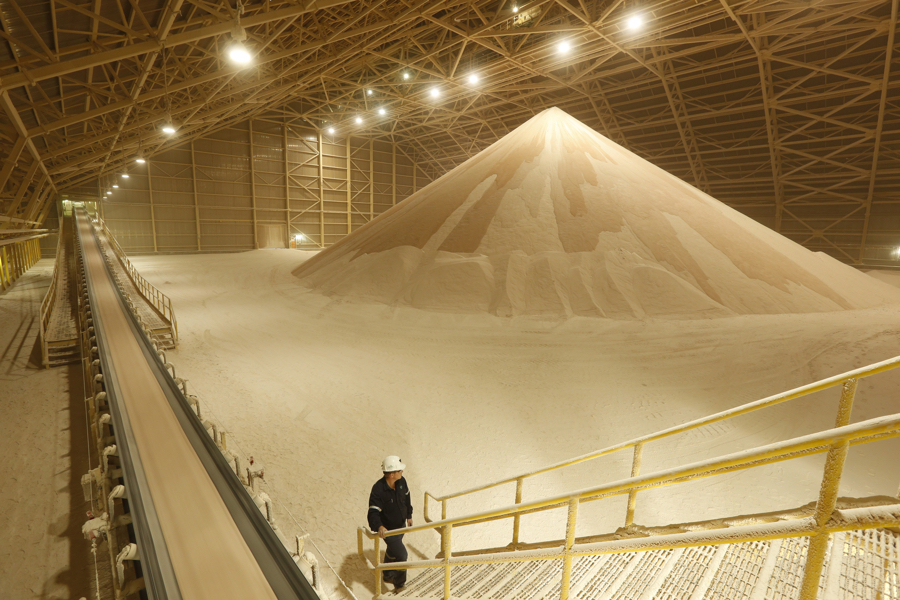
Saskatchewan, the heart of Canada’s potash industry, remains the world’s top-destination for mining investments. (Image courtesy of Potash Corp.)
Canada’s mining sector could capture a larger share of global capital as rising critical-mineral demand, expanding development spending and government support create opportunities from mines to processing, according to BMO Global Metals & Mining.
The outlook comes ahead of the Canada Investment Summit on Sept. 14-15, which aims to bring together major global investors and business leaders to help catalyze C$1 trillion ($721 billion) in total investment in Canada over the next five years, according to Matthew Murphy of BMO Global Metals & Mining. The federal government has identified critical minerals as one of the key areas for attracting that capital.
Canada already ranks as the world’s largest potash producer, second-largest uranium producer, and fourth-largest gold producer and aluminum refiner. Global mining expertise and leadership as well as government regulators that aim to develop the industry domestically, give the country an established base from which to expand.
Development spending is also returning to corporate capital allocation plans. As of 2025, companies planned about C$120 billion of spending on projects included in Natural Resources Canada’s 10-year Major Projects Inventory outlook, Murphy said. That is C$50 billion more than in the 2018 outlook, though still well below the previous cycle’s peak of about C$220 billion in real 2026 dollars.
The investment gap leaves substantial room for growth. BMO Equity Research forecasts annual Canadian development capital expenditures will rise more than 11% over the next two years. Mining companies covered by BMO are expected to spend C$350B on operating costs, sustaining capital, and growth projects to produce metals and minerals in Canada over the next five years.
Investment in key areas
BMO’s study asks investors to shift from upstream towards downstream investment to make end-to-end production in Canada a reality. That spending could reinforce Canada’s position as governments seek more secure supplies of commodities essential to energy, defence and advanced manufacturing, while miners increasingly consider the country for new development capital, the bank says.
For that shift to happen, the next mining investments need to focus on domestic copper smelting and refining, by-product capture, battery precursor materials, rare earth separation and other specific materials smelting and production, BMO recommends.
Infrastructure has always been a key area for investing in mining, but it now can unlock new mining districts and generate new opportunities across the country. From British Columbia to Ontario’s Ring of Fire to Nunavut in projects ranging from gold, nickel and lithium.
Considering the importance of critical minerals in the global market, BMO recommends developing niche critical-mineral supply chains, which may require government intervention where market economics alone are insufficient.
Targeted price supports could be needed for some commodities, while capital and regulatory backing for vertical integration could help companies develop more profitable downstream portions of the critical-mineral supply chain, Murphy said.
Those measures could address some of the challenges facing critical-mineral projects, including volatile prices, limited domestic processing capacity and competition for investment capital.
Infrastructure financing may provide another route to expanding the industry. Separating infrastructure investment from mine development could attract specialized infrastructure funds, reduce the cost of capital and free miners to direct more money toward production capacity and downstream facilities, according to Murphy.
Funding gap
Improving mining profitability and advancing new projects will require not only greater investment in the sector, but also careful decisions about where that capital is allocated.
Separating infrastructure and mine operations investments could attract more infrastructure funds, lower the cost of capital and bring more capital for mining capacity and downstream industry, BMO reported.
While Canadians are investing in mining, BMO finds it could be invested more domestically. It suggests that there’s an opportunity for mining infrastructure investment, especially through the Canadian pension fund that manages C$4.5T in assets that are under-allocated domestically.
Murphy said that alignment could allow Canadian pension funds to generate more competitive risk-adjusted returns domestically, while helping finance infrastructure and mining capacity needed to unlock new districts.
Canada has generated successful mining companies based in and outside of Canada for years. From Canada’s Agnico Eagle (TSX, NYSE: AEM) to top global companies such as Glencore (LON: GLEN) and BHP (ASX, LON: BHP), investment in the country’s mining sector has always been filled with opportunities and is now opening up to more.
For investors gathering at the Canada Investment Summit, BMO’s analysis suggests the opportunity is therefore broader than financing individual mines. Reaching Canada’s investment ambitions will require capital across infrastructure, mineral production, processing and other downstream industries that can turn the country’s resource base into more complete domestic supply chains.
With the increasing alignment of government, regulators, and citizens, the Canadian mining sector can offer highly competitive risk-adjusted returns and enable funds to invest in the country, BMO concludes.
USCG Commissions Cutter Dedicated to 9/11 Hero
USCGC Jeffrey Palazzo was commissioned in New York City, note the steel on the end of the pier is a piece of the World Trade Center destroyed on Sept. 11, 2001 (photo courtesy of U.S. Coast Guard Auxiliary Northeast District Southern Region)
The U.S. Coast Guard joined the ceremonies around the United States remembering the heroes of the 9/11 terrorist attacks, completing the commissioning of the second of two Fast Response cutters dedicated to members of the Coast Guard who were among the first responders at New York’s World Trade Center. The Fast Response Cutter Jeffrey Palazzo (WPC 1163) was commissioned in New York Harbor on September 12, before the vessel deploys to Guam.
The cutter is the 63rd ship of the Sentinel-class Fast Response Cutter class, which is being used to replace the 1980s Island class 110-foot patrol boats. The vessels are being built by Bollinger Shipyards in Mississippi and deployed around the continental United States, in Puerto Rico, Bahrain, and Guam. Each FRC is named for an enlisted Coast Guard hero who distinguished themselves in the line of duty.
USCG flyover during the ceremony to commission the newest Fast Response Cutter (Allan Jordan - The Maritime Executive)
The newest cutter is named for Jeffrey Palazzo, who began his Coast Guard career in 1988 and served as a machinery technician. During his Coast Guard service, he was involved in numerous rescues, including the 1993 grounding of the cargo ship Golden Venture, which was carrying more than 200 Chinese immigrants, many of whom jumped into the ocean when the vessel grounded. Palazzo joined the New York City Fire Department in 1996 and continued to serve in the Coast Guard Reserve. He was part of an elite fire rescue team and, on September 11, 2001, responded to the World Trade Center. He was one of 343 New York Fire Department personnel killed that day.
The vessel is one of two named for Coast Guard members who were first responders that day, with the USCGC Vincent Danz (WPC-1162), commissioned in May 2026 in memory of Danz, a Coast Guard reservist and member of the New York City Police Department. Two pieces of steel from the debris of the World Trade Center were placed aboard the ships in commemorative plaques, and members of the New York Fire Department also donated pieces of Jeffrey Palazzo’s gear to be displayed on the vessel. Reflecting Palazzo’s sense of duty, the vessel was given the motto “Answer the Call.”
Presiding at the commissioning was Admiral Kevin Lunday, the 28th Commandant of the U.S. Coast Guard. The “Long Glass Presenter” in the ceremony, and aiding in setting the first watch on the new cutter, was MK2 Matthew V. Palazzo, son of Jeffrey Palazzo and an active-duty member of the Coast Guard.
USCGC Jeffrey Palazzo (WPC 1163) (USCG photo)
It was the third Fast Response Cutter commissioned in 2026, following the USCGC Olivia Hooker in January. Bollinger had been under contract to build 67 vessels, with the final FRC scheduled for delivery in 2028. In September 2025, the U.S. Coast Guard awarded Bollinger 10 additional FRC contracts, increasing the program to 77 vessels. Bollinger reports the additional contract extended the production line by approximately three years.
The 154-foot Sentinel-class Fast Response Cutter is considered among the most capable patrol vessels in the U.S. Coast Guard fleet and has been called “operational game changers” by Coast Guard command. Admiral Lunday, during the presentation, called the Sentinel "the best class of ship in the history of the USCG." Featuring a flank speed of 28 knots and a state-of-the-art Command, Control, Communications, Computers, Intelligence, Surveillance, and Reconnaissance suite, the vessels each have 25 officers and crew. The design also features a stern-launch-and-recovery ramp for a 26-foot over-the-horizon interceptor cutter boat.
The USCG took delivery of the UCSCG Jeffrey Palazzo on June 11, and the crew has been undergoing training in the United States. After the New York ceremony, it is preparing to deploy to Guam, where it will become the fifth FRC, alongside the Vincet Danz as well as the Myrtle Hazard (WPC 1139), Oliver Henry (WPC 1140), and Frederick Hatch (WPC 1143). Deployed in the Oceania District, the vessels conduct maritime security operations, combat illegal fishing, support search and rescue missions, and strengthen the U.S. partnership with Pacific Island nations.