Wednesday, September 02, 2026

Trump's 'deeply stupid' stunt flops with voters — and a smirking Joe Rogan: analysis


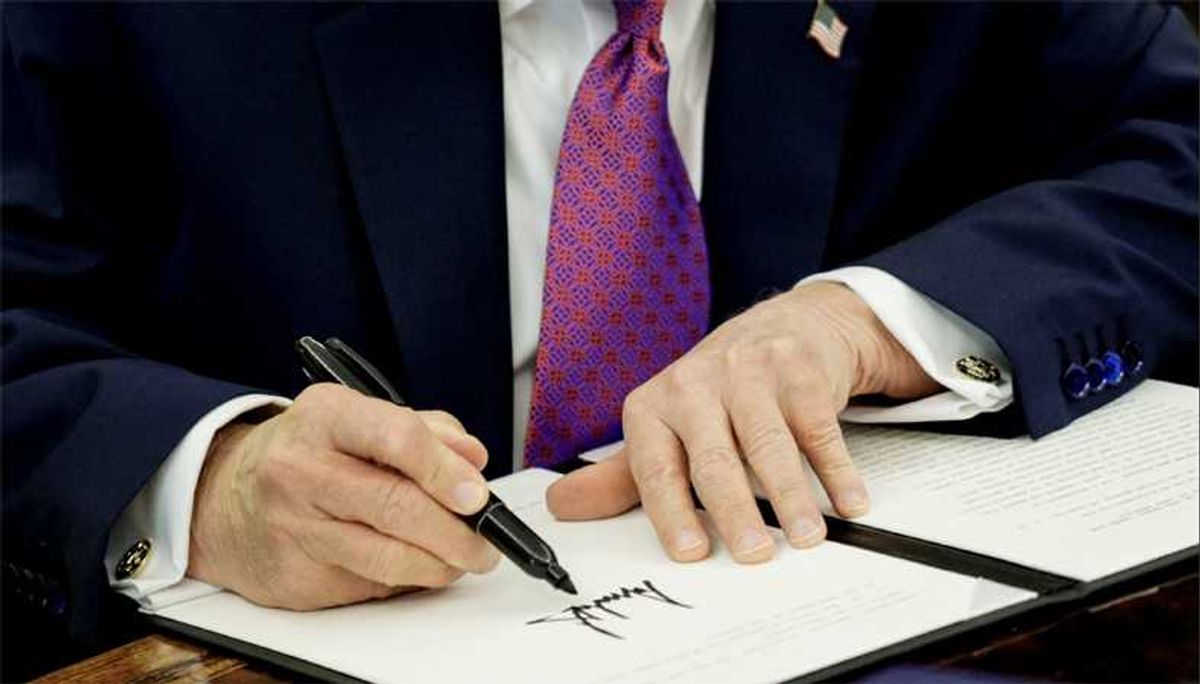
U.S. President Donald Trump signs an executive order renaming Lake Ontario as Lake America, at the Oval Office of the White House in Washington, D.C., U.S., August 27, 2026. 
REUTERS/Evan Vucci

Tom Boggio
September 2, 2026 
RAW STORY

President Donald Trump’s decision to sign an executive order renaming Lake Ontario as “Lake America” has been a spectacular flop with voters — and one very high-profile political podcaster, according to a new analysis.

Two “Morning Joe” co-hosts Wednesday morning discussed Joe Rogan's dismissal of the move as a mere 14 percent of Americans voters report support for the decision.

The segment begins with a clip of a smirking Rogan.

“It’s to distract you from the fact we are in a war we can’t win with Iran — it doesn’t make any sense,” Rogan said. “Who cares if it’s Lake Ontario? It’s a good name. We’ve had that name forever."

Co-host Jonathan Lemire and Willie Geist were quick to pile on.

Geist reported that a recent Ipsos/Reuters poll found 63 percent of respondents opposed Lake Ontario’s renaming, a mere 14 percent supported the decision and 21 percent said they weren’t sure how they feel about it.

"Perhaps because it was so, so deeply stupid,” Geist said with a laugh. "Jonathan Lemire, this again, the case of President Trump diving headfirst into an issue that apparently has no audience.”

"I don't say this a lot, but Joe Rogan? Exactly right," Lemire said. "It's meant to be a distraction; it's a culture war. And, you know, it's to get us to talk about something else. But there is a serious underbelly here, which is the fact that this trade war with Canada, as we just discussed, is going to have real political implications and not good ones for Republicans. And frankly, Willie, it also shows Trump's just running out of ideas. We already did the Gulf of America. Now it's Lake of America.”


Pentagon caught purging decades of classified docs after generals' warnings leak: WaPo

Bennito L. Kelty
September 2, 2026 
RAW STORY


U.S. Defense Secretary Pete Hegseth speaks during a meeting with Australia’s Deputy Prime Minister and Defence Minister Richard Marles, not pictured, at the Pentagon, in Washington, D.C., U.S., September 2, 2026. REUTERS/Kylie Cooper

Anonymous insiders told The Washington Post that the Pentagon scrubbed decades of classified documents following a story about senior military officials' warnings about Iran.

In a Wednesday article, The Post revealed that the Pentagon pulled decades' worth of classified documents from a secret computer system that is commonly used by defense officials and U.S. troops. Insiders tipped The Post off following a story on Sunday about several top generals and admirals cautioning Defense Secretary Pete Hegseth about the risks of extending a war with Iran.

The documents were removed from the internal web portal on the Secret Internet Protocol Router Network (SIPRNet), according to three anonymous insiders who spoke to The Post. SIPRNet contains information that is labeled 'secret,' while top-secret information is put on other highly classified networks where fewer people have access, according to The Post.

Insiders told The Post that the documents were associated with the Secretary of Defense Orders Book (SDOB), which details the location and availability of U.S. warships, military units, weapons systems, and other resources. The SDOB also gives top generals and admirals a forum in which they can disagree with President Donald Trump and Hegseth while still carrying out their orders, The Post noted.

SDOB provides a "non-concurring" process where top generals and admirals can explain any reservations or disagreements they have with the orders or describe the detrimental effects of those orders on other military plans.

The Post noted that the SDOB became the "focus of intense discussion" after a story detailing how top generals and admirals told Hegseth that a prolonged, large-scale conflict against Iran is unsustainable. Those senior military officials also told Hegseth that operations against Iran risked weakening their ability to confront threats elsewhere.

Those warnings from senior military officials appeared in an August 14 edition of the SDOB, according to The Post.

Sean Parnell, a Pentagon spokesman, declined to discuss the removal of the classified documents with The Post, saying, "The Department of War does not publicly discuss internal operational deliberative processes," and "the success of our service members is Secretary Hegseth's top priority."

Who Has The Right To Tell Our Story: The Fight Over Cultural Heritage In The United States – OpEd


Key Takeaways:

  • The author says an Aug. 27, 2026 letter from 600+ groups opposes a rewrite of National Historic Preservation Act Section 106 that would let federal projects sidestep public comment and put historic sites in the wrecking ball’s path—developers call the old rule slow and costly; he says it is not a jobs killer and loss is permanent.

  • Heritage fights are framed as global and existential for Indigenous, local, and diasporic communities (a Mongolian herder: comforts without ceasing to be Mongolian); officials treat culture as “soft” next to extraction.

  • The rewrite is cast as narrative control, not streamlining—likened to erasing a people (ICC Timbuktu case)—and he urges taking the past back from federal whim so places can still tell who lived there.

Cultural heritage is under attack in the United States. The National Historic Preservation Act’s Section 106 regulation, which balances economic development and historic preservation, has been rewritten to leave historic places in the path of the wrecking ball at the federal government’s whim. Developers contend that a new regulation is required because the Section 106 process is too slow, too unpredictable, and too costly. They argue that locking up lands from oil and gas extraction, timber interests, and mining costs jobs and denies the country needed resources. But they’re wrong. Section 106 does not cost jobs, money, or time. Allowing the public to comment on what happens on public land is not to be deplored but celebrated. Most importantly, once destroyed, cultural and historic sites are irretrievably lost, and all of us diminished.

While currently playing out in the United States, fights about heritage are not unique to America. Battles between development and preservation play out across the globe—in countries rich and poor, autocratic and democratic, and new and old. Some of these struggles escalate into loud, contentious, take-no-prisoners pitched battles.

Economic development is often a Faustian bargain for local and affected communities. The lure of a better life must be weighed against unknowable and incalculable costs to one’s way of life. Most communities embrace the jobs, improvements, and well-being that ensue from development. What they fear is severing ties to land and places—some known and others yet to be discovered—that hold meaning and values essential for their community to persist. For local, Indigenous, and diasporic communities, severing these ties is yet another cut added to the thousands of previous cuts that continues to transform their culture in ways they do not like and that they cannot control

Many developers and government officials mistake cultural heritage as a “soft” or secondary concern for communities. They base their arguments for development on economic and material concerns, convinced that these are paramount in the minds of community members. For some, these arguments resonate. But for most, economic and infrastructure improvements are only beneficial if they do not transform society into something foreign and unrecognizable. As one Mongolian camel herder explained to me, “We would like the comforts promised by the mining companies but not at the expense of being Mongolian. We’ve been poor for a thousand years; being poor is not that big a deal. Not being nomads or having nomads in the country would be the end of our way of life and the end of Mongolia.”

On August 27, 2026, more than 600 organizations sent an open letter to Congress outlining their opposition to the proposed changes to Section 106. Why the outrage? It’s simple. Though couched as common sense reform to enable economic development, the rewrite of the Section 106 regulation is nothing less than the federal government’s attempt to usurp control over whose history counts and whose can be disregarded. If the proposed regulation is simply about the timeliness and cost of development projects, then it would not have elicited so much opposition. Many in the preservation community offered to engage in regulatory reform. But the authors of the proposed change are not interested in reform. Their objective is to control the country’s historical narrative—whose story gets told and whose story is forgotten.

History is replete with attempts to legitimize the present by destroying vestiges of the past. Ofttimes these attempts are resisted, sometimes violently. In these clashes, groups are oppressed and their material culture destroyed. Rarely are such attempts forgotten or forgiven. Remarking on the guilty verdict in the case of Ahmad Al Faqi Al Mahdi for destruction of ancient texts in Timbuktu, Mark Ellis of the International Bar Association, stated in 2016: “Politically, there will be those who will question why Bensouda [then-International Criminal Court Prosecutor Fatou Bensouda] is focusing on ancient sites rather than going after rape, torture and murder convictions, but destruction of cultural heritage is not a second-rate crime. It’s part of an atrocity to erase a people.”

We need to wrest control of the past from the federal government and give it back to the people of this country. This is not a fight we sought. But it is the fight we must win. All of us need to spread a message about why Section 106 matters and why we will not let the government destroy it. Simply put, we will not give up the right to tell who we were and what we did through the places we lived, as we want it to be known free from government censure or control.


About Jeffrey H. Altschul

Jeffrey H. Altschul is the co-president of the Coalition for Archaeological Synthesis.

View all posts by Jeffrey H. Altschul →

Russia: Prosecutions For Cooperation With ‘Undesirable Organizations’ – Analysis


Olga Sibiryova, March 2023 Photo Credit: Private


September 2, 2026
F18News
By Victoria Arnold


Key Takeaways:

Forum 18 reports Moscow Region prosecutors charged Sova researcher Olga Sibiryova under Admin. Code 20.33 because the U.S.-coordinated International FoRB Alliance—listed “undesirable” in Jan. 2025—cited her public annual reports; first hearing is Sept. 10. Sova (a 2016 “foreign agent,” liquidated 2023) says neither she nor the centre ever dealt with the Alliance.

Days after Mission Eurasia was listed in May 2026, courts fined a Krasnogorsk Baptist pastor and ordered 178 New Testaments and 74 John booklets destroyed; St Petersburg Christian University was fined 60,000₽ for library copies; Baptist Union rector Pyotr Mitskevich took a 20,000₽ fine. Lawyers note a 2017 prosecutor letter distinguished classic texts from an NGO’s own output.

Repeat 20.33 can become Criminal Code 284.1 (up to 4 years). The “undesirable” list has 391 entries; Jehovah’s Witnesses have been fined for on-camera discussion of Watch Tower material. Prosecutors did not answer Forum 18 on why a third-party citation or a locked-room Bible counts as “participation.”


A researcher for one of Russia’s leading freedom of religion and belief monitors is facing administrative prosecution after a different organisation, deemed “undesirable” by Russia, cited her work in its own materials. Prosecutors in the Moscow Region have charged Olga Sibiryova of the Sova Centre for Information and Analysis with “participation in the activities” of the International Freedom of Religion or Belief Alliance, with which the Sova Centre says neither it nor Sibiryova has ever interacted.

The case against Sibiryova appears to be the first under Administrative Code Article 20.33 (“Participation in the activities of an undesirable organisation”) to be based exclusively on a citation by an “undesirable organisation”. Fines under this Article are relatively small, but a further offence could lead to criminal prosecution with up to a 4-year jail term (see below).


The Justice Ministry added the Sova Centre to its register of “foreign agents” in 2016, and went to court to have it liquidated as a legal entity in 2023. It has since operated as an unregistered group of researchers (see below).

Forum 18 wrote to Naro-Fominsk City Prosecutor’s Office and Moscow Region Prosecutor’s Office, asking which documents of the International Freedom of Religion or Belief Alliance form the basis of the case, and why prosecutors had initiated a case under Article 20.33 simply on the basis of an “undesirable organisation” citing Sibiryova’s publicly available reports without her knowledge. Forum 18 received no response (see below).

Other recent prosecutions reviewed by Forum 18 appear to be based on minimal or unknowing “participation”. They include those of a Baptist church and two Protestant higher education institutions, for continuing to “distribute” books published by Mission Eurasia a matter of days after the organisation – a US-based Protestant missionary body – was added to the register of “undesirable organisations” (see below).

Krasnogorsk City Court in Moscow Region fined the pastor of a local Baptist church, Aleksey Kruchinin, under Administrative Code Article 20.33 on 23 June. The judge also ordered that the literature confiscated from his church – 178 copies of the New Testament and 74 booklets containing the Gospel of St John, published by Mission Eurasia – be destroyed. The decision went into force on 20 August when the Pastor lost his appeal (see below).


Pastor Kruchinin’s lawyer Sergey Chugunov questions the aims of decisions to seize and destroy religious literature produced by organisations such as Mission Eurasia. “The text of the Bible is being classified as material from an ‘undesirable’ organisation simply because the book was printed by that organisation. But does the content of the text change because of that? Has it suddenly become a threat to public safety?” (see below).

Moscow Region Prosecutor’s Office, Krasnogorsk City Court and Krasnogorsk department of the bailiffs’ service did not respond to Forum 18’s questions on why the possession of ordinary Biblical texts had been considered to be “participation in the activities of an undesirable organisation”, and whether the books have yet been destroyed (see below).

In a 20 August court hearing when St Petersburg Christian University was fined for having books published by Mission Eurasia in its library, the university representative “maintained that steps had been taken to destroy the books”, according to the city courts’ press service (see below).

If the General Prosecutor’s Office decides that a foreign or international organisation poses a threat in Russia’s political and security sphere, it can order it to be added to the Justice Ministry’s register of “undesirable organisations”. Inclusion in this list shuts down a legal entity immediately and bars individuals’ involvement with it, even outside Russia (see below).

“In practice, independent media outlets, as well as political, human rights, religious, educational, research, and other projects, are designated ‘undesirable’ for simply carrying out their lawful activities,” human rights monitor OVD-Info notes. The register currently has 391 entries, including more than 20 which are religious bodies, religious media, missionary, or educational organisations, or non-governmental organisations with religious links or which promote freedom of religion and belief (see below).

Charges and punishments

Administrative Code Article 20.33 punishes “Participation in the activities of a foreign or international organisation whose activities have been declared undesirable within the territory of the Russian Federation in accordance with the legislation of the Russian Federation, or violation of prohibitions established by Federal Law No. 272-FZ of 28 December 2012 ‘On Measures Against Persons Involved in Violations of Fundamental Human Rights and Freedoms and the Rights and Freedoms of Citizens of the Russian Federation'”.

This is punishable by the following fines: for individuals – 5,000 to 15,000 Roubles; for people in an official capacity – 20,000 to 50,000 Roubles; for legal entities – 50,000 to 100,000 Roubles; staff of election commissions are disqualified for one year. A fine of 100,000 Roubles represents about six weeks’ average wage.

A repeat offence may lead to criminal prosecution under Criminal Code Article 284.1, Part 1 (“Participation in the activities of a foreign or international organisation whose activities have been declared undesirable within the territory of the Russian Federation in accordance with the legislation of the Russian Federation, committed by a person who has been subjected to an administrative penalty for a similar act”).

Penalties for this include: a fine of 300,000 to 500,000 Roubles; up to 360 hours’ compulsory labour [obyazatelniye raboty]; up to 4 years’ assigned labour [prinuditelniye raboty] with up to 2 years’ possible restriction of freedom [ogranicheniye svobody]; or 1 to 4 years’ imprisonment with a possible ban on “holding certain offices or engaging in certain activities” for up to 10 years.

(Criminal Code Article 284.1 also includes Part 2, which covers the financing of “undesirable organisations”, and Part 3, which covers the organisation of their activities.)
Moscow Region: “Anyone could be deemed a ‘collaborator'”

lOn 17 August, prosecutors in the town of Naro-Fominsk in Moscow Region charged Olga Sibiryova, a researcher at the Sova Centre for Information and Analysis, with “participation in the activities of an undesirable organisation” (Administrative Code Article 20.33) because an “undesirable organisation” – the International Freedom of Religion or Belief Alliance – had cited her work in their own reports. Naro-Fominsk City Court has listed the first hearing of the case on 10 September, according to the court website.

“We believe that the charge brought against Olga Sibiryova under Article 20.33 of the Administrative Code is entirely baseless”, the Sova Centre said in a statement on 17 August. “Neither she personally nor the Sova Centre as a whole has ever had any interaction with the International Freedom of Religion or Belief Alliance; the organisation is mentioned on the Sova website solely in connection with its designation as ‘undesirable’, and even then, without any value judgments whatsoever.”


Sibiryova has worked for the Sova Centre, Russia’s leading organisation monitoring freedom of religion and belief violations, for over sixteen years. Among other work, she produces the Centre’s annual reports on such violations in Russia.

The Justice Ministry added the Sova Centre to its register of “foreign agents” in 2016, and went to court to have it liquidated as a legal entity in 2023. It has since operated as an unregistered group of researchers.

The International Freedom of Religion or Belief Alliance describes itself as “a network of like-minded countries fully committed to advancing freedom of religion or belief around the world”, which “brings together senior government representatives to discuss actions their nations can take together to promote respect for freedom of religion or belief and protect members of religious minority groups”. The US State Department coordinates its activities.

On 25 December 2024, Russia’s General Prosecutor’s Office named the Alliance an “undesirable organisation”. The Justice Ministry added it to its register of “undesirable organisations” on 17 January 2025.

On 4 August 2026, officers from the Interior Ministry’s Centre for Countering Extremism carried out an “inspection of premises” at Sibiryova’s home and seized electronic devices and books, the Sova Centre noted in its 17 August statement on the case.

On 17 August, Naro-Fominsk City Prosecutor’s Office summoned Sibiryova for an interview. Only then did she learn which organisation she was accused of cooperating with, and was charged under Article 20.33. The case appears to be based on the Alliance having allegedly cited Sibiryova’s 2024 and 2025 annual reports on freedom of conscience in Russia in its own documents, although it is unclear which documents these may be.


“This may be the first instance of an individual being accused of collaborating with an organisation simply because that organisation cited them. Moreover, the issue is not a matter of an expert providing specific commentary, but rather the fact that an organisation designated as ‘undesirable’ has made use of publicly available material from another project”, Sova emphasised in its statement.

“And this in itself, in our view, contradicts both the letter of the law and common sense: if this approach were applied consistently, anyone could be deemed a ‘collaborator’ with an undesirable organisation – for instance, any Russian media outlet whose material such an organisation chose to mention on its website.”

Forum 18 wrote to Naro-Fominsk City Prosecutor’s Office and Moscow Region Prosecutor’s Office on 24 August, asking which documents of the International Freedom of Religion or Belief Alliance materials form the basis of the case, and why prosecutors had initiated a case under Article 20.33 simply on the basis of an “undesirable organisation” citing Sibiryova’s publicly available reports without her knowledge. Forum 18 had received no response by the end of the working day in Moscow Region of 31 August.
General Prosecutor’s Office names Mission Eurasia “undesirable organisation”

Russia’s General Prosecutor’s Office named Mission Eurasia an “undesirable organisation” on 30 April 2026, and the Justice Ministry added it to the register of “undesirable organisations” on 13 May 2026.


Mission Eurasia was founded in 1991 by American Protestant pastor Peter Deyneka to evangelise in the former Soviet Union. It now trains local Protestant leaders in Eastern Europe, Central Asia, and Israel, who then engage in church planting and evangelism in workplaces and schools. It also publishes and distributes translations of the Bible and what it calls “strategic Christian books and resources”.

“The likely reason for the organisation’s inclusion on the Russian [undesirable organisations] list is that, following the outbreak of the full-scale war, Mission Eurasia has been actively assisting Ukraine, documenting pressure on believers in occupied territories, criticising the persecution of religious communities in Belarus and Russia, and reporting on the influence of the ‘Russky Mir’ [Patriarch Kirill’s ‘Russian World’ ideology] and the Russian Orthodox Church”, Christians Against War noted on 14 May.

It is common for Protestant churches and educational institutions to possess Bibles and other literature published by Mission Eurasia, even if they have no other relationship to the organisation.

The law on “undesirable organisations” includes a ban on “the dissemination of information materials issued by a foreign or international [undesirable] organisation and/or disseminated by it – including via mass media and/or using the Internet information and telecommunication network – as well as the production or storage of such materials for the purpose of dissemination”.
Prosecutions only days after “undesirable organisation” listed, Bibles to be destroyed?

Almost immediately after the designation of Protestant organisation Mission Eurasia as “undesirable” in May 2026, prosecutors in Russia began seizing books and initiating administrative cases.

Prosecutors searched a Christian bookshop in St Petersburg on 14 May, one day after Mission Eurasia appeared on the Justice Ministry’s List. St Petersburg Christian University and the Baptist Union’s Moscow Theological Seminary were searched on 15 May, a Baptist church in the Moscow Region town of Krasnogorsk on 23 May.
In Moscow Region ..

Krasnogorsk City Court in Moscow Region found the pastor of a local Baptist church, Aleksey Kruchinin, guilty under Administrative Code Article 20.33 on 23 June. Judge Yekaterina Govorun handed him an unknown fine. She also ordered that the literature confiscated from his church – 178 copies of the New Testament and 74 booklets containing the Gospel of St John, published by Mission Eurasia – be destroyed.


Pastor Kruchinin appealed unsuccessfully at Moscow Regional Court on 20 August. The decision entered legal force on that date, meaning that the New Testaments and Gospels “could be destroyed at any moment”, according to Kruchinin’s lawyer Sergey Chugunov. He added that they will nevertheless continue to appeal.

“In court, we naturally pointed out that the inspection took place just ten days after the organisation was added to the list of ‘undesirable’ organisations, and that no dissemination of materials occurred during that period – the books were kept in a locked room”, Chugunov commented on his Telegram channelshortly after Kruchinin’s guilty verdict.

Chugunov also pointed out that, in 2017, the Deputy General Prosecutor had stated in a letter to the Culture Minister (No. 27/3-491-2015/Нд26284-17) that, firstly, “It is necessary to distinguish between materials that disclose the content and results of an ‘undesirable’ organisation’s activities, and works by well-known authors that were merely republished or distributed by such an organisation as part of humanitarian projects”, and secondly, “If the organisation is not the author of the works and their content is unrelated to the activities of the ‘undesirable’ organisation, the possession of such books cannot be considered a violation of the law and does not require their seizure”.

“The texts of the New Testament and the Gospel of John are widely known and form part of the Bible. The fact that the books bear the imprint of the ‘Mission Eurasia’ publishing house is a technical detail”, Chugunov argued.

“This raises the question: what is the aim of such decisions? The text of the Bible is being classified as material from an ‘undesirable’ organisation simply because the book was printed by that organisation. But does the content of the text change because of that? Has it suddenly become a threat to public safety?”

The first instance court decided that “the mere possession of printed literature belonging to [an undesirable organisation] constitutes an administrative offence. The lack of access to the premises where said literature was stored does not indicate the absence of the elements of an administrative offence”, Chugunov quoted the court decision as saying.

“The fact that the door was locked and only the pastor held the key is not sufficient proof – you have to prove that no one had entered the room. But did we need to? In short, that is how the hearing unfolded; the conclusion was that everything was lawful and justified, and the ruling was upheld”, Chugunov wrote on 20 August, after Kruchinin’s unsuccessful appeal.

Forum 18 wrote to Moscow Region Prosecutor’s Office and Krasnogorsk City Court on 24 August to ask why the possession of ordinary Biblical texts had been considered to be “participation in the activities of an undesirable organisation”, especially given the General Prosecutor’s Office’s stance on the matter, and whether the books have yet been destroyed.

Forum 18 also wrote to the Krasnogorsk department of the bailiffs’ service to ask whether it had destroyed the New Testaments and Gospels of John, and if so, how this had been done. Forum 18 had received no response from any of these agencies by the end of the working day in Moscow Region of 31 August.

.. and in St Petersburg

In St Petersburg on 20 August, Lenin District Court fined the St Petersburg Christian University 60,000 Roubles under Administrative Code Article 20.33 for having books published by Mission Eurasia in its library two days after the latter was added to the “undesirable organisations” register.

The university was founded by the Russian Baptist Union in Krasnodar in 1990. It moved to St Petersburg and became an interdenominational Evangelical institution in the early 1990s. On its website, it describes its library as “one of the best Protestant libraries in Russia”, with over 28,000 books, mostly on Biblical studies.

Prosecutor’s office officials seized all Mission Eurasia books from the university library on 15 May, having determined that “any library patron could easily obtain the material”, 7×70 News reported on its Telegram channel on 20 August. In court, Judge Anastasiya Spiridonova ordered the university “permanently to cease the dangerous dissemination of undesirable literature”.

The seized books included “A Professional Mission: Achieving the Maximum While Overcoming Challenges” and “The Alphabet of Family Worship: 55 Characteristics of God for Family Worship”, which were “available for circulation to an unlimited number of individuals upon presentation of a library card (membership pass)”, the St Petersburg court system’s unified press service stated on 20 August.

“During the court hearing, the representative of the religious organisation did not admit guilt and maintained that steps had been taken to destroy the books”, the press service added.

The day before the search of St Petersburg Christian University, just one day after Mission Eurasia appeared on the register of “undesirable organisations”, prosecutor’s office officials also inspected Slovo, a Christian bookshop in the city. They confiscated “about 100” copies of the Synodal translation of the Bible, published by Mission Eurasia, 7×70 News reported on 17 May. According to the booksellers, investigators told them that someone had made a complaint against the shop.

“Shop staff emphasised that although Mission Eurasia has been designated an undesirable organisation, the book itself is no different from other Protestant editions”, 7×70 noted in its report of the incident. “Everyone publishes the Bible in this format,” bookshop staff told the outlet. “No matter which organisation publishes it, it is still the Bible. To us, this feels like an insult – seizing the most affordable edition of the Bible, the one pensioners used to buy.”

Neither the shop nor any of its staff appears to have faced charges under Administrative Code Article 20.33. It is unclear what has happened to the confiscated books.

Forum 18 wrote to the St Petersburg Prosecutor’s Office on 24 August to ask why the presence of books published by Mission Eurasia was considered an administrative offence only one or two days after Mission Eurasia was added to the register of “undesirable organisations”, and what has happened to the books seized in the inspections. Forum 18 had received no response by the end of the working day in St Petersburg of 31 August.

.. and in Moscow

In Moscow, prosecutors accused another Protestant educational institution – the Baptist Union’s Moscow Theological Seminary – of “participation” in Mission Eurasia activities because of the books in its library. In this case, however, they brought the charge against the seminary’s rector, rather than against the institution itself.

Moscow’s Perovo District Court found Pyotr Mitskevich (who is also head of the Russian Baptist Union) guilty under Article 20.33 on 20 July 2026. According to the court decision, seen by Forum 18, he received the minimum fine for a person in an official capacity, which is 20,000 Roubles. He “agreed with the charge” and has not appealed.

The Prosecutor’s Office of Moscow’s Eastern Administrative Okrug carried out an inspection of the Moscow Theological Seminary’s library and reading room on 15 May. This “revealed the presence of informational materials (books) published by ‘Mission Eurasia’, which by Order No. 629-r of the Justice Ministry of the Russian Federation of 13 May 2026, was included in the List of foreign and international non-governmental organisations whose activities have been declared undesirable”, according to the court decision.

These included: “Holistic Mission”, “Evangelical Culture: History and Modernity”, “The Phenomenon of Leadership”, “School Without Walls”, “Steps of Faith”, “A Perspective on Theological Education”, “Leadership in Ministry”, “Stars of the Reformation”, “A Collection of Interviews with Church, Ministry, and Mission Leaders and Ministry Experts”, “Ministry to Professional Communities”, “Faith and Work”, and “The Zohar” (in Aramaic).

Prosecutors interpreted the presence of these books as “participation by the religious spiritual educational organisation of higher education ‘Moscow Theological Seminary of Evangelical Christian-Baptists’ in the activities of [an undesirable organisation]’, through the storage and dissemination of informational materials (books) published by ‘Mission Eurasia'”.

Judge Olga Ashurova noted that Mitskevich “has recently taken steps to remedy the violations”, and did not order the books to be destroyed.

Forum 18 wrote to the Prosecutor’s Office of the Eastern Administrative Okrug and Perovo District Court on 24 August to ask why the presence of books in the library only two days after Mission Eurasia was added to the register of “undesirable organisations” was considered grounds for administrative prosecution. Forum 18 had received no response by the end of the working day in Moscow of 31 August.
St Petersburg: Online discussion

A wide range of activity can lead to prosecution under Administrative Code Article 20.33, even if it does not involve any direct interaction with the “undesirable organisation” in question. In February and June 2026, Kirov District Court in St Petersburg handed two Jehovah’s Witnesses fines of 5,000 Roubles each. They were punished for discussing their faith using resources from the Watch Tower Bible and Tract Society of Pennsylvania, in videos which investigators claim were posted on a Telegram channel.


The Watch Tower Bible and Tract Society is the Jehovah’s Witnesses’ main publishing house, which produces and distributes religious literature worldwide and maintains the main Jehovah’s Witness website, jw.org. The website was banned and blocked in Russia as “extremist” in 2015. Russia’s General Prosecutor’s Office deemed the Watch Tower Society an “undesirable organisation” on 12 October 2023, and the Justice Ministry added it to its register of “undesirable organisations” on 8 November 2023.

In September 2024, Federal Security Service (FSB) investigators found two videos on a Telegram channel in which three men “are conversing on the topic of Jehovah’s Witness beliefs, discussing religious dogma”, according to one of the court decisions, seen by Forum 18. One of three, Sergey Oblakov, allegedly shared his computer screen, showing content from jw.org. Investigators later found this to be “Lesson 42” from “Enjoy Life Forever! An Interactive Bible Course: What the Bible Says About Marriage and Singleness”.

“The prosecutor’s office construed this as the ‘use and dissemination of materials’ and, accordingly, as participation in the activities of the Watch Tower Bible and Tract Society of Pennsylvania”, the European Association of Jehovah’s Witnesses told Forum 18 on 25 August. “Any engagement with [the Watchtower Bible and Tract Society] – even talking about one’s faith on camera – is treated by the court as an offence.”

The Telegram channel, “Researchers of Scripture” [Issledovateli Pisaniya] stated in its profile that “We invite all believing brothers and sisters to join in the study of Scripture”, and used a tower as its profile picture. Its address, cited in court documents seen by Forum 18, does not as of August 2026 lead to a public or private channel. The channel is not connected to either of the two men prosecuted, the European Association of Jehovah’s Witnesses told Forum 18 on 27 August, and is not officially affiliated with the Jehovah’s Witnesses.

Judge Darya Shmeleva found Oblakov guilty on 18 June 2026. He has lodged an appeal at St Petersburg City Court, which is due to be heard on 9 September 2026.

Prosecutors also charged a second man whom the FSB identified in the videos, Aleksandr Smirnov, with the same offence, although it is unclear what material he is alleged to have shared, or whether he only engaged in discussion of it. Judge Shmeleva found him guilty on 5 February 2026. He appealed unsuccessfully on 8 April 2026.
Designating organisations “undesirable”

The process of designating organisations “undesirable” is governed by Article 3.1 (adopted on 23 May 2015) of the 2012 Federal Law “On measures of influence on persons involved in violations of fundamental human rights and freedoms [and the] rights and freedoms of citizens of the Russian Federation” (known as the Dima Yakovlev Law).

This legislation applies to foreign or international non-governmental organisations which allegedly threaten Russia’s constitutional order, defence capabilities, or state security – explicitly including influence on elections and referendums – or which are deemed to have acted as a financial intermediary for an “undesirable organisation” already on the list.


Once listed, an “undesirable organisation” must close all its branches in Russia and is banned both from opening more and from founding any other legal entities. It can no longer produce, distribute, or store any informational materials, online or offline, and is barred from carrying out any programmes or projects.

In 2021, Russian legal entities and citizens (plus stateless persons resident in Russia) were barred from involvement with “undesirable organisations” outside Russia (punishments for such involvement inside Russia had already been in place since 2015). In 2024, further amendments made it possible for organisations founded by foreign government bodies to be placed on the register.

“Because the law does not clearly define the criteria for designating an organization as ‘undesirable’, the authorities can, in effect, ban any activity that runs counter to their interests under the guise of protecting the constitutional order”, human rights monitor OVD-Info notes.

“In practice, independent media outlets, as well as political, human rights, religious, educational, research, and other projects, are designated ‘undesirable’ for simply carrying out their lawful activities,” OVD-Info adds.

The register currently has 391 entries, including more than 20 which are religious bodies, religious media, missionary, or educational organisations, or non-governmental organisations with religious links or which promote freedom of religion and belief. These include: Jehovah’s Witness bodies from the US, Germany, and Ukraine; Brigham Young University (which is sponsored by the Church of Jesus Christ of Latter-day Saints); Friede Allen (Peace Unto All), which supports Russian clergy who have opposed Russia’s war in Ukraine; and seven Falun Gong or Falun Gong-linked organisations.


About F18News
Forum 18 believes that religious freedom is a fundamental human right, which is essential for the dignity of humanity and for true freedom.
View all posts by F18News →


Malta jury clears suspect mastermind businessman in Daphne Caruana Galizia murder case

This April 4, 2016 file photo shows Maltese investigative journalist Daphne Caruana Galizia, who was killed by a car bomb in Malta on Oct. 16, 2017.
Copyright Jon Borg/AP


By Greta Ruffino
Published on

His arrest in 2019, as he was sailing away from Malta on his yacht, sparked a series of mass protests in the country that culminated with Prime Minster Muscat’s resignation.

A jury in Malta on Wednesday found Maltese businessman Yorgen Fenech not guilty of charges related to the 2017 car bomb killing of investigative journalist Daphne Caruana Galizia.

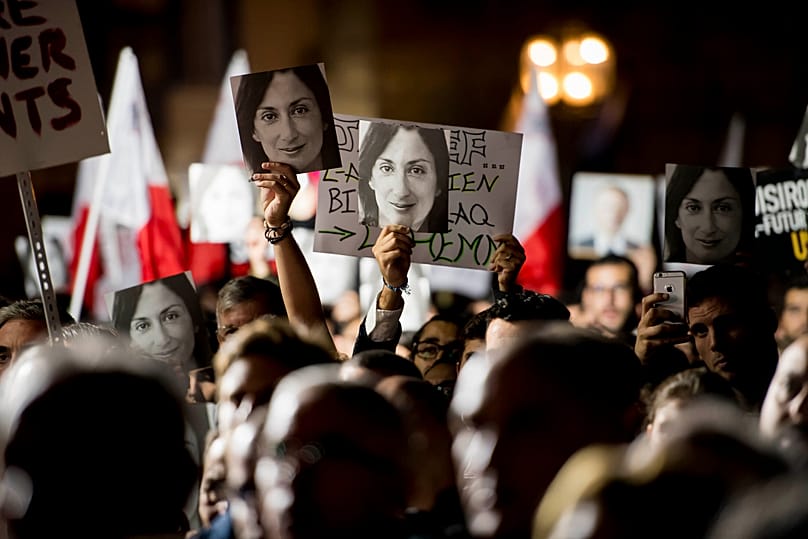
Caruana Galizia's killing shocked Europe, sparked protests that led to the resignation of a prime minister and exposed a culture of impunity in Malta, the European Union's smallest member state.

Fenech, a prominent Maltese businessman, was indicted in 2021 on charges of complicity and criminal conspiracy. He was involved in a consortium that won a controversial contract with the Maltese government to build a power station.

Prosecutors accused Fenech of masterminding the killing and of ordering and paying for it.

Fenech pleaded not guilty, and the jury on Wednesday found him not guilty on both counts. He was the last of a half-dozen people charged over the plot to be prosecuted.

Following the verdicit, he walked out of the Valletta courtroom to a chaotic scene outside, with hecklers yelling as he walked into a waiting car. He made no comment.

Yorgen Fenech leaves court in Valletta, Malta, on 29 November 2019.
Yorgen Fenech leaves court in Valletta, Malta, on 29 November 2019. Martin Agius/AP/str

Targeted over her anti-corruption investigations

Caruana Galizia, 53, was killed on 16 October 2017 when a car bomb exploded as she was driving near her home.

She had reported extensively on suspected corruption involving political and business figures in Malta.

Her investigations included members of then-Prime Minister Joseph Muscat's inner circle, whom she accused of having offshore companies in tax havens revealed by the Panama Papers. Her reporting also scrutinised opposition figures and Maltese business leaders.

At the time of her death, Caruana Galizia was facing more than 40 libel lawsuits.

An independent inquiry into her killing, published in 2021, concluded that the Maltese state “has to bear responsibility” for the assassination due to a culture of impunity that emanated from the highest levels of government.

Protesters in Valletta call for Prime Minister Joseph Muscat's resignation following developments in the Daphne Caruana Galizia murder case, 29 November 2019.
Protesters in Valletta call for Prime Minister Joseph Muscat's resignation following developments in the Daphne Caruana Galizia murder case, 29 November 2019. Image Rene Rossignaud/AP

Others prosecuted over the killing

In 2022, George Degiorgio and his brother Alfred Degiorgio pleaded guilty to carrying out the killing and were each sentenced to 40 years in prison.

In 2025, Jamie Vella and Robert Agius were sentenced to life in prison, the maximum possible penalty, after being convicted of complicity in the murder. The two men were accused of supplying the bomb that killed Caruana Galizia.

Another man, Vincent Muscat, pleaded guilty in 2021 for his role in the slaying, and was sentenced to 15 years in prison.

Melvin Theuma, a taxi driver who admitted acting as a middleman, was granted a presidential pardon in 2019 in exchange for his testimony.

'Our country failed to protect Daphne'

Caruana Galizia's children were at the forefront in demanding accountability and justice for her death. Her sons were in the courtroom when the verdict was read out but left without commenting.

In a statement later posted to Facebook, the family said the verdict denied Caruana Galizia the “justice she deserves."

“Nine years after Daphne’s brutal assassination, the institutional failures that enabled her murder remain unaddressed and unreformed. Lasting justice means no person should ever face the same risks again," the statement said. "Our country failed to protect Daphne. It owes it to her to prevent other lives being lost.”

No cameras were allowed in the courtroom, as is customary in Maltese criminal trials.


'Climate policy must survive, because we want to survive in Europe,' EU Commission says

Wind turbines operate near Aschersleben, Germany, Tuesday, Sept. 1, 2026.
Copyright AP Photo / Matthias Schrader

By Marta Pacheco
Published on

Europe cannot afford to choose between climate policy and competitiveness or security, a senior EU official said.

The European Union's worsening exposure to extreme weather and imported fossil fuels makes decarbonisation as much a matter of economic and security policy as climate policy, a senior European Commission official said.

Russia’s war against Ukraine and the disruption around the Strait of Hormuz have raised successive warnings about Europe’s dependence on imported oil and gas, Jan Dusik, director general at the Commission's climate department, said on the sidelines of the think tank Bruegel Annual Meetings on Wednesday.

“Climate policy must survive, because we want to survive in Europe,” Dusik said, arguing that abandoning or weakening the agenda would ignore its links to energy security, resilience and affordability.

The EU's premise is faster electrification of its economy and the development of domestic energy sources to reduce its vulnerability to volatile fossil-fuel markets, Dusik said, which have raised energy bills and are threatening the bloc's industrial competitiveness.

At a time when climate policy is being contested as too onerous for industry competitiveness vis-a-vis China and the United States, the Commission is rolling out its next climate measures in stages, with the end goal of reaching net-neutrality by 2050, even if many critics argue the climate targets are becoming unrealistic and can become counterproductive if the market stops believing in it.

"Most people will tell you we're not going to be in net zero in 2050. That's what I hear. And so it creates some cognitive dissonance, because by pretending we are going there, but having a lot of people believing we're not going there, you lose the credibility of the instruments,” Wunsh told the Bruegel audience on Wednesday.

But the EU executive remains focused on pursuing climate neutrality. The first step came in July with the proposed review of the EU carbon market, the Emissions Trading System (ETS).

Next month, the Commission plans to present a climate resilience framework to help Europe better cope with heatwaves, floods and other climate impacts. By the end of 2026, it plans to unveil the rest of its post-2030 climate package, setting out how the EU intends to deliver its 2040 emissions-cutting target.

ETS: defending the credibility of the 2040 pathway

On the ETS, Dusik rejected suggestions that the EU executive is effectively “playing with numbers” by allowing flexibilities, existing carbon allowances and future carbon removals while simultaneously targeting a 90% reduction in net greenhouse-gas emissions by 2040.

The Czech EU politician said the ETS and the wider post-2030 climate package were designed as a single system and will ultimately have to add up to the EU’s overall carbon budget.

"There are moments where we look at how the legislation is implemented, and we are doing adjustments as we have done for the market stability reserve, as we are doing for the benchmarks in the ETS, which does not jeopardise that total carbon budget that we should have in 2040 or 2050. It needs to add up and this is designed to add up," Dusik said.

The key mechanism, Dusík suggested, will increasingly be price rather than simply the quantity of carbon allowances. As the number of allowances declines through the 2030s, prices are expected to rise, creating a stronger financial incentive for companies to invest in cutting emissions rather than continue paying for carbon.

The Commission is also preparing to introduce additional flexibility through carbon removals and international carbon credits.

But the official stressed that these should complement, rather than replace, European investment.

International credits could help lower the overall cost of meeting targets, but Brussels does not want a system in which European companies simply buy reductions abroad instead of investing in clean technologies at home.

"This needs to be done in a very smart way, knowing what the amount of credit is available, how it complements rather than replaces domestic investments. Because after all, we are also interested in investing in Europe, rather than purchasing investments abroad. So it needs to be the right mix," the Commission official said.

Climate adaptation is becoming unavoidable

The official also acknowledged that the EU is increasingly having to deal with climate impacts that cannot be prevented by mitigation alone.

Following a summer marked by extreme weather, the Commission plans to put forward a climate resilience framework, arguing that Europe needs to prepare for a world in which climate impacts become increasingly severe.

Even if the world fails to stay within the Paris Agreement's 1.5°C goal, the official argued, every fraction of additional warming still matters because it translates into higher economic and social costs.

“This doesn't mean that we will give up on the Paris targets. It means that we have to recognise that the challenge is going beyond being able to stay under the one and half degree target," Dusik said.

"At the same time, we know that every fraction of a degree is a massive impact, a massive cost for the whole society, and the longer and the further we get into the overshoot, the more of the problem it will be.”

ETS revenues: Brussels wants more money going back into industry

One of the sharper criticisms focused on how governments use the revenues generated by the ETS. The Commission's analysis, according to the EU official, found that only around 5% of ETS revenues are actually being returned to industry for decarbonisation.

Since its inception in 2005, the ETS was not supposed to function simply as a source of government revenue. With a growing climate finance gap, Brussels wants more of the money generated by carbon pricing to finance the transition itself, including hydrogen, batteries, carbon capture and storage and other industrial technologies.

The proposed 'ETS investment booster', the industrial decarbonisation bank and the Innovation Fund are intended to turn carbon pricing into an investment mechanism rather than simply another cost for companies, the EU official said.