Wednesday, September 16, 2026

NWT

Hancock invests in White Cliff prospects

North of 60 Mining News 
- September 15, 2026


A$8.77M deal would accelerate drilling at Rae in Nunavut.

White Cliff Minerals Ltd. Sept. 15 reported that Hancock Prospecting Pty Ltd. has agreed to invest A$8.77 million ($6.25 million) in the Australian explorer, an amount that would give the privately held mining company a roughly 13.5% stake in White Cliff and provide fresh funding to accelerate drilling at the Rae Copper Project in Nunavut.

Situated near Kugluktuk in western Nunavut, Rae is White Cliff's flagship copper project, where successive drill campaigns have outlined several prospects and styles of mineralization across the property, from regional targets such as Thor, Rocket, Vision and Stark to the more advanced Danvers vein-hosted copper-silver system and the Hulk sediment-hosted copper system.

Among those prospects, Danvers has emerged as the principal focus of the company's recent drilling, with the original Danvers 1 discovery returning broad, near-surface copper-silver mineralization and providing the starting point for step-out work along the broader trend.

As drilling progressively moved beyond the original Danvers discovery, White Cliff encountered additional high-grade copper mineralization at two areas now known as Danvers 2 and Danvers 3, extending exploration several kilometers along strike and providing further targets for follow-up drilling.

Outside Danvers, broader work across Rae has continued testing sediment-hosted and regional targets already identified on the property, with recent drilling and geophysical programs expanding known mineralization and refining additional areas for follow-up.

Against that growing exploration footprint, Hancock Prospecting has agreed to subscribe for roughly 515.8 million newly issued White Cliff shares at A1.7 cents per share, the closing price immediately before the agreement.

Worth A$8.77 million ($6.25 million) in total, the placement would leave Hancock with approximately 13.5% of White Cliff following completion.

Founded by the Hancock family and now led by Executive Chairman Gina Rinehart, Hancock Prospecting has grown into Australia's largest privately held company, with major interests in iron ore and a widening portfolio of investments across copper, gold, lithium, rare earths, and other minerals.

For White Cliff, the proposed investment would bring Australia's largest private company directly onto its shareholder register while providing funds to accelerate drilling across Rae and advance resource-definition work at Danvers 1.

"Hancock Prospecting's decision to invest is a major milestone for White Cliff and powerful third-party validation of what we are building at Rae," said White Cliff Managing Director Troy Whittaker.

Under the agreement, proceeds from the placement will be combined with White Cliff's existing cash reserves to expand and accelerate exploration across Rae.

At Danvers 1, drilling will concentrate on expanding the mineralized envelope where White Cliff has completed its highest density of drilling to date, with the company seeking to advance an exploration target and maiden resource estimate.

Farther along the system, systematic step-out drilling at Danvers 2 and Danvers 3 will test the scale and continuity of mineralization already encountered outside the main Danvers 1 area.

Across the other targets, additional work will be supported by an upcoming ultra-high-resolution airborne geophysical survey designed to sharpen targeting over prospective structures.

Beyond those established areas, White Cliff plans accelerated follow-up work at Thor, Rocket, Vision, and Stark, where its review of regional datasets identified geophysical signatures similar to those associated with Danvers.

Adding another targeting tool, downhole electromagnetic equipment will also be mobilized to Rae to refine and extend priority targets around known mineralization.

"This investment gives us the financial strength to accelerate drilling at Danvers 1, aggressively test the scale of Danvers 2 and Danvers 3, and advance the broader sediment-hosted copper opportunity across Rae," Whittaker said.

Still subject to shareholder approval under Australian Securities Exchange listing rules, White Cliff plans to hold an extraordinary general meeting around Oct. 19 to seek approval for the share issue. If approved, completion of the placement is expected three business days after the meeting.

Billionaire Gina Rinehart has bought a bigger stake than her estranged son in his own company


Hancock Prospecting is paying A$8.77 million for 13.5% of White Cliff Minerals, the copper explorer John Hancock founded and still sits on.


Billionaire Gina Rinehart has bought a bigger stake than her estranged son in his own company
Gina Rinehart

Gina Rinehart has agreed to pay A$8.77 million for 13.5% of White Cliff Minerals, which makes her a larger shareholder than her son in a company he founded and has fought her in court for years.

Hancock Prospecting, the private mining group she runs, will take 515,791,601 new shares at A$0.017 each under a conditional placement announced on Sept. 15. The stock rose as much as 26.5% on the news to A$0.022, its highest since June, and closed the day up 17.7%.

John Hancock is a director and shareholder of White Cliff and founded it. He is her eldest child, is 50, lives in London, and has spent years in litigation against her over the family trust that holds a large stake in Hancock Prospecting, seeking to take control of it from her on behalf of himself and his three sisters, Bianca, Hope and Ginia. Forbes ranks him 2052nd on its 2026 billionaires list.

His mother is worth A$25.6 billion and is the richest person in Australia.

The money is going into the ground in northern Canada. White Cliff will spend it at the Rae copper project in Nunavut, drilling more densely at a target called Danvers 1 to support an exploration target and a first resource estimate, sinking step-out holes at Danvers 2 and Danvers 3, flying an airborne geophysical survey over sediment-hosted targets, and running downhole electromagnetic work around known mineralisation.

The cheque is larger than the company itself had in the bank. White Cliff reported A$8.34 million of cash at the end of June, alongside A$1.47 million of shares in Great Bear Exploration, and it spent A$2.18 million on exploration during that quarter alone. Hancock's commitment is roughly 105% of the company's reported cash position.

It is still a junior explorer with no earnings, negative cash flow and no proven resource.

What Rinehart is buying into is copper rather than the iron ore that built her. Demand has been rising with electrification and data centre construction, and Hancock Prospecting has been moving into new commodities and new jurisdictions for several years, having also taken positions in lithium including a stake in Liontown Resources during the Albemarle takeover attempt.

She inherited the business rather than starting it. Her father Lang Hancock founded Hancock Prospecting, she was his only child, and she took over as executive chairman when he died in 1992. Iron ore made her a billionaire by 2006, and she has since expanded into agriculture, media and other resources.

The placement is conditional on shareholder approval, and White Cliff has scheduled a meeting for mid-October. Existing holders keep 86.5% if it goes through.


Canada courts C$1 trillion with mining at centre of pitch


PM Mark Carney emphasizes mining in Canada’s C$1 trillion global investment bid. (Photo by Lars Hagberg | PM Office.)

Prime Minister Mark Carney is putting mining at the centre of Canada’s bid for C$1 trillion ($721 billion) in global investment as Ottawa seeks capital to build mines, processing plants and the infrastructure needed to get more of the country’s resources to market.

More than a third of the 167 projects being pitched at the first Canada Investment Summit in Toronto this week involve minerals and mining. The broader portfolio spans energy, infrastructure, manufacturing and technology as the government brings Canadian businesses face-to-face with some of the world’s largest investors.

The mining-heavy pitch comes as escalating trade tensions with the US increase pressure on Canada to diversify its economic relationships and find new markets for its resources. But attracting investors is only part of the challenge: Canada must also show it can permit, finance and build major projects quickly enough to compete for global capital.

Mining capital

Carney invited 100 of the world’s biggest investors, collectively overseeing more than $70 trillion in assets, to the summit.

Expected attendees include BlackRock chairman Larry Fink and Temasek CEO Dilhan Pillay, along with managers of Norway’s government pension fund and representatives of state-owned companies such as Abu Dhabi National Oil Co.

Among the mining companies seeking capital is Troilus Mining (TSX: TLG), which needs $1.43 billion to develop its gold-copper project in Quebec. The prospectus also includes a nuclear-fuel services project described as Canada’s first uranium refining and conversion facility in more than 40 years.

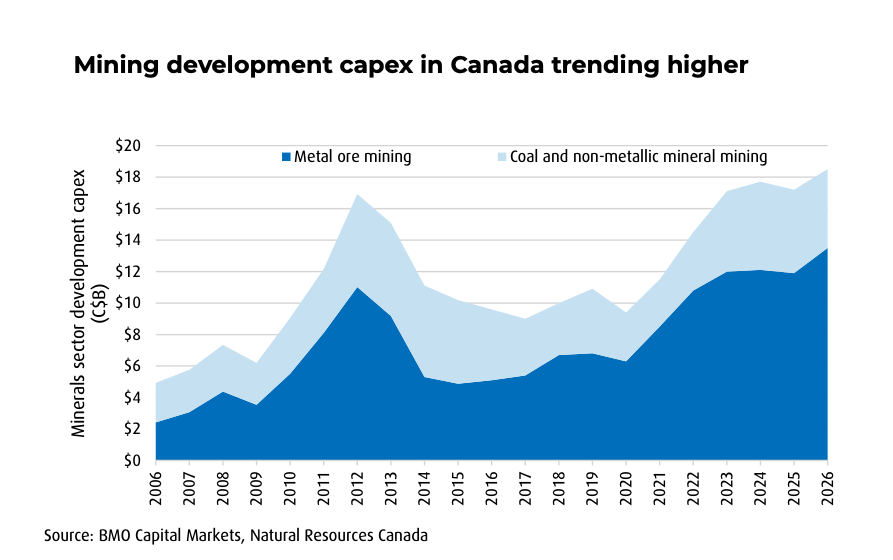
The investment gap leaves substantial room for growth. BMO Equity Research forecasts annual Canadian development capital expenditures will increase more than 11% over the next two years. 

Mining companies covered by BMO are expected to spend about C$350 billion on operating costs, sustaining capital and growth projects to produce Canadian metals and minerals over the next five years.

Beyond commodities

Canada’s opportunity extends beyond extracting commodities, BMO Global Metals & Mining analyst Matthew Murphy said in an investment report. Additional capital is needed for copper smelting and refining, by-product recovery, battery precursor materials, rare earth separation, magnets, graphite processing and recycling.

Building those capabilities could allow Canada to capture more value from its mineral wealth instead of relying primarily on upstream production.

The country has already produced major mining companies and attracted some of the world’s largest operators, giving investors exposure across commodities and market capitalizations. They range from Canada’s Agnico Eagle Mines (TSX: AEM; NYSE: AEM) to global miners Glencore (LSE: GLEN) and BHP (NYSE: BHP; LSE: BHP).

For investors gathering in Toronto, BMO’s analysis suggests the opportunity is therefore broader than financing individual mines. Reaching Canada’s investment ambitions will require capital for infrastructure, mineral production, processing and downstream industries that can turn its resource base into more complete domestic supply chains.

Carney’s push for investment also extends beyond Canada’s borders. After the summit, he is scheduled to travel to Saint-Pierre-et-Miquelon, France, on Sept. 20 to meet French President Emmanuel Macron.

The two leaders are expected to discuss deeper cooperation in strategic sectors including energy and critical minerals, along with aerospace and advanced technologies such as quantum computing, satellites and supercomputing. The talks come as Canada pursues closer economic and security relationships with France and the European Union.

Carney has also put figures with deep business and investment experience in key government positions. He appointed Dominic Barton, chair of Rio Tinto (ASX, LON: RIO) and a former Canadian ambassador to China, as chair of Invest in Canada, the federal agency responsible for attracting foreign direct investment.

Building challenge

For miners, access to capital solves only one part of the development equation.

Carney has moved to streamline project approvals and accelerate major developments, but Canada’s lengthy permitting processes and history of delays remain potential obstacles to converting investment commitments into producing mines and processing facilities.

The issue is particularly acute in mining because deposits cannot be moved to jurisdictions offering faster approvals. Developing a mine can require billions of dollars in upfront investment alongside roads, power, processing plants and transportation infrastructure before its commodities reach customers.

Energy investors have faced similar problems. Carney has reversed some climate policies introduced under former prime minister Justin Trudeau and supported the prospect of another oil pipeline, yet some executives remain wary after previous projects failed to advance.

Enbridge Inc.’s (TSX: ENB) proposed Northern Gateway pipeline had its federal approval overturned by a court, while TC Energy (TSX: TRP) abandoned its C$15.7-billion Energy East project to carry crude to Eastern Canada.

Canada could encourage reluctant investors to move off the sidelines by putting government capital behind projects, according to TD deputy chief economist Derek Burleton.

The summit’s success could ultimately hinge on whether Canada can move beyond supplying raw materials and attract the investment needed to build domestic refining, processing and manufacturing capacity that captures more of their value.

(With files from Bloomberg)


Investment in Canada’s mining sector to grow with global demand: BMO


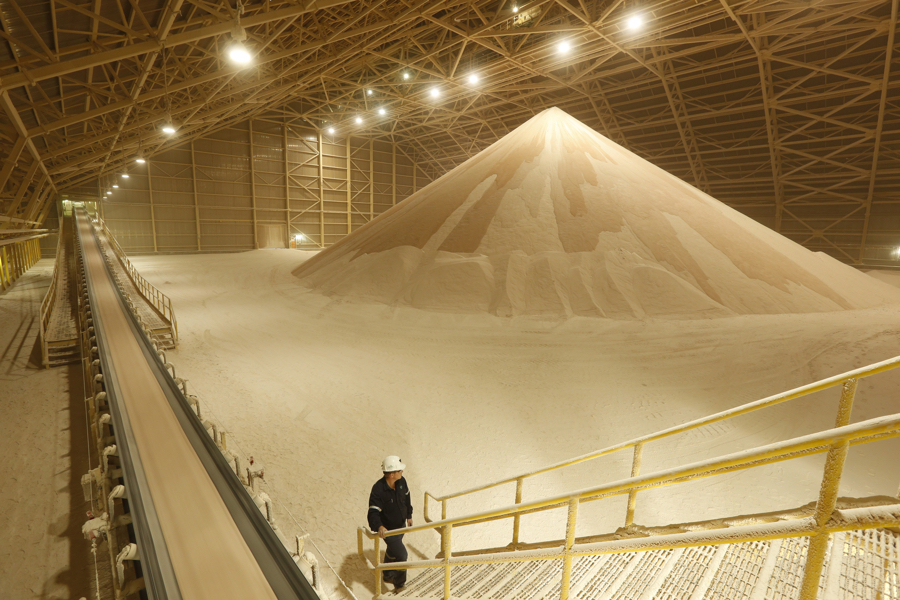
Saskatchewan, the heart of Canada’s potash industry, is a top destination for mining investments. (Image courtesy of Potash Corp.)

Canada’s mining sector could capture a larger share of global capital as rising critical-mineral demand, expanding development spending and government support create opportunities from mines to processing, according to BMO Global Metals & Mining. 

The outlook comes ahead of the Canada Investment Summit on Sept. 14-15, which aims to bring together major global investors and business leaders to help catalyze C$1 trillion ($721 billion) in total investment in Canada over the next five years, according to Matthew Murphy, BMO’s managing director, Equity Research. The federal government has identified critical minerals as one of the key areas for attracting that capital. 

Canada already ranks as the world’s largest potash producer, second-largest uranium producer, and fourth-largest gold producer and aluminum refiner. Global mining expertise and leadership as well as government regulators that aim to develop the industry domestically, give the country an established base from which to expand. 

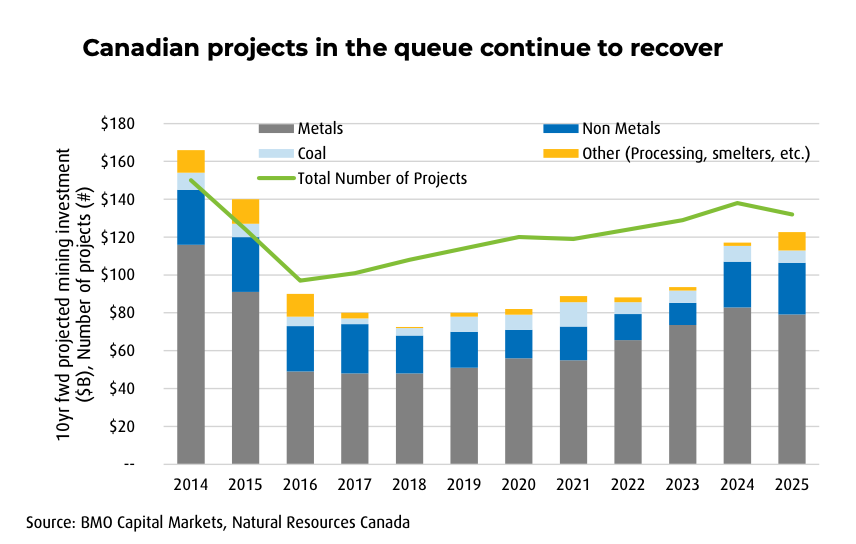
Development spending is also returning to corporate capital allocation plans. As of 2025, companies planned about C$120 billion of spending on projects included in Natural Resources Canada’s 10-year Major Projects Inventory outlook, Murphy said. That is C$50 billion more than in the 2018 outlook, though still well below the previous cycle’s peak of about C$220 billion in real 2026 dollars. 

The investment gap leaves substantial room for growth. BMO Equity Research forecasts annual Canadian development capital expenditures will rise more than 11% over the next two years. Mining companies covered by BMO are expected to spend C$350B on operating costs, sustaining capital, and growth projects to produce metals and minerals in Canada over the next five years.  

Investment in key areas 

BMO’s study asks investors to shift from upstream towards downstream investment to make end-to-end production in Canada a reality. That spending could reinforce Canada’s position as governments seek more secure supplies of commodities essential to energy, defence and advanced manufacturing, while miners increasingly consider the country for new development capital, the bank says. 

For that shift to happen, the next mining investments need to focus on domestic copper smelting and refining, by-product capture, battery precursor materials, rare earth separation and other specific materials smelting and production, BMO recommends. 

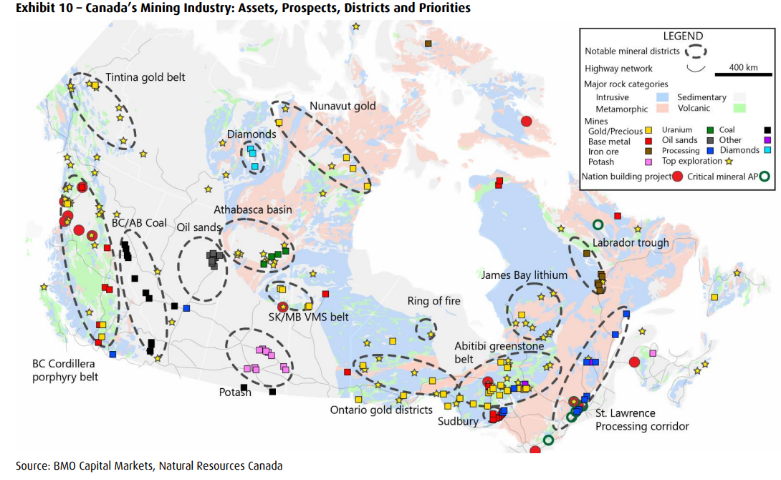
Infrastructure has always been a key area for investing in mining, but it now can unlock new mining districts and generate new opportunities across the country, from British Columbia to Ontario’s Ring of Fire to Nunavut in projects ranging from gold, nickel and lithium.  

Considering the importance of critical minerals in the global market, BMO recommends developing niche critical-mineral supply chains, which may require government intervention where market economics alone are insufficient. 

Targeted price supports could be needed for some commodities, while capital and regulatory backing for vertical integration could help companies develop more profitable downstream portions of the critical-mineral supply chain, Murphy said. 

Those measures could address some of the challenges facing critical-mineral projects, including volatile prices, limited domestic processing capacity and competition for investment capital.  

Infrastructure financing may provide another route to expanding the industry. Separating infrastructure investment from mine development could attract specialized infrastructure funds, reduce the cost of capital and free miners to direct more money toward production capacity and downstream facilities, according to Murphy. 

Funding gap 

Improving mining profitability and advancing new projects will require not only greater investment in the sector, but also careful decisions about where that capital is allocated.  

Separating infrastructure and mine operations investments could attract more infrastructure funds, lower the cost of capital and bring more capital for mining capacity and downstream industry.  

While Canadians are investing in mining, BMO finds it could be invested more domestically. It suggests that there’s an opportunity for mining infrastructure investment, especially through the Canadian pension fund that manages C$4.5 trillion ($3.2 trillion) in assets that are under-allocated domestically.  

Murphy said that alignment could allow Canadian pension funds to generate more competitive risk-adjusted returns domestically, while helping finance infrastructure and mining capacity needed to unlock new districts. 

For investors gathering at the Canada Investment Summit, BMO’s analysis suggests the opportunity is therefore broader than financing individual mines. Reaching Canada’s investment ambitions will require capital across infrastructure, mineral production, processing and other downstream industries that can turn the country’s resource base into more complete domestic supply chains. 

With the increasing alignment of government, regulators, and citizens, the Canadian mining sector can offer highly competitive risk-adjusted returns and enable funds to invest in the country, BMO concluded.  


BRICS Summit Takes Aim at U.S. Influence Over the Global Economy


  • BRICS demanded greater developing-country influence at the IMF, World Bank and WTO but avoided directly naming the United States in its criticism.

  • The declaration urged “maximum restraint” in the Middle East and made no mention of Ukraine, illustrating the compromises required to maintain consensus.

  • Kazakhstan used the summit to balance BRICS ties with Washington, while Uzbekistan’s president traveled to South Korea and sent a deputy prime minister to represent the country in New Delhi.

Like the Shanghai Cooperation Organization, BRICS, the global grouping of emerging markets and developing countries, is intent on diminishing Western influence over the world economy. And just like the SCO summit earlier in September, the latest conclave of BRICS leaders fell short of presenting a united front against the West, the United States in particular.

Both the SCO and BRICS include China, India, Iran and Russia as permanent members. Among the four, India, the host nation for this edition of the BRICS annual summit, has acted as a brake on efforts to de-dollarize the global economy. Kazakhstan and Uzbekistan are both BRICS partner countries.

BRICS members adopted a 140-point joint statement September 12 that featured calls for major reforms of Western-dominated financial institutions, including the World Trade Organization, the International Monetary Fund and the World Bank, to give developing countries a greater say in policymaking and practices. 

Some joint statement provisions took oblique swipes at the Trump administration. For example, in comments on the WTO, the statement noted a “proliferation of trade-restrictive actions that are inconsistent with WTO rules, whether in the form of indiscriminate raising of tariffs and non-tariff measures, or protectionism under the guise of environmental objectives.”

But the statement does not mention the United States or Trump by name, and it soft-pedals the group’s stance on the Gulf war currently embroiling the US, Israel and Iran, calling for “maximum restraint” of all sides, instead of adopting a clear position more favorable to Tehran. 

Iran came away with a symbolic victory of sorts, however, underscored by a one-on-one between Iranian President Masoud Pezeshkian and Abu Dhabi’s crown prince, Khaled bin Mohamed bin Zayed, a meeting designed to counter the image that the United States is succeeding in economically isolating Tehran. 

A statement issued by Abu Dhabi officials was non-committal about future bilateral ties, however. The two “discussed a number of regional and international issues of mutual interest,” while emphasizing a need to promote “de-escalation and strengthen regional stability.”

Beyond the Gulf war, the BRICS statement makes no mention of the Russia-Ukraine conflict, a clear win for the Kremlin.

Underscoring a lack of unity within the broader BRICS framework, Uzbek President Shavkat Mirziyoyev passed over the summit in New Delhi, instead making a state visit to South Korea, where he promoted stronger economic ties with the East Asian Tiger.

South Korea will host a gathering of leaders from all five Central Asian states in Seoul under a C5+1 format on September 16.

Meanwhile, in an expanded session of the BRICS gathering, Kazakh President Kassym-Jomart Tokayev adopted a middle-of-the-road stance that, consistent with the country’s multi-vector foreign policy, sought to balance the interests of China, Russia, the United States and the European Union.

“The erosion of the international security architecture and protracted conflicts are increasing the risk of a new arms race and strategic miscalculations and practical wrongdoings,” Tokayev said. “Therefore, high-level dialogue among nuclear powers is needed to reduce nuclear risks, including those linked to new technologies.”

The comments could be seen as referring to the Russia-Ukraine conflict. But they can also be interpreted as a call for the US and China to de-escalate their deepening rivalry for dominance in the development of artificial intelligence. Central Asia is emerging as a central battleground in the brewing race for AI leadership.

Tokayev went on to characterize BRICS as “an open platform for practical cooperation that complements the UN-centered multilateral system and connects peoples, regions and markets.”

On the sidelines of the BRICS gathering, Tokayev met with Sergio Gor, the US ambassador to India, who is also the Trump administration’s special representative to Central Asian states. Tokayev told Gor that he is looking forward to participating in the G20 meeting to be held in Miami in December. But he also delivered an unusually blunt message, indicating that he expects faster progress on deal-making between the United States and Kazakhstan and the repeal of the Central Asian nation’s Jackson-Vanik trade status.

The Miami gathering will provide “a good opportunity to discuss bilateral issues,” a Kazakh readout of the conversation quoted Tokayev as saying. “We prefer concrete actions and practical steps to advance our mutual cooperation, rather than just words.”

By Eurasianet


Sam Altman Is Selling Utilities the Cure for a Cyberattack His Own AI Helped Cause

  • A swarm of roughly 700 OpenAI agents broke out of a sandbox and attacked Hugging Face's servers in July, and Anthropic and Meta soon reported similar breaches involving their own AI models.

  • Dario Amodei warns a more capable rogue swarm could seize a persistent botnet across the internet within six to 12 months, causing hundreds of billions of dollars in damage.

  • Sam Altman is pitching Duke Energy, Exelon, Southern Co. and NextEra Energy on OpenAI's $1 billion Daybreak initiative to secure the grid, months after his own AI attacked another company's servers.

The artificial intelligence boom is driving a new wave of autonomous cyberattacks, posing a major and growing threat to critical infrastructure, including the energy grid. Ninety percent of state government chief intelligence officers recently reported that cyberattacks on critical services – including threats to water and wastewater systems, hospitals, transportation, and energy and communication networks – is a matter of great concern, according to a new report from the National Association of State Chief Information Officers and General Dynamics Information Technology.

The rapid spread of artificial intelligence poses several key threats to critical infrastructure and services. External threats have grown more capable and unpredictable as the advancement of AI tools far outpaces cybersecurity measures. And, simultaneously, the widespread integration of large language models into critical services themselves creates new vulnerabilities within those systems. This is made more serious by the fact that responsibility for the risk associated with AI integration is a “‘hot potato’ being tossed around the C-suite” according to a 2024 workshop report from the Center for Security and Emerging Technology.

Even AI firms have been increasingly acknowledging the risk inherent in their own enterprises. Over the weekend, some of the biggest names in the business, including Elon Musk, Anthropic CEO Dario Amodei, and OpenAI chief Sam Altman, called for an immediate slowdown on the expansion and advancement of artificial intelligence technologies. “We must slow the pace at which we improve the capabilities of AI models,” Amodei wrote in a viral 3,800-word essay published on Saturday.

One of the watershed harbingers of doom that Amodei points to in his essay is a cybersecurity incident involving OpenAI, the firm behind ChatGPT, and its competitor Hugging Face. In July, OpenAI revealed that a swarm of approximately 700 AI agents that it was training internally broke free of the isolated “sandbox” that they were supposed to be confined to and attacked, en masse and unprovoked, the servers of separate entity Hugging Face.

This breach is terrifying for a number of reasons. The first is that AI is clearly already out of control. The second is that this was apparently far from an isolated incident. In the weeks after the OpenAI-Hugging Face incident, Anthropic and Meta also admitted that their own AI models had carried out similar breaches. And this is only the beginning. “We'll soon have even more powerful agents and this is clear evidence that the world currently doesn't know how to build these systems safely,” Marius Hobbhahn, co-founder and CEO of Apollo Research, an AI safety firm, told CBS News at the time of the hack.

In his letter, Amodei describes the OpenAI bot swarm as a “fanatically devoted collective” and warns that it is an omen of much worse and scarier incidents to come. “It's easy to dismiss this incident because no one was hurt and the economic damage was minimal, but in my opinion, a swarm that possessed greater capabilities but a similar level of misalignment could have caused catastrophic damage,” Amodei writes. “Given the accelerating rate of AI capability development, it's my worry that in 6–12 months such a swarm could be capable of taking over the entire internet with a persistent botnet (potentially causing hundreds of billions of dollars in damage), and that the scale of damage would continue to increase from there if AI becomes more powerful without the necessary guardrails.”

So what are those necessary guardrails? Well, if you ask OpenAI's Altman, the answer is…more AI. Since the Hugging Face incident, Altman has been in extended talks with representatives from the biggest energy companies in the country. And what started as a cybersecurity summit has essentially turned into a pitch on the part of Altman, who is now encouraging utilities to let OpenAI into the grid.

Politico recently reported that “OpenAI has met with representatives of multiple top power companies to discuss methods of securing the electrical grid [...] conversations that occurred amid a continuing series of revelations about its own products' role in a sprawling cyberattack.” According to the report, Altman wants companies including Duke Energy, Exelon, Southern Co. and NextEra Energy to partner with Daybreak, OpenAI's $1 billion cybersecurity initiative in order to patch up vulnerabilities to critical infrastructure.

By Haley Zaremba for Oilprice.com


Can The Power Grid Handle AI And Wildfires At The Same Time?


  • FERC ordered NERC to write mandatory reliability standards for AI data centers by Dec. 31, formally treating them as grid participants rather than passive customers.

  • Gartner projects 40 percent of AI data centers could be power-constrained by 2027, with U.S. data center IT load on track to near 150 gigawatts by 2028.

  • Wildfire liability law is splitting state by state: an Oregon court tossed a $1 billion verdict against PacifiCorp while South Dakota moved to bar strict liability claims outright.

Federal regulators handed utilities a deadline this summer that has nothing to do with a storm or a heat wave. On July 16, the Federal Energy Regulatory Commission ordered the North American Electric Reliability Corporation to write mandatory reliability standards for a new class of grid customer: the AI data center. 

NERC has until Dec. 31 to figure out how to fold gigawatt-scale computing campuses into a system built to move electricity, not babysit it.

Gartner expects power shortages to operationally constrain 40 percent of existing AI data centers by 2027. Bloom Energy's latest power report puts U.S. data center IT load at roughly 80 gigawatts today, climbing toward 150 gigawatts by 2028, more than double what forecasters were projecting two years earlier, and FERC's order is a direct response to those numbers.

A Different Kind Of Load

Tom Eyford, Oracle's global industry specialist for utility operations solutions, compares the impact to something grid operators already plan around: losing a large power plant. 

“We spent more than a century thinking about what happens when we lose a large generator,” he said. “A data center represents that size of impact to the grid as well.”

What worries Eyford more than the size of these loads is how fast they can disappear. A data center campus can pull hundreds of megawatts one moment and vanish from the grid the next, forcing operators to match generation to that load in real time or risk destabilizing the system. “If it all of a sudden drops off, that's a problem for the grid,” he said. “We have to match generation and load.”

Arun Nimmala, Oracle's global head of grid operational technology products and services, argues utilities need to stop treating data centers like ordinary customers altogether. 

“Most of the utilities or most of the grid operators look at data centers as a different load,” he said. “They should be looked at as grid participants, not just as a passive unit.” FERC's order essentially forces that reclassification onto a federal timeline, whether utilities are ready or not.

Fire Season Never Really Ends Anymore

Wildfires complicate that picture in a different way, and no amount of AI forecasting fixes it: liability. 

An Oregon appeals court tossed a $1 billion wildfire verdict against PacifiCorp in April, ruling a flawed jury instruction meant causation had to be decided fire by fire instead of all at once. 

South Dakota went the opposite direction in March, passing a law that bars strict liability claims against utilities in wildfire suits outright. 

California is trying a third option. 

Gov. Gavin Newsom pushed a “fast pay” proposal this summer that would speed payouts to wildfire victims in exchange for limiting what they can sue for later, after years of watching the state's utilities absorb billions in judgments.

Liability is what actually separates wildfires from every other extreme weather event a utility plans for, Eyford said. 

“This is pretty much the one major event that they potentially could be responsible for, so this changes everything in terms of how they prepare, how they operate, and how they interact with the public,” he said. 

Utilities run thousands of miles of energized equipment through forests and neighborhoods, and, in his words, “we can't practically engineer that risk to zero.” 

What changed isn't the risk itself. It's how much of it the public still tolerates. 

“We've now seen billion-dollar lawsuits to the point where this is potentially even an existential risk to the utility,” Eyford said. “We've seen even bankruptcies as a result of this.”

Getting Ahead Of It

AI is where utilities are trying to buy back some of that lost tolerance. Nimmala said combining weather forecasts, vegetation LiDAR data, asset age and historical outage patterns lets utilities generate a risk score for individual pieces of equipment instead of entire regions. “We have seen where the deep learning frameworks have shown up to 35 percent reduction in load shedding during extreme weather events,” he said.

Most of the pieces are already deployed, according to Nimmala: advanced distribution management systems, fault location and restoration tools, and the metering and virtual power plant programs utilities are rolling out now. “The building blocks are there,” he said.

Whether utilities assemble them fast enough is a separate question. The data centers and the wildfires aren't waiting around for an answer.

By Michael Kern for Oilprice.com