It’s possible that I shall make an ass of myself. But in that case one can always get out of it with a little dialectic. I have, of course, so worded my proposition as to be right either way (K.Marx, Letter to F.Engels on the Indian Mutiny)
Wednesday, September 16, 2026
Aged microplastics can reshape how pharmaceuticals break down during wastewater treatment
Surface radicals on weathered plastic particles accelerate carbamazepine degradation in UV-based treatment systems, but may also increase the formation of some more toxic intermediate products
Shenyang Agricultural University Collaborative Journals
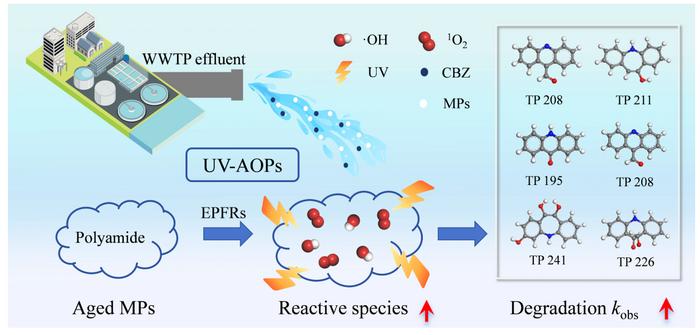
Microplastics in wastewater may do more than simply carry pollutants. A new study shows that aged microplastics can actively alter the chemical reactions used to remove pharmaceutical contaminants during advanced wastewater treatment, accelerating pollutant degradation while also changing the abundance of potentially harmful transformation products.
Researchers investigated how aged polyamide microplastics affect the breakdown of carbamazepine, a widely used pharmaceutical frequently detected in surface water, wastewater, and even drinking water. The team examined three ultraviolet-based advanced oxidation processes, known as UV/PMS, UV/H₂O₂, and UV/Cl, which use ultraviolet light and oxidants to generate highly reactive chemical species that destroy organic contaminants.
“Our results show that aged microplastics should not always be regarded as passive particles during wastewater treatment,” said corresponding author Xiaohui Wang of Beijing University of Chemical Technology. “Their aged surfaces can participate in chemical reactions, increase the production of reactive species, and ultimately influence both pollutant removal and the products formed during treatment.”
The researchers found that aging caused environmentally persistent free radicals, or EPFRs, to develop on the surface of polyamide microplastics. These surface radicals promoted electron transfer and enhanced the formation of reactive species, particularly hydroxyl radicals and singlet oxygen.
As a result, aged microplastics increased the observed degradation rate constant of carbamazepine by 1.2 to 1.8 times across the three treatment systems. The largest relative enhancement occurred in the UV/Cl system, where the degradation rate constant increased by about 1.8 times.
However, faster disappearance of the original pharmaceutical does not necessarily mean lower environmental risk.
Using mass spectrometry, the researchers identified numerous transformation products and found that aged microplastics increased the abundance of several intermediates. The fundamental degradation pathways remained broadly similar, involving reactions such as hydroxylation, oxidation, ring condensation, and ring cleavage, but the distribution of the resulting products changed.
Toxicity modeling further indicated that some transformation products were more toxic to aquatic organisms than the original carbamazepine molecule. In particular, TP 194 showed substantially higher acute and chronic toxicity, while several other intermediates were classified as harmful or toxic. Structural analysis suggested that removal of the amide group, hydroxyl substitution, and formation of unsaturated rings could contribute to increased toxicity.
The study also showed that wastewater chemistry matters. Nitrate promoted carbamazepine degradation in all three systems, while bicarbonate and humic acid generally inhibited it. The influence of chloride depended on its concentration and the oxidation system being used.
The findings highlight the need to consider microplastics as chemically active components of wastewater treatment environments, rather than inert contaminants. They also suggest that evaluating treatment efficiency solely by measuring the disappearance of a parent pollutant may overlook changes in transformation-product toxicity.
The authors note that the experiments were conducted under controlled laboratory conditions and used only polyamide microplastics. Future studies will need to test a broader range of plastics and verify these effects in complex, environmentally realistic waters.
===
Journal reference: Wang Y, Zhou X, Xu Z, Liu H, Wang X, et al. 2026. Oxidant-dependent carbamazepine transformation: how aged microplastics modulate degradation pathways in UV-AOPs. New Contaminants 2: e024 doi: 10.48130/newcontam-0026-0021
Oxidant-dependent carbamazepine transformation: how aged microplastics modulate degradation pathways in UV-AOPs
Article Publication Date
9-Sep-2026
Iron-modified nanotubes help accelerate the breakdown of toxic nitrobenzene in wastewater
A solar-inspired system combining heat, electrochemistry and photocatalysis removed more than 92% of nitrobenzene within two hours while limiting harmful intermediate products
Shenyang Agricultural University Collaborative Journals
Credit: Bin Bian, Jiayue Hu, Xinrui Ma, Pengkai Wang, Zhan Shen, Pascal E. Saikaly & Ling Liu
Nitrobenzene is a persistent industrial pollutant that can be difficult to eliminate from wastewater. Now, researchers have developed an integrated treatment system that combines thermal, electrochemical and photocatalytic processes to break down the pollutant more rapidly and drive it further toward mineralization.
The system removed 92.1% of nitrobenzene within two hours and achieved a calculated mineralization efficiency of 62.4%, substantially outperforming simpler electrochemical configurations tested in the study.
“Instead of relying on a single treatment mechanism, our approach brings together several forms of energy to accelerate pollutant degradation while promoting a more direct oxidation pathway,” said Jiayue Hu, a corresponding author of the study. “The results show how engineering both the electrode surface and the reaction environment can improve the treatment of persistent organic contaminants.”
Nitrobenzene is used in industrial chemical production and can enter agricultural, municipal and pharmaceutical wastewater. Its chemical stability makes it resistant to conventional oxidation. Some treatment approaches first convert nitrobenzene into aniline or require additional chemical reagents, which can increase costs or generate secondary pollution concerns.
The researchers explored a solar thermal electrochemical photocatalytic, or STEP, strategy, which combines photo, thermal and electrochemical effects. At the center of the system is an electrode made from titanium dioxide nanotube arrays modified with iron, known as Fe-TNT.
Titanium dioxide is widely used as a photocatalyst, but its relatively wide bandgap limits its ability to utilize light efficiently. The team's theoretical calculations suggest that local iron coordination introduces new electronic states that make charge transfer and nitrobenzene activation more favorable. The calculations also indicated stronger interactions between nitrobenzene molecules and the modified surface.
The researchers compared three operating modes. After two hours, the conventional solar-electrochemical configuration removed only 7.5% of nitrobenzene. Adding thermal assistance increased removal to 52.5%. When the Fe-TNT photocatalytic electrode was incorporated into the complete STEP configuration, removal reached 92.1%, while calculated nitrogen-based mineralization reached 62.4%.
Importantly, the combined treatment also appeared to change how nitrobenzene was broken down. Conventional electrochemical and thermal-electrochemical processes produced intermediates including phenol and para-benzoquinone. Under STEP conditions, these intermediates were not detected by the study's HPLC analysis, while maleic acid became the dominant detected product. The findings indicate a more direct pathway from nitrobenzene to maleic acid, followed by further oxidation toward smaller molecules and eventual mineralization.
This streamlined pathway could help reduce the accumulation of potentially harmful intermediates during treatment.
The researchers emphasize that the work remains at the laboratory stage. The experiments used an external solar heater and a UV lamp to separately reproduce the energy inputs represented in the STEP concept, rather than full-spectrum sunlight. Future studies under simulated or natural solar irradiation, together with long-term electrode stability, iron leaching and energy-efficiency tests, will be important for assessing practical applications.
===
Journal reference: Bian B, Hu J, Ma X, Wang P, Shen Z, et al. 2026. Enhanced nitrobenzene mineralization in a STEP system. Energy & Environment Nexus 2: e024 doi: 10.48130/een-0026-0018
About Energy & Environment Nexus: Energy & Environment Nexus (e-ISSN 3070-0582) is an open-access journal publishing high-quality research on the interplay between energy systems and environmental sustainability, including renewable energy, carbon mitigation, and green technologies.

No comments:
Post a Comment