Showing posts sorted by date for query 9/11. Sort by relevance Show all posts

Sunday, September 13, 2026


Lithium’s inventory upheaval confounds industry, hits prices


(Image courtesy of SQM.)

A surprise surge in lithium stockpile data — after a change in methodology — has confounded traders and weighed on prices, prompting some to call on authorities to step in.

Data released last week by SMM Information & Technology Co., leaning on a larger sample than previously, saw stockpiles jump to 175,000 tons. The previous figure stood at 78,800 tons. In response, prices for the most-active lithium carbonate contracts in China fell more than 14% across three days.

The lithium market has seen plenty of turmoil over recent years, but the sharp and unexpected jump in inventories raised fresh concerns about the true state of demand and about the challenges of predicting next steps for an opaque and still-developing market.

A dozen company officials, traders and analysts described an industry left baffled by the sudden jump, and fretting about reliable data. They all asked not to be named speaking on sensitive matters, but pointed to a petition circulating online demanding that relevant agencies investigate.

SMM said on Friday that its new method showed stockpiling among downstream cathode-material plants, while upstream smelters and battery plants showed destocking activities.  

The revised method includes sampling from more manufacturers and will also result in changes to some previously published data, SMM said. It added that estimates are derived from public information, market communications and its internal data models.

One official at SMM said the company may have underestimated the impact of its inventory shift, but had begun internal compliance checks to examine the issues. He also asked not to be named as those discussions are not public.

SMM did not respond to messages requesting comment.

“If data and prices provided by some third-party pricing platforms fail to objectively reflect the real market levels, we will adopt more market-oriented and diversified pricing methods to ensure that product prices are fair and reasonable,” Ganfeng Lithium said in response to investors query on a stock exchange platform.

(By Annie Lee and Alfred Cang)


Lohum ships first lithium ore from Zimbabwe, starts overseas mining


Zimbabwe is one of the top 10 lithium producers but currently produces only a fraction of the worldwide total. (Image courtesy of Prospect Resources | Investor Presentation at Mining Indaba, Feb. 2018. )

Lohum said on Wednesday it had dispatched its first shipment of lithium ore from Zimbabwe, marking the start of its mining operations in the southern African country and making it the first domestic company to produce lithium from overseas assets.

The Indian producer of sustainable critical minerals has secured rights to 10 lithium mining blocks in Zimbabwe’s Matabeleland South Province covering about 1,100 hectares, with estimated deposits of 30 million-40 million tonnes of ore.

The assets are expected to support production of around 300,000 metric tonnes of lithium carbonate equivalent and carry an estimated value of about $7 billion at current prices.

The company also holds an option to acquire up to 90 adjacent mining blocks.

Lohum said the move expands its presence across the critical minerals value chain, complementing its existing refining, advanced manufacturing and recycling businesses.

Chief Executive Officer Rajat Verma said securing lithium supplies at the source would help reduce battery costs and strengthen India’s electric vehicle supply chain.

It also plans to build processing capabilities in Zimbabwe rather than exporting raw ore.

(Reporting by Urvi Dugar in Bengaluru and Neha Arora in Delhi; Editing by Ronojoy Mazumdar)


Cuba property claims complicate rival bids for Canadian miner Sherritt


Credit: Sherritt International

The tussle for control of Sherritt International Corp, a Canadian mining company with deep ties to Cuba, has drawn in two unlikely players: Citigroup Inc. and Office Depot Inc.

Thanks to a byzantine series of mergers and acquisitions that go back almost a century, both companies hold claims on property seized during Cuba’s 1959 revolution and subsequently used by the Toronto-based nickel and cobalt producer.

Now, as Sherritt looks for a US backer to help get out from under Donald Trump’s punishing sanctions, those long-dormant claims are taking on new life. Worth more than $350 million on paper, they’re also shining a light on how laws designed to protect those who lost property to the communist regime have created a minefield for the new investment Cuba desperately needs.

“These claims are a veto, not a nuisance,” said Davy Karkason, founding attorney at Transnational Matters PLLC, which specializes in US sanctions and international arbitration. “If Citi says ‘no’ nobody gets to have the mine and Sherritt goes back to square one.”

Sherritt’s fate has been up in the air since May, when the US president issued an executive order designed to chase foreign companies out of Cuba. The Canadian miner initially said it would dissolve its joint ventures on the island, which include a mine and a power-generation operation, only to reverse course when a former adviser to Trump emerged as a potential savior.

In addition to talks with Gillon Capital LLC, the family office of real estate magnate and Republican Party patron Ray Washburne, Sherritt has been approached by a rival consortium that includes global commodities giant Glencore Plc and another Texas billionaire, oil tycoon Albert Huddleston. 

Washburne confirmed in an interview that he’s working to resolve at least one of the two claims as part of his pursuit of the company. “It’s the mine I’m concerned about,” he said this week in Dallas. Asked if he’d be willing to buy out the claim on the facility, he replied: “That’s right.”

Kyma Capital Ltd., Sherritt’s biggest creditor and part of the Glencore consortium, said the group is aware of the claims and “will seek to resolve them in the context of the applicable US legal and policy framework,” declining to elaborate on how a solution might be structured. Spokespeople for Huddleston didn’t respond to requests for comment.

Should the successful buyer find a formula that satisfies Citi and Office Depot, it could pave the way for untangling nearly 6,000 outstanding claims under the Helms-Burton Act that have made investing in Cuba treacherous, according to Pedro Freyre, the chair of international practice at Akerman LLC in Miami.

Any business that touches — even tangentially — on one of those claims is open to allegations of “trafficking” in seized property, the attorney said.

However, if the claim holders can be bought out, brought in as partners or paid some sort of lease, it might be “a model” for a number of the bigger registered cases, Freyre said. “Solving American claims under the Helms-Burton framework is the Gordian knot as it pertains to investing in Cuba.”

Trump has been pummeling the island with almost weekly economic sanctions as he tries to end nearly seven decades of one-party rule. The US has also imposed a de facto oil blockade on Cuba, worsening chronic blackouts. The energy crisis prompted Sherritt to halt operations at its mine in February. 

Citigroup is linked to Sherritt through a legacy equity stake in the Moa Bay Mining Co. that was seized by Fidel Castro in 1960 after he overthrew US-backed dictator Fulgencio Batista. Since 1994, the mine was operated by the Canadian company’s joint venture with Cuba’s state-owned General Nickel Co. SA. 

The Foreign Claims Settlement Commission — established to adjudicate claims by US nationals against foreign governments — valued the demand against the Moa mine at $88 million. It’s now held by Citi and is the third-largest of all certified cases, according to the US-Cuba Trade and Economic Council, which tracks the issue. The group estimates that, with interest, the 5,913 combined claims are now worth more than $9 billion.

A spokesperson for Citi declined to comment.

Office Depot’s connection to Sherritt goes back to 1927, when the Cuban Electric Co. was incorporated in Florida and started buying regional power plants in Cuba. By the 1950s, the company was providing more than 90% of all electricity to the island and was a major natural gas supplier to the capital of Havana.

When Castro swept to power, Cuban Electric was among the first foreign companies expropriated in the name of the revolution. Its majority shareholder at the time was American & Foreign Power Co. Inc., which in 1967 merged with another firm and became Ebasco Industries Inc. Two years later, paper giant Boise Cascade Co. bought Ebasco.

In 2003, Boise purchased OfficeMax and adopted its name. A decade later, OfficeMax merged with Office Depot and took its name. And in 2025, Connecticut-based private equity firm Atlas Holdings LLC bought Office Depot’s parent company, ODP Corp., and inherited the Cuba claim.

By that point, recovering the debt was so precarious that ODP had relegated it to two sentences in its most recent US regulatory filing.

“The company owns 88% of a subsidiary that formerly owned assets in Cuba, which were confiscated by the Cuban government in the 1960s,” ODP said. “Due to various asset restrictions, the fair value of this investment is not determinable.”

Initially valued at $268 million by the claims commission, the Cuban Electric claim has been growing at a rate of 6% annually. It’s the largest on the books and is almost three times more valuable than the next nearest one.

In 2000, Sherritt took a stake in Energas SA, a power-generation company it operates as a joint venture with two state-run companies. Those gas-fired installations formerly belonged to Cuban Electric. In July, Atlas sued Cuba’s state electricity company and Energas for $803 million under Helms-Burton. 

Atlas didn’t respond to emailed requests for comment. 

Karkason, the sanctions lawyer, said there’s a possibility that the suitors circling Sherritt’s nickel mine might be able to cut a deal that leaves Energas, and therefore Atlas and Office Depot, out of it. 

Washburne indicated that’s his intent. “I don’t really care about that,” he said of Sherritt’s power business.

John Kavulich, president of the US-Cuba trade council, said the miner is one of the “poster children” of the investment quagmire that Helms-Burton created. And the successful resolution of its case could be a “miracle of miracles” that resolves both the largest and third-largest certified claims. 

No bidder for Sherritt will get the Trump administration’s blessing “unless they have the approval of the certified claimants,” Kavulich said. “It’s sort of a race for these parties to cut a deal.”

(By Jim Wyss, Ari Natter and Sybilla Gross)

 Poten: VLCC Rates Hit Unprecedented Levels Amidst Mideast Conflict


Tanker owners should take advantage of the current market, which may never happen again, says Poten & Partners

Press handout / file image courtesy China COSCO

Published Sep 11, 2026 
 by Erik Broekhuizen / Poten & Partners

Participants in the tanker industry are no strangers to market cycles combined with extreme volatility. However, even seasoned veterans are looking at current developments in the market and scratching their heads. What is happening is truly unprecedented. It begs the question: What is driving this market and, more importantly, how sustainable is it? In this Tanker Opinion we will focus on the market for Very Large Crude Carriers (VLCCs), the most volatile and visible tanker segment.

Just to provide a little context, VLCCs are large crude oil tankers, with a carrying capacity of two million barrels, They are the main vehicle for long-haul seaborne crude oil transportation. As per September 1st, the global VLCC fleet consisted of 928 vessels, with an average age of 13 years. VLCC earnings are notoriously volatile, driven by supply and demand dynamics in a highly competitive market.


Chart 1 shows VLCC Time Charter Equivalent earnings over the last 15+ years (monthly averages in $/day). In July 2008, at the tail-end of the shipping “super cycle”, VLCC rates hit almost $200,000/day. On the back of China's extraordinary growth, shipping markets were exuberant, and owners had lined up at Asian shipyards to order more capacity. The orderbook ballooned. In late 2008, the global financial crisis hit, sending the world economy into a tailspin, taking the shipping markets with it. By mid-2009, tanker rates had dropped below $20,000/day.

The market has gone through a few more cycles since then. The next time the market closed in on $200,000/day was in April 2020, at the onset of the Covid-19 pandemic. Saudi Arabia flooded the oil markets after Russia refused to make the deep production cuts needed to address the demand destruction resulting from the pandemic lockdowns. The oil glut that followed quicky filled onshore tanks and raised demand for floating storage, boosting VLCC rates. This rate boom was also followed by a long period of depressed earnings. A recovery was triggered by Russia’s war on Ukraine, but that benefited Aframaxes/Suezmaxes more than VLCCs.

This brings us to the current rate spike. The war in the Middle East and the subsequent closure of the Strait of Hormuz, recently followed by significant restrictions transiting the Bab el-Mandeb Strait, have pushed VLCC rates to levels that we have never seen before. Earnings on the benchmark AG-Far East route averaged $600,000/day in August and reached more than $800,000/day in September to date.

It should be noted that these rates are for voyages originating within the Arabian Gulf. Due to the hazards associated with traversing the Strait of Hormuz, only a few owners are willing to take that risk, leading to sky-high rates. However, VLCC rates on other key routes are very high as well. Vessels loading in the Gulf of Oman, just outside the Strait of Hormuz, can earn $450,000/day. Even VLCCs that stay far way from the conflict zone can earn exceptional returns: $380,000/day for West Africa – Far East and $275,000/day for U.S. Gulf to Asia.

Not surprisingly, the exceptional spot rate environment has had an impact on time-charter rates and vessel values as well. Values for modern secondhand vessels are much higher than prices for newbuildings. A 5-year-old VLCC (if you can find one) will set you back $158 million, while you can order a new vessel for $129 million. The reason for the discrepancy is simple: You can employ a newly acquired vessel immediately in the red-hot spot market, while you have to wait several years before a newbuilding is delivered from the shipyard. And while you know what a vessel can earn in the market today, the future rate environment is much more uncertain. If history tells us anything, it is that periods of exceptional rates are usually followed by periods of low earnings, especially if the high earnings have spurred an ordering bonanza (Chart 2).

So, what’s next for the VLCC market? Opinions differ. Some people look at the unusual set of circumstances that triggered the current rate bonanza and with an eye toward the high orderbook (40% of the current fleet), they see another bust following this boom within a few years. Others are more sanguine considering the age profile of the fleet and the large contingent of sanctioned vessels that could be sidelined once the geopolitical conflicts are resolved. On top of that, restocking and a diversification trend away from the Middle East could create a higher ton-mile demand baseline. In the meantime, owners should take advantage of the current market. This may never happen again!

This post appears courtesy of Poten & Partners.


Alphaliner: Economic Pressures to Push Carriers to 27,500 Gigamax Boxships

giant containership loaded with record 22,000 boxes
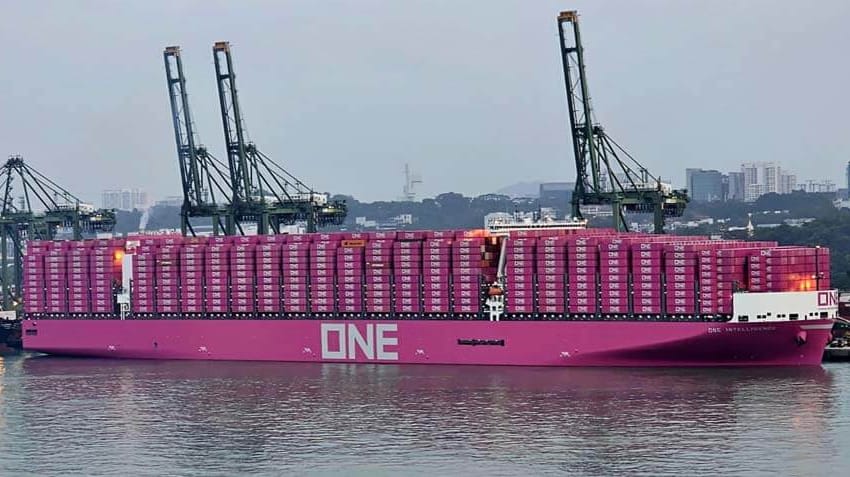
Just a few years ago, ONE was claiming records when it loaded more than 22,000 TEU in Singapore (ONE)

Published Sep 9, 2026 6:52 PM by The Maritime Executive


Do you want to supersize that containership may soon be the question shipbuilders and owners are contemplating, according to the consultants at Alphaliner. While the industry has plateaued at ultra-large container vessels, Alphaliner sees the elements that could easily lead to a new, ever-bigger class of Gigamax container vessels.

The consultancy is dusting off hypothetical concepts it presented five years ago, saying that market factors may just make the timing right for the new, bigger ship. It foresees a time by 2030 when the world’s top carriers could “theoretically deploy at least one 'full set’ of next-generation containerships on the East-West mainlines.”

“Increased cost pressure might prompt some of the largest carriers to reconsider their fleet strategies,” writes Alphaliner. It predicts some of the carriers will “opt for a novel ship type that is slightly larger than the current capacity record holders.”

The industry has a strong history of moving through these size categories. It went to the 18,000 to 19,000 TEU vessel for economies of scale. The next jump was to 23,000 to 24,000 TEU, but according to Alphaliner, for about a decade now carriers have stuck with that level. The ships are about 400 meters (1,312 feet) in length and have a beam of 61 meters (201 feet). It fits through the Suez Canal, and ports are adapted to handle this size of vessel. Shipyards and naval architects have toyed with the available space, and by making small changes to loading patterns and systems, they have squeezed the capacity by at most a few hundred boxes. The largest official TEU rating now stands at just over 24,300 boxes. 

Carriers have discussed bigger ships, but so far none has made the move. They said the 24,000 TEU load seems "about right" for the market and the operating factors.


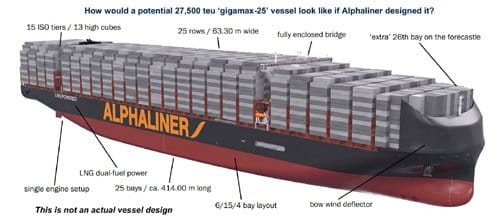
Alphaliner's hypothetical concept for a 425+ meter container vessel with 27,500 TEU capacity


The consultants at Alphaliner, however, are answering the question of why carriers might finally jump the current barrier.

“Especially in very long-haul East-West mainlines,” says Alphaliner, “factors like the increasing price of fuel and the introduction of carbon emissions taxes will give bigger ships a competitive edge in the long run.”

Its Giamax concept would be incremental, adding one hold or possibly two 40-foot bays beyond today’s 400-meter ships. They forecast a length of 425 meters or more, and that would give the ships a capacity of 27,500 TEU.

They believe that the ports that have already adapted to the 24,000 TEU ships would be able to absorb these slightly larger vessels. The applications would be limited, however, as many ports, such as in the United States, cannot handle even the 24,000 TEU ultra-large vessels.

Alphaliner is not the only one working on theories for the next generation of giants. China’s Shanghai Ship Research and Design Institute and projects looking at the future of nuclear-powered containerships have also shown the potential to leap the 24,000 TEU barrier.

The concept of going to bigger ships seems to fit with the trends in the industry. As the ships get more expensive to build and operate, more boxes will rebalance the economic equation and potentially help with the anticipated wave of older ship retirements that has long been predicted. 

The container segment already has a record orderbook as carriers continue to order new ultra-large vessels. Alphaliner points out that over a relatively short period of time the industry’s capacity has soared from 23.2 million TEU to a current 34.1 million TEU. It is up 47 percent, and deliveries from the orderbook are likely to continue to drive capacity in the sector.


After a Leak, Troubled Ferry Glen Sannox No Longer Runs on LNG

CalMac
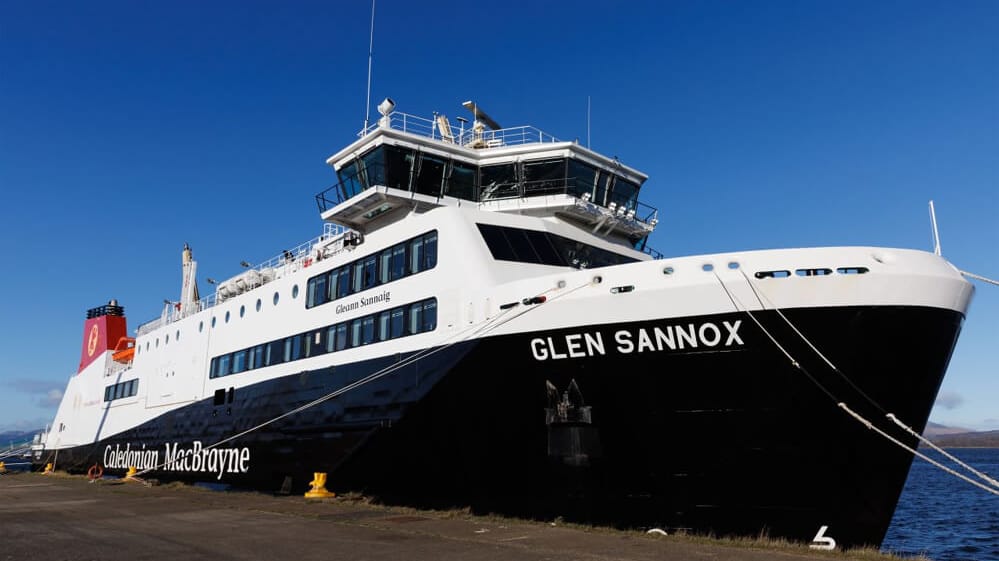
File image courtesy CalMac

Published Sep 11, 2026 9:43 AM by The Maritime Executive

The Scottish ferry Glen Sannox was billed as an environmentally-friendly LNG powered alternative when it was first ordered in 2014, and the builder and the operator invested heavily in bringing its LNG fuel system online, a factor in the vessel's years-long delivery delay. But after a serious gas leak incident last year, it is no longer using the high-spec system and has switched to running on diesel, according to a new investigation by BBC. 

On June 3, 2025, Glen Sannox began a routine crossing from Troon to Brodick, Arran. During the crossing, gas alarms sounded and the port engine automatically cut out, a safety response to an abnormality in the supply of natural gas fuel. The crew switched to diesel and investigated the matter further when they reached the pier in Brodick; no serious issues were found and the vessel departed for the return journey as usual. 

Later that evening, while the vessel was under way back to Troon and running on gas once more, a high-pressure LNG vent valve failed. Over the course of 12 minutes, it released 700 kilos of gas out to the exterior of the ship through a vent pipe on the starboard side. The size of the leak and the location of the vent - just forward of a ventilation intake - meant that a small quantity of gas was drawn back inside the ship, not enough to cause harm but enough to provoke concern.

The crew did not initially recognize that a leak had occurred, and they attempted to restart an engine before they discovered the root cause of the incident. The crew had to manually close the electrically-operated valve for the return journey. That appears to have been the last time that the ship ran on LNG, and the vessel's LNG fuel tank has been empty since late last year.

The operator's internal investigation report - obtained by BBC - found that the vent valve may have been damaged through contact with a loose component, possibly linked to the ship's severe vibration issues when operating astern. It did not have a monitoring sensor or position indicator at the time; that safety function has since been retrofitted. The OEM had previously issued three service memos suggesting that the valve be upgraded or replaced, and reinstalled with extra care in order to prevent loosening of fasteners.

In a statement, operator CalMac said that it has taken remedial action and that the ship is safe to run on LNG, but has not done so for the sole reason of speeding up its return to operations. At the time, CalMac had other serious issues to contend with, notably a persistent problem with hull cracking

The Glen Sannox saga has had many twists and turns, and the BBC's revelation is just the latest. Shipyard Ferguson Marine started work on the CalMac ferry in 2015, went bankrupt after serious design flaws emerged, and was nationalized in 2019. After rework, budget hikes and personnel changes, the ferry finally entered service in January 2025, six years behind schedule and four times over budget. It has been repeatedly out of operation for repairs since delivery. 


China Grows Arctic Container Routes, Reaching England and Opening Murmansk

containership departing China for transit of the NSR to UK
Dubai Tower sailing from China last month for the first 2026 run across the NSR (Ningbo-Zhoushan Port Co.)

Published Sep 11, 2026 10:09 AM by The Maritime Executive


Chinese containerships are continuing in their efforts to expand operations along the Northern Sea Route through the Arctic. The first of their planned 2026 runs reached England today, while in the high Arctic at Murmansk, it opened a new export service for Central Russia.

The containership Dubai Tower arrived at Teesport in the north of the UK on September 9, completing its trip along the NSR that departed China on August 19. The reports are that the ship is carrying 1,300 TEU, hauling electric vehicles, batteries, and other renewable energy equipment from China.

The  23,338 dwt containership, which has a capacity for 1,740 TEU, appears to have had a mostly uneventful crossing, which was expected to take about 20 days. However, it was scheduled to go to Felixstowe, with no explanation for why it diverted to Teesport in the north. Teesport lists itself as the UK’s sixth-largest port and a gateway to the north, but it has limited container operations.

PD Ports, which operates at Teesport, however, did recently report that it had received one of the largest automotive vessel calls to Teesport in recent years. It was carrying 5,000 vehicles arriving at the beginning of the month from China as part of a major UK import operation. The shipment included vehicles from across the Chery Automotive portfolio, including Jaecoo and Chery models, alongside the first 1,300 Lepas plug-in hybrid cars to be imported into the UK market. Chery, a major Chinese manufacturer, reported that it looks forward to expanding its relationship with Teesport.

Sea Legend, which is operating the ship, published a schedule that shows the ship proceeding to Rotterdam, possibly Hamburg, and a stop at Gdynia, Poland, before starting back across the Arctic. The Chinese shipping company is billing it as the start of regularly scheduled NSR crossings, with a total of eight scheduled for 2026.

Other companies are following close behind. New New Shipping is expected to send voyages through to Europe, while South Korea’s PanStar’s trial voyage is well underway. The PanStar Arco is currently off the coast of Norway. It is scheduled to reach Felixstowe on Friday, September 11. While it was billed as a demonstration and opportunity to gather data, Alphaliner reports the vessel only has 737 laden containers aboard, while its full capacity is over 2,700 TEU. The company had said it was targeting approximately 1,200 TEU.

China’s New New Shipping this week also opened up a new service to Murmansk, Russia, along the NSR. One of the company’s vessels carried 502 containers from China to Murmansk, transporting car parts and other material for delivery via trains into Central Russia. The ship then loaded 26,400 tons of potash fertilizer.  It is a first for the port.

“We’re testing not just a single operation, but the entire logistics scheme,” said an official for the Murmansk Terminal company. “It is important for us to understand how sustainable, convenient, and economically viable this route is for the chain’s participants.”

Officials in Murmansk highlight the opportunities to open new trade avenues and build the region’s economy. They also said New New Shipping is discussing building a dedicated terminal at the port, while they are also in discussion with Indian companies about launching container service on the NSR.

The developments are in keeping with Russia’s plan to build up trade on the NSR.  Earlier this week, they opened a large new oil export operation on the NSR, and they are highlighting advancements as they move toward year-round transits. 

What the shofar’s ancient sound means on Rosh Hashanah


(RNS and NPR) — The shofar marks moments of heightened experience and emotion — and the Jewish new year.
A man blows a shofar, a ram’s horn, marking Rosh Hashana, the Jewish new year, overlooking the port of Haifa, Israel, Oct. 4, 2024. (AP Photo/Maya Alleruzzo)

(RNS and NPR) — Rosh Hashanah, the Jewish new year, begins at sunset Friday (Sept. 11). Across the world, Jews will spend the holiday in prayer, reflection and celebration. And for many, a highlight will be hearing the shofar: an animal’s horn blown like a trumpet.

It can be the small, curved horn of a ram or the dramatic spiral of an African antelope. But the sound it creates is unmistakable. 

Creating that sound is not difficult, but it does take some practice, said Rabbi Alicia Jo Rabins, who is also a musician based in Portland, Oregon. You take a deep breath — which Rabins calls one of the most basic spiritual practices — and purse your lips, like you are playing a brass instrument. 

“When we say horn, we think of, like, a trumpet or maybe a trombone,” she told RNS and NPR. “But really the original horns are the horns of animals.” 

How did this primal instrument become a holiday’s spiritual soundtrack?

“ The most basic answer is that it makes noise, right? It calls people to attention,” said Daniel Picus, associate professor of biblical studies in the ancient world in the Department of Global Humanities and Religions at Western Washington University in Bellingham. “All of the instances in which a shofar is used in the Hebrew Bible, that is what it’s doing.”

Shofars on display for sale at a workshop in Tel Aviv, Israel, on Sept. 22, 2014. (AP Photo/Ariel Schalit)

Shofar blasts marked the revelation of the Torah at Mt. Sinai and the start of the Jubilee year, Picus said. Priests blew shofars when they circled the walls of Jericho to bring down the walls. The shofar marks moments of heightened experience and emotion — and Rosh Hashanah.


“In the Hebrew Bible, Rosh Hashanah is the day of trumpeting and the day of remembrance,” Picus explained. “… The association of the shofar with Rosh Hashanah is right there in the Biblical text.” 

Centuries later, the Mishnah, the earliest rabbinic codification of law, drilled down into greater detail in the tractate Rosh Hashanah, laying out exactly how a shofar should be prepared (hollowed out), repaired (it depends), blown (a complex series of blasts at several times during the service, thanks to debate over linguistic interpretation), and whether or not it can be blown when Rosh Hashanah falls on Shabbat (no, although some modern synagogues have changed course).  

And within the Talmud and for centuries thereafter, people have debated the meaning of the shofar.

Rabbi Micha’el Rosenberg, who teaches at the Hadar Institute, a center for Jewish learning based in New York City, pointed to several sources that compare the sound of the shofar to the cry of a mother in pain — the mother of the slain biblical military commander Sisera, and the cries of a woman in labor.

(Photo by Megs Harrison/Unsplash/Creative Commons)

Rosenberg said you can hear that in the sound — especially the broken staccato blasts, known as “teruah.” “You can really imagine someone so caught up that they can’t get the full sound out even, that they’re gasping with their cries,” he said. 

Another interpretation comes from Maimonides, the medieval Jewish rabbi and scholar known as the Rambam, who wrote “The Laws of Repentance.” He describes the blast of the shofar as a sort of spiritual wake-up call to become your best self. 

“The shofar wakes us out of our slumber,” Rosenberg said, adding that, especially in the last decade or so, when many people have faced offenses to their ethical poles and spiritual lives, it has become easy to sort of fall into that slumber.

“In Jewish law, we have this expression of “daled amos,” my four cubits — I focus on the 6 feet around me, as it were,” he said. “It’s easy to do that — and there’s value in doing that sometimes. But the shofar, per the Rambam, wakes us up and says, ‘No, there’s more beyond what I can immediately see around me.’” 

Rosenberg also pointed to Hasidic theories that the blowing of the shofar reenacts the breathing of life into the world. But he said one of the most powerful things about the shofar is that it doesn’t say anything at all. “It transcends my words, it transcends my rational thoughts, and it really is just a feeling that I can hope to hold onto,” he said. 


Sam Shonkoff teaches at the Graduate Theological Union in Berkeley, California, and has studied the early Hasidic movement’s embrace of these more direct, democratized spiritual practices. He said the dance between words and wordlessness within Rosh Hashanah is powerful. “The way the liturgy unfolds, it can be this torrential downpouring of words,” he said. “The actual shofar blasts are like these sound baths.” The shofar itself, visually and materially, takes participants from text to ancient practice.

Rabins, the Portland rabbi and musician, said the shofar can call across time to speak to those wordless places inside us. “It really brings you into the moment, and you also feel connected to your ancestors, who have been hearing this sound and making this sound for thousands of years,” she said. 

It’s a sound, Rabin said, that can wake you up to all the joy and sadness of life, whether it be a birthday horn or a mother’s cry. And it makes you pay attention — both to this moment, and to the year to come.

This story was produced through a collaboration between NPR and RNS. Listen to the radio version of the story.

 Opinion

25 years after 9/11, war is still not the answer


(RNS) — It pains me to consider how much harm my government has inflicted abroad and within our own communities since 9/11.
The twin towers of the World Trade Center burn behind the Empire State Building, Sept. 11, 2001, in New York. (AP Photo/Marty Lederhandler, File)


(RNS) — I was 27 years old, living in New York City and early in my career as a Quaker peace advocate, when the attacks of Sept. 11, 2001, shook our country and the world. Days later, the Friends Committee on National Legislation (FCNL) — where I began my career and which I now run — issued a statement mourning the thousands of lives lost and calling for those responsible to be brought to justice through the rule of law.  

FCNL also warned against backlash targeting innocent Muslim and Middle Eastern communities and urged the U.S. government not to “commit the same sin by compounding the hatred, violence, and injustice of these attacks with its own acts of terror and war against another people.” Even amid profound national grief and uncertainty, FCNL offered a clear and steadfast witness: “War is not the answer.”  

Sadly, many of the concerns we raised after 9/11 became reality — and then became normalized through the Global War on Terror. While the U.S. has a long history of military interventions abroad and racialized oppression at home, our government’s response to 9/11 ushered in decades of endless war and entrenched discrimination, codified through the 2001 and 2002 Authorizations for the Use of Military Force, the Patriot Act and other shortsighted policies. We also saw this war-first approach take root domestically with the creation of the Department of Homeland Security, which folded immigration enforcement into the post-9/11 national security apparatus and helped bring the tools and logic of wars abroad to immigrant communities here at home.    

Rather than making us safer, these laws deepened the militarization of U.S. policy. The result has been decades of failed wars and military interventions far beyond the countries connected to the 9/11 attacks, alongside increasingly punitive treatment of immigrants within our own borders. A recent FCNL Education Fund report, for example, documents how U.S. military-first approaches since 9/11 have undermined stability and fueled violent conflict in Somalia. Meanwhile, Somali communities in Minnesota, many of whose members came to the U.S. seeking safety, have come under direct attack recently as part of the administration’s campaign against immigrant — particularly Muslim — communities. 


The Trump administration’s reckless use of military force, cruel mass deportation campaign, erosion of core democratic protections and blatant disregard for the rule of law demand unequivocal opposition. But these abuses did not begin with President Trump. For decades, Democratic and Republican administrations alike have invoked the “war on terror” and national security to justify expanding military action abroad and curtailing immigrant rights at home.  

Friends have long rejected the premise that we must choose between protecting our communities and upholding the rights and dignity of people seeking safety; instead, we have called for policies that advance security for all. For 25 years, fear and violence have too often driven U.S. policy. We need not allow them to dictate what comes next. 

A fully armed MQ-9 Reaper drone taxis down an Afghanistan runway Nov. 4, 2007. (Photo by Staff Sgt. Brian Ferguson/U.S. Air Force/Creative Commons)

It can be difficult to remember that it did not have to be this way. A different response was possible. Rather than invading Afghanistan and Iraq and launching military operations across the globe, the United States could have pursued accountability for the 9/11 attacks through U.S. and international law. It could have strengthened human rights at home while investing in diplomacy, development and peacebuilding abroad. And it could have honored the victims of 9/11 and their loved ones by choosing a path that upheld human dignity and protected innocent lives from further violence.  

Research and experience show that such alternatives are not simply aspirational. The landmark 2008 RAND study, “How Terrorist Groups End,” found that terrorist groups were most often brought to an end through the work of local police and intelligence agencies or through negotiated political settlements—not military force. In other words, the tools most effective at reducing terrorism have often been those that treat it as a matter of law enforcement or political conflict rather than war. 

We have seen that approach work around the world. From the peace agreement between the Colombian government and the Revolutionary Armed Forces of Colombia (FARC) to the Good Friday Agreement in Northern Ireland, negotiation and diplomacy have helped end or dramatically reduce decades of violence involving non-state armed groups. These examples are reminders that pursuing security does not require defaulting to war.

At 52, I still remember the attacks vividly. It was a defining moment for my generation, our country and the world — one that ushered in dangerous and costly changes to U.S. policy, along with new restrictions on our civil liberties and everyday freedoms. I remember a time before security lines and metal detectors became routine at airports, and before the prospect of deployment to war loomed over so many young people.   

It pains me to consider how much harm my government has inflicted abroad and within our own communities since 9/11. Yet when I look back over these 25 years, I am also reminded that the story is not only one of violence and loss. We have made meaningful progress toward peace — and that progress offers both a lesson and a reason for hope.  

Our world is more connected, and civil society has found new ways to organize and advance change across borders and in our own communities. Nonviolent movements have toppled long-standing dictators, more people are challenging racism, sexism and ableism; and our own Congress has grown more diverse than ever before. Younger generations, too, are building movements for greater justice. Even as the promise of a more peaceful, just and sustainable world has sometimes seemed to recede, the work of creating it has grown. 

We have seen that persistence translate into policy change. Last October, Congress repealed the 2002 Authorization for the Use of Military Force, ending the Iraq War authorization after decades of advocacy and bipartisan cooperation. And this year, growing public outcry — including from faith leaders standing with their immigrant neighbors — helped stall funding for the administration’s cruel mass deportation campaign for months.   

In 2001, Rep. Barbara Lee stood alone in Congress in voting against the authorization that opened the door to the Global War on Terror. Today, more lawmakers recognize the danger of leaving that law on the books, and momentum for repeal is building. The House recently passed a resolution to end U.S. military action against Iran, which narrowly failed in the Senate. Slowly but surely, Congress is beginning to reclaim its constitutional authority over war. 


It is also long past time to reject an immigration system that treats migrants, families, asylum seekers and entire communities as threats. That fear-driven framework has helped enable the indiscriminate mass deportation campaign we see today. Armed federal agents have no place roaming our streets masked, detaining people without cause or accountability. Congress must confront these abuses, hold Immigrations and Customs Enforcement and Border Patrol accountable and ensure that armed federal agents are not used to intimidate communities — including at or near polling places.  

Twenty-five years after 9/11, another world is still possible. Congress can honor this anniversary by rejecting policies rooted in fear and violence, reasserting constitutional authority over war and protecting the rights and dignity of all people in this country. We do not have to choose between security and justice; lasting security depends on pursuing both.   

At FCNL, our advocacy for a better world continues, just as it did in the grief and uncertainty following 9/11. After 25 years, our conviction remains unchanged: War is not the answer — at home or abroad. 

(Bridget Moix is the general secretary of the Friends Committee on National Legislation and leads two other Quaker organizations, Friends Place on Capitol Hill and the FCNL Education Fund. The views expressed in this commentary do not necessarily reflect those of Religion News Service.)