Poten: VLCC Rates Hit Unprecedented Levels Amidst Mideast Conflict
Tanker owners should take advantage of the current market, which may never happen again, says Poten & Partners

Published Sep 11, 2026
Participants in the tanker industry are no strangers to market cycles combined with extreme volatility. However, even seasoned veterans are looking at current developments in the market and scratching their heads. What is happening is truly unprecedented. It begs the question: What is driving this market and, more importantly, how sustainable is it? In this Tanker Opinion we will focus on the market for Very Large Crude Carriers (VLCCs), the most volatile and visible tanker segment.
Just to provide a little context, VLCCs are large crude oil tankers, with a carrying capacity of two million barrels, They are the main vehicle for long-haul seaborne crude oil transportation. As per September 1st, the global VLCC fleet consisted of 928 vessels, with an average age of 13 years. VLCC earnings are notoriously volatile, driven by supply and demand dynamics in a highly competitive market.

Chart 1 shows VLCC Time Charter Equivalent earnings over the last 15+ years (monthly averages in $/day). In July 2008, at the tail-end of the shipping “super cycle”, VLCC rates hit almost $200,000/day. On the back of China's extraordinary growth, shipping markets were exuberant, and owners had lined up at Asian shipyards to order more capacity. The orderbook ballooned. In late 2008, the global financial crisis hit, sending the world economy into a tailspin, taking the shipping markets with it. By mid-2009, tanker rates had dropped below $20,000/day.
The market has gone through a few more cycles since then. The next time the market closed in on $200,000/day was in April 2020, at the onset of the Covid-19 pandemic. Saudi Arabia flooded the oil markets after Russia refused to make the deep production cuts needed to address the demand destruction resulting from the pandemic lockdowns. The oil glut that followed quicky filled onshore tanks and raised demand for floating storage, boosting VLCC rates. This rate boom was also followed by a long period of depressed earnings. A recovery was triggered by Russia’s war on Ukraine, but that benefited Aframaxes/Suezmaxes more than VLCCs.
This brings us to the current rate spike. The war in the Middle East and the subsequent closure of the Strait of Hormuz, recently followed by significant restrictions transiting the Bab el-Mandeb Strait, have pushed VLCC rates to levels that we have never seen before. Earnings on the benchmark AG-Far East route averaged $600,000/day in August and reached more than $800,000/day in September to date.
It should be noted that these rates are for voyages originating within the Arabian Gulf. Due to the hazards associated with traversing the Strait of Hormuz, only a few owners are willing to take that risk, leading to sky-high rates. However, VLCC rates on other key routes are very high as well. Vessels loading in the Gulf of Oman, just outside the Strait of Hormuz, can earn $450,000/day. Even VLCCs that stay far way from the conflict zone can earn exceptional returns: $380,000/day for West Africa – Far East and $275,000/day for U.S. Gulf to Asia.
Not surprisingly, the exceptional spot rate environment has had an impact on time-charter rates and vessel values as well. Values for modern secondhand vessels are much higher than prices for newbuildings. A 5-year-old VLCC (if you can find one) will set you back $158 million, while you can order a new vessel for $129 million. The reason for the discrepancy is simple: You can employ a newly acquired vessel immediately in the red-hot spot market, while you have to wait several years before a newbuilding is delivered from the shipyard. And while you know what a vessel can earn in the market today, the future rate environment is much more uncertain. If history tells us anything, it is that periods of exceptional rates are usually followed by periods of low earnings, especially if the high earnings have spurred an ordering bonanza (Chart 2).
So, what’s next for the VLCC market? Opinions differ. Some people look at the unusual set of circumstances that triggered the current rate bonanza and with an eye toward the high orderbook (40% of the current fleet), they see another bust following this boom within a few years. Others are more sanguine considering the age profile of the fleet and the large contingent of sanctioned vessels that could be sidelined once the geopolitical conflicts are resolved. On top of that, restocking and a diversification trend away from the Middle East could create a higher ton-mile demand baseline. In the meantime, owners should take advantage of the current market. This may never happen again!
This post appears courtesy of Poten & Partners.
Alphaliner: Economic Pressures to Push Carriers to 27,500 Gigamax Boxships
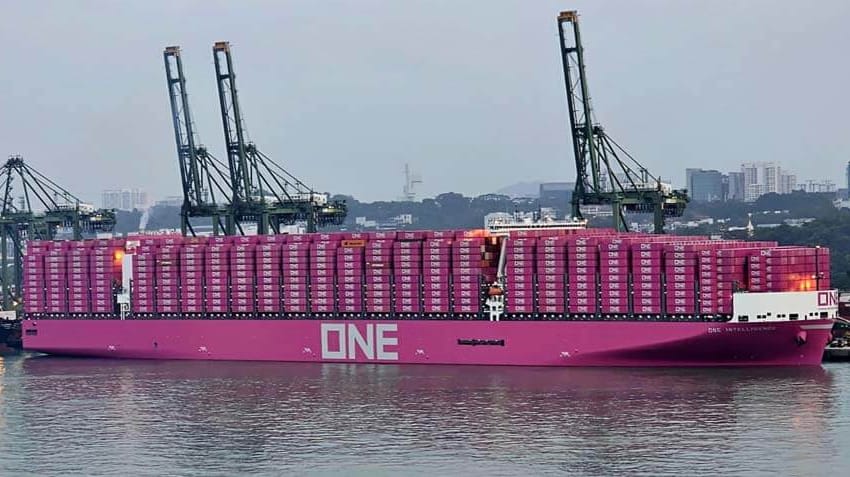
Do you want to supersize that containership may soon be the question shipbuilders and owners are contemplating, according to the consultants at Alphaliner. While the industry has plateaued at ultra-large container vessels, Alphaliner sees the elements that could easily lead to a new, ever-bigger class of Gigamax container vessels.
The consultancy is dusting off hypothetical concepts it presented five years ago, saying that market factors may just make the timing right for the new, bigger ship. It foresees a time by 2030 when the world’s top carriers could “theoretically deploy at least one 'full set’ of next-generation containerships on the East-West mainlines.”
“Increased cost pressure might prompt some of the largest carriers to reconsider their fleet strategies,” writes Alphaliner. It predicts some of the carriers will “opt for a novel ship type that is slightly larger than the current capacity record holders.”
The industry has a strong history of moving through these size categories. It went to the 18,000 to 19,000 TEU vessel for economies of scale. The next jump was to 23,000 to 24,000 TEU, but according to Alphaliner, for about a decade now carriers have stuck with that level. The ships are about 400 meters (1,312 feet) in length and have a beam of 61 meters (201 feet). It fits through the Suez Canal, and ports are adapted to handle this size of vessel. Shipyards and naval architects have toyed with the available space, and by making small changes to loading patterns and systems, they have squeezed the capacity by at most a few hundred boxes. The largest official TEU rating now stands at just over 24,300 boxes.
Carriers have discussed bigger ships, but so far none has made the move. They said the 24,000 TEU load seems "about right" for the market and the operating factors.
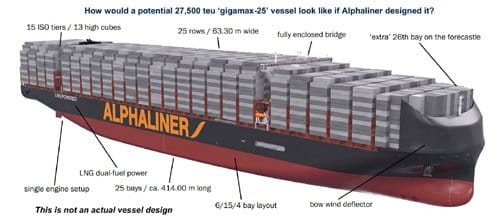
Alphaliner's hypothetical concept for a 425+ meter container vessel with 27,500 TEU capacity
The consultants at Alphaliner, however, are answering the question of why carriers might finally jump the current barrier.
“Especially in very long-haul East-West mainlines,” says Alphaliner, “factors like the increasing price of fuel and the introduction of carbon emissions taxes will give bigger ships a competitive edge in the long run.”
Its Giamax concept would be incremental, adding one hold or possibly two 40-foot bays beyond today’s 400-meter ships. They forecast a length of 425 meters or more, and that would give the ships a capacity of 27,500 TEU.
They believe that the ports that have already adapted to the 24,000 TEU ships would be able to absorb these slightly larger vessels. The applications would be limited, however, as many ports, such as in the United States, cannot handle even the 24,000 TEU ultra-large vessels.
Alphaliner is not the only one working on theories for the next generation of giants. China’s Shanghai Ship Research and Design Institute and projects looking at the future of nuclear-powered containerships have also shown the potential to leap the 24,000 TEU barrier.
The concept of going to bigger ships seems to fit with the trends in the industry. As the ships get more expensive to build and operate, more boxes will rebalance the economic equation and potentially help with the anticipated wave of older ship retirements that has long been predicted.
The container segment already has a record orderbook as carriers continue to order new ultra-large vessels. Alphaliner points out that over a relatively short period of time the industry’s capacity has soared from 23.2 million TEU to a current 34.1 million TEU. It is up 47 percent, and deliveries from the orderbook are likely to continue to drive capacity in the sector.

No comments:
Post a Comment