First LNG Carrier with Two Wind Sails Named Ahead of Commissioning

Japan’s Mitsui O.S.K. Lines celebrated the naming of the first LNG carrier fitted with rigid sails, which is also the first vessel to be fitted with two of the sails. The vessel, named Fujin Sailor, was built at Hanwha Ocean’s Geoje, South Korea, shipyard and, when delivered at the end of the month, will begin operating under a long-term charter to Chevron.
Development of the ship required a collaborative effort between MOL, Chevron, and Hanwha Ocean to address the unique challenges of fitting the sails to an LNG carrier. They had previously highlighted that for tradability, the installation position of the Wind Challenger rigid sails aims to minimize impact on the existing design of membrane-type LNG carriers. They said it would enable the unchanged retention of the existing mooring arrangement and thereby minimize impacts on ship-to-shore compatibility, together with limited impact on the vessel's windage area.
It is the first application of a design concept that was approved in 2024 after MOL and its partners conducted a risk assessment that comprehensively evaluated factors such as the placement of the sails, their impact on visibility, emergency operation procedures, and other safety measures, to add the technology to an LNG carrier. It also worked with GTT (Gaztransport et Technigaz), which holds the patents on the technology for the LNG tanks, for the evaluation of the impact on the cargo tank due to the sail installation.
The vessel is 295 meters (968 feet) with a capacity for 174,000 cbm of LNG. It uses an Everllence (MAN Energy Solutions) main engine and is also fitted with air lubrication for the hull and shaft generators. The telescoping rigid sails are made of fiber-reinforced plastic. Each sail consists of three panels and, when fully extended, stands approximately 49 meters (160 feet) above the deck near the bow of the ship. Each is about 15 meters (49 feet) in width. The first images of the ship appeared in May as it was outfitting after the sails were installed.
It is the fourth vessel that MOL has outfitted with its wind sails, after two coal carriers and a bulker. Plans call for a second, similarly sized, LNG carrier to be delivered later this year, also fitted with two Wind Challenger sails. It will be operating under charter to Tokyo LNG Tanker Co., a subsidiary of Tokyo Gas. The vessel is also being built by Hanwha Ocean at the same shipyard.
MOL has currently committed to installing the Wind Challenger rigid sail on a total of 11 vessels. It has also ordered six bulk carriers, each to be fitted with one rigid sail. They are being built by Japan’s Oshima Shipbuilding Co.
It is a further demonstration of the growing trend to leverage wind-assisted propulsion more broadly in commercial shipping and in more categories of ships. Maersk and Anemoi Marine Technologies recently agreed to the first test of a wind rotor aboard a containership. That installation is scheduled for mid-2027.
bound4blue Secures Bureau Veritas Design Assessment for Model 3-24 eSAIL
bound4blue's eSAIL® technology gains independent validation from Bureau Veritas.
[By bound4blue]
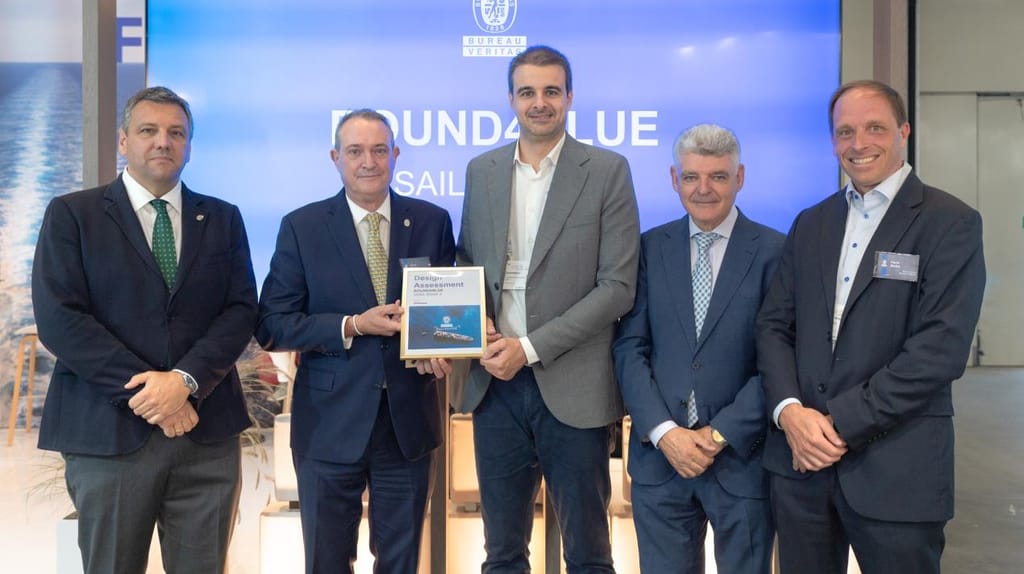
bound4blue has received a Design Assessment from Bureau Veritas Marine & Offshore for its flagship Model 3-24 eSAIL®, developed to maximise the contribution of wind propulsion on larger vessels.
Presented during a handover ceremony at SMM 2026 in Hamburg, the assessment confirms that the design has been independently reviewed against Bureau Veritas' technical requirements, providing further confidence for shipowners looking to deploy proven, scalable wind propulsion solutions.
bound4blue’s eSAIL® suction sail technology has made significant strides forward across multiple shipping segments in the space of the past year, with more than 50 units now ordered and installations completed onboard 13 vessels.
The Model 3 range spans heights from 24 metres to 36 metres, with the 3-24 becoming the first commercial installation earlier this year onboard Klaveness Combination Carriers' newbuild MV Baltazar. The sails feature an expanded surface area and optimised aerodynamic profile, ensuring even the largest ships can take advantage of compelling commercial and regulatory gains.
“As the market matures, confidence becomes just as important as innovation,” says José Miguel Bermúdez, CEO and co-founder of bound4blue. “So, as wind takes its place within mainstream fleet investment, independent assessments really do play an increasingly important role in differentiating and substantiating technical solutions.
“Here at bound4blue it’s been a focus since day one. We are committed to engaging with leading Class societies to demonstrate the quality and potential of our proprietary technology. By doing so we provide owners, yards and wider industry stakeholders with the reassurance they need to embrace the wind revolution and unlock significant environmental and business benefits. We’re delighted to achieve this latest recognition from Bureau Veritas as we continue to cement our position as a trusted industry partner.”
The Model 3-24 builds on bound4blue's proven Model 2 platform, retaining the company's hallmark technical simplicity for straightforward installation and autonomous operation.
eSAILs® work by utilising boundary layer suction to draw air across an aerodynamically optimised surface and generate propulsive force up to seven times greater than rigid sails of the same size, while requiring far less maintenance. The result is significantly lower fuel consumption, reduced CO? emissions and improved operational efficiency. In addition, the non-ATEX technology supports compliance with a growing range of environmental regulations, including FuelEU Maritime and the EU Emissions Trading System (EU ETS), while contributing towards improved Carbon Intensity Indicator (CII) performance and EEXI compliance.
Speaking of the Design Assessment process, David Barrow, SVP for Western Europe and Americas at Bureau Veritas Marine & Offshore, comments: “Wind propulsion is becoming an increasingly important element of the maritime industry's decarbonisation journey, and independent technical assessment helps provide confidence as these technologies continue to mature and scale. Through this Design Assessment, Bureau Veritas is pleased to support bound4blue in advancing safe and reliable innovation, helping shipowners reduce emissions while maintaining robust technical standards.”
eSAILs® have emerged as a solution of choice for many of shipping’s leading names, including companies such as Maersk Tankers, Eastern Pacific Shipping, Odfjell, Louis Dreyfus Company, and many more.
Designed as a simple, plug-and-play system for both retrofits and newbuilds, bound4blue suction sails operate alongside conventional propulsion systems while also supporting the adoption of future fuels such as methanol and ammonia, helping shipowners integrate complementary sustainability solutions into their decarbonisation strategies.
eSAILs® are market proven to deliver double-digit fuel savings, with typical payback periods of less than five years.
The products and services herein described in this press release are not endorsed by The Maritime Executive.

No comments:
Post a Comment