Veteran Catalan trade union activist Alfons Bech was imprisoned during the 1939–75 Franco dictatorship in Spain. During the civil war in Yugoslavia in the 1990s, he was involved in organising aid convoys to Bosnia and afterwards in cooperating with trade unions in Bosnia, Macedonia, Kosovo and Serbia.
Bech is now the International Network for Solidarity with Ukraine (INSU) trade union coordinator and a member of the Coordination Group of the International Solidarity Convoy to Ukraine, organising its Southern Route from Barcelona to Kyiv. He spoke to Dick Nichols for LINKS International Journal of Socialist Renewal about the goals and organisation of the Convoy.
Where did the idea of the International Solidarity Convoy to Ukraine come from?
It emerged on the second anniversary of Russia’s full-scale invasion (February 22, 2024), when the European Network for Solidarity with Ukraine (ENSU, now INSU) proposed organising a large international delegation of trade unions and trade unionists to an event in Kyiv that the Federation of Trade Unions of Ukraine (FPU) and the Confederation of Free Trade Unions of Ukraine (KVPU) prepared with the support of the European Trade Union Confederation (ETUC).
We in Catalonia wanted as many European trade unions as possible to send delegations to make their solidarity visible.
What happened?
Trade unions participated in very large numbers, but online. Only one delegation went to Kyiv, representing the Catalan affiliate of the all-Spanish General Union of Workers (UGT).
The UGT delegation was very shocked by what they saw, but very pleased to have been there in person. They saw the devastation Russia had caused in Bucha and in the neighbourhoods of Kyiv, took part in the distribution of some material aid, and got to know a little about Ukrainian culture.
From this, a sort of twinning has developed between the UGT and Ukrainian trade unions, which has been key to our understanding of this war and to the aid effort for Ukraine in Catalonia.
Many aid convoys have already gone to Ukraine, including from the trade union movement. What makes this one different?
This Convoy is building on what has already been done at the grassroots level in terms of aid to Ukraine.
The Ukraine Solidarity Campaign (USC) in England and Wales has run many convoys to Ukraine and trade unions in many European countries have themselves been running convoys, often supported by local Ukraine solidarity committees.
There have also been the workers’ aid convoys organised by the International Labour Network for Solidarity and Struggle, with participation from different European countries and Brazil. Norwegian and Swedish trade unions maintain shipments of vehicles and materials every month.
In Catalonia, Sister Lucia Caram of the Convent of Santa Clara Foundation has already organised 45 convoys. There has been, and continues to be, a great deal of solidarity with Ukraine in Catalonia. So, we start from this reality and the accumulation of valuable experience it represents.
Nonetheless, this Convoy takes place at a crucial moment for Ukraine and Europe. We are entering the fifth year of a brutal war, and it is not clear how much further attacks the country’s already heavily damaged infrastructure can withstand.
The experience of the past four years shows Ukrainian workers will continue to suffer greatly from always having to repair infrastructure under enemy fire. Russia, conscious of this situation, is preparing to attack even more forcefully what is essential to the survival of the population: energy, cities, hospitals, schools, the bridges of Kyiv, the water supply and the sewerage system
It is a genocidal plan. But it is not being implemented because Russia is doing well in the war or economically; on the contrary, it is a case of “killing while dying.” [Vladimir] Putin’s regime faces many difficulties, and these are translating into savage attacks on Ukraine’s civilian population and more repression within Russia itself.
In this situation of extreme need, we of course know that any help the Convoy can provide, while useful, will be a drop in the ocean.
That is one potent reason why the Convoy must have an extra, political, dimension, as a public and visible show of support from the working people of the rest of Europe to their sisters and brothers in Ukraine. It repeats the cry of the Spanish Civil War, ¡No Pasaran! (They shall not pass) against today’s enemies of human and democratic rights and their chief guarantor, the majority of working people.
We, in Catalonia, cannot bear to see in Ukraine a repeat of the Spanish Republic’s fate, which was abandoned in the face of international fascism. That treachery by great “civilised” powers intent on appeasing [Adolf] Hitler and [Benito] Mussolini cost the peoples of the Spanish state forty years of fascism.
So, the stakes could not be higher…
It is why we in INSU see the need for the sort of sharp expansion of solidarity action that the Convoy represents — it is not enough for us to just carry on doing what we have been doing up to now.
What the Convoy offers is not only humanitarian or material aid, important though it is this be as large as possible. It is also an instrument for showing that boosted solidarity with Ukraine starts from the bottom up. We know much more can be done than is being done, and that the time to do it now.
This is not just a message about getting more and bigger donations, but of raising awareness about what the overall effort of solidarity with Ukraine must involve. One critically important example: it is urgent Ukraine receive the €210 billion in frozen Russian assets held by Western financial institutions, such as Euroclear, to fund its defence effort.
I am against the increase in military budgets by Western European governments that will come at the expense of the social budget. But the people of Europe must be aware that, while most of their governments are looking for ways to cut social spending and increase military spending, these same governments are also reluctant to declare the kind of financial war on the Kremlin that would be involved in releasing these assets to Ukraine. The Convoy will be a platform for this and other important messages.
Many networks, committees and individuals have been doing very valuable work helping Ukraine. But there are still many social movement activists, trade unionists or people just concerned about what is happening in Ukraine who would like to help but do not know how. Supporters of Ukraine must keep trying to find projects that allow them to do so.
For example, in Catalonia, the local affiliate committee of INSU has managed to bring three important and very different organisations into the Convoy organising core. There is a major trade union confederation (the UGT); a pacifist, non-violent action association (NOVACT, International Institute for Nonviolent Action), which is also carrying out work in Ukraine; and a humanitarian NGO that has been working in Ukraine since before the 2014 Maidan mass protest (Help to Ukraine).
The Convoy is therefore not the work of a single network, but of a conglomerate of associations and networks, as can be seen on its website.
What organisations are supporting the Convoy? And just how international is it?
As of early October, a growing number of trade union organisations, social movements and elected representatives from 20 countries have officially supported the Convoy.
Trade union support includes the FPU, the Swiss Trade Union Federation, the Brazilian Trade Union and Popular Centre Conlutas, the General Labour Federation of Belgium, the Belgian Confederation of Christian Trade Unions, the UGT of Catalonia, the Irish Nurses and Midwives Organisation, the University and College Union of the United Kingdom and the Theatre and Performing Arts Trade Union of Norway.
It is also supported by more than 20 political organisations and parties spanning Europe, the Americas, Asia and Oceania, and more than 40 MPs and public representatives, including 18 Members of the European Parliament, as well as national MPs and regional and local councillors.
More than 50 solidarity associations, NGOs and independent media outlets have also expressed support. All of this can be found on the Convoy’s website, which we update weekly as the number of organisations and volunteers grows.
In Catalonia, Convoy partners have also been seeking institutional backing. For example, they have submitted a proposal to the Parliament of Catalonia for a formal declaration of support, which will go to a parliamentary session in mid-October. Likewise, they have sent motions to several councils in the Barcelona metropolitan area with the same aim. Some cities have already approved them.
This initiative has allowed supporters of the Convoy to hold events with the backing of local authorities, raise funds and publicise the Convoy before new audiences. It is also a step towards encouraging municipalities to undertake longer-term projects with Ukrainian counterparts, applying the city-to-city approach that was developed during the Bosnian War between the Barcelona City Council and that of Sarajevo (a relationship that continues to this day).
This is another necessary dimension of solidarity: establishing long-term relationships and connections between trade unions, NGOs, feminist and LGTBI associations, and municipalities in Ukraine and the rest of Europe. It is practical, human internationalism that becomes political because it has a long-term perspective, is committed to a just peace for Ukraine and will, we hope, allow civil society involvement in future reconstruction work.
Can you explain how the Convoy will work? For example, it has launched its own fund appeal.
The initiators of the Convoy took the view that the project itself would open new possibilities for fundraising that would not “crowd out” fundraising already under way, some of it by INSU affiliates.
That certainly appears to be the case, because the fundraisers of INSU affiliates in Belgium, Italy and Scotland are already approaching their targets while the central fund appeal “Generators and Stoves to Ukraine” is now (as of October 19) approaching 30% of its €100,000 target after a bit more than a month of serious effort. This shows the initiative is reaching a broader audience of people who want to do something for Ukraine.
After all, contributing to the fund appeal is the least that anyone can do. If people cannot do anything else, please make a donation.
What experience do the people on the Convoy have of conditions in Ukraine?
It is varied. Some, like our Italian colleagues from Sinistra per l'Ucraina (Left for Ukraine) and the English and Welsh colleagues from USC have been taking aid to Ukraine for many years, but for many participants, it will be their first time.
I have been to Ukraine three times during the war myself, but not on a convoy. As you can imagine, the Convoy will be organised with the greatest possible emphasis on security, and with clear rules of behaviour and training provided by Convoy supporters with experience of Ukrainian conditions, including Ukrainian supporters themselves.
What is the Convoy planning to take to Ukraine?
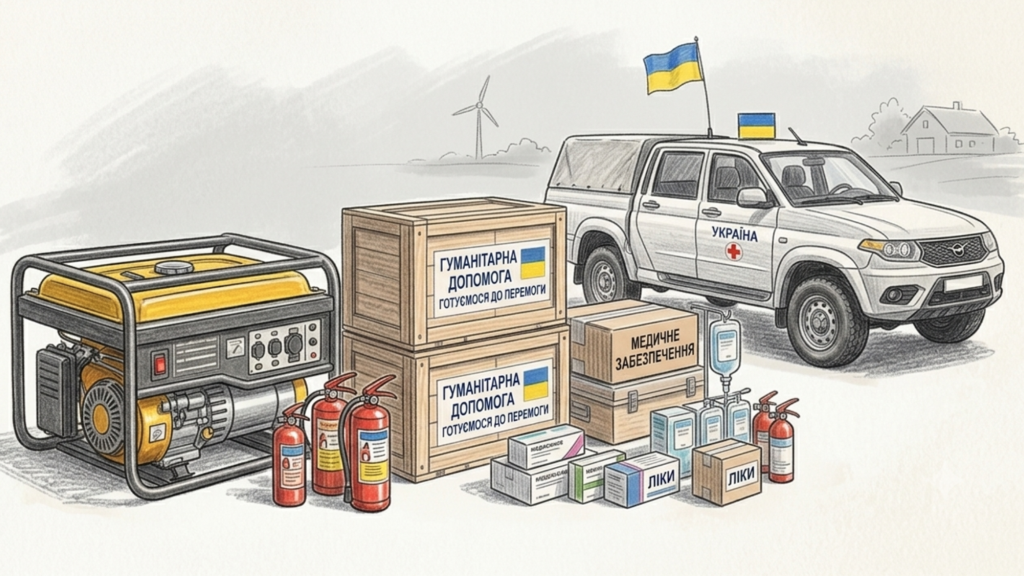
The main “cargo” will be generators, wood-burning stoves, medical supplies, electrical equipment that cannot be sourced in Ukraine and vehicles. We will provide humanitarian aid, supplying whatever we can of the requests received from Ukrainian organisations.
What stops will the Convoy be making along the way?
We will be holding events in various capitals and key cities where there are European and international institutions, to have them listen to this initiative that comes from the grassroots.
The Convoy will set off along three routes crossing Europe — a Nordic, a Central and a Southern route, with this last having two branches (one starting from Barcelona, the other from southern Italy). This approach allows us to organise events in Geneva, home to the ILO [International Labor Organization] and the United Nations; in Strasbourg, home to the European Parliament; and in Brussels, Berlin, Warsaw, Krakow and other cities before entering Ukraine.
The full Convoy itinerary before entering Ukraine will be publicised once finalised.
How are organisations or other initiatives that are already involved in solidarity with Ukraine, and have organised other aid deliveries, responding to the Convoy?
Most of the committees and organisations in INSU in Europe are involved, associating their own ongoing projects to one degree or another with the Convoy.
However, a very interesting feature is that the Convoy has sparked the enthusiasm of organisations and activists with whom INSU had little or no contact until now. This is happening both in Europe and in Ukraine itself, as well as on other continents such as North and South America and Australia.
It confirms that if one works with an open and general idea of solidarity, a very broad united front can be formed to help Ukraine, its working people and their social and democratic organisations. This sort of unity is essential, and its visibility in turn strengthens the base of social support for the Ukrainian people’s resistance.
While the Call for Support of the Convoy sets out clear and concrete points, there are organisations supporting the Convoy from very different ideological standpoints — from conservative Labourism through to anarchism. How will the Convoy Coordination Group reconcile such differences?
In part by anticipating them. At the outset, those of us involved in developing the Convoy’s Call for Support decided on a document that would articulate the core positions uniting supporters of Ukraine’s national and social rights.
This came down to three objectives: deliver the aid requested by Ukrainian beneficiaries; build lasting links between progressive organisations from across Europe and Ukraine; and defend the principles of democracy, human rights and international law.
This, of course, means that the Convoy is silent on very important issues thrown up by Russia’s full-scale invasion, such as the need or otherwise of NATO and the nature of the Zelensky government.
Debate on such issues is unavoidable, ongoing and necessary. As the Convoy’s media statement on its political basis explains: “As a broad solidarity initiative the Convoy, while welcoming the necessary discussion on such questions, does not adopt a stance on them, but confines its public statements to the principles on which it has been launched.”
The Convoy is already a meeting point for many different people and ways of thinking. For example, not everyone wants to “do politics.” Many activists are there to bring humanitarian aid; for them the convoy is an opportunity to do something they consider useful and essential.
But that does not prevent those of us who believe that, in addition to bringing this humanitarian aid, the Convoy must try to help strengthen Ukraine’s trade unions and civil society organisations. For some, this is as important for preparing the just reconstruction of Ukraine as securing aid and company and government financial support.
For example, Ukrainian trade unions have been calling on European trade unions to support a reconstruction of Ukraine with full rights of association, negotiation and social dialogue, where working people have a voice and vote in decisions, so as to protect themselves from the greed of oligarchs.
In the proposal for a Declaration by the Parliament of Catalonia that I mentioned, Convoy organisers incorporated some points requested by the FPU and KVPU regarding this concept of a just reconstruction. Hopefully, the declaration will be approved by a large majority of Catalan political forces.
In Ukraine, trade unions are not content with the neoliberal policies being implemented or with labour reforms that will diminish rights. There is also broad popular discontent with corruption, even on the streets amid the war. What impact, if any, do you expect the Convoy to have?
The Convoy, while supporting Ukraine’s rights and its resistance in general, also looks to help strengthen trade unions and civil society organisations inside Ukraine and make them more visible in the rest of Europe. The goal is to have Ukrainian workers enjoy the same conditions and opportunities that we have won.
That is why we stand with workers’ unions, student unions, nurses’ unions, and railway unions when the Ukrainian government attacks their rights.
The process Ukraine is undertaking to join the European Union should serve to raise the bar on guarantees for labour rights, human rights, and opportunities for progress for the entire population. It cannot be that working families who had to flee because of the war, choose not to return to Ukraine because there is no affordable housing, or because there are only low-paid jobs, or because schools are so damaged that children and young people cannot study.
Families should have a choice whether the men leave to join their wives and children abroad or whether all return because there are decent living conditions. Demographic collapse after the war would be a disaster of great magnitude for Ukraine.
That is one important reason why we hope the arrival of the Convoy will have an impact within Ukraine, for everyone, including local oligarchs and Western investors — it will demonstrate that there is support from workers in the rest of Europe for Ukrainian workers and trade unions. That all are united in the perspective of a just peace and a reconstruction with rights and guarantees.
With the agreement of the Ukrainian trade unions and organisations, we would like to hold a unity event in Kyiv on this vitally important theme.
Can solidarity with Palestine, which has enormous support in much of Europe, go with solidarity with Ukraine?
The Convoy does not require participants to take a position on Palestine, but my personal response is: “Yes, it should.” Both peoples are victims of ruthless attacks by aggressive colonialist powers that want to lay hold of their wealth and, moreover, root out their very culture.
The key difference is that Ukraine has a real state while Palestine does not. That is why Ukraine can defend itself much better than the Palestinians. But the underlying problem, which is the right to self-determination of nations, is identical.
Some on the left make a banner of Palestine’s freedom and reject Ukraine’s freedom. Their viewpoint is tainted because they only want to see one dangerous imperialism. They are so short-sighted that when [Donald] Trump rolls out the red carpet for Putin and connives with him to ensure that Ukraine cannot fully defend itself, they just do not want to see the ongoing cynical collaboration between imperialists in front of their eyes.
This section of the left would embrace a deal between powerful actors against Ukraine’s sovereignty, territory and resources in the name of “peace”. But an imperialist peace, agreed from above between mafiosi who ignore the invaded nation, can never be just.
As the Ukrainians say: “Nothing about Ukraine without Ukraine.” To defend Palestine but to turn that solidarity against Ukraine, as some do, is to fall into the trap set by Putin. By being passive or indifferent about either oppressed nation, you effectively offer support to their oppressor.
That is why we in INSU go to demonstrations for both Ukraine and Palestine with a banner that says: “From Ukraine to Palestine, occupation is a crime.”
What final message would you give to anyone reading this interview? Why should they support this Convoy?
This Convoy is an opportunity for everyone who wants to do something to end a horrendously cruel invasion on just terms. For everyone who has no trouble recognising that this aggression was started by Putin, not NATO, and who want to do something to support Ukrainians’ just resistance. For everyone who does not want to be on the wrong side of history or have their conscience scarred by the thought of having done nothing until the war was over.
Readers of LINKS can contribute to the International Solidarity Convoy to Ukraine Fund Appeal here.

_2.jpg)