Germany's shocking far-right surge rattles Europe's political foundations
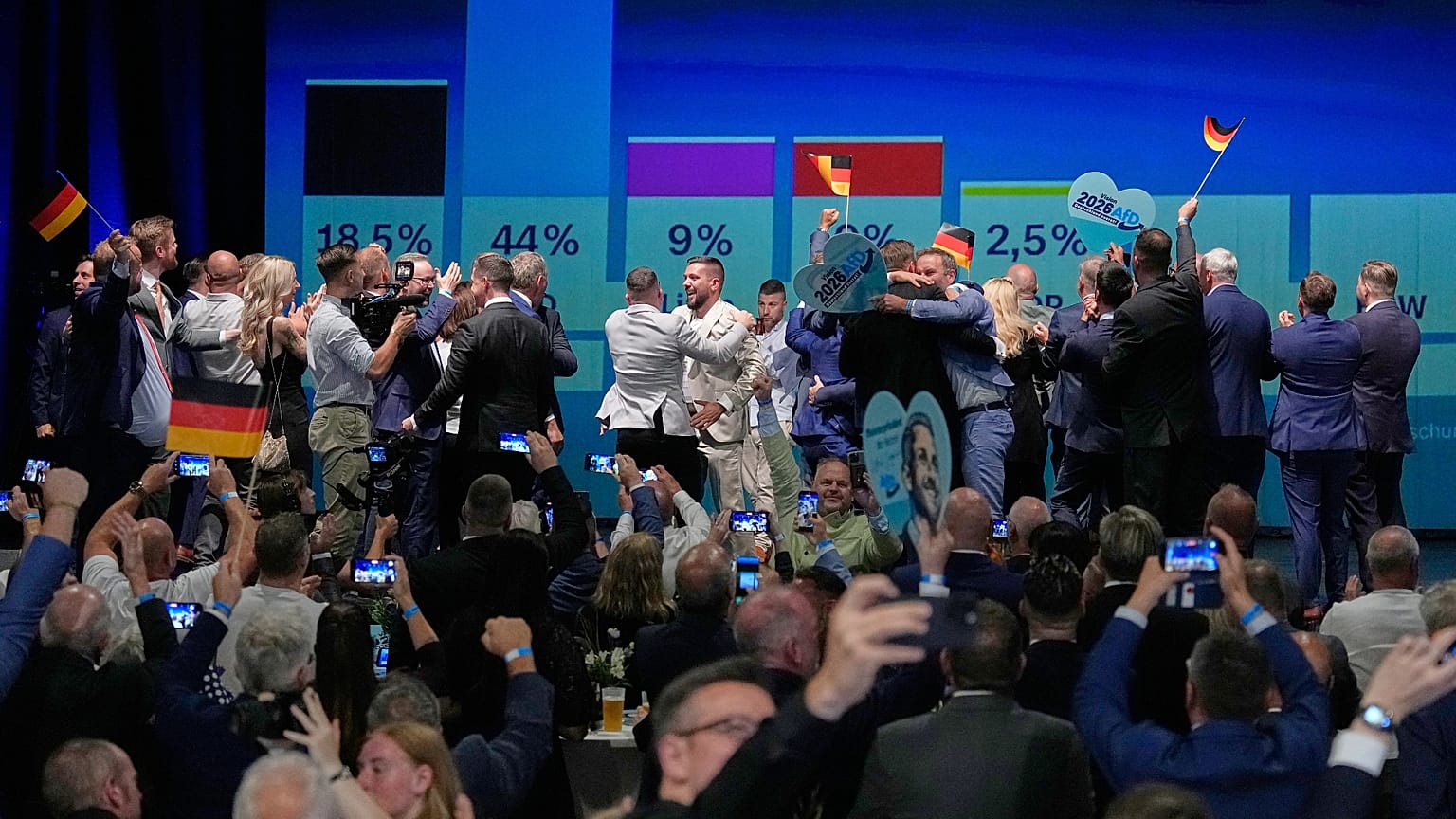
AfD's landslide win in Saxony-Anhalt could be the prelude to far-right forces governing alone across Europe. Germany's 'grand coalition' model, and the centrist alliance underpinning EU politics, are starting to crack.
The radical-right Alternative for Germany's landslide victory in the Saxony-Anhalt region election may be the first real crack in the power structure that has held European politics together since the Second World War
On Sunday, Alternative for Germany (AfD) won a resounding victory in the eastern German region, taking 43.8% of the vote. Chancellor Friedrich Merz's Christian Democratic Union (CDU), which leads the governing coalition in Berlin, collapsed to 17.2%, while its junior coalition partner, the Social Democrats (SPD), managed just 9.3%.
For the first time since the Nazi period, a German region could be led by a far-right force, as local leader Ulrich Siegmund could become president if the far-left party BSW decides to support him or to abstain in the election.
Beyond dealing a further blow to an already deeply unpopular government in Berlin, the results drew mixed reactions across Europe, with far-right forces eager to capitalise as key EU states head to the polls next year.
"This result is not an outlier - it is a signal to the rest of Germany and to Europe," René Aust, the head of the AfD delegation to the European Parliament, told Euronews.
"We are on course to become the country's leading governing party, and I am convinced that at the next European elections we will return to the European Parliament with more than twice our current strength," Aust said.
European repercussions
"The region Saxony-Anhalt is a small part of Germany. 1 out of 16 regions," Andreas Schwab (Germany/EPP) said, playing down the impact of the vote. "The [AfD] party has no real power in Berlin, where the great coalition has a clear majority."
For Schwab, the vote's impact in Brussels will likely be limited to reinforcing the EU's simplification agenda — cutting red tape, including for farmers — and pushing for a more nationally oriented EU budget.
Svenja Hahn (Germany/Renew) echoed that view. "We can only hold up a democratic majority in 2029 by finally delivering on economic growth and prosperity and taking the regulatory burden off of people and businesses," she said.
Still, the result is bound to raise alarm bells across Europe, not just for its impact on German domestic politics, butbecause Germany’s grand-coalition tradition provided a foundation for the political consensus at the heart of European integration for much of the postwar era.
The centre-right European People's Party (EPP) and centre-left Socialists and Democrats (S&D) have been the linchpin of Brussels politics since the European Parliament was created, at times with the support of the centrist Renew Europe group.
But the rise of extremist parties and the steady erosion of the political centre is now calling that approach — born in Germany, exported to Brussels — into question. Last month, Europe Elects projected that the three centrist forces would, for the first time, fail to secure an absolute majority if European Parliament elections were held today.
"It is no more about who can speak with whom and how different factions of democratic society can unite. It is about how to get their joint share larger, not by stealing the electorate from one another, but by convincing those who are disappointed by all of us, democrats," MEP Sergey Lagodinsky (Germany/Greens-EFA) told Euronews.
Far-right into power
The AfD's growing electoral gains across Europe have raised the prospect that far-right parties could enter government outright. In Saxony-Anhalt, the AfD fell short of a majority to govern alone but could reach one in coalition with the BSW.
How much power-sharing traditional parties allow has depended on national context, and on whether mainstream forces are willing to ally with the far right.
In Italy, for instance, Giorgia Meloni has steered her coalition government towards the centre, making her European party, the European Conservatives and Reformists (ECR), increasingly mainstream. As a result, she now faces competition from a new far-right force led by Roberto Vannacci (Italy/ESN), a former army general turned MEP.
In Spain, the centre-right Popular Party has partnered with the hard-right Vox to govern several regions, including Andalusia and Castilla y León, a model some would like to see exported to Brussels.
"In each country, it really depends on how radical the far right is and how much there can be any kind of collaboration. But, in general, collaboration with the far right was not good for us. We have stayed weak," MEP Hildegard Bentele (Germany/EPP) told Euronews.
Within the European Parliament, the EPP group led by the Bavarian Manfred Weber has throughout this legislative term kept a flexible approach to forming variable majorities, at times seeking support from hard-right parties over specific files.
While Weber's strategy has strengthened the EPP's negotiating hand and drawn the ire of other centrist forces, moving from case-by-case alignment to a more structural alliance would entail a fundamental reshaping of power-sharing at the EU level.
As of now, Weber has always excluded structured cooperation with far-right forces, while some parties forming the EPP have often wished for it.
Elections loom
In 2027, voters in France, Italy, Poland, Spain, Estonia, Greece, Finland, Malta and Slovenia will all go to the polls in high-stakes national elections. In France, in particular, far-right presidential candidate Marine Le Pen is projected to win against any other candidate in the run-off.
These upcoming elections will reshape Europe's political landscape ahead of the next EU elections in 2029, which, if current trends hold, could be the first not to hand mainstream parties a governing majority.
"[The Saxony-Anhalt election] It's a very strong warning signal, but we have three years ahead of elections, so we have a lot of time to become stronger again. The warning signal is out. We have to work on our own strengths," Bentele said.
Bentele drew two main lessons from the results: the need to mobilise people who had not voted in the last elections — the main driver of the AfD's surge — and the need to choose better-suited candidates.
Meanwhile, Aust noted that only voters over 70 kept the AfD from securing an absolute majority at the regional level, which he considers clear evidence that the future belongs to patriotic forces and that the CDU will soon become "the party of yesterday," as was the case for Democrazia Cristiana in Italy.
For Lagodinsky, the challenge ahead is nothing less than restoring disappointed voters' faith in liberal democracy. "If we don't get our act together on that, our democracy is doomed," he concluded.
AfD surge in Germany exposes deep divisions on the Italian right
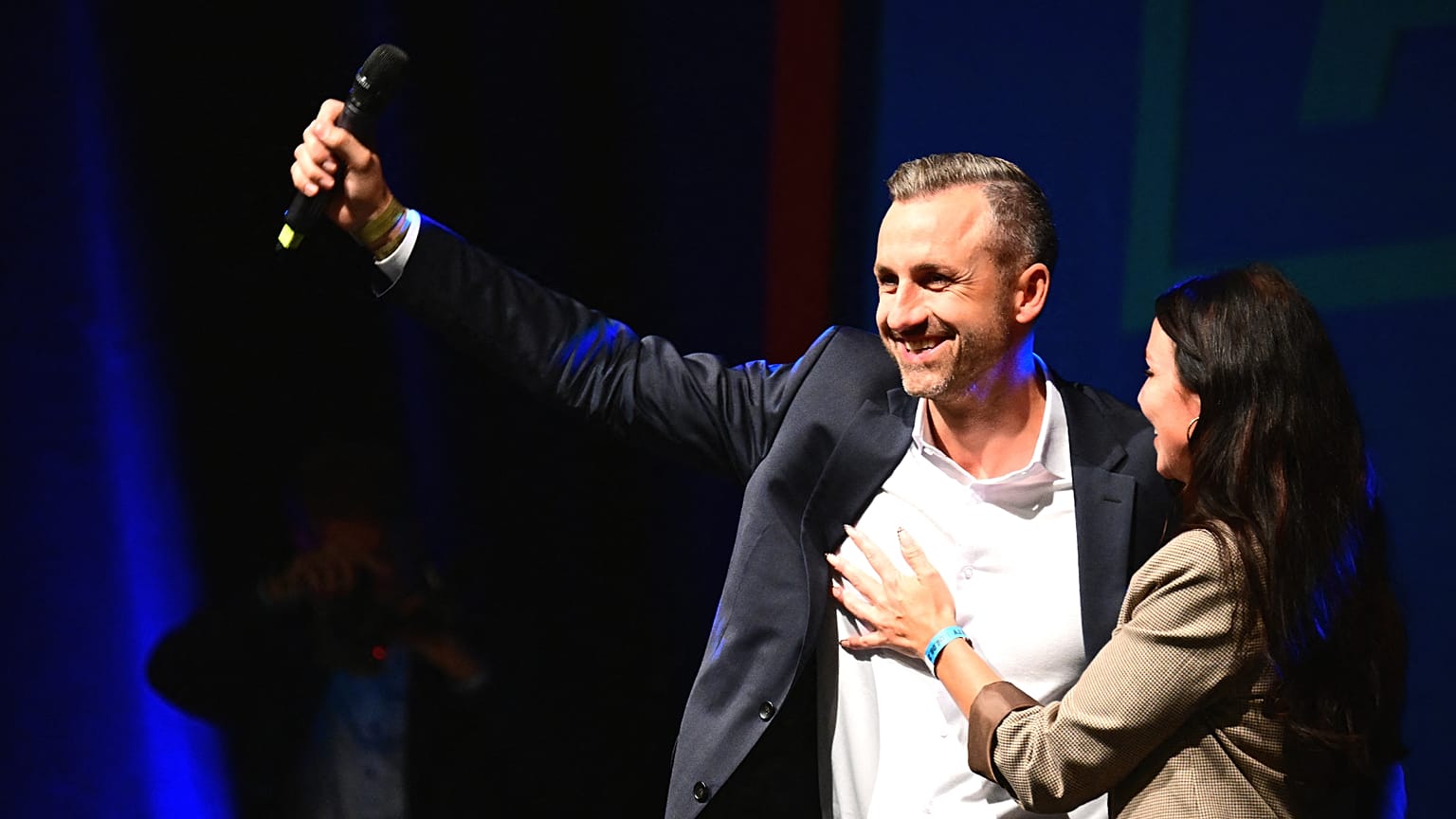
A landslide win for Germany's AfD has forced Italy's right-wing leaders into the open, revealing sharply different views on Russia, Ukraine and how far the political mainstream should go in engaging with Europe's rising far right.
As the far right made significant gains in local elections in Germany, divisions have opened up within Italy's political right.
The AfD (Alternative for Germany) took 43.8 per cent of the vote in Saxony-Anhalt, a historic result that has shaken the federal government in Berlin. The shockwave reached Rome, where reaction from Italy's governing parties was sharply divided.
Sunday's election result in Saxony-Anhalt is "a worrying signal", said Forza Italia leader and foreign minister Antonio Tajani. "A negative signal," he added, although there is no need to "overdramatise" it, he told Il Messaggero.
"It was widely expected — it was known that the AfD could score a clear victory. After all, most of their success comes in eastern Germany," said the deputy prime minister. "That region is the poorest part of Germany, and extremism always takes root where there are the greatest economic difficulties."
Transport and infrastructure minister Matteo Salvini took a very different view. "An extraordinary success, which highlights the strong demand for change, security and jobs," the League leader said in a post on X.
"Fear? Terror? Danger? No, it's called DEMOCRACY. Another Europe is possible," he concluded.
Italy's two deputy prime ministers remain split over support for the AfD who is opposed to arming Ukraine and keen to end sanctions on Moscow in return for cheaper energy supplies. Meloni herself chose not to comment directly, leaving Galeazzo Bignami, Brothers of Italy's leader in the Chamber of Deputies, to speak on her behalf.
"This is neither a positive nor a negative assessment," he said. "When the electorate speaks, the outcome of the vote must always be accepted, whatever it is."
"Handing out certificates of democracy or otherwise to a force that has taken part in the democratic game and been democratically elected seems to us a prejudiced judgement," Bignami added.
The Vannacci question and the rise of the pro-Russian right
The election result in Saxony-Anhalt, Germany's poorest state, has made the question of how to handle the rise of former general Roberto Vannacci even more complex for Rome.
The former Folgore Brigade commander — now an MEP and leader of Futuro Nazionale — celebrated the AfD's victory on social media. "Europe is changing," he wrote on Facebook. "Nessun dorma."
Vannacci's platform overlaps closely with the AfD's: both attack the EU, call for forced "remigration", and push for cuts to aid for Ukraine. According to the latest YouTrend polling, his party stands at 7.9 per cent, ahead of Forza Italia (7.1 per cent) and the League (4.4 per cent) — putting Meloni's next election at risk without his support.
Vannacci has repeatedly criticised the governing coalition's approach to migration and aid for Kyiv, earning him the Financial Times label "Russia's Trojan horse". Russia remains one of the sharpest fault lines on the right: the AfD opposes aid to Ukraine, and leader Alice Weidel has proposed scrapping sanctions on Moscow and resuming Russian gas and oil imports.
The result was welcomed in the Kremlin. "The historic AfD victory humiliates the arrogance, narrow-mindedness, warmongering, ineptitude and hypocrisy of the discredited German governing coalition," wrote Kirill Dmitriev, the Kremlin's special envoy and head of the Russian Direct Investment Fund, in a post on X.
This pro-Russian wave — echoed in Italy by Vannacci — creates headaches for Meloni, who has pledged support for Ukraine, underscored by defence minister Guido Crosetto's appointment of former Ukrainian defence minister Mykhailo Fedorov as an adviser on military innovation.
Divisions on the right are visible in Europe
Italy's right is split on how to treat the AfD, and the divide is sharpest on foreign policy — particularly Russia.
Forza Italia takes the toughest line. As Italy's member of the European People's Party (EPP), the centre-right group that dominates the European Parliament, it firmly backs NATO unity and supports a "cordon sanitaire" — a deliberate political isolation — to keep the AfD shut out of mainstream EU politics.
Meloni's own party, Brothers of Italy, sits in a different group, the European Conservatives and Reformists (ECR), but takes a broadly similar view.
Salvini's The League's relationship with the AfD has followed a different path. The two parties were once allies in the European Parliament, first in a group called Europe of Nations and Freedom, then in its successor, Identity and Democracy. That alliance collapsed in May 2024, when the League voted to expel the AfD after its lead candidate, Maximilian Krah, made controversial remarks about the Nazi SS.
Since then, the two parties have gone their separate ways. The League now sits with the Patriots for Europe group, while the AfD leads its own bloc, Europe of Sovereign Nations although Salvini's overtures could pave the way for closer cooperation once again.
AfD victory exposes divisions in France’s far-right as National Rally stays silent
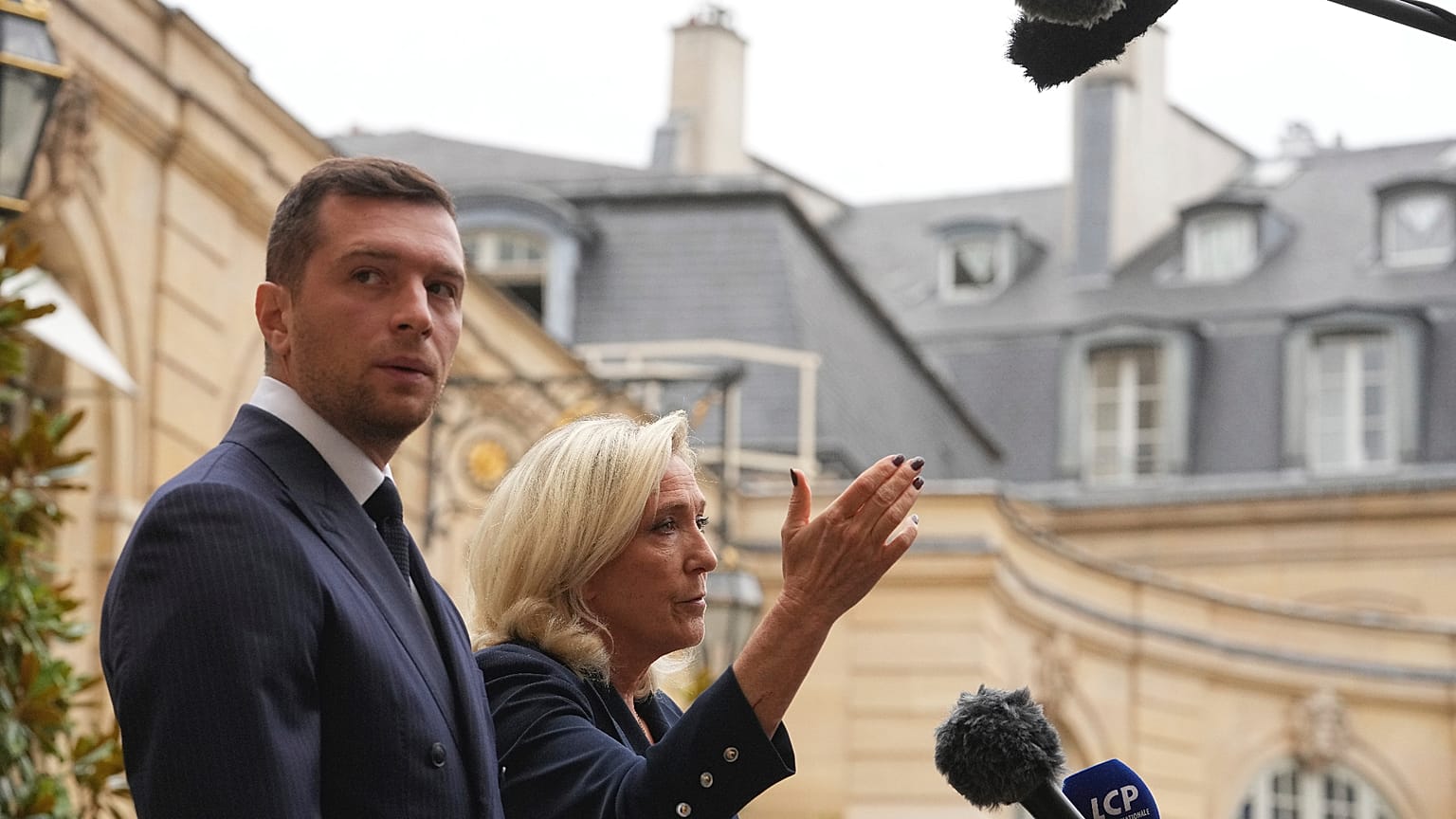
France’s far-right responded in markedly different ways to the AfD’s sweeping victory in Germany’s regional elections, with the National Rally (RN) maintaining a conspicuous silence on Monday while Éric Zemmour’s Reconquête openly celebrated the result.
France's National Rally party reacted to the victory of Germany’s far-right Alternative für Deutschland (AfD) party with a noticeable silence on Monday, a move that reflects its complicated ties to the party.
Marine Le Pen and Jordan Bardella — who are respectively campaigning to be France's next president and prime minister — made no mention of the AfD after the party took 43.8% of votes in Saxony-Anhalt’s elections, racing ahead of Christian Democratic Union, Chancellor Friedrich Merz’s party, which secured 17.2%.
Meanwhile, the Reconquête party — which is positioned further to the right than the National Rally and sits in the same group as the AfD in the European Parliament — welcomed the victory, reflecting political divergences within France's far-right.
Although the National Rally's leading figures have yet to comment publicly, other MPs from the party have weighed in. Bardella had also addressed the issue before the vote, when reporters at the Ambrosetti Forum — an annual economic and geopolitical conference held in Italy — questioned him about the prospect of the National Rally renewing ties with the AfD on Saturday.
In response, he said that this was not "planned," but underlined that "the electoral pressure exerted by the AfD in Germany has helped shift the political landscape within [Chancellor Friedrich] Merz's government, as Germany reinstated border controls a few months ago."
A campaign to recover the party's image
The silence at the top of the party is not surprising, given that Marine Le Pen has spent over a decade working to normalise the image of the National Rally (formerly known as the National Front), both at home and abroad, as part of a campaign to move away from the overt racism and antisemitism promoted by her father, Jean-Marie Le Pen, the party’s founder.
At present, her party is leading in the polls, with around 34 to 36% of respondents stating they intend to vote for her in the first round of the presidential elections scheduled for April 2027, according to a poll by IPSOS/BVA published by the French newspaper Le Parisien on Saturday.
National Rally politician and Patriots for Europe (PfE) MEP Pierre-Romain Thionnet told Euronews that the AfD's result "should not come as a surprise to anyone", arguing that its victory was vested in issues which mainstream parties have not worked to solve: "mass immigration, loss of national identity, and social and industrial decline."
According to the MEP, the result reflects "the collapse of the mainstream parties in favour of political forces that truly represent the aspirations of the European people."
Despite this, he ensured that the National Rally's decision to "no longer be an ally of the AfD" in the European Parliament would remain "unchanged."
"Several members of that political party continue to hold positions on historical and remembrance issues that we find unacceptable, and because there are very significant differences on other issues, such as foreign policy," said Thionnet.
The National Rally party and AfD were formerly part of the Identity and Democracy group, along with Italy’s League and Austria’s Freedom Party (FPÖ), among others. However, things came to a head ahead of the 2024 European Parliamentary elections, following a series of controversies involving some of the AfD's senior figures.
This included comments made by Maximilian Krah, the AfD's lead candidate in the Parliamentary elections, who stated that membership of the Nazi SS did not automatically make someone a criminal, during an interview with Italian newspaper La Repubblica.
The Identity and Democracy group voted to exclude the AfD in May 2024, just weeks before the European Parliament elections. Following the election, the AfD helped form a new far-right group, Europe of Sovereign Nations (ESN), which was formally established in July 2024.
Echoing these points, another MEP from the Patriots for Europe group told Euronews that "nothing will move before the French election," stating that "no one wants to be associated with the AfD, even though we have some points in common and cooperate on many topics."
Reconquête comes out in support of the AfD
The National Rally party may be keeping quiet, but the Reconquête party, part of the same political group as the AfD in the European Parliament (Europe of Sovereign Nations), came out in support of the election results.
In an X post shared on Sunday evening, MEP Sarah Knafo described the results as "historic," stating that "the European peoples have shown a great deal of patience. Today, they want to take their destiny back into their own hands. An entire continent is rising up."
Meanwhile, Éric Zemmour, the leader of Reconquête, who has said he will wait until December to announce whether he will run in France's 2027 presidential election, qualified the results as "the hour of truth." In the first round of France's 2022 presidential election, Marine Le Pen took 23.15% of the votes, while the hard-right secured 7.07%.
The Reconquête party aligns itself with the Alternative for Germany (AfD) on a number of points — notably on the concept of “remigration” — which the National Rally avoids endorsing explicitly, instead presenting its policy as favouring the systematic expulsion of illegal immigrants and foreign criminals.
According to Gilles Ivaldi, researcher and professor of politics at Sciences Po Paris, the political strategy adopted by Reconquête is more similar to the AfD's than the National Rally's.
"The AfD expresses itself in a more radical and openly far-right manner, if I may say so, whereas the National Rally is currently trying to tone down its platform significantly in order to win the presidential election, because they know that to do this, they need to normalise their image," Ivaldi told Euronews.
"Ahead of the last presidential elections in 2022, we saw two different political strategies emerge: Le Pen continued to try to normalise her image and de-demonise her party, whereas Zemmour pursued a much more aggressive strategy of radicalisation and reclaiming certain political themes."
"I think we need to be careful not to treat the National Rally and Reconquête as completely different, because they share many common views on migration, crime, and a whole range of issues concerning Ukraine and France's proximity to Russia."


No comments:
Post a Comment