Thursday, April 09, 2020

Health-damaging PFAS 'forever chemicals' likely released at 2,500 sites


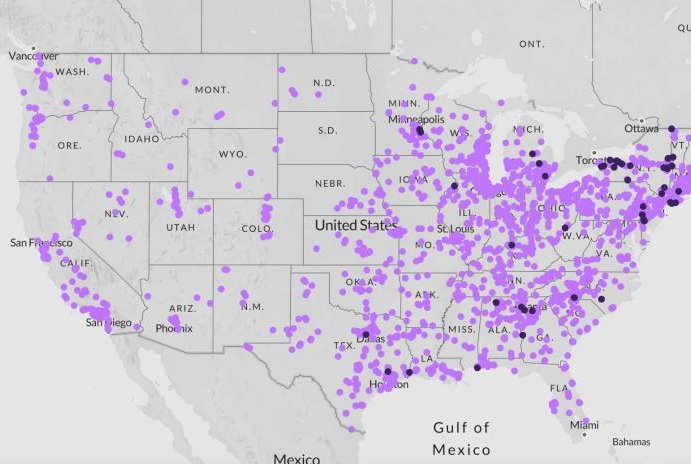
More than 2,500 industrial sites in the United States are likely releasing toxic PFSAs linked to cancer and other human health problems, a new analysis of federal data shows. Photo courtesy of Environmental Working Group

April 9 (UPI) -- More than 2,500 industrial operations in the United States most likely are releasing toxic perfluoroalkyl chemicals, or PFAS, into air and water supplies, a report based on federal data says.

The Washington, D.C.,-based Environmental Working Group, a non-profit that advocates for clean air and water, on Thursday released an interactive national map of likely polluters.

The list came from two online databases compiled by the U.S. Environmental Protection Agency, along with data from a 2017 survey by New York state.

Industrial sources of PFASs include chemical producers, tanneries, carpet and rug mills, coated-paper-product plants, electroplating facilities, semiconductor factories and wire manufacturers, the organization said.


RELATED Elevated PFAS levels found in tap water in major U.S. cities

PFAS, also dubbed "forever chemicals," are a family of chemical compounds that have been linked to human health problems, including cancer, liver damage, decreased fertility, and an increased risk of asthma and thyroid problems.

Congress has mandated that the EPA next year require companies to report their releases of PFASs as part of their mandatory Toxic Release Inventory.

But some lawmakers want the EPA to do more.

RELATED PFAS should be classified as carcinogens, researchers say

U.S. Rep. Chris Pappas, D-N.H., has also proposed a bill that add mandatory reporting of PFSAs to the chemical pollutants listed in the EPA's Clean Water Act.

"In our district [people] have questions about whether they can bathe their kids or drink water in their house," Pappas said on a telephone press conference Thursday.

"We can't do this community by community and state by state. It's critically important that we have federal maximum contaminant level," Pappas added. "We should look for ways to provide [federal] funding for additional testing."


RELATED Many household drinking water filters fail to totally remove PFAS

In Pappas's district in Merrimack, N.H., a state water investigation found PFASs released by smokestacks from the French-owned Saint-Gobain Performance Plastics company over decades had contaminated water supplies for 60 miles in southern New Hampshire.

The company applies PFSA-laden water-repelling surfactant when manufacturing plastics like tape, films, seals and textiles.

Contaminated wells were found in the towns of Bedford, Londonderry, Manchester and Litchfield, said Jim Martin, spokesman for the New Hampshire Department of Environmental Services.

"This has turned out to be the largest groundwater investigation in the history of New Hampshire where PFASs have impacted hundreds of wells," Martin said.

A chemical signature identified Saint-Gobain as the source of the water contamination, Martin said. State health agencies found elevated levels of PFASs in blood samples from regional residents who lived near the factory.

Under a 2018 consent decree, the company has paid to disconnect 700 homes from private wells and connect them to treated municipal water systems. The company also has also paid for private home water filtering systems and has provided bottled water to other homes, Martin said.

PFASs are used commercially in stain repellents on carpets and other fabrics, polishes, paints and coatings such as non-stick Teflon on pots and pans. Some PFSAs have been banned by the United States and other countries, but the toxic "forever chemicals" remain in soil and water.

On more than 670 U.S. military sites, PFSA water contamination nearby was linked to chemicals used in fire-retardant foams. Military bases around the country have been deemed EPA Superfund sites to clean up water contamination from PFSAs.

U.S. Rep. Harley Rouda, D-Calif., pointed out Thursday that the new map showed the industrial PFAS contamination problem reached into every state and congressional district.

"Unfortunately our watershed knows no boundaries," Rouda said. "Unless we have federal action, we can't do more to reduce ongoing levels of PFAS and make sure legacy polluters are accountable for contamination."

MAY 1 GENERAL STRIKE MEME AGAINST RETURNING TO WORK

TRUMP CLAIM'S THAT AMERICANS WILL BE ABLE TO GO TO WORK ON MAY 1
INTERNATIONAL WORKERS SOLIDARITY DAY

 CDC: Essential workers can return to work if they are asymptomatic


Gallup said Thursday a new survey shows U.S. investors now think it will take a long time for the market to recover after the coronavirus crisis ends. 


April 9 (UPI) -- A new survey shows a majority of U.S. investors no longer expect the quick rebound in the stock market after the coronavirus pandemic they did last month, Gallup said Thursday.

In mid-March, 55 percent of U.S. investors said the stock market would bounce back quickly once the coronavirus crisis ended and 45 percent said it would take a long time. Now, those figures are reversed, a new survey shows, with 55 percent saying it will take a long time and 45 percent saying it will be quick.

U.S. investors were defined as those with $10,000 or more invested in stocks or bonds, Gallup said.

Fifty-five percent of investors said in the new survey conducted in early April that they would hold onto their stocks and wait for the market to come back. Slightly fewer, 52 percent, said last month it was time to hold onto stocks.


Investors who said it was a good opportunity to purchase stocks while prices were down slipped 5 from 34 percent to 29 percent. And the percentage who said it was time to decrease their stock holdings to protect from further losses was still small at 6 percent, up only 2 percentage points, from 4 percent last month.

Still, most investors were at least somewhat confident they could weather the storm. More than eight in 10 said they could handle the current market downtown, with 39 percent being very confident and 46 percent being somewhat confident.

The survey is an update of the Wells Fargo/Gallup survey on investors from March 17-19.

RELATED Gallup: U.S. residents hesitant to return to regular activities


"At that time, the Dow Jones Industrial Average closings were hovering around 20,000, down nearly 30 percent from the Dow's high point a month earlier," senior Gallup editor Lydia Saad noted. "Since then, the Dow fell further to below 18,000 before building back up to just over 21,000 at the time of the last survey."

Findings were based on a random sample of 2,691 U.S. adults polled April 3-5, with a 4 percentage point margin of error.

Poll: 70% of Americans believe U.S. economy in either recession or depression

A Gallup poll relased Wednesday found that 70 percent of Americans believe the United States is in either a recession or a depression as hundreds of thousands of Americans have lost jobs amid shutdowns to prevent the spread of the COVID-19 outbreak. 


April 8 (UPI) -- Amid economic turbulence due to the COVID-19 outbreak, 70 percent of Americans believe that the U.S. economy is either in a recession or depression, according to a Gallup poll released Wednesday.

The survey, based on interviews conducted on April 3-5, found that 40 percent of Americans believe the United States is in a recession and 30 percent believe it is in a depression.

Nine percent more U.S. adults believe the country is in an economic depression and 3 percent more believe it is in a recession from Gallup's previous report last week.

Democrats had the most pessimistic outlook on the economy as 85 percent said they believe the economy is in a recession or depression compared to 68 percent of independents and 53 percent of Republicans.

The survey was conducted as the U.S. Department of Labor said the country lost 701,000 jobs in March and the unemployment rate rose to a historic low of 4.4 percent.

U.S. markets on Wednesday continued to rebound from COVID-19 woes as the Dow Jones closed up 780 points after White House health adviser Dr. Anthony Fauci said Wednesday that the United States should begin to experience a "turn around" in coronavirus cases this week.

President Donald Trump on Tuesday also called for Congress to provide an additional $250 billion in funding for small business loans provided by the so-called Paycheck Protection Program established in a $2.2 trillion coronavirus response bill signed last month.
The survey results were based on self-administered web surveys conducted with a random sample of 3,876 U.S. adults aged 18 and older, with a 3 percent margin of error at the 95 percent confidence level.


APRIL 9, 2020
Another 6.6 million Americans file for unemployment


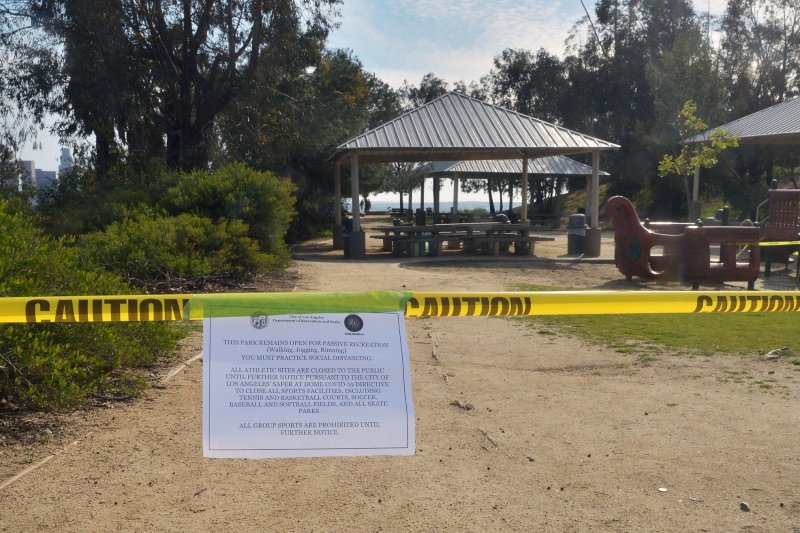
A sign informs the public of the closure at Elysian Park in Los Angeles, Calif., which was shuttered until further notice on March 28 due to the coronavirus pandemic. Photo by Jim Ruymen/UPI | License Photo

April 9 (UPI) -- More than 6.6 million people in the United States filed for unemployment benefits last week, the Labor Department said Thursday.

The department said 6,606,000 initial claims were filed for the week ending April 4. It also revised the prior week's claims up by 219,000.

Last week's claims represented a decrease of 261,000 compared to the prior week.

Thursday's report continued a surge of unemployment following lockdown conditions for workers in 43 states under stay-at-home orders.
Non-essential businesses -- especially in retail -- were either closed or sharply curtailed in areas affecting 95 percent of the U.S. population.

Thursday's figures came on top of the nearly 10 million claims made during the final two weeks of March, including a record 6.6 million the last week.

Some analysts had expected 5.5 million new filings, while others expected more. Bank of America Merrill Lynch predicted 6.5 million initial claims, while JP Morgan Chase had estimated an all-time-high of 7 million.

The latest numbers included losses that came after more state and local governments instituted wider restrictions affecting a much broader range of retail sectors.

Some economists estimated the joblessness surge has already pushed the actual U.S. unemployment rate above 10 percent. The official figure for March was 4.4 percent.

U.S. copes with COVID-19 pandemic

Workers with the nonprofit group SWBID pick up food to distribute to those in need from World Central Kitchen's makeshift distribution site at Nationals Park in Washington, D.C. on April 9. Photo by Kevin Dietsch/UPI | License Photo
First lady Melania Trump sported a face mask Thursday in a new public service announcement posted on her Twitter account urging Americans to follow guidelines from the U.S. Centers for Disease Control and Prevention.
April 9 (UPI) -- DO AS WE SAY NOT AS WE DO 
WTF
Rastafarian fights solitary confinement over dreadlocks


Eric McGill Jr., awaiting trial on charges stemming from a shooting, has been 
placed in solitary confinement for refusing to cut his dreadlocks. 
Photo courtesy of Pennsylvania Institutional Law Project

March 19 (UPI) -- A Pennsylvania inmate placed in solitary confinement because he refuses to cut off his dreadlocks is asking a judge to expedite his lawsuit challenging his detention conditions.

Eric McGill Jr. -- a Rastafarian who follows the "nazirite vow" taken by Samson in the Bible to avoid cutting his hair -- has been in administrative segregation in the Lebanon County Correctional Facility since his arrival on Jan. 19, 2019.

McGill, 27, who is awaiting trial on charges stemming from a shooting that injured four people, was put in solitary confinement for failing to comply with a rule prohibiting braids and cornrows.

The jail's rules, which officials say aim to stop inmates from hiding contraband in their hair and to ensure cleanliness, allow long hair only if it is tied up or worn in a single ponytail. No religious exemptions are made for dreadlocks.

McGill offered to tie up his dreadlocks, but he still landed in the jail's Security Housing Unit for refusing to have them cut off, according to his lawsuit.

McGill is allowed out of his cell for up to one hour a day five days a week between midnight and 2 a.m. for recreation, according to the suit. That is the only time McGill can use the phone, and he is limited to one visit a week for a maximum of 30 minutes. The lights in the unit are on 22 hours a day.

The conditions have caused McGill to suffer depression and frequent panic attacks and exacerbated a previously diagnosed post-traumatic stress disorder, the suit alleges.

Suit: cruel and unusual

At first, McGill, who is not a lawyer, filed a suit himself alleging cruel and unusual punishment and false imprisonment and sought to end his solitary confinement. He later wrote to the Pennsylvania Institutional Law Project, and the nonprofit is representing him for free.

The project provides assistance to low-income people who are incarcerated or institutionalized in civil cases that allege their constitutional rights have been violated.

The suit, filed in U.S. District Court, seeks McGill's immediate placement in the general jail population and an unspecified amount of money for compensatory and punitive damages. Warden Robert Karnes, two other correctional employees and Lebanon County are named as defendants

McGill's attorneys contend his placement in solitary confinement violates the First Amendment right to the free exercise of religion and the Religious Land Use and Institutionalized Persons Act, which bars prisons and jails from placing arbitrary or unnecessary restrictions on religious practice.

"Mr. McGill believes that his spirit lives through his dreadlocks," the suit says. "Mr. McGill also believes that his dreadlocks keep him spiritually pure, a requisite for entry into the afterlife. For Mr. McGill, cutting off his dreadlocks would be akin to cutting off his strength and his spirit."

The suit also alleges the defendants are violating McGill's right under the 14th Amendment's due process clause to be free from punishment as a pretrial detainee.

'Dreadlocks detached'


The defendants have responded in court documents that the braids and cornrows policy in the jail's rules is reasonable and has legitimate interests of security and cleanliness. They say the policy applies to all inmates, and those who keep their dreadlocks are placed in administrative segregation.

"Other inmates chose to have the dreadlocks detached, at which time inmates were removed from administrative segregation and placed into the general population," attorney Peggy Morcom, who represents Lebanon County and its employees, wrote.

Another attorney for the defendants, Matthew Clayberger, argues in a brief that McGill "refers to the security housing unit as 'solitary confinement,' but the evidence will prove that this is simply not the case."

Clayberger declined to discuss the case.

The Pennsylvania Institutional Law Project lawyers argue that the rules do not cover dreadlocks because they are not braids or cornrows. Dreadlocks form naturally without any manipulation in some people's hair.

"Once hair has naturally formed dreadlocks, it cannot be taken out of dreadlocks. The only way to 'remove' natural dreadlocks is to cut them off," the suit says.

Managing attorney Alexandra Morgan-Kurtz said several other Rastafarian inmates have been put in solitary confinement for declining to cut their dreadlocks. Prisoners with long straight hair are allowed to pull their hair into a ponytail, but offers by these inmates to tie up their hair were rejected, she said.

Morgan-Kurtz said any security concerns could be addressed with searches and disputed that there is a cleanliness issue with dreadlocks, calling that assertion "racist." She pointed out that the Pennsylvania Department of Corrections, as well as the federal Bureau of Prisons and many jails and prisons in the country, permit dreadlocks.

In addition to McGill and other prisoners who are in administrative segregation, prisoners who are in disciplinary confinement are put in the Security Housing Unit, the suit says. The estimated sentences for intoxication, fighting and threatening an employee with bodily harm range from 30 to 120 day, the suit says.

Earlier this month, McGill's lawyers filed a request for limited, expedited discovery, which is the pretrial exchange of evidence. The request is pending.

'Social death'


The United Nations has recognized solitary confinement for any duration lasting more than 15 days as a form of torture. The American Civil Liberties Union says solitary confinement costs too much, does nothing to rehabilitate prisoners and causes or exacerbates mental illness.

Alexander Reinert, a law professor at the Benjamin N. Cardozo School of Law at Yeshiva University in New York City, describes solitary confinement as a form of "social death." Even when it's imposed for a short period, solitary confinement has a detrimental effect on a person's psychological and physical health, and as the time in isolation gets longer, the risk of harm increases, he said.

"Solitary confinement is the most severe kind of punishment that we inflict on people short of executing them," said Reinert, who specializes in the rights of prisoners and detainees.

Two recent reports by the Association of State Correctional Administrators and the Arthur Liman Center for Public Interest Law at Yale Law School show that prison directors around the country are trying to reduce the use of solitary confinement, Reinert said.

However, isolating inmates still is used too much and for too long, he said. In addition, prison systems have increased the kinds of disciplinary incidents that are punished with solitary confinement, he said.

The reports define solitary confinement as holding individuals in their cells for 22 hours or more each day and for 15 continuous days or more at a time. They estimate that on an average day, as many as 5 percent of prisoners are held in solitary.

DRAWN BY BINGO WHO WOULD DRAW WWI TOONS FOR US ARMY NEWSPAPER

US Supreme Court tackles whether teachers at religious schools are 'ministers'

The U.S. Supreme Court has postponed arguments because of the coronavirus pandemic. Photo by Kevin Dietsch/UPI | License Photo

April 8 (UPI) -- A pair of cases pending before the U.S. Supreme Court involving discrimination claims by teachers fired by Catholic schools could have such a significant impact on religious institutions and their employees that several hundred groups and individuals are weighing in.

More than 40 friend-of-the-court briefs have been filed in the consolidated cases of Our Lady of Guadalupe School vs. Morrissey-Berru and St. James School vs. Biel, which center on whether the teachers are barred by the "ministerial exception" from bringing employment discrimination claims against their employers.

Under the exception, religious institutions have the ability to choose their own leaders without government interference, and employees who qualify as "ministers" are not protected by employment discrimination laws. The exemption, which is based on the First Amendment's religion clauses, stems from a 2012 Supreme Court decision in a similar case.

Both teachers taught fifth grade at Catholic parish schools in Los Angeles County. Kristen Biel worked in Torrance at St. James School, which had a recommendation -- but not a requirement -- that its teachers be Catholic. (Biel was Catholic).

In addition to teaching all academic subjects, Biel also taught a half-hour religion class four times a week by following instructions in a workbook. She accompanied her students to a multipurpose room for mass once a month and her job was to keep the class settled and quiet, according to court documents.

Biel learned toward the end of her first full year of teaching that she had breast cancer and told school administrators she would need to take time off for treatment. A short time later, she was told the school would not renew her contract.

Her one teaching evaluation had been generally positive but Biel was told her classroom management was "not strict" and it wasn't fair for children to have two teachers during the school year, court documents say.

Our Lady of Guadalupe

Agnes Morrissey-Berru, who worked at Our Lady of Guadalupe in Hermosa for 16 years, taught academic subjects and a religion class. The school also preferred, but did not require, that its teachers be Catholic; Morrissey-Berru is Catholic.

Morrissey-Berru occasionally said a classroom prayer with the students for an ill parent, brought her students to a cathedral once a year to serve at the altar and directed the annual school Easter play, a brief says. In addition, her contract in her final year directed her to "assist with liturgy planning for school mass."

In 2014, when Morrissey-Berru was in her 60s, the school's principal expressed dissatisfaction with her classroom instruction and asked if she wanted to retire. After the teacher said no, she was demoted to part-time and her contract was not renewed the following year, court records say.

Biel and Morrissey-Berru sued and claimed, respectively, violation of the Americans with Disability Act and age discrimination. In both cases, a federal judge said the ministerial exception barred the suit.

Separate panels of the 9th U.S. Circuit Court of Appeals reversed those rulings after considering whether the school held out the teacher as a minister by bestowing a formal religious title, whether her title reflected ministerial training, whether the teacher held herself out as a minister and whether her duties included important religious functions.

Young progressives say they don't want 'return to normalcy' under Biden


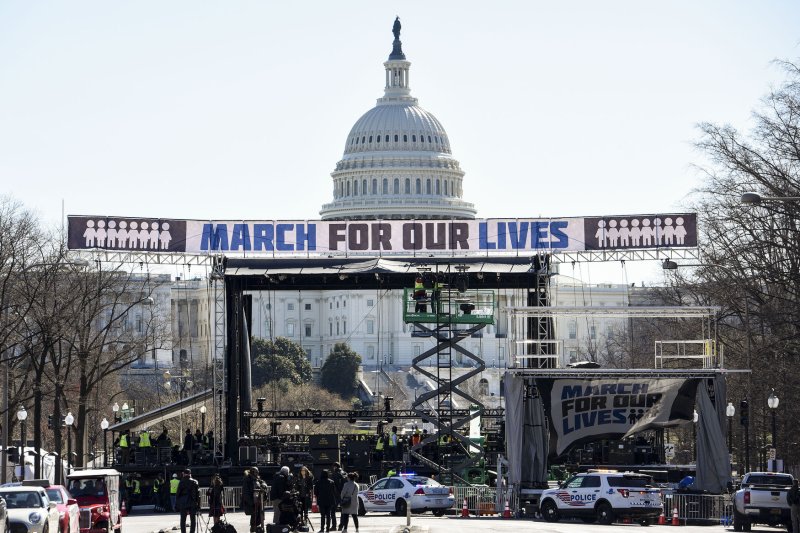
The March For Our Lives Action Fund was one of seven groups that signed an open letter to former Vice President Joe Biden calling on him to support a reduction in gun deaths by 50 percent within 10 years. File Photo by Leigh Vogel/UPI | License P
hoto


April 8 (UPI) -- Several groups of young progressives said they're not on board with Democratic presidential candidate Joe Biden's call for life to go back to what it was before the election of President Donald Trump.

They wrote an open letter to the former vice president Wednesday, hours after Sen. Bernie Sanders, I-Vt., suspended his campaign to be president.


"While you are now the presumptive Democratic nominee, it is clear that you were unable to win the votes of the vast majority of voters under 45 years old during the primary," the open letter begins.

"Messaging around a 'return to normalcy' does not and has not earned the support and trust of voters from our generation. For so many young people, going back to the way things were 'before Trump' isn't a motivating enough reason to cast a ballot in November."

The letter details a list of demands for Biden to earn the votes of the younger generation.

It's signed by Alliance for Youth Action, Justice Democrats, IfNotNow Movement, March for Our Lives Action Fund, NextGen America, Student Action, Sunrise Movement and United We Dream Action. Collectively, the group says it will spend more than $100 million in messaging aimed at younger voters during the 2020 election cycle.

The groups called on Biden to support the Green New Deal on climate change, a plan to reduce gun deaths by 50 percent in 10 years, expansion of the Deferred Action for Childhood Arrivals program and a law to lower prescription drug costs.


They also seek support for criminal justice reform to cut prison populations by 50 percent, free undergraduate tuition at public schools, canceling student loan debt, a wealth tax, the repeal of the Authorization for Use of Military Force, eliminating the filibuster and expanding the Supreme Court.

In terms of his future administration, the letter calls on Biden to appoint progressive elected officials, establish a national director of gun violence prevention, and refrain from appointing zero current or former Wall Street executives or corporate lobbyists.

"Exclusively anti-Trump messaging won't be enough to lead any candidate to victory. We need you to champion the bold ideas that have galvanized our generation and given us hope in the political process," the letter read.


Comics vs. coronavirus: Comics industry shut down for the first time in almost a century


An extended pause by the biggest publishers could spur comic creators to pursue new projects and accelerate a shift away from comic book stores. Here, the cover of Batman Giant #4, which was expected in stores this April 1, 2020. (DC Comics)

Last week, the producers behind a number of comic book-derived movies and TV shows announced delays for their franchises: release dates for Wonder Woman and Black Widow were pushed ahead, while The Walking Dead announced that COVID-19 had made it impossible for the show to complete work on the current season and that the finale was being delayed.

But what of the comic books that spawned these blockbuster franchises?

On March 23, Steve Geppi, CEO of Diamond Comic Distributors, announced the closing of the distribution system that holds a near-monopoly on the circulation of comic books in North America. He cited a number of problems related to the COVID-19 pandemic: comic retailers can’t service customers, publishing partners are having supply chain issues and shipping is delayed. He wrote his “only logical conclusion is to cease the distribution of new weekly product until there is greater clarity on the progress made toward stemming the spread of this disease.”

New Comics Day has occurred every Wednesday since the creation of the direct market in the 1970s, as die-hard fans rush to buy new books before spoilers pop up online.

But no longer: This week, for the first time in more than 80 years, no new comic books will ship to shops, and production is on hold into the foreseeable future. No previous global event — not the Second World War, not 9/11 — has previously shuttered the comic book industry.

To understand how this single decision could transform the operations of comic book publishers owned by Disney (Marvel Comics) and AT&T (DC Comics), among dozens of others, as well as comic production, consumption and culture, one needs to understand how the status of the comic book has shifted over the past century.
Bygone newsstand days

As Jean-Paul Gabilliet, professor of North American studies at Université Bordeaux demonstrates, the comic book form emerged in the 1930s as a promotional giveaway for department stores and gas stations before it migrated to the newsstand as a part of the larger magazine industry.Joe Shuster poses with ‘Superman,’ comic books, based on the character he and writer Jerry Siegel created, in New York, in November 1975. AP Photo

Despite some fits and starts, the format took off based the success of Superman, created in spring 1938, and the many imitation superheroes his popularity spawned as comic books became a staple of the newsstand. Circulation grew during the war, and exploded shortly after as new publishers initiated new genres like crime, romance and horror comic books.

By 1952, the peak year for comic book sales in the United States, comic books were a formidable cultural presence. But the rise of television, changes to the magazine distribution system and criticisms of the industry by public figures led to an industry-wide collapse of sales. Comic books limped through the 1960s as a cheap disposable form of entertainment for children, found on magazine racks that catered to parents.

By the 1970s, the American comic book had lost its status as a mass medium. At the same time, a rapidly growing network of used comic-book dealers began to spring up at flea markets, conventions, bookstores and eventually specialty stores that catered to a devoted set of comic collectors. The growing fan network presented a life raft to the industry.
1970s turning point

The turning point, as American writer and reporter Dan Gearino points out in his history of comic book stores, came in 1972 when a convention organizer named Phil Seuling convinced the major publishers to wholesale new issues to him on a non-returnable basis.Stan Lee, standing, publisher of Marvel Comics, discusses a ‘Spiderman’ comic book cover with artist John Romita at Marvel headquarters in New York in January 1976. AP Photo

This appealed to the publishers, who were accustomed to routinely over-printing comic books by the hundreds of thousands to supply the inefficient system of mom-and-pop corner stores that retailed their work. Seuling’s model shifted risk from the publisher to the retailer, who ordered product on a non-returnable basis, but it facilitated the growth of a network of thousands of comic book shops across North America.

For more than two decades, comic book shops were supplied by a network of regional wholesale distributors that served specific geographic regions based on the location of their warehouses. This changed at the end of 1994 when Marvel Comics bought Heroes World, the third largest distributor.
Marvel meets Diamond

American writer Sean Howe’s history of Marvel Comics details how, in July 1995, the company made their new subsidiary the exclusive supplier of their market-leading product, reducing income at the other distributors by a third. A scramble ensued, with Geppi’s Diamond securing the rights to DC Comics and Image Comics, the next two largest publishers after Marvel. Other publishers quickly fell in line, signing exclusive deals with Diamond and bankrupting the regional distributors.

When Heroes World proved incapable of supporting Marvel’s needs, the company folded in 1996 and Marvel joined forces with Diamond, the only other distributor still standing. That same year, the Bill Clinton government began investigating Diamond as a monopoly. But the government dismissed the case in 2000, finding that the new company was not monopolistic because comic books were only a small part of the overall publishing industry.Marvel comics impresario Stan Lee, centre, poses with Lou Ferrigno, right, and Eric Kramer, left, who portray The Incredible Hulk and Thor, respectively, in ‘The Incredible Hulk Returns.’ They’re pictured here in Los Angeles, Calif., in May 1998. AP Photo/Nick Ut

The situation remained largely unchanged for more than 20 years. Diamond is the exclusive dealer of comic books to the a network of thousands of comic book stores who have continued to order on a non-returnable basis. Until now.
‘Pencils down’

The consequences of Diamond’s decision are immediate and wide-reaching. In closing their warehouses to new product, publishers have alerted printers to stop. Comic book freelancers recently began tweeting they’d received “pencils down” messages from publishers curtailing production.

Communication to comic book retailers, creative personnel and fans has been haphazard as the large publishers scramble to plan for an uncertain future. Many are concerned about the growing digital footprint of comic book publishers.

Since 2011, most comic books have been released to comic book stores and in electronic format to consumers through platforms like Comixology (a subsidiary of Amazon) on the same day.
Archie Comics has announced the company will release some April titles digitally. Here, the front cover of an edition of ‘Archie vs. Predator II.’ (Archie Comics)

With a protracted closure of the distribution system, publishers like Marvel and DC could continue to move forward with electronic sales, which would inevitably bolster that end of their business at the expense of their retail partners. Archie Comics has announced that they will release some April titles digitally.

If several months passed with electronic sales but no physical comic book sales, it’s uncertain that those printed books would ever find an audience. An extended pause by the biggest publishers, on the other hand, would undoubtedly spur comics creators to pursue new projects either online or through the book trade.

This could accelerate a shift away from comic collectors’ habitual buying that take place comic shops as establishments that foster unique social relations, as described by Benjamin Woo, associate professor of communication and media studies at Carleton University.

While comic books sales proved remarkably resilient during the 2008 financial crisis, if the current situation breaks readers’ buying habits for a few months, they might never return in the same way.

This is a corrected version of a story originally published on March 30, 2020. The earlier story said Diamond Comic Distributors made an announcement March 24 instead of March 23.

March 30, 2020
Author
Bart Beaty
Professor of English, University of Calgary
Disclosure statement
Bart Beaty receives funding from the Social Sciences and Humanities Research Council of Canada.

THE CONVERSATION

Why passenger pigeons went extinct a century ago
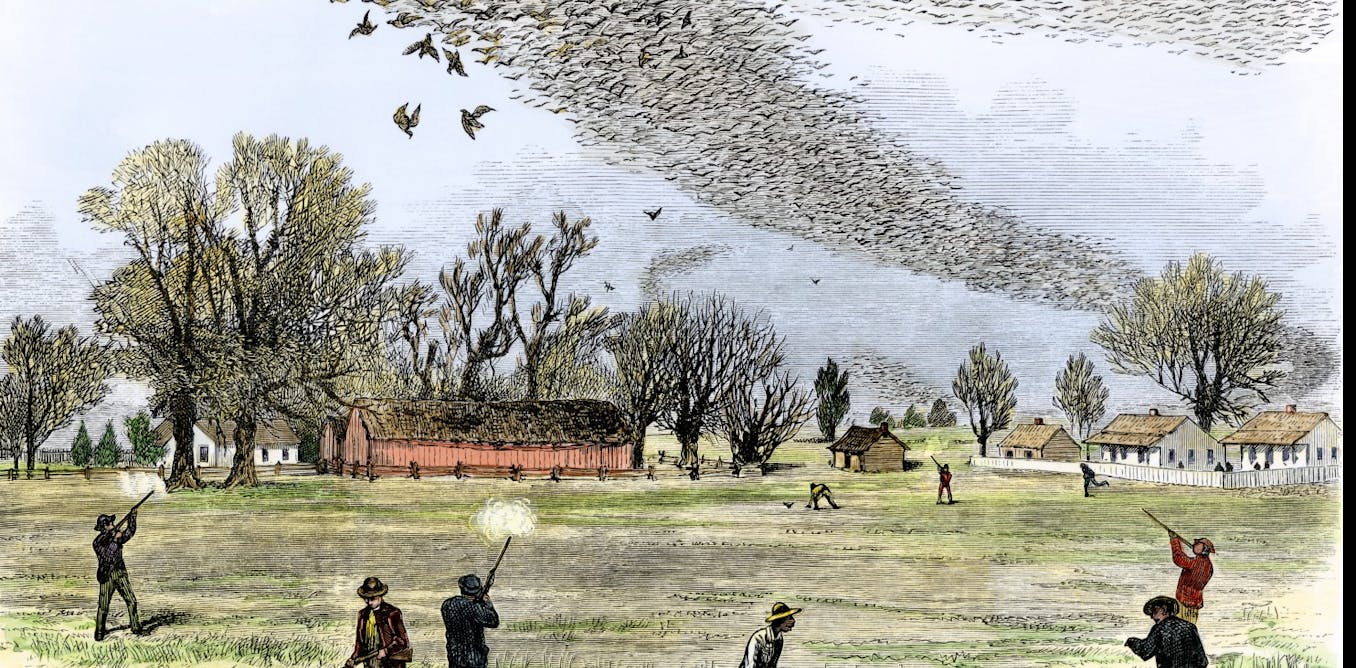
A passenger pigeon flock being hunted in Louisiana. From the ‘Illustrated Shooting and Dramatic News’, 1875. (Wikimedia/Smith Bennett)CC BY-NC-ND

On Sept. 1, 1914, a Cincinnati Zoological Gardens employee found the lifeless body of Martha, the world’s last living passenger pigeon, resting beneath her perch.

Forty years earlier, Martha’s ancestors numbered in the billions. Their flocks formed avian clouds across eastern North America, obstructing sunlight for days. The sight was so overwhelming that the American conservationist Aldo Leopold called them a “biological storm.”

By the early 1900s, only a handful of birds remained, and these were in captivity. How, in a few short decades, could one of the world’s most prodigious bird vanish from the sky?

As an archaeological scientist with a background in ecology and chemical analyses, I have always been fascinated by great extinction events and the disappearance of the passenger pigeon is one of the most notable in North America’s history. It’s exciting to look at the events that led to their demise.

Forests of food?


For decades, two theories have been used to explain the extinction of passenger pigeons. While it has long been understood that human activity caused their extinction, the exact mechanism wasn’t known.A male passenger pigeon on display at the Cleveland Museum of Natural History in Ohio. The last wild bird was shot in 1901, and Martha, the last captive bird, died on Sept. 1, 1914, at the Cincinnati Zoo. (Tim Evanson/flickr), CC BY-SA

One theory was that because the birds mostly ate a highly specialized diet of tree nuts (known as “mast”), such as acorns and beechnuts, they died off when they could no longer find enough food after the forested habitats they devoured were cut down by humans.

The other theory was that their obliteration was due mainly to humans killing staggering numbers of birds for sport and to feed growing urban populations.

The conflict between these two ideas was already evident in the early 19th century, when the almost ceaseless slaughter of passenger pigeons was well underway. After the Civil War, technological advancements, such as the telegraph and expanding rail networks, helped professional hunters, called pigeoners, to locate migrating flocks at their nesting sites and collect birds, young and old, on an industrial scale.

The great American ornithologist John James Audubon may have captured popular sentiment when he said, “… nothing but the gradual diminution of our forests can accomplish their decrease as they not infrequently quadruple their numbers yearly, and always at least double it.”

So, which was more likely: hunting or habitat destruction?

Diet clues


My colleagues and I used stable isotope analysis to study chemical markers in the bones of passenger pigeons found in archaeological deposits dating from 900-1900, in the heart of the birds’ former nesting habitat in Ontario and Québec.

An animal’s bones can tell us a lot about what ate before it died. Because bones grow and remodel slowly over the course of an animal’s lifetime, their stable isotope composition gives us information about average diet over a period of months or even years. This longer-term record of diet lets us see what a bird ate over its entire life, rather than at a single meal or in a single season.

Read more: Why giant human-sized beavers died out 10,000 years ago

Our study found that passenger pigeons could live off other foods, including farmers’ crops. This suggests that an unchecked commercial pigeon industry was likely the more important driver behind the birds’ extinction.
A passenger pigeon skull collected during archaeological excavations. (Eric Guiry)

Prior to our research, little was known about the diversity (or lack thereof) of their diet. At the time of their decline and disappearance, no one had the technology to be able to follow and document the birds throughout their full life cycle, including cross-continental migration.

Past historical research indicated that mast was the birds’ food of choice, as they roamed up and down the great forests of eastern North America searching out patches at the peak in their masting cycle. Yet there was also scattered anecdotal evidence that the birds would at times descend on farmers’ fields of corn and wheat.

Most of the birds we sampled did eat mostly mast, but a subset had chemical compositions that suggest their diet was made up largely of crops like corn that would have been available even as their traditional sources of food grew scarcer. We also tested the subset of birds to see if they belonged to a specific age category or genetic group but found that corn-based diets occurred in both young and old birds, as well as in all genetic groups, suggesting that this dietary flexibility may have been widespread.

A new mystery?


Our analysis answered our original question, but also opened up another mystery for future study. 
The passenger pigeon was found across most of North America east of the Rocky Mountains, north of the Mississippi and south of Canada. But sometimes they were seen in Bermuda, Cuba or Mexico. (Shutterstock)

We performed DNA analyses to confirm the birds we were testing were, in fact, passenger pigeons. These results suggested that there may have been more genetic diversity in these birds than previous studies revealed.

Much of the previous DNA work was concentrated on birds that died not long before the species disappeared entirely, which may have meant the genetic diversity in the birds was already waning. A sample from the earlier birds in our study suggests there may have been more internal diversity during the thousands of years these flocks dominated the skies and forests of eastern North America.

Read more: Bird species are facing extinction hundreds of times faster than previously thought

This research reveals the amazing potential that archaeology and scientific techniques have for helping us understand major events of the past and how the actions of humans have shaped the world as we know it today.


March 4, 2020
Author
Eric Guiry
P
ost-Doctoral Fellow, Trent Environmental Archaeology Laboratory, Trent University
Disclosure statement
Dr. Guiry received funding from Social Sciences and Humanities Research Council of Canada.
As ships move north with climate change, their noise scares Arctic cod away

A cruise ship leaves Resolute Bay, Nunavut, in the summer of 2014. (Silviya V. Ivanova)Author provided

When people who haven’t been to the Arctic think of this remote and cold region, they may picture animals, such as polar bears, narwhal or ringed seals, and the people who live there. Rarely does this vision include modern cargo ships and ocean liners.

Yet these large vessels are increasing their activity in the Arctic Ocean as declining sea ice opens previously inaccessible Arctic regions to shipping. This surge in vessel traffic is also causing an increase in underwater noise, which research has shown can affect marine mammals and fish by interfering with communications, behaviour and movement.

Our new study shows that Arctic cod, a key fish in this ecosystem, are also sensitive to ship noise. Such sensitivity may affect their well-being and the predators that feed on them.

Noise disruptions

Most fish and marine mammals can hear sound, which they use to communicate, forage, detect approaching predators and locate prey. Noise in the environment can impede all of these functions, and this can have negative short- or long-term implications for the health of aquatic organisms. 


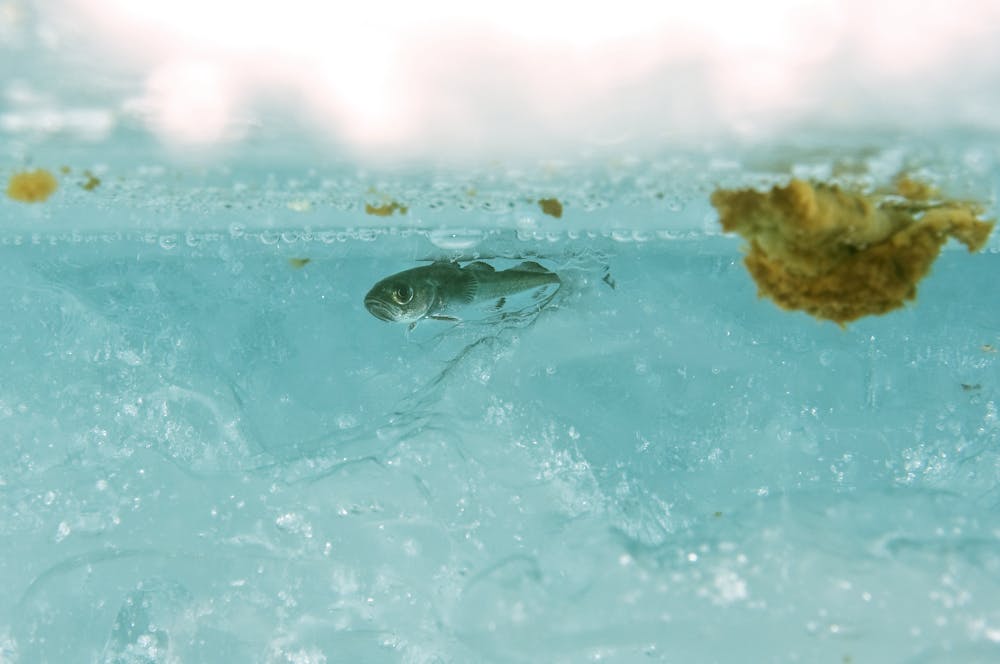
Arctic cod are slender fish that range further north than any other fish
 (Erling Svensen/Ocean Photo), CC BY

For example, noise-induced temporary hearing loss and an increase in stress hormones have been observed in fish. The former can lead to death due to inability to hear approaching predators. Masked communication can also lead to loss of critical mating opportunities.

Some Arctic communities have raised concerns about the effect increasing ship traffic might have on aquatic animals, particularly marine mammals that are an important source of food and livelihood. They also worried that the noise might be pushing the Arctic cod into new areas, followed by marine mammals.

We carried out a study in Resolute Bay, Nunavut, to measure how ship noise might be changing the behaviour of Arctic cod, an abundant small fish that is a key prey for seals, whales and seabirds.
Missed meals

We used acoustic telemetry to track 77 individual Arctic cod. We found they moved to areas with less noise when cargo ships and cruise ships were present in the bay, whether they were anchored or moving.

Cod form schools, so we assumed that the fish we were tracking represented the population living in Resolute Bay. When ship activity was low (a single ship), the cod moved 250-350 metres away.

We would expect the displacement to be larger with more ship activity. In recent years, two ships are commonly seen in the bay at once. There has also been a sharp increase in the traffic through the Parry Channel — the main passage running through Lancaster Sound — over the past decade.

Any shift, whether short- or long-term, in the distribution of an animal’s population has implications for that species and for the predators that rely on them. As the primary food source of seabirds and marine mammals, a shift in Arctic cod distribution has consequences for the marine food webs, as well as for the Indigenous communities that depend on them.
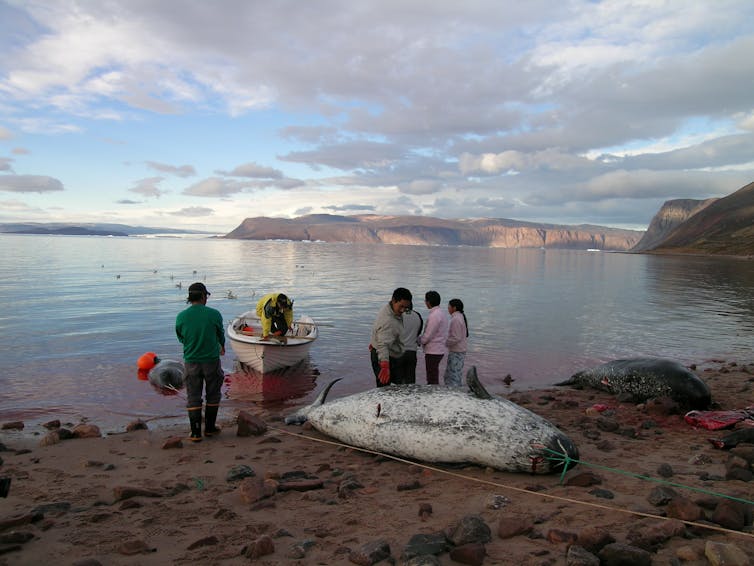
Marine mammals are an important source of food for many Arctic Indigenous communities. 
(Judith Slein/Flickr), CC BY-NC-SA

Summer is a short but critical period in the Arctic. Fish, birds and marine mammals feed prolifically in open waters when prey is more abundant. The warmer temperatures also allow animals to grow faster and accumulate more body fat.

We found Arctic cod changed their swimming behaviour when ships were present, spending less time searching for and consuming food, and more time travelling, which is associated with higher speeds and thus, more energy use.

But if ship traffic occurs in an important feeding area for Arctic cod, the fish may find themselves missing meals and using more energy for travel. This could have significant negative effects. For example, it may lead to lower body weight or reduced winter survival due to lower fat reserves.


Under pressures
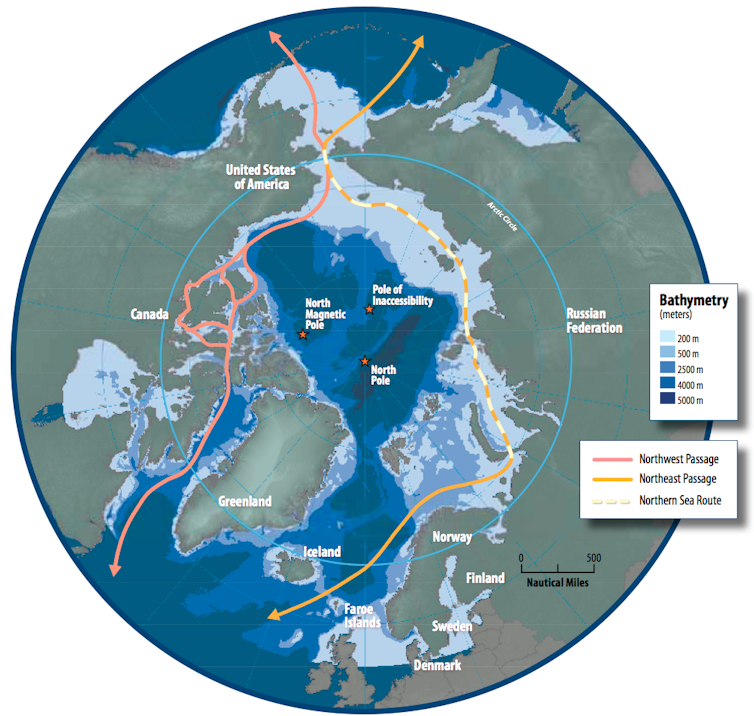
Ship traffic in Arctic Canada has already doubled over the past 20 years, and the number of days ships spend in the Arctic has nearly quadrupled since 2000. This trend is also seen elsewhere in the Arctic and is projected to continue. The Northwest Passage, a sea route through the Canadian Arctic Archipelago, has long been eyed for shipping to Asia from North America and Europe. As vessel traffic grows, underwater noise will also continue to increase.

Map of the Arctic region showing the Northeast Passage the Northern Sea Route 
and Northwest Passage and bathymetry. (Arctic Council)

Underwater ship noise is a new disturbance to Arctic marine animals. Although fish from temperate regions have shown the ability to adapt to noise, Arctic organisms may not have enough time to adjust.

The effects of climate change are greatest at the poles and the organisms there already face many stressors. The Arctic ecosystem also has lower species diversity compared with temperate and tropical climates, reducing its resilience to stress.

Read more: The fishy problem of underwater noise pollution

Although Canada, Europe and the United States broadly support environmental protection, human health and sustainable management of anthropogenic disturbances, such as ship traffic and noise, we need to develop and implement effective conservation and management plans.

We need Indigenous people to be involved in decision-making processes, marine protected areas that protect important foraging and breeding grounds, strict rules on ship speed and their distance from sensitive regions, as well as technologies that lower vessel noise, such as modified propellers and regular cleanings.

The precautionary principle in environmental decision-making suggests we should take preventive action in the face of uncertainty. For the Arctic, uncertainty is associated to the response of biology in the oceans and on land and its magnitude. We believe that preventive timely action is of the essence.

April 1, 2020
Authors
Silviya V. Ivanova
PhD Candidate, Great Lakes Institute for 
Environmental Research (GLIER), University of Windsor
Silviya V. Ivanova receives funding from the Natural Science 
and Engineering Research Council of Canada (NSERC), and the University of Windsor.
Aaron Thomas Fisk
Professor, School of the Environment, University of Windsor
Disclosure statement
Aaron Fisk receives funding from the Natural Science and Engineering Research Council of Canada (NSERC), Canadian Foundation for Innovation (CFI), Canada Research Chairs, and the Pew Charitable Trust

War metaphors used for COVID-19 are compelling but also dangerous
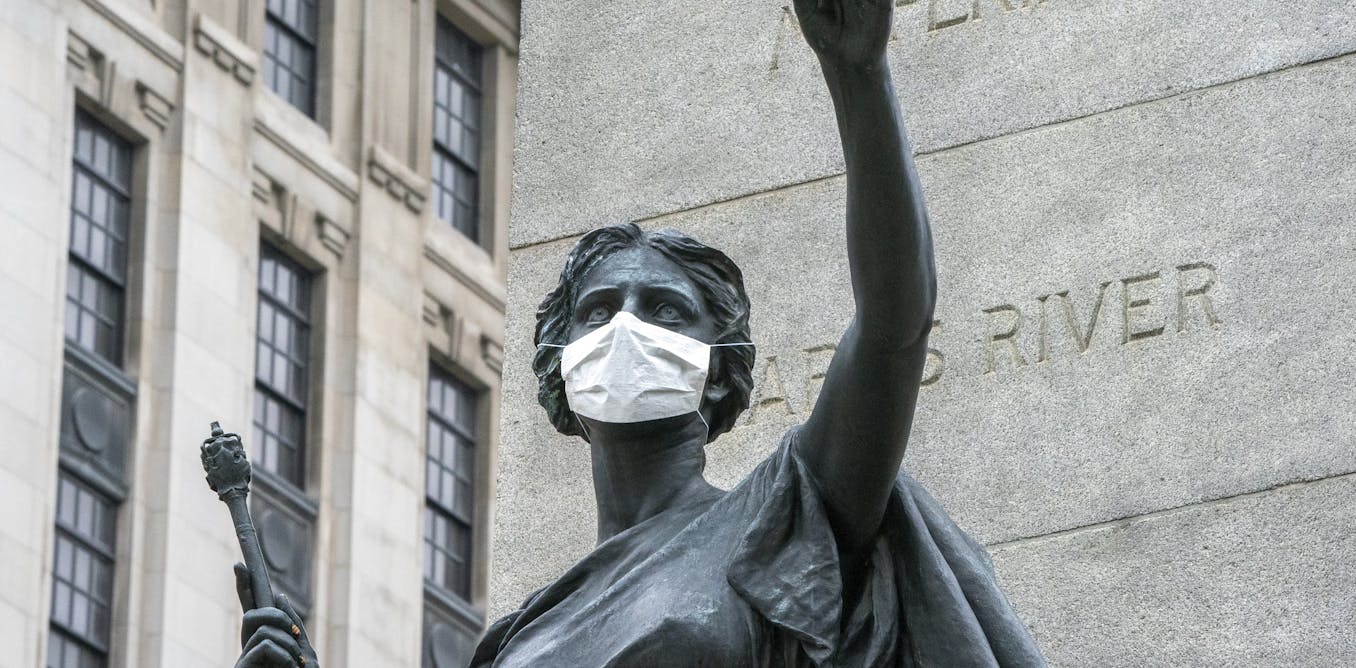
A surgical mask adorns a war memorial statue in Toronto on March 19, 2020. 
THE CANADIAN PRESS/Frank Gunn

Author
Costanza Musu
April 8, 2020 

As COVID-19 sweeps across the globe, many politicians and news media have adopted war metaphors to describe the challenges we are facing.

In Britain, Queen Elizabeth II delivering a rare speech on Apr. 5 said “we will meet again” evoking a Second World War song. On March 9, Italian Prime Minister Giuseppe Conte also invoked the Second World War when he used Winston Churchill’s words to talk about Italy’s “darkest hour.” President Donald Trump has described himself as a “war-time president,” fighting against an invisible enemy.

In New York, as residents face the explosion of new cases and casualties, Governor Andrew Cuomo used the war metaphor extensively during a press conference:

“The soldiers in this fight are our health care professionals. It’s the doctors, it’s the nurses, it’s the people who are working in the hospitals, it’s the aids. They are the soldiers who are fighting this battle for us.”

The United Nations Secretary-General Antonio Gutiérrez embraced the comparison during his remarks at a G20 virtual summit on the COVID-19 pandemic:

“We are at war with a virus – and not winning it. …This war needs a war-time plan to fight it.”

Journalists have also been using the metaphor. A recent headline in the Globe and Mail read: “We are at war with COVID-19. We need to fight it like a war.”The ‘We Can Do It!’ poster was made to boost worker morale during the Second World War.
 (J. Howard Miller/Office for Emergency Management. War Production Board, circa 1942.)

The war-time imagery is compelling. It identifies an enemy (the virus), a strategy (“flatten the curve,” but also “save the economy”), the front-line warriors (health-care personnel), the home-front (people isolating at home), the traitors and deserters (people breaking the social-distancing rules).

Furthermore, it highlights the urgency that underpins drastic policy decisions like the closing of schools, the imposition of travels bans, the grinding to a halt of economies around the world. It appeals to citizens’ sense of duty and obligation to serve in their country’s hour of need.

This is certainly not the first time leaders and policy-makers have used the war metaphor to describe a threat that does not qualify as military. Think the war on poverty, on cancer, on illegal immigration, not to mention the war on drugs or on crime.

While highly appealing as a tool of political rhetoric, the war metaphor hides several pitfalls that, in the case of the COVID-19 pandemic, are particularly dangerous.
Are we all soldiers now?

Using the war metaphor shuffles categorizations in insidious ways. For example, we are no longer citizens; we are now “soldiers” in a conflict. As such, politicians call for obedience rather than awareness and appeal to our patriotism, not to our solidarity.

It is under the guise of these categorizations that we have already seen, across the world, shifts towards dangerous authoritarian power-grabs, as in Hungary, where Prime Minister Viktor Orbán seized wide-ranging emergency powers and the ability to rule by decree.

Similarly, in the Philippines President Rodrigo Duterte, in the context of a national emergency bill, gained the right to punish people spreading “false information” about the outbreak, a right that could easily be used to silence political dissent.

In the United Kingdom, a country with robust democratic institutions, the Coronavirus Bill gave government ministries the power to detain and isolate people, ban public gatherings including protests and shut down ports and airports. Health Secretary Matt Hancock put it this way:


“The measures that I have outlined are unprecedented in peacetime. We will fight this virus with everything we have. We are in a war against an invisible killer and we have to do everything we can to stop it.”

In Alberta, the passing of Bill 10 gives the premier and his cabinet broad and extraordinary powers.

Moreover, defining the pandemic as war leads inevitably to the need to identify an enemy. The enemy here is the the coronavirus, but many politicians have also added qualifiers to the enemy virus.

The expression, “the China Virus,” by President Trump and other American policy-makers, has been linked to a rise of racist anti-Asian attacks in the North America.

As the virus has spread like wildfire in large cities like New York, Toronto and Montréal, another dichotomy is between big urban centres and smaller rural areas whose residents may feel at risk of exposure from city-dwellers escaping the metropolis.
A new nationalism

As we find ourselves at war we may be irresistibly drawn to an inward-looking, my-country-first attitude. Arguments over essential supplies have erupted, with countries blocking shipments of items like masks and other protective equipment or life-saving ventilators.
Inspired by Second World War efforts, a Canadian artist created posters to help prevent the spread of COVID-19. (Michael Slotwinski), CC BY-SA

Within the European Union an initial failure of solidarity has made many suggest that the pandemic might eventually claim another victim: the EU itself.

The Trump administration has attempted to prevent 3M, the world’s largest manufacturers of protective medical gear, from sending masks to Canada. The attempt was promptly followed by a not-too-subtle reference by Prime Minister Justin Trudeau to the large number of Canadian doctors and nurses crossing the border to work in American hospitals.
The long run

Experts have been increasingly talking about a large time window before we can expect this crisis to be over. Laboratories around the world are racing to find a vaccine or, at least, an effective treatment to reduce casualties.

In other words, we are in this for the long run: democracies and authoritarian states, rich and poor states, Chinese, Americans, Russians and the rest of the world.

If we are “at war” for an undetermined amount of time, battle fatigue may derail all efforts. Leaders would do better to promote civil responsibility and global solidarity instead of the idea of warfare. Finding a solution to the pandemic is a shared responsibility, and the solution must be global.

It is not by cultivating the image of warriors that governments will convince people to continue to comply with health authorities: it is by appealing to civic duty, solidarity and respect for fellow human beings.

This shift in perspective is necessary, if we want to resolve not only this crisis, but other global emergencies, including climate change and the depletion of the planet which are, as the World Health Organization has indicated, inextricably linked with the spread of infectious diseases.


Costanza Musu
Associate Professor, Graduate Scool of Public and International Affairs, University of Ottawa, L’Université d’Ottawa/University of Ottawa
Disclosure statement
Costanza Musu receives funding from the Social Sciences and Humanities Research Council (SSHRC)
Partners
University of Ottawa provides funding as a member of 
The Conversation CA.