Monday, November 23, 2020

UK
Low-paid women will bear the brunt of the public sector pay freeze
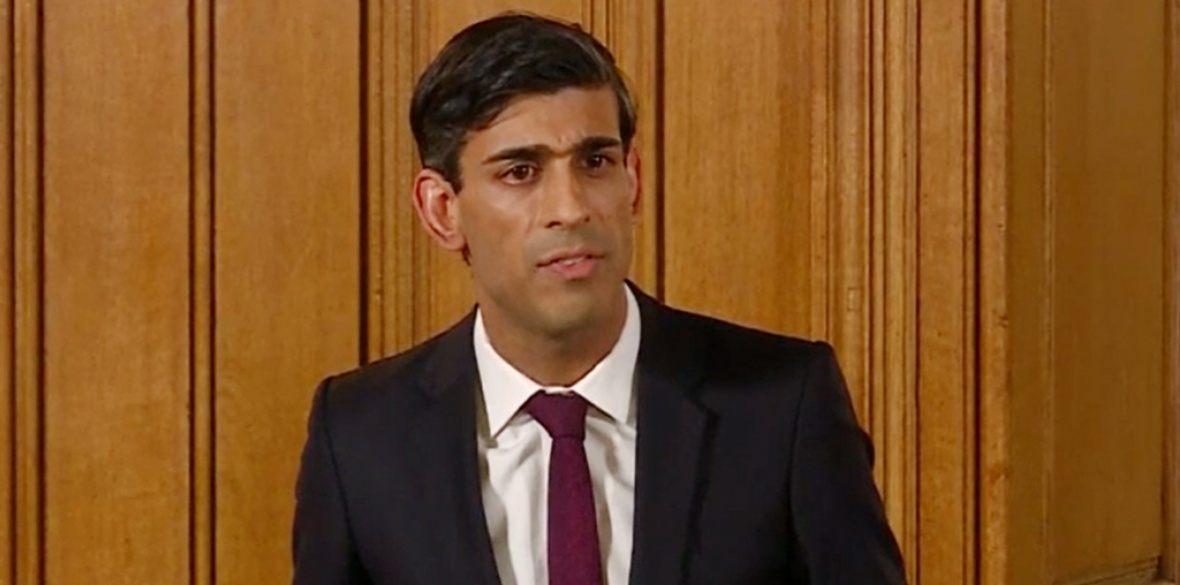

Chancellor of the Exchequer Rishi Sunak

LOW-PAID female workers will bear the brunt of the public-sector pay freeze Chancellor Rishi Sunak is expected to announce on Wednesday, union Unite has warned.

Mr Sunak is expected to announce a three-year freeze on public-sector wages, which would cost public-sector workers an estimated £15 billion, according to financial analysts.

He hinted yesterday that he could impose the freeze by arguing that it would be “entirely reasonable” to consider pay policy in an economy hard-hit by the coronavirus pandemic.

The freeze will not be applied to NHS front-line staff but will affect other key workers including firefighters, hospital porters and teaching assistants.

Unite assistant general secretary Gail Cartmail said: “It is clear that any public-sector pay freeze will bear down hardest on female employees, who make up the majority of the public-sector workforce, such as nurses, teaching assistants and those who care for our most vulnerable.

“Already women have been badly affected by the pandemic as they juggle childcare responsibilities, their work commitments and worries about elderly relatives, and now the Chancellor Rishi Sunak appears to be going to make their financial situation a lot worse, which is shameful.”

General union GMB said a wage freeze to pay for the government’s botched handling of the coronavirus pandemic could cost the Tories 43 of the 54 seats they took from Labour in 2019.

GMB national officer Rehana Azam said: “GMB will not rest in campaigning for pay justice for all public service workers and if Conservative MPs insist on pushing this cruel and counter-productive measure through then it will not be forgotten at the next election.

“A new pay freeze would be an outrageous attack on some of the workers who sacrificed the most during the Covid pandemic.

“Public-sector workers’ wages have never recovered from a decade of pay austerity, which forced thousands of key workers to depend on debt and foodbanks.”

Local Government Association chairman James Jamieson said: “The coronavirus crisis has highlighted the exceptional commitment of council staff and care workers who, alongside NHS health workers, have been on the front line in the battle against Covid-19 and are true heroes of this pandemic.”

He called for more government funding for local councils “to support their employees as much as possible and recruit and retain the staff needed to provide the local services that are delivered every day by our hard-working staff, alongside care workers and NHS colleagues.”

Labour’s shadow chancellor Anneliese Dodds will say in a speech today that taxpayers “shouldn’t have to pay the price for a government that doesn’t know the value of public money, splurging it on outsourced contracts to Tory-linked firms that don’t deliver.”

And Communist Party of Britain (CPB) northern district secretary Martin Levy said that Tory incompetence and corruption over the handling of the pandemic meant that “many thousands more people have lost their lives, jobs are being destroyed and small businesses are going to the wall.”

He said at an online meeting of the CPB executive at the weekend: “Faced with the prospect of mass unemployment, our economy urgently needs a boost in demand and production, not a public-sector pay freeze.”

UK

Government taps consultants to consult on consultancy plans

Written by Beckie Smith on 23 November 2020 in News

Management experts and trade bodies are reportedly providing pro bono advice on plans to establish an in-house Crown Consultancy

Credit: Pixabay

The Cabinet Office has called in management consultants to give advice on how government can reduce its reliance on consultants, it has been revealed.

The department has called on consultancies and trade associations to inform the government’s plans to set up an in-house “Crown Consultancy”, emails leaked to The Telegraph show.

In the emails, civil service chief people officer Rupert McNeil outlined plans to set up a “brand and platform” to provide capacity and skills to government bodies where it is needed, according to the newspaper.

The Cabinet Office aims to “launch an alpha pathfinder for a new Crown Consultancy capability” sometime between January and August next year, the report said. Trade bodies and consultancies are offering input to the project but are not being paid for their work, a source told The Telegraph.

Related content


Under the plans, which were first reported in the Financial Times earlier this month, external consultants would be used less frequently only for specific tasks.

The project is being led by Cabinet Office minister Lord Agnew, who has recently said the government's extensive use of external suppliers is “providing poor value for money” and “infantilises the civil service by depriving our brightest people of opportunities to work on some of the most challenging, fulfilling and crunchy issues”.

In a letter to civil service chief operating officer Alex Chisholm in September, Agnew said the government seemed to be ineffectual at using graduate Fast Stream civil servants to carry out work that is outsourced to consultants, “using similar people at a vastly inflated cost”.

The latest plans would see fast streamers – of whom 60 of the latest intake joined the digital,data and technology profession – along with other officials appointed to the internal consultancy from elsewhere in the civil service.

Once the internal body is set up, McNeil said the use of external consultants "should only be... for new capability requirements or for very scarce skills that the government does not need to use regularly".

His comments echo those made earlier this month by Chisholm, who said the civil service should make “sparing” use of consultants only where it is justified to provide skills that are not available in house or where extra short-term capacity is needed.

Chisholm told a committee of MPs that he agreed with Lord Agnew that “we should be doing more in house, and that capabilities that used to be seen as things you would get external consultants to do... should now be regarded as core disciplines in the civil service”.

He said departments' use of consultants had peaked this year, as extra support was needed for the coronavirus response and preparations for the end of the Brexit transition period.

A Cabinet Office spokesperson said: "Ministers are concerned that the government is too reliant on consultants and have written to departments to make clear that services should only be procured when external expertise is essential and represents value for money. Where possible, we want to harness the wide range of skills within the civil service."


About the author

Beckie Smith is acting deputy editor for PublicTechnology sister publication Civil Service World, where this story first appeared. She tweets as @beckie__smith.

To Wear Their Masks, the Beards (and a Tradition) Had to Go

Members of ski patrols nationwide are known for their beards, but many have shaved them to wear masks in the pandemic, causing good-natured angst.


Image
Hunter Mortensen with his beard and now-retired patrol dog, Tali, in 2016.Credit...Shauna Farnel

Image
Mortenson and his current patrol dog, Huckleberry.Credit...James Stukenberg for The New York Times


By Shauna Farnell

Tony Cammarata dreaded the news he had to deliver to his employees. They were not losing their jobs. They were not losing their perks.

They were losing their beards.

Cammarata, who oversees the ski patrol for an area in the Rocky Mountains west of Denver, had to clamp down on the facial hair so that the patrol could properly wear their N95 respirator masks for protection in the coronavirus pandemic.

But he knew this would be a tough measure to accept for the men on his crew (47 of the resort’s 56 patrollers). For the vast majority of them, beards and the ski patrol go together like snow and the mountains.

“You could tell people they’re not getting a merit increase, that you’re cutting their skiing privileges,” said Cammarata, the Arapahoe Basin Ski Area operations director. “It’s not as bad as telling them they have to shave. The whole beard thing is ingrained in our culture.”


The masks are required this season. And they fit much better without the facial hair.

“You need to have a good, tight seal,’’ said Dr. Kendrick Adnan, the medical adviser for the Arapahoe Basin, Copper Mountain and Keystone ski resorts and a former ski patroller himself. “Facial hair will interfere with that and put that ski patroller at risk.”

“I’ve known many ski patrollers whose facial hair is near and dear,” he added. “This year is going to be painful for them.”

Unlock more free articles.Create an account or log in


Painful doesn’t quite capture it.

“It was shocking,” said Hunter Mortensen, a longtime Breckenridge ski patroller who recently shaved for the first time in 10 years. “It was like that jumping-in-a-cold-lake-feeling the first time the wind blew.”

His colleague Ryan Dineen, who has not owned a razor since 2005 and whose wife has never seen him without a beard, agreed that hearing about the new shaving protocol was jarring.

“The kneejerk reaction was, how dare you? This is who I am,” Dineen said, preparing to succumb to the razor in the coming days. “I might have to FaceTime with my dad so he can reteach me how to use a razor.”

Ski resorts are trying to recover from a spring season cut short by virus lockdowns. Skiers now face a range of precautions including mask requirements, social distancing measures on lifts, reservation-only time on slopes and some closed indoor dining spots.

By and large, ski patrol members cutting their beards see it as a small inconvenience for the sake of safety and keeping the slopes active. But all the shaving has come with some peculiarities.

In ski areas like Arapahoe Basin, about 80 percent of the male patrollers have had to drastically change (or introduce) shaving regimens. A chart issued by the Centers for Disease Control and Prevention highlighting the variety of facial hairstyles permitted with a fitted respirator mask has become a go-to resource.


Image
Thomas Olsen, a ski patroller in Colorado, before shaving his beard.Credit...Ian Zinner/Arapahoe Basin Ski Area

Olsen with his clean, mask-ready look.Credit...Ian Zinner/Arapahoe Basin Ski Area

“It’s one of the funniest government-issued documents I’ve ever seen,” Cammarata said. “It’s a pictogram with 40-plus styles of facial hair. They’ve named them all. We’ve always had a long tradition of hiring these Viking-looking men to do this job. When I showed them this chart, we all laughed hysterically. We’ve been trying to keep it pretty lighthearted. People started showing up with some ridiculous facial hair.”

Bearded patrollers say their facial hair serves as protection against the elements — a warm layer in strong winds, blizzards, frigid temperatures and harsh high elevation sun.

“It’s like Mother Nature’s neck gaiter,” said Drew Kneeland, the patrol director in Jackson Hole, Wyo. “Also, it’s funny how people look at you differently if you have a beard or not. For some reason, people don’t question someone with a beard as much as if they’re clean-shaven. It becomes part of your identity and how you interact with the world around you.”

And if Kneeland is being honest, “if you’re skiing deep powder and you come down to the bottom and have a face full of snow, it’s kind of fun.”

For Rick Hamlin, a National Ski Patrol historian who has covered Vermont’s Smugglers’ Notch for 48 years and has rocked a bushy mustache since 1979, the prospect of shaving is something he is willing to put up with in order to continue doing what he loves.

“I’d be sad about it, but given the choice between patrolling and having facial hair, I would definitely do it,” Hamlin said. “One thing you can say about patrollers everywhere is they’re used to adapting and doing whatever is needed to get the job done.”

Mark Hardy, longtime patroller at Alpental, Wash., expects initial grumbling among his notoriously hairy co-workers, but said it won’t be unlike other safety measures that have come into play over the years.

“They made us all switch to helmets several years ago,’’ he said. “I thought there would be an uprising.”

Mike O’Hara, a ski patrol supervisor at Killington, Vt., recently shaved the beard he had sported for nearly 30 years.

“We have a few patrollers whose beards are older than some of their co-workers,” he said. “After the initial shock of learning the new shaving protocol, most patrollers understood it’s a small step to take to help ensure the safety of ourselves, our families, our company and the community as a whole.”

And, really, it’s a small step considering the gravity of the pandemic.

“I’m not a frontline doctor in an E.R. who has to wear an N95 all day,” Dineen said. “I don’t live in a city. There’s a lot of things about Covid that haven’t impacted us here. As much as we love our facial hair, we love what we do more. This beard will come back. Maybe I’ll shave it and think, man, I look like an adult for the first time in my life.”

And many patrollers are finding a silver lining. “Most of us look a lot younger and less weathered,” Mortensen said.

“The beard has been part of our iconic look. There are going to be some grown men with separation anxiety for a little while. They might need a big hug every now and then.”

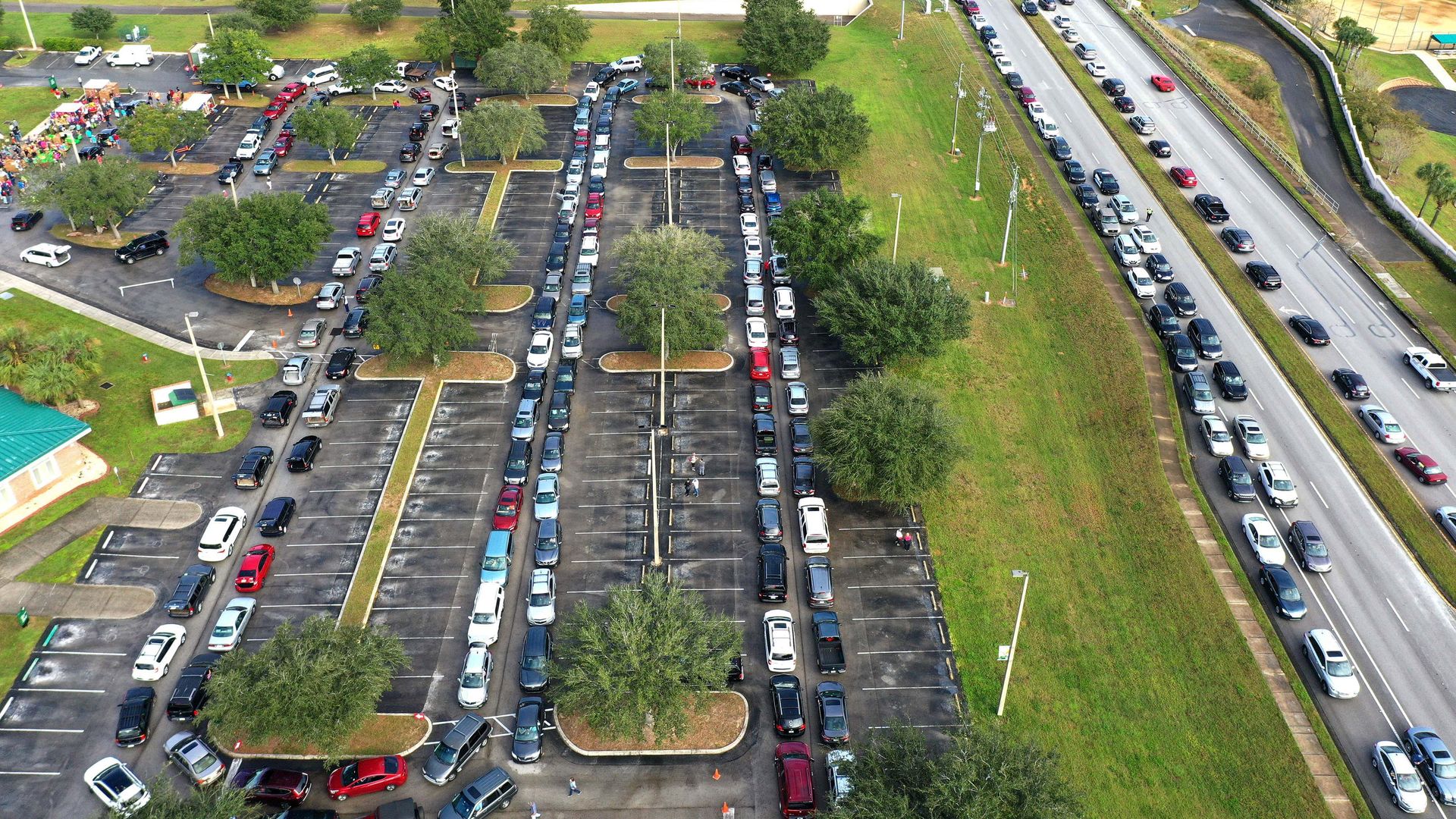
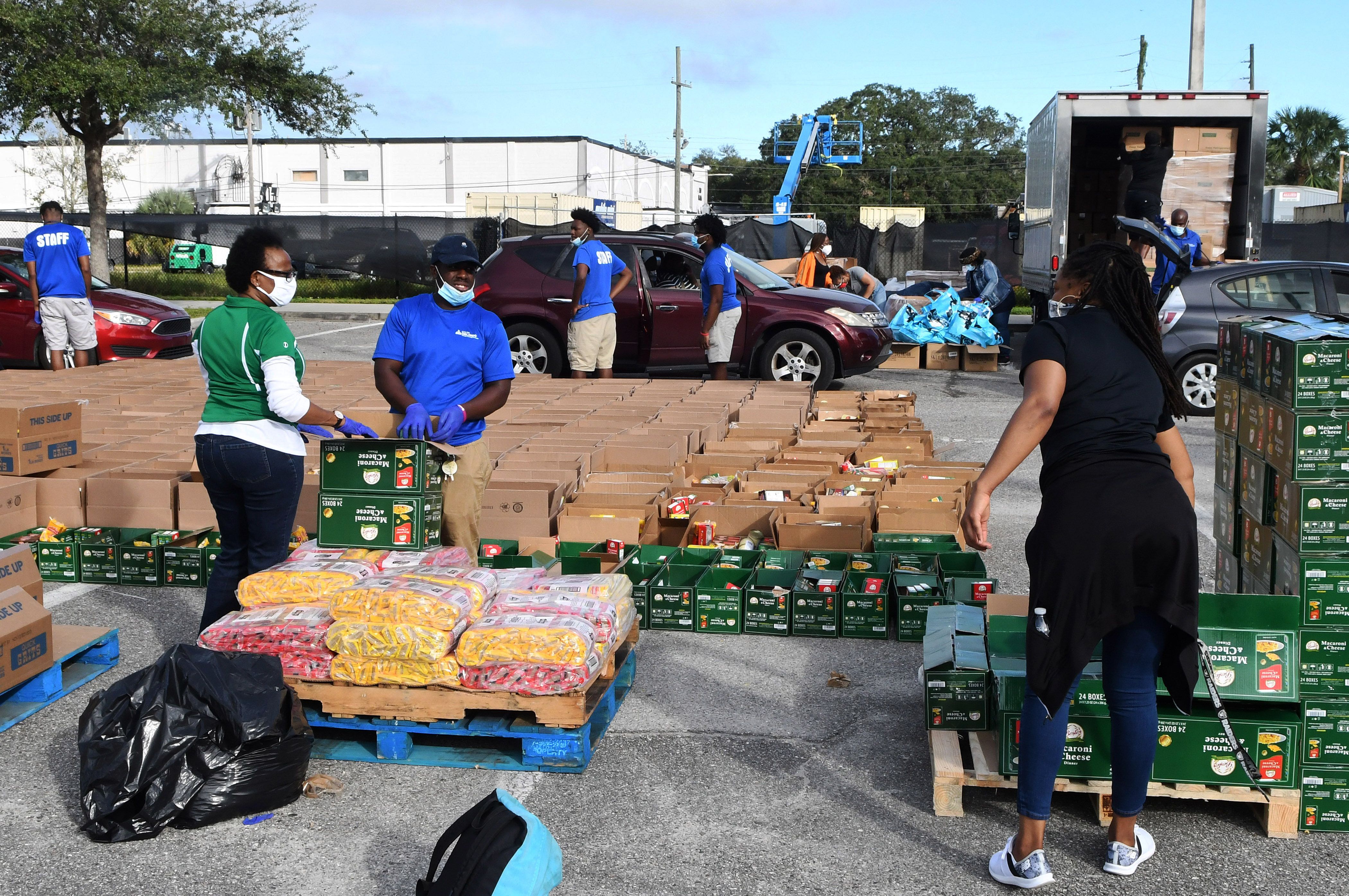
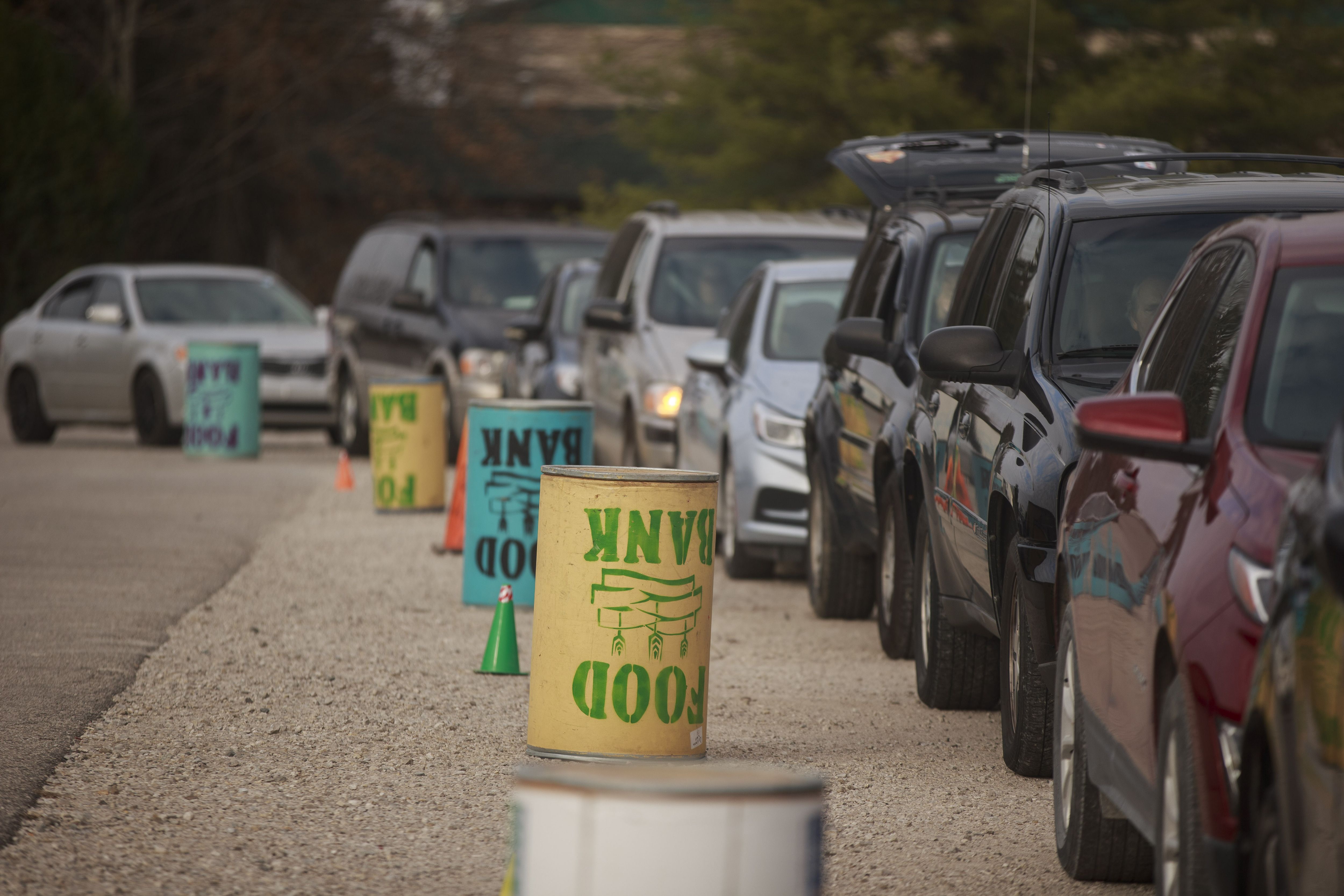
Residents line up in their cars at a food distribution site in Clermont, Fla., Nov. 21. Photo: Paul Hennessy/SOPA Images/LightRocket via Getty Images

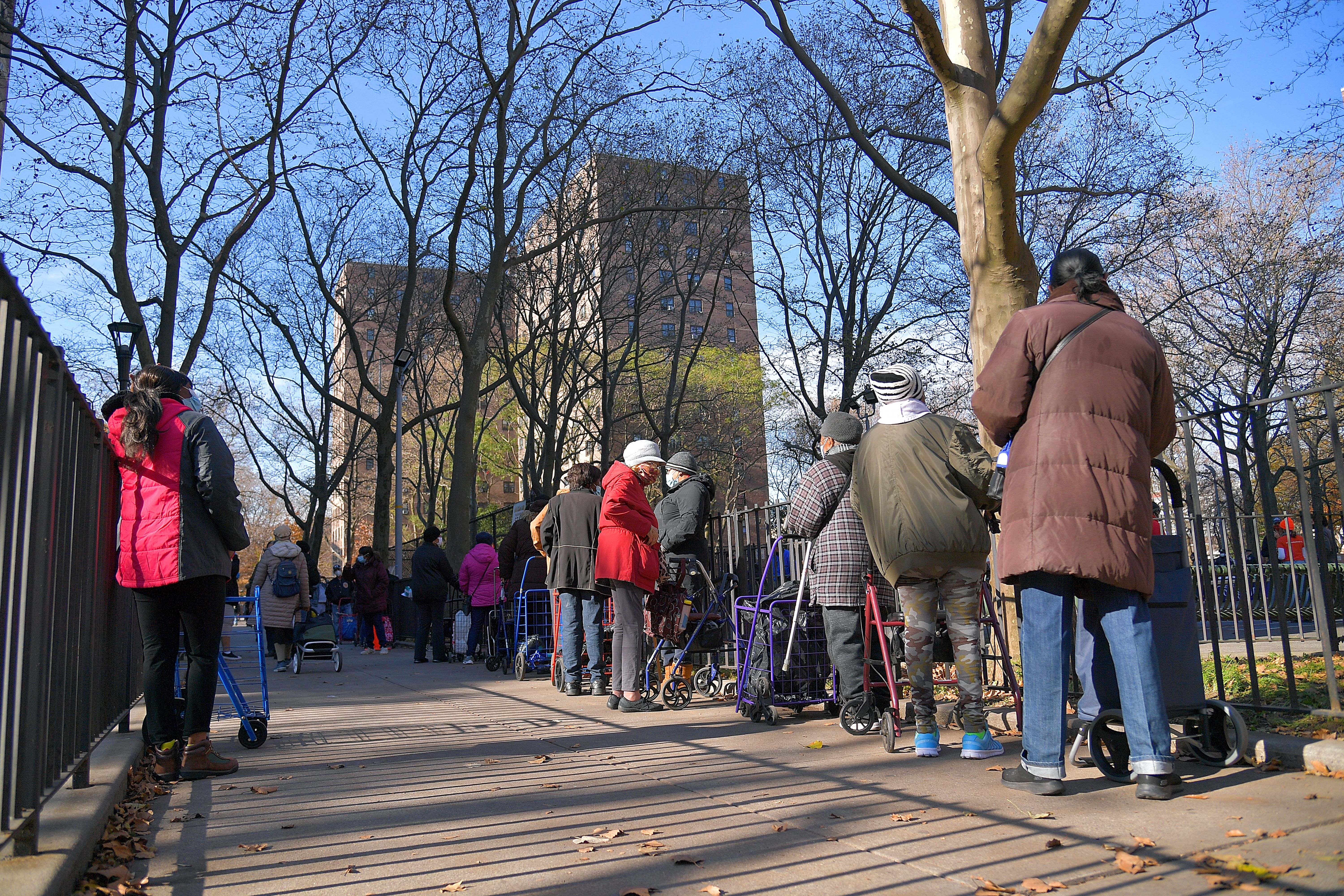
Thousands of Americans waited in long lines at food banks in the week before Thanksgiving to pick up turkeys, canned goods, broccoli and other vegetables.

Why it matters: As the holiday season approaches, families across the U.S. are in need of food assistance due to chronic unemployment and economic hardship caused by COVID-19 — and many food pantries already served an unprecedented number of people this spring.

Zoom in: The Middle Georgia Regional Food Bank, part of the Feeding America Network, has distributed almost 3 million meals this quarter — 1 million more than the previous quarter before the pandemic began, NPR reports.

  • Los Angeles' First Unitarian Church expected roughly 1,000 people to line up this weekend, CNN reports, while people in DeKalb County, Georgia, lined up nearly five hours before one food drive opened.
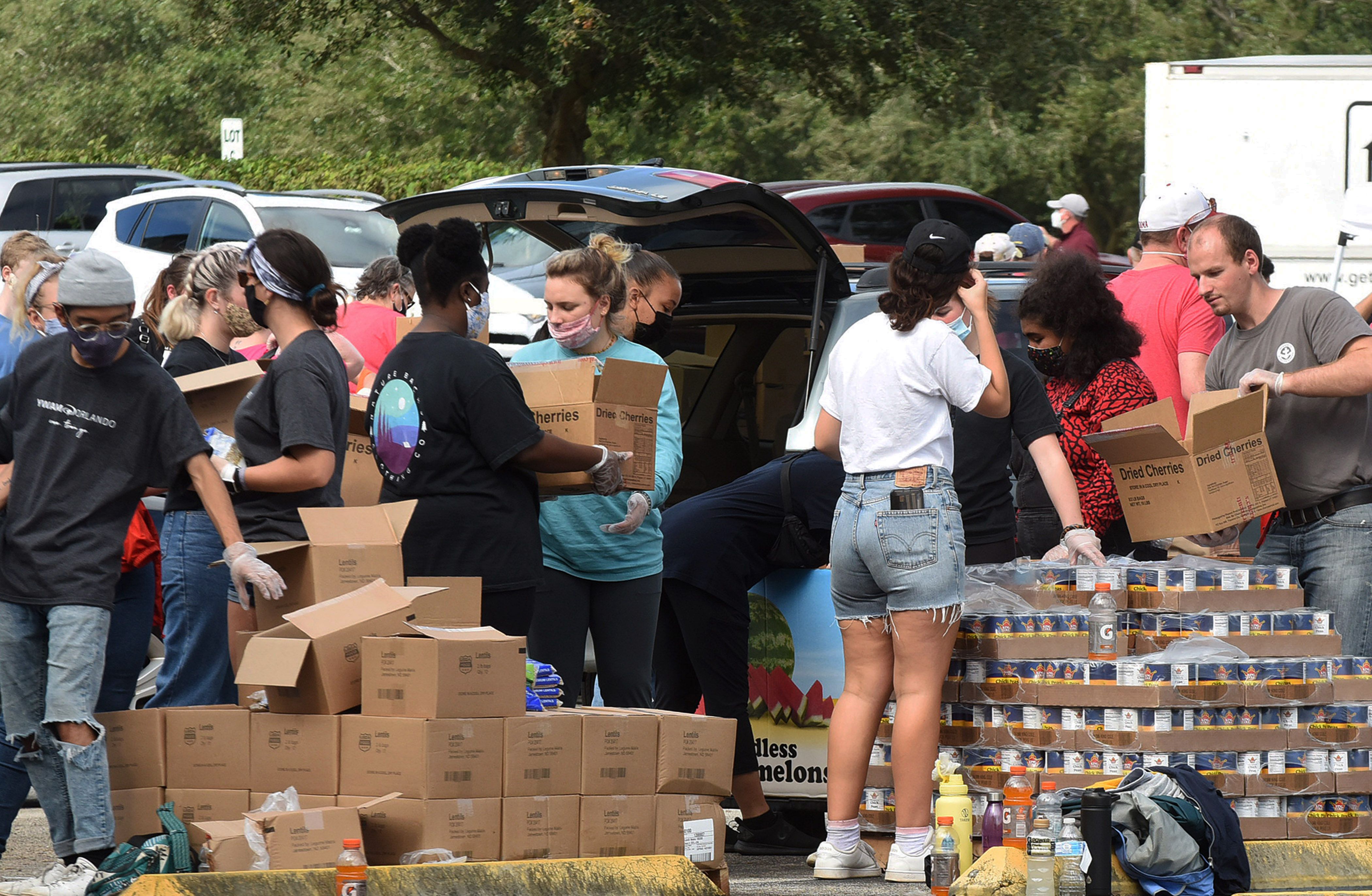
Volunteers distribute turkeys and other food assistance in Clermont, Fla., Nov. 21. Photo: Paul Hennessy/SOPA Images/LightRocket via Getty Images
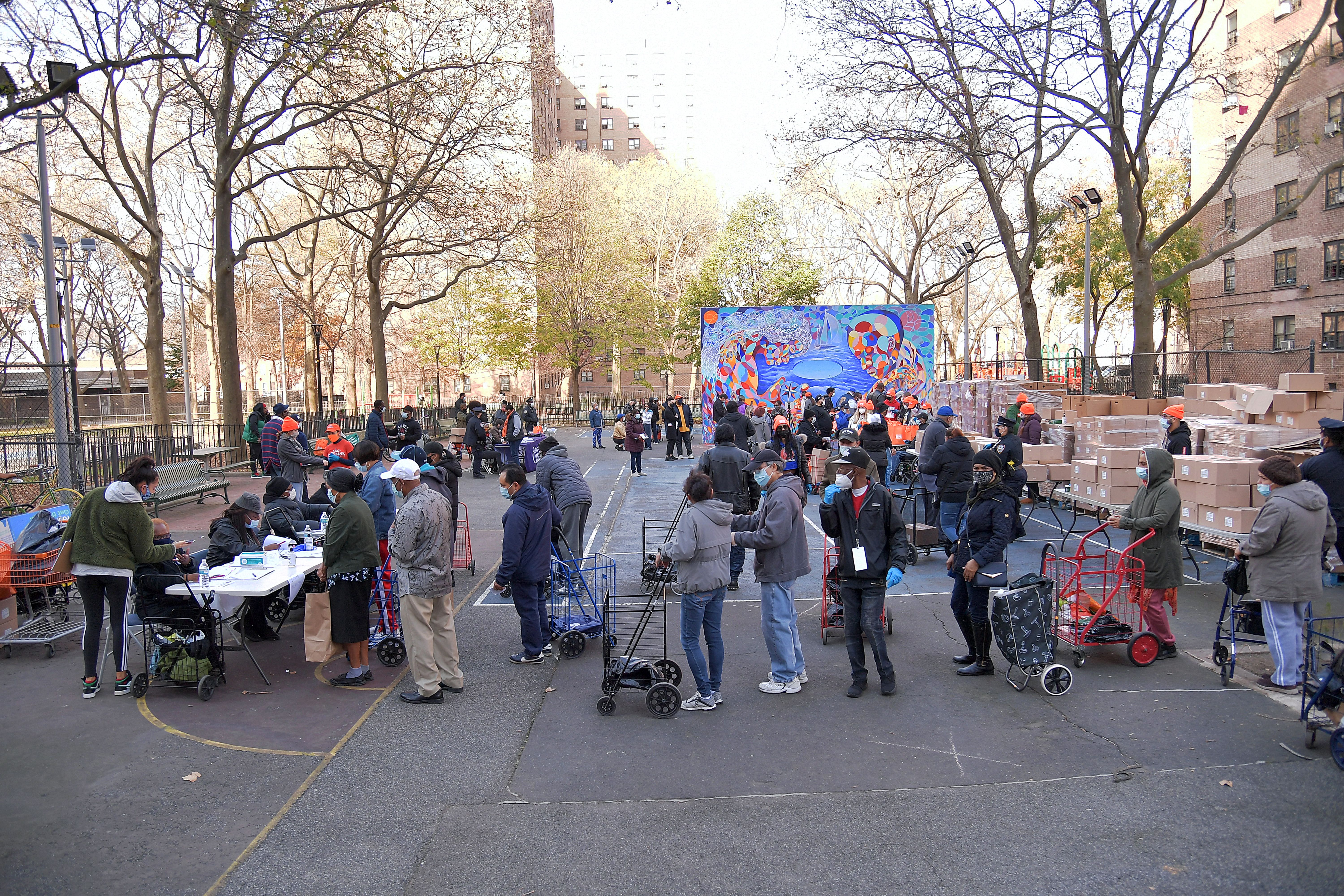
Food Bank for New York City, Tracy Morgan, and Council Member Robert E. Cornegy Jr. distribute turkeys to Brooklyn families, Nov. 21. Photo: Michael Loccisano/Getty Images for Food Bank for New York City
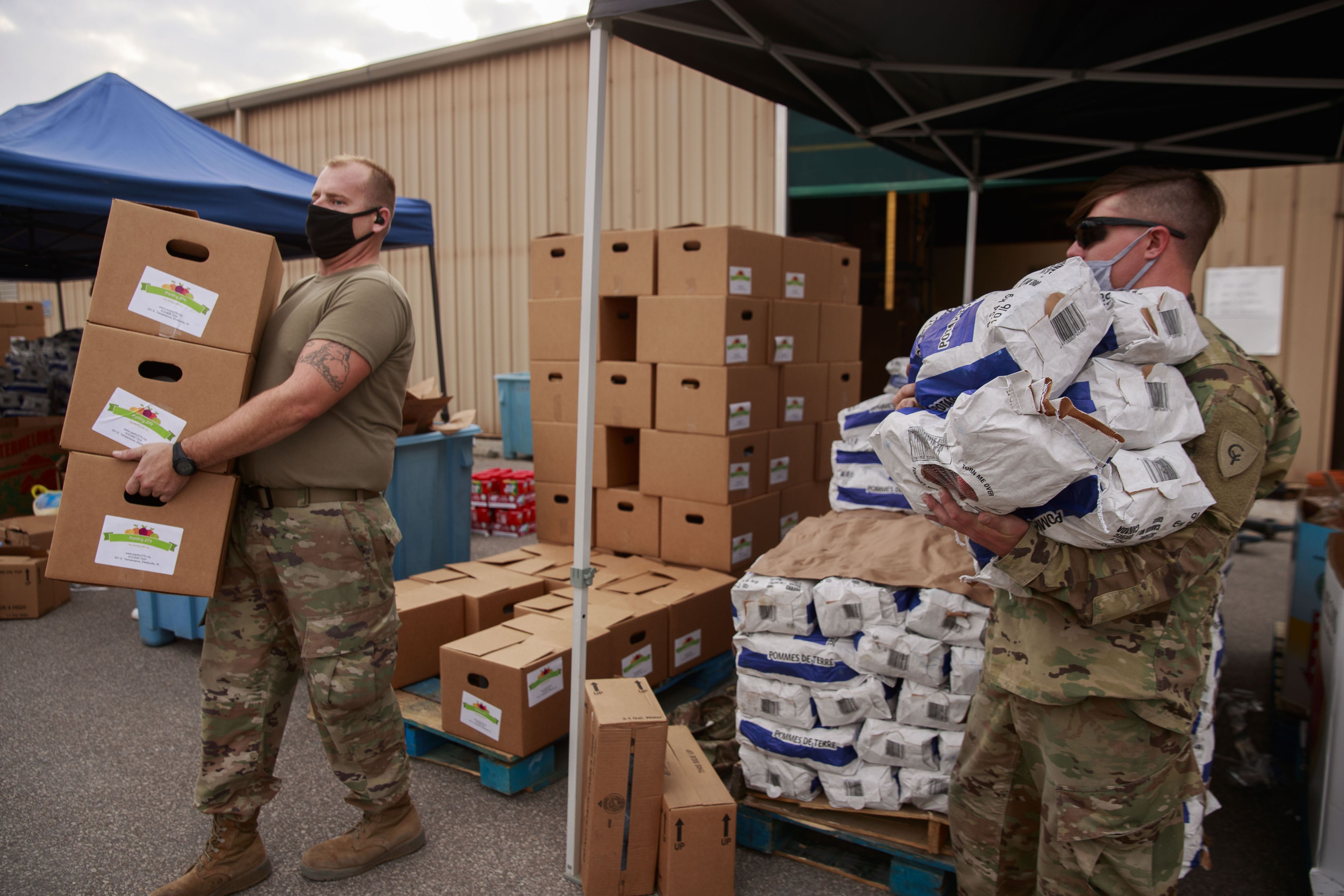
Indiana National Guard members help distribute Thanksgiving meals at the Hoosier Hills food bank, Nov. 20. Photo: Jeremy Hogan/SOPA Images/LightRocket via Getty Images
Volunteers with the Second Harvest Food Bank of Central Florida and the City of Orlando at Jones High School, Orlando, Fla., Nov. 20. Photo: Paul Hennessy/NurPhoto via Getty Images
Cars line up as Pantry 279 food bank distributes Thanksgiving meals in Bloomington, Ind., Nov. 21. Photo: Jeremy Hogan/SOPA Images/LightRocket via Getty Images
People line up as Food Bank for New York City distributes turkeys to Brooklyn families, Nov. 21. Photo: Michael Loccisano/Getty Images for Food Bank for New York City


Government complicity fuels coronavirus among Brazil's indigenous people

By agency reporter
NOVEMBER 21, 2020

A new report released this week exposes a humanitarian crisis rapidly unfolding in Brazil’s largest indigenous territory, home to the Yanomami and Ye’kwana tribes. Xawara– tracing the deadly path of Covid-19 and government negligence in the Yanomami territory was compiled by Yanomami and Ye’kwana organisations and a group of researchers from the Pro-Yanomami and Ye’kwana Network

The report says, “The Yanomami and Ye’kwana people, facing a dangerous combination of mining, malaria and COVID-19, are on their own.” It reveals that government neglect and complicity in the ongoing invasion and destruction of significant parts of Yanomami land by illegal goldminers means coronavirus is spreading rapidly in the territory. This is having devastating consequences for the 27,000 Yanomami and Ye’kwana indigenous people who live there.

A detailed timeline catalogues many incidents of neglect and abuse, significant under-reporting of cases of COVID-19 (and in some areas no reporting at all), few tests carried out, and a lack of vital medicines and medical staff.

The report found that:

  • over 10,000 people, a third of the total indigenous population in the Yanomami Territory, may have already been exposed to COVID-19,
  • from August to October alone, confirmed cases jumped from 335 to 1,202,
  • less than 4.7 per cent of the total population in the territory has been tested,
  • in the three regions with the greatest concentrations of illegal mines, coronavirus is rife and was brought in by the miners,
  • several uncontacted Yanomami groups are at extreme risk should there be any encounter with outsiders,
  • from January to September 2020, there was an increase of 20 per cent in environmental degradation caused by mining.

The report highlights that before the pandemic took root, many Yanomami were already weakened by diseases like malaria, the incidence of which has quadrupled in the last five years. This makes them more susceptible and less equipped to combat coronavirus.

Graphic testimonies from Yanomami are a strong indictment of government negligence. A Yanomami woman from Kanayau, one of the areas most affected by mining, said: “We are all sick. Our forest got sick. That’s the miners’ airstrip, because many planes land there. When a plane arrives, many people get off it, and as many planes are coming, today this disease has arrived! It’s a strong disease!”

Francisco Yanomami, from the Marauiá region, warned about the lack of testing: “We weren’t supposed to be dying of this, because of a strong disease, you know. […] Now it’s happening, COVID-19 symptoms are increasing, it’s increasing. What can we do? How do we know if it’s really COVID-19? How can we find out if it’s from COVID-19 that we’re dying? We have to know which disease is killing us.”

Xawara is the Yanomami word for epidemics and is associated with the fumes emanating from machinery used by outsiders, particularly the goldminers’ dredging equipment, airplane and boat engines, and the mercury vapor produced when gold is processed.

Yanomami leader and shaman Davi Kopenawa explains: “What we call xawara are measles, flu, malaria, tuberculosis, and all those other white people diseases that kill us to devour our flesh. The only thing that ordinary people know of them are the fumes that propagate them. “But we shamans, we also see in them the image of the epidemic beings, the xawarari.”

One shocking event was the 'disappearance' of three young Yanomami children who died from suspected COVID-19. After public protests, it was revealed that their bodies had been buried in a cemetery in the city of Boa Vista without the knowledge or consent of their parents.

Anthropologist Bruce Albert’s article in the report explains the torment and pain felt by Yanomami families who were kept in the dark by the authorities over the death of their loved ones, and denied the opportunity to organise the proper funerary rites of cremation. He draws a parallel between the desecration of dead Yanomami from COVID-19 today with the disappearances of political protestors during Brazil’s military dictatorship: “In fact, taking possession of the dead of others to erase them from collective memory and denying the grieving of their family members has always been the mark of a supreme stage of barbarism based on the contempt and denial of the Other, ethnic and/or political.”

The Yanomami are among those worst hit by President Bolsonaro’s attacks on indigenous peoples. Nationwide, their lands are being stolen for mining, agribusiness and logging and they are fighting back to stop Brazil’s genocide.

Faced with the government’s criminal negligence, Yanomami and Ye’kwana organizations are calling for all illegal invaders to be removed now, the implementation of an emergency COVID-19 action plan, and a programme to eradicate malaria. They have launched an online petition calling on the authorities to act before it is too late.

* Read Xawara– tracing the deadly path of Covid-19 and government negligence in the Yanomami territory here

* Survival International https://www.survivalinternational.org/

[Ekk/6]


Neo-Nazis attack journalists at protests against Germany's COVID-19 measures

By agency reporter
NOVEMBER 23, 2020

Reporters Without Borders says the latest anti-COVID-19 protests in Germany reveal a worrying increase in the willingness to resort to violence against journalists. Neo-Nazis and hooligans use the demonstrations to brutally attack representatives of the media under the guise of a citizen protest movement. The demonstrators and their leaders are yet to distance themselves from this violence. At times, the police appear helpless to intervene, sometimes even impeding the coverage of events, instead of firmly protecting the right to free reporting.

"If the neo-Nazis and hooligans have their way, the new normal in these times of coronavirus will include constant harassment, threats and attacks against journalists", said Christian Mihr, managing director of Reporters Without Borders (RSF) Germany. “Anyone who fails to clearly distance themselves from the violent right-wing scene during demonstrations accepts that the media can only report on certain topics at risk of life and limb. Police and security authorities must ensure effective protection for media representatives during demonstrations and enforce the basic right to freedom of the press", he added.

During the demonstration held by the coalition Querdenken (lateral thinking) in Leipzig on 7 November, the German Union of Journalists (DJU) recorded 43 attacks and disruptions to the work of journalists. In particular, photographers and cameramen reported substantial threats, jostling and attacks by "larger groups of hooligans". Media representatives were struck on the head, punched, or chased off by groups of well-known right-wing extremists.

Journalists who were involved have reported that demonstrators screamed at journalists from a close distance. They were particularly aggressive against journalists from the public media. Several media representatives removed the channel logos from their microphones to avoid being targeted. A ZDF camera team was “deliberately attacked several times" and, according to a number of accounts, was surrounded at one stage by a group of right-wing extremists The team was only able to safely escape with the help of security services.

According to reports, the attacks were often initiated by groups led by well-known right-wing extremists from all over Germany. One journalist reported that he was in a group who had to suspend reporting for a second time because "larger groups of hooligans" were running towards them.

Right-wing extremist groups had been mobilising extensively in the run-up to the demonstration and had travelled from all over Germany – as they had during the large-scale Querdenken demonstration in Berlin on 29 August. The demonstration was led at times by neo-Nazis and members of the right-wing martial arts scene. Chat groups of Querdenken supporters celebrated when the demonstrators forcibly breached a police barrier, thus allowing the already prohibited march to proceed to the inner city ring road. RSF says the organisers of the protest were apparently willing to accept this use of violence as it fits into their strategy of staging the protest as self-empowerment against a perceived "Corona dictatorship".

Before the main rally began, the police had detained and recorded the personal details of around a dozen members of the press at the main train station, thereby temporarily impeding their work. At the rally itself, it is said that the police either failed or were slow to intervene when the media were being attacked. One journalist is said to have been threatened with being ejected and taken into custody by the police, forcing him to stop his work.

RSF says that during a Querdenken demonstration in Dresden on 31 October, groups of neo-Nazis and hooligans had harassed and  hounded media workers. Johannes Filous from Straßengezwitscher, which publishes on Twitter, described how a group of no less than six young men in hoods had "very specifically" targeted him, pursuing and attempting to isolate him. Similar incidents were reported by the freelance journalist Henrik Merker, who writes for the Störungsmelder blog on Zeit.de. It is reported that the police did not intervene. The national director of the German Journalists' Association Lars Radau spoke of "targeted and organised threats" against media representatives.

RSF says the latest events have underlined a trend that started months ago: journalists are routinely harassed, threatened or obstructed during protests against the government's COVID-19 measures. In Berlin alone, DJU have recorded more than 100 such incidents at COVID-19 related protests in the past six months. Around ten of these cases are said to involve media workers who were kicked or beaten. There have also been reports of abuse and harassment of female photographers or camera teams, and even death threats against reporters.

Reporters Without Borders has called on the German authorities to ensure journalists’ safety and help guarantee the fundamental right to inform.

Germany ranks 11th out of 180 countries in RSF’s World Press Freedom Index 2020.

* Reporters Without Borders https://rsf.org/en


UK

Education union calls for action on COVID-19 transmission in schools

By agency reporter
NOVEMBER 23, 2020

The latest school infection rate figures were released by the Office for National Statistics on 20 November 2020. Secondary school infection rates have rebounded since half term, and the National Education Unions says it appears that the lockdown has done nothing to slow the increase in infection amongst school age pupils.
 
The rate of infection amongst secondary age pupils has risen by 51 times since the start of September, and they have a significantly higher rate of infection than any other age group. Primary and secondary age children are the only age groups with an increasing rate of infection.
 
There were 124 confirmed outbreaks in secondary schools in the week following half term. Secondary and primary schools were the second and third most commonly reported location by people testing positive for coronavirus.
 
Kevin Courtney, Joint General Secretary of the National Education Union said: “The Government cannot bury their heads in the sand about coronavirus transmission in schools any longer. There is very clear evidence that secondary age pupils are catching the virus in school and on their way to school, and then passing it to their families. In these circumstances the Government cannot expect schools to ran as normal with almost no measures to protect staff and pupils.
 
"The Government's failure to break the chains of transmission in schools means this period of lockdown will not result in cases falling to any significant degree – we will be in the same place on 2 December as we were on 5 November when we needed to introduce the lockdown because cases were so high.

"Today’s missive to school leaders forbidding them to move to rotas is another example of the Government failing to act to suppress viral transmission in schools and from them to the community. The Government’s refusal to give schools any money to deal with coronavirus this term speaks volumes.”

* Coronavirus (COVID-19) Infection Survey, UK: 20 November 2020 here

* National Education Union https://neu.org.uk/

Thailand to charge school students for joining protests

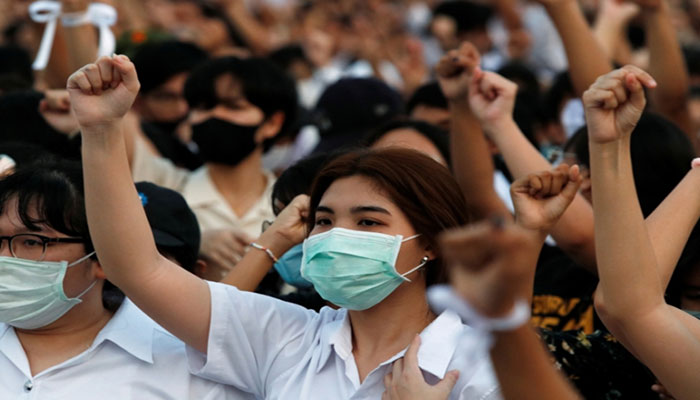
BANGKOK: Two Thai high school student leaders will be charged for joining a banned protest last month, police said on Friday, a day after embattled Prime Minister Prayuth Chan-ocha threatened tougher action against protesters, a British wire service reported Friday.

The students said they had been summoned for violating an emergency decree by joining a protest on Oct 15, when tens of thousands of people defied a ban by Prayuth aimed at halting protests demanding his removal and reforms of the monarchy.

“Even if you arrest protest leaders, there is not enough space in prison because hundreds more will rise up,” one of the students, 15-year Benjamaporn Nivas, told Reuters in an instant message.

The “Bad Student” group is planning a protest on Saturday and Benjamaporn said she would still attend. The other member of the group who faces charges is Lopanapat Wangpaisit, 17. Police spokesman Yingyos Thepjumnong said the two were summoned to acknowledge the charge and would be questioned in the presence of their parents and lawyer.

Youth- and student-led protests since July have become the greatest challenge to Thailand’s establishment in years and dozens of arrests and attempts to quell them have so far only brought more people into the streets.

Prayuth has refused the protesters’ demand to resign and rejected their accusation that he engineered last year’s election to keep power he seized in a 2014 coup. Protesters also seek to redraw the constitution written by his former junta and curb the powers of King Maha Vajiralongkorn, saying the monarchy has enabled decades of military domination. The Royal Palace has made no comment since the protests began.

https://www.thenews.com.pk/print/746845-thailand-to-charge-school-students-for-joining-protests

Alexandria Ocasio-Cortez roots for Harry Styles as he breaks gender barriers in fashion

All hell hath broken loose after British singer Harry Styles graced the cover of Vogue donning a stunning couture gown.

After the heartthrob was criticized widely over his androgynous style, many had stepped up to defend him, and the latest name in the list of his supporters is of US Representative Alexandria Ocasio-Cortez.

Asked about what she thought of Styles’s dressing game, AOC responded on her Instagram: "It looks wonderful. The masculine and feminine elements are balanced beautifully – the hair and jacket styling give me James Dean vibes too."

"Some people are mad at it [because] some folks are very sensitive to examining and exploring gender roles in society. Perhaps for some people it provokes some anger or insecurity around masculinity/femininity/etc.,” she continued.

“If it does, then maybe that’s part of the point. Sit with that reaction and think about it, examine it, explore it, engage it, and grow with it,” she went on to say.

"What’s the point of creating things if they don’t make people think? Or feel or reflect? Especially as an artist or creative? Who wants to see the same thing all the time? And never explore their assumptions? Anyways it looks bomb so,” she added.


Singer Harry Styles first man on the cover of Vogue; wears ball gown

Monday, 16 Nov 2020


Harry Styles modelling a full-length Gucci ball gown paired with a tuxedo jacket. Photo: Vogue/Twitter

British singer-songwriter Harry Styles leaned into his androgynous dress sense and donned a gown to grace the cover of Vogue - the first man to do so solo in the American fashion magazine's 127-year history.

The magazine and Styles himself both uploaded photos of his shoot onto social media.

He models several high-fashion get-ups, including a full-length Gucci ball gown paired with a tuxedo jacket on the cover.

He also wears items such as a kilt, custom-made corduroy pants and a crinoline - a structure designed to hold women's skirts, popular in the 19th century - over wide-legged pants.

The 26-year-old says in his Vogue interview: "When you take away 'There's clothes for men and there's clothes for women', once you remove any barriers, obviously you open up the arena in which you can play.

"I'll go in shops sometimes and I just find myself looking at the women's clothes thinking they're amazing. It's like anything - anytime you're putting barriers up in your own life, you're just limiting yourself. There's so much joy to be had in playing with clothes. I've never really thought too much about what it means - it just becomes this extended part of creating something."

The One Direction member (the boy band is currently on indefinite hiatus) has had a good year musically too, with his single Watermelon Sugar topping the Billboard Hot 100 songs chart in August. – The Straits Times/Asia News Network
RIP
Robert Fisk’s FINAL message: Journalists should challenge the narratives of power
By Pacific Media Watch -
November 3, 2020

A clip from This Is Not A Movie,
 a 2020 documentary by about Robert Fisk.
 Video: Doc Edge Festival

Veteran journalist Robert Fisk, who for decades covered events in the Middle East and elsewhere as a foreign correspondent for the British newspaper The Independent, has died after suffering a suspected stroke at his Dublin home.

Fisk became unwell on Friday and was admitted to St Vincent’s Hospital where he died a short time later, reports Al Jazeera English.

Almost six months ago, RNZ Saturday Morning’s Kim Hill did the following interview with Fisk. The Pacific Media Centre republishes this article here as a tribute to the celebrated journalist.

Celebrated veteran war correspondent Robert Fisk believed that journalists aren’t automatons keeping neutral battle scores between oppressed and oppressors and are duty-bound to ensure history isn’t written by politicians.

Fisk, who had spent the past 40 years living in war zones covering conflicts in the Middle East, the Balkans and Ireland, died last Friday. He was 74.

He argued that journalists and editors cower from reporting honestly because of corporate and political influence.

LISTEN TO RNZ SATURDAY MORNING: The full Robert Fisk interview – Duration 48m25s

He told Kim Hill in an interview in May that the notion unbiased reporting must not take a moral position was a nonsense and that journalists should, at the very least, challenge narratives of power, which were usually distortions of truth.

The high-profile career of the Englishman who took Irish nationality was the focus of This Is Not A Movie, a documentary by Canadian director Yung Chang about the journalist screened in New Zealand’s 2020 Doc Edge Festival.

Fisk broke several big stories in his time, even landing an interview with Osama bin Laden, notorious Saudi founder of the pan-Islamic terror group al-Qaeda.

A story that didn’t make it on to the front page of The Times – his former employer – was one exposing US responsibility for shooting down a Iranian passenger aircraft in 1988, at the tail end of the Iraq-Iran war.
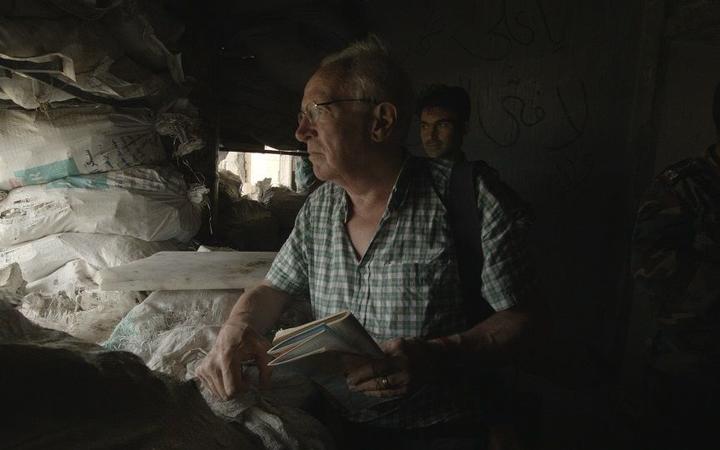
Robert Fisk … exclusive interview with Osama Bin Laden. Image: RNZ

Verified story spiked

The story, which Fisk verified using local air traffic control sources, was spiked and instead the paper published claims by the US navy that the pilot had tried to carry out a suicide mission on a US warship in the Gulf. His story was eventually published by Ireland’s Sunday Tribune, with Fisk resigning and moving to rival newspaper The Independent.

“I thought, that’s the time I go. If I’m going to risk my life for a newspaper but my editor will not risk his reputation with his owner over a story of mine then it’s time I left,” he said.

Fisk said The Times editor toed owner Rupert Murdoch’s political line, telling him his story was rubbish. An official inquiry by US authorities subsequently backed the content of Fisk’s story.

“It’s a sort of self-censorship… the problem is once you have a ruthless owner and you know your livelihood is in the pocket of that man – and if you’re not fortunate enough to have the reputation that can possibly get you another job – there is a tendency to start not wanting to rock the boat… so it’s in the journalists’ blood, as it is the editors’, not to do something that will cause a ‘crisis’.”

He said this power dynamic affected the way reporters framed stories and reflected the type of politically-contrived language used too. Not least in the Middle East, and especially when dealing with Israel’s occupation of Palestine.

“That’s why, for example, journalists refer to the Israeli wall separating the West Bank as a ‘security fence’, because they don’t want to offend the Israelis and Israel’s supporters by calling it a wall, even though it is higher and longer than the Berlin Wall.

“That’s why we call it a ‘Jewish settlement’ in the West Bank, when it’s a Jewish colony… which has a kind of soft impression of settlements in the Wild West perhaps, of course, you think of the Native Americans attacking them.

Distorting the Palestinian struggle

“And also you have this thing where you must never talk about a war between Israel and the Palestinians, it’s always a dispute… it’s more of course, it’s one group of people stealing other people’s land. By de-semiticising this conflict, because we are frightened of what editors or owners will say… we effectively say ‘there must be something wrong when the Palestinians throw stones, they must be generically a violent people’. So, in a sense, we contribute towards warfare, by self-censorship.”

He rejected the concept of giving a false “balance” to stories – that, in some fashion, balance was the ultimate measure of reporting. It was not enough that a journalist merely kept an accurate score of events in a conflict situation, without taking into account history or power differentials.

The argument that a slave owner’s views on the slave trade must be used to strike balance in a story for it to be fair and accurate, he argued, was morally absurd. So too with a Nazi’s views in a story dealing with the extermination of Jews.

Fisk cites a contemporary example – the Sabra and Shatila massacre in 1982. Scores of Palestinians and Lebanese Shiites were killed by a militia linked to a right-wing Lebanese party, allies of Israel.

The names of at least 1390 were identified, with some death-toll estimates nearly tripling that number. Fisk was on the scene in Lebanon.

Robert Fisk on ’50/50 journalism’. Video: Pacific Media Centre


“I did not spend my time giving equal time to the killers,” he said. “I talked to the relatives of the dead and tried to find out the identities of the dead… My feeling is, you must be neutral and unbiased, but unbiased on the side of those who suffer.

“The idea that we are some kind of robotic creature that reports wars as if it’s a football match, where you give equal time to each side, is a bloody tragedy. It is not a football match.”

Landed in hot water

Fisk’s manner of reporting landed him in hot water at times. In Belfast, he was accused of giving succour to the IRA because he exposed British security force brutality during the Anglo-Irish conflict, which ended in the 1990s.

More recently, he was attacked for undermining those attempting to overthrow Syria’s President Bashar al-Assad, after a story questioned proof Assad’s forces had carried out a deadly chemical attack in April 2018.

The documentary This Is Not A Movie highlights a story Fisk wrote that found no trace of a chemical attack in Douma that had supposedly killed dozens of civilians, a story widely disseminated by western media.

He travelled to the Syrian town and talked exhaustively with local people to find proof of the attack, even inspecting underground tunnels of interest, again finding nothing to back the veracity of the claims.

Fisk talked to a doctor, who said respiratory distress by civilians had been caused by a dust storm created by nearby joint Syrian and Russian bombings.

“The final report of Organisation for the Prevention of Chemical Weapons did in fact censor out some of the evidence by its own scientists so that it would say that it’s an open-and-shut case that Assad did use gas. In fact, its own staff could not finally prove gas was used,” he said.

This didn’t stop verbal attacks suggesting he’d done Assad a favour. Fisk brushed this off as merely something to be expected if a journalist was doing their job properly.

“If we don’t do that we’re handing over the writing of history to political parties,” he said.

‘Do our best to get at the truth’

“We simply have to bash on and do our best to get at the truth, even though in Douma I couldn’t establish what it was, at least we raise the doubt.”

Getting to grips with history was essential if serious reporters wanted to do their jobs properly, illuminating meaning behind what would otherwise seem random or vindictive acts of violence, Fisk said.

“I do very much think you cannot report a war or go to a war without at least a very good history book in your back pocket… without knowing what lies underneath the embers you don’t know why the fire is burning.”

An understanding of World War I and the 1919 Treaty of Versailles, which ended the war between Germany and allied forces, could account of much of the antecedents of conflict in the Middle East, he said. The treaty, in part, amounted to a carve-up of imperial rights to occupy nations and created divisive, artificial lines of territory across the region.

“I think there’s an automatic connection between the collapse of industrial civilisation and WWI and then a peace treaty that was effectively going to collapse the ruins of the Ottaman Empire in 1919 and from that came all these borders… particularly the borders of Iraq and Lebanon and Syria and Turkey and all my working life in the Middle East and indeed also in Yugoslavia and Belfast I’ve watched over the past 50 years all the people within those borders burn.

“I said to my friend in Beruit yesterday I think the reason we’re not finding evidence of covid-19 among the Middle Eastern people is that, for them, it was covid 1919 – Versailles was their infection and that continues now to spread its disease across the Middle East, of injustice, lack of independence and lack of freedom.”

Good journalism was needed as much now as at any time in history. He said the hope that the world was getting better with the defeat of Fascism and the establishment of post-war institutions like the United Nations and human rights organisations had proven false. The historical causes of conflict hadn’t be resolved.

Living with tragedy every day

“When you go into the alleyways of the world, the Palestinian camps in Beirut for example, and you actually talk to the people there you realise that they are living in squalor and dirt because Arthur Balfour, the British foreign secretary, signed the Balfour Agreement in 1917, and because the victorious allies, principally the French and the British divided up the Middle East. Britain would have Palestine and France would get Syria and Lebanon in the aftermath of that war and for those people, waking up in their hovels everyday, Balfour signed the declaration last night.

“For them Versailles happened yesterday and history in their experience is something that they are living tragically with every day.

“Whereas we people can luxuriate in a post-war world with values of civilisation, or we think we do, and technology to look after us.”

Journalism should question our cozy, false impression of ourselves as enlightened and civilised Westerners, who conveniently see others embroiled in conflict as lacking these values. He also pointed out a Western hypocrisy of rightly attacking anyone who denied the German holocaust against the Jewish people, yet those in the West allowed Turkey to deny its own Armenian holocaust in 1915, when 1.5 million Christians were killed.

Our complicity in imperialist wars and attitudes should be challenged by reporting facts within an authentic historical context, shorn of political spin.

“One of the things I think journalists have to do, as well as recognise the goodness of ordinary people, is to try and find out why ordinary people do wicked things,” Fisk said.

“We all sort of participate in it in the sense that we wring our hands with anguish when a hospital is destroyed in northern Syria but when a hospital is destroyed in Mosul by an American aircraft we do not wring our hands.

Pandemic pushes Yemen from sight

“We wait to see if the Americans will give us an explanation and then we hope that their claim that they didn’t hit the hospital is true. Same applies to wedding parties and medical centres in Afghanistan and so on.

“When you consider that half a million Iraqis might have died as a result of the Anglo-American illegal invasion of Iraq in 2003, when people used to say to me, ‘why don’t you want Tony Blair and George Bush put on trial’, I would always say ‘because they are not going to be put on trial’ there’s no point in wasting your energies’. Now I’m not so sure that would be my reply.”

With the current pandemic the focus of the world’s attention, the situation in places like Yemen had fallen from sight. But, he said, the intractable problems of the region were continuing without any respite.

“One of the great tragedies of the coronavirus pandemic is that the whole Middle East tragedy, of injustice, dispossession and blood, has basically faded away from all of us who are concentrating on our own families, our own countries, and we’ve largely forgotten that long after Covid-19 is in the history books, the same terrible history will continue in these regions.”

This article is republished by the Pacific Media Centre under a partnership agreement with RNZ.