Sunday, June 06, 2021

US intel report on UFOs: No evidence of aliens, but ...
Video: U.S. intel report on UFOs inconclusive (NBC News)
Duration 1:09
WASHINGTON (AP) — Whatever or whoever they are, they’re still out there. U.S. intelligence is after them, but its upcoming report won't deliver any full or final truth about UFOs.
Video: U.S. intel report on UFOs inconclusive (NBC News)
Duration 1:09
WASHINGTON (AP) — Whatever or whoever they are, they’re still out there. U.S. intelligence is after them, but its upcoming report won't deliver any full or final truth about UFOs.
© Provided by The Canadian Press
The tantalizing prospect of top government intel finally weighing in — after decades of conspiracy theories, TV shows, movies and winking jokes by presidents — will instead yield a more mundane reality that’s not likely to change many minds on any side of the issue.
Investigators have found no evidence the sightings are linked to aliens — but can’t deny a link either. Two officials briefed on the report due to Congress later this month say the U.S. government cannot give a definitive explanation of aerial phenomena spotted by military pilots.
The report also doesn’t rule out that what pilots have seen may be new technologies developed by other countries. One of the officials said there is no indication the unexplained phenomena are from secret U.S. programs.
The officials were not authorized to discuss the information publicly and spoke on condition of anonymity. Findings of the report were first published by The New York Times.
The report examines multiple unexplained sightings from recent years that in some cases have been captured on video of pilots exclaiming about objects flying in front of them.
Congress in December required the Director of National Intelligence to summarize and report on the U.S. government’s knowledge of unidentified aerial phenomena, or UAPs — better known to the public as unidentified flying objects or UFOs. The effort has included a Defense Department UAP task force established last year. The expected public release of an unclassified version of the report this month will amount to a status report, not the final word, according to one official.
A Pentagon spokeswoman, Sue Gough, declined Friday to comment on news stories about the intelligence report. She said the Pentagon's UAP task force is “actively working with the Office of the Director of National Intelligence on the report, and DNI will provide the findings to Congress.”
White House Press Secretary Jen Psaki, when asked about the report, said of the question at first, “It’s always a little wacky on Fridays.” But she added, “I will say that we take reports of incursions into our airspace by any aircraft — identified or unidentified — very seriously and investigate each one.”
The Pentagon and Central Intelligence Agency have for decades looked into reports of aircraft or other objects in the sky flying at inexplicable speeds or trajectories.
The U.S. government takes unidentified aerial phenomena seriously given the potential national security risk of an adversary flying novel technology over a military base or another sensitive site, or the prospect of a Russian or Chinese development exceeding current U.S. capabilities. This also is seen by the U.S. military as a security and safety issue, given that in many cases the pilots who reported seeing unexplained aerial phenomena were conducting combat training flights.
The report's lack of firm conclusions will likely disappoint people anticipating the report, given many Americans' long-standing fascination with UFOs and the prospect of aliens having reached humankind. A recent story on CBS' “60 Minutes" further bolstered interest in the government report.
Luis Elizondo, former head of the Pentagon’s Advanced Aerospace Threat Identification Program, said the one official's claim that there was no indicated link to secret U.S. programs would be significant. But he called on the government to be fully transparent.
"I think that our tax dollars paid for information and data involving UFOs," Elizondo said. “And I think it is the U.S. government’s obligation to provide those results to the American people.”
But skeptics caution that the videos and reported sightings have plausible Earth-bound explanations. Mick West, an author, investigator and longtime skeptic of UFO sightings, said he supported the military looking into any possible incursion of U.S. airspace, especially by an adversary.
“People are conflating this issue with the idea that these UFOs demonstrate amazing physics and possibly even aliens,” West said. “The idea that this is some kind of secret warp drive or it’s defying physics as we know it, there really isn’t any good evidence for that.”
The Pentagon last year announced a task force to investigate the issue, and the Navy in recent years created a protocol for its pilots to report any possible sightings. And lawmakers in recent years have pushed for more public disclosure.
“There’s a stigma on Capitol Hill,” Sen. Marco Rubio, R-Fla., told “60 Minutes” in May. “I mean, some of my colleagues are very interested in this topic and some kind of, you know, giggle when you bring it up. But I don’t think we can allow the stigma to keep us from having an answer to a very fundamental question.”
Nomaan Merchant And Robert Burns, The Associated Press
The tantalizing prospect of top government intel finally weighing in — after decades of conspiracy theories, TV shows, movies and winking jokes by presidents — will instead yield a more mundane reality that’s not likely to change many minds on any side of the issue.
Investigators have found no evidence the sightings are linked to aliens — but can’t deny a link either. Two officials briefed on the report due to Congress later this month say the U.S. government cannot give a definitive explanation of aerial phenomena spotted by military pilots.
The report also doesn’t rule out that what pilots have seen may be new technologies developed by other countries. One of the officials said there is no indication the unexplained phenomena are from secret U.S. programs.
The officials were not authorized to discuss the information publicly and spoke on condition of anonymity. Findings of the report were first published by The New York Times.
The report examines multiple unexplained sightings from recent years that in some cases have been captured on video of pilots exclaiming about objects flying in front of them.
Congress in December required the Director of National Intelligence to summarize and report on the U.S. government’s knowledge of unidentified aerial phenomena, or UAPs — better known to the public as unidentified flying objects or UFOs. The effort has included a Defense Department UAP task force established last year. The expected public release of an unclassified version of the report this month will amount to a status report, not the final word, according to one official.
A Pentagon spokeswoman, Sue Gough, declined Friday to comment on news stories about the intelligence report. She said the Pentagon's UAP task force is “actively working with the Office of the Director of National Intelligence on the report, and DNI will provide the findings to Congress.”
White House Press Secretary Jen Psaki, when asked about the report, said of the question at first, “It’s always a little wacky on Fridays.” But she added, “I will say that we take reports of incursions into our airspace by any aircraft — identified or unidentified — very seriously and investigate each one.”
The Pentagon and Central Intelligence Agency have for decades looked into reports of aircraft or other objects in the sky flying at inexplicable speeds or trajectories.
The U.S. government takes unidentified aerial phenomena seriously given the potential national security risk of an adversary flying novel technology over a military base or another sensitive site, or the prospect of a Russian or Chinese development exceeding current U.S. capabilities. This also is seen by the U.S. military as a security and safety issue, given that in many cases the pilots who reported seeing unexplained aerial phenomena were conducting combat training flights.
The report's lack of firm conclusions will likely disappoint people anticipating the report, given many Americans' long-standing fascination with UFOs and the prospect of aliens having reached humankind. A recent story on CBS' “60 Minutes" further bolstered interest in the government report.
Luis Elizondo, former head of the Pentagon’s Advanced Aerospace Threat Identification Program, said the one official's claim that there was no indicated link to secret U.S. programs would be significant. But he called on the government to be fully transparent.
"I think that our tax dollars paid for information and data involving UFOs," Elizondo said. “And I think it is the U.S. government’s obligation to provide those results to the American people.”
But skeptics caution that the videos and reported sightings have plausible Earth-bound explanations. Mick West, an author, investigator and longtime skeptic of UFO sightings, said he supported the military looking into any possible incursion of U.S. airspace, especially by an adversary.
“People are conflating this issue with the idea that these UFOs demonstrate amazing physics and possibly even aliens,” West said. “The idea that this is some kind of secret warp drive or it’s defying physics as we know it, there really isn’t any good evidence for that.”
The Pentagon last year announced a task force to investigate the issue, and the Navy in recent years created a protocol for its pilots to report any possible sightings. And lawmakers in recent years have pushed for more public disclosure.
“There’s a stigma on Capitol Hill,” Sen. Marco Rubio, R-Fla., told “60 Minutes” in May. “I mean, some of my colleagues are very interested in this topic and some kind of, you know, giggle when you bring it up. But I don’t think we can allow the stigma to keep us from having an answer to a very fundamental question.”
Nomaan Merchant And Robert Burns, The Associated Press

CANADA
IN THE NATIONS CAPITOL CITY
Resumption of evictions during COVID-19 risks worsening of homelessness, affordable housing crisis
Bruce Deachman
OTTAWA CITIZEN
JUNE 5,2021

© Provided by Ottawa Citizen Dustin Munro is one of the residents of 249 and 253 Des Peres Blancs that have received eviction notices.
The lifting of Ontario’s temporary pause on residential evictions this week could create a “devastating” housing crisis in Ottawa by tossing thousands of residents from their homes, Somerset Ward Coun. Catherine McKenney says.
“If you think about the people who simply fell behind (on paying their rent), they can catch up and find a way to work with their landlord. But, if you haven’t been able to pay anything because you’ve lost your job and have no income — let’s say it’s about three per cent, or 3,000 households that can pay nothing — that’s 3,000 households that we could find unhoused in Ottawa if they were all evicted.
“That would be devastating for the city, and there’s nothing we could do; we could not absorb that number of households.”
The lifting of Ontario’s temporary pause on residential evictions this week could create a “devastating” housing crisis in Ottawa by tossing thousands of residents from their homes, Somerset Ward Coun. Catherine McKenney says.
“If you think about the people who simply fell behind (on paying their rent), they can catch up and find a way to work with their landlord. But, if you haven’t been able to pay anything because you’ve lost your job and have no income — let’s say it’s about three per cent, or 3,000 households that can pay nothing — that’s 3,000 households that we could find unhoused in Ottawa if they were all evicted.
“That would be devastating for the city, and there’s nothing we could do; we could not absorb that number of households.”
© Errol McGihon Catherine McKenney, the Ottawa city councillor for Somerset ward.
McKenney, who is council liaison for housing and homelessness and sits on the board of directors of Ottawa Community Housing, says the eviction moratorium gave some stability to people who lost their jobs or faced other financial hardships because of the pandemic and allowed them time to recover without worrying about homelessness. During the pandemic’s second wave, she says, the city estimated that between three and six per cent of roughly 108,000 renter households in Ottawa were either behind on rent or hadn’t been able to pay any rent at all.
The issue, McKenney adds, is typically less dire with landlords who have only a few tenants and tend to develop closer relationships with them. Far more problematic are companies with thousands of units and little or no connection with renters.
“They’re the ones trotting off to Landlord and Tenant Board to get people evicted, when in fact there’s nowhere for (tenants) to go.”
Ontario announced in January a suspension of most residential evictions while the province remained under a state of emergency and a stay-at-home order. But on Tuesday this past week, the Ministry of Municipal Affairs and Housing confirmed that the temporary measure would expire along with Ontario’s stay-at-home order and that evictions would resume.
During the time that evictions were suspended, however, Landlord and Tenant Board’s hearings into applications continued so the resolution of disputes wouldn’t be delayed. And, according to Ottawa-Centre NDP MPP Joel Harden, residential evictions didn’t entirely cease. Those that were already “in the pipeline,” he said, continued.
“The government has to understand, inasmuch as they may be getting complaints from big landlords who are frustrated that evictions aren’t happening fast enough, now is not the time to be throwing people out on the street,” Harden said.
“You can’t get blood from a stone. What are people to do when so many people have been thrown out of work and the CERB benefits have ended, and folks on income security programs like OBSP or OW … Those are woefully inadequate to pay for the increased costs of living.
“This government,” he added, “hasn’t done anything at all, beyond episodic eviction relief, for tenants.”
On Thursday, Bill 276: Supporting Recovery and Competitiveness Act, 2021, was passed at Queen’s Park. A section of the bill, which now requires only royal assent to become law, prohibits anyone from photographing or recording a hearing, including a Landlord Tenant Board hearing, or disseminating recordings. Offenders facing fines of up to $25,000
McKenney, who is council liaison for housing and homelessness and sits on the board of directors of Ottawa Community Housing, says the eviction moratorium gave some stability to people who lost their jobs or faced other financial hardships because of the pandemic and allowed them time to recover without worrying about homelessness. During the pandemic’s second wave, she says, the city estimated that between three and six per cent of roughly 108,000 renter households in Ottawa were either behind on rent or hadn’t been able to pay any rent at all.
The issue, McKenney adds, is typically less dire with landlords who have only a few tenants and tend to develop closer relationships with them. Far more problematic are companies with thousands of units and little or no connection with renters.
“They’re the ones trotting off to Landlord and Tenant Board to get people evicted, when in fact there’s nowhere for (tenants) to go.”
Ontario announced in January a suspension of most residential evictions while the province remained under a state of emergency and a stay-at-home order. But on Tuesday this past week, the Ministry of Municipal Affairs and Housing confirmed that the temporary measure would expire along with Ontario’s stay-at-home order and that evictions would resume.
During the time that evictions were suspended, however, Landlord and Tenant Board’s hearings into applications continued so the resolution of disputes wouldn’t be delayed. And, according to Ottawa-Centre NDP MPP Joel Harden, residential evictions didn’t entirely cease. Those that were already “in the pipeline,” he said, continued.
“The government has to understand, inasmuch as they may be getting complaints from big landlords who are frustrated that evictions aren’t happening fast enough, now is not the time to be throwing people out on the street,” Harden said.
“You can’t get blood from a stone. What are people to do when so many people have been thrown out of work and the CERB benefits have ended, and folks on income security programs like OBSP or OW … Those are woefully inadequate to pay for the increased costs of living.
“This government,” he added, “hasn’t done anything at all, beyond episodic eviction relief, for tenants.”
On Thursday, Bill 276: Supporting Recovery and Competitiveness Act, 2021, was passed at Queen’s Park. A section of the bill, which now requires only royal assent to become law, prohibits anyone from photographing or recording a hearing, including a Landlord Tenant Board hearing, or disseminating recordings. Offenders facing fines of up to $25,000
.
Joel Harden, NDP MPP for the Ottawa Centre riding.
“Sometimes,” Harden said, “these sittings happen in between two-and-a-half to five minutes. Sometimes there are language barriers or issues with respect to people’s access to the internet, so many tenant advocates and tenant unions have sat in on and recorded these proceedings when, in their opinion, there’s been a very unfair procedure, and then released that on social media. But the government has instituted a bill to prevent that, and I think this shows, sadly, who the Ford government cares about in this pandemic.
“Recording a legal proceeding should not be understood as a criminal or unsavoury act,” Harden added, “but the Ford government is treating it as such, and I think it’s because the corporate landlords in Ontario are frustrated.”
William Blake of the Ontario Landlords Association agrees that tenant evictions are largely being driven by big corporate landlords. The OLA, he said, represents “tens of thousands” of small and medium-size landlords that he estimates constitute about 80 per cent of Ontario’s residential rental market.
“You’re going to have some people saying it’s great to end the moratorium,” Blake said, “but, among our members, there’s no happiness in evicting someone.”
Blake notes, however, that many smaller landlords who rely on rental income for their survival have no choice.
“Most are working-class landlords renting to working-class tenants, and we all have relatives who are renting as well. The vast majority of out members don’t want to evict somebody. However, just to get a hearing if someone decides not to pay rent can take over six months.
“It’s a terrible situation for both the tenants and landlords.”
Rather than ratcheting confrontation between the two sides, Blake says the OLA has been lobbying the province for more than a year for the sort of system being used in British Columbia, where low- and medium-income tenants can receive $500 per month, sent directly to their landlords.
“The B.C. government said airlines get bailouts, everybody gets bailouts, so let’s try to help landlords and tenants. It was a really good solution and it helped a lot of people.”
Blake said the OLA met with Premier Doug Ford and Minister of Municipal Affairs and Housing Steve Clark to pitch the idea, but to no avail.
“Unfortunately, the Ford government didn’t come in and play the role they should have to help both sides. They have simply failed to do it, and it’s a total failure of policy. These evictions are not the solution.”
One Ottawa tenant who is greatly concerned about these recent developments is Dustin Munro, one of a dozen renters in a pair of Vanier apartment buildings who in late March received letters from a potential buyer of the building, threatening eviction if they didn’t agree to move. The letter, Munro said, cites pending renovations, or possibly demolition, as the reason behind the demand.
But the 53-year-old Munro, an ODSP recipient and seasonal street-sweeper on Sparks Street who lost his job because of the COVID-19 pandemic, worries he won’t be able to move back or be able to find a similar affordable apartment — he currently pays about $660 for his bachelor apartment — when the dust settles.
Furthermore, he wonders how he was supposed to look for a new apartment while respecting the stay-at-home order. “Why is it that I can’t even go buy a pair of running shoes, but these guys who want to buy the property don’t seem to have to obey the rules? But they put us at risk by making us go look at new apartments.”
Munro sent emails to the three provincial parties, city and federal public health officials and others, asking for help, but says he hasn’t received much beyond lip service.
“Doug Ford sent a reply saying thanks for letting me know what you think, and the federal NDP sent me a reply saying, yes, it’s too bad you have to go through that demoviction stuff, but unfortunately we can’t help you because it’s a provincial jurisdiction.”
Munro is considering purchasing a used camper trailer in case he finds himself homeless, but says he hopes he can simply avoid being evicted. He recently reached out to the Ottawa chapter of ACORN, a national organization that advocates for residents of low- and moderate-income neighbourhoods.
“Sometimes,” Harden said, “these sittings happen in between two-and-a-half to five minutes. Sometimes there are language barriers or issues with respect to people’s access to the internet, so many tenant advocates and tenant unions have sat in on and recorded these proceedings when, in their opinion, there’s been a very unfair procedure, and then released that on social media. But the government has instituted a bill to prevent that, and I think this shows, sadly, who the Ford government cares about in this pandemic.
“Recording a legal proceeding should not be understood as a criminal or unsavoury act,” Harden added, “but the Ford government is treating it as such, and I think it’s because the corporate landlords in Ontario are frustrated.”
William Blake of the Ontario Landlords Association agrees that tenant evictions are largely being driven by big corporate landlords. The OLA, he said, represents “tens of thousands” of small and medium-size landlords that he estimates constitute about 80 per cent of Ontario’s residential rental market.
“You’re going to have some people saying it’s great to end the moratorium,” Blake said, “but, among our members, there’s no happiness in evicting someone.”
Blake notes, however, that many smaller landlords who rely on rental income for their survival have no choice.
“Most are working-class landlords renting to working-class tenants, and we all have relatives who are renting as well. The vast majority of out members don’t want to evict somebody. However, just to get a hearing if someone decides not to pay rent can take over six months.
“It’s a terrible situation for both the tenants and landlords.”
Rather than ratcheting confrontation between the two sides, Blake says the OLA has been lobbying the province for more than a year for the sort of system being used in British Columbia, where low- and medium-income tenants can receive $500 per month, sent directly to their landlords.
“The B.C. government said airlines get bailouts, everybody gets bailouts, so let’s try to help landlords and tenants. It was a really good solution and it helped a lot of people.”
Blake said the OLA met with Premier Doug Ford and Minister of Municipal Affairs and Housing Steve Clark to pitch the idea, but to no avail.
“Unfortunately, the Ford government didn’t come in and play the role they should have to help both sides. They have simply failed to do it, and it’s a total failure of policy. These evictions are not the solution.”
One Ottawa tenant who is greatly concerned about these recent developments is Dustin Munro, one of a dozen renters in a pair of Vanier apartment buildings who in late March received letters from a potential buyer of the building, threatening eviction if they didn’t agree to move. The letter, Munro said, cites pending renovations, or possibly demolition, as the reason behind the demand.
But the 53-year-old Munro, an ODSP recipient and seasonal street-sweeper on Sparks Street who lost his job because of the COVID-19 pandemic, worries he won’t be able to move back or be able to find a similar affordable apartment — he currently pays about $660 for his bachelor apartment — when the dust settles.
Furthermore, he wonders how he was supposed to look for a new apartment while respecting the stay-at-home order. “Why is it that I can’t even go buy a pair of running shoes, but these guys who want to buy the property don’t seem to have to obey the rules? But they put us at risk by making us go look at new apartments.”
Munro sent emails to the three provincial parties, city and federal public health officials and others, asking for help, but says he hasn’t received much beyond lip service.
“Doug Ford sent a reply saying thanks for letting me know what you think, and the federal NDP sent me a reply saying, yes, it’s too bad you have to go through that demoviction stuff, but unfortunately we can’t help you because it’s a provincial jurisdiction.”
Munro is considering purchasing a used camper trailer in case he finds himself homeless, but says he hopes he can simply avoid being evicted. He recently reached out to the Ottawa chapter of ACORN, a national organization that advocates for residents of low- and moderate-income neighbourhoods.

© Errol McGihon Dustin Munro, left, Jude Belanger, middle, and Warren Cole are residents of 249 and 253 Des Peres Blancs who have received eviction notices.
According to Norma-Jean Quibell, co-chair of ACORN’S Ottawa West Nepean chapter, sternly worded letters threatening eviction and other high-pressure tactics have become more common during the pandemic as landlords — typically corporate ones — have tried to circumvent the restriction on evictions. The practice, she says, only worsens tenants’ anxiety.
“One of the things a lot of our tenants report is that, when their landlords do come around and start harassing them or giving them notices or trying to get them to go to the landlord tenant board, it creates a great amount of stress during an already stressful period. People have their kids at home, people have lost jobs, people are barely scraping by, and this adds a whole new level of stress.
“We’re seeing a lot of tenants going through a very stressful time because they’ve been having trouble with making ends meet. Many have lost jobs or had reduced hours, and landlords have still been handing out eviction notices because a lot of these tenants don’t know their rights, so they think they’re being evicted right away. So right now it’s a concern that a lot of low-income families are going to end up homeless because of the situation.
“This is going to cause a lot of problems,” she added. “A lot of tenants are going to have issues, they’re going to fall into rent arrears. This is going to increase the current housing crisis in Ottawa.”
Quibell adds that ACORN isn’t interested in fighting landlords. The group would like to see the province step in with assistance, similar to how it helped small businesses with loans and grants to pay their rent.
“We would like to see something similar for low-income people. Sometimes these people don’t qualify for CERB or EI, so there’s a big gap there, and people are falling through the cracks.”
ACORN and McKenney support the idea of a rent bank, a municipal project where those behind in rent payments can apply for loans or grants to help them stay in their homes. “We’ve seen something similar in Toronto and we would like to see it here in Ottawa,” Quibell said. “Something has to happen here. We want the ban to stay in place. We want the provincial government to step in to help these low-income people, these vulnerable people, because we know that that’s adding to the problem.”
McKenney notes that about 20,000 households in Ottawa pay more than 50 per cent of net income for rent, with a further 16,000 above the generally accepted affordability threshold of 30 per cent.
“So those renters are at serious risk of falling into homelessness, and they often do.
“For me, one of the frustrating things is that we don’t have the resources we need just to help people pay their rent. But at some point we’re going to have to, so we can decide to do it now, or we can wait until more people are homeless, but at some point we have to stop people from falling into homelessness.”
According to Norma-Jean Quibell, co-chair of ACORN’S Ottawa West Nepean chapter, sternly worded letters threatening eviction and other high-pressure tactics have become more common during the pandemic as landlords — typically corporate ones — have tried to circumvent the restriction on evictions. The practice, she says, only worsens tenants’ anxiety.
“One of the things a lot of our tenants report is that, when their landlords do come around and start harassing them or giving them notices or trying to get them to go to the landlord tenant board, it creates a great amount of stress during an already stressful period. People have their kids at home, people have lost jobs, people are barely scraping by, and this adds a whole new level of stress.
“We’re seeing a lot of tenants going through a very stressful time because they’ve been having trouble with making ends meet. Many have lost jobs or had reduced hours, and landlords have still been handing out eviction notices because a lot of these tenants don’t know their rights, so they think they’re being evicted right away. So right now it’s a concern that a lot of low-income families are going to end up homeless because of the situation.
“This is going to cause a lot of problems,” she added. “A lot of tenants are going to have issues, they’re going to fall into rent arrears. This is going to increase the current housing crisis in Ottawa.”
Quibell adds that ACORN isn’t interested in fighting landlords. The group would like to see the province step in with assistance, similar to how it helped small businesses with loans and grants to pay their rent.
“We would like to see something similar for low-income people. Sometimes these people don’t qualify for CERB or EI, so there’s a big gap there, and people are falling through the cracks.”
ACORN and McKenney support the idea of a rent bank, a municipal project where those behind in rent payments can apply for loans or grants to help them stay in their homes. “We’ve seen something similar in Toronto and we would like to see it here in Ottawa,” Quibell said. “Something has to happen here. We want the ban to stay in place. We want the provincial government to step in to help these low-income people, these vulnerable people, because we know that that’s adding to the problem.”
McKenney notes that about 20,000 households in Ottawa pay more than 50 per cent of net income for rent, with a further 16,000 above the generally accepted affordability threshold of 30 per cent.
“So those renters are at serious risk of falling into homelessness, and they often do.
“For me, one of the frustrating things is that we don’t have the resources we need just to help people pay their rent. But at some point we’re going to have to, so we can decide to do it now, or we can wait until more people are homeless, but at some point we have to stop people from falling into homelessness.”
DEFUNDING POLICE WORKS FOR THE COMMUNITY
CALGARY
Alanna Smith
After struggling to secure consistent funding in the past, a $1 million reallocation from the police budget to a downtown outreach program run by Calgary’s Alpha House Society comes as a “relief” as their efforts are needed now more than ever.

Jacqueline Jerran, right, and Chelsey Cascadden, full-time DOAP members, help a homeless person outside Alpha House in Calgary on Thursday, August 15, 2019.
The Downtown Outreach Addictions Partnership (DOAP) program , which deploys mobile-response teams to support people living on the streets or struggling with substance use, is using the money to add two additional teams to its fleet, bringing the total to six. One will be Indigenous-focused and the other will run overnight.
In total, Alpha House is receiving $1,065,135 as part of a $16-million package from the Calgary Police Service and the City of Calgary to reform crisis response after calls for change echoed through Calgary’s streets last summer .
Shaundra Bruvall, a spokesperson for Alpha House, said adding two teams should help reduce wait times in the city, especially during the overnight hours.
The agency’s staff transport vulnerable individuals to supports across the city and work as a “conduit” to the homeless service sector. They also respond to overdoses, public intoxication and concerns from locals and businesses — reducing the need for police or emergency services.
“We know that some of the people we serve just have a bit more distrust toward members of authority. They might just be a bit more wary or more antagonistic if it was a cop that was showing up or a bylaw or peace officer,” said Bruvall.
“Having it being a civilian, and particularly a program that most of the people that we serve do recognize and do know, already puts that interaction off on a better footing.”
Last year, the DOAP team conducted 20,759 transports and served 3,685 unique clients. More than 1,400 referrals came from the police and EMS.
Team members also handed out more than 6,800 harm reduction supplies for safer consumption, 300 naloxone kits that can reverse overdoses and more than 1,600 bagged lunches.
Bruvall said the organization went through a “rough patch” in recent years, during which Alpha House had to rely on community support to make up gaps in DOAP program funding . But the additional $1-million backing means the program will be “safe” for the next year.
“It’s just a relief,” she said. “The DOAP team is just such a massive program, and connected with so many different organizations in the city, that it (was) just really disheartening and sad when we were looking down the road and thinking, ‘this team can’t operate.'”
Funding will be used to support all six teams, including vehicles, insurance, staffing and necessary supplies to help Calgary’s most vulnerable.
Police Chief Mark Neufeld said partnerships with programs like DOAP help keep people out of crisis and reduce repeat calls for service from the same individuals. He said It’s “proactive” work.
—With files from Madeline Smith
The Downtown Outreach Addictions Partnership (DOAP) program , which deploys mobile-response teams to support people living on the streets or struggling with substance use, is using the money to add two additional teams to its fleet, bringing the total to six. One will be Indigenous-focused and the other will run overnight.
In total, Alpha House is receiving $1,065,135 as part of a $16-million package from the Calgary Police Service and the City of Calgary to reform crisis response after calls for change echoed through Calgary’s streets last summer .
Shaundra Bruvall, a spokesperson for Alpha House, said adding two teams should help reduce wait times in the city, especially during the overnight hours.
The agency’s staff transport vulnerable individuals to supports across the city and work as a “conduit” to the homeless service sector. They also respond to overdoses, public intoxication and concerns from locals and businesses — reducing the need for police or emergency services.
“We know that some of the people we serve just have a bit more distrust toward members of authority. They might just be a bit more wary or more antagonistic if it was a cop that was showing up or a bylaw or peace officer,” said Bruvall.
“Having it being a civilian, and particularly a program that most of the people that we serve do recognize and do know, already puts that interaction off on a better footing.”
Last year, the DOAP team conducted 20,759 transports and served 3,685 unique clients. More than 1,400 referrals came from the police and EMS.
Team members also handed out more than 6,800 harm reduction supplies for safer consumption, 300 naloxone kits that can reverse overdoses and more than 1,600 bagged lunches.
Bruvall said the organization went through a “rough patch” in recent years, during which Alpha House had to rely on community support to make up gaps in DOAP program funding . But the additional $1-million backing means the program will be “safe” for the next year.
“It’s just a relief,” she said. “The DOAP team is just such a massive program, and connected with so many different organizations in the city, that it (was) just really disheartening and sad when we were looking down the road and thinking, ‘this team can’t operate.'”
Funding will be used to support all six teams, including vehicles, insurance, staffing and necessary supplies to help Calgary’s most vulnerable.
Police Chief Mark Neufeld said partnerships with programs like DOAP help keep people out of crisis and reduce repeat calls for service from the same individuals. He said It’s “proactive” work.
—With files from Madeline Smith
Turkey plagued by 'sea snot' outbreak

ISTANBUL (AP) — Turkey’s president promised Saturday to rescue the Marmara Sea from an outbreak of “sea snot” that is alarming marine biologists and environmentalists.

© Provided by The Canadian Press
A huge mass of marine mucilage, a thick, slimy substance made up of compounds released by marine organisms, has bloomed in Turkey's Marmara, as well as in the adjoining Black and Aegean Seas.
Turkish President Recep Tayyip Erdogan said untreated waste dumped into the Marmara Sea and climate change had caused the sea snot bloom. Istanbul, Turkey’s largest city with some 16 million residents, and five other provinces, factories and industrial hubs border the sea.
Marine mucilage has reached unprecedented levels this year in Turkey. It is visible above the water as a slimy gray sheet along the shores of Istanbul and neighboring provinces. Underwater videos showed suffocated coral covered with sea snot.
Erdogan said he instructed the Ministry of Environment and Urbanization to coordinate with relevant institutions, municipalities and universities. Teams are inspecting waste water and solid waste facilities, along with other potential sources of pollution, he said.
“We will save our seas from this mucilage calamity, leading with the Marmara Sea,” Erdogan said. “We must take this step without delay.”
Marine experts say that human waste and industrial pollution is choking Turkey’s seas. They say the rise in water temperatures from climate change is contributing to the problem.
VIDEO
A huge mass of marine mucilage, a thick, slimy substance made up of compounds released by marine organisms, has bloomed in Turkey's Marmara, as well as in the adjoining Black and Aegean Seas.
Turkish President Recep Tayyip Erdogan said untreated waste dumped into the Marmara Sea and climate change had caused the sea snot bloom. Istanbul, Turkey’s largest city with some 16 million residents, and five other provinces, factories and industrial hubs border the sea.
Marine mucilage has reached unprecedented levels this year in Turkey. It is visible above the water as a slimy gray sheet along the shores of Istanbul and neighboring provinces. Underwater videos showed suffocated coral covered with sea snot.
Erdogan said he instructed the Ministry of Environment and Urbanization to coordinate with relevant institutions, municipalities and universities. Teams are inspecting waste water and solid waste facilities, along with other potential sources of pollution, he said.
“We will save our seas from this mucilage calamity, leading with the Marmara Sea,” Erdogan said. “We must take this step without delay.”
Marine experts say that human waste and industrial pollution is choking Turkey’s seas. They say the rise in water temperatures from climate change is contributing to the problem.
VIDEO

The Associated Press
Pipeline foes gear up for large northern Minnesota protests
SOLWAY, Minn. (AP) — Environmental and tribal groups opposed to Enbridge Energy’s ongoing effort to replace its aging Line 3 crude oil pipeline are planning large protests in northern Minnesota as the Canadian-based company gears up for a final construction push
SOLWAY, Minn. (AP) — Environmental and tribal groups opposed to Enbridge Energy’s ongoing effort to replace its aging Line 3 crude oil pipeline are planning large protests in northern Minnesota as the Canadian-based company gears up for a final construction push
.
© Provided by The Canadian Press
Organizers say they expect hundreds of people to participate in the “Treaty People Gathering” on Monday, which they are billing as the largest show of resistance yet to the project. They plan to march to the headwaters of the Mississippi River, one of the water crossings for the pipeline, where they will deliver speeches and participate in organized civil disobedience.
Opponents of the project have say they will do whatever it takes to block completion of the project, including risk being arrested. Among those they say will be on hand Monday will be actors Jane Fonda, Catherine Keener, Rosanna Arquette and Taylor Schilling, as well as environmentalist and author Bill McKibben.
Line 3 carries Canadian crude from Alberta. It clips a corner of North Dakota on its way across northern Minnesota to Enbridge’s terminal in Superior, Wisconsin. The Canadian and Wisconsin replacement segments are already carrying oil. The Minnesota segment is about 60% complete.
Project opponents say the replacement pipeline, which would carry Canadian tar sands oil and regular crude, would worsen climate change and risk spills in sensitive areas where Native Americans harvest wild rice, hunt, fish, gather medicinal plants and claim treaty rights.
Minnesota Gov. Tim Walz told Minnesota Public Radio News that he doesn't plan to deploy the National Guard during the event, saying he doesn't expect protesters to "interfere with lawful construction or lawful practices.”
The Associated Press
Organizers say they expect hundreds of people to participate in the “Treaty People Gathering” on Monday, which they are billing as the largest show of resistance yet to the project. They plan to march to the headwaters of the Mississippi River, one of the water crossings for the pipeline, where they will deliver speeches and participate in organized civil disobedience.
Opponents of the project have say they will do whatever it takes to block completion of the project, including risk being arrested. Among those they say will be on hand Monday will be actors Jane Fonda, Catherine Keener, Rosanna Arquette and Taylor Schilling, as well as environmentalist and author Bill McKibben.
Line 3 carries Canadian crude from Alberta. It clips a corner of North Dakota on its way across northern Minnesota to Enbridge’s terminal in Superior, Wisconsin. The Canadian and Wisconsin replacement segments are already carrying oil. The Minnesota segment is about 60% complete.
Project opponents say the replacement pipeline, which would carry Canadian tar sands oil and regular crude, would worsen climate change and risk spills in sensitive areas where Native Americans harvest wild rice, hunt, fish, gather medicinal plants and claim treaty rights.
Minnesota Gov. Tim Walz told Minnesota Public Radio News that he doesn't plan to deploy the National Guard during the event, saying he doesn't expect protesters to "interfere with lawful construction or lawful practices.”
The Associated Press
THESE THINGS TOO SHALL PASS
U.S. Treasury's Yellen tells G7 to keep spending, says inflation will pass

© Reuters/POOL G7 finance ministers meet in London
LONDON/WASHINGTON (Reuters) -U.S. Treasury Secretary Janet Yellen urged other rich nations on Saturday to keep up spending to support their economies even as the COVID-19 pandemic wanes, and said U.S. inflation this year would be elevated but transitory.
Yellen told a news conference after G7 finance ministers met in London that they needed to invest in a fight against climate change and inequality, even after putting their economies "back on track" from the enormous hit of the pandemic.
Her comments placed a different emphasis on fiscal support than the joint statement by the G7 finance ministers, which also stressed the need to ensure long-term sustainability of public finances once the recovery takes hold.
"Most countries have fiscal space, and have the ability to put in place, fiscal policies that will continue promoting recovery and deal with some of the long run challenges that all of us face when it comes to climate change and inclusive and sustainable growth, and we urge countries to do that," she said.
Last week, U.S. President Joe Biden's administration put forward a $6 trillion budget plan that opponents said will fuel higher inflation - something that Yellen on Saturday said was unlikely to be permanent.
She hailed an agreement to pursue a global minimum tax of at least 15% on corporations as a return to multilateralism that would help to stabilize tax systems, while preserving national authority to set tax rates and policies.
"I really consider this a historic achievement, and it shows that multilateral collaboration can be successful," Yellen told reporters.
The United States was still pursuing a 21% minimum for the overseas earnings of U.S. companies even though the G7 agreed on at least 15%, she said.
"We haven't demanded or expressed the view that it's necessary for us to have the same level globally, but we do hope that countries will be ambitious and that the agreement is at least 15%. So we've yet to set the final rate," Yellen said.
Treasury officials have said they believe a higher U.S. tax rate will create incentives for other countries to push higher, otherwise they would miss out on potential revenue from American companies in their territory.
Not all countries would need to sign on to the global corporate tax deal for it to work, Yellen said, as it would allow countries to additionally tax overseas income of companies operating via tax havens, negating that advantage.
"It doesn't require absolute agreement across the board. It has a way of bringing hold-outs into it," she said, adding that she hoped to secure the backing of G20 countries that represent a "very large share" of global GDP at a meeting in July.
KEEPING AN EYE ON INFLATION
Yellen said inflation will remain elevated at 3% on a year-over-year basis until about the end of 2021.
"I personally believe that this represents transitory factors," she said. Production bottlenecks had caused elevated prices in some industries, such as motor vehicles, while other prices, such as airline fares, were rebounding back to more normal levels, she added.
"We'll watch this very carefully, keep an eye on it and try to address issues that arise if it turns out to be necessary," Yellen said.
There is still slack in the labor market, she said, because of people who had lost jobs permanently, and it will take a while to reabsorb those workers into the economy.
"So we shouldn't expect this process to be complete in a month or two," Yellen said. "And while we're seeing some inflation, I don't believe it's permanent."
Yellen said the G7 finance ministers agreed to ambitious commitments to de-carbonize their economies and mobilize public and private finance for action to combat climate change.
"To facilitate the mobilization of private climate finance, the G7 also agreed to take action to improve the availability of consistent, comparable, and decision-useful climate-related financial information to market participants," Yellen said in prepared remarks.
(Reputing by Andy Bruce in London and David Lawder in Washington; Editing by Bill Berkrot)
LONDON/WASHINGTON (Reuters) -U.S. Treasury Secretary Janet Yellen urged other rich nations on Saturday to keep up spending to support their economies even as the COVID-19 pandemic wanes, and said U.S. inflation this year would be elevated but transitory.
Yellen told a news conference after G7 finance ministers met in London that they needed to invest in a fight against climate change and inequality, even after putting their economies "back on track" from the enormous hit of the pandemic.
Her comments placed a different emphasis on fiscal support than the joint statement by the G7 finance ministers, which also stressed the need to ensure long-term sustainability of public finances once the recovery takes hold.
"Most countries have fiscal space, and have the ability to put in place, fiscal policies that will continue promoting recovery and deal with some of the long run challenges that all of us face when it comes to climate change and inclusive and sustainable growth, and we urge countries to do that," she said.
Last week, U.S. President Joe Biden's administration put forward a $6 trillion budget plan that opponents said will fuel higher inflation - something that Yellen on Saturday said was unlikely to be permanent.
She hailed an agreement to pursue a global minimum tax of at least 15% on corporations as a return to multilateralism that would help to stabilize tax systems, while preserving national authority to set tax rates and policies.
"I really consider this a historic achievement, and it shows that multilateral collaboration can be successful," Yellen told reporters.
The United States was still pursuing a 21% minimum for the overseas earnings of U.S. companies even though the G7 agreed on at least 15%, she said.
"We haven't demanded or expressed the view that it's necessary for us to have the same level globally, but we do hope that countries will be ambitious and that the agreement is at least 15%. So we've yet to set the final rate," Yellen said.
Treasury officials have said they believe a higher U.S. tax rate will create incentives for other countries to push higher, otherwise they would miss out on potential revenue from American companies in their territory.
Not all countries would need to sign on to the global corporate tax deal for it to work, Yellen said, as it would allow countries to additionally tax overseas income of companies operating via tax havens, negating that advantage.
"It doesn't require absolute agreement across the board. It has a way of bringing hold-outs into it," she said, adding that she hoped to secure the backing of G20 countries that represent a "very large share" of global GDP at a meeting in July.
KEEPING AN EYE ON INFLATION
Yellen said inflation will remain elevated at 3% on a year-over-year basis until about the end of 2021.
"I personally believe that this represents transitory factors," she said. Production bottlenecks had caused elevated prices in some industries, such as motor vehicles, while other prices, such as airline fares, were rebounding back to more normal levels, she added.
"We'll watch this very carefully, keep an eye on it and try to address issues that arise if it turns out to be necessary," Yellen said.
There is still slack in the labor market, she said, because of people who had lost jobs permanently, and it will take a while to reabsorb those workers into the economy.
"So we shouldn't expect this process to be complete in a month or two," Yellen said. "And while we're seeing some inflation, I don't believe it's permanent."
Yellen said the G7 finance ministers agreed to ambitious commitments to de-carbonize their economies and mobilize public and private finance for action to combat climate change.
"To facilitate the mobilization of private climate finance, the G7 also agreed to take action to improve the availability of consistent, comparable, and decision-useful climate-related financial information to market participants," Yellen said in prepared remarks.
(Reputing by Andy Bruce in London and David Lawder in Washington; Editing by Bill Berkrot)
Canada to tax tech giants as planned despite framework G7 tax deal, says Freeland
Canada is proceeding with its plan to tax technology giants next year even as the world's wealthiest democracies proposed a new global tax framework that includes plans to impose a levee on the firms, federal Finance Minister Chrystia Freeland said Saturday.

© Provided by The Canadian Press
Her remarks came following a meeting of G7 finance ministers, who hammered out details of the possible global taxation plan during talks held in London.
The Group of Seven wealthy democracies agreed to support a global minimum corporate tax of at least 15 per cent to deter multinational companies from avoiding taxes by stashing profits in low-rate countries. They also endorsed proposals to make the world's biggest companies — including U.S.-based tech giants — pay taxes in countries where they have lots of sales but no physical headquarters.
Freeland said Ottawa will still unilaterally impose its own digital services tax starting Jan. 1, 2022. Similar measures are already in place in Britain, France and Italy.
But Freeland noted countries would repeal their taxation plans following a transition to the new global system, she said after the meeting.
"We've shown today that it is possible to end the global race to the bottom on taxation and this world's leading liberal democracies are able to work together in the common interest," Freeland said in a media call from London.
"Multinational companies need to pay their fair share of taxes. Jurisdiction shopping allows them to avoid doing that."
Freeland wouldn't say if any Canadian companies would face the proposed new tax formula, but said some domestic firms would be subject to next year's digital tax.
Other G7 finance ministers said the framework agreement is not the end of the story. Instead, they said, is meant to propel long-standing discussions among a wider group of countries and signal that taxation changes are necessary.
U.S. Treasury Secretary Janet Yellen said the proposal "provides tremendous momentum" for reaching a global deal that "would end the race-to-the-bottom in corporate taxation and ensure fairness for the middle class and working people in the U.S. and around the world."
Nations have been grappling for years with the question of how to deter companies from legally avoiding paying taxes by using accounting and legal schemes to assign their profits to subsidiaries in tax havens — typically small countries that entice companies with low or zero taxes, even though the firms do little actual business there.
International discussions on tax issues gained momentum after U.S. President Joe Biden backed the idea of a global minimum of at least 15 per cent — and possibly higher — on corporate profits.
The meeting of finance ministers came ahead of an annual summit of G7 leaders scheduled to take place from June 11-13 in Cornwall, England. Prime Minister Justin Trudeau is planning to attend.
The endorsement from the G7 could help build momentum for a deal in wider talks among more than 135 countries being held in Paris, as well as a Group of 20 finance ministers meeting in Venice in July.
"We understand that this whole idea works only if we get the broadest possible group of countries to sign on and for that to happen they need to have a say as well," said Freeland, who is also deputy prime minister.
The framework proposes allocating taxing rights to countries on at least 20 per cent of profit exceeding a 10 per cent margin for the largest and most profitable multinational enterprises. That's something Canada doesn't currently have.
It also commits to a global minimum tax of at least 15 per cent to be levied on a country by country basis.
The framework could force some of the world's biggest companies, including U.S.-based tech giants like Facebook, Google, Apple and Microsoft, to pay taxes in countries where they generate significant revenue but have no physical headquarters.
The U.S. considers those national taxes to be unfair trade measures that improperly single out American firms.
Facebook vice-president for global affairs Nick Clegg said the deal is a big step toward increasing business certainty and raising public confidence in the global tax system, but acknowledged it could cost the company.
"We want the international tax reform process to succeed and recognize this could mean Facebook paying more tax, and in different places," Clegg said on Twitter.
Freeland said it's important to Canada that a minimum floor be established for corporate taxes.
"We're a relatively high-tax country. We need to be because we have a high level of public services and that means that a corporate tax race to the bottom really hurts us," she said.
Conservative finance critic Ed Fast said the party strongly disagrees with Canada's decision to sign on to a global minimum tax.
"We strongly support efforts to make multinational tax avoiders like Facebook and Google pay their fair share, but that doesn't mean giving up sovereignty over our tax system," he said in a statement. "Canadians, and Canadians alone, determine our nation's domestic tax policy and rates."
Britain’s Treasury chief Rishi Sunak, the meeting’s host, said the deal would reform the global tax system to make it fit for the digital age and to ensure "the right companies pay the right tax in the right places."
The global minimum tax rate was backed by U.S. President Joe Biden, who originally pushed for a minimum tax rate of 21 per cent. Biden is proposing a 21 per cent U.S. tax rate on companies' overseas earnings, an increase from the 10.5 to 13.125 per cent enacted under former president Donald Trump. Freeland credited Yellen with proposing a compromise position.
Freeland also said she had a bilateral meeting with Yellin where they discussed Buy America policies, softwood lumber, the Line 5 pipeline, carbon pricing and climate action.
This report by The Canadian Press was first published June 5, 2021.
— With files from The Associated Press
Ross Marowits, The Canadian Press
Her remarks came following a meeting of G7 finance ministers, who hammered out details of the possible global taxation plan during talks held in London.
The Group of Seven wealthy democracies agreed to support a global minimum corporate tax of at least 15 per cent to deter multinational companies from avoiding taxes by stashing profits in low-rate countries. They also endorsed proposals to make the world's biggest companies — including U.S.-based tech giants — pay taxes in countries where they have lots of sales but no physical headquarters.
Freeland said Ottawa will still unilaterally impose its own digital services tax starting Jan. 1, 2022. Similar measures are already in place in Britain, France and Italy.
But Freeland noted countries would repeal their taxation plans following a transition to the new global system, she said after the meeting.
"We've shown today that it is possible to end the global race to the bottom on taxation and this world's leading liberal democracies are able to work together in the common interest," Freeland said in a media call from London.
"Multinational companies need to pay their fair share of taxes. Jurisdiction shopping allows them to avoid doing that."
Freeland wouldn't say if any Canadian companies would face the proposed new tax formula, but said some domestic firms would be subject to next year's digital tax.
Other G7 finance ministers said the framework agreement is not the end of the story. Instead, they said, is meant to propel long-standing discussions among a wider group of countries and signal that taxation changes are necessary.
U.S. Treasury Secretary Janet Yellen said the proposal "provides tremendous momentum" for reaching a global deal that "would end the race-to-the-bottom in corporate taxation and ensure fairness for the middle class and working people in the U.S. and around the world."
Nations have been grappling for years with the question of how to deter companies from legally avoiding paying taxes by using accounting and legal schemes to assign their profits to subsidiaries in tax havens — typically small countries that entice companies with low or zero taxes, even though the firms do little actual business there.
International discussions on tax issues gained momentum after U.S. President Joe Biden backed the idea of a global minimum of at least 15 per cent — and possibly higher — on corporate profits.
The meeting of finance ministers came ahead of an annual summit of G7 leaders scheduled to take place from June 11-13 in Cornwall, England. Prime Minister Justin Trudeau is planning to attend.
The endorsement from the G7 could help build momentum for a deal in wider talks among more than 135 countries being held in Paris, as well as a Group of 20 finance ministers meeting in Venice in July.
"We understand that this whole idea works only if we get the broadest possible group of countries to sign on and for that to happen they need to have a say as well," said Freeland, who is also deputy prime minister.
The framework proposes allocating taxing rights to countries on at least 20 per cent of profit exceeding a 10 per cent margin for the largest and most profitable multinational enterprises. That's something Canada doesn't currently have.
It also commits to a global minimum tax of at least 15 per cent to be levied on a country by country basis.
The framework could force some of the world's biggest companies, including U.S.-based tech giants like Facebook, Google, Apple and Microsoft, to pay taxes in countries where they generate significant revenue but have no physical headquarters.
The U.S. considers those national taxes to be unfair trade measures that improperly single out American firms.
Facebook vice-president for global affairs Nick Clegg said the deal is a big step toward increasing business certainty and raising public confidence in the global tax system, but acknowledged it could cost the company.
"We want the international tax reform process to succeed and recognize this could mean Facebook paying more tax, and in different places," Clegg said on Twitter.
Freeland said it's important to Canada that a minimum floor be established for corporate taxes.
"We're a relatively high-tax country. We need to be because we have a high level of public services and that means that a corporate tax race to the bottom really hurts us," she said.
Conservative finance critic Ed Fast said the party strongly disagrees with Canada's decision to sign on to a global minimum tax.
"We strongly support efforts to make multinational tax avoiders like Facebook and Google pay their fair share, but that doesn't mean giving up sovereignty over our tax system," he said in a statement. "Canadians, and Canadians alone, determine our nation's domestic tax policy and rates."
Britain’s Treasury chief Rishi Sunak, the meeting’s host, said the deal would reform the global tax system to make it fit for the digital age and to ensure "the right companies pay the right tax in the right places."
The global minimum tax rate was backed by U.S. President Joe Biden, who originally pushed for a minimum tax rate of 21 per cent. Biden is proposing a 21 per cent U.S. tax rate on companies' overseas earnings, an increase from the 10.5 to 13.125 per cent enacted under former president Donald Trump. Freeland credited Yellen with proposing a compromise position.
Freeland also said she had a bilateral meeting with Yellin where they discussed Buy America policies, softwood lumber, the Line 5 pipeline, carbon pricing and climate action.
This report by The Canadian Press was first published June 5, 2021.
— With files from The Associated Press
Ross Marowits, The Canadian Press
Tech giants and tax havens targeted by historic G7 deal
LONDON (Reuters) -The United States, Britain and other large, rich nations reached a landmark deal on Saturday to squeeze more money out of multinational companies such as Amazon and Google and reduce their incentive to shift profits to low-tax offshore havens.
Hundreds of billions of dollars could flow into the coffers of governments left cash-strapped by the COVID-19 pandemic after the Group of Seven (G7) advanced economies agreed to back a minimum global corporate tax rate of at least 15%.
Facebook said it expected it would have to pay more tax, in more countries, as a result of the deal, which comes after eight years of talks that gained fresh impetus in recent months after proposals from U.S. President Joe Biden's new administration.
"G7 finance ministers have reached a historic agreement to reform the global tax system to make it fit for the global digital age," British finance minister Rishi Sunak said after chairing a two-day meeting in London.
The meeting, hosted at an ornate 19th-century mansion near Buckingham Palace in central London, was the first time finance ministers have met face-to-face since the start of the pandemic.
U.S. Treasury Secretary Janet Yellen said the "significant, unprecedented commitment" would end what she called a race to the bottom on global taxation.
German finance minister Olaf Scholz said the deal was "bad news for tax havens around the world".
Yellen also saw the G7 meeting as marking a return to multilateralism under Biden and a contrast to the approach of U.S. President Donald Trump, who alienated many U.S. allies.
"What I've seen during my time at this G7 is deep collaboration and a desire to coordinate and address a much broader range of global problems," she said.
Ministers also agreed to move towards making companies declare their environmental impact in a more standard way so investors can decided more easily whether to fund them, a key goal for Britain.
TAXING TIMES
Current global tax rules date back to the 1920s and struggle with multinational tech giants that sell services remotely and attribute much of their profits to intellectual property held in low-tax jurisdictions.
Nick Clegg, Facebook's vice-president for global affairs and a former British deputy prime minister, said: "We want the international tax reform process to succeed and recognise this could mean Facebook paying more tax, and in different places."
But Italy, which will seek wider international backing for the plans at a meeting of the G20 in Venice next month, said the proposals were not just aimed at U.S. firms.
Yellen said European countries would scrap existing digital services taxes which the United States says discriminate against U.S. businesses as the new global rules go into effect.
"There is broad agreement that these two things go hand in hand," she said.
Key details remain to be negotiated over the coming months. Saturday's agreement says only "the largest and most profitable multinational enterprises" would be affected.
European countries had been concerned that this could exclude Amazon - which has lower profit margins than most tech companies - but Yellen said she expected it would be included.
How tax revenues will be split is not finalised either, and any deal will also need to pass the U.S. Congress.
French Finance Minister Bruno Le Maire said he would push for a higher minimum tax, calling 15% "a starting point".
Some campaign groups also condemned what they saw as a lack of ambition. "They are setting the bar so low that companies can just step over it," Oxfam's head of inequality policy, Max Lawson, said.
But Irish finance minister Paschal Donohoe, whose country is potentially affected because of its 12.5% tax rate, said any global deal also needed to take account of smaller nations.
The G7 includes the United States, Japan, Germany, Britain, France, Italy and Canada.
(Additional reporting by Andy Bruce, David Lawder, Padraic Halpin, Thomas Escritt, Giulia Segreti, Sabahatjahan Contractor and Mathieu RosemainEditing by Alexander Smith and David Holmes)
Hundreds of billions of dollars could flow into the coffers of governments left cash-strapped by the COVID-19 pandemic after the Group of Seven (G7) advanced economies agreed to back a minimum global corporate tax rate of at least 15%.
Facebook said it expected it would have to pay more tax, in more countries, as a result of the deal, which comes after eight years of talks that gained fresh impetus in recent months after proposals from U.S. President Joe Biden's new administration.
"G7 finance ministers have reached a historic agreement to reform the global tax system to make it fit for the global digital age," British finance minister Rishi Sunak said after chairing a two-day meeting in London.
The meeting, hosted at an ornate 19th-century mansion near Buckingham Palace in central London, was the first time finance ministers have met face-to-face since the start of the pandemic.
U.S. Treasury Secretary Janet Yellen said the "significant, unprecedented commitment" would end what she called a race to the bottom on global taxation.
German finance minister Olaf Scholz said the deal was "bad news for tax havens around the world".
Yellen also saw the G7 meeting as marking a return to multilateralism under Biden and a contrast to the approach of U.S. President Donald Trump, who alienated many U.S. allies.
"What I've seen during my time at this G7 is deep collaboration and a desire to coordinate and address a much broader range of global problems," she said.
Ministers also agreed to move towards making companies declare their environmental impact in a more standard way so investors can decided more easily whether to fund them, a key goal for Britain.
TAXING TIMES
Current global tax rules date back to the 1920s and struggle with multinational tech giants that sell services remotely and attribute much of their profits to intellectual property held in low-tax jurisdictions.
Nick Clegg, Facebook's vice-president for global affairs and a former British deputy prime minister, said: "We want the international tax reform process to succeed and recognise this could mean Facebook paying more tax, and in different places."
But Italy, which will seek wider international backing for the plans at a meeting of the G20 in Venice next month, said the proposals were not just aimed at U.S. firms.
Yellen said European countries would scrap existing digital services taxes which the United States says discriminate against U.S. businesses as the new global rules go into effect.
"There is broad agreement that these two things go hand in hand," she said.
Key details remain to be negotiated over the coming months. Saturday's agreement says only "the largest and most profitable multinational enterprises" would be affected.
European countries had been concerned that this could exclude Amazon - which has lower profit margins than most tech companies - but Yellen said she expected it would be included.
How tax revenues will be split is not finalised either, and any deal will also need to pass the U.S. Congress.
French Finance Minister Bruno Le Maire said he would push for a higher minimum tax, calling 15% "a starting point".
Some campaign groups also condemned what they saw as a lack of ambition. "They are setting the bar so low that companies can just step over it," Oxfam's head of inequality policy, Max Lawson, said.
But Irish finance minister Paschal Donohoe, whose country is potentially affected because of its 12.5% tax rate, said any global deal also needed to take account of smaller nations.
The G7 includes the United States, Japan, Germany, Britain, France, Italy and Canada.
(Additional reporting by Andy Bruce, David Lawder, Padraic Halpin, Thomas Escritt, Giulia Segreti, Sabahatjahan Contractor and Mathieu RosemainEditing by Alexander Smith and David Holmes)
INSURER WILL NOT RENEW TRANSMOUNTAIN PIPELINE POLICY
CALGARY — An insurance provider for the Trans Mountain pipeline said it will not renew its policy with the company when it expires in August.
CALGARY — An insurance provider for the Trans Mountain pipeline said it will not renew its policy with the company when it expires in August.
© Provided by The Canadian Press
Argo Group International Holdings Ltd., an international underwriter based in Bermuda, said the project no longer fits the company's risk appetite.
"We currently insure the Trans Mountain pipeline, but do not intend to renew when the policy expires in August 2021," spokesman David Snowden said.
"This type of project is not currently within Argo's risk appetite."
The decision by Argo Group comes after the operator for Trans Mountain received regulatory approval to protect the identity of its insurers.
Trans Mountain had argued that identifying its insurers could make it harder to get insurance at a reasonable price and prejudice its competitive position.
Underwriters such as Zurich Insurance Group AG have also dropped Trans Mountain as a possible client amid pressure from environmental and Indigenous groups opposed to the government-owned pipeline.
Environmental groups, such as the Sunrise Project, have been petitioning insurance providers to refuse coverage for Trans Mountain as a means to prevent its ability to operate.
In a statement, Trans Mountain said it currently has all the required insurance in place.
"Trans Mountain is committed to providing the Canada Energy Regulator with full information about our financial resourcing and ensuring Canadians know that we are sufficiently insured," said a company spokeswoman.
Construction for the pipeline's expansion project is ongoing and the company said it is on track to be completed by the end of 2022.
The federal government purchased the existing line in 2018 from Texas-based Kinder Morgan for $4.5 billion when the company threatened to walk away because of resistance to the project from the British Columbia government, environmentalists and some Indigenous groups.
The expansion will more than double the pipeline's capacity from approximately 300,000 barrels per day to 890,000 barrels per day.
This report by The Canadian Press was first published June 3, 2021.
The Canadian Pres
Argo Group International Holdings Ltd., an international underwriter based in Bermuda, said the project no longer fits the company's risk appetite.
"We currently insure the Trans Mountain pipeline, but do not intend to renew when the policy expires in August 2021," spokesman David Snowden said.
"This type of project is not currently within Argo's risk appetite."
The decision by Argo Group comes after the operator for Trans Mountain received regulatory approval to protect the identity of its insurers.
Trans Mountain had argued that identifying its insurers could make it harder to get insurance at a reasonable price and prejudice its competitive position.
Underwriters such as Zurich Insurance Group AG have also dropped Trans Mountain as a possible client amid pressure from environmental and Indigenous groups opposed to the government-owned pipeline.
Environmental groups, such as the Sunrise Project, have been petitioning insurance providers to refuse coverage for Trans Mountain as a means to prevent its ability to operate.
In a statement, Trans Mountain said it currently has all the required insurance in place.
"Trans Mountain is committed to providing the Canada Energy Regulator with full information about our financial resourcing and ensuring Canadians know that we are sufficiently insured," said a company spokeswoman.
Construction for the pipeline's expansion project is ongoing and the company said it is on track to be completed by the end of 2022.
The federal government purchased the existing line in 2018 from Texas-based Kinder Morgan for $4.5 billion when the company threatened to walk away because of resistance to the project from the British Columbia government, environmentalists and some Indigenous groups.
The expansion will more than double the pipeline's capacity from approximately 300,000 barrels per day to 890,000 barrels per day.
This report by The Canadian Press was first published June 3, 2021.
The Canadian Pres
U.S. leisure and hospitality pay surges to a record. Now will workers come?
Jonnelle MarteAnn Saphir
June 4, 2021


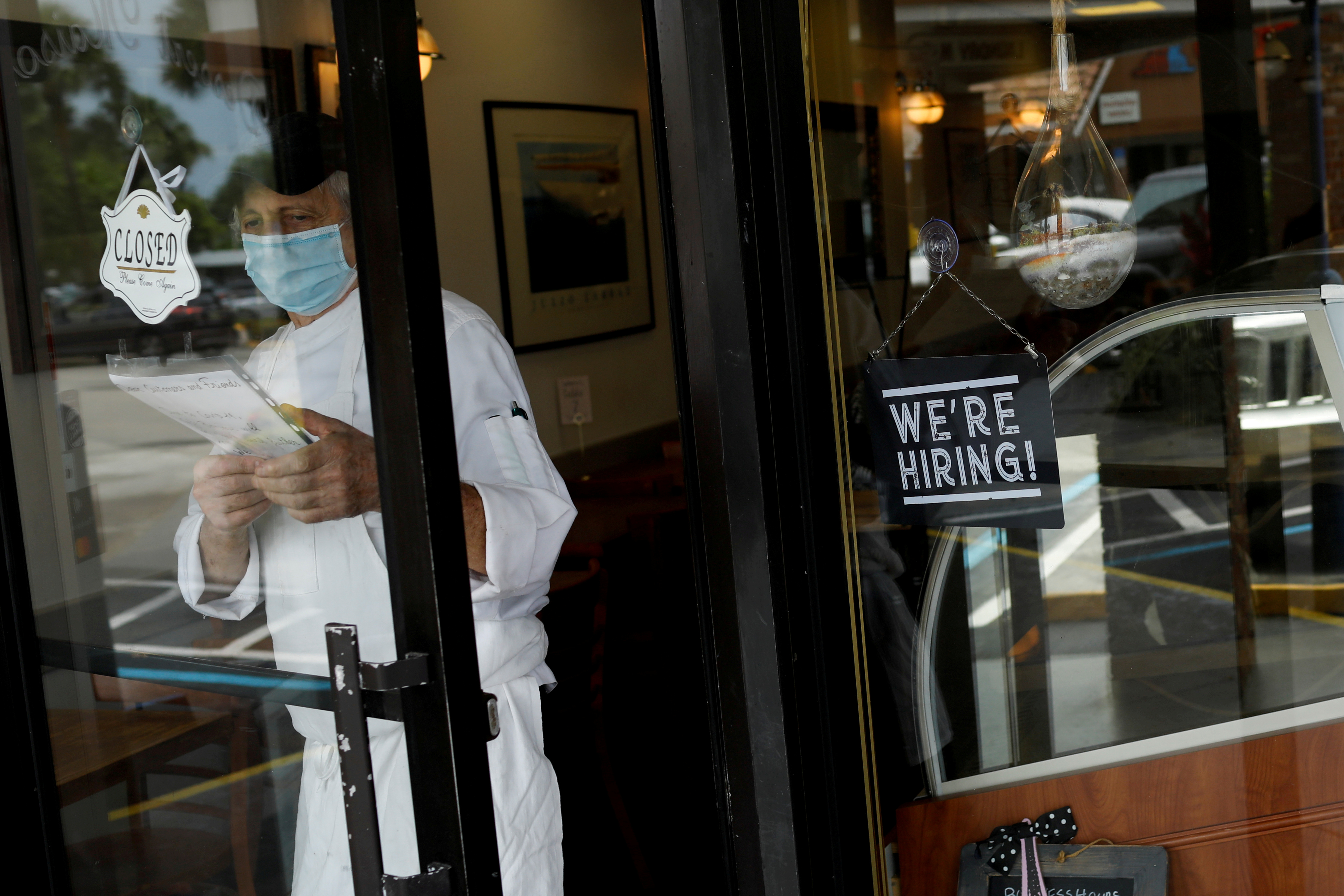
Restaurant workers are seen inside one of the city's most popular restaurants amid the coronavirus disease (COVID-19) outbreak, in El Paso, Texas, U.S. November 15, 2020. REUTERS/Ivan Pierre Aguirre
Hotels, restaurants and other businesses are boosting pay as they try to rebuild their staffs and meet increasing demand from Americans ready to venture out as pandemic-related restrictions are lifted and more people are vaccinated.
But it is unclear if the increases will be sufficient to entice enough workers back to close the employment gap remaining in the sector hit hardest by COVID-19 job losses.
Average hourly earnings for workers in leisure and hospitality rose to $18.09 in May, the highest ever and up 5% from January alone, according to Labor Department data released on Friday. Pay rose even faster for workers in non-manager roles, who saw earnings rise by 7.2% from January, far outpacing any other sector.

That higher pay could be a sign that companies are lifting wages as they seek to draw people back to work after more than a year at home. Some businesses are struggling to keep up with higher demand as more consumers, now fully vaccinated, get back to flying, staying in hotels and dining indoors. Job gains in leisure and hospitality this year have so far outpaced gains in other sectors.
But it is too soon to know whether the boost will be enough to help speed up hiring at a time when many workers are still facing other obstacles, including health concerns and having to care for children and other relatives.
"The fact of the matter is, the pandemic is still going on," said Daniel Zhao, a senior economist for Glassdoor. "The economy is running ahead of where we are from a public health situation."

Some 2.5 million people said they were prevented from looking for work in May because of the pandemic, according to the Labor Department. And just about 40% of Americans are now fully vaccinated, meaning that many workers may still be concerned about the health risks they might face on the job, Zhao said.
STILL IN A HOLE
Employment in leisure and hospitality is still in a deep hole when compared with pre-pandemic levels.
The industry added 292,000 jobs in May, with about two-thirds of that hiring happening in restaurants and bars. But overall employment is still down 2.5 million jobs, or 15% from pre-pandemic levels, more than any other industry.

If job gains continued at the pace seen in May, it would take more than eight months to replace the jobs lost. And it's not yet clear that all of the jobs will be recovered, especially if business travel remains depressed or if other habits change after the pandemic.
Some people who previously worked at hotels or restaurants moved on to other types of jobs during the pandemic, such as packaging goods at a warehouse, and it's too soon to know whether they will switch back as more of the economy reopens, said Zhao.
Some Republicans and businesses struggling to find workers say generous unemployment benefits are slowing down the labor market recovery by making it easier for workers to stay home. Others say the benefits may be helping workers cover the bills while they wait for schools to reopen, receive vaccinations and resolve other obstacles that made it difficult for them to work during the pandemic.
"People were making decisions based on those other factors, but they had the wherewithal to make those choices because of the extended unemployment benefits," Cleveland Federal Reserve Bank President Loretta Mester said during an interview with CNBC.
Either way, any frictions caused by unemployment benefits may be resolved over the next several months as those benefits are reduced. About half of states are putting an early end to a $300 federal supplement to weekly unemployment benefits, winding them down as soon as June 12. The supplement expires nationwide on Sept. 6.
Jonnelle MarteAnn Saphir
June 4, 2021
Restaurant workers are seen inside one of the city's most popular restaurants amid the coronavirus disease (COVID-19) outbreak, in El Paso, Texas, U.S. November 15, 2020. REUTERS/Ivan Pierre Aguirre
Hotels, restaurants and other businesses are boosting pay as they try to rebuild their staffs and meet increasing demand from Americans ready to venture out as pandemic-related restrictions are lifted and more people are vaccinated.
But it is unclear if the increases will be sufficient to entice enough workers back to close the employment gap remaining in the sector hit hardest by COVID-19 job losses.
Average hourly earnings for workers in leisure and hospitality rose to $18.09 in May, the highest ever and up 5% from January alone, according to Labor Department data released on Friday. Pay rose even faster for workers in non-manager roles, who saw earnings rise by 7.2% from January, far outpacing any other sector.
That higher pay could be a sign that companies are lifting wages as they seek to draw people back to work after more than a year at home. Some businesses are struggling to keep up with higher demand as more consumers, now fully vaccinated, get back to flying, staying in hotels and dining indoors. Job gains in leisure and hospitality this year have so far outpaced gains in other sectors.
But it is too soon to know whether the boost will be enough to help speed up hiring at a time when many workers are still facing other obstacles, including health concerns and having to care for children and other relatives.
"The fact of the matter is, the pandemic is still going on," said Daniel Zhao, a senior economist for Glassdoor. "The economy is running ahead of where we are from a public health situation."
Some 2.5 million people said they were prevented from looking for work in May because of the pandemic, according to the Labor Department. And just about 40% of Americans are now fully vaccinated, meaning that many workers may still be concerned about the health risks they might face on the job, Zhao said.
STILL IN A HOLE
Employment in leisure and hospitality is still in a deep hole when compared with pre-pandemic levels.
The industry added 292,000 jobs in May, with about two-thirds of that hiring happening in restaurants and bars. But overall employment is still down 2.5 million jobs, or 15% from pre-pandemic levels, more than any other industry.
If job gains continued at the pace seen in May, it would take more than eight months to replace the jobs lost. And it's not yet clear that all of the jobs will be recovered, especially if business travel remains depressed or if other habits change after the pandemic.
Some people who previously worked at hotels or restaurants moved on to other types of jobs during the pandemic, such as packaging goods at a warehouse, and it's too soon to know whether they will switch back as more of the economy reopens, said Zhao.
Some Republicans and businesses struggling to find workers say generous unemployment benefits are slowing down the labor market recovery by making it easier for workers to stay home. Others say the benefits may be helping workers cover the bills while they wait for schools to reopen, receive vaccinations and resolve other obstacles that made it difficult for them to work during the pandemic.
"People were making decisions based on those other factors, but they had the wherewithal to make those choices because of the extended unemployment benefits," Cleveland Federal Reserve Bank President Loretta Mester said during an interview with CNBC.
Either way, any frictions caused by unemployment benefits may be resolved over the next several months as those benefits are reduced. About half of states are putting an early end to a $300 federal supplement to weekly unemployment benefits, winding them down as soon as June 12. The supplement expires nationwide on Sept. 6.
Subscribe to:
Posts (Atom)