Saturday, March 22, 2025

Sanders, AOC Draw Biggest Crowd of Their Careers at Rally to Fight 'Oligarchy' in Denver

 A rally in Denver, Colorado on Friday evening  drew more than 34,000 people

"The American people will not allow Trump to move us into oligarchy and authoritarianism. We will fight back. We will win," said Sanders.
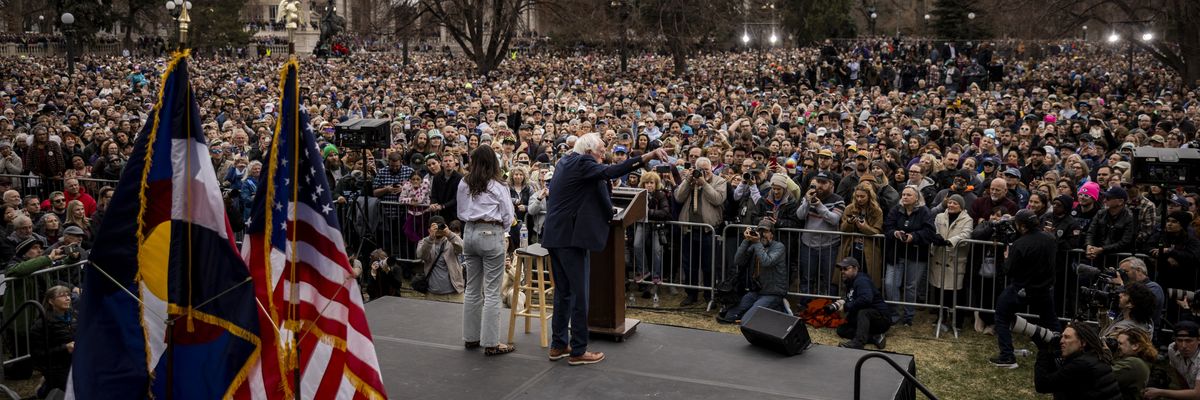


Sen. Bernie Sanders (I-Vt.) speaks during a rally on March 21, 2025 at Civic Center Park in Denver, Colorado. Rep. Alexandria Ocasio-Cortez (D-N.Y.) stands next to him.
(Photo: Chet Strange/Getty Images)

Eloise Goldsmith
Mar 22, 2025
COMMON DREAMS

On the heels of record-breaking attendance at a "Fighting Oligarchy" event in Tempe, Arizona earlier this week, Sen. Bernie Sanders of Vermont and Rep. Alexandria Ocasio-Cortez of New York held a rally in Denver, Colorado on Friday evening that drew more than 34,000 people—making it largest event that Sanders or Ocasio-Cortez have ever held.

Sanders, an Independent, wrote on social media on Friday that the turnout is a sign that "the American people will not allow Trump to move us into oligarchy and authoritarianism. We will fight back. We will win."

According to Anna Bahr, Sanders' communications director, the senator's largest rally prior to Denver took place in Brooklyn, New York in 2016, when he was running for president.

Ocasio-Cortez, a Democrat, wrote online that "something special is happening... Working people are ready to stand together and fight for our democracy. Thank you Colorado!"

At the rally, which took place at Denver's Civic Center Park, the two lawmakers hit on the same themes they spoke about in Arizona.

"The American people are saying loud and clear, we will not accept an oligarchic form of society," Sanders said, according to Colorado Public Radio. "We will not accept the richest guy in the world running all over Washington, making cuts to the Social Security Administration, cuts to the Veterans Administration, almost destroying the Department of Education—all so that they could give over a trillion dollars in tax breaks to the wealthiest 1%."

"If you don't know your neighbor, it's easier to turn on them," said Ocasio-Cortez, per CPR. "That's why they want to keep us separated, alone, and apart. Scrolling on our phones thinking that the person next to us is some kind of enemy, but they're not."

Sanders launched his "Fighting Oligarchy: Where We Go From Here" tour in February, with the aim of talking to Americans about the "takeover of the national government by billionaires and large corporations, and the country's move toward authoritarianism."

The series of "Fighting Oligarchy" events have been taking place as some Democrats have gotten an earful at town halls back home, where constituents have come out to implore them to do more to counter efforts by the Trump administration.

Earlier in the day, Ocasio-Cortez and Sanders also held a rally in Greeley, Colorado—which is represented by Republican Gabe Evans in the House of Representatives—which drew more than 11,000 people.

Semaforreporter David Weigel, who attended both the Greely and Denver rally, posted online that at the Greeley rally it wasn't easy to find people in the crowd who had voted for Sanders in the 2020 presidential primary. Weigel also wrote that the Sanders team told him that half of the RSVPs to the rallies were not from the lawmaker's supporter list.

Eric Blanc, an assistant professor the School of Management and Labor Relations at Rutgers University, wrote on Bluesky on Saturday that it is "pretty remarkable how AOC and Bernie have become leaders not just of lefties, but of the Democratic Party's mainstream liberal base."

While its dangerous that "establishment liberals" are yielding to Trump, he wrote, "the silver lining is that this has enabled anti-corporate forces such as labor unions and AOC-Bernie to set the tenor of Resistance 2.0."

"Because today's anti-Trump resistance is more focused on economic concerns, more rooted in labor unions, and more anti-billionaire, it has the potential to sink much deeper roots among working people and, in so doing, to definitively overcome MAGA," wrote Blanc.
DEI IS MERIT

Zimbabwe's Coventry elected as head of International Olympic Committee

Seven-time Olympic medallist Kirsty Coventry was elected on Thursday as president of the International Olympic Committee (IOC).


Former Olympic swimming champion Kirsty Coventry was elected president of the International Olympic Committee following a vote of the 109 committee members.
 AP - Fabrice Coffrini

By: Paul Myers
Issued on: 20/03/2025 - 

The 41-year-old Zimbabwean was chosen after the first round of voting among the 97 IOC members at the 144th IOC session and will take over on 23 June from Thomas Bach.

She will be the first woman and the first African to occupy the top job in an organisation founded 131 years ago by Pierre de Coubertin and Demetrios Vikelas to oversee the organisation of the Olympic Games.

Zimbabwe's aspiring Olympics supremo Coventry targets development of athletes

"This is not just a huge honour, but it is a reminder of my commitment to every single one of you that I will lead this organisation with so much pride," said Coventry in her first speech as the planet's most powerful sports administrator.

"And I will make all of you very, very proud and hopefully extremely confident in the decision you’ve taken today. Thank you from the bottom of my heart, and now we’ve got some work together."

Coventry won her medals - two of them gold - swimming for her country at Olympic Games between 2000 and 2016.

To rise to the top spot, she beat beat off challenges from six other candidates including the Frenchman David Lappartient who heads his country's national Olympic committee as well as the International Cycling Union.

Olympic gold medallist Sebastian Coe, who leads World Athletics, was also in the running with Morinari Watanabe, Prince Feisal Al-Hussein, Johan Eliasch and Juan Antonio Samaranch whose father led the IOC between 1980 and 2001.

"This race was an incredible race," added Coventry, who has been her country's sports minister since 2018. "And it made us better, made us a stronger movement. Thank you very much for this moment, and thank you very much for this honour."

On the eve of the vote at the exclusive Greek coastal resort of Costa Navarino, Bach graciously offered to share the wisdom and experiences harvested from his 12 years in the job since replacing Jacques Rogge.


"If the new president would like to have some advice or support they can call me in the middle of the night," said the 71-year-old German.

"I don't know if I'll respond then but I'll be happy at any time if they want my advice. If not, I will not impose my advice."

Coventry will be head of the organisation for an eight-year term which will encompass the Summer Games in Los Angeles in 2028 and Brisbane in 2032 as well as the Winter Games in Cortina d'Ampezzo next February and the French Alps in 2030.

In an interview with RFI just before the vote, Coventry vowed to use the memories of her trials and tribulations as an aspiring athlete in her homeland to improve the lot of up-and-coming youngsters if successful.

"The hardest part of my journey was becoming an Olympic champion," she said.

"That's where I believe we should be focusing a little bit more with dedicated programmes to help support directly athletes on their journey to becoming an Olympian. So I would like to do that."
Two die from chikungunya as virus spreads on France's Reunion Island

A mosquito-borne disease called chikungunya has killed two elderly people on France's Reunion Island, local authorities said on Friday.


The tiger mosquito is one of two species that can infect humans with the chikungunya virus. © Shutterstock _ InsectWorld


By: RFI
Issued on: 21/03/2025 - 

An 86-year-old and a 96-year-old died last week from the virus, which causes fever and severe joint pain.

Nearly 9,000 cases have been reported on the French Indian Ocean island since August 2024.

With infections rising earlier this month, local officials activated Orsec Plan 4 – an emergency response for medium-intensity epidemics.

"The epidemic has accelerated in recent weeks and is now spreading throughout the country," authorities said on Friday.

Health response

Health workers have been deployed across the island alongside municipal teams to carry out daily fumigation operations. Around 150 medical personnel are involved in the response.

Officials have advised vulnerable people to get vaccinated.

The chikungunya virus is spread by two species of mosquito, which also transmit dengue and Zika. The disease is not usually fatal, but can be dangerous for older people or those with other health conditions.

The name “chikungunya” comes from the Kimakonde language of southern Tanzania. It means “to become contorted” and refers to the bent posture of people suffering from joint pain caused by the virus.

Reunion experienced a major outbreak in 2005 and 2006, when around 240,000 people were infected and 225 died. Until this current wave, no chikungunya cases had been recorded on the island since 2010.
Vaccine trial

In June 2023, Franco-Austrian drugmaker Valneva published encouraging results from a vaccine trial.

The randomised, placebo-controlled phase three trial tested a live-attenuated vaccine – which uses a weakened version of the virus – to see how well it triggered an immune response.

Out of a subgroup of 266 people who received the vaccine, 263 – or 99 percent – developed antibodies that could neutralise the chikungunya virus, said the study, which was published in The Lancet journal.

In a larger trial involving 4,100 healthy adults, the single-shot vaccine was found to be “generally safe”, with side effects similar to other vaccines.

Only two participants developed serious side effects linked to the vaccine, and both made a full recovery.
French farmers contend with drop in demand for organic food

A drop in demand for organic food in France is raising difficult questions for the country's organic farmers. A new law passed in March maintained organic farming targets, but critics say it does nothing to boost the sector at a time when climate concerns are crucial, and pits productivity against the environment.

00:46
Only 6 percent of food consumed in France is organic, and as demand drops, farmers are worried about their long-term economic prospects.


Video by:Sarah Elzas
Issued on: 21/03/2025 - 

After double-digit growth in the last few years, including throughout the Covid-19 pandemic, organic food is in free fall in France.

"During Covid we reached 12 to 15 percent of our sales in organic, but then after Covid, people were more cautious about their food spending, so it has dropped," Pierre Gratacos, operations director for Cardell, an apple producer in south-western France, explained at the recent Paris international agricultural show, where he was showcasing the company’s organic Juliet apples.

During the pandemic people cooked at home more and spent more money on food, but as leisure activities resumed and rising inflation started to impact prices, the cost of buying organic has become a sticking point.

More about how organic farmers are dealing with the drop in consumer demand in the Spotlight on France podcast:

Spotlight on France, episode 125 © RFI

"People have less money to spend on food, so they usually buy less," said Gratacos, explaining that organic apples are more expensive to grow because the trees yield less fruit.

"Because the method of growing is a bit more demanding, so there are fewer apples in one organic tree than in a normal tree, and if you grow fewer apples, you need to sell them at a higher price," he explained.

With increased costs for packing added, the company's organic apples are 25 to 30 percent more expensive than conventionally grown ones.
Convincing the middlemen

However, Gratacos believes consumers would be willing to pay more, with the right information.

"They are OK about buying more expensive apples if they're organic," he said. "I think the end consumers are ready, but the middle buyers are not ready and are not really educated about it."

The middle buyers are the middlemen who buy produce wholesale and resell it to grocery chains, where the bulk of food is purchased.

Today, just 6 percent of food consumed in France is organic, according to the Agence Bio, the agency supported by the agriculture ministry which promotes organic production.

This drop in demand means farmers have less of a market to sell to, which has led them to question their business models.

In 2023, France had around 61,000 organic farms – 14.4 percent of the total number – which were working on 10.4 percent of the country's agricultural land.

That was a drop of 1.3 percent from the previous year and, according to the chamber of agriculture, the number of farmers converting to organic dropped by 30 percent.
Organic aspirations

Those in the organic sector say this drop impacts everyone, as half of all France’s farmers are set to retire in the next 10 years, and newcomers to the sector are particularly interested in organic

"We have a lot of aspiring farmers, and they want to become organic farmers," said Philippe Camburet, president of the National Organic Agriculture Federation. "If we do not allow them to go into organic farming, they will not go into this profession."

Setting up any agricultural enterprise requires significant investment. Conventional farms need to sign contracts with pesticide and fertiliser suppliers and are under pressure to produce.

"They don’t want this," Camburet says of new farmers. "This is not the agriculture that makes you dream. What makes you dream is what has meaning."

French PM Bayrou says more must be done to support farmers

But ideals only go so far, and without the consumer demand, people are hesitant to go into organic farming.

"Some people who want to get installed in organic agriculture think a little bit more, and they sometimes hesitate to go into this field," says Vincent Kraus, co-founder of Fermes en Vie ("Farms alive"), an organisation which raises investor funds to provide new farmers with land to start out as organic farmers.

"They really want to do things differently, and are interested in other ways to produce," he says of the farmers he works with.
Agriculture and environment

He and others had hoped that the long-delayed agricultural reform law that was passed in March to address the grievances raised by farmers in protests in the winter of 2024, would provide more support to organic farmers.

Environmentalists and politicians on the left have criticised the law for backtracking on environmental commitments, with articles loosening rules on pesticides and land usage.

"I was expecting the pragmatic guidelines that make sense for future generations," Camburet said. "Unfortunately, that is really not at all the case."

The text of the law states that agriculture is a "major national interest", essential to the French economy. It goes on to define food sovereignty as not only the capacity to produce enough food to feed the French population, but also to support France’s exports to "contribute to global food security".

"The agricultural industry wants to be on the world market, to compete with others, who are much bigger than we are," Camburet said. "What we must do is take a different path. Why should we continue to go big, exhausting ourselves, and exhausting our economy, our environment and our health?"
Linking farm and plate

This law maintains France’s ambition to reach 21 percent organic agriculture by 2030 – a target that had been removed in the right-leaning Senate version of the text, but which was later reinstated.

The Senate argued that there was no point in setting targets if consumer demand was not there.

EU ramps up support for farmers with agricultural policy overhaul

Laure Verdot, director of the Agence Bio – which the senators had also wanted to cut – agrees with this to some extent, but says that the goal should instead be to change consumer demands.

"It’s not enough to declare an objective of the number of hectares of organic in the fields," she said "We must have ambitions for organic consumers."

The agency has launched a campaign to promote organic food to the general public.

"We must absolutely make the link between our consumption, on our plates, and the farmers in the field," Verdot said. "If we want to be able to draw in farmers who want to go organic, we must make room for them on our plates."

To hear more on the state of organic farming in France, on the Spotlight on France podcast, episode 125, listen here.
Preserving the planet's glaciers is a 'matter of survival' says UN

All 19 of the world's glacier regions experienced a net loss of mass in 2024, for the third consecutive year, the United Nations said on Friday. It has declared 21 March World Day for Glaciers, warning that at current rates of melting, many glaciers "will not survive the 21st century".

A sign indicates the level of the Mer de Glace glacier in 1990, at Chamonix in the French Alps, pictured in June 2019. AFP/Marco Bertorello

By: RFI
Issued on: 21/03/2025 

Five of the last six years have seen the most rapid glacier retreat on record, the UN's World Meteorological Organisation (WMO) said, on its inaugural World Day for Glaciers.

"Preservation of glaciers is a not just an environmental, economic and societal necessity: it's a matter of survival," said WMO chief Celeste Saulo.

"From 2022 to 2024, we saw the largest three-year loss of glaciers on record," she said, adding that the worst year was 2023.

Together, "all 19 glacier regions lost 450 billion tonnes of mass," the WMO said, citing new data from the Swiss-based World Glacier Monitoring Service (WGMS).

Beyond the continental ice sheets of Greenland and Antarctica, more than 275,000 glaciers worldwide cover approximately 700,000 square kilometres, said the WMO. But they are rapidly shrinking due to climate change.

Why climate change is heating Europe faster than the rest of the world

Until now, scientists had counted only 220,000 glaciers. "This doesn't mean that new glaciers have appeared, it means that the new inventory is much more detailed," French glaciologist Etienne Berthier told RFI.

A specialist in the spatial analysis of glaciers at the Legos laboratory at the University of Toulouse, he says technology has vastly improved monitoring systems.

"We now have very high-resolution space instruments, on the order of 50 centimetres, which provide much more detail in this inventory of glaciers based on satellite images. We can therefore better see each small glacier, or those that deserve to be separated in two because they have different behaviours," he explained.
According to a study published in the scientific journal Nature on 19 February, approximately 273 billion tonnes of ice melted each year between 2000 and 2023.

This is like emptying "the equivalent of three Olympic-sized swimming pools per second," warned the European Space Agency project Glambie, which authored the study.

Berthier points out that Europe, the fastest-warming continent, lost 39 percent of its glacier volume between 2000 and 2023. In 2021 and 2023 alone, Swiss glaciers lost 10 percent of their mass, the same amount lost between 1960 and 1990.

As Arctic climate warms, even Santa runs short of snow

"Melting accelerated and became widespread in the 1990s due to anthropogenic greenhouse gas emissions. Each decade, mass losses are greater. In the Alps, it is estimated that between 1 percent and 10 to 15 percent of glacier volume will remain in 2100, depending on the scenario," he explained.

"In the Pyrenees, we have been losing one glacier per year since 2000. Around 10 remain, which are expected to disappear in the next 10 to 15 years," he said.

Based on a compilation of worldwide observations, the WGMS estimates that glaciers – not including the continental ice sheets – have lost more than 9,000 billion tonnes since records began in 1975.

"This is equivalent to a huge ice block of the size of Germany, with a thickness of 25 metres," said WGMS director Michael Zemp.
View of Borebukta Bay, located at the northwestern side of Isfjorden, in Svalbard Archipelago, northern Norway, on 3 May, 2022. AFP - JONATHAN NACKSTRAND

However, the rate of loss is not the same around the globe.

Glacier mass loss was relatively moderate last year in regions such as the Canadian Arctic and the peripheral glaciers of Greenland – while glaciers in Scandinavia, Norway's Svalbard archipelago and North Asia experienced their worst year on record.

At current rates of melting, many glaciers in western Canada and the United States, Scandinavia, central Europe, the Caucasus and New Zealand "will not survive the 21st century," said the WMO.

The agency said that together with ice sheets, glaciers store around 70 percent of the world's freshwater resources, with high mountain regions acting like the world's water towers. If they were to disappear, this would threaten water supplies for millions of people downstream.

No chance of saving global glaciers as melt rate goes 'off the charts'

Another issue is rising sea levels, which saw an increase of 1.8 cm between 2000 and 2023.

A rise of at least 30 to 60cm is projected by the end of the century, according to the European Union's observation programme Copernicus, which will affect hundreds of millions of people living in coastal areas.

For the UN, the only possible effective response is to combat global warming by reducing greenhouse gas emissions.

"We can negotiate many things in the end, but we cannot negotiate physical laws like the melting point of ice," said Stefan Uhlenbrook, the WMO's water and cryosphere director.

"Ignoring the problem" of climate change "is maybe convenient for a short period of time," he said, but "that will not help us to get closer to a solution".


Nike, do you see us now?

We have just launched a major new campaign in support of women workers -- check it out here.

The campaign features an extraordinary video featuring women workers from across Asia who make clothing and shoes for Nike.  I just watched it and was very moved by these women and their struggle. 

The message they are sending could not be clearer: 

  • Pay us what you owe us.  
  • Treat us with respect.  
  • And if you're going to be running advertisements promoting the image of "strong women", why not include us? 

You can watch this very short video here

Those women come from 25 garment worker unions from India, Indonesia, Pakistan, Sri Lanka, Cambodia and Bangladesh, coordinated by Asia Floor Wage Alliance and Global Labor Justice. 

Today, the campaign is sending a photo petition from over 1,000 workers to Nike to demand wage increases and human rights protections in its supply chain. 

You can help make sure that Nike hears those women by clicking here 

Please share this message with your friends, family and fellow union members.

Thank you.

Eric Lee

LabourStart

The impact of lockdown on young people in France, five years after Covid crisis

On 17 March, 2020, France implemented its first nationwide lockdown in an effort to curb the spread of the Covid-19 virus. What followed was a two-month period of strict confinement, mandatory mask-wearing, curfews and university closures. While the pandemic took a psychological toll on almost everyone, the lasting impact on young people has been severe.

The Covid lockdown has left psychological scars on young people in France.
 Getty Images - Victor Dyomin

By: RFI
Issued on: 21/03/2025 

In a bar in the 15th arrondissement of Paris, Maya orders an espresso. Five years ago, during the first Covid-19 lockdown, meeting like this in a café would have been impossible.

"I think it's crazy that we went through that, and now, I don’t think about it anymore. I love going out. I’m definitely not a homebody," the 24-year-old told RFI.

However, she does still have painful memories of that period. Her mother worked at the Regional Health Agency (ARS) and came home with news of terrible statistics every day.

But the worst, for Maya, came after that first lockdown. "I moved into an apartment on my own, but there I was much more isolated, I think. My studies were bothering me," she explains.

"Honestly, I kind of fell into depression during that time. It was weird because, at the same time, it was nice not to be confined anymore, in the sense that I was doing a lot of things in my apartment. But I wasn’t stimulated at all. I enjoyed my day itself, but I didn’t see the point of having a second one."

Maya is feeling better now and doesn’t miss an opportunity to go out. For her, it's a way to reclaim some of the youth that was stolen from her.

Five years on from the Covid-19 pandemic, what legacy has the virus left?

For other young people, however, the outside world has become threatening since the lockdowns. "I’m not necessarily going to walk around, visit Paris, go to museums or things like that alone," says Élisa, 28. "I’d like to do it more, but I don’t feel capable of it."

She has always been a bit of a homebody – she likes being in her tidy, cosy apartment, with a book in hand or watching a good TV series. But it was after the lockdown that her anxiety began.

"For example, going grocery shopping takes huge mental preparation. Or if I arrive in a place where I don’t know many people and I’m going to have to socialise, my body reacts, my body can’t breathe, without knowing why," she said.

"It really annoys me to be like this when I’m in Paris, I’m young, I’m 28. I have so many things to live for and I’m actually getting anxious about things that, objectively, aren’t a big deal."
Social media, eco-anxiety and international conflicts

According to a study of 20 million young people in France, published on 7 January in the Journal of the American Medical Association, "a significant increase in mental health consultations, hospitalisations, and prescriptions for antidepressants, mood stabilisers, and antipsychotics was found among young people, particularly after the Covid-19 pandemic".

The findings continued: "This trend aligned with studies indicating that Covid-19 infection and lockdowns have had biological and societal impacts on the mental health of the youth."

The study also found that this change was particularly marked among females

But while the lockdown has left scars on France's young people, five years on it is not the sole cause of their distress.

"It’s true that these particular circumstances did weaken students, isolated them, and may have anticipated this decline in their mental health," says Melissa Macalli, a researcher at the French National Institute of Health and Medical Research (Inserm) who studies the mental health of young adults.

She added: "It's also true that the causes are probably multiple: worsening instability, feelings of loneliness, the impact of social media. But also collective environmental factors that have been added – especially eco-anxiety, international conflicts and the global political situation, which worries them a lot."

This report was adapted from the RFI podcast Reportage en France produced by Lou Ecalle.

France accused of failing migrant teens trapped in legal limbo

Thousands of unaccompanied migrant youths arrive in France each year seeking safety, education and healthcare. Many claim to be under 18, which would entitle them to special protections under French law. But without documents, they fall into a legal grey zone – too young to be treated as adults, yet not officially recognised as minors.

Their cases are passed between institutions and the process can take months. In the meantime, they risk sleeping rough, being arrested or even deported before a final decision is made.

The recent police eviction of hundreds of youths occupying a Paris theatre has thrown a spotlight on this national challenge.

"We are not criminals, nor drug addicts. The only thing we are asking for is shelter, education and access to health. How can this be bad for France?" said Hamadou, a 16-year-old from Guinea who was among those evicted.

Each year, around 8,000 undocumented migrant minors arrive in Paris alone. Only about 2,500 are officially recognised as underage and immediately taken into care, according to Mayor Anne Hidalgo.

For those caught in administrative limbo, options are limited. Some, like Hamadou and 500 others, occupied La Gaîté Lyrique theatre in central Paris from 10 December 2023, before being forcibly removed by police on 18 March.

"I was so frightened, I could not find any sleep that night, before the police evicted us," Hamadou told RFI.

"The policemen, a hundred of them, looked like they were geared up for war with their shields, helmets and batons. Up till the last minute, I was convinced that they would never use force, that the Paris municipality will come to the rescue with news of lodgings for us."

Most of the youths at Gaîté Lyrique come from former French colonies in Sub-Saharan Africa. Many find themselves in a paradox: French law guarantees protection for unaccompanied minors under the International Convention on the Rights of the Child – but proving they qualify for that protection is increasingly difficult.

The X-ray bone examination is hardly ever carried out nowadays, the age assessment tests is mainly through interviews.

“This is problematic for us because it is not based on scientific evidence and it looks like the interviewer can decide whatever they choose to believe,” Hamadou said.

A hot potato

Mohamed Gnabaly, mayor of Ile-Saint-Denis and member of the Green party, told RFI that the Gaîté Lyrique case shows how different institutions bounce responsibility back and forth.

"It is fine as long as they remain invisible. The unaccompanied migrant minors became a problem because they were a sore sight right in the centre of the capital city," he said.

"And this fed the racist speech we heard about them within both the ranks of the government and the far-right."

Fousseni, from the Belleville park youth group which helped organise the occupation, said the delays and lack of shelter push the minors into impossible choices.

"By the time many have built up their case while trying not to get arrested, they have already reached 18," he said.

The Municipality of Paris brought the case to court in January. A court then issued an order on 13 February for the theatre to be evacuated within one month. When the city failed to act by the deadline, police chief Laurent Nunes said he had to intervene.

"The Municipality of Paris [owner of the theatre] did not contact me by 13 March. I had to take my responsibilities and put an end to this occupation which was disrupting public order," Nunes said on the TV programme C à vous.

"The Municipality of Paris asked for details on what accommodation would be given to the young people and how they were to be treated," he added. "This to me implicitly meant that the Municipality of Paris did not want security forces to intervene."

Caught in the clash

On 18 March, riot police used batons and tear gas to enter the theatre, pushing past human chains formed by activists, civilians and politicians.

"This show of force and attacking vulnerable black migrant minors is the first step of the military discourse the government and the far-right is currently using," Danièle Obono, an MP from the left-leaning France Unbound party, told RFI.

Police evict migrants from Paris theatre after months-long occupation

Belleville parc youth group reported that around 60 people were arrested, including minors and adult supporters. Ten were injured. So far, 25 minors have been issued deportation orders – a move the group says violates their legal rights.

"This is illegal because they are minors and are currently being processed by the ministry of Justice to prove that they are under 18," said Fousseni. "They cannot be thrown out of the French territory like used tissue papers."

Differing perspectives

Government officials say the situation is not as clear-cut. Minister François-Noël Buffet told parliament that the youths were mostly over 18. The government and far-right groups blamed them for damage and losses to neighbouring businesses.

Mayor Hidalgo defended the eviction, saying the situation had become unsafe.

"There are around 8,000 young undocumented migrants who arrive in Paris every year. Approximately 2,500 of them are recognised as minors and are immediately taken care of," she told France Inter.

"The situation was tensed, dangerous and very complicated."

Hidalgo said accommodation had been offered, but turned down.

Fousseni said the offer was in Rouen – too far from Paris, where most of the young people are enrolled in school, receiving healthcare and attending legal appointments. Only six accepted the placement.

Billionaire Elon Musk commented on the case on X, writing: "Another case of suicidal empathy... it will end civilization. Game over." He later added, "They're exploiting a bug in Western civilisation which is the empathy response."

Uncertain future

For Hamadou, the eviction had immediate consequences.

"I couldn't breathe. I escaped with only the clothes I am now wearing," he said. His suitcase, containing all the documents gathered to prove his age, was lost in the chaos.

Now, he and others like him try not to sleep in the same place twice, fearing police checks. They depend on charities for food.

"The greatest danger they now face is police violence," said Fousseni. "Police in Paris are preventing the unaccompanied migrants to sleep in the streets of the city. They are being pushed to the outskirts of Paris."

La Gaîté Lyrique management had supported the occupation at first, despite cancelling shows and taking financial losses.

"It is out of question to throw them out in the streets where it is freezing cold. We regret, however that we were taken over so suddenly," it said in a communiqué last December.

The theatre later criticised the lack of coordination between the Paris Municipality and the national government, which left the minors in limbo for three months.

For thousands of unaccompanied minors across France, the system remains opaque, slow and unforgiving – and the stakes are growing by the day.

Migrant deaths hit new record in 2024 with at least 8,938 lives lost

At least 8,938 people died while attempting to migrate to another country in 2024 – marking the deadliest year on record for migrants worldwide, the UN said on Friday.

A migrant returns to shore after attempting to cross the English Channel to reach Great Britain on a smuggler's inflatable dinghy at Sangatte beach near Calais, northern France. © AFP/Bernard Barron

By: RFI
Issued on: 21/03/2025 -

The International Organisation for Migration (IOM) warned that the actual death toll is likely much higher, as many deaths go undocumented due to a lack of official sources.

"The tragedy of the growing number of migrant deaths worldwide is both unacceptable and preventable. Behind every number is a human being, someone for whom the loss is devastating," said IOM deputy director general for operations Ugochi Daniels in a press release.

"The increase in deaths across so many regions in the world shows why we need an international, holistic response that can prevent further tragic loss of life."


Five-year upward trend


The 2024 figure continues a five-year trend of rising migrant deaths. It surpasses the previous record of 8,747 deaths recorded in 2023.

Asia recorded the highest regional toll with 2,778 deaths, followed by Africa with 2,242. The IOM documented 2,452 deaths in the Mediterranean Sea. Although not a record, the number remains high.

The agency said: "The figures showed the need for adequate search and rescue systems as well as the need for safe and regular migration routes."

Data for the Americas is not yet complete, but at least 1,233 deaths were reported there in 2024. That includes 341 people who died in the Caribbean – an unprecedented number – and a record 174 deaths in the Darién jungle between Panama and Colombia.


Violence a major cause

Since 2022, at least 10 percent of all recorded migrant deaths have been due to violence. In 2024, this was largely linked to violence against people in transit in Asia. Nearly 600 people died on migration routes across South and South-Eastern Asia.

The IOM said most of the victims remain unidentified, leaving families without answers and hindering efforts to respond to the crisis.

"The rise in deaths is terrible in and of itself, but the fact that thousands remain unidentified each year is even more tragic," said Julia Black, coordinator of the IOM's Missing Migrants Project.

"Beyond the despair and unresolved questions faced by families who have lost a loved one, the lack of more complete data on risks faced by migrants hinders life-saving responses."

Call for global response

The IOM is calling for an international response to address the growing number of deaths.

Its upcoming annual report will provide further analysis of the data from 2024, as well as a new focus on missing migrants in humanitarian crises.

The agency said the rising death toll highlights the need for safe, legal routes for people on the move. It described them as the only sustainable solution to the crisis of migrant deaths.


Antarctica: how geopolitics plays out at the end of the Earth

Antarctica is Earth's only uninhabited continent, home to the South Pole, and subject to a delicate balance of cooperation between key players. So what is at stake in the world's southernmost region?


The Ceremonial South Pole, surrounded by the flags of the member countries of the Antarctic Treaty. © Photo: Business Wire

By:RFI
Issued on: 22/03/2025

Ordinarily, little disturbs the peace of the white continent – inhabited only temporarily, by the scientists and support staff who come and go to work at its various research stations.

When news emerged this week that a member of a South African research team at one of Antarctica's remote bases has been put under psychological evaluation after allegedly assaulting and threatening colleagues – who sent an email to authorities pleading to be rescued – it served to highlight the fragility of that peace.

A few weeks prior, another visit acted as a reminder of the cooperation and collaboration required when it comes to the continent – around the world, far removed from its bases, as well as inside them.

On 3 January, Chile's President Gabriel Boric reached the American Amundsen-Scott station – the first leader in the Americas to visit the South Pole.

It was a visit Boric said reaffirmed Chile's claim to sovereignty over part of the Antarctic, reminding the rest of the world that his country remains "the world's main gateway to Antarctica".

In defence of international agreements over the continent, he added that it "is and must remain a continent of science and peace".

It was a trip that "fits President Boric's profile well," his compatriot Miguel Salazar, who has a doctorate in political science and international relations from Science Po Paris and has written a thesis on the Antarctic, told RFI.

He recounted that in 2023, Boric accompanied UN secretary-general Antonio Guterres to King George Island, 120km off the coast of Antarctica, where there is a Chilean air base. He also adds that Boric hails from Punta Arenas in the Magallanes region, the southernmost of the American continent.

"He had a natural connection, I'd say, and wanted to demonstrate Chile's ability to reach the pole, quite simply," said Salazar. "At the same time, he reinforced the doctrine promoted by Santiago since the middle of the 20th century. It's a country that collaborates and contributes, but which claims part of the Antarctic territory by tradition. What I find interesting is that the visit took place within a framework of cooperation. Going to the South Pole is something you never do completely independently."
Flagship agreements

Alongside Argentina, Australia, France, Norway, New Zealand and the United Kingdom, Chile stakes a claim in Antarctica – claims not recognised by the United States and most other countries.

Chile's claim is based on the historical inheritance of the Spanish Governorate of Terra Australis, which was transferred to the Governorate of Chile in 1555 – what had belonged to Madrid would revert to Santiago.

But Salazar insists that Chile's mindset is "completely collaborative", explaining: "Chile is positioning itself as a logistical and scientific hub. It is planning to build an Antarctic centre in Punta Arenas, a large building in the shape of an iceberg."

The idea is to provide a platform so that "20 or 25 percent" of the world's Antarctic programmes can one day operate from this city. The Chileans want to be "useful to research" – and not just their own, he says.

Ice loss and plant growth mark new era for warming Antarctica

The Antarctic Treaty, which came into force in 1961, was the result of collaboration between 12 nations whose scientists had been working in and around these territories during the International Geophysical Year, an international scientific project of 1957 to 1958 – Argentina, Australia, Belgium, Chile, France, Japan, New Zealand, Norway, South Africa, the United Kingdom, the United States, and the USSR. The signatories now number 58, including Russia.

Article 1 of the treaty states that Antarctica shall be used for peaceful purposes only. Articles 2 and 3 specify that freedom of scientific investigation on the continent and "cooperation toward that end shall continue" and that "scientific observations and results from Antarctica shall be exchanged and made freely available".


The Neumayer Channel at the Palmer Archipelago from the Antarctic Peninsula, pictured in January 2024. AFP - JUAN BARRETO

While neither the US nor Russia have made any territorial claims, but maintain a basis for claims against the seven "possessor" states, Article 4 of the text freezes the 1959 situation in this respect, stating: "No new claim, or enlargement of an existing claim to territorial sovereignty in Antarctica shall be asserted while the present treaty is in force."

However, there is another, newer agreement just as essential to understanding the recent statements by the Chilean president: the Madrid Protocol, which was signed in 1991 and came into force in 1998. It supplements the 1959 text by prohibiting any activity relating to mineral resources other than those carried out "for scientific purposes" and stating that any activity must be "subject to a prior environmental impact assessment".

Law researcher Anne Choquet of the University of Brest is also vice-president of the French National Committee for Arctic and Antarctic Research (CNFRA). She recounts the adoption of the Madrid Protocol: "It was a response to the non-entry into force of the Wellington Convention, adopted in 1988, which provided a mechanism for considering the exploitation of mineral resources. France and Australia opposed its entry into force, and we subsequently looked for another approach."

Some believe that it will be possible to revisit this point in 2048, half a century after the Protocol was ratified. In reality, that's not the issue, says Choquet: "It's true that in 1991, the [signatory] states said to themselves that such a statement was perhaps too ambitious, and that one day we might need to go and see, explore and exploit mineral resources. So they provided a way out."

But right now, she added, we could very well "consider lifting the ban". However, this would require "a consensus among the states that have voting rights, the consultative parties, of which there are currently 29, and a legal system that strictly regulates activities, particularly in environmental matters".

Such a move would take place within the framework of the Antarctic Treaty Consultative Meeting – an annual congress at which every decision is made by consensus. "After 2048," said Choquet, "it will be possible for a state with voting rights to say that it would like to open negotiations on lifting the ban, but under very specific conditions."

In summary, unless all these major treaties are broken, where today the approval of 29 parties is needed, 26 will be needed after 2048 – "the 26 who were consultative parties in 1991".
Fragile riches

In the eyes of glaciologist Éric Rignot, from a scientific point of view Antarctica is "the most important place on the planet". The Antarctic ice sheet is the largest single mass of continental ice on Earth. Its ecosystems concern us all, but are still poorly understood.

Antarctica's southern regions are essential to glaciology, climate and geology, and home to a wildlife population that is consistently high on the agenda at the annual Consultative Meeting. For example: "There is currently a difficult discussion about penguins becoming a specially protected species," explained Choquet. "They deserve greater protection because of the threats they face."

But according to her, it is preferable to adopt an "ecosystem approach" rather than "species by species" because "unbalancing one species has consequences for all the others". This principle was adopted, for example, by the 1980 Convention for the Conservation of Antarctic Marine Living Resources.

No chance of saving global glaciers as melt rate goes 'off the charts'

Salazar uses a theory from sociology to illustrate this: the "actor-network theory". By this theory, everything, including humans and non-humans, can be viewed as "actors" that form networks, and agency emerges from these complex, interconnected relationships rather than being solely a human attribute. Applying this theory, if whales eat krill, for example, then in order to protect whales we need to find ways of protecting krill.

Salazar also gives the example of the Antarctic toothfish: "In the early 2000s, we organised ourselves to protect it after a serious crisis of overexploitation, around two species, Dissostichus eleginoides and Dissostichus mawsoni, large fish that can measure two metres and live for 50 years. In France, Europe, the United States etc, they have enormous gastronomic value and were in danger of disappearing. And yet they are essential predators in the trophic chain."

In addition to the involvement of the International Union for Conservation of Nature, an intergovernmental organisation, the establishment of rules has also been made possible by NGOs, says Salazar, notably the Antarctic and Southern Ocean Coalition.
The division of Antarctica between its 'possessor' states. © RFI/Jan van der Made

There have been attempts to link the Antarctic treaties with other agreements, such as the Convention on International Trade in Endangered Species of Wild Fauna and Flora – a move backed by Australia, but which did not pan out. However, this suggestion did lead to the establishment of two Marine Protected Areas around the Antarctic continent – at the South Orkney Islands, and the Ross Sea.

"Other areas have been proposed by France, the EU, New Zealand and recently Chile and Argentina," said Salazar. But these have been "blocked by China and Russia" – states whose stances sometimes raise questions. In 2024, the US magazine Newsweek revealed that Moscow had told London that one of its Antarctic exploration vessels had discovered a large quantity of oil at sea – "around 511 billion barrels worth of oil, equating to around 10 times the North Sea's output over the last 50 years".

Newsweek reported: "According to documents discussed in UK parliament last week, the discovery was made by Russian research ships in the Weddell Sea, which falls under the UK's claim in Antarctic territory. That claim overlaps with those of Chile and Argentina. Despite having no territorial claims in Antarctica, Russia, along with the US and China, has been gradually escalating its presence in the region in recent years through various scientific campaigns, establishing five research stations in the territory since 1957."

In reality, according to Choquet, all the states, including Russia, continue to demonstrate their commitment to banning activities relating to mineral resources. In a resolution in 2023, she notes, they not only reiterated their continuing commitment to this imperative, but even asked governments to "undertake to dispel the myth" that the Treaty or the Protocol would expire "either in 2048 or at any other time".
China, a contentious player

China is the latest arrival on the continent – present since the 1980s and relying heavily on its links with Latin America for its activities. With its icebreakers Xuelong 1 and 2, it has led some 40 expeditions there.

It has also surrounded the Franco-Italian base Concordia with five scientific stations of its own, the last of which was inaugurated last year. However, Choquet insists: "Having more stations doesn't mean more weight in decision-making, because decisions are taken by consensus."

Construction of China's fifth base in the Antarctic worries west

"When it became a state involved in decision-making, China was really collaborative and participative when it came to protection projects. In recent years, however, it has become more contentious," notes Salazar.

Their technique is to challenge studies, such as those carried out by the Scientific Committee on Antarctic Research, prior to projects. "China always finds a small point, makes a remark... and that stops everything."

Is there any guarantee that countries will comply with requirements on their stations in the middle of the desert? "There are inspections," says Salazar, "and everything has always gone well." However, these inspections are announced well in advance.

View of an iceberg on Half Moon island, Antarctica, November 2019. 
AFP - JOHAN ORDONEZ

And what of Donald Trump and his territorial ambitions? While he has made contentious statements concerning the sovereignty of Greenland – the second largest body of ice in the world – he is yet to make any earth-shattering statements about Antarctica.

The American president has his eyes firmly on the Far North, and on catching up with his fleet of icebreakers against the Russians. "The United States has always had the same attitude towards Antarctica," points out Salazar. "It's a very important player, always committed to protecting the continent and working together. To take a different path would contradict its entire history."

Thanks to Starlink – the satellite internet service owned by Trump's right-hand man Elon Musk – surfing the internet from low latitudes has never been easier – good news for scientists, as well as for increasing numbers of tourists to the region.

"As far as I'm concerned," says Salazar, "this [tourism boom] shouldn't be happening. We're talking about the only region where the human species doesn't exist, where it's not adapted. Every time someone goes there, they bring invasive species and micro-organisms."

He also points out that the tourism sector is made up of private, competitive companies. "I've seen prices of $15,000 for five days on a comfortable boat, with a glass of Champagne. It's the elites, or people who sacrifice a lot of resources, who go there."

"I'm often asked whether I'm in favour of a total ban on tourism in Antarctica," says Choquet. "That would be an admission that we are not capable of managing, and it would be very complicated from a legal point of view." Instead, she favours a stricter framework, with "a responsible approach from all players". But once again, it's all a question of unanimity.

This article was adapted from the original version n French.