Wednesday, July 23, 2025


What's Driving India's Historic Renewable Energy Expansion?

  • India added a record 22 gigawatts of renewable energy capacity in the first half of 2025, a 57% increase from the previous year, primarily from solar and wind.

  • Despite significant renewable growth, fossil fuels still account for around 75% of India's electricity generation, and the country plans to install an additional 80 GW of new thermal projects.

  • India's western states, led by Rajasthan and Gujarat, are at the forefront of the renewable energy rollout, while battery energy storage systems also saw a significant increase in awarded capacity.

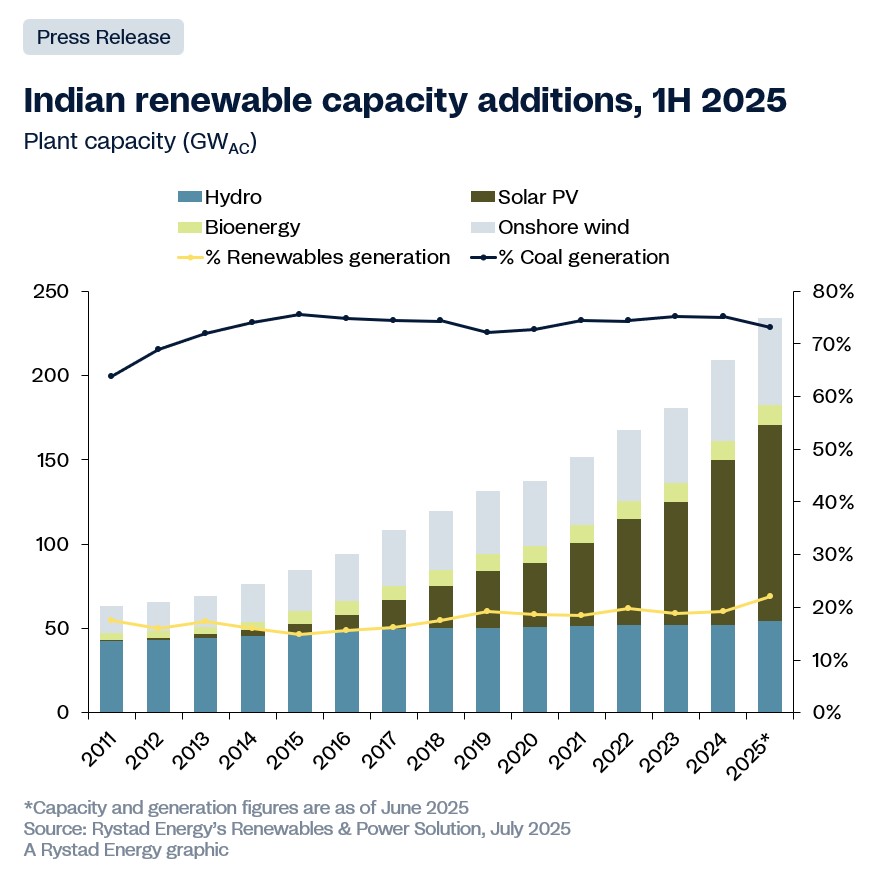
India added a record 22 gigawatts (GW) of renewable energy capacity in the first half of 2025 – a 57% jump from the 14.2 GW installed during the same period last year. The new capacity includes 18.4 GW of solar, 3.5 GW of wind and 250 megawatts (MW) of bioenergy, which is generated from plant and animal waste. This marks the country’s highest-ever addition in any six-month period. The surge was largely driven by developers moving quickly to take advantage of the government’s Interstate Transmission System charge waiver, which begins at 25% and increases annually until full implementation by June 2028, significantly lowering project costs and incentivizing developers to act now.

India is now inching closer to its goal of sourcing 50% of its installed power capacity from clean energy sources, with a total of 234 GW in place, including large hydropower projects. While this growth is positive from a strict emissions reduction perspective, fossil fuels continue to dominate actual energy consumption in the country, accounting for around 75% of electricity generated in the first half of the year from coal, oil and gas-fired plants.

Additionally, nuclear power is beginning to play a larger role, with the commissioning of Unit 7 of the Rajasthan Atomic Power Project – a 700-MW unit connected to the northern grid – and government approval for the country’s first small modular reactor (SMR) planned in the northern state of Bihar. However, reliance on coal remains a significant challenge and the role of nuclear energy continues to be debated due to concerns over costs, safety and waste management.

India installed 22 GW of renewable energy capacity in the first half of 2025, a new record. However, the country is still banking heavily on coal to meet growing power demand, with plans to install an additional 80 GW of new thermal projects. India is not yet undergoing a true energy transition; instead, it is focusing on building up installed capacity from both conventional and renewable energy sources to ensure energy security. Without urgent action to improve affordability and sustainability, particularly through grid upgrades and energy storage, coal will remain central to electrification efforts, jeopardizing progress toward India’s net-zero goals

Sushma Jaganath, Vice President, Renewables & Power Research, Rystad Energy
Learn more with Rystad Energy’s Renewables & Power Solution.

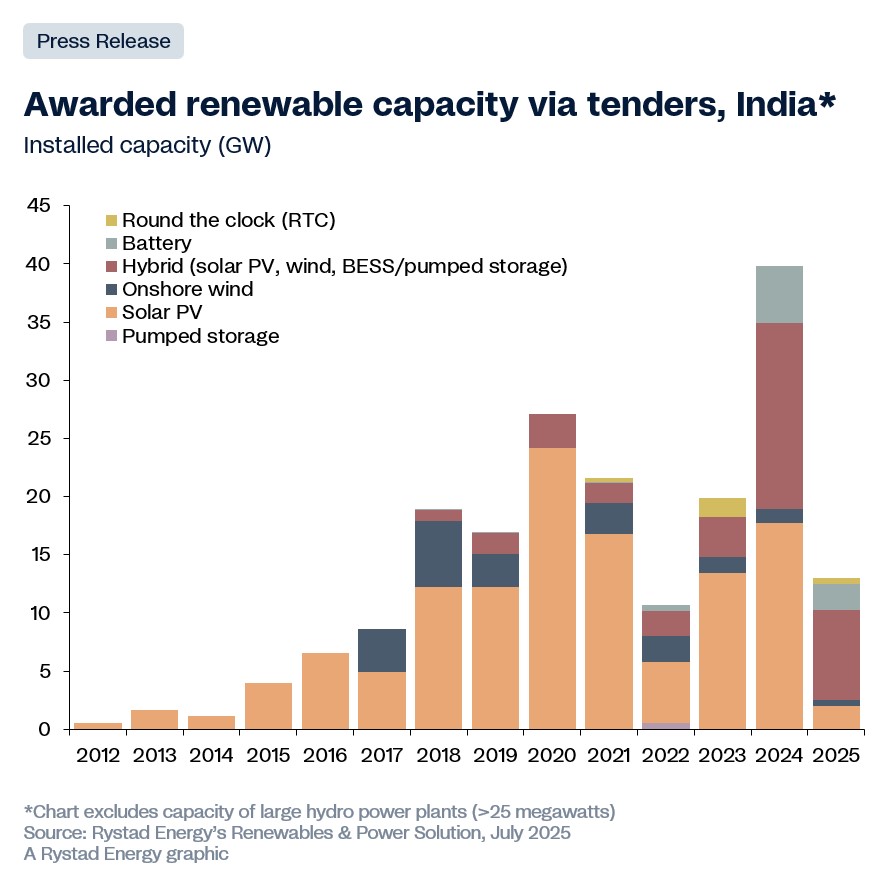
While India’s renewable energy capacity more than doubled in the first half of the year, battery energy storage systems (BESS) also saw a significant uptick, with 5.4 GW of collocated solar-BESS and 2.2 GW of standalone BESS awarded to developers, marking the country’s highest BESS allocation to date. The strong participation across auctions reflects a growing emphasis on grid stability and renewable integration, with Rystad Energy projecting accelerated growth in the sector over the coming years. Average quoted tariffs stood at around INR 4,000 ($48.02) per megawatt-hour (MWh) for standalone BESS and INR 3,208 ($38.50) per MWh for collocated solar-BESS projects – a downward trend in pricing that could encourage more developers to pursue integrated installations over standalone solar.

Among the top developers, Jindal Group secured 990 MW of collocated solar and BESS capacity, while NTPC and ReNew each won 900 MW in the same category. In the standalone BESS segment, JSW Energy was allocated 625 MW and Reliance Power won 525 MW of collocated capacity. Adani Green also participated, securing a 510 MW collocated solar and BESS project, indicating a shift from its previous focus on standalone solar and wind.
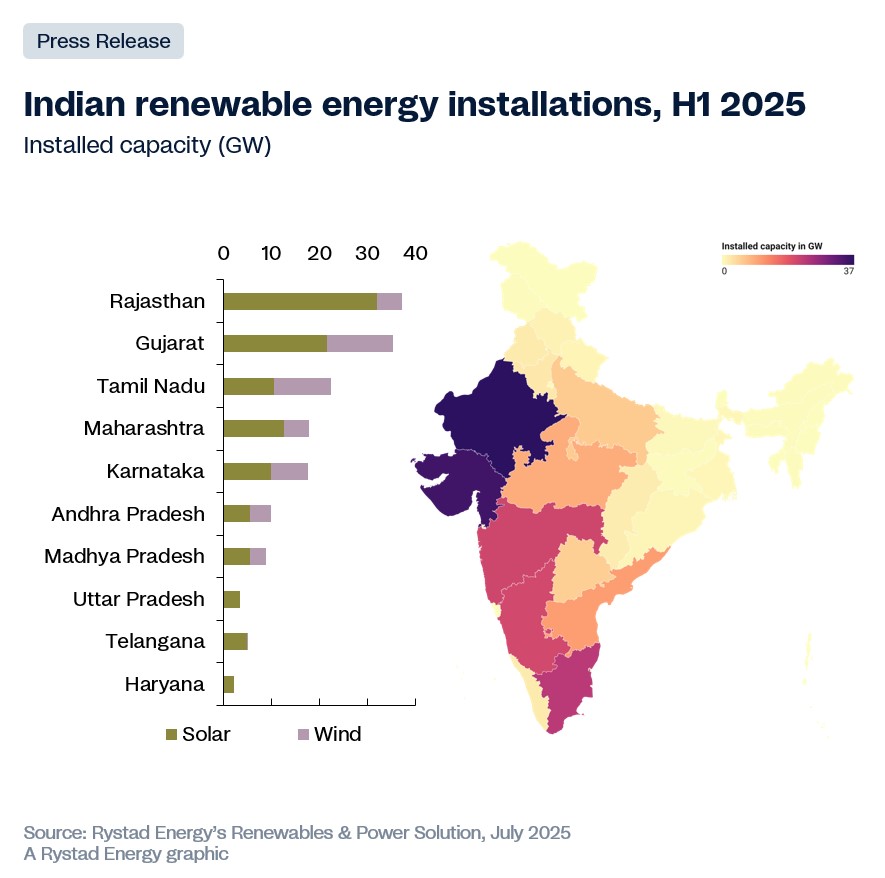
India’s western states remain at the forefront of the country’s renewable energy rollout. Rajasthan leads with 37.4 GW of installed capacity, driven by 32 GW of solar and 5.2 GW of onshore wind, supported by high solar irradiance and vast desert terrain. Gujarat follows with 35.5 GW, including 21.5 GW of solar and 13.8 GW of wind. Tamil Nadu ranks third, with 11.8 GW of wind and 10.6 GW of solar and is also a top performer in bioenergy, contributing 1 GW of the national total of 11.6 GW. Onshore wind also features prominently in several other states, including Karnataka (7.7 GW), Maharashtra (5.3 GW), Andhra Pradesh (4.4 GW) and Madhya Pradesh (3.2 GW).

By Rystad Energy

Biomethane Could Be the Unsung Hero of the Energy Transition

By Leon Stille - Jul 21, 2025


Biomethane is steadily gaining ground as a practical and scalable decarbonization tool.

Europe leads with supportive policies and grid integration, while North America sees growth driven by transport credits and private investments.

Beyond energy, biomethane contributes to circular sustainability by producing low-carbon fertilizers and capturing CO? for reuse.


In the fast-paced world of clean energy innovation, biomethane is rarely the star of the show. It doesn’t sparkle like solar, boom like batteries, or stir geopolitical intrigue like hydrogen. But quietly, consistently, and with increasing impact, biomethane is doing exactly what many climate technologies still promise to do someday: replacing fossil fuels today.

Produced from organic waste, agricultural residues, and even wastewater sludge, biomethane is essentially upgraded biogas with a methane content high enough to substitute fossil natural gas. It can be injected into existing gas grids, used in transport, or serve as a feedstock for chemicals and fertilizers. In a world scrambling to decarbonize gas use without rebuilding everything from scratch, biomethane is proving to be an invaluable bridge, and in some sectors, a long-term solution.

Biomethane in Europe: From policy footnote to energy asset


Europe has taken biomethane seriously for longer than most. France, in particular, has emerged as a leader, with a supportive feed-in tariff structure, regional planning, and grid injection mandates. The country now boasts over 600 biomethane plants, with a national target of 20 TWh of production by 2030. In practice, it could exceed that.

The UK is also leaning in. Its Green Gas Support Scheme provides financial incentives for anaerobic digestion (AD) plants upgrading biogas into biomethane. The use of biomethane in transport, particularly heavy-duty vehicles, is receiving growing interest as a near-term alternative to diesel in hard-to-electrify fleets.

Denmark, Germany, and Italy are similarly accelerating development, often linking biomethane to agricultural policy, waste management, and even rural economic development. It’s an example of what happens when climate goals and circular economy logic align.

And importantly, biomethane is not just being blended. In some networks, particularly in rural or islanded areas, it is starting to replace fossil gas outright. This changes the game: from marginal substitution to full decarbonization.

North America: From RNG hype to steady deployment


Across the Atlantic, biomethane, typically referred to as renewable natural gas (RNG), is gaining traction in the United States and Canada, albeit along a different path. Driven largely by transport credits (like California’s Low Carbon Fuel Standard), RNG has been growing steadily, especially in waste-to-fuel applications.

In the U.S., major gas utilities are beginning to invest in RNG as part of their decarbonization pledges, and several states are introducing procurement targets. Canada’s Clean Fuel Regulations and supportive provincial programs are creating space for biomethane to scale in both transport and stationary uses.

The Inflation Reduction Act, while more prominently associated with hydrogen and CCS, also contains provisions that could bolster RNG. And private sector players, especially in agriculture-heavy states, are investing in manure-based biomethane, with co-benefits in methane mitigation and fertilizer production.

Still, the U.S. faces some challenges that Europe has already begun to address: fragmented policy, uneven grid access, and limited visibility in national energy strategy. But the potential is undeniable, and the building blocks are there.

Beyond energy: Biomethane’s circular bonus

One of biomethane’s most powerful selling points is its integration with other sustainability goals.

Anaerobic digestion not only produces gas, but also digestate, a nutrient-rich byproduct that can be used as a low-carbon fertilizer. As synthetic nitrogen fertilizers face rising costs, carbon scrutiny, and supply volatility, digestate offers a regenerative alternative. France and the Netherlands are already exploring large-scale fertilizer substitution through AD outputs.

Meanwhile, the CO? released during biogas upgrading, normally considered a waste stream, is increasingly being captured and used in everything from beverage carbonation to greenhouses and even e-fuel production. CO? valorization turns what was once a liability into an asset, improving project economics and climate performance.

In this way, biomethane is not just a fuel, it’s a node in a broader circular bioeconomy. It cleans up waste, produces energy, captures carbon, and replaces petrochemicals. Not bad for something that’s been hiding in plain sight.

What’s next: Policy, scale, and recognition


The next stage in biomethane’s evolution is all about scale and integration. That means:Clear targets: The EU has set a 2030 goal of 35 billion cubic meters (bcm) of biomethane, roughly 10% of current gas demand. Achieving this will require robust national implementation and faster permitting.
Infrastructure access: Streamlining injection into gas grids and securing blending rights is critical, especially in North America.
Cross-sector planning: Linking biomethane strategies with agriculture, waste management, and fertilizer policy is essential to unlock its full potential.
Carbon recognition: Accurately accounting for biomethane’s life-cycle benefits, including methane mitigation and soil health, can unlock additional funding streams and emissions credits.

Conclusion


Biomethane may not make headlines, but it is shaping the energy transition in very real, very measurable ways. In both Europe and North America, its growth reflects a shift in thinking: that decarbonization isn’t just about the next breakthrough, but about deploying the tools we already have and doing so smartly.

In previous publications, I’ve explored how technologies like hydrogen and CCS can help us decarbonize industry and energy systems. Biomethane deserves a place in that same conversation. It’s practical, circular, and increasingly scalable.

As policymakers look for fast, affordable, and systemic climate solutions, they shouldn’t overlook the quiet climber. Biomethane is already proving it can rise to the challenge one digester, one pipeline, one molecule at a time.

By Leon Stille for Oilprice.com


Indonesia Forges $8 Billion Refinery Deal with U.S. Firm


Indonesia prepares to sign an $8-billion contract with U.S. engineering company KBR Inc to help it build 17 modular refineries, as part of the U.S.-Indonesia trade deal, Reuters reported on Tuesday, citing sources with knowledge of the plans and a government presentation it has seen. 

Last week, Indonesia and the United States reached a trade deal, under which the U.S. tariffs on Indonesian products will be lowered to 19% from an initial levy of 32%.  

Indonesia was slapped with one of the highest tariffs - 32% - in the “liberation day” tariffs announced by U.S. President Donald Trump in early April. These tariffs were suspended for 90 days, during which the Trump Administration expected most countries to come pleading their cases and promising to boost their imports of U.S. goods to avoid high tariffs. 

Following weeks of negotiations, Indonesia’s products will now face a lower – 19% -- tariff on entering the United States. 

Days before the deal was announced, Indonesia’s Energy Minister Bahlil Lahadalia said his country would buy billions of U.S. dollars worth of American oil and oil products if the U.S. tariffs on Indonesian goods are lowered. 

Indonesia, Southeast Asia’s biggest economy, has signaled it would offer to buy an additional $10 billion worth of American oil and liquefied petroleum gas (LPG). 

Indonesia also plans to slash its fuel imports from Singapore and source more refined products from the United States as the country looks to negotiate lower tariffs with the U.S.

Argus reported in May that state energy firm Pertamina is considering importing oil products from the United States. 

Now Indonesia’s sovereign wealth fund Daya Anagata Nusantara Investment Management Board (Danantara) is preparing to sign an $8-billion deal with KBR for the construction of modular refineries, according to Reuters’ sources. 

As part of the trade deal with the U.S., Indonesia will also buy 50 Boeing aircraft and ease its local content requirements for U.S. investors including Apple and General Electric.  

By Michael Kern for Oilprice.com


Mexico Unveils Financial Maneuver to Stabilize Debt-Laden Pemex

Mexico’s Finance Ministry announced Tuesday it will launch a new financial operation to support the country’s embattled state oil company, Pemex—the most indebted energy firm in the world.

The operation involves issuing “Pre-Capitalized Notes,” a form of financing designed to strengthen Pemex’s balance sheet without a direct government guarantee. The plan—part of an ongoing effort to prop up a company mired in debt, production decline, and operational dysfunction—is noticeably short on specifics.

Pemex reported a $2 billion loss in Q1 2025, following a $9.1 billion loss in Q4 2024. Crude production has fallen to 1.58 million barrels per day—well below the government’s 1.8 million bpd target. Exports have collapsed too, plunging 44% in January to their lowest levels since 1990. The company has responded by slashing 3,000 jobs, restructuring its leadership, and announcing plans to reopen thousands of idle wells—efforts that require capital it doesn’t have.

Meanwhile, Pemex is juggling more than $105 billion in financial debt and over $20 billion in unpaid supplier bills. Refining output has stagnated, and issues with crude quality—including high water content—have alienated key buyers. Despite a 2024 cash infusion from the federal government, Pemex’s working capital remains deeply negative.

The use of Pre-Capitalized Notes appears to be a way to inject liquidity without triggering broader credit concerns or formal bailouts. But the underlying issue remains: Pemex’s financial health depends heavily on political will. Past interventions have come with the quiet backing of Wall Street banks and oilfield service giants like SLB, which issued over $1 billion in credit-default swaps last year to keep Pemex solvent.

With production declining and global energy markets shifting, Mexico’s latest move may buy Pemex time—but without structural reform or a credible path to profitability, it’s just another patch on a cracking hull.

By Julianne Geiger for Oilprice.com

Exxon Considers Exploration Offshore Trinidad

Exxon is reportedly in talks with the government of Trinidad and Tobago for oil exploration in up to seven offshore blocks, according to unnamed sources who spoke to Reuters.

Per the report, the Trinidad and Tobago blocks are in close proximity to Exxon’s Stabroek block offshore Guyana.

“We are in discussions with major players to ramp up exploration and production within and outside of bid rounds,” the energy minister of Trinidad and Tobago, Roodlal Moonilal, told Reuters.

“We are currently considering one such proposal, and if the negotiations are successful, a major announcement will soon be made,” the minister also said without mentioning names.

The Caribbean nation is the largest oil and gas producer in the region and ranks 17th in the world. Its oil and gas industry is seen growing at a compound annual rate of 4.4% over the decade to 2030, with companies involved in that growth including BP, Shell, and Spain’s Repsol.

Earlier this year, the Trinidad and Tobago government announced plans to tender 26 offshore blocks along its eastern and northern coast. The deadline for submissions was July 2, and the winning bids will be announced in three months. The blocks subject to that tender, however, do not include the seven blocks that Exxon is in talks about, Reuters noted in its report.

Meanwhile, Trinidad and Tobago’s neighbor Guyana has become the fifth-largest oil exporter in Latin America in less than a decade, output has grown from 400,000 bpd to over 660,000 bpd in a matter of months, and Exxon’s plans to boost this to 1.3 million bpd by 2030 seem perfectly realistic.

Exxon recently got itself a new partner in Guyana’s Stabroek block, after Chevron won the arbitration case against Exxon concerning its acquisition of Hess Corp. Its expansion in the region marks a natural development from the success in Guyana.

By Irina Slav for Oilprice.com


Energy Giants Abandon Global Net Zero Group Over Oil and Gas Clampdown

  • Shell, Aker BP, and Enbridge exited the SBTi advisory group over a draft standard banning new oil and gas projects.

  • The SBTi paused its work on oil and gas standards but denied that industry pressure influenced the decision.

  • The clash highlights growing tensions between fossil fuel companies and climate accountability frameworks.

Shell and other major energy players have withdrawn from a high-profile effort to establish a global “net zero” emissions benchmark, after draft proposals effectively demanded an end to new oil and gas developments, according to documents seen by the Financial Times.

The companies—Shell, Norway’s Aker BP, and Canada’s Enbridge—exited an expert advisory group convened by the Science Based Targets initiative (SBTi), a widely followed climate standard-setter whose approval is sought by global corporations ranging from Apple to AstraZeneca. Their departures reflect mounting tensions between the fossil fuel industry and evolving climate disclosure and accountability frameworks.

A Standoff Over New Oil and Gas Projects

The draft standard at the heart of the dispute would have prohibited companies from pursuing new oil and gas fields after submitting a climate plan to the SBTi, or after 2027—whichever came first. It also called for a sharp decline in fossil fuel production, escalating concerns in the oil and gas industry that the standard would impose an unworkable path toward net zero targets.

Shell, which has participated intermittently in the SBTi process since 2019, confirmed that it withdrew after concluding the draft “did not reflect the industry view in any substantive way.” The company maintained its commitment to achieving net zero by 2050 but argued that any credible standard must offer companies “sufficient flexibility” and reflect what it called a “realistic” societal pathway.

Aker BP said its ability to influence the emerging standard had proven “limited,” while emphasizing that its departure was “in no way” a sign of diminished climate ambition. Enbridge declined to comment, according to the Financial Times.

SBTi Pauses Work on Oil and Gas Standard

Following these high-profile exits, the SBTi announced it had “paused” work on its oil and gas standard, citing internal “capacity considerations.” However, the organization rejected claims that this decision was driven by pressure from industry, telling the FT there was “no basis in reality for these claims.”

Separately, the SBTi has reportedly delayed and diluted planned guidance for financial institutions regarding their financing of fossil fuel projects. According to sources cited by the FT, the deadline for ending finance or insurance for companies pursuing new oil and gas production was quietly pushed back from 2025 to 2030 after David Kennedy, a former EY partner, took the helm as SBTi’s CEO in March.

Industry vs. Climate Standards: A Growing Divide

The outcome underscores a fundamental fault line: The burning of fossil fuels remains the leading contributor to global warming, and scientists broadly agree that capping long-term temperature rises to 1.5°C is critical to avoiding catastrophic and irreversible damage.

Yet the oil and gas sector remains wary of climate standards that would effectively mandate an abrupt halt to exploration, raising concerns about energy security, investor interests, and the feasibility of meeting future demand during the transition.

One source involved in drafting both the oil and gas and financial sector standards expressed frustration at the delay, telling the Financial Times“The more we delay, the more cover we are providing to big oil.”

For now, Shell and others continue to publicly state their commitment to achieving net zero by 2050, even as the frameworks meant to define what “net zero” means in practice remain mired in controversy.

By Charles Kennedy for Oilprice.com


Big Oil Rethinks Renewable Investments

  • BP has sold its US onshore wind power business, indicating a strategic shift away from renewables and back towards its traditional oil and gas operations.

  • This move by BP reflects a broader trend in the energy industry where major companies are re-evaluating the financial viability of low-carbon energy projects due to lower-than-expected returns.

  • The article highlights challenges facing wind and solar companies, including political factors like President Trump's energy agenda, which are impacting the sustainability of renewable energy projects.

BP has sold its onshore wind power business in the United States. The news comes amid a steady flow of reports that both wind and solar companies are in major trouble, thanks to President Trump’s energy agenda and a small but meaningful Republican majority in Congress. It is the latest in a string of developments that raise questions about the financial sustainability of transition energy projects.

For BP, the move represents another step away from wind and solar and back to oil and gas, as indicated by the company’s senior management repeatedly over the past year. In the broader industry context, it is indicative of the overall retreat of Big Oil from business ventures that do not yield the expected profits, even with the subsidies that governments are willing to shower over businesses involved in wind and solar.

“We have been clear that while low carbon energy has a role to play in a simpler, more focused bp, we will continue to rationalize and optimize our portfolio to generate value.” BP’s vice president for gas and low-carbon energy, William Lin said in comments on the news of the divestment. It involved a portfolio of 1.3 GW in already existing capacity, which will now join the portfolio of LS Power, the buyer.

Indeed, BP has been clear that it is going back to what it does best and what makes it money, especially at a time of rife speculation in the media that the company should put itself up for sale and let Shell buy it because that’s the tie-up that makes the most sense. Shell has denied the news, quite officially, but it is a fact that BP is not in as good a shape as it could be—and some are blaming its transition course, charted by now former CEO Bernard Looney.

Under Looney, BP struck off into the green direction with determination and a whole new set of priorities. The company promised to decarbonize fast and furiously and go from being a Big Oil major to a Big Power major in a matter of a few short years. It did not work. Less than five years after the initial announcement of the green pivot, BP scrapped its ambition to boost its power generation from wind and solar 20-fold by 2030 and abandoned earlier plans to reduce oil and gas production to cut emissions this year.

All this happened early in the year as evidence mounted that wind and solar may be a noble goal, but they are not a money-making business, at least not on the scale that oil and gas generate profits. Then the Trump factor came on stage, and it came with a bang. The U.S. president has made no secret of his aversion to wind power, and one of the first things he did when he came into office was to suspend new turbine construction, likely causing major panic among developers who assumed their projects would be secure.

Indeed, there is sound reason for panic. A recent report by Enverus found that just 57% of wind power projects in the United States would survive the One Big, Beautiful Bill. This means that as much as 43% are under threat of getting destroyed by the end of subsidies, but solar is doing even worse – Enverus estimated that just 30% of solar capacity is resilient to the end of subsidies.

It appears BP’s management is acutely aware of these developments. It is also on course to generate $20 billion from various divestments per strategic plans made public earlier this year. For this year, the divestment target is between $3 and $4 billion, with $1.5 billion already completed by April. The company did not disclose the size of the wind divestment deal.

Meanwhile, BP is moving back to Libya, which it left along with other supermajors when the civil war broke out over a decade ago. Earlier this month, the company signed a preliminary deal with the National Oil Corporation for the redevelopment of two big fields in the Sirte Basin. BP will also reopen its office in the country by the end of the year, the Financial Times reported.

Out of wind and solar and back to oil and gas, the course seems to be for Big Oil. Yet this is not the complete picture. The supermajors have invested heavily into their diversification into things like power generation from low-carbon sources, carbon capture, and other alternative energy sources, mostly under pressure from governments but also, probably, out a genuine desire to diversify in order to become more resilient in the long run.

The problem with the wind and solar venture was that it did not generate the returns its advocates promised. Wind and solar energy were to be simultaneously cheap for the consumers and profitable for the producers, even though the two were mutually exclusive by definition. Big Oil has realized this. BP’s divestment is the latest acknowledgment of the fact. But not all is lost for the transition fans. TotalEnergies just announced a major wind power project in Kazakhstan.

By Irina Slav for Oilprice.com 


Darlington SMR to feature Arabelle Solutions turbine gear

Monday, 21 July 2025
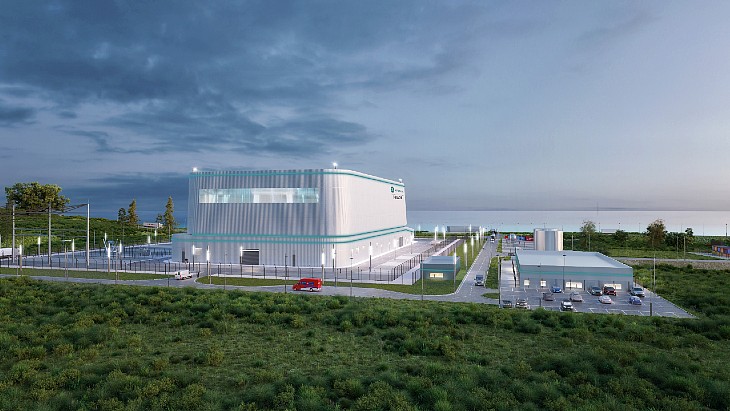
EDF subsidiary Arabelle Solutions is to supply turbine island equipment for the first BWRX-300 small modular reactor project at the Darlington site in Ontario, Canada.
Darlington SMR to feature Arabelle Solutions turbine gear
GE Vernova Hitachi Nuclear Energy

The company will supply a small modular reactor (SMR) nuclear steam turbine, an air-cooled TOPAIR generator, and associated heat exchanger for the project.

"We are proud to be delivering the main turbine hall equipment for the G7's first SMR project," said Arabelle Solutions CEO Catherine Cornand. "Leveraging our global engineering expertise, we have optimised our steam turbine generator modules for the SMR environment, underlining our strategy of providing turbine island solutions for any reactor type."

Cedric Couffignal, head of New Build at Arabelle Solutions, added: "The 300 MWe-class steam turbine generator has been specifically engineered to operate under the steam conditions of the BWRX-300 SMR and the team has optimised the turbine island's steam and water loop to enhance overall plant efficiency and maximise electrical output."

The BWRX-300 is a 300 MWe water-cooled, natural circulation SMR with passive safety systems that leverages the design and licensing basis of GE Vernova Hitachi Nuclear Energy's (GVH's) 1500 MW ESBWR boiling water reactor.

The Canadian Nuclear Safety Commission issued a construction licence for the first BWRX-300 at the Darlington SMR project in April, and the government of Ontario gave its approval for construction to begin on 8 May. It will be the first new nuclear build in Ontario in more than three decades and Ontario Power Generation (OPG) said it was set to be the first commercial grid-scale SMR in North America, with an in-service target date of 2030.

The supply chain for the turbine hall will include specialist providers from Canada, including Ontario-based Chemetics Inc, which will manufacture components for the heat exchangers.

In total, the full-speed steam turbine generator shaftline for the Darlington SMR will be 34 metres long and includes a single-flow high-pressure module and two double-flow low-pressure modules to improve cycle efficiency. It will be coupled with a TOPAIR generator rated up to 370 MVA for the 60 Hz Canadian grid.

EDF completed its acquisition of a portion of GE Vernova's nuclear conventional islands technology and services, including its Arabelle steam turbines, in May last year. The transaction included the manufacturing of conventional island equipment for new nuclear power plants as well as related maintenance and upgrade activities for existing nuclear plants outside of the Americas. EDF's acquisition of the business - at that time, known as GE Steam Power - was first announced in early 2022 and the final agreement was signed in the November of that year.

Employing around 3,300 people, Arabelle Solutions supplies equipment for new nuclear power plants and also maintains and upgrades equipment in existing nuclear power plants. Its steam turbines will be used in particular in the EPR, EPR2 and SMR reactor series, EDF said.

OPG, OSGE enhance cooperation on SMR deployment in Poland

Monday, 21 July 2025
Poland's Orlen Synthos Green Energy has signed a letter of intent with Canada's Ontario Power Generation to collaborate on a framework for the commercial development and operation of BWRX-300 reactors in Poland.
OPG, OSGE enhance cooperation on SMR deployment in Poland
(Image: OSGE)

The agreement was signed in Warsaw by Ontario Power Generation (OPG) President and CEO Nicolle Butcher and Orlen Synthos Green Energy (OSGE) Vice-Presidents Jacek Drózd and Bartosz FijaÅ‚kowski. The signing ceremony was attended by representatives of Poland's Ministry of Industry: Wojciech Wrochna – Secretary of State, Government Plenipotentiary for Strategic Energy Infrastructure and PaweÅ‚ Gajda – Director of the Nuclear Energy Department.

The signed document will facilitate close cooperation between OPG and OSGE, enabling both companies to collaborate on a framework for the commercial development and operation of GE Vernova Hitachi Nuclear Energy's BWRX-300 reactors in Poland. Under the agreement, OPG will provide pre-operational services, including site assessment, project management, and consulting services.

The agreement builds on a previous agreement announced by the companies in June 2023. That letter of intent was aimed at concluding future agreements under which OPG and its subsidiaries could provide operator services for SMR reactors to OSGE in connection with the deployment of SMRs in Poland and other European countries. The partnership would include a number of SMR-related activities including: development and deployment; operations and maintenance; operator training; commissioning; and regulatory support.

In November 2024, OPG subsidiary Laurentis Energy Partners signed an agreement with OSGE to support the preparation of the Preliminary Safety Analysis Report for deploying GE Hitachi Nuclear Energy's BWRX-300 in Poland. That agreement followed the signing of a Framework Agreement in 2022 between Laurentis and OSGE for the provision of services supporting the development and implementation of SMRs in Poland. 

The Canadian Nuclear Safety Commission issued a construction licence for the first BWRX-300 at OPG's Darlington SMR project in April, and the government of Ontario gave its approval for construction to begin on 8 May. It will be the first new nuclear build in Ontario in more than three decades and Ontario Power Generation (OPG) said it was set to be the first commercial grid-scale SMR in North America, with an in-service target date of 2030.

OSGE plans to deploy a fleet of the BWRX-300 reactors in Poland, with the first unit ready at the beginning of the next decade. For OSGE, OPG's Darlington SMR project is a reference project. In April 2023, OSGE named seven shortlisted locations for further geological surveys to site SMRs. The company has applied to the Polish government for a Decision in Principle on six of the sites. In February 2024, the General Director for Environmental Protection issued a decision defining the scope of the environmental report for the construction of a SMR in Stawy Monowskie in the Małopolska province.

"Our collaboration with Ontario Power Generation, the company building the first power plant with the BWRX-300 reactor – GE Vernova Hitachi technology – gives us greater confidence in the path to building BWRX-300 reactors in Poland," said Jacek Drózd, Vice President of the Management Board of OSGE. "We appreciate OPG's experience and expertise in the nuclear industry, as well as the progress made in building the first BWRX-300 reactor. At ORLEN Synthos Green Energy, we are determined to follow OPG's lead and provide safe, clean, and stable energy for our citizens and Polish industry."

OPG CEO Nicolle Butcher added: "With decades of safe nuclear power plant operation and our experience with SMRs, more and more entities are turning to OPG and Ontario as they look to expand nuclear power and enhance their energy security. We are honoured by the potential opportunity to help Poland build a fleet of small reactors, while also expanding our domestic nuclear supply chains and contributing to economic growth."