Saturday, March 07, 2026


Tanker Squeeze Adds Insult to Oil Injury amid Iran War

  • Tanker markets are under extreme strain, with VLCC rates exceeding $420,000 per day and very few supertankers available in the Persian Gulf as insurance cancellations and security risks reduce traffic through the Strait of Hormuz.

  • Structural constraints are worsening the shortage, including sanctions on Russian tankers, consolidation in the tanker market, and Sinokor’s growing control over available VLCC capacity.

  • Prolonged disruption could force major production shut-ins, with Iraq already cutting 1.5 million bpd and analysts warning that global shut-ins could reach nearly 5 million bpd if Hormuz remains disrupted for several weeks.

Tanker rates are through the roof, movement through the Strait of Hormuz is severely reduced because of war cover cancellations by insurers, and the combination of these developments has sent oil prices flying. Now, there’s a third factor that would likely aggravate the situation further: there are not enough supertankers.

Bloomberg reported the news this week, saying there were between six and a dozen supertankers that were available for booking in the Persian Gulf, if, of course, the potential client was willing to pay the record daily rates and deal with insurance. Twelve supertankers could theoretically be enough to handle one day’s outbound oil traffic – but no more than that. Every supertanker can carry 2 million barrels of crude and, as Bloomberg notes in its report, it takes two days to load.

It is worth noting that the squeeze on supertankers available for loading Middle Eastern oil comes on top of already rising freight rates on the back of tightening sanctions on vessels carrying Russian oil, a consolidation drive in the tanker segment, and the U.S. takeover of Venezuela’s oil industry.

The trend has been going on for a while. Last November, the tanker rates on the route from the Middle East and China hit a five-year high as s traders rushed to find alternatives to Russian crude after the U.S. sanctioned Russia’s biggest oil producers and exporters, Rosneft and Lukoil. Then, in January, rates dipped amid seasonal weakening in trade, only to rebound in February amid growing tensions between the United States and Iran.

Yet there is more. South Korean shipping company Sinokor has been on a supertanker buying spree that has resulted in what Bloomberg called “unprecedented control” over a substantial portion of the world’s supertankers for immediate booking. This has also contributed to higher tanker rates—for routes beginning at the U.S. Gulf Coast. Indeed, Bloomberg reported that Sinokor, along with its partner Mediterranean Shipping Co., “controlled almost all the VLCCs available for hire to load oil from the U.S. Gulf Coast.”

Meanwhile, the freight rate for a supertanker carrying crude oil on the key Middle East-to-China route hit a record high of more than $420,000 per day this Monday, and the rally is likely far from done, seeing as the missile strike exchange between the United States and Israel, and Iran continues unabated for the time being. Average supertanker rates globally have hit over $280,900. There are reports of Iranian forces attacking tankers in the Strait of Hormuz. The security situation, in other words, does not look good.

This means that at some point oil production would get affected, analysts are warning. “With the Strait of Hormuz still inactive, the clock is ticking,” JPMorgan analysts said in a note earlier this week. “If it does not reopen within 21 days, upstream shut?ins could begin.” In fact, upstream shut-ins have already begun in Iraq.

The situation in the Persian Gulf has forced OPEC’s second-largest producer to shut in as much as 1.5 million barrels daily in production, and this could be just the beginning, with further shut-ins likely to bring the total to 3 million barrels daily, according to Iraqi officials. That amount is almost equal to Iraq’s entire export volumes, which average between 3.2 million and 3.4 million barrels daily. Interestingly, the amount of 3 million barrels daily is also approximately equal to the global supply overhang as estimated by the International Energy Agency. And Iraq will not be the only one shutting in production if the war is prolonged.

Indeed, earlier today, JP Morgan analysts released another note, warning that Iraq would be forced to suspend all oil exports in three days and Kuwait has 14 days of storage space. The more time passes, the worse it would get, too, with the bank’s analysts estimating production shut-ins at 4.7 million barrels daily by the 18th day of Hormuz disruption.

What is happening, then, is an already bad situation becoming a lot worse, very fast. Tanker rates were already high to begin with. As the U.S. and Israel started firing missiles at Iran, insurers decided they did not need that risk in their lives, making matters worse. Meanwhile, Sinokor has become the dominant player on that very same troubled tanker market, setting the price for a major alternative oil export route: from the U.S. Gulf Coast. And there are dozens of tankers under sanctions, which limits their availability, to put it mildly.

Some observers make a point of noting that Iran cannot physically block the Hormuz Strait. Yet evidence suggests it does not need to. Just warning that it would attack tankers if they try to enter has been enough: tanker traffic on Monday consisted of one or two mid-sized vessels, per data from Kpler and Vortexa. The oil market should brace up for more blows.

By Irina Slav for Oilprice.com

Octopus CEO Urges UK To Tap North Sea Oil To Stabilize Prices

  • Octopus founder Greg Jackson has warned the UK is facing an energy price shock due to the Middle East conflict and has called for the government to use North Sea resources and strip "expensive distractions" like carbon capture from energy bills.

  • Global gas prices have doubled and UK wholesale electricity prices are up 50pc since the Strait of Hormuz was effectively closed, with the Resolution Foundation warning this could add £500 to energy bills this year.

  • Opposition parties are advocating for easing restrictions on North Sea exploration, and the Chancellor has signaled a commitment to replacing the energy profits levy, though policy is complicated by uncertainty from the Middle East crisis.

Octopus founder and government adviser Greg Jackson has urged Labour to “use what’s available” in the North Sea and rethink its key net zero policies. 

Jackson said the county was “staring down the barrel” of an energy price shock in light of the conflict in the Middle East. 

The Octopus chief executive who is also a member of the industrial strategy advisory council and has shared close ties with key government figures including business secretary Peter Kyle, warned “economic damage” from the crisis was imminent. 

He called on the UK government to ditch “wishful thinking” and “ideology” in order to keep prices stable and the economy afloat. 

“Global gas prices have doubled since Iran effectively closed the Strait of Hormuz, and UK wholesale electricity prices are up about 50pc,” Jackson wrote in The Telegraph.

“Hikes in energy prices are bad enough, but they feed through to inflation, which in turn raises interest rates, compounding the economic damage.”

He added: “We should use what’s available from the North Sea. While the price is set globally, there’s no point shipping gas from the other side of the world when we have it here.

Jackson also suggested that subsidy costs and “expensive distractions” including carbon capture and hydrogen projects should be stripped from energy bills. 

His intervention adds to the pressure on energy secretary Ed Miliband, who has pushed the government into doubling down on net zero efforts. 

Calls for North Sea exploration grow

Opposition parties have pledged to remove restrictions on exploration in the North Sea while President Trump has pressed Sir Keir Starmer into easing taxes on energy giants operating in the area. 

The Resolution Foundation warned that should recent rises in oil and gas prices stick, some £500 could be added onto energy bills later this year. 

Reeves met executives from North Sea oil giants BP, Serica and TotalEnergies in London to discuss energy price rises, fuelling speculation the government could ease regulation on businesses to ease pressures on Britons. 

It is understood the Chancellor said she would look to replace the energy profits levy with another tax mechanism based on revenue and market prices, as previously announced by the government. 

She warned, however, that there was greater uncertainty over policy in the face of the conflict in the Middle East.

A government source said:”The Chancellor was clear with industry that she wants the energy profits levy to come to an end. She has made that promise and she stands by it. Indeed, it was a commitment she wanted to make this week. But the crisis in the Middle East has had real-time consequences on oil and gas prices and it is right that we respond to this.”

Starmer said during Prime Minister’s Questions that the “sprint” to decarbonise the electricity grid was more important to stop the UK from being over-reliant on international markets.

By City AM 

Hormuz Shock Sends China and India Racing for Russian Crude

  • The effective halt of tanker traffic through the Strait of Hormuz has instantly jeopardized more than 1/3 of Asian crude imports, forcing China and India to urgently search for non-Gulf supply.

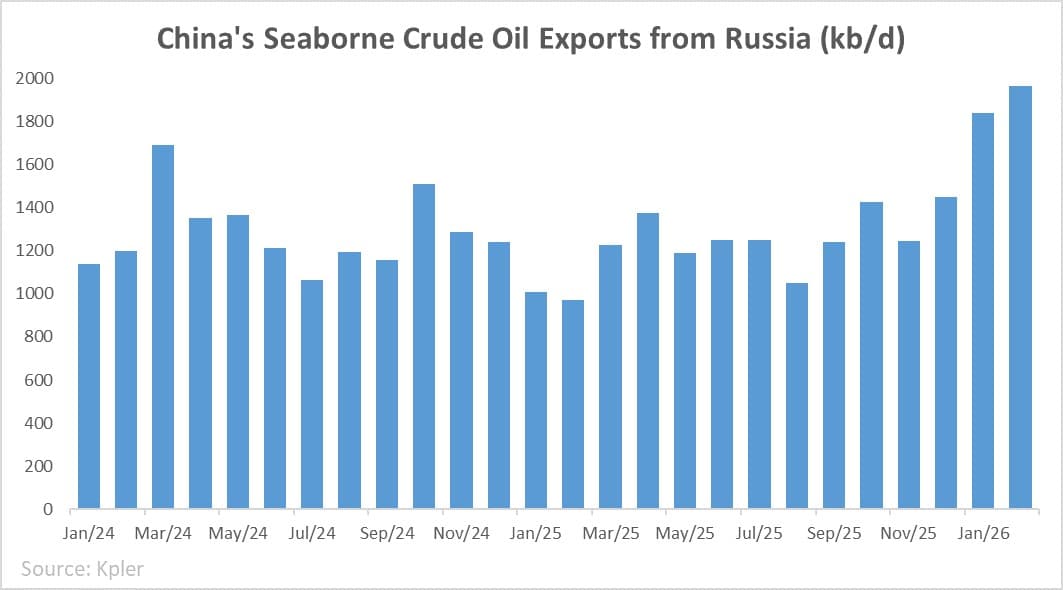
  • As Gulf cargoes stall at sea, Russian crude – already near record flows to China at 1.92 million b/d – has emerged as the most immediate alternative for Asia’s largest oil buyers.

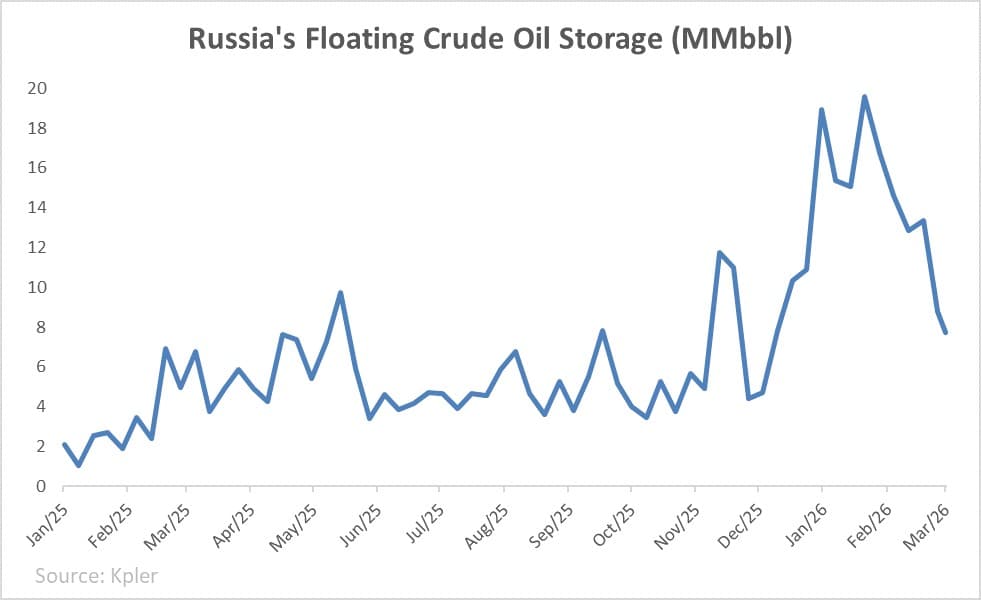
  • Shrinking floating storage and narrowing Urals discounts suggest Moscow may exploit the disruption to tighten supply and drive prices higher by playing Chinese and Indian demand against each other.

The crisis around the Strait of Hormuz has become a severe stress test for both Gulf crude suppliers and their key buyers. Despite repeated assurances from U.S. officials that the waterway was never formally blocked, satellite tracking suggests that no oil or product tankers transited the strait since March 1. The disruption immediately placed the world’s largest importers under pressure. China and India together consume tens of millions of barrels per day, and both remain structurally dependent on Gulf crude. China has steadily expanded purchases of Russian oil since 2022, yet roughly 1/3 of its crude imports originate in the Gulf. India, meanwhile, has been deliberately reducing its earlier heavy reliance on Russian barrels and replacing them with Middle Eastern supplies. With the Iranian crisis unfolding and no quick normalization of Hormuz traffic in sight, both Asian giants may turn to their long-standing supplier in Moscow like never before. The key question is: does Russia have sufficient export capacity to meet the sudden surge in demand?

The shift in India’s purchasing pattern has been particularly visible in recent months. Indian imports of Russian crude declined steadily from 1.85 million b/d in November 2025 to just 1.06 million b/d in February 2026. Much of the remaining flow has been concentrated in a single outlet: the Vadinar refinery operated by Nayara Energy, partly owned by Rosneft. By February, roughly half of the Russian crude delivered to India (around 510,000 b/d out of the 1.06 million b/d total) was imported there. In November 2025, the share was markedly smaller, with 560,000 b/d flowing to Vadinar out of the 1.85 million b/d imported overall. The retreat from Russian supply was largely driven by mounting pressure from Washington, prompting Indian refiners to stop buying Russian barrels. By February 2026 crude from Iraq, Saudi Arabia, the United Arab Emirates and Kuwait accounted for more than half of India’s total imports of 5.18 million b/d, reaching roughly 2.8 million b/d compared with just 2 million b/d in November 2025. The nearly 1 million b/d increase reflected a belief that Gulf crude offered legal stability and relatively low prices. That assumption is now being severely tested, as a significant share of those cargoes is effectively stranded in Gulf waters waiting for safe passage through the Strait of Hormuz. The disruption is likely to force New Delhi to reconsider its recent distancing from Russian supply – assuming those barrels are still available.

China faces a challenge of its own. In February 2026, its seaborne imports of Russian crude reached a new record of 1.92 million b/d. Yet the Iranian crisis affects Chinese refiners on two fronts. Unlike India, China was also a major buyer of Iranian crude, importing roughly 1 million b/d in February. Combined imports from Kuwait, Iraq, the UAE and Saudi Arabia totalled about 3.4 million b/d in the same month. Taken together, the potential loss of Iranian supply and disruption to Gulf shipments threatens more than 1/3 of China’s crude imports. In this context, Russian barrels appear both politically and logistically attractive. Overland pipeline flows and shipments from Russia’s Far Eastern ports offer one of the few large-scale supply channels that bypass the Gulf entirely.

Recent tanker movements underline how the market is already adjusting. A wave of U.S. enforcement actions against Venezuelan oil exports has left a number of numerous VLCCs idle in Asian waters. Many of these vessels had previously been used to collect Venezuelan crude through ship-to-ship (STS) transfers. With those flows disrupted, several of the VLCCs became redundant. Russia appears to have quickly stepped into that logistical vacuum. Although Russian exporters rarely relied on VLCCs in the past, at least 8 such vessels are currently positioned in the Arabian Sea and near Singapore, either en route to China or waiting offshore. There’s 12 million barrels of medium sour Urals alone that are carried by VLCCs, not counting Russia’s Far Eastern grades, surpassing the previous record carry of 9.8 million barrels from February 2023. Most of the cargoes they carry are already committed to Chinese buyers, offering little hope for India’s supply concerns.

How much of the spare Russian oil is available now? Floating storage suggests that Russia’s spare export capacity may be limited. Inventories of Russian crude at sea climbed steadily through late January 2026, reaching about 19.6 million barrels. Since then, they have declining continuously. By early March, only 12 vessels remain in floating storage, holding roughly 7 million barrels in total, and several of those tankers are already anchored near Chinese ports awaiting a signal to offload. In other words, the pool of unsold Russian crude available on short notice has shrunk significantly.

Pricing dynamics are shifting as well. Market insiders report that the Hormuz disruption has narrowed the discount of Russia’s Urals grade to Brent from roughly $10/bbl to $5-6/bbl. At the same time, Russia itself may soon have additional crude available for export because domestic refining activity has slowed. Russian refinery throughput fell from about 5.5 million b/d in December 2025 to roughly 5.15 million b/d in February 2026. Part of the decline followed drone strikes on two refining facilities, including the Volgograd refinery (300,000 b/d capacity) and the Ukhta refinery (80,000 b/d capacity). Planned maintenance at several other plants scheduled for March and April is expected to further reduce domestic crude demand, potentially freeing additional barrels for exports.

Moscow’s most likely strategy in the current environment will be to play its two largest Asian customers against each other. In previous months, Russian exporters often stored unsold cargoes in tankers near Singapore or along the Chinese coast, a tactic that unintentionally signalled oversupply and widened price discounts. The current market situation is markedly different. With most floating cargoes already allocated and supply chains disrupted across the Gulf, the next wave of Russian barrels is not yet visible. That scarcity gives Russian sellers leverage to raise prices by pointing to strong demand from competing buyers. For both India and China, the Hormuz crisis may therefore lead to the same conclusion: Russian crude remains one of the few reliable alternatives – but it may no longer come as cheaply and abundantly as before.

By Natalia Katona for Oilprice.com

Reliance Industries Pivots Back to Russian Oil with U.S. Waiver

India’s largest private refiner, Reliance Industries, is sounding the market for buying Russian crude, an anonymous source told Bloomberg on Friday, after the United States on Thursday issued a temporary one-month license to India allowing it to purchase Russia-origin crude loaded on vessels before or on March 5. 

Even before the waiver was issued, India was considering returning to buying Russian crude amassed in floating storage in Asia as the war in Iran and Tehran’s retaliatory strikes in the region have severely disrupted oil flows from the Middle East.   

India, the world’s third-largest crude importer, depends on Middle East supply for about 60% of its imports, and the de facto halted tanker traffic in the Strait of Hormuz has put severe pressure on its supplies. 

So the U.S. Treasury’s Office of Foreign Assets Control (OFAC) on Thursday issued a general license to India for Indian refiners to buy Russian crude loaded on any vessel, including blocked vessels, on or before March 5, 2026, until April 4, 2026.  

Currently, as many as 15 million barrels of Russia-origin crude are sitting on tankers close to India – in the Arabian Sea and Bay of Bengal – while another 7 million Russian crude barrels are idling near Singapore, per vessel-tracking data compiled by Bloomberg. 

Related: No Missiles, No Drones: What Happens When Rare Earths Stop Flowing?

Before the U.S. sanctions on Russia’s top producers Rosneft and Lukoil in October 2025, Reliance Industries of Indian billionaire Mukesh Ambani was the biggest buyer of Russian crude oil, importing more than 500,000 barrels per day (bpd) thanks to a long-term deal with Rosneft.   

However, the Indian refiner halted all Rosneft purchases in the wake of the U.S. sanctions and took to procuring crude from non-Russian sources.

Now Reliance Industries has a one-month window to buy Russian crude that’s on tankers and, most importantly, these tankers are not blocked in the Strait of Hormuz. 

The largest private refiner in India plans to use that window to buy part of the Russian oil and process it at a refinery unit producing fuels for the domestic Indian market, according to Bloomberg’s source. 

A separate unit processing fuels for exports will continue to use non-Russian crude, as the EU enacted on January 21 a ban on imports into the bloc of petroleum products obtained in third countries that are derived from Russian-origin crude oil. 

By Charles Kennedy for Oilprice.com 


Wall Street Demands Clarity on Trump’s Hormuz Rescue Plan

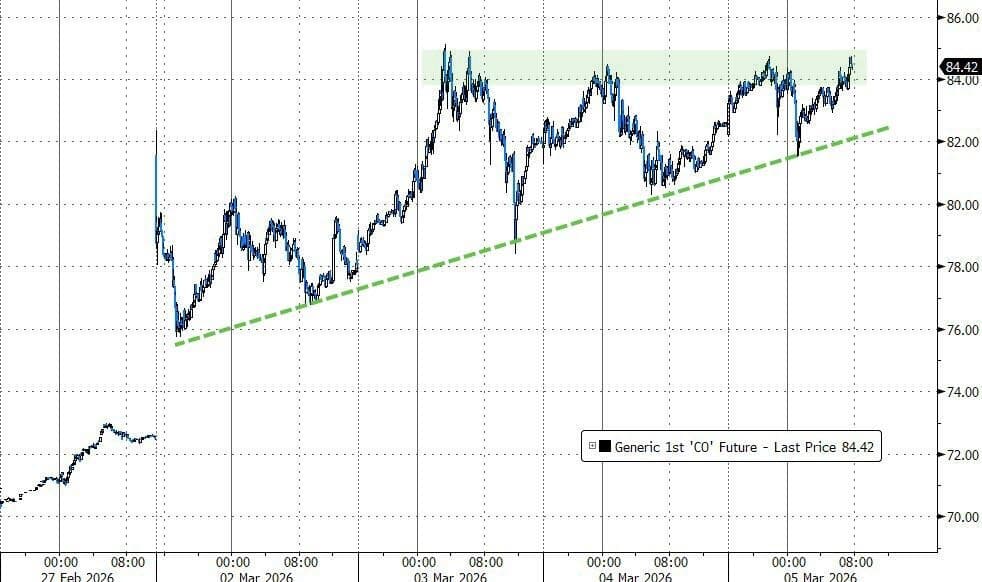
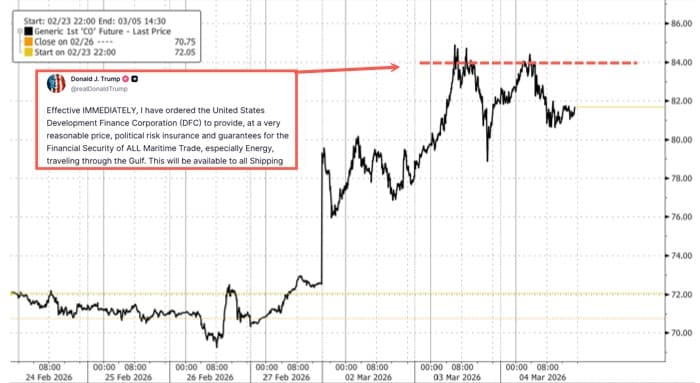
It's been a wild ride in crude over the past few days, with Brent crude futures were capped near $84 a barrel on Tuesday afternoon before sliding down to the $81 level late Wednesday afternoon, only to surge back up to $84 this morning...

...as shipping industry insiders and Wall Street analysts await exact details on the Trump administration's proposal to keep tankers transiting the Strait of Hormuz. The critical maritime chokepoint remains paralyzed, raising the risk of an energy shock in parts of the world that rely heavily on those flows, particularly in Asia.

President Trump wrote in a Truth Social post that the U.S. will provide insurance for "ALL Maritime Trade" through the U.S. Development Finance Corporation (DFC) and will provide Navy escorts "if necessary."

The shutdown is already hitting global energy flows:

Now comes the hard part, with the shipping industry and Wall Street analysts all asking the same question: how will every tanker transiting the Arabian Sea through the Gulf of Oman, into the Strait, and onward to the Persian Gulf be protected by U.S. or allied air or naval forces? 

"Nothing is sure and we need immediate clarity," said Khalid Hashim, managing director of Precious Shipping Pcl, a Thai firm that owns bulk carriers.

Hashim said, "Lives are at risk, cargoes are at risk, ships are at risk. We need immediate cover that protects us from all this."

While some shipowners say they're mulling over joining escorted convoys, many remain very cautious, noting that escorts do not eliminate the risk of the IRGC's asymmetric warfare, such as the use of drones.

Related:How China’s Rare Earth Ban Backfired into a U.S. Tech Breakthrough

Analysts also question whether the Trump administration has done enough planning to make the proposal bulletproof in the near term. Overall, the market sees Trump's plan as a temporary fix to restart flows in the Strait, with Brent crude futures capped at $84 since the announcement and currently trading around $81. 

UBS analyst Benjamin Benson, "Improved risk sentiment following US President Trump's announcement on maritime insurance and US Navy security support further aided the recovery in prices." 

Current activity in the Strait of Hormuz:

"The core thing shipowners are thinking about is the real risk of loss," said Karnan Thirupathy, partner at Kennedys Law LLP, who specializes in commodities and shipping. "No one goes into the trade if the risk of loss is simply too high."

RBC Capital Markets LLC analysts noted, "President Trump's comments about insurance and tanker escorts caused a pullback in oil prices, we question how much planning has been done on the insurance backstop thus far and think there could be a number of challenges in executing this plan quickly." 

Wall Street Journal noted by late afternoon that the Trump administration was in talks with one major insurance broker about how to get ships moving through the Strait of Hormuz: 

A team from insurance broker Marsh Risk met with administration officials Tuesday and offered to help the U.S. government create an insurance mechanism that could lower shipping risk and make insuring ships more affordable, said Marcus Baker, the firm's global head of marine, cargo and logistics. Energy prices have soared since Iran warned it could start attacking ships in the strategic waterway, slowing oil shipping to a standstill.

"Providing protection for all tankers operating in areas currently threatened by Iran is unrealistic as this would require a very high number of warships and other military assets," Bimco security analyst Jakob Larsen noted. 

Let's remind readers that the U.S. and its allies had a difficult time securing the Bab el-Mandeb chokepoint, where Houthi rebels repeatedly launched missiles and drones at commercial ships linked to the U.S. and Israel. That certainly matters now. It also comes as the U.S. and its allies are burning through significant volumes of air-delivered munitions in Operation Epic Fury.

By Zerohedge.com

Beyond Oil: How The Iran War Could Send Food Prices Soaring

  • Global food production is structurally vulnerable because roughly half of all food depends on synthetic nitrogen fertilizer, a substantial portion of which is exported from the Gulf region through the threatened Strait of Hormuz.

  • Unlike oil markets which have a strategic buffer, fertilizer trade operates on a just-in-time basis with no equivalent strategic stockpile to offset a prolonged disruption.

  • A sustained disruption would not cause an immediate price spike but would lead to reduced nitrogen availability, lower crop yields months later, and ultimately result in tighter inventories and elevated food prices.

In the wake of U.S. and Israeli strikes on Iranian military infrastructure, the financial press has reflexively focused on oil. Tanker traffic, Brent crude, and the risk of triple-digit prices dominate the discussion.

But oil is not the only commodity posing a serious long-term risk.

Another deep vulnerability runs through natural gas—and from there into nitrogen fertilizer. If commercial shipping through the Strait of Hormuz were significantly restricted, the impact would extend beyond fuel markets. It would reach directly into global food production.

That’s because the Gulf region is not just a major energy exporter. It is one of the world’s most important suppliers of nitrogen fertilizer—the foundation of modern agricultural yields.

The Energy Behind the Food System

Nitrogen fertilizer begins with natural gas. Through the Haber-Bosch process, methane is converted into ammonia, which is then upgraded into urea and other nitrogen products. In practical terms, nitrogen fertilizer is natural gas transformed into plant food.

Roughly half of global food production depends on synthetic nitrogen. Without it, crop yields would decline sharply.

Globally, about 180 million metric tons of nitrogen fertilizers are consumed each year (measured in nutrient terms). Of that, roughly 55 to 60 million metric tons of urea move through international seaborne trade annually. The Middle East accounts for approximately 40% to 50% of that traded volume.

And nearly all of those exports must transit the Strait of Hormuz.

In other words, close to one-quarter of globally traded nitrogen fertilizer—and a meaningful share of total global nitrogen production—moves through that single maritime chokepoint that is now threatened by war.

Oil may be the artery of the global economy. Nitrogen fertilizer is central to the global food chain.

A Highly Concentrated Export Base

The scale of production clustered behind Hormuz is significant:

  • Qatar exports roughly 5.5 to 6 million metric tons of urea and ammonia annually from its QAFCO complex.
  • Iran exports around 5 million metric tons of urea per year, representing roughly 10% of global trade.
  • Saudi Arabia contributes approximately 4 to 5 million metric tons annually through SABIC and related producers.
  • Oman and the UAE add several million metric tons combined.

Collectively, more than 15 million metric tons of annual export capacity sits inside the Gulf. If you broaden the lens to include ammonia and related nitrogen products, the exposure rises further.

Unlike oil, fertilizer markets lack a meaningful strategic buffer. The United States maintains a Strategic Petroleum Reserve with hundreds of millions of barrels of crude. There is no equivalent stockpile of nitrogen fertilizer ready to offset a prolonged disruption.

Fertilizer trade operates largely on a just-in-time basis. Seasonal demand spikes align with planting cycles, and inventories are not built to absorb major geopolitical shocks.

Why Timing Amplifies the Risk

Agriculture is governed by biology and weather.

In the Northern Hemisphere, fertilizer procurement accelerates ahead of spring planting. If shipments are delayed during that window, farmers face difficult choices: reduce nitrogen application rates, switch crops, or accept higher costs.

Lower nitrogen application generally translates into lower yields. Even modest reductions in application rates can trim output in corn, wheat, and rice—the staples that anchor global calorie supply.

The world saw a version of this dynamic in 2022 following Russia’s invasion of Ukraine. Fertilizer prices surged, and farmers in several regions scaled back usage in response. Yields proved resilient in some areas, but the episode underscored how sensitive food systems are to fertilizer availability and pricing.

Replacing 10 to 20 million metric tons of annual export capacity from the Gulf would not be straightforward. New ammonia plants require years to permit and construct. Existing facilities outside the region typically operate near capacity. Incremental supply cannot simply be switched on in the middle of a planting season.

Global Exposure Runs Deep

The reliance on Gulf nitrogen is widespread.

India depends heavily on imported LNG—much of it from Qatar—to fuel its domestic urea production. If gas flows are interrupted, Indian fertilizer output would tighten just as planting cycles approach.

Brazil, one of the world’s largest agricultural exporters, imports substantial volumes of Middle Eastern urea. Soybean and corn production in regions such as Mato Grosso relies on consistent fertilizer deliveries. Any sustained disruption would quickly tighten global grain balances.

The United States is a major fertilizer producer, but it is not insulated. A significant portion of U.S. urea imports transits Hormuz. Domestic producers cannot rapidly add millions of metric tons of new supply to replace disrupted imports.

This is not a regional supply issue. It is a structural vulnerability embedded in the global agricultural system.

The Overlooked Transmission Channel

Oil price spikes are immediate and visible. Gasoline prices adjust in real time, and financial markets respond within minutes.

Fertilizer disruptions operate on a slower but potentially more consequential timeline. Reduced nitrogen availability today can translate into lower crop yields months later. That eventually shows up in tighter inventories, higher feed costs, and elevated food prices.

Modern agriculture is fundamentally an energy conversion system: natural gas becomes ammonia; ammonia becomes nitrogen fertilizer; fertilizer becomes calories.

If the Strait of Hormuz faces sustained disruption, the most important price to monitor may not be Brent crude. It may be urea benchmarks and ammonia export flows.

Energy security and food security are intertwined. When a single chokepoint handles a large fraction of both oil and nitrogen fertilizer trade, the implications extend well beyond the fuel market.

The headlines may focus on tankers and crude prices. The more enduring story could unfold in the food supply.

By Robert Rapier