Monday, April 27, 2026

After the Ceasefire Illusion: Why Gaza’s “Day After” Still Has No Buyer?

Source: Middle East Monitor

The international community remains fixated on a phantom: Gaza’s “Day After.” While Washington, Cairo, and Doha debate elaborate governance frameworks and the “Board of Peace,” these plans share a fatal flaw—they lack a viable “buyer” on the ground.

This diplomatic theatre has been eclipsed by the US-Israeli aggression against Iran that began on 28th February. Since then, Gaza has been sidelined globally, yet the genocide—begun in October 2023—has never stopped. Even before the Iran escalation, the 10th October ceasefire was a hollow promise; Israel violated the agreement over 2,400 times through near-daily air raids and shelling.

Since that supposed de-escalation, nearly 1,000 Palestinian civilians have been killed, pushing the total death toll past 72,300. This grim reality proves the “Day After” is not a sincere peace plan, but a cynical mask for a permanent, lethal status quo. Far from transitioning to Phase II, the current impasse suggests the ceasefire was merely a tactical suspension of a conflict Israel refuses to end. With the occupation intact and violations occurring daily, Gaza is not moving toward a post-war era. Instead, it is being forced into a state of managed catastrophe, where “peace” serves as a placeholder for the next phase of destruction.

The “Day After” blueprints—specifically the Trump-led Board of Peace and the National Transitional Committee (NTC)—envision technocratic governance for Gaza but face a wall of refusal. For the Israeli government, any plan offering a pathway to Palestinian sovereignty is a non-starter; Netanyahu’s coalition instead prioritises “forward defence” and indefinite military hegemony. Conversely, the Palestinian Authority (PA) remains wary of being “parachuted” into the ruins on the back of Israeli tanks, a move that would permanently strip them of national legitimacy.

The vacuum is further complicated by the survival of the Resistance on the ground. Despite the fanfare surrounding the Board of Peace’s “Phase II,” Hamas has explicitly rejected  any form of international guardianship, viewing the NTC not as a governing partner, but as a Trojan horse for disarmament. Meanwhile, the wealthy Arab states—the intended financiers of a reconstruction effort now estimated to cost $71.4 billion—have failed to commit any tangible funds.

Without a “buyer” willing to assume the immense security and political risks of governing a site of ongoing genocide, the various “roadmaps” coming out of Washington and Brussels serve as little more than academic exercises in a theater of the absurd. The international community continues to pitch governance models to a phantom audience, while the reality on the ground remains one of systematic destruction, leaving Gaza caught in a loop where “reconstruction” is discussed as a future hope but never funded as a present necessity.

The “Day After” illusion is further sustained by the inflammatory rhetoric of Nickolay Mladenov, the High Representative for the Board of Peace. In his recent April 2026 briefings, Mladenov has essentially weaponised Gaza’s reconstruction, explicitly linking the release of the $71.4 billion in aid to the immediate and total disarmament of Palestinian factions.

Hamas has responded by accusing Mladenov of siding with the Israeli occupation and ignoring the thousands of ceasefire violations that have occurred since October 2026 effectively freezing the process in Phase II. By prioritizing the “decommissioning of weapons” over the immediate cessation of the genocide and the lifting of the blockade, Mladenov’s framework has become a symbol of international bias rather than a bridge to peace. This disconnect is why the “Day After” has no buyer: the brokers are selling a plan that demands the surrender of the victims while the aggressor continues its military operations with impunity.

Sensing that the Resistance groups are not convinced by his frameworks, Mladenov has recently attempted to soften his public tone while maintaining his rigid demands. In an interview with  Reuters on 20th April, he admitted that negotiations with Hamas are “not easy,” yet he struck a jarringly optimistic note, claiming he is “optimistic that we will be able to come up with an arrangement that works for all sides and, most importantly, works for the people in Gaza.” Since neither Israel—which continues its strikes—nor the Resistance—which has rejected international guardianship—has publicly shifted their positions, Mladenov’s forward-looking posture appears increasingly detached from the ground reality.

In recent high-level meetings in Cairo (ending 17th April), Hamas negotiators, led by Khalil al-Hayya, delivered a firm list of prerequisites to the Egyptian mediators. They made it clear that they will not consider any decommissioning of weapons without:

A definitive and irreversible plan toward a sovereign Palestinian State.

The complete and immediate lifting of the 19-year blockade.

A full Israeli withdrawal to the pre-October lines (specifically removing the “Yellow Line” military zones).

The prior implementation of all Phase I humanitarian commitments, including the reopening of all commercial crossings and the restoration of Gaza’s power plant.

By insisting on these core national rights as a baseline, the Resistance has effectively neutralized Mladenov’s “aid-for-arms” trade-off, exposing the Board of Peace as a seller with a product that the actual stakeholders refuse to buy.

Ultimately, the “Day After” is failing because it has lost its primary architect. Donald Trump, once the loudest champion of these regional “deals,” is now completely bogged down by the escalating war on Iran, a conflict that is siphoning away the political capital and attention once directed toward Gaza. His schedule for next month confirms this pivot: a rescheduled state visit to China (May 14-15) and a high-stakes reception for the UK’s King Charles later this month, both of which were delayed specifically by his war on Iran.

With Trump preoccupied by a naval blockade in the Strait of Hormuz and a domestic battle over war powers, Gaza has been relegated to a secondary theatre.

This article was originally published by Middle East Monitor; please consider supporting the original publication, and read the original version at the link above.

As Opposition Grows, Oklahoma Organizers Share How They Halted an ICE Warehouse

Source: Truthout

The recent move from the Department of Homeland Security (DHS) to convert empty or surplus warehouses into large-scale ICE detention centers has produced a new terrain of struggle in the fight against Immigration and Customs Enforcement (ICE). A notable departure from ICE’s existing detention system, which largely relies on contracts with county sheriff’s departments and privately run prison companies, this initiative is expanding and consolidating the federal government’s capacity to cage immigrants. Proposed ICE warehouses are largely in areas near logistics hubs, many of which are in towns that voted for Donald Trump in the 2024 election. However, from Western Maryland to Oklahoma City to rural Georgia, opposition has in many cases slowed down or even halted such proposals. This opposition has culminated in a national day of action on April 25 as part of a coordinated campaign of mobilizations to stop warehouse incarceration.

In the interview that follows, community organizers and officials in Oklahoma City recount their collective organizing to thwart an ICE warehouse conversion proposal earlier this year. Although initially seen as a longshot, grassroots mobilizations were successful in not only stopping this proposal but also connecting people’s outrage to long-haul organizing for immigration justice in Oklahoma and beyond.

JoBeth Hamon is a city councilor in Oklahoma City, serving Ward 6. CJ Garcia is a queer immigrant from Nayarit, Mexico, who has called Oklahoma home for over 20 years and combats detention and deportation at both local and federal levels with organizations such as Dream Action Oklahoma and Detention Watch Network. Cole McAfee is the executive director of Freedom Oklahoma and an organizer with the local abolitionist organization Home Base, whose work is rooted in disability justice and trans liberation. Katrina Ward is an abolitionist organizer with Home Base and a Ph.D. candidate researching Oklahoma’s carceral state.

This interview has been lightly edited for length and clarity.

Lydia Pelot-Hobbs: Can you tell me about the proposal to convert a warehouse to an ICE detention center in Oklahoma? Who owns this warehouse? How did this become available for conversion?

Cole McAfee: This warehouse was built in the early COVID-19 online shopping boom as a speculative development for e-commerce businesses. It’s owned by Flint Development which is based in Kansas and the brokerage firm is Oklahoma-based Newmark Robinson Park. Robinson Park is run by Mark Beffort, who is also on the board of the Greater Oklahoma City Chamber and runs the chamber’s  economic development programsDHS did buy a warehouse in El Paso from Flint Development so we think it is likely this company had been in talks with DHS about the various warehouses it has available. The warehouse in Oklahoma City has been sitting empty and was up for lease. The amount DHS offered for the warehouse was never public.

The proposal was for it to be an ICE processing facility that they claimed would not be for long-term stays, but we know that is not how things work and were concerned about conditions. There was never an official bed count for the size of this proposed detention center. We were told it could be between 500 to 1,500 beds for warehousing people.

How did folks find out this was happening?

JoBeth Hamon: Community organizations first found out what was happening from a  Washington Post article that named Oklahoma City as one of the locations ICE was looking at for turning a warehouse into a detention facility. I contacted city staff and learned that they knew about this proposal a few weeks before the Washington Post story. DHS had sent a letter to the city planning department’s historic preservation officer to get a positive affirmation that no historic properties would be affected by this plan. She probably shared it with the planning director and then the news trickled up to the city manager’s office. It then got picked up by local media. If that Washington Post article hadn’t happened, it is unclear when the public would have known because the city government was not proactively sharing this letter.

How did people respond to this proposal?

Hamon: Different organizations such as the ACLU, the Oklahoma Policy Institute, and Dream Action Oklahoma reached out about what was happening to see what mechanisms or levers at the city council could be pulled.

CJ Garcia: It was unsurprising. This has been one way DHS is expanding detention capacity, especially with places that had taken a hit on COVID-era real estate. The repurposing of existing warehouses has given ICE a wide range of places they can access with property owners who are just trying to maximize profits. Also, I knew from my work against a detention center proposal in Leavenworth, Kansas, that zoning was a limited tool for stopping these plans.

I also wanted to make sure that we are connecting this warehouse struggle to the broader ICE ecosystem. My question was: How do we make sure folks don’t lose sight of the fact that we’ve also tripled the amount of 287(g) agreements in Oklahoma [in which state and local law enforcement agencies work with federal agents on immigration policing] and that they’re using state prisons to detain people at a much larger scale than the warehouse proposal? How do you bridge this moment of urgency to broader organizing?

McAfee: There was this urgency among groups that had been following increased criminalization, detention, and deportations. The biggest response I saw was people mobilizing around the Oklahoma City Council even as the mayor and council members said they had limited power. I thought if folks are driving people to council, what are the asks we can make? What are some of those longer-term organizing connections we can help build? If there isn’t anything on the agenda that is actionable, what is the broader narrative work we can do around immigration justice?

Katina Ward: When this information came out, the city started saying they were going to be open and transparent about their communication with DHS. That they were going to ask DHS to go through the city’s zoning process. City leaders’ narrative became “we’ve done our best.” The mayor said that he was talking with our federal delegation to request that DHS go through the formal city process. But at the same time, the city attorney made clear that the city didn’t have legal standing to deny this proposal.

Can you describe what happened at the city council?

McAfee: A mix of people came out. Some had come to council meetings before, along with people for whom this was their first time. People who were organized directly within impacted communities, people activated to show up by folks doing ICE watch, and some advocacy and policy organizations. We were there for several hours in a hot very full room that was over capacity with folks out in the lobby, too.

There was a sense that we have a limited window. People are already saying this is beyond our control. Were there asks that could be made to drive the political imagination of everyone in the room? Could we help council members envision action that was in their hands? For the people who felt compelled to show up, could we give them a broader framework to think about what else could be done? What are ways that we can plug people into other organizing, to get people to think about detention and deportation as a much bigger system that already operates in our community and has to be addressed beyond just this detention expansion plan?

Garcia: Something we haven’t named yet is people were also mobilized because of Renee Nicole Good and Alex Pretti’s murders, a click for a lot of the population in Oklahoma who is largely white and haven’t been activated before. I don’t want to dismiss that. Why were hundreds of people flooding the city council? Because they saw themselves in Renee Good and Alex Pretti. They did not see themselves in people who have died in detention. They have not seen themselves in the hundreds of people that die crossing the border every day. People are finally making sense that the violence this system has built is also coming for them when they betray whiteness, when they do not just comply. That agitation is underneath all of this — not just that ICE is coming for a warehouse.

Ward: There was also a tension at the meeting between symbolic action versus us providing some tangible actions that the city council could take. For instance, Durant, Oklahoma, recently passed a moratorium on detention facilities being built that were not municipal detention facilities. Our city council discussed something similar even though the city attorney said that didn’t have much legal ground. We emphasized there were other actions that could be taken at other government levels against ICE.

Hamon: There’s not the political appetite among our current city council members to take on legal battles (unless it’s criminalizing poor people). The council leans on our legal department to be the most risk-averse, especially things they don’t deem to be a priority. It’s not that we can’t pass a moratorium or do other things. The question is: How effective will they be? How will they get challenged? That’s where the narrative from the mayor — that we can’t do anything — was just so shallow. Legality is a conversation between different institutions and you’re giving up before you even started. You are finding a way out of having to take any moral responsibility for fighting this.

McAfee: We showed up to city council with the following asks: The city publishing all correspondence between DHS, making sure there were regular updates; a moratorium on evictions; and Oklahoma City police citing and releasing people as much as possible to limit the number of people going into the jail where ICE is present. We also wanted folks to understand city surveillance cameras and databases being used by ICE and we asked the city to end those agreements. We asked for the city to share a legal briefing with the public that outlined all the legal pathways that would be available to the city to disrupt this warehouse plan so that we could have deeper public conversations about all the options that were available — even if they carried some legal risk.

How did this outrage, and the different asks made by the community, end up halting the warehouse conversion plan? And what were the outcomes with your other asks at the time?

Hamon: While city legal counsel said there is nothing we can do, this fever pitch of a response seemed to pressure the mayor to at least try and have a few conversations behind the scenes. My assumption is that these occurred with the chamber of commerce and the warehouse property owners. While we don’t know all of what happened, the outrage compelled the mayor to step in. And it appears that DHS was pursuing a lot of different potential warehouses and knew not all were going to work out. Then DHS announced it was no longer interested in pursuing this site.

The question has now become: How do we take the energy of this moment and focus it on things that could have a broad impact for people who are criminalized? Can we use this as an education moment about the surveillance company Flock [that had shared data from its license plate reader technology with ICE] and drive energy toward canceling that contract with the city? We’re also staying prepared if this warehouse proposal comes up again.

McAfee: One of the other guiding questions is: What are ways we can plug allies into showing up beyond moments of political urgency? Freedom Oklahoma [the only 2SLGBTQ+ advocacy organization in the state] and Dream Action Oklahoma [a community-based organization for immigration justice] are partnering together around a zine launch about what it looks like to approach this from the perspective of a neighbor and not a savior and get involved in local organizing to have the future that we want to see.

Ward: Also, because the mayor was gone, JoBeth presided over this meeting and leveraged the momentum in the room to pull back a vote on surveillance related to a proposal for a “LexisNexis Accurint Virtual Crime Center,” which is an interagency information-sharing technology that has the potential to share law enforcement information with ICE (even if Oklahoma City doesn’t officially allow it). I had never seen them go back in the agenda, re-vote, and deny something the police department had requested. It was a material win to delay that.

Garcia: Organizing against detention is a long-haul process. It requires the spaces, trainings, and relationships for people to see a different world is possible. So long as there is prison infrastructure, the state will find a way to reinvent itself. People are largely being detained through law enforcement and sheriff’s departments. These are the biggest threats for immigrants in Oklahoma. ICE is the second layer that makes it possible. We’ve tracked over 3,000 deportations in Oklahoma over the last year, and the vast majority are through contact with law enforcement — even departments that don’t officially collaborate with ICE.

How do we organize people to think about safety from a completely different formulation? Policies that don’t criminalize trans and queer people, unhoused people, not criminalizing access to resources. Because that brings more safety for undocumented people. As an immigrant living in Oklahoma, I know we have a big task ahead. We cannot lose local politics, and we cannot lose the narrative about what safety is — to help people reimagine something different.

This article was originally published by Truthout; please consider supporting the original publication, and read the original version at the link above.

Progressive NGOs Will Enable Trump: A Warning—And A Way Out

Source: Originally published by Z. Feel free to share widely.

For over forty years, I have worked inside what critics call the “NGO-industrial complex.” In 1982, as a Vietnam combat veteran, I quit teaching organizational psychology at MIT’s Sloan School of Management to work full-time for peace and justice. Since then, I have helped lead and build social change efforts across the country.

That experience has made me a critic of the NGO model—not because NGOs are useless, but because of how they are structured.

After World War II, social movements increasingly adopted the corporate form: hierarchical organizations led by executive directors, dependent on professional staff, governed by boards often populated by wealthy donors and their allies. These organizations require large budgets and rely heavily on foundation funding. That dependence shapes behavior.

Anyone who has served in leadership in such organizations knows the reality: the first question each morning is often not “How do we advance the mission?” but “How do we make payroll?”

The result is predictable: caution, conservatism, and risk aversion. Protect the 501(c)(3) status. Avoid legal exposure. Maintain relationships with elected officials and the media. Above all, keep funders comfortable.

This dynamic has been widely recognized. Activists, initially women of color in “Incite,”coined the term “NGO-industrial complex.” Scholars like Harvard’s Theda Skocpol have analyzed how large climate change organizations drifted toward caution. Over a century ago, Robert Michels described the same tendency as the “iron law of oligarchy”: organizations, even those committed to radical change, tend to become dominated by professional leadership with a stake in stability.

So what does this have to do with Trump?

Research and historical experience are clear: the only reliable way to stop an authoritarian like Trump from consolidating power is large-scale, sustained, nonviolent noncooperation—mass disruption that imposes real economic and political costs on those in power and their backers.

To their credit, a broad coalition of NGOs and unions is now calling for escalating actions, potentially culminating in national shutdowns. On paper, this is exactly what is needed.

But here is the problem: I have watched, repeatedly, as these same organizations retreat at the decisive moment.

In the 1980s, the nuclear disarmament movement mobilized millions. When grassroots activists escalated to civil disobedience at the Nevada Test Site, the national organizations withdrew support, citing legal and political concerns. We continued anyway. Thirteen thousand people were arrested, and that campaign helped force an end to U.S. underground nuclear testing—the only clear policy victory of that movement.

In 2020, a coalition of organizers prepared for mass disruption if Trump attempted to overturn the election. When he did, the NGOs chose not to mobilize. They trusted the legal process. That time, we were fortunate. It worked.

We cannot assume that outcome again. Remember 2000 when the movement relied on the legal process while the Republicans stole the election with the “Brooks Brothers riot.”

The pattern is not accidental. It is structural. When confronted with real risk, large organizations tend to hesitate, compromise, and delay. They are embedded in systems—legal, financial, political—that reward caution.

If Trump moves to cancel or subvert the upcoming elections, we should expect more of the same.

The question, then, is not whether people will resist. It is whether that resistance will be organized enough—and independent enough—to matter.

The answer, as always, lies in the grassroots.

Across the country, local networks are already forming: organizers training for nonviolent action, communities confronting ICE, groups moving into the streets, from protest to disruption. These are the people who do not hesitate.

What is missing is national coordination.

To meet tha t need, some of us are organizing a National Noncooperation Spokescouncil—a horizontal, grassroots network capable of planning and coordinating mass action independent of large NGOs.

This model has a long history. From the Spanish Civil War to the Clamshell Alliance, from the Pledge of Resistance in the 1980s to the “Battle of Seattle” in 1999, movements have used decentralized, democratic structures to coordinate large-scale disruption.

The key principle is simple: decisions are made from the bottom up. Local groups send representatives (“spokes”) to a council. Those representatives do not act on personal authority. They return to their groups, consult, and carry back decisions. Power remains rooted in the base.

This structure avoids the central weakness of large NGOs: decisions are not filtered through institutional risk calculations or funder concerns. They reflect the will of people prepared to act.

If and when a national crisis comes, we will not rely solely on executive directors weighing legal risk and donor reactions. We will rely on thousands of organized people deciding, together, whether to act—and how.

I am writing this while traveling, trying to raise the initial resources needed to build this network before the next election cycle reaches its peak in the fall.

If we succeed, by the time you read this, you may hear from a National Noncooperation Spokescouncil asking a simple question:

If Trump tries to steal the election, should we shut it down?

Unlike the NGOs, I think we know your answer.Email

A combat veteran of the US war on Vietnam, Jim Driscoll quit teaching at MIT in 1982 to work full-time in the movement for peace and justice. Raised in West Lynn, a progressive, Irish-Catholic, working-class community, he used his Ivy-League degrees to raise $30 million over the years for progressive and radical organizations which he co-founded and helped lead. Among them, the Nuclear Weapons Freeze was the largest which helped pause the Cold War. The American Peace Test helped 13,000 get arrested in Nevada in a successful effort to finally stop US nuclear testing. Arizonians for Clean Elections won full public funding for all state elections there, helping lead that national movement. Most recently, Extinction Rebellion shut down the white, northwest quadrant of DC twice over climate change. Simultaneously, for thirty years he was a low-level leader in two large, but confidential peer-support communities. His writing connects what he has learned from both the worlds of activism and peer support. He is married with two children, eight grandchildren. Over his lifetime, he chose to follow family around the country and now lives in North Bethesda, MD, USA, outside DC, where he helped launch a local Green New Deal.

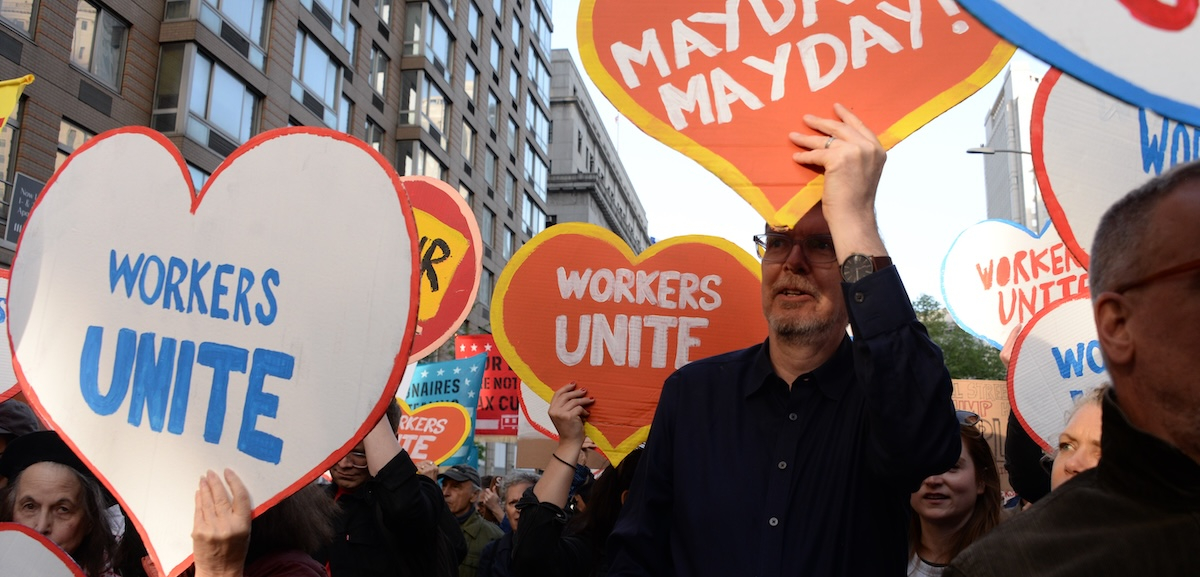
As May Day Approaches, What About the Working Class?—or, 21st Century Common Sense, Part 9 (of 10)

Source: Originally published by Z. Feel free to share widely.

For many socialists and revolutionaries for a long time, the “working class” has been seen as THE revolutionary group. Karl Marx in the 1840s was among the first to identify the working class as a key sector, particularly the industrial working class which was growing in numbers in the mid-1800s as the industrial revolution advanced in Europe and elsewhere. Marx saw this sector of the population as the key revolutionary sector for several reasons.

First, industry was concentrating large numbers of people, by the hundreds and thousands, into factories where the workers shared the common experience of debilitating exploitation of their labor by the owners of the factories. Because of this shared common exploitation, over time the industrial working class, and other workers influenced by them even if not in as stark or clear-cut a situation as workers in large factories, would come to see the power in their hands due to their crucial role in the functioning of capitalist society. In Marx’s, and Friedrich Engels’, line of reasoning, and that of many revolutionaries who came after them, this situation was distinct from the realities of life for peasants/farmers, artisans and craftspeople who may have been poor and were definitely workers, but whose conditions of life did not teach them the lesson of collective organization as the means toward improving those conditions.

Marx saw this industrial working class growing to the point where there would be a vast gulf between the great majority of exploited workers and the tiny minority of private property-owning capitalists. In other words, over time the working class would become and would learn that it was the dominant class in terms of numbers. This, combined with the experience of working together in the factories and learning how to struggle together against the capitalists for improvements in their lives, were the major reasons for the Marxist determination that the unification and enlightenment, through experience and training, of the working class, particularly the industrial working class, was the way in which capitalism would be replaced by socialism.

On the face of it, there are transparent difficulties with a couple of the key components of this theoretical/strategic perspective when it comes to United States realities today. First, the number of workers in factories has been going down as runaway shops and exporting of jobs, automation, robots and computerization increasingly take over industrial processes within many industries. Right now we are facing a major escalation of this process through Artificial Intelligence, AI, and massive and destructive Data Centers. Related, the “industrial proletariat” is hardly the dominant group even within the overall working class, much less the population as a whole. Government workers, retail salespeople, office employees, health sector workers, truck drivers, those in so-called “service” industries—these are much more the types of jobs that are growing in numbers, and are projected to do so for years to come.

The US working class, however, those who own no significant income-generating property and must work for others for a living, is a decided majority, taking all of the many occupations and sectors into account. Estimates by economists who have studied this question put its total range at around 60-65% of the adult working population but others see it as higher.

Many of these working-class people are people of color, women and/or lgbtq+ folks, which is one reason why in our work for fundamental, systemic change, it is essential that our movement deal not just with “class issues” but also the issues of racism, sexism, heterosexism, and other “isms” that can keep us divided and weaker.

In my book 21st Century Revolution: Through Higher Love, Racial Justice and Democratic Cooperation, I do my best to analyze what I see as seven class groupings within US society, trying to help us get a handle on our particular realities in the USA as far as class differences. These are the seven:

-the barely-surviving working class
-the low-income working class
-the moderate- to middle-income working class
-the property-owning, small/medium business class
-the professional and managerial middle class
-the lower level, capitalist supporting elite
-the corporate/financial ruling class

What does all this mean as far as the question of how we bring about revolutionary, transformative change in the world?

First, we need to reaffirm the realities of class exploitation as central to how capitalism works. More specifically, we need to reject strategic perspectives which downplay the importance of class because the industrial working class, in the US and other economically advanced societies, is declining in numbers. We must also reject the argument which says that the correct approach to bring about major change is just to bring together all of the various sectors of the population who are putting forward their specific demands for change, without seeing class as a key element within that popular alliance.

The fact is that even though industrial workers are no longer a major portion of the workforce, virtually all workers in various categories of work continue to experience difficulties and injustice on the job. Many are forced to work at stressful, boring or dangerous jobs that are one small part of an overall set of fragmented tasks divided up among many workers. Most of the new jobs that have been and are continuing to be created are part-time, temporary or contract jobs with no or few benefits. Wages and benefits for full-time work are generally stagnant, but for the barely surviving and low-income sectors of the overall working class, they have been going down for decades.

Within the roughly 2/3rds of the population that makes up the working class, all three sectors of that class—the barely surviving, the low income and the moderate/middle income sectors—are important to the alliance that must be built, but it is the low-income sector that is both the largest numerically and, for various reasons, most consistently progressive, most open to a progressive consciousness, and capable of engaging in effective action.

Another major reason for the strategic importance of this sector is the reality that a significant percentage of the women workers and workers of color in the US workforce are to be found here. The dual or triple oppressions of class/race, gender/class, or class/race/gender, are powerful teaching tools about the true nature of the system.

The major divisions keeping the working class separated are racism, sexism and heterosexism. As a popular alliance emerges that unites the movements of people of color, the women’s movement, the lgbtq+ movement, the climate and environmental movement, young people, and the progressive elements of the labor movement and community-based working-class based movements, there is an arena for popular education on these and other divisive and backwards-looking ideologies. In the process of working together around commonly felt issues of concern, people grow and change. This can only benefit the working class.

A popular alliance will be of benefit to the progressive trade unions that continue to contend with middle-of-the-road to conservative elements within their ranks. By putting forward its program for resolution of the crises of US society, by organizing around that program and in support of its immediate demands on the government and on corporate power, by running candidates for office on that program, masses of working-class people both inside and outside of the trade union movement can be educated and galvanized into action. This can only help the process of trade union organization and working-class based community organization.

Of course, in order for these positive developments to take place out of the alliance building process, it is essential that there be significant involvement of working-class leaders in the leadership of the alliance. There will be other classes part of it, farmers, professionals, small businesspeople, ministers, others. The potential of the alliance will not be realized unless there is a broadly-based, multi-racial, multi-gender, multi-issue leadership representing not just the different movements and sectors of the population but especially the different sectors of the working class, 2/3rds or more of the population.

With such an alliance, and with sound strategy, tactics, methods of organizing and ways that we relate to one another, we can truly create another world.Email

avatar

Ted Glick has devoted his life to the progressive social change movement. After a year of student activism as a sophomore at Grinnell College in Iowa, he left college in 1969 to work full time against the Vietnam War. As a Selective Service draft resister, he spent 11 months in prison. In 1973, he co-founded the National Committee to Impeach Nixon and worked as a national coordinator on grassroots street actions around the country, keeping the heat on Nixon until his August 1974 resignation. Since late 2003, Ted has played a national leadership role in the effort to stabilize our climate and for a renewable energy revolution. He was a co-founder in 2004 of the Climate Crisis Coalition and in 2005 coordinated the USA Join the World effort leading up to December actions during the United Nations Climate Change conference in Montreal. In May 2006, he began working with the Chesapeake Climate Action Network and was CCAN National Campaign Coordinator until his retirement in October 2015. He is a co-founder (2014) and one of the leaders of the group Beyond Extreme Energy. He is President of the group 350NJ/Rockland, on the steering committee of the DivestNJ Coalition and on the leadership group of the Climate Reality Check network.