Monday, April 27, 2026

UK

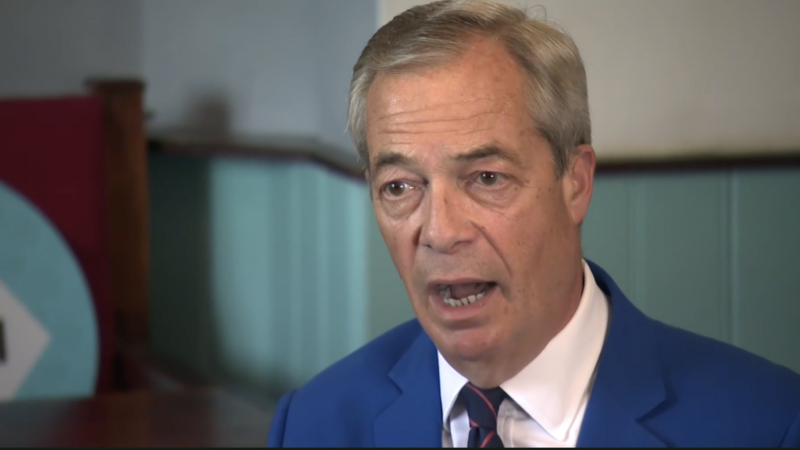
Disaster for Nigel Farage as his approval rating drops to lowest ever

22 April, 2026

Now Farage's personal approving ratings have dropped too, alongside those of his party.


The bad poll ratings are continuing for Nigel Farage and his party after the Reform leader dropped to his lowest approval rating since becoming an MP.

It’s been a bad few weeks for Reform, which has seen the party slump in a number of polls after scandals continued to take their toll, amid bitter infighting, suspensions and defections ahead of the local elections next month.

Add to that the anger over Richard Tice’s alleged failure to pay the correct amount of tax as well as Nigel Farage’s enthusiastic support for the Iran war in its early stages, and it’s no surprise that Reform is beginning to lose momentum in the polls.

Now Farage’s personal approving ratings have dropped too, alongside those of his party.

According to new polling from Opinium, carried out for the Observer, Farage has dropped to an approval rating of net -21, which is the lowest score he has recorded this Parliament.

Basit Mahmood is editor of Left Foot Forward


 UK 

Opinion

Wera Hobhouse MP: The missing piece in the Government’s strategy to combat violence against women and girls

22 April, 2026 
Left Foot Forward

We Liberal Democrats believe misogyny should be recognised within hate crime legislation


Wera Hobhouse is the Liberal Democrat MP for Bath

Over the past few months, I have been campaigning for legislation to combat the alarming trend of ‘nightlife’ filming. Women are being filmed in public without their knowledge or consent, often in inebriated states, with this footage then shared online for millions to view. Collectively, this content has been viewed more than 3 billion times in just three years.

Algorithms are not neutral. They elevate what captures attention, and what captures attention is often what is extreme, polarising, or degrading. These ‘nightlife videos’ are accompanied by a barrage of misogynistic comments and abuse, driving engagement and generating profit for the video’s creator. In this environment, misogynistic content is not just present, it is incentivised and rewarded.

For the victims, the impact is devastating. They are ridiculed, humiliated, face reputational damage and left fearing for their safety in public. And yet, once again, the law is scrambling to catch up.

I saw this during my campaign to make the disgusting act of ‘upskirting’ – taking photographs or videos under a person’s clothing without their consent – a criminal offence, which led to the Voyeurism (Offences) Act 2019. At the time, there was a clear gap in the law and an urgent need to act. But even then, it was obvious that we were responding to one manifestation of a much wider problem.

Today, we are seeing increasingly sophisticated forms of online abuse, from AI-generated deepfake imagery to coordinated harassment campaigns. It is happening at a pace and scale that we have not seen before.

Technology has made it easier to commit these acts, and social media platforms have made it easier for them to spread, but the underlying issue has not changed.

Violence against women and girls is an epidemic in the UK. One in four women in England and Wales will experience domestic abuse in their lifetime. One in four have been raped or sexually assaulted since the age of 16. These are not isolated crimes. They are part of a wider pattern.

In December, the Government published its new Violence Against Women and Girls strategy. Its focus on prevention, education and early intervention is welcome, and long overdue.

But there is a conspicuous omission. Despite recognising the need to address the drivers of abuse, the strategy makes no commitment to recognising misogyny as a hate crime.

Not long ago, following the rape and murder of Sarah Everard, there was much political momentum behind doing exactly that. Labour themselves committed to making misogyny a hate crime. Yet now they’re in Government, we have heard very little about it.

Instead, we are left navigating the same reactive approach: legislating against each new form of technology-facilitated abuse as it emerges, without addressing the hostility towards women that underpins them.

We Liberal Democrats believe misogyny should be recognised within hate crime legislation, not as a new standalone offence, but as an aggravating factor in sentencing, and something police are required to record.

This matters for three reasons. First, it would help us properly understand the scale of the problem. Without consistent recording, misogyny remains largely invisible in official data, despite being a common factor in many forms of abuse.

Second, it would improve accountability. Where crimes are motivated by hostility towards women, that should be reflected in how they are investigated and prosecuted, just as it is for other forms of hate crime.

And third, it would recognise what many women already know: that these experiences are not random. They are rooted in attitudes towards women that continue to shape behaviour, both offline and online.

Recognising misogyny as a hate crime will not, on its own, end violence against women and girls. But it would be an important step towards treating this as a connected problem, rather than a series of unrelated offences.

If we are serious about prevention, we cannot ignore the role misogyny plays. If we continue to avoid naming it, we will remain stuck in a cycle of reacting to harm, rather than preventing it.
Polls suggest pro-independence majority ahead of May 7 Scottish election
25 April, 2026 
Left Foot Forward

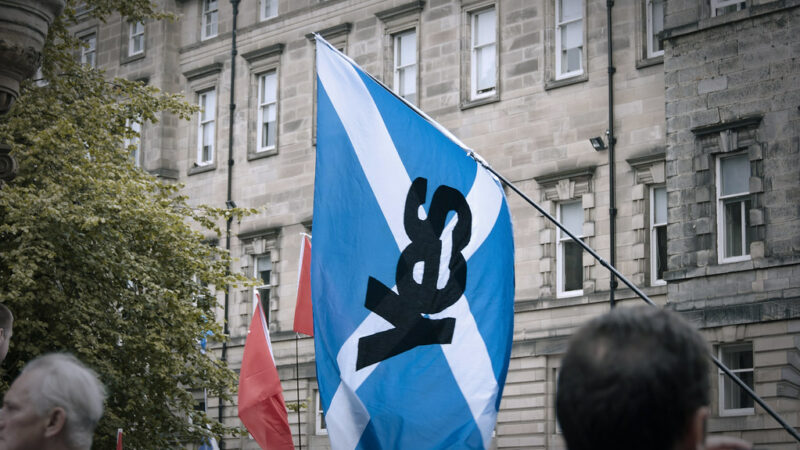
The polls suggest that while no single party may secure a majority, the balance of the next Scottish Parliament could hinge on the combined strength of pro-independence parties.


With less than two weeks to go until the 2026 Scottish Parliament election, when voters will elect 129 MSPs – 73 constituency and 56 regional – a growing body of polling is shaping expectations for both the electoral outcome and Scotland’s constitutional future.

Two polls released this week suggest that a majority of Scots could now favour independence. A Find Out Now survey of more than 1,000 respondents, commissioned by James Kelly of the pro-independence blog Scot Goes Pop, found that 53 percent would vote ‘Yes’ in a referendum when undecided voters are excluded. Including ‘don’t knows,’ support stands at 50 percent for independence and 44 percent for remaining in the UK.

The poll also indicates that the SNP is on course to dominate the constituency vote with 35 percent, well ahead of Reform UK on 16 percent. Scottish Labour follows on 14 percent, with the Scottish Greens at 12 percent, the Scottish Liberal Democrats on 10 percent, and the Scottish Conservatives on 9 percent.

On the regional list vote, the SNP is projected to win 27 percent, with the Greens in second place on 20 percent. Reform follows on 17 percent, ahead of Labour on 12 percent, the Liberal Democrats, 11 percent, and the Conservatives, 10 percent.

These figures point to a potentially strong combined showing for pro-independence parties.

According to pollster James Kelly, nine out of fifteen polls conducted so far this year have found a majority in favour of independence.

The data also reveals a notable generational divide, that support for independence is strongest among people in their 30s, 68 percent ‘Yes’ to 27 percent ‘No,’ while opposition is highest among those aged 65 to 74, 69 percent ‘No’ to 26 percent ‘Yes.’

The polling suggests the Greens could achieve a record result, raising the possibility of a substantial pro-independence majority at Holyrood. However, the SNP alone is projected to fall short of an outright majority, potentially complicating the path to a second independence referendum.

A separate poll by Survation for Ballot Box Scotland places the SNP on 35 percent in constituency voting and 29 percent on the regional list, which would translate into around 57 seats. The Greens are projected to win a record 11 seats based on 11 percent of the list vote.

In that poll, Reform UK and Labour are tied on 20 percent in the constituency vote, followed by the Conservatives on 13 percent and Liberal Democrats on 10 percent. On the regional list, Reform leads on 19 percent, ahead of Labour, 17 percent, the Conservatives, 13 percent, and the Liberal Democrats, 8 percent.

The survey also asked voters which party they would least like to see in the next Scottish Government. Reform UK topped that measure at 34 percent, followed by the SNP on 17 percent and Labour on 14 percent.

The polls suggest that while no single party may secure a majority, the balance of the next Scottish Parliament could hinge on the combined strength of pro-independence parties.

Rule by Secrecy – How Covert Regime Change Shaped Our World

In Covert Regime Change, Lindsey A. O’Rourke reconstructs the hidden architecture of US power and shows how Western democracies repeatedly destroyed foreign political orders.

by  | Apr 27, 2026 |

The modern international order rests on a contradiction rarely examined in full daylight. Western states present themselves as guardians of international rules, democracy, and self-determination, yet the historical record of their behavior abroad tells a different story — one written not in treaties or speeches, but in classified cables, deniable operations, and shattered political systems. Covert Regime Change, first published in 2018, matters because it documents, with unusual rigor, how this contradiction became a governing method. Lindsey A. O’Rourke, Associate Professor at Boston College, does not ask whether covert intervention occasionally went wrong. She demonstrates that it became a routine instrument of statecraft, one whose predictable consequences were political collapse, mass violence, and long-term instability.

The book’s starting point is empirical, not rhetorical. O’Rourke assembles the most comprehensive dataset to date of U.S.-backed regime change attempts during the Cold War, identifying seventy cases between 1947 and 1989. Sixty-four were covert. Only six were overt. This imbalance is not incidental. It reveals a strategic preference for secrecy as a means of exercising power without democratic constraint. Covert regime change allowed policymakers to intervene repeatedly while insulating themselves from public accountability.

O’Rourke also dismantles the notion that covert regime change primarily served democratic ends. Statistically, covert interventions overwhelmingly produced authoritarian outcomes. Where democratic transitions occurred – and they are hard to find – , they were more often associated with overt interventions, where public scrutiny imposed limits. Secrecy correlated with repression, not reform. O’Rourke’s findings dispel the myth that the US fought for democracy during the Cold War: “The United States supported authoritarian forces in forty-­four out of sixty-­four covert regime changes, including at least six operations that sought to replace liberal demo­cratic governments with illiberal authoritarian regimes. Yet, Washington’s proclivity for installing authoritarian regimes was also not absolute. In one-­eighth of its covert missions and one-­half of its overt interventions, Washington encouraged a demo­cratic transformation in an authoritarian state.” In other words: Washington supported whatever regime or rebel group served its interests — and showed little concern for democracy.

What makes the book so unsettling is that it refuses to stop at the moment of intervention. O’Rourke tracks what followed. Using comparative statistical analysis, she shows that states targeted by covert regime change were significantly more likely to experience civil war and mass killings. Her statistical analysis shows that “states targeted for covert regime change were 6.7 times more likely to experience a Militarized Interstate Dispute with the United States in the ten years following intervention.” US regime change operations also steeply increased episodes of mass killing: “States targeted in successful operations were 2.8 times more likely to experience an episode of mass killing, whereas states targeted in failed covert missions ­were 3.7 times more likely.”

Vietnam demonstrates how covert regime change could deepen rather than prevent war. Before large-scale U.S. troop deployments, Washington pursued covert efforts to shape South Vietnam’s leadership. O’Rourke reconstructs the U.S. role in facilitating the 1963 coup against President Ngo Dinh Diem. Rather than stabilizing the regime, the coup fragmented power and intensified dependence on U.S. military support. What began as covert political manipulation ended in a war that killed millions of Vietnamese and devastated the region.

In the Western Hemisphere, the United States utilized hegemonic operations to enforce a brutal regional conformity, often at the direct expense of democratic institutions. The CIA-backed overthrow of Jacobo Árbenz in 1954 destroyed Guatemala’s young democracy. Guatemala’s subsequent trajectory: decades of military rule, a civil war lasting more than thirty years, and the killing of roughly 200,000 people, the majority civilians. Indigenous communities were systematically targeted.

The case of the Dominican Republic illustrates the cold transition from secret meddling to open violence. The US first backed Rafael Trujillo’s dictatorship. Following the 1961 assassination of Trujillo — an operation in which the CIA provided the weapons — the country attempted a fragile democratic opening. When the reformist Juan Bosch won the presidency in 1962, his refusal to launch a McCarthyite purge of domestic leftists led Washington to view him as a “weak link” in the regional defense against communism. After Bosch was ousted in a military coup, a popular uprising in 1965 sought to restore the democratic constitution. Fearing a “second Cuba,” the Johnson administration launched a massive overt invasion to crush the rebellion and install a more compliant regime. The empirical record here is clear: for American planners, the survival of a pro-Washington hierarchy was far more important than the survival of a Caribbean democracy.

One of the book’s most analytically important findings concerns repetition. States subjected to one covert regime change attempt were far more likely to experience subsequent interventions. Covert action did not resolve instability; it institutionalized it. Political systems weakened by external manipulation became perpetual sites of interference.

The moral failure documented in Covert Regime Change is therefore not accidental. It is structural. Secrecy enabled policymakers to externalize violence, displace responsibility, and treat foreign societies as experimental terrain. Civil wars prolonged, civilians killed, and political futures destroyed were foreseeable consequences of deliberate choices. 

Proxy Wars and Moral Evasion

One of the most revealing dimensions of Covert Regime Change is the attention it pays to proxy warfare. Covert intervention rarely meant the United States acted alone. It meant empowering others to act violently on its behalf, often with full awareness of who those actors were and what they represented.

The rollback operations in Eastern Europe during the early Cold War provide one of the clearest illustrations. O’Rourke documents U.S.-backed covert efforts to destabilize Soviet-aligned regimes in countries such as Albania, Romania and Ukraine through the infiltration of exile groups and paramilitary networks. These operations were conceived as low-risk alternatives to direct confrontation with the Soviet Union. In practice, they relied heavily on émigré militias whose ideological and historical backgrounds were deeply compromised.

Many of these groups included former collaborators with Nazi Germany and fascists, implicated in wartime atrocities. This was not incidental. They were selected precisely because of their militant anti-communism and organizational cohesion. O’Rourke shows that U.S. officials were aware of these backgrounds and proceeded regardless. The operations themselves were militarily ineffective. Infiltrators were frequently captured or killed soon after insertion. What they did achieve was the reinforcement of authoritarian control. The existence of covert Western-backed networks confirmed Soviet narratives of external subversion and justified intensified repression across Eastern Europe.

Afghanistan represents the most consequential case of proxy warfare in the book. During the Soviet occupation, the United States conducted one of its largest and most expensive covert operations, channeling billions of dollars in weapons and support to Afghan resistance fighters. These forces were often described in sanitized terms, but O’Rourke is clear about their ideological character. Most were brutal Islamist extremists, organized around rigidly authoritarian visions of society.

The objective of the operation was narrowly defined: bleed the Soviet Union and force its withdrawal. On those terms, it succeeded. What followed, however, was political collapse. After the Soviets left, U.S. engagement rapidly diminished. Afghanistan descended into civil war as rival militias turned their weapons on one another and on civilians. Out of this chaos emerged the Taliban, followed by transnational jihadist networks whose violence would reverberate globally. The intervention did not merely fail to build a viable state; it actively contributed to the conditions under which one of the most repressive regimes of the late twentieth century took power.

Western publics rarely saw the consequences of policies carried out in their name. Violence was outsourced to proxies. Responsibility was fragmented across agencies and allies. Failure could be reframed as complexity or local pathology. What Covert Regime Change ultimately makes impossible is the claim that these outcomes were unfortunate side effects of well-intentioned policies. The evidence shows that policymakers repeatedly chose secrecy over accountability, power politics over democracy, and short-term advantage over human cost. The victims were not abstractions. They were civilians caught between armed factions, dissidents silenced, and societies denied the chance to determine their own futures. 

Power Without Reckoning

By the end of Covert Regime Change, the accumulation of evidence leaves little room for comforting interpretation. It documents a system of intervention that functioned as intended — discreet, flexible, and largely insulated from domestic scrutiny — while producing outcomes that were consistently destructive for the societies it targeted. Failure abroad rarely translated into accountability at home. The result was a cycle in which intervention became easier precisely because its consequences were borne elsewhere.

The statistical findings reinforce this interpretation with striking consistency. States subjected to covert regime change were more likely to experience adverse regime transitions — coups followed by coups, fragile governments replaced by more repressive ones. Civil wars in these countries lasted longer and were harder to resolve. These were not marginal increases. They were structural shifts in political trajectory, affecting millions of lives over decades.

O’Rourke’s insistence on evidentiary discipline gives these conclusions their force. She shows how similar mechanisms produced similar outcomes under varying conditions. Whether in Latin America, Africa, Europe, or Asia, covert regime change followed a recognizable script: identify a political outcome deemed unacceptable, undermine it quietly, empower local actors willing to use force, and withdraw once immediate objectives were met. What followed — repression, civil war, or long-term instability — was treated as local failure rather than external design.

Covert Regime Change challenges the reader to reconsider how international responsibility is assigned. Violence that is indirect is no less real. Harm that is delayed is no less consequential. Political destruction carried out through intermediaries is no less deliberate.

As a work of scholarship, the book is meticulous and restrained. As a historical record, it is devastating. It reveals an era in which power was exercised without witness and accountability. The world that emerged from those decisions — fractured, militarized, and distrustful — is their legacy. The enduring lesson of Covert Regime Change is that secrecy does not merely hide violence; it makes it sustainable, allowing great powers to destroy other societies while preserving the illusion of innocence at home.

Michael Holmes is a German-American freelance journalist specializing in global conflicts and modern history. His work has appeared in Neue Zürcher Zeitung – the Swiss newspaper of record – Responsible Statecraft, Psychologie Heute, taz, Welt, and other outlets. He regularly conducts interviews for NachDenkSeiten.  He has reported on and traveled to over 70 countries, including Iraq, Iran, Palestine, Lebanon, Ukraine, Kashmir, Hong Kong, Mexico, and Uganda.  He is based in Potsdam, Germany.

Source: Truthout

When word of an upcoming maritime flotilla coming from countries thousands of kilometers away first began circulating, Palestinians were in the heart of this war, in one of its harshest moments, with famine silently tearing through Gaza — heavier even than the shelling itself. Despite my awareness of the Israeli occupation’s brutality and severity, and my knowledge that it does not really distinguish much between one nationality and another, there was something that made me hold on to a small hope: that the flotilla would be allowed to pass. That those ships carrying aid, medicine, and teams of doctors whose only purpose was to save what could be saved, would actually reach us.

The first attempts to send a humanitarian maritime flotilla during the genocide emerged in the spring of 2024, when an international civil coalition announced it was sending ships loaded with aid toward Gaza in an attempt to break Israel’s naval blockade — or, at least, to draw attention to the deepening humanitarian catastrophe. The route was never easy. From the very beginning, these efforts faced all manner of obstruction from the Israeli and U.S. governments and their allies. Some ships were stopped before arrival, and participants encountered various forms of pressure and restrictions.

Still, the idea could not be stopped. What began as a single attempt turned into continuous repetition. Each time the flotilla was blocked, it did not return the same — it became larger and more diverse: doctors, journalists, writers, and activists from different countries deciding to undertake this journey despite fully understanding the risks.

The idea did not disappear after the first failed attempt; it kept repeating and expanding, as if its persistence was stronger than the ability of Israel to stop it. Each time, the initiative was revived again in the face of a reality that was becoming more complex and harsher.

In 2025, another flotilla came, the Global Sumud Flotilla. Larger and more organized than the previous one, it carried both a humanitarian and a political message, determined to break the blockade and open a maritime corridor for aid. This effort faced a harsh response; it was intercepted at sea, participants were stopped and detained, and force was used against them, despite all of them being part of a purely civilian mission without any military element.

This treatment was not an isolated incident; it was part of an ongoing policy aimed at enforcing the blockade and preventing any attempt to challenge it, regardless of the identity or background of those involved. The diversity of nationalities and the clearly humanitarian nature of the initiative did not change the firmness of the response.

The flotilla, however, did not remain confined to the sea. As it was intercepted, its echoes spread to different cities around the world, where protests and solidarity actions were held rejecting the blockade and demanding the flotilla be allowed to continue its journey. I, like many others, received photos and videos of demonstrations in Italy and elsewhere, as the flotilla turned into a global point of convergence that placed the blockade itself at the center of international debate.

Still, the interception continued, and so did the blockade — the existing policies allowed no exception. Yet what the Global Sumud Flotilla left behind could be measured not only by its immediate outcome, but also by the scale of reaction it generated and the questions it reopened about the legitimacy and continuation of the blockade under growing international pressure.

A number of participants in the 2025 flotilla gave public testimonies upon their release, describing harsh detention conditions and treatment they characterized as abusive and humiliating. Some said they were restrained for long hours, denied sufficient access to medication and food, and subjected to psychologically punishing conditions and degrading procedures.

Journalists and European activists who took part in one of these journeys stated that they were subjected to prolonged restraint and confiscation of personal belongings, simply for attempting to reach Gaza by sea, despite the declared humanitarian nature of the mission.

In other testimonies, activists spoke about being denied communication for periods of time and being transferred between jails before being deported to their home countries. Meanwhile, Israeli authorities asserted that all procedures were carried out in accordance with the law and that the objective was to prevent entry into restricted waters.

These conflicting narratives between activists and Israeli authorities added a new dimension to the debate. The discussion was no longer limited to the interception of ships at sea but extended to the treatment of those on board and how it reflects broader Israeli policy.

For me, as a woman from Gaza, the scene has remained present in my mind. It carried a mixture of exhaustion, astonishment, and hope at the same time. Exhaustion from the continuation of blockade conditions, from the limited humanitarian corridors, and from a reality that continues to impose constraints on people’s lives despite months of war, ongoing scarcity, and irregular entry of aid through border crossings.

At the same time, there is an undeniable sense of astonishment at the persistence of those at sea. After two rounds of interception and detention, they return again in larger, more organized flotillas, as if each previous attempt did not defeat the idea but deepened it. This persistence, to me, creates a deep sense that the cause is still alive in distant places, and that there are those who consider it a moral responsibility that cannot be abandoned despite pressure or humiliation.

This persistence has, in many moments, become a small but real source of hope — that the world has not completely closed in, and that there are still those trying to reach us despite all obstacles. At the same time, reality here remains harsh. Our pain is reduced to a simple yet heavy question: How can the distance between our need and their support be only a border crossing or a small strip of sea, yet life remains suspended in a state of prolonged suffering? Still, this encounter between those trying to arrive and those waiting under blockade forms a complex human space that tells us all at least one thing: This cause is still capable of moving people and reshaping the meaning of solidarity, even in the most difficult moments.

The diversity of participants in these initiatives is evident. They included doctors who left their workplaces, journalists who left their professional duties, as well as writers, volunteers, and students — all gathered within a single framework, driven by a shared sense of human responsibility.

Among them was my Italian friend who was on board the flotilla and is a journalist like me. Throughout her time there, she would send me messages full of hope and encouragement despite the difficult conditions she was experiencing. Her presence on the flotilla was not just a passing participation, but an extension of a human purpose that brings together people from distant places, meeting around a single idea and a shared desire for support and survival.

In the end, what is happening at sea does not appear to be an isolated event or a passing moment, but rather a continuous chain of attempts that repeat themselves despite all obstacles. Each flotilla that reaches the point of interception leaves behind an impact that continues beyond the moment it is stopped and reopens the same question about the blockade and its limits.

With another flotilla now en route, it is clear that the idea continues to be reshaped with each new experience. For me, there remains in this tactic a meaning that cannot be ignored: a sense that there are still those trying to reach us, that the cause has not been closed, and that hope — despite its weight — continues to find its way across the sea again and again.

This article was originally published by Truthout; please consider supporting the original publication, and read the original version at the link above.\\\\\\\\Email

Eman Abu Zayed is a writer and journalist from Gaza who believes in the power of words to change reality.


Ukrainians join Global Sumud Flotilla Mission to Gaza

APRIL 26, 2026

Ukrainian volunteers in the Global Sumud Flotilla Mission to Gaza say their participation is a call for humanitarian access, international accountability and solidarity against occupation, reports the European Network for Solidarity with Ukraine.

Two representatives of Ukrainian human rights activism have announced their participation in the international civilian mission to Gaza, joining volunteers from across the world in an effort to deliver humanitarian aid and challenge the Israeli naval blockade of Gaza.

Nina Potarska is a Ukrainian sociologist, feminist political economy researcher and director of the Centre for Social and Labor Research, as well as a member of the Global Women’s Alliance for Security Leadership. Andrii Movchan is a Ukrainian left-wing activist, journalist and publicist and a member of the European Network for Solidarity with Ukraine.

In their video address to people who support Ukraine, the Ukrainian team says they are heading to Gaza as part of a broader movement of volunteers, doctors, teachers and human rights activists who are responding to what they describe as a total humanitarian catastrophe. The group states that the blockade has cut civilians off from essential goods, including food and medicine, and that urgent international action is needed to ensure safe humanitarian access.

“Our journey is not about geopolitics,” Nina Potarska says in the video statement. “We are here to remind the world that international law and human rights are universal principles.”

As representatives of a country that continues to resist Russian invasion, the Ukrainian representatives say they cannot remain silent in the face of Palestinian suffering. “As Ukrainians – representatives of a nation resisting aggression and occupation – we cannot stand aside. We cannot leave the Palestinian people alone,” Andrii Movchan points out.

Nina Potarska adds: “As a researcher of war and survival, I see in Gaza not an abstract crisis but a pattern: when civilians are cut off from food, water and care, everyday life collapses. UN data shows hundreds of thousands facing acute food insecurity. As Ukrainians, we understand how occupation affects civilian life — through control over infrastructure, mobility and access to basic necessities. This is not only a humanitarian emergency — it is a failure of civilian protection, one that demands political accountability.”

The Ukrainians say their participation in the flotilla is rooted in solidarity with civilians living under siege and in a belief that opposition to occupation, annexation and violations of international law must be applied consistently everywhere.

The Ukrainian team is calling on media outlets, civil society organizations, elected officials and supporters of Ukraine worldwide to pay attention to Gaza, and to defend the principle that international law must apply to all peoples.

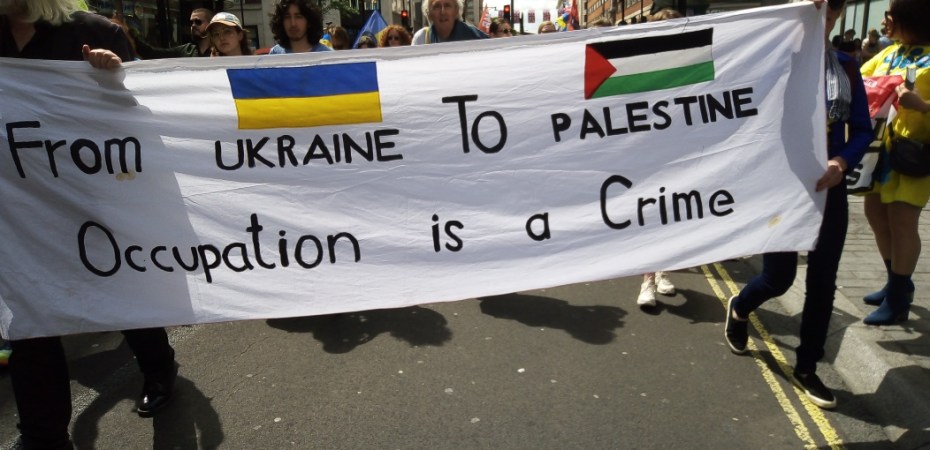
“From Ukraine to Palestine, occupation is a crime,” the video statement concludes.

The broader Global Sumud Flotilla describes its Spring 2026 mission as a civilian-led international effort formed in response to calls from Palestinians in Gaza. According to the organization, the mission brings together participants from more than 70 countries and includes humanitarian, medical, and reconstruction-oriented volunteers.

Image: c/o Labour Hub


Rights of Nature Defender Wins Goldman Prize for Protecting Colombia’s Magdalena River From Fracking

Source: Inside Climate News

As a child growing up along the banks of Colombia’s Magdalena River, Yuvelis Morales Blanco learned to read the water.

“Dark spots on the river meant that we were not going to eat,” she recalled.

One of those slicks—oil spills from the country’s powerful fossil fuel industry—killed thousands of animals and forced hundreds of residents to relocate in 2018. That included people in Morales Blanco’s Afro-Colombian fishing community in Puerto Wilches, a tropical river town located in one of Colombia’s most biodiverse regions. Just 16 at the time, she emerged from the crisis as one of Colombia’s fiercest environmental defenders.

Now 24, Morales Blanco has been awarded the Goldman Environmental Prize—often called the “Green Nobel”—for her role in helping halt hydraulic fracturing, or fracking, in Colombia. That effort reflects a broader legal and moral argument: that ecosystems like the Magdalena River should be treated not as resources to exploit, but as living systems with rights.

Her work, part of the growing rights of nature movement, has centered on protecting her hometown from fracking pilot projects proposed in Puerto Wilches around 2019. Fracking—an extraction method that blasts water, sand and chemicals into rock to release fossil fuels—is notorious for its environmental toll. The process has been linked to groundwater contamination, aquifer depletion,  seismic activity and serious human health impacts,  including cancer and birth defects.

In response, Morales Blanco co-founded Aguawil, a youth-led anti-fracking organization, in 2019. Its members organized protests and went door-to-door, translating complex technical information about fracking into the daily realities of local fishers and farmers. 

As the town became a focal point in the debate over Colombia’s fossil fuel industry, Morales Blanco warned her neighbors that promises of prosperity from expanded fossil fuel production were hollow. Decades of drilling, she argued, had already contaminated ecosystems but Puerto Wilches’ 30,000 residents still lacked basic services like quality healthcare and education. 

Then the backlash came. One resident warned Morales Blanco she would get herself killed. Two years later, she received her first death threat. In 2022, after a peaceful protest she helped organize, armed men arrived at her home. Colombia is consistently ranked among the world’s most dangerous countries for environmental defenders—in 2022, more than a third of all recorded killings occurred there. Morales Blanco fled, temporarily relocating to France. 

Weeks later, a Colombian court suspended fracking projects pending community consultations. Soon after, newly elected president Gustavo Petro imposed a nationwide moratorium on fracking. But on May 31, Colombians will return to the polls to elect a new president—raising the possibility that the ban could be reversed. 

Morales Blanco is one of six recipients of this year’s Goldman Prize and part of the first all-women cohort in the award’s 37-year history, underscoring the central role women play in frontline environmental struggles worldwide. Women are often both disproportionately  affected by environmental harm and at the forefront of efforts to confront it. 

Inside Climate News talked with Morales Blanco about her advocacy work, including her role in the rights of nature movement. 

This conversation has been translated from Spanish and lightly edited for length and clarity. 

KATIE SURMA: You’ve described the Magdalena River as “like a mother.” How has that relationship shaped the way you see your work today? 

YUVELIS MORALES BLANCO: The Magdalena region is a very complex region socially and also very biodiverse, so this has helped me to live passionately and to defend it with all my heart. I’m the daughter of the river, and I look at nature not as a resource, but as life itself. 

The region is at the heart of our lives. It’s part of our life, part of our family and part of ourselves. It is what shows us that there is something bigger than us, and this vision is what helps us continue to move forward and to dream of a future with peace and dignity, away from the effects of the fossil fuel industry.

SURMA: How does your anti-fracking advocacy connect to your work promoting the rights of nature movement? 

MORALES BLANCO: It’s often the case that we see nature as something to serve us, something to be used for humans. We believe we have the right to govern it. We’ve never been asked how it is to live among nature, not to look at it as a resource but as a fundamental part of who you are.

When a community loses a river, the impact is not only about the water itself. It’s about the river, its spirit, the way that people see the spirit. Sometimes companies come and tell the people, “We’ll give you energy,” and people think that’s great, we need that energy—but at what price? Or, “We’ll give you a refinery,” but at what cost? 

Nature is everything. It’s what gives us life itself. No one has ever been able to live without water, but man has been able to live without fossil fuels. 

The fracking industry in Colombia and in all countries justifies its presence by framing water as a mere resource to be consumed or managed for industrial needs. But frontline communities in Colombia and across the globe are rejecting this logic, asking instead: Why must our rivers be dried up and our waterways dammed to fuel an industry that threatens our very existence?

Communities take care of nature and defend the rights of nature not only because they need it for subsistence, but because it’s part of their true identity, who they are. That’s why the fight against fracking in Colombia, in Argentina, in the United States and in Mexico continues. It’s a fight for human rights, a fight for the rights of nature and the rights of the youth and children to have what we have today. 

SURMA: What strategies proved most effective in slowing or stopping the fracking pilot projects along the Magdalena River? 

MORALES BLANCO: The main strategy is networks. In the Colombia Free of Fracking Alliance, we think that networks are the string that ties communities together. We also see the battle to defend the territory as something where one can think you’re alone, but you’re not. There are hundreds of organizations that are also working on this effort. 

We also think about this as an educational movement—we have schools where we educate ourselves, the community and the youth in regards to the rights of nature. 

Another strategy that’s been successful is having visibility. We’re protected by that. When the world sees what we’re going through and is aware of the threats we’re facing, the world itself goes into action to protect us. 

We also never give up. 

SURMA: You faced threats that ultimately forced you into exile in France for a period of time. How did that experience affect you?

MORALES BLANCO: It’s no secret that Colombia is one of the most dangerous places for activists working on social justice and the environment, and ironically, it’s also one of the most biodiverse areas on the planet. 

It’s true I suffered threats and displacement, but it’s an experience that many people have faced. That’s why I feel it’s important that Colombian communities have a right to participation, to defend nature and to have protections when fighting against these industries. It’s really unjust what’s happening in our country and the southern part of the world, that the oil and gas industries continue to move forward despite the cost—the cost of life. 

SURMA: Colombia will have presidential elections in May. How concerned are you that fracking could return? 

MORALES BLANCO: Voters face two polar opposites in these elections: one that is advocating for total destruction of nature and violation of human rights, and the other that thinks about defending life and humanity. 

We will continue to fight no matter what government is in place because we’re independent. We will always continue to fight for the rights of nature. I am still in Colombia and still part of the Colombia Free of Fracking Alliance, and we continue to defend life, the community and the territory. 

In late April, Colombia is hosting the First Conference on Transitioning Away from Fossil Fuels in Santa Marta. I’d like to make a call to action for people to imagine a future beyond fossil fuels. From there, we hope communities—agricultural, farming, fishing communities—can begin to dream of a world and create a vision of a world beyond fossil fuels. The biggest call to action is to imagine what’s possible and then to make it a reality. 

SURMA: You are part of the first all-women cohort of Goldman Prize winners. How do you see the role of women in environmental defense, particularly in Colombia?

MORALES BLANCO: We live in the southern region, with all that entails, living in this part of the world. Injustice deepens when you’re a woman, and especially when you’re a woman of color. This group of winners, all women, is a real call to society regarding the suffering we’ve had to face because of our leadership. This also shows how women in different parts of the world are fighting for life and to make social justice a right for everyone.

SURMA: What advice would you give your younger self, or to other women like you?

MORALES BLANCO: I think about embracing ourselves, and that might sound trivial, but it’s true that when I encounter other women, I feel inspired. I feel the support, and we help one another. The solidarity and tenderness women bring forth is our salvation. A lot of times we’re isolated, targeted and marginalized, so when we find one another, we find refuge and courage. 

This article was originally published by Inside Climate News; please consider supporting the original publication, and read the original version at the link above.