Wednesday, May 06, 2026


Austal USA Starts Construction on Fifth Navy Landing Craft Utility Vessel

Austal USA

Published May 5, 2026 4:53 PM by The Maritime Executive


[By: Austal USA]

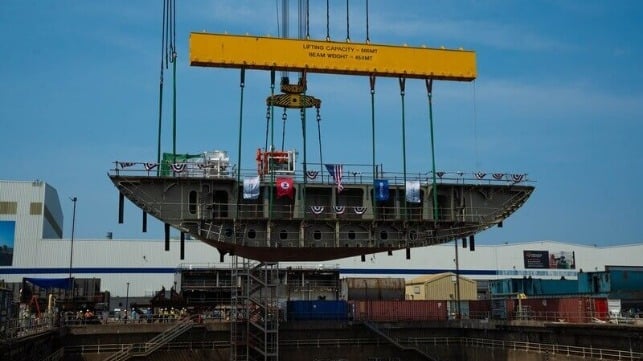
Austal USA celebrated the start of construction on its fifth U.S. Navy Landing Craft Utility (LCU) 1700-class vessel, LCU 1714, at its Mobile, Ala. ship manufacturing facility on April 27, 2026. 

This progress highlights continued momentum for the LCU program, a key component of the U.S. Navy and U.S. Marine Corps’ expeditionary capabilities. Austal USA was awarded a $91.5 million contract in September 2023 for the design and construction of up to 12 LCUs and associated support efforts. Currently, five construction contracts have been awarded to Austal USA.

“Austal USA is proud to continue advancing the LCU program with the start of construction on LCU 1714,” said Bill Bingle, acting vice president of surface ship programs. “This milestone reflects the strength of our serial production approach and the dedication of our workforce to delivering high-quality ships that support critical Navy and Marine Corps missions.”

LCU vessels are deployed from the Navy’s amphibious assault ships and operate across a wide range of missions, transporting Marine Corps vehicles, equipment and personnel from ship to shore and back. These platforms provide significant heavy-lift capability, carrying payloads comparable to multiple C-17 aircraft.

LCU 1710, the first vessel in the program constructed at Austal USA, recently conducted acceptance trials and will be delivered to the Navy soon. The program continues to scale as part of Austal USA’s growing steel shipbuilding portfolio.

The LCU program is one of three ship platforms under serial production at Austal USA. In total, 12 ships are under construction across the company’s programs with three vessels preparing for sea trials. This demonstrates the company’s ability to execute multiple programs simultaneously while maintaining production efficiency.

Austal USA continues to leverage its advanced manufacturing facilities, uniquely supporting both aluminum and steel shipbuilding, along with lean production techniques to meet the Navy’s evolving fleet requirements and deliver ships on schedule.

The products and services herein described in this press release are not endorsed by The Maritime Executive.

China’s Production Capacity for Green Fuels Reaches Eight Million Tons

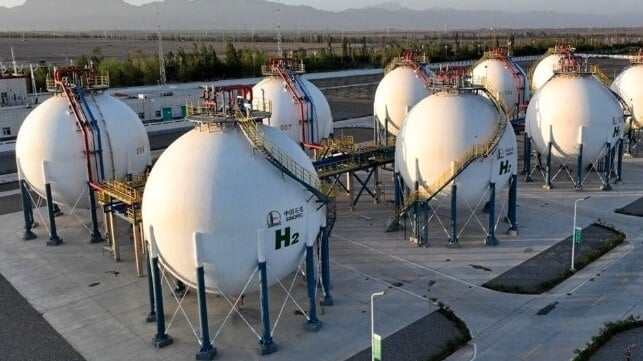
Green hydrogen storage tanks at a new green-fuel facility (Sinopec press handout)

Published May 3, 2026 6:24 PM by The Maritime Executive


As global shipping builds momentum for a net-zero emissions future, countries are increasingly investing in production of green fuels. China continues to be a trailblazer in the green fuel industry, going by data released last week by the country’s energy regulator, the National Energy Administration (NEA).

As of March, China’s green hydrogen production capacity exceeded over 1.1 million tons. This consists of 250,000 tons for operational projects, which is more than double the capacity in 2024. The other remaining 900,000-plus tons is for projects under construction. The huge pipeline of projects - now exceeding the installed capacity - reflects on the success of China’s hydrogen policy, launched in 2022.

In addition, NEA revealed that China has so far built an overall green fuel production capacity of around 8 million tons of oil equivalent per year. This production scale reflects expansion from traditional ethanol and biodiesel fuels to green ammonia and green methanol. NEA added that annual production capacity for green ammonia stands at 700,000 tons, while that of green methanol is around 380,000 tons.

With disruptions in the Strait of Hormuz, NEA has emphasized the development of green fuels as a strategic priority. NEA described the transition as progressively substituting petroleum for energy security. “This is new for green fuel. It is the first time green fuels have been explicitly framed in China as part of an energy security narrative,” commented Kai Yu, a researcher in China’s clean energy.

Besides the policy milestones, Beijing has also rolled out incentives for city clusters supporting scaling of hydrogen applications to areas such as aviation, shipping and manufacturing. The reward scheme promised by the central government to five city clusters is worth around $232 million.

In a world moving towards decarbonization, hydrogen will play a fundamental energy role, especially in the production of other alternative fuels like green methanol and ammonia. China is still in the initial phases of achieving commercial scale for these fuels, supported by renewable electricity surplus and electrolyzer deployment.

However, the risks at this stage are also massive. The hydrogen fuels market is not yet mature and the export volumes are low. Again, there are few bankable offtake plans and the next 12-24 months will be pivotal in indicating ammonia and methanol demand levels. The fact that China is not waiting for the hydrogen market to mature could indicate it is aiming for an influential role in production of green fuels.

This positioning is also evident in recent strategic decisions taken by one of China’s largest shipbuilding companies, the Yangzijiang Group. The Singapore-listed company last month unveiled a new ship repair and conversion arm, targeted at the rising demand for retrofits and green upgrades of vessels.


Maersk Boxship Collides With Container Feeder at Chattogram

Maersk Chattogram
Via Bangladeshi social media

Published May 4, 2026 9:22 PM by The Maritime Executive


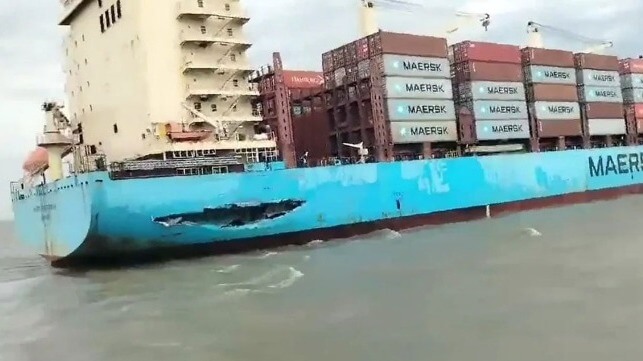
On Friday, a Maersk boxship collided with a former fleetmate near the outer anchorage at Chattogram, leaving the Maersk vessel with a large gash in her starboard quarter. 

The Maersk Chattogram was approaching the pilot station at Chattogram at about 0930 on Friday when she was in collision with the feeder HR Turag (formerly a Maersk vessel, ex name Maersk Arun). No injuries were reported, but photos from the scene show a long and substantial penetration in Maersk Chattogram's hull plating on the starboard quarter. 

"The damage is limited to the external hull. The engine and steering gear remain in good condition," the crew told local TBS News. 

The ship will unload first at Chattogram before arrangements are made for repairs, Maersk's local office told the outlet. Bangladesh's shipping department and the port of Chattogram 

HR Turag is a 1,000 TEU feeder built in 1999. She changed flags to Bangladesh in 2023, and has not had a recorded port state control inspection since, indicating domestic or regional trade. 

Maersk Chattogram is a 2,700 TEU sub-panamax operated by Maersk and flagged in Singapore. The vessel has a history of minor inspection deficiencies within the last three years. As of Monday, she was still moored alongside at a container terminal on Chattogram's waterfront. 


CMA CGM Routes New Giant Containership Through the Suez Canal

Suez Canal
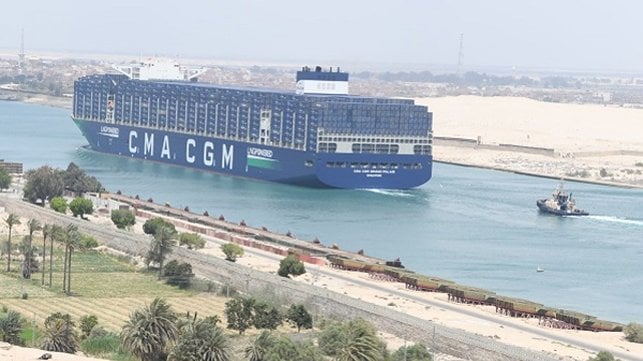
CMA CGM deployed its news large containership through the the Suez Canal (SCA photos)

Published May 4, 2026 5:51 PM by The Maritime Executive


The Suez Canal Authority is highlighting the passage of a new ultra-large containership through the Red Sea and Canal. It is part of its continuing effort to restore confidence in the route and attract the major carriers to restore service using the canal.

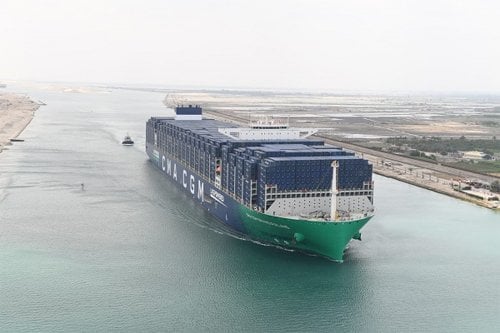
The newly built CMA CGM Grand Palais was just completed about six weeks ago at one of the shipyards of China State Shipbuilding Corporation. According to the Suez Canal Authority, at 220,923 dwt and a capacity of 23,876 TEU, the new ship is the largest LNG-fueled containership in the world. The ship measures 400 meters (1,312 feet) in length and has a beam of 61 meters (200 feet) and is registered in Singapore.

Her naming ceremony was in the middle of March, and then she departed the first of six Chinese ports on March 26 on her maiden voyage and also made stops in Vietnam and Singapore before beginning the Indian Ocean transit. She was in the south convoy transiting the Suez Canal on Sunday, May 3, and is bound for Malta. She will then proceed to ports in France and Spain, before making a return call in Malta and again transiting the Suez Canal at the end of the month. The ship is deployed on CMA CGM’s Mediterranean Club Express route.

SCA Chairman Osama Rabie said the transit, which included the Bab al-Mandab Strait, demonstrates the renewed safety and stability in the region. He notes that CMA CGM has a long partnership with the Suez Canal Authority and continues to send vessels through the waterway after restoring transits earlier this year.

CMA CGM, however, is the exception, as most of the major carriers continue to avoid the Suez Canal and the Red Sea for security concerns. Maersk and partner Hapag-Lloyd had announced they were restoring some routes early this year. They, however, suspended the routing after the start of hostilities in the Middle East.


The SCA remains anxious to attract more transits for the waterway. It highlights the improvements made in the channel and navigation, quoting the captain of the CMA CGM vessel, saying how it improved operations. It has also provided incentives on its fees to attract ships.

MSC Cruises and Celestyal Cruises recently sent three cruise ships through the Suez Canal as they were finally repositioning after the long wait in the Persian Gulf. The ships, however, made the trip without passengers and reduced crews.

Another cruise line, however, will be making the transit with passengers in the coming days. Luxury cruise line Crystal Cruises deadheaded its Crystal Serenity (68,870 gross tons) as part of the repositioning from Mumbai. The ship made the transit of the Bab al-Mandeb and Red Sea, arriving at the Sokhna Port on May 3. They report that approximately 400 tourists were due to board the cruise ship along with the approximately 520 crew. An additional 200 passengers are expected to board the cruise ship at West Port Said as she heads into the Mediterranean. 


What Maritime Transition Means in Practice?

Trade Estonia

Published May 5, 2026 11:32 AM by Trade Estonia


Across shipping, sustainability is no longer only an environmental issue, but increasingly a question of competitiveness, resilience, and operational readiness. The real test is no longer whether the sector wants to decarbonize, but how quickly it can move from pilot projects to large-scale deployment.

One of the biggest bottlenecks today lies in investment certainty, infrastructure readiness, and high costs of vessel retrofits. While ambitions are high, concrete decisions are often slowed by uncertainty around fuel pathways, regulation, and supporting infrastructure. Without more predictable conditions, large-scale investment remains harder to unlock.

Estonia’s Approach is Grounded in Implementation

Backed by a long-term vision, Estonia has increasingly framed maritime transition around implementation – from retrofit support and digital tools to port modernization and regional cooperation in the Baltic Sea region. One example is Estonia’s €25 million grant, funded by the EU Emissions Trading System, to support green retrofitting of ships in Estonian ports between 2025 and 2028. 

“The maritime transition will depend on practical implementation – how ports are electrified, how vessels are retrofitted, and how new technologies can be deployed at scale,” said Kristjan Truu, Deputy Minister for Maritime Affairs and Water Resources at Estonia’s Ministry of Climate. “The sector already has many of the ideas and technologies it needs. The key question is how to make them commercially viable, scalable, and practical to use. Coordination across ships, ports, and infrastructure plays a critical role here. That is why many of the most realistic near-term measures are not futuristic concepts, but solutions that can be implemented now.” 

In that context, shore-side electricity (OPS), energy-efficiency improvements, and retrofitting existing vessels stand out as some of the most practical ways to reduce emissions in the short term. Longer-term pathways, namely alternative fuels – including methanol, hydrogen, and ammonia – are under development, however they will depend on market maturity, infrastructure development, and clearer investment signals.

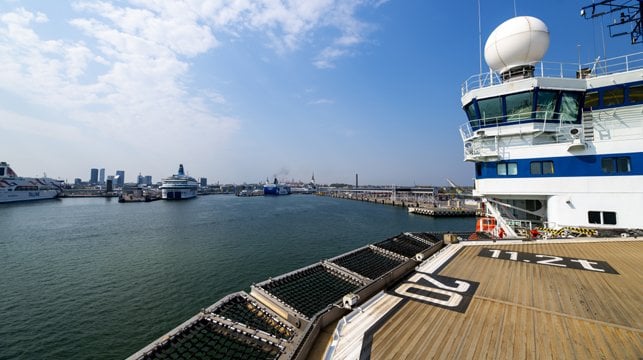
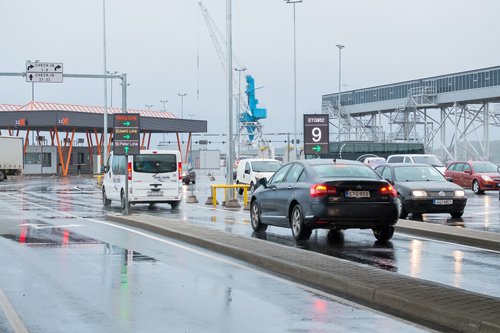
One practical example from Estonia is the Port of Tallinn’s Smart Port concept, which provides a holistic view of automated terminal operations, digital check-in smart gates, and automatic data gathering processes supported by e-documentation and Maritime Single Window solutions. Estonia has also used Maritime Single Window solutions at the national level for more than a decade, showing how digitalization can support both efficiency and sustainability in everyday port operations.

Another area where Estonia offers relevant examples is regional cooperation. The FinEst Green Corridor between Tallinn and Helsinki shows how ports, operators, cities, and public authorities cooperate to accelerate low-emission maritime transport. Estonia is also involved in wider Baltic and European cooperation on green shipping corridors on different multilateral fora and concrete projects.

As Truu put it: “The Baltic Sea region is rapidly becoming the model for green shipping corridors.”
The same practical focus is visible in Estonian companies working across the maritime value chain, from AI-driven engineering tools to retrofit. SRC has developed Methanol Superstorage technology to help solve one of the biggest retrofit challenges with methanol – how to fit more fuel storage into limited space. The solution has recently received Type Approval from RINA and can nearly double the fuel volume compared with conventional tank arrangements.

ShoreLink is supporting port decarbonization through shore power and charging solutions that help reduce emissions at berth. LTH Baas contributes retrofit, outfitting, and technical integration expertise for cruise ships and other passenger vessels. Its current work for Disney Cruise Line’s Disney Adventure includes the design, supply, prefabrication, and integration of piping systems, electrical networks, insulation, HVAC, and passenger cabins.

Other examples include Eumar Design’s lightweight bathroom and interior solutions for passenger vessels, Inspirators!’ AI-powered engineering tools for shipbuilding and offshore applications, and Primostar’s waterproofing solutions for concrete structures in ports.

On a route from innovation to large-scale deployment

At Seatrade Cruise Global 2026, these themes were reflected clearly in the panel discussion “The Future of Sustainable Cruising: Priorities, Pressures, Progress.” What stood out in the Seatrade discussion was not disagreement, but alignment: ports will play a central role in the transition, many near-term tools already exist, and the next stage depends less on inventing entirely new ideas than on scaling the solutions already available.

This is also where smaller maritime countries can play an outsized role. Estonia may not compete on size, but it can contribute through innovative pilot projects, retrofit capability, digital systems, energy infrastructure, and international cooperation. In that sense, one of the clearest conclusions from Seatrade Cruise Global was that shipping is entering a more demanding phase – one where implementation, coordination, and commercial realism matter just as much as ambition.

About Trade Estonia

As part of Enterprise Estonia, the official governmental business and innovation agency, Trade Estonia connects enterprises to a dynamic, innovation-driven economy, providing access to global markets. Trade Estonia also serves as a gateway for foreign enterprises seeking sourcing opportunities in Estonia, offering e-consulting services and facilitating connections with leading Estonian companies.

This project is funded by the European Union – NextGenerationEU and organized in collaboration with the Ministry of Foreign Affairs of Estonia.


 

This article is sponsored by Trade Estonia

The opinions expressed herein are the author's and not necessarily those of The Maritime Executive.

DECRIMINALIZE DRUGS

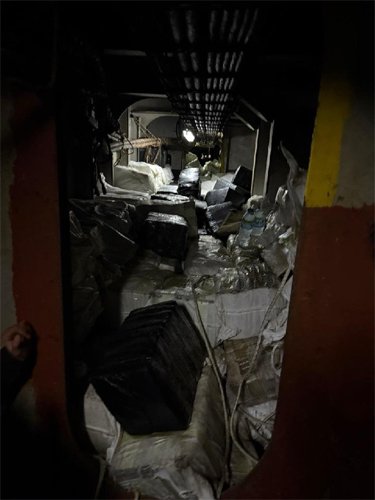
Spanish Intercept Ship “Completely Stuffed” with Record Cocaine Load

cocaine seizure in Spain
The ship seen arriving in Gran Canaria was reportedly "stuffed" with bales of cocaine (IGC NACIONAL)

Published May 5, 2026 1:32 PM by The Maritime Executive


Details are starting to come out on what will likely be Spain’s largest ever drug seizure, possibly three to four times the prior record. Guardia Civil intercepted a general cargo ship last week, which reports said was “completely stuffed,” and when the final tally is done, the expectation is that the load was between 30 and 45 tonnes.

Guardia Civil has declined to release details at this stage, saying the investigation is ongoing and that it is working under a court order. Spain’s Interior Minister, Fernando Grande-Marlaska, however, told reporters in Madrid the seizure would be one of the largest not only nationally but internationally.

The ship named Arconian (4,347 dwt) was observed making its way north along the African coast. It departed Freetown, Sierra Leone, on April 22. The ship, which is 91 meters (299 feet) in length, is registered in Comoros and listed as owned by a company in Sierra Leone. It was reporting a destination of Benghazi, Libya, but according to the reports, the authorities believe that may have been false information.

Authorities speaking to the French news agency AFP said it was likely the ship was going to be met by multiple small boats to offload portions of the drugs. Due to the amount onboard, they believe many small boats and multiple ports would have been involved in the operation. The report points out that the authorities said offloading that amount of cargo in any one port was likely to raise suspicion. Also, Libya would have been a transshipment stop, as the final destination was surely Europe.


Reports said the ship was stuffed with the bales of cocaine (AUGC Guardia Civil)


The vessel was intercepted on May 1 off the coast of Western Sahara. The ship was directed to the naval base at Las Palmas de Gran Canaria, where it arrived Sunday evening.

There were 23 crewmembers aboard who have all been placed in detention. The media reports are that they were from the Philippines, the Netherlands, and Angola.

The police were beginning a comprehensive search of the vessel on Monday and starting to offload the bales of cocaine. Pictures are also showing a cache of weapons found on the ship.  The case remains under a sealed court order from Spain’s Audiencia Nacional.

Spanish authorities had reported a seizure of 13 tonnes of cocaine found in containers at the Port of Algeciras in October 2024. This year, in January, they also reported a seizure at sea of 10 tonnes, which was said to have been the largest seizure from a ship at sea.


Work Begins at Philly Shipyard on Next Two Matson Containerships

Matson shipbuilding containerships
The grand block for the first of the three ships was placed in 2025 and today work progressed on the second and third ship (Matson 2025 Grand Block photo)

Published May 5, 2026 8:15 PM by The Maritime Executive


Matson and Hanwha Philly Shipyard marked construction milestones for the second and third new Aloha Class containerships being built at the yard. Along with the first ship, which started assembly in 2025, the three ships, which will be similar in size and speed to the two earlier vessels, will be among the largest containerships ever built in the United States.

In a dual ceremony on May 5, the first grand block for the second ship, to be named Malama, was placed in the dry dock for assembly. The yard also started steel cutting for the third ship, which will be named Makena. Matson reports it is investing approximately $1 billion in these three ships, which will replace vessels currently deployed on its Hawaii and China-Long Beach Express routes.

The ships, when completed, will measure 854 feet (260 meters) and have a capacity of 3,220 TEU with 408 reefer slots. Part of the hallmark of the Matson ships is their speed. The company reports the main engine will have 51,000 horsepower (38,000 kW), giving each ship a maximum speed of 23.5 knots. 

The first ships, Daniel K. Inouye completed in 2018, and Kaimana Hila, completed in 2019, underwent significant modifications after five years of service to convert them to LNG-fueled operations. The new ships are being built with dual-fuel engines and will be ready to start LNG operations immediately. The hull design of the class was developed for fuel efficiency, and the ships have double hull tanks for safety, as well as freshwater ballast systems.

The order for the three containerships was placed in 2022 as part of the company’s fleet renewal program and to contribute to its efforts to reduce fleet emissions. Matson has called the Aloha Class ships among the fastest and most efficient vessels in its fleet.

Work on the first of the ships, which is named Makua, started with its steel cutting in September 2024. Assembly began with the placement of the grand block on August 4, 2025.

Matson expects to receive the first new vessel in the first quarter of 2027 from Hanwha Philly Shipyard. The subsequent deliveries are scheduled for the third quarter of 2027 and the second quarter of 2028.

The companies highlight the work as an expansion of their long-standing relationship. The predecessor company, Aker Philly and Philly Shipyard, delivered the first two ships of the class in 2018 and 2019. Before that, it also built four Jones Act containerships for Matson between 2003 and 2006.


Jeff Bezos is Reported to be Selling the World's Largest Sailing Yacht

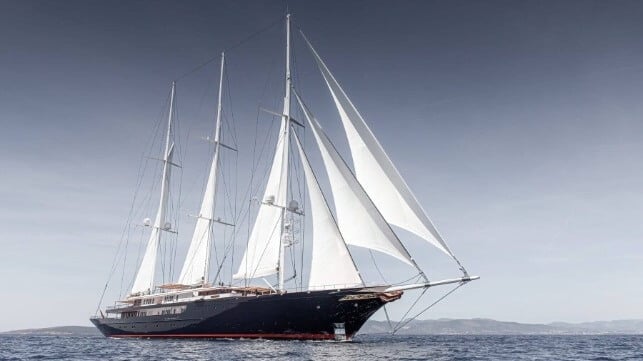
His three-year-old megayacht Koru is the largest yacht currently capable of running under sail alone

Koru (press handout courtesy Oceanco)

Published May 5, 2026 9:29 PM by The Maritime Executive


Gossip column Page Six has obtained confirmation that Amazon founder Jeff Bezos is selling is megayacht, the $500 million sailing vessel Koru. The reason, according to the outlet's sources, is that the vessel has become "too recognizable" for the multibillionaire tech executive. 

Koru is among the world's most distinctive yachts - and not just because of her imposing three-masted silhouette, her 417-foot length or her elegant counter stern. Famously, the yacht's prow features a life-size bust of Bezos' second wife, Lauren Sanchez Bezos, carved from wood and adorned in gold trim.  

The yacht is among the largest vessels operating under sail, and has a massive sail plan. Koru is normally attended by a support vessel, the Damen-designed Abeona, itself valued at $75 million. As sailing yachts are incompatible with helicopters, Abeona provides a helipad and a way for Sanchez - a helicopter pilot - to exercise her skills. It is unclear whether Abeona is also for sale, either separately or as a package with Koru

The Koru's sheer size is notable for a sailing yacht, and also comes with limitations. Annual upkeep is in the eight digits, and the ship is too large to fit into many of the specialized port terminals that cater to yachts, most vessels of this type being smaller and of shallower draft. For this reason, Koru has often been spotted at less glamorous parts of the working waterfront, near warehouses and freighters rather than boutiques and clubs.

The vessel's scale was a challenge even before delivery. The Koru was built at one of Oceanco's yards a few miles upriver from Rotterdam. To reach the sea, it needed to fit under the historic Koningshaven Bridge - a locally-beloved reminder of the WWII era. With masts stepped, Koru's air draft was too high to pass. When the yard proposed that the bridge be partially dismantled to permit passage, some residents arranged plans to throw eggs at the vessel as it went by. Instead, the yacht quietly departed the yard in the night, without masts, and the passage was completed without altering the bridge. The masts were stepped afterwards at another site.


Rheinmetall and MSC in Negotiations to Buy Romania’s Mangalia Shipyard

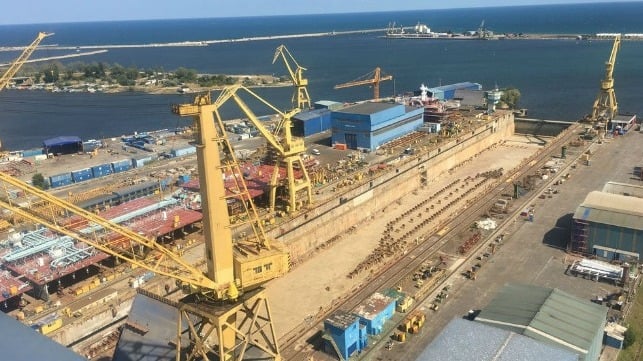
Mangalia shipyard Romania
Romania is reportedly negotiating a deal with Rheinmetall and MSC to take over the bankrupt shipyard (file photo)

Published May 5, 2026 10:41 PM by The Maritime Executive


German industrial giant Rheinmetall confirmed it is discussing a deal with MSC Mediterranean Shipping Company for the two companies to take over the bankrupt Mangalia shipyard in Romania. A year ago, MSC had expressed interest in the yard as the government was beginning a reorganization of the operations.

Romanian government officials are reported to be negotiating a deal in which Rheinmetall and MSC would acquire the majority ownership in the yard, with the government retaining a small investment share. The yard, which has been involved with insolvency hearings and a planned reorganization, was pushed into bankruptcy last month. 

Rheinmetall, best known for its military equipment and security systems, got into shipbuilding, announcing it would acquire NVL shipyards from Lürssen Group. The yard supports the German Navy, and the acquisition was seen as an opportunity to expand the company’s systems integration in naval warfare. Recent reports have linked Rheinmetall with a four-ship order, including two offshore patrol boats, to be built for Romania.

In a statement released on May 5, Rheinmetall says the acquisition of the shipyard would go beyond the four-ship contract and would represent an opportunity to support the future of Romanian shipbuilding and create a position in the defense industry. It says the plan envisions resuming shipyard operations and expanding from the four ships to the point that Romania could develop into a major European production hub for shipbuilding. It says the yard could eventually grow in the long-term to employ several thousand people.

“The revitalisation of the shipyard in Mangalia is of strategic importance,” says Rheinmetall. “The resumption of shipyard operations is expected to have significant positive effects on the region, contributing to the stability and development of the local business environment.”

Romanian media reports the government has moved to take over the assets of the shipyard, which has been held in a joint venture where the government is the majority investor and 49 percent is owned by Damen. Mangalia, which was established by the government in 1976, became a partnership with South Korea’s Daewoo Shipbuilding & Marine Engineering in 1997. Damen had taken over the yard in 2018, but it closed in 2024 after Damen notified the government of its intent to end a joint venture. Damen is reported to be the yard’s largest creditor.

The yard was recently valued by the insolvency court at €87 million ($102 million). Under the new legislation, the government could reclaim the yard by paying no more than the liquidation value of the yard.

Romania’s Defense Minister has said the plan calls for the government to contribute the land and assets of the yard to the new partnership with Rheinmetall and MSC. The German company would develop the defense shipbuilding operation, while MSC would participate as the partner specializing in commercial shipbuilding. 

Last year, MSC had written to the government saying it was looking to diversify its relationships for shipbuilding and repair. It said the operation could start with ship repair and be developed to become a builder of commercial ships, including future construction of cruise ships, ropax, and tugboats. The company proposed paying in advance for repair work to provide the yard funds for hiring back employees.

Supercarrier USS Gerald R. Ford Transits Gibraltar into Atlantic

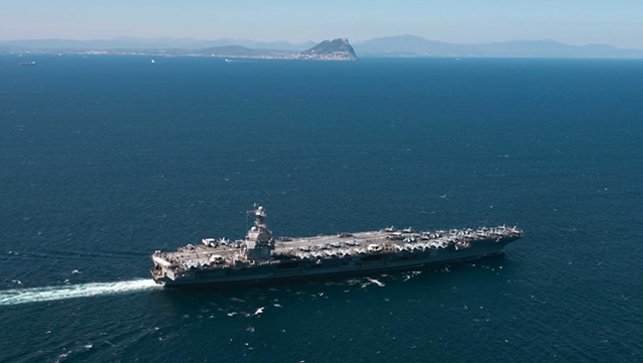
carrier Ford passing Gibraltar
Gerald R. Ford made her first of four transits of the Strait of Gibraltar in July 2025 (USN)

Published May 6, 2026 12:34 PM by The Maritime Executive


Eagle-eyed ship spotters confirmed what had been anticipated for days as the supercarrier USS Gerald R. Ford transited the Strait of Gibraltar on Wednesday, May 6. It was widely anticipated that the carrier was due to leave the Mediterranean, and the speculation is that she will reach her home base in Norfolk, Virginia, before the end of the month.

The U.S. Navy has not confirmed the speculation that the long deployment is coming to an end, but Stars & Stripes is quoting a defense official speaking on background who confirmed the carrier is now operating in the Atlantic. She passed the 315-day mark on what is becoming a record-setting deployment after having departed Virginia in June 2025. The carrier has been deployed longer than any warship since the end of the Vietnam War, but it looks like she will fall shy of the 332-day deployment of USS Midway during the Vietnam War.

Further adding to the speculation that the carrier is homeward bound, Acting Secretary of the Navy Hung Cao posted pictures on social media confirming a visit to USS Gerald R. Ford “earlier this week.” He writes that he was there to thank the sailors and airmen for “completing a long, demanding deployment.”

The visit included Ford as well as her destroyer escorts, USS Winston S. Churchill and USS Bainbridge.


USS Gerald R. Ford departed Norfolk bound for Northern Europe last year and took part in NATO exercises and visited Norway. She later made her first transit into the Mediterranean on what has become four trips through the Strait of Gibraltar during this deployment. In October, she was ordered to the Caribbean to support operations off Venezuela and then earlier this year ordered back to the Mediterranean and then the Red Sea to support the attacks on Iran.

The carrier was removed from the Red Sea after a significant laundry room fire in mid-March that injured three sailors and damaged sleeping compartments on the ship. She visited the repair base at Souda Bay, Crete, and then went to Croatia before making another Suez Canal transit in mid-April. 

Her deployment seems to have come to an end after USS George H.W. Bush completed training exercises off Virginia and was deployed to the Middle East. The U.S. briefly had three carriers in the region, with the USS Abraham Lincoln deployed in the Arabian Sea.

Completing her second full deployment since becoming active, the speculation is that Ford will spend the next year receiving significant maintenance and possible upgrades. The Navy also expects to take delivery of the second carrier of the class, USS John F. Kennedy, possibly in March 2027. The third carrier of the class, USS Enterprise, is expected in late 2029 or early 2030.