Wednesday, May 06, 2026

The West’s Bubble of Illusion About Israel – and About Itself – Is Finally Being Burst

The genocide in Gaza and ethnic cleansing in Lebanon exhausted the West’s moral legitimacy. Now Iran is slowly exhausting the West’s military primacy.

by  | May 5, 2026 | 

For decades, two irreconcilable narratives about Israel and its motivations have existed in parallel.

On the one side, an official western narrative portrays a plucky, besieged “Jewish” state of Israel, desperate to make peace with its hostile Arab neighbors. Even to this day, that story dominates the political, media and academic landscape.

Time and again, or so we are told, Israel has held out an olive branch to “the Arabs”, seeking acceptance, but is always rebuffed.

A largely unspoken subtext suggests that supposedly irrational, bloodthirsty, Jew-hating regimes across the region would have completed the Nazis’ exterminationist agenda but for the West’s humane protection of a vulnerable minority.

A Palestinian counter-narrative, accepted across much of the rest of the world, is choked into silence in the West as an antisemitic “blood libel”.

It presents Israel as an ethnic supremacist, highly militaristic state – armed by the United States and Europe – bent on expansion, mass expulsions and land theft.

On this view, the West implanted Israel as a colonial military outpost, there to subdue the native Palestinian population, and terrorize neighboring states into submission through relentless and overwhelming displays of force.

Palestinians cannot make peace, or reach any kind of accommodation, because Israel pursues only conquest, domination and erasure. No middle ground is possible.

The proof, note Palestinians, is Israel’s long-standing refusal to define its borders. As its military power has grown decade after decade, ever more extreme political agendas have surfaced, demanding not just Israel’s takeover of the last remnants of the Palestinian territories it illegally occupies but expansion into neighboring states like Lebanon and Syria.

Drunk on power

Here are two conflicting narratives in which each side presents itself as the victim of the other.

Two and a half years into a series of Israeli wars against the peoples of Gaza, Iran and Lebanon, how are these two perspectives holding up?

Does Israel look like the frustrated peacemaker facing off with barbaric opponents, or a rogue state whose decades-long aggression has provoked the very retaliatory violence exploited to excuse its constant war-making?

Is Israel a small, reluctant fortress state defending itself, or a western military client so drunk on its own power that it can no more limit its territorial ambitions than a great white shark can stop swimming?

The truth is that the past 30 months have graphically exposed not only what Israel always was but, by extension, what our own western states aspired to achieve through their most favoured Middle East client.

In a moment of imprudence last month, Christian Turner, Peter Mandelson’s replacement as British ambassador to the US, let slip the reality. Washington, the West’s imperial hub, he said, had no deep loyalty to its allies – apart from one.

Unaware his words were being recorded, he told a group of visiting students: “I think there is probably one country that has a special relationship with the United States, and that is probably Israel.”

That special relationship requires that the political and media class in Washington’s other client states, such as Britain, shield the West’s Sparta in the Middle East from critical scrutiny.

So glaring have Israel’s atrocities become that the British government announced last month that it was shuttering its Foreign Office unit tracking war crimes – citing the need for cuts – rather than face further exposure of its collusion in those crimes.

If the British government refuses to monitor Israel’s war crimes, don’t expect more from the establishment media.

For months, Israel has been blowing up village after village in south Lebanon, driving millions of inhabitants from lands lived on for millennia by their ancestors, and it barely registers with our politicians and media.

Israel is destroying Gaza’s water supplies, as it earlier did the tiny enclave’s hospitals and health system, ensuring the further spread of disease, and our politicians and media have barely a word to say about it.

Israel kills journalists and emergency crews in Gaza and Lebanon week after week, month after month, and it raises barely an eyebrow from the political and media class.

Israel declares “yellow lines“ in Gaza and Lebanon, demarcating expanded borders that formalize its theft of other peoples’ lands, and this instantly becomes the new normal.

Israel continuously violates ceasefires in Gaza and Lebanonspreading misery and inflaming yet more anger and bitterness, and once again, our politicians and media turn a blind eye.

Which western media outlets are pointing out a starkly revealing fact: that Israel now occupies more of Lebanon than Russia does of Ukraine?

Media bias

An analysis by the Newscord media monitoring group last month confirmed earlier research: that the British media studiously avoid naming ethnic cleansing and genocide when it is Israel – rather than Russia – carrying them out.

Comparing the coverage of the most “serious” establishment British news outlets – the BBC, the Guardian and Sky – with that of Al Jazeera, the study found that UK media consistently choose to obscure Israel’s responsibility for its crimes.

Israel was identified as conducting attacks in Gaza in only around half of British news reports, in contrast to nearly 90 per cent of Al Jazeera’s. As Newscord noted: “Half the time, BBC readers aren’t told who killed the person in the story.”

That was graphically illustrated in a notorious BBC headline: “Hind Rajab, 6, found dead in Gaza days after phone calls for help”.

In fact, an Israeli tank had sprayed a stationary car with gunfire even though the Israeli military had known for hours that it contained a Palestinian girl – the sole survivor of an earlier attack – who emergency crews were desperately trying to reach. Israel killed the rescue team, too.

In another revealing finding, Newscord notes that four out of every five BBC reports on casualties caused by Israel’s attacks used the convoluted passive – rather than active – voice, clearly with the intent to downplay Israel’s culpability and savagery.

The British media also actively undermined the enormity of the Palestinian death toll in Gaza by regularly attributing the figures to a “Hamas-affiliated” health ministry – even though the numbers, currently at well over 70,000 Palestinians, are almost certainly a massive undercount, given Israel’s early destruction of the enclave’s government and its capacity to count the dead.

The fact that the United Nations has found the Gaza figures to be credible was mentioned in only 0.6 percent of reports.

Genocidal intent

Similarly, the BBC and the Guardian made the decision to humanize Israeli captives of Hamas twice as often as they did Palestinian captives of the Israeli state.

The inappropriateness of that double standard is underscored by continuing insinuations from politicians and the media that Hamas “beheaded babies” and carried out systematic rapes on 7 October 2023 – more than two years after those claims were utterly discredited.

Contrast that with the media’s effective burial of Euro Med Monitor’s report last month on the sickening practice by the Israeli military of raping Palestinian prisoners with dogs trained for that very purpose.

There has been a flood of accounts from Palestinians held captive by Israel of their systematic rape and sexual abuse, confirmed by human rights groups and by the testimonies of whistleblowing Israeli soldiers and medics. Little of this is making headway in the western media.

Newscord points to a further, veiled problem that skews western coverage: the omission of established but inconvenient facts that would present Israel in a depraved – that is, an accurate – light.

For example, observes Newscord, the BBC has entirely failed to report all but one of the hundreds of clearly genocidal statements made by Israeli officials, from Prime Minister Benjamin Netanyahu down.

It is easy to understand why. Legal authorities usually struggle to make a conclusive determination of genocide because, crucially, it depends on divining intent, which is typically hidden by those committing atrocities.

Starkly, in Israel’s case, not only do its actions in Gaza look like genocide, but its leaders have been crystal clear that those actions are intended to be genocidal. That is behaviour only seen in those intoxicated by a sense of their own impunity.

Once again, the British media have obligingly taken it upon themselves to shield Israel from any legal jeopardy – all in the interests of objective reporting, you understand.

An old story

This is nothing new. It has been the same story since before Israel’s violent creation on the Palestinians’ homeland in 1948, when 80 percent of the native population were ethnically cleansed by Israel from the new, self-declared “Jewish” state. Or when, in the continuing language of deceit employed by western political, media and academic elites, some 750,000 Palestinians “fled”.

The aim has been to manufacture and maintain a bubble of illusion for western publics, one where our own crimes – and those of our allies – remain invisible to us.

Note in this regard the UK government’s determined exclusion of Israel from a recent “independent” inquiry, under former Whitehall bureaucrat Philip Rycroft, into malign foreign financial influence on British politics. It was, of course, Russia that was put chiefly under the spotlight.

Predictably, Keir Starmer’s government rejected in April a petition signed by more than 114,000 people calling for a similar public inquiry into the influence of the powerful Israel lobby.

That came as no surprise, given that any such investigation would have risked foregrounding the many hundreds of thousands of pounds known to have been received by Starmer and his ministers from pro-Israel lobbyists.

The same British political and media class so averse to investigating the malign influence of the pro-Israel lobby is also ignoring Israel’s current, systematic destruction of villages and infrastructure across south Lebanon – in flagrant violation of a supposed ceasefire.

Israeli soldiers have told local media that their job is to target all structures indiscriminately, whether civilian or “terrorist”, with the goal of preventing the Lebanese inhabitants from returning to their villages.

That fits with Israel’s announcement that it does not intend to withdraw after the fighting ends, and widespread plans to colonize the occupied lands in Lebanon with Jewish settlers.

Were it not for videos of Israel blowing up Lebanese communities breaking through on social media, despite algorithmic suppression, we might not know about Israel’s wholesale efforts to ethnically cleanse south Lebanon.

Responding to these videos with a rare “mainstream” report on the campaign of destruction, the Guardian sugar-coated the horror faced by Lebanese families discovering their homes gone, along with priceless memories and heirlooms. This experience was described – absurdly – by the paper as “bittersweet”.

Critics note a consistent pattern. Israel is not only leveling south Lebanon; over the past 30 months, it has leveled almost every building in Gaza, too.

But the template for both is of much earlier origin, as every Palestinian learns from a tender age.

Having expelled most Palestinians from their homes in 1948, Israel spent years blowing up some 500 villages one after another – even as Israeli leaders publicly claimed to be begging the refugees to return and western leaders were extolling Israel as the “only democracy” in the Middle East.

Expulsions that the West still pretends did not take place eight decades ago are now being live-streamed. This time, they are impossible to deny, as well as the colonial, supremacist agenda behind them.

Vilify the messenger

If the message inhering in Israel’s atrocities can no longer be disappeared, laundered or normalized – as it was in an age before 24-hour rolling news and social media – then a different strategy is required: vilify the messenger.

This is the political task of our times.

The anti-racist left are demonized as Jew-hating bigots for trying to burst the West’s long-established bubble of illusion by noisily flagging both the atrocities committed by Israel, supposedly in the name of Jews, and the complicity of their own governments in those atrocities.

Last month, Starmer’s government forced through the Commons a law allowing the police to outlaw protests causing “cumulative disruption” – that is, repeat protests like those against Israel’s genocide in Gaza. The media barely blinked.

This week’s attack on two Jewish men in Golders Green, allegedly by a mentally ill man with a long history of violence, is being quickly exploited by the main parties to prepare for even tighter restrictions on the right to protest.

Britons who try to stop Israeli war crimes, whether by targeting Israel’s factories of death located in the UK or by holding placards in support of this kind of direct action, continue to be treated as “terrorists”, even after a court ruling that the proscription of Palestine Action is unlawful.

With juries often proving reluctant to convict, the British state has set about openly rigging the trials. Juries are blocked from learning about the reasons for the targeting of Israeli weapons factories – the accused’s main defence. Judges instruct juries to convict.

Members of the public who silently hold signs outside court are arrested for reminding juries of a long-established right in law to defy such instructions, follow their consciences and acquit – a police abuse contravening hundreds of years of legal precedent, and one the courts appear increasingly ready to condone.

There are gags, being dutifully obeyed by the media, on other secret malpractices designed to help the British government secure the verdicts it needs to stop activism against the genocide. We only know because Your Party MP Zarah Sultana has used parliamentary privilege to draw attention to them.

It was telling this week that, in the current repeat trial of six Palestine Action defendants, five of them dispensed with their barristers for the closing speeches. They noted, darkly, that their legal representatives could not properly represent them due to “decisions made by the court”.

Meanwhile, the Starmer government is pressing ahead with plans to finally rid itself of troublesome juries and let more reliable judges decide these political show trials alone.

Welcome to the rapid unravelling of Britain’s most cherished constitutional rights – needed chiefly, it seems, to protect a far-off country that, according to the International Court of Justice, commits the crime of apartheid against Palestinians and may plausibly be committing genocide in Gaza.

Painful lesson

But, of course, the British government – like the US, German and French governments – isn’t hollowing out its liberal democracy just to protect Israel. It is being forced to such extremes out of desperation.

The West can no longer sustain the bubble of illusion – about its moral or civilizational superiority – in a world of diminishing resources, a world where western elites are willing to cause planetary immolation to protect the fossil-fuel profits on which they have grown obese.

The agenda of the Epstein class is ever more transparent at home, and ever more under challenge abroad. The genocide in Gaza, and the ethnic cleansing in Lebanon, have exhausted the West’s moral legitimacy. Now Iran is slowly exhausting the West’s military primacy.

It is no surprise that a US empire on its last legs – an empire built on the control of fossil fuels – has chosen as the hill to die on the Strait of Hormuz, the world’s largest oil spigot.

Israel was, indeed, implanted in the region eight decades ago as a highly militarized client state whose primary job was to project western – that is, US – power into the oil-rich Middle East.

The US shielded Israel from scrutiny over its oppression of Palestinians and the theft of their homeland.

In return, “plucky” Israel helped the US construct a self-serving narrative that required the containment and overthrow of secular nationalist governments in the Middle East while protecting backward-looking monarchies that cosplayed opposition to Israel as they secretly colluded with it.

The region’s resulting states, embattled and divided, were ripe for control. They lacked the kind of accountable governments that would need to be responsive to their publics and might ally to protect the region’s interests from western colonial interference.

Now, Iran is stress-testing this decades-old system to destruction. It is forcing the Gulf states to choose: will they continue to serve the US, even though it has shown it cannot protect them, or ally with Iran as it emerges as a new great power, levying fees to pass through the strait?

The West is quickly learning that cheap drones can elude even its most sophisticated detection systems, and that a few mines and gunboats can choke off much of the fuel the global economy depends on.

The bubble of illusion has finally burst. The West is getting a rude and long-overdue awakening. The lesson will be painful indeed.

Originally appeared at Middle East Eye.

Jonathan Cook is the author of three books on the Israeli-Palestinian conflict, and a winner of the Martha Gellhorn Special Prize for Journalism. His website and blog can be found at www.jonathan-cook.net.

A Chemical Breakthrough That Could Fix the Plastic Crisis

Hyper-industrial-scale plastic production has become an industrial-scale health, environmental, and remediation problem. It is challenging to put a dollar figure on burying ourselves alive.

The damage appears to have no endpoint. The UNDP estimates that up to $600 billion in environmental damage and ecosystem losses so far, but that figure fails to capture a bare minimum of $250-billion in annual health-care costs linked to plastics. Microplastics are now in our blood and our organs. They are the air that we breathe.

It’s becoming harder each day to put a figure on such a broad scale of damage, and it’s getting worse, quickly. The world is now producing more than 400 million tonnes of plastic annually, and is eyeing 500 million tonnes in the next five years, with less than 10% recycled into usable material.

Textiles account for a massive share of this. Around 92 million tonnes of clothing are discarded every year, much of it polyester, and only about 1% is recycled back into new fibers. We built synthetics to last, and they do–forever.

Forever is now a present-day problem, but tech innovator Denovia has a solution: It’s taking aim at one of the largest failure points in the global materials economy: The inability to turn plastic waste back into a usable supply.

The company has demonstrated that mixed, contaminated textile waste can be broken down into terephthalic acid at 98.3% purity, approaching virgin-grade quality. And it can do it in a fraction of the time any other technology has managed so far. If that holds at scale, it could mark a new beginning for our forever synthetics and a new era for plastics.

“What we have achieved is not just an incremental improvement; it is a fundamental shift in what textile recycling can deliver. Our technology handles the complex, blended materials that have historically been impossible to recycle, and it does so with remarkable efficiency and output quality. This is the solution the world has been waiting for,” the company said in a March statement.

You can see how their technology works HERE

The Plastics Recycling Edge

Denovia’s technology originated from a collaboration with a group of expert scientists      who had been developing the underlying chemistry for roughly six years     . At its core, the process uses a proprietary liquid to break down plastics at the molecular level. Waste material such as PET bottles or polyester textiles is first shredded to increase surface area, then introduced into the solution, where heat and pressure trigger rapid depolymerization.

In practical terms, the system splits long polymer chains back into their original chemical building blocks, such as terephthalic acid and monoethylene glycol, within minutes. These monomers are then purified and reused to produce new, virgin quality plastic, effectively resetting the material to its original state rather than degrading it through traditional recycling methods.

Denovia’s edge comes down to how quickly and efficiently the process works compared to what’s out there today. Most competing technologies take far longer to break plastics down and require significantly higher costs to operate, and many still haven’t proven they can generate meaningful revenue at scale.

In contrast, Denovia’s process brings depolymerization down to minutes, not hours, using moderate heat and a system that can reuse the majority of its input liquid. From what the company has seen, few, if any, technologies appear to match it on speed, economics, and output quality.

Published research shows how slow and energy intensive traditional plastic recycling      still is. Most PET depolymerization today runs in the range of 30 to 180 minutes and often at temperatures well above 150°C. Denovia is claiming something very different — depolymerization in about five minutes. 

If that holds outside the lab, it changes the equation. Shorter cycle times mean more throughput from the same system, lower energy use per ton, and less capital tied up in equipment. More importantly, it shifts the economics. Instead of paying to dispose of plastic and textile waste, operators can convert it into a usable chemical output and generate revenue from it.

A Different Kind of Recycling Business

Recycling has been a failure.

That’s why Denovia is doing it differently. It’s structured as a technology platform, not a traditional recycling operator. It doesn’t collect waste or operate large processing networks. It builds and licenses its system to existing waste management companies, plugging into infrastructure that already handles the majority of global waste.

Most of the world’s waste is already being collected. Denovia is simply plugging it directly into its high-tech infrastructure. The model centers on granting exclusivity and taking a share of revenue over time. Users pay an upfront premium for exclusivity, and Denovia takes a percentage of revenue–indefinitely.

Denovia is also exploring Ontario as the home of its planned Canadian flagship innovation hub — a next-generation facility built to process waste at scale, showcase Denovia’s technologies in action, and prove what true circularity can look like in the real world. With major feedstock suppliers already in the region, strong industrial infrastructure, and direct access to the U.S. border, Ontario gives Denovia a powerful platform to serve both Canadian and American markets.

The economics represent something that could shake the recycling business out of its doldrums.

Researchers estimate that disposing of plastic waste costs up to $13.3 billion annually. That translates into costs that run into the hundreds of dollars per ton once collection, transport, and processing are included.

Denovia’s process moves in the opposite direction. Based on current estimates, each batch could generate the equivalent of roughly $4,000 to $8,000 in output value, depending on recovery rates, output quality, and market pricing.  “You’re turning a guaranteed loss into a scalable revenue stream,” Denovia Inc. founder Nick Spina told Oilprice.com. 

Throughput is designed to scale. The PL5000 system processes roughly two tonnes per batch, with cycle assumptions around 30 minutes and the ability to run continuously.      

The Industry Everyone Is About to Chase

Between now and 2040, the world requires over $15 trillion in private sector investment and $1.5 trillion in public expenditure in order to reduce “annual mismanaged plastic volumes by 90% relative to 2019 levels”, according to Circulate Initiative.

McKinsey sees it as a multi-billion opportunity for those companies that can crack the technology to make it all usable again.

“Amidst growing recognition that plastics will continue to play a vital role in many applications long into the future, plastic recycling represents a $50-$75 billion economic opportunity by 2035,” McKinsey told investors recently.

And capital is now pouring in.

In Europe alone, more than €8 billion has already been committed to scaling chemical recycling technologies designed to process mixed and contaminated waste streams. In the U.S., the American Chemistry Council (ACC) says there has been about $10.5 billion in announced investments for both mechanical and advanced recycling in the U.S. in recent years.

And it could be a $48.5-billion boost for the American economy.

The biggest players in the chemical industry are already circling. Dow Inc. (NYSE: DOW),  the world’s largest plastics producer, has been building its circularity strategy for years, backing advanced recycling partnerships and quietly positioning recycled feedstock as a core supply chain asset. DuPont de Nemours (NYSE: DD) has been repositioning itself around the materials science that makes advanced recycling possible, filtration, separation, specialty chemistry — the backbone of any serious depolymerization operation.

Then there’s Air Products and Chemicals (NYSE: APD), which may be the quietest play of all. Industrial gases don’t make headlines, but hydrogen and nitrogen are the backbone of large-scale chemical processing, and that includes every serious advanced recycling system being built today. Air Products is already embedded in the industrial infrastructure this sector runs on. When the build-out accelerates, it’s already there.

Early projections have placed the value of Devonia’s technology in the multi-billion dollar range, with commercial partnerships and discussions underway across waste-heavy institutions including donation networks and healthcare systems.

That’s because Denovia has a major competitive edge.

Denovia’s process runs in minutes. Competing systems take significantly longer and are far more expensive, with little evidence of consistent profitability.

It doesn’t collect waste or build processing networks. It licenses its technology into existing infrastructure. Partners pay upfront for access and exclusivity, and Denovia takes a share of revenue.

Plastic was engineered to last. We never built a system to deal with it after use, and the cost is now running into the trillions when you include environmental damage, health impacts, and remediation. If Denovia’s process scales, it flips the script, turning a frightening liability into revenue. A trillion-dollar problem becomes a multi trillion-dollar revenue stream, and the economics of waste change with it.

By. Michael Scott

Trump Turns to Courts to Shield Big Oil from Climate Lawsuits

  • The Trump administration is using federal courts to block state lawsuits targeting oil companies, arguing that climate regulation falls under federal—not state—authority.

  • Multiple Democratic-led states have sued firms like ExxonMobil and American Petroleum Institute for alleged climate deception, but the Justice Department is actively intervening to stop these cases.

  • Legal outcomes are mixed: some courts have rejected federal interference while others favor industry, highlighting an ongoing battle between state-level climate litigation and federal energy policy.

Donald Trump has denied, downplayed, or sought to reverse action on climate change through a combination of public rhetoric, the appointment of skeptics to key positions, and the dismantling of environmental regulations. As of 2026, his actions have included calling climate change a “hoax” or “scam,” withdrawing the US from global climate agreements, and systematically removing climate data from federal websites. (Natural Resources Defense Council)

Now his administration is turning to the courts to defend oil and gas companies against lawsuits by mostly blue (Democratic-led) states.

The U.S. Justice Department filed a lawsuit on Monday to block Minnesota from moving forward with a long-running lawsuit seeking to hold ExxonMobil and other oil industry participants responsible for harms caused by climate change…

The Justice Department’s latest lawsuit took aim at a lawsuit that Minnesota Attorney General Keith Ellison filed in 2020 during Trump’s first term against Exxon, Koch Industries and the American Petroleum Institute.

That lawsuit accuses the defendants of fraud and of violating state law by misleading Minnesotans about the climate-change consequences of using fossil fuels. The defendants deny wrongdoing and have been fighting the case for years.

In announcing Monday’s lawsuit, the Justice Department cited an executive order Trump signed last year directing it to take action to stop the enforcement of state laws and lawsuits that burden the production of oil and gas.

“President Trump promised to unleash American energy dominance, and Minnesota officials cannot undermine his directive by mandating that their woke climate preferences become the uniform policy of our nation,” Associate Attorney General Stanley Woodward said in a statement.

The Justice Department argues that through its lawsuit, Minnesota is seeking in violation of the U.S. Constitution to regulate greenhouse gas emissions, which are the exclusive domain of the federal government.

At least 15 other states brought similar lawsuits, including Massachusetts, New York and Rhode Island, states the Associated Press.

“The American people deserve a Department of Justice that fights for us, and it's a tremendous shame that Trump's DOJ would rather sell us out to Big Oil,” Ellison, a Democrat, said.

The American Petroleum Institute said when Ellison sued in 2020 the action was baseless.

AP notes The administration in February revoked a scientific finding that long has been the central basis for U.S. action to regulate greenhouse gas emissions and fight climate change, the most aggressive move by the Republican president to roll back climate regulations. The rule finalized by the Environmental Protection Agency rescinded a 2009 government declaration known as the endangerment finding that determined carbon dioxide and other greenhouse gases threaten public health and welfare.

ExxonMobil (NYSE:XOM) has a long history of both studying climate change — a misnomer because the warming is not a change, it’s been going on for 21,000 years  — and questioning the scientific evidence for it.

A 2015 investigation by InsideClimateNews found ExxonMobil, currently the eighth largest oil company by revenue, was aware of climate change as early as 1977, before it became a public issue.

A 2015 article in Scientific American stated:

This knowledge did not prevent the company from spending decades refusing to publicly acknowledge climate change and even promoting climate misinformation—an approach many have likened to the lies spread by the tobacco industry regarding the health risks of smoking…

Exxon didn’t just understand the science, the company actively engaged with it. In the 1970s and 1980s it employed top scientists to look into the issue and launched its own ambitious research program that empirically sampled carbon dioxide and built rigorous climate models. Exxon even spent more than $1 million on a tanker project that would tackle how much CO2 is absorbed by the oceans. It was one of the biggest scientific questions of the time, meaning that Exxon was truly conducting unprecedented research.

In their eight-month-long investigation, reporters at InsideClimateNews interviewed former Exxon employees, scientists and federal officials and analyzed hundreds of pages of internal documents. They found that the company’s knowledge of climate change dates back to July 1977, when its senior scientist James Black delivered a sobering message on the topic. “In the first place, there is general scientific agreement that the most likely manner in which mankind is influencing the global climate is through carbon dioxide release from the burning of fossil fuels," Black told Exxon’s management committee. A year later he warned Exxon that doubling CO2 gases in the atmosphere would increase average global temperatures by two or three degrees—a number that is consistent with the scientific consensus today. He continued to warn that “present thinking holds that man has a time window of five to 10 years before the need for hard decisions regarding changes in energy strategies might become critical." In other words, Exxon needed to act.

A spokesman for ExxonMobil disagrees that any of its earlier statements were so stark, let alone conclusive.

“We didn’t reach those conclusions, nor did we try to bury it like they suggest,” Allan Jeffers told Scientific American.

But the magazine goes on to say that One thing is certain: in June 1988, when NASA scientist James Hansen told a congressional hearing that the planet was already warming, Exxon remained publicly convinced that the science was still controversial. Furthermore, experts agree that Exxon became a leader in campaigns of confusion. By 1989 the company had helped create the Global Climate Coalition (disbanded in 2002) to question the scientific basis for concern about climate change. It also helped to prevent the U.S. from signing the international treaty on climate known as the Kyoto Protocol in 1998 to control greenhouse gases. Exxon’s tactic not only worked on the U.S. but also stopped other countries, such as China and India, from signing the treaty.

Meanwhile, the lower courts are fighting back against perceived federal intervention in state court processes.

In mid-April, a federal judge dismissed a Trump administration lawsuit seeking to stop Hawaii from suing fossil fuel companies in state court over ‌global warming.

Targeted companies include BP (LSE:BP), Chevron (NYSE:CVX), ExxonMobil and Shell (LSE:SHEL) for allegedly selling products the companies knew would warm the Earth.

In January, a different federal judge threw out a similar suit that sought to block Michigan from suing major oil companies, Reuters reported.

The Center for Climate Integrity goes deeper into both cases, stating that Hawaii’s case, filed just hours after the Trump administration’s preemptive attempt to block it, seeks to make the companies pay for damages caused by “a decades-long campaign of deception to discredit the scientific consensus on climate change.” Michigan’s, filed earlier this year in federal court, accuses the “fossil fuel cartel” of driving up costs for consumers by conspiring to block cleaner and cheaper energy sources in violation of antitrust laws.

Also in mid-April, the US Supreme Court handed a win to oil and gas companies fighting lawsuits over coastal land loss and environmental degradation in Louisiana — a red (Republican-led) state.

As reported by News 15The unanimous procedural decision gives the companies a new day in federal court after a state jury ordered Chevron to pay upward of $740 million to clean up damage to the state’s coastline, one of multiple similar lawsuits. The companies were backed by the Trump administration and argued that the case belongs in federal court because they began oil production and refining during World War II as U.S. contractors. Louisiana’s coastal parishes have lost more than 2,000 square miles of land over the past century.

SCOTUS currently has a 6-3 conservative majority, with the six appointed by Republican presidents (including three appointments by Trump) and three by Democratic presidents.

By Andrew Topf for Oilprice.com


British Billionaire Slams Europe's Energy Policy and Expands U.S. Oil Business

  • Ineos acquired a 21% stake in three Gulf of Mexico oil and gas assets alongside Shell.

  • Founder Jim Ratcliffe said Europe’s energy strategy is damaging economic growth and industrial competitiveness.

  • The company has invested more than $3 billion in the U.S. as it shifts focus away from Europe.

Europe and the UK’s approach to energy policy is “all over the place” and eroding the region’s security and growth prospects, Jim Ratcliffe has said in an announcement confirming Ineos’s plans to expand its oil and gas operations in the Gulf of Mexico.

In a statement announcing Ineos’s fresh investment in the US alongside Shell, the billionaire chemicals tycoon blasted Britain and the EU for neglecting their energy and industrial sectors, saying both were crucial for a vibrant economy.

“Growth in an economy is highly correlated to competitive energy prices, and it’s a huge issue for national security,” Ratcliffe said. “If you can’t get energy, then you can’t run your hospitals, run industry or heat your houses.”

Ineos announced on Tuesday it had taken a 21 per cent stake in three oil and gas sites off the east coast of America as part of a wider push into the world’s largest economy. Ineos did not disclose how much it bought the stake for.

The chemicals juggernaut, which also boasts a large oil and gas division, has now committed over $3bn to its US operations as it seeks to diversify away from upstream operations in Europe and the UK.

Jim Ratcliffe, who also owns Manchester United, has repeatedly hit out at British and EU policymakers’ decision-making for throttling Ineos’s growth, blaming the continent’s sky high energy costs and excess regulation for its latest push into the US.

Jim Ratcliffe hails ‘stable investment environment’ in America

The stinging broadside comes despite the government injecting £105m into Ineos’s Grangemouth plant as recently as December, after the tycoon warned what is the UK’s last ethylene plant faced closure without state support. The investment saved hundreds of jobs, ministers said at the time, and Ratcliffe hailed it as a sign of the UK government’s “commitment to British manufacturing”.

The deal announced on Tuesday means Ineos’s energy division will now work with Shell to seek out untapped oil and gas reserves in the shelf, which is located 80 miles off the Louisiana coast. The group will chiefly help the Anglo-Dutch energy major to develop the Fort Sumter discovery, which is estimated to contain over 125m barrels of oil equivalent. But it will also launch more exploration projects in the area before 2030, Ineos Energy said.

“Europe is all over the place,” Ratcliffe added. “From an investment point of view, you always go to the stable rather than the unstable. I would have a lot more confidence in investments in America in the energy sector than I would in Europe.”

Jim Ratcliffe’s wider Ineos business is currently locked in a battle to bear down on its enormous debt pile, which at the end of last year topped $18bn – 13.5 times more than its annual earnings. Credit ratings agency Moody’s has downgraded the group’s debt twice since September, saying the company’s operating performance has suffered from “continued and greater than expected deterioration”.

Billionaire Ratcliffe is currently overseeing a major disposal programme in a bid to shore up the company’s balance sheet. He is reportedly nearing a sale of Ligue 1 football team Nice, while his co-founder Andy Currie has reportedly put his 271ft yacht on the market for €85m.

A spokesman for the government told The Times: “The UK has one of the most robust fiscal frameworks in the world, which helps maintain economic stability while unlocking £120 billion of investment in our future infrastructure with disciplined day-to-day spending.

By City AM

The Central Asian Corridor Powering Russia’s Wartime Trade

  • A Washington-based watchdog says Central Asia has become a major conduit for Russian sanctions evasion through trade and financial networks.

  • Kazakhstan and Kyrgyzstan are accused of facilitating the movement of dual-use goods and financial flows into Russia, though both governments deny wrongdoing.

  • The report urges Western governments to intensify monitoring and sanctions enforcement targeting logistics, banking, and intermediary service providers.

Central Asian states are a key conduit for Russia’s sanctions-busting trade, enabling “logistical and financial support for diversion networks” dedicated to procuring goods for the Russian war machine, a watchdog group has documented. 

A report, titled Russia’s Sanction Evasion Research 2025-2026, published by the Washington, DC-based Center for Global Civic and Political Strategies (CGCPS), notes that “Russia has demonstrated significant adaptive capacity in mitigating the operational impact of Western sanctions,” adding that Central Asia serves as a pivotal “‘back door route’ for imports into Russia.”

The report maintains that flows of “some” Common High Priority List (CHPL) commodities – items that can range from capacitors and transceivers to ball bearings and automated machine tools – increased in 2025 from Kazakhstan, Kyrgyzstan and Uzbekistan to Russia.

Kazakhstan and Kyrgyzstan “share open borders [with Russia] through the Eurasian Economic Union (EAEU), removing customs inspections scrutiny for intra-bloc trade,” the report states. “Western-made [dual-use] electronics, microchips, and communications equipment are imported into Kazakhstan or Kyrgyzstan as civilian goods, then legally exported into Russia under local trade codes.”

Central Asian governments have denied helping Russia evade sanctions, but the numbers paint a complicated picture. In Kazakhstan’s case, exports of CHPL goods to Russia shot up by over 400 percent in 2022, indicating the existence of “a systematic evasion mechanism supported by shared infrastructure and minimal oversight.” Over the past two years, however, CHPL exports from Kazakhstan to Russia have sharply fallen. Several Kazakh entities have been hit with Western sanctions in recent years.

The CGCPS report concludes that the Kazakh government is not systematically complicit in helping Russia evade sanctions, stating that the Astana’s membership in the EAEU and Kazakhstan’s long-shared border with Russia “create structural vulnerabilities that can be exploited by sanctions-evasion networks.”

Kyrgyzstan has faced scrutiny not only for funneling CHPL goods to Russia, but also for helping Russia finance its procurement efforts by offering the Kremlin access to international financial markets. The report characterizes the country as an “increasingly visible node within broader sanctions-evasion networks.”

“Analysts [in 2025] identified several Kyrgyz-registered crypto platforms as potential transit nodes for Russian-linked financial flows,” the report states. “Concerns emerged that some exchanges may have functioned as shell or successor entities to previously sanctioned digital asset platforms operating within the wider Eurasian shadow-finance network.”

US, EU and UK officials found sufficient evidence in 2025 of sanctions-busting activity that several Kyrgyz banks were sanctioned, along with the cryptocurrency exchange Grinex. In April, the EU imposed “anti-circumvention” sanctions on the Kyrgyz government as part of its 20th sanctions package.

In the Caucasus, the report notes that Georgia is “one of the most significant transit and re-export risk nodes” in the region, while Azerbaijan has served as an important logistics hub for the North-South corridor, a trade route that connects Russia to Iran, India and beyond.

The report recommends that Western sanctions enforcement mechanisms devote more “monitoring resources” to the “geographic chokepoints” of sanctions-busting activity, including in Central Asia. 

The CGCPS also urges heightened scrutiny of and targeted sanctions on the financial enablers of sanctions evasion schemes, including insurance providers, legal and corporate service providers and financial institutions.

“Targeting intermediary service providers can generate broader deterrence across evasion networks,” the report states.

By Eurasianet

Supply Chain Pressures Reshaping the European Offshore Wind Market

  • The European offshore wind market is experiencing a structural supply constraint as the exit of GE Vernova from new orders leaves Siemens Gamesa and Vestas as the primary suppliers for the region.

  • Turbine selling prices have increased by 40% to 45% since 2020, a surge that outpaces manufacturing cost inflation and reflects the immense technical complexity of newer 14 to 15 MW models.

  • Original equipment manufacturers have gained significant pricing power and are now passing higher costs and risks to developers through stricter contract terms as they recover from previous inflationary losses.

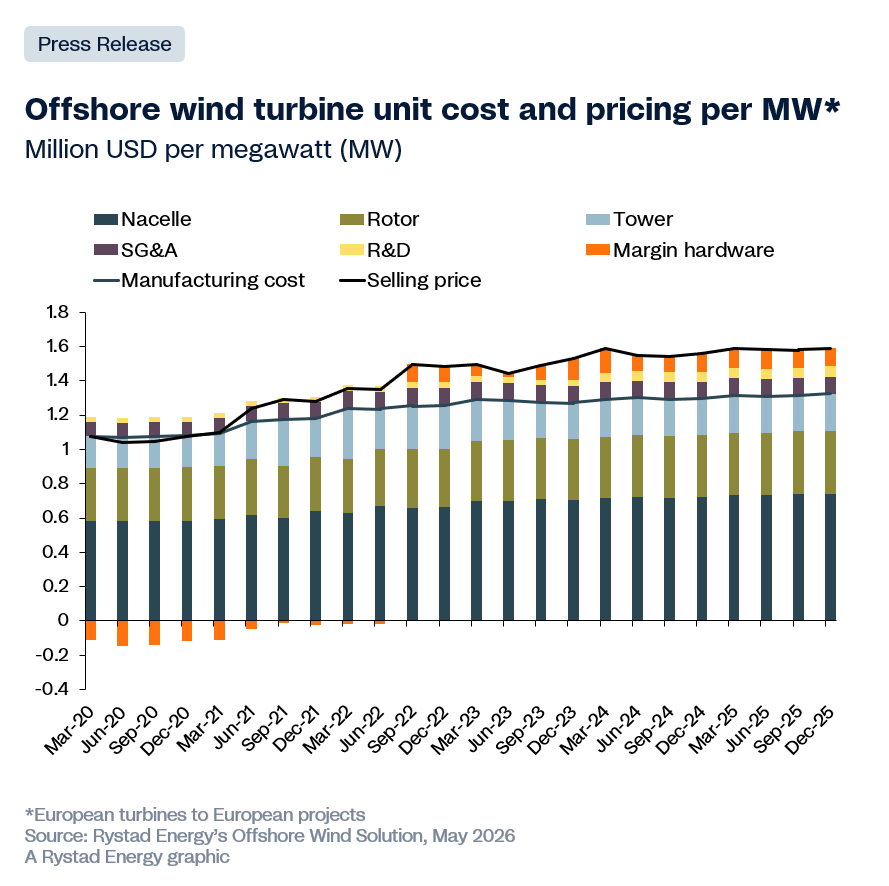
Europe's offshore wind expansion is running into a structural supply constraint where the turbine market is becoming increasingly concentrated. GE Vernova, Siemens Gamesa and Vestas have historically anchored Western offshore turbine supply, but with GE Vernova having paused new offshore wind orders following a series of technical and operational setbacks, Siemens Gamesa and Vestas now account for virtually all turbines available to European developers. Rystad Energy’s analysis of the offshore wind market outlines a sharp increase in per-megawatt (MW) costs, with turbine selling prices rising by between 40% and 45% since 2020, outpacing manufacturing cost increases of 20% to 25% over the same period.

This pricing pressure is most acute in the turbine's most complex components. The nacelle, which houses the generator, gearbox and power electronics that convert wind into electricity, sits at the center of current supply constraints, while similar pressures are emerging in blade manufacturing, driven by increasing turbine sizes, longer production cycles and the logistical demands of transporting and installing next-generation components.

The supply constraint is not evenly distributed across the turbine value chain. It is most pronounced in nacelles and blades, where supplier concentration is high and substitution is limited, while towers remain comparatively more flexible, with a broader supplier base and lower barriers to entry. As a result, the market is becoming increasingly constrained in its most critical components, shaping the overall balance between supply and demand.

Europe's offshore ambitions are real, and the pipeline reflects genuine political commitment. But the market has moved into structurally tight territory: high demand, limited supplier diversity and rising turbine complexity. That combination gives original equipment manufacturers (OEM) real pricing power and the ability to be selective about which projects get built. If Europe doesn't meaningfully expand Western manufacturing capacity or rethink how supply constraints are addressed in its auction frameworks, it won't deliver its post-2030 targets at the pace or cost the energy transition requires; especially in the current climate that has so much uncertainty as a result of the middle east conflict,

Sander Baksjoberget, Senior Analyst, Offshore WInd Research

Learn more with Rystad Energy’s Offshore Wind Solution.

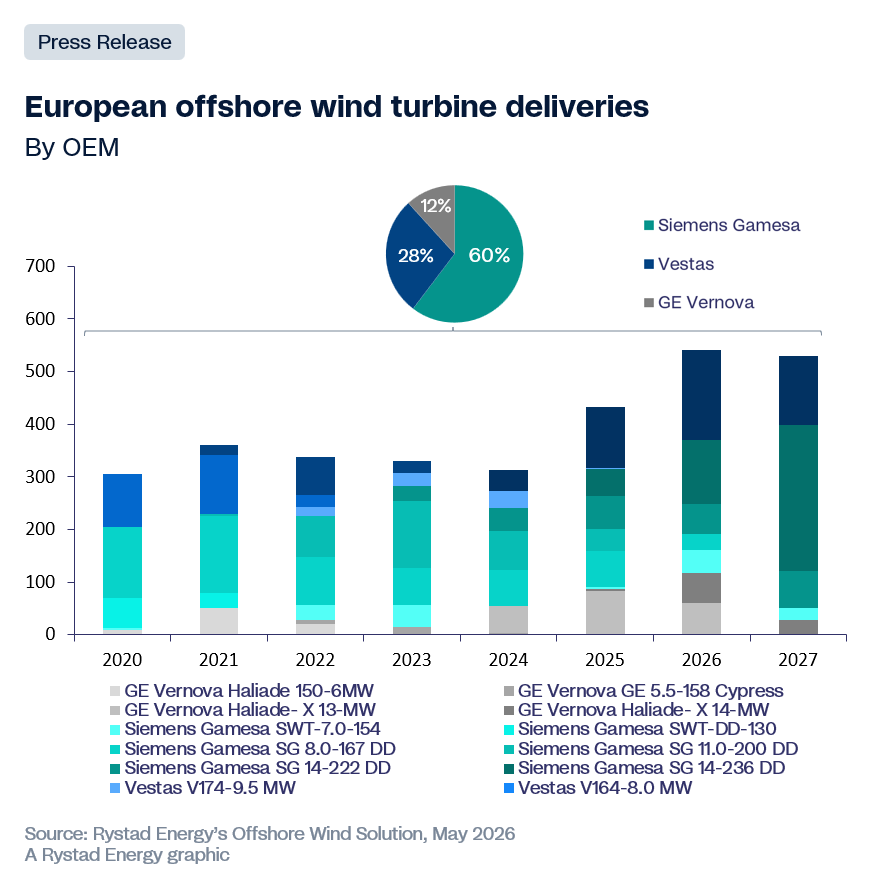
The mix of turbines being delivered between 2020 and 2027 shows how quickly the market has changed. Earlier years were dominated by smaller 9 to 10 MW turbines, while more recent deliveries are shifting toward the larger 14 to 15 MW class. Siemens Gamesa was first to move into bigger turbines, signing contracts for its 14-MW model ahead of Vestas before moving into the 15-MW class, while Vestas' V236-15-MW grew in popularity from 2024 onward. Siemens Gamesa still holds the larger overall share of deliveries, cementing its position as the market leader. This shift in turbine size is important context for understanding price increases: the turbines being built and installed today are significantly larger and more complex than those from five years ago, and that complexity is reflected in what OEMs can charge.

The 40% to 45% rise in turbine selling prices since 2020 cannot be explained by rising costs alone. In 2020 and 2021, turbines were sold under contracts that assumed relatively stable input costs, and when inflation hit hard through 2021 to 2023, manufacturers were locked into those agreements and absorbed the losses themselves. When those contracts expired from 2023 onward, prices reset sharply and the burden shifted to developers, who now face higher turbine prices and tighter contract terms. Manufacturers are recovering their margins on newer deals, although profitability across offshore divisions remains squeezed by the costs of ramping up and scaling a new generation of larger, more complex turbines.

The key shift in the offshore turbine market is not just the level of cost inflation, but how those costs are distributed across the value chain. Rystad Energy’s analysis models a scenario where a 30% increase in selected input categories would raise total manufacturing costs by around 17%, reflecting how different components are exposed to different cost drivers.

The ability of manufacturers to absorb such increase has also changed. Between 2021 and 2023, OEMs were largely locked into fixed price contracts and absorbed rising costs through margin compression. As those contacts have rolled off and supply conditions have tightened, newer agreements are being signed with less pressure on OEMs to take on that risk. While developers continue to anchor project economics, suppliers are now in a stronger position to pass a larger share of future cost increases through to developers via higher turbine prices and stricter contract terms.

By Rystad Energy