Friday, May 08, 2026

Narratives At War: Media Framing, Discourse, And Control In The Iran Conflict – Analysis

Secretary of War Pete Hegseth conducts a press briefing about Operation Epic Fury at the Pentagon, April 24, 2026. Photo Credit: Navy Petty Officer 1st Class Eric Brann


May 6, 2026 0 Comments
By Scott N. Romaniuk


In the early weeks of the 2026 US–Israel war on Iran, Secretary of Defense Pete Hegseth emerged as one of the most outspoken and controversial voices shaping the public narrative of the conflict. Beyond the typical role of a defense official, Hegseth has consistently sought not only to discursively shape battlefield developments but also to actively challenge and rewrite media headlines that do not align with his preferred portrayal. This behavior exposes a fundamental tension inherent in any democracy during wartime: the conflict between the government’s desired narrative and independent journalists’ reporting. In today’s deeply polarized media landscape, it raises more fundamental questions about who has the authority to shape a story and how much control anyone should have over it.

While frequently described in shorthand as a ‘US–Israel war with Iran’, the conflict more closely resembles a hybridized form of engagement combining elements of indirect warfare (proxy warfare, delegated warfare, externalized conflict, and networked conflict), limited confrontation, and undeclared hostilities. The absence of a formal declaration of war and the fluidity of operational boundaries complicate analytic categorization, making evident the extent to which narrative construction precedes and shapes the public’s understanding of the conflict.

Since the outset of the current hostilities, Hegseth has publicly admonished news outlets for what he considers ‘negative’ coverage of the war. He has criticized major networks by name, dismissing unfavorable reporting as ‘fake news’ and urging journalists to adopt a more ‘patriotic’ tone when covering US military operations. In press briefings, Hegseth has offered alternative headlines, suggesting more favorable ways to present developments that, in conventional reporting paradigms, would be conveyed with cautionary language.
Strategic Media Manipulation

Hegseth’s approach extends beyond rhetoric, suggesting an effort to limit critical scrutiny at a time when the human and material costs of the conflict are escalating, public opinion is becoming increasingly divided, and the media landscape is more fragmented. Journalists covering the Pentagon have described Hegseth’s tone as combative, noting that he frequently interrupts, ridicules, or dismisses reporters in real time, creating an environment in which critical questioning is implicitly discouraged. His remarks are not limited to casual frustration; they form part of a pattern in which the Pentagon’s civilian leadership appears to see independent reporting not as a safeguard on power but as an obstacle to be managed—or redirected.

To further situate this dynamic within media theory, Daniel C. Hallin’s concept of indexing is particularly instructive. Indexing theory suggests that media coverage tends to reflect the range of debate among political elites; when elite consensus narrows, so too does the spectrum of viewpoints presented in mainstream reporting. In this context, Hegseth’s efforts to delegitimize critical journalism and define acceptable narratives serve to compress the boundaries of permissible discourse. Portraying dissenting interpretations as unpatriotic or illegitimate contracts the ‘index’ itself, thereby limiting the diversity of perspectives available to the public.


This pattern of discourse also reflects the reasoning behind ‘manufacturing consent,’ as described by Noam Chomsky and Edward S. Herman. While this model emphasizes structural pressures—ownership, advertising, sourcing, and ideological filters—Hegseth’s approach functions as a more personal and overt attempt to shape media output. The convergence of structural constraints and direct rhetorical pressure underscores how narrative control operates both subtly and explicitly in wartime environments.

Hegseth’s opposition to the press coincides with broader Pentagon measures that have limited access for some journalists, which critics argue undermines journalistic integrity and the public’s right to information. A US federal judge recently ruled that these actions were unconstitutional. That ruling reaffirmed the importance of a diverse and independent press, especially during times of war.

The substance of Hegseth’s criticism matters as well. He has openly chided the media for highlighting the deaths of American servicemembers—depicting such reporting as politically motivated and unfairly damaging to the administration’s image. Comments about fallen soldiers, including dismissive interpretations of coverage, have prompted reactions from commentators and former military officials who argue that mourning and critical reporting are not inherently at odds.

Refusal and Confrontation: Media Under Pressure


Hegseth has made repeated comments on media framing and has frequently declined to answer questions from reporters, particularly those probing the human cost of the conflict or the strategic logic of US actions. At multiple press briefings, he has engaged in disputes with reporters, interrupted questions, and responded with sarcasm and dismissive remarks, recasting press questions as challenges to American patriotism rather than legitimate journalistic scrutiny.

Hegseth’s divisive rhetoric was on display during a recent briefing, where he promised the families of fallen service members that he would ‘finish this’ and honor their sacrifice. He drew a sharp distinction between the current war against Iran and earlier conflicts in Iraq and Afghanistan, while also contrasting the media with what he referred to as his true audience—the American people—who, in his words, ‘know better.’

By explicitly telling reporters that they were not his audience, Hegseth positioned himself as speaking directly to what he described as the ‘good’, ‘decent’, and ‘patriotic’ American public. This appears to reinforce a communicative strategy that bypasses journalistic mediation and appeals directly to a segmented audience.

Despite the prominence of media confrontation, the influence of Hegseth’s messaging also lies in the specific linguistic choices he uses. Recurrent phrases such as ‘patriotic’, ‘fake news’, and ‘bad guys’ function as more than rhetorical flourishes; they constitute a structured discursive strategy. Drawing on Erving Goffman’s framing theory and the critical discourse analysis of Norman Fairclough, these expressions can be understood as mechanisms that shape interpretive boundaries.

First, they produce moral binarization, dividing the public sphere into ‘good’ Americans and suspect critics, thereby delegitimizing dissent. Second, they rely on euphemistic abstraction, with terms like ‘bad guys’ obscuring the complexity of actors and the human consequences of military action. Third, phrases such as ‘finish this’ introduce a teleological framing, implying inevitability, moral clarity, and a predetermined endpoint that discourages critical engagement with strategy or cost. Collectively, these linguistic patterns reproduce a simplified moral universe that privileges alignment over analytical engagement.

Public and Online Reactions: The Daily Show Segment

The public response has extended past traditional journalism. A segment on The Daily Show highlights Hegseth’s aggressive ‘rewriting of history’ approach, emphasizing his insistence that media portray the Iran war only in ways he deems acceptable. Online, viewers responded with biting commentary, likening the effort to Orwellian oversight and invoking imagery such as the ‘Ministry of Truth.’

Extending the scope from immediate reactions, the online response illustrates the dynamics of memetic warfare and digital virality. References to dystopian control function as shareable cultural shorthand, rapidly disseminated across platforms. Such ridicule can undermine authority by exposing perceived excesses of narrative control; yet it can also unintentionally amplify the original message by extending its reach into new audiences.

The information environment is not purely top-down. It is co-produced by state actors, media institutions, and digitally networked publics who reinterpret, parody, and redistribute official messaging in real time. Attempts at control can generate their own forms of resistance and amplification simultaneously, creating a contested informational environment in which official messaging is rapidly recast, challenged, and redistributed.
Governments and Media: A Historical Pattern

Hegseth’s approach fits within a wider historical pattern: governments often manipulate media narratives to align public perception with political or strategic objectives. From wartime propaganda campaigns to selective press briefings and censorship, state actors have long recognized that controlling information can influence morale, international opinions, and domestic support.

Like many governments, the US has a long history of shaping media narratives during conflict—from the Committee on Public Information during World War I to the Pentagon Papers during Vietnam and embedded journalism during the Iraq War. From a sociological perspective, these practices exemplify what Pierre Bourdieu described as ‘symbolic power,’ in which language and discourse shape social reality without overt coercion. Globally, similar strategies can be observed, reinforcing the notion that the tension between state power and independent journalism is not exclusive to the US.

Abstracting War: Money, Strategy, and the Human Cost


Another telling aspect of Hegseth’s public framing is the way he abstracts the human dimension of conflict. In a recent briefing, he remarked that ‘it takes money to kill bad guys’, compressing complex strategic, ethical, and human considerations into a stark transactional logic. The phrase ‘bad guys’ obscures identities and lived realities, while the focus on financial input foregrounds efficiency over consequence. This language illustrates how discourse can simultaneously simplify, legitimize, and depersonalize war realities.
Counterargument: Strategic Communication or Propaganda?

It is important, however, to acknowledge a countervailing perspective. Governments engaged in active conflict face legitimate incentives to shape public communication: maintaining morale, preventing panic, and protecting operational security are longstanding considerations in wartime governance. From this vantage point, efforts to encourage supportive coverage or to challenge reporting perceived as harmful are interpretable as strategic communication as opposed to manipulation.

Yet this raises a critical question: where is the line between strategic communication and propaganda? When efforts to sustain morale evolve into the delegitimization of scrutiny, the balance shifts from managing information to constraining it. It is precisely this boundary—often contested—that defines the tension between democratic accountability and wartime messaging.

Shifting Media Norms and Democratic Consequences

What makes this dynamic particularly significant is that it reflects a broader shift in how political elites conceptualize media narratives. Instead of being viewed as independent observers, news outlets are increasingly treated as battlegrounds within the informational space where political fortunes are contested. The implications are deeply consequential. When senior officials openly seek ‘patriotic’ coverage, they obscure the distinction between information and propaganda. In a conflict with unclear objectives and duration, the narratives that gain traction are likely to shape public opinion, policy choices, and the historical record.

Global Perceptions and the Stakes of Narrative Control

There is also an international dimension. Historically, the US has declared itself a champion of press freedom, but it risks undermining its credibility when its own officials appear hostile to independent reporting. When democratic governments adopt tactics associated with narrative control, such as censorship or disinformation campaigns, they blur distinctions that have long underpinned claims of liberal democratic legitimacy.

The implications of this shift transcend immediate media dynamics. This concerns not only the discursive shaping of a single conflict but also the integrity of epistemic trust, the resilience of democratic accountability, and the boundaries of civil–military relations in a polarized age. When political leaders position critical journalism as adversarial instead of essential, they risk eroding the informational foundations upon which democratic decision-making depends.

As the war continues to evolve, the struggle over narrative may shape not only public perception but also policy trajectories and historical memory. The contest over headlines is not peripheral to the war—it appears to be one of its central battlegrounds.


This article was published at Geopolitical Monitor.com

Three dead after Indonesia’s Mount Dukono erupts

Three dead after Indonesia’s Mount Dukono erupts
/ Unsplash - Gary Saldana
By IntelliNews May 8, 2026

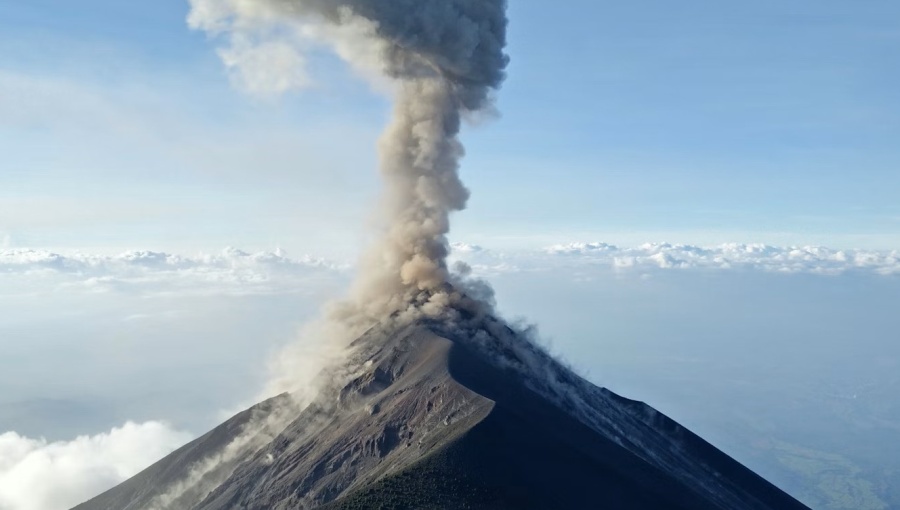
Three hikers have died after Indonesia’s Mount Dukono erupted on Friday morning, May 8. The volcano sent a vast ash plume 10km into the sky and triggered a major rescue operation.

Local police said all surviving members of a group of 20 hikers who had gone missing on the volcano had now been found, however. According to the BBC, 15 people were evacuated from the mountain, while two porters remained behind to assist rescuers in attempting to recover the bodies of the deceased.

The group included nine Singaporeans, according to officials. Authorities said the hikers had entered the mountain region despite a climbing ban that had been in force for roughly two weeks as a result of heightened volcanic activity.

Indonesia’s Volcanological Survey said the eruption occurred at 07:41 local time on May 8 and that the eruption produced a towering ash column visible from surrounding areas and continued to eject ash and volcanic rocks from the crater throughout the day.

Rescue teams positioned at shelters about 2km from the summit said conditions near the crater remained extremely dangerous. Local rescuers identified the positions of two victims near the summit but had not yet been able to retrieve the bodies because of ongoing eruptions and falling debris. The location of the third victim has not yet been confirmed.


BALKAN BLOG: Wave of Trump-linked Balkan investments sparks transparency concerns

BALKAN BLOG: Wave of Trump-linked Balkan investments sparks transparency concerns
/ IntelliNews
By Clare Nuttall in Glasgow April 30, 2026

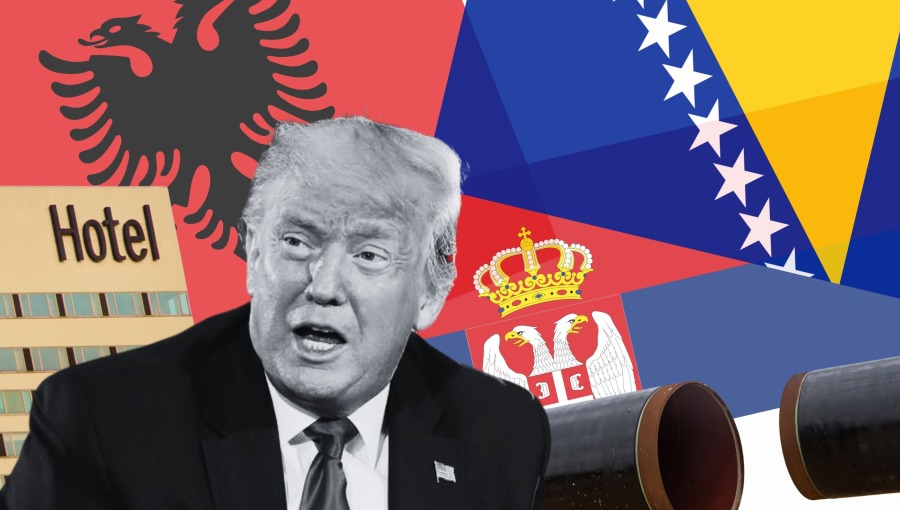
A wave of multi-billion-dollar agreements between the United States and countries in the Western Balkans is reshaping the region’s energy and investment landscape, combining strategic geopolitical goals with an expanding footprint by companies linked to US President Donald Trump and his associates.

The latest deals, announced around the Three Seas Initiative summit in Dubrovnik, span gas infrastructure, liquefied natural gas (LNG) supply, and energy hubs, as well as emerging sectors such as artificial intelligence and data infrastructure. They build on earlier, more controversial real estate ventures spearheaded by Trump’s son-in-law Jared Kushner’s Affinity Partners, some of which have since stalled amid legal and political challenges.

US officials frame the new agreements as part of a broader strategy to deepen ties with Southeast Europe and reduce dependence on Russian energy. Critics, however, warn of governance risks, environmental consequences and opaque deal-making processes.

“President Trump is opening a new era of cooperation with southern, and central and eastern Europe,” US Energy Secretary Chris Wright said at the Dubrovnik forum.

Southern Interconnector deal

One of the agreements signed at the forum concerns the Southern Interconnector, a long-delayed gas pipeline linking Bosnia & Herzegovina with Croatia. The project is designed to bring US LNG from the terminal on the Croatian island of Krk into Bosnia, reducing the country’s reliance on Russian supplies routed through Serbia.

The agreement was signed on April 28 in Dubrovnik by the Chair of Bosnia’s Council of Ministers Borjana Krišto and Croatian Prime Minister Andrej Plenković. The pipeline will run from Split and Zagvozd in Croatia through several Bosnian cities, with branches reaching other major urban centres.

A statement from the Council of Ministers said the deal would ensure “a secure and stable energy supply and improving conditions,” enabling “the diversification of natural gas routes and sources” and supporting “the energy independence of Bosnia and Herzegovina”. 

Krišto described the agreement as “a major step forward,” adding that she was “Grateful to our US partners.”

The project is expected to be financed and led by US-based AAFS Infrastructure and Energy LLC, run by Trump-linked figures including Jesse Binnall and Joseph Flynn, the brother of former national security adviser Michael Flynn. AAFS has said it plans to invest around €1.5bn.

The US has previously signalled strong support for the project, with its embassy in Sarajevo saying that “American private-sector investors can ensure that construction of the Southern Interconnection will move quickly and will help secure affordable and reliable US liquefied natural gas.”

Concerns over transparency and costs

Despite official backing, the pipeline has drawn criticism from anti-corruption watchdogs and energy experts.

Even the European Union has warned Bosnia that plans to award the gas pipeline contract to a US-linked company without a tender could jeopardise its bid to join the bloc, The Guardian reported in April, quoting a letter from EU ambassador to Sarajevo Luigi Soreca.

Transparency International Bosnia and Herzegovina warned previously that proposed legal amendments tied to the project “eliminates any possibility of competition” and could create a “dangerous precedent” by directly designating a private investor.

Pippa Gallop of Bankwatch said in a statement emailed to IntelliNews the framework would bypass the state-owned transmission company. “We’ve analysed the proposed amendments, which directly appoint this Trump-linked, newly-formed company AAFS as the investor instead of [Bosnian] Federation-owned BH Gas — with no tender,” she said.

She added that the arrangements could breach concession laws and rely on “opaque negotiations between the Federation government and AAFS, raising red flags for corruption and excessive transfer of financial risks to the Federation”. 

“One way or another, the public is bound to end up paying, either via their bills or the Federal budget,” she said.

Environmental groups have also raised concerns that new gas infrastructure could lock the region into fossil fuel dependence.

“Governments are still planning new gas pipelines and power plants despite repeated energy crises,” Gallop said in a joint statement by civil society groups. Such investments, she warned, risk becoming stranded assets or requiring heavy subsidies.

She also questioned the scale of the project, noting that gas currently accounts for less than 3% of Bosnia’s energy supply. “The pipeline would anyway come too late to replace Russian gas, as we expect it would take up to a decade to complete,” she said.

Also this week, Albania signed agreements with US-linked companies aimed at transforming it into a regional energy hub. Under a 20-year deal, AKTOR LNG USA will supply 1bn cubic metres of LNG annually from 2030. The agreement, signed in Tirana in the presence of Prime Minister Edi Rama, is valued at around $6bn.

Separately, a  transatlantic investment consortium announced plans to build a €50bn artificial intelligence (AI)-focused data centre and innovation campus in Croatia, in what it described as the largest investment in the country’s history and one of the biggest private US investments in Europe.

Trump-linked projects face backlash

The latest wave of energy deals follows earlier high-profile investments linked to Kushner’s Affinity Partners, which have proven contentious.

In Serbia, a planned $500mn redevelopment of the former Yugoslav army General Staff complex in Belgrade — potentially Europe’s first Trump-branded hotel — has been derailed by legal challenges and public protests.

The General Staff buildings remain a sensitive symbol in Serbia, widely seen as a memorial to victims of Nato’s bombing, making their demolition and redevelopment by an American company unacceptable to many Serbs.

On top of that, the project became embroiled in a corruption investigation, with Culture Minister Nikola Selakovic and others accused of falsifying documents to remove heritage protection from the site. Selakovic and his co-defendants went on trial in February. 

President Aleksandar Vučić said the collapse of the deal cost Serbia dearly. “Unfortunately for the state and the people, we are big losers. We lost an exceptional investment of at least €750mn,” he said.

Kushner also faces scrutiny in Albania over plans for a $1.4bn luxury resort on Sazan Island, a former military zone.

Kushner’s investment plans on Sazan have been promoted by the Albanian government as part of efforts to attract high-end tourism and foreign capital, but the project has faced growing domestic and international criticism from environmental groups, who argue it undermines Albania’s commitments as an EU candidate country, particularly in the area of environmental protection and biodiversity conservation.

In a letter sent on January 23 to Prime Minister Edi Rama and Environment Minister Sofjan Jaupaj, the groups called for “the immediate suspension of any executive or parliamentary decision related to the advancement of this project”, which is linked to a company owned by Kushner.

Investment ambitions

In Bosnia’s Serb-majority Republika Srpska, leader Milorad Dodik is actively courting US investment, leveraging ties with Trump and his network.

“I trust Trump as a person who can change narratives that were disastrous for Serbs and Republika Srpska,” Dodik said in a recent interview with Bloomberg. “The new administration has a new framework. They want to preserve peace and to do business here.”

Dodik said talks were underway with US partners, including Bechtel, on infrastructure projects such as highways and hydroelectric plants.

Dodik’s outreach comes shortly after US sanctions on him, imposed under the Biden administration, were lifted. The Bosnian Serb politician is an outspoken fan of both US President Donald Trump and Russian President Vladimir Putin.

After the sanctions were lifted, Dodik visited Washington in February together with fellow Bosnian Serb leaders, a trip he called an “undeniable success” after meeting with several congressmen and senators.

At the beginning of April, the US president’s son Donald Trump Jr travelled to Banja Luka, the administrative centre of the Serb-run region, as a guest of Dodik’s son Igor Dodik, meeting with politicans and business figures. The trip was widely viewed as a show of support for the former Republika Srpska president. 

Dodik has for years challenged Bosnia’s post-war constitutional order and has repeatedly threatened to withdraw Republika Srpska from key state institutions, raising fears among Western governments of renewed instability in the Balkans. He remains under UK sanctions, and several US senators have called for sanctions on him to be re-imposed. 

Geographic shift 

For Washington, the deals represent both economic opportunity and geopolitical leverage in a region where Russian and, increasingly, Chinese influence has been significant.

However, critics say the combination of large-scale investment, political ties and weak governance structures raises concerns about transparency, public accountability and long-term sustainability.

Transparency International has warned that opaque decision-making around major projects is a growing vulnerability across the Western Balkans, increasing the risk of corruption and misuse of public funds.

Similar concerns have been raised in the past about major investments by firms from other parts of the world, notably China and the United Arab Emirates (UAE). 

Small states and transition economies are particularly vulnerable to ‘corrosive capital', a concept pioneered by think-tank the Center for International Private Enterprise (CIPE) and defined as international financing to countries that lacks transparency, accountability and market orientation. The former Yugoslav republics are both small and in transition and as such have been the target of what analysts from CIPE and its partners say are un-transparent investments with a geopolitical agenda. 

In an interview with IntelliNews in 2021, Eric Hontz, who leads CIPE's work on corrosive capital, detailed projects such as the first section of the Bar-Boljare highway across Montenegro; Podgorica had struggled for a long time to find partners for the project to replace an unsafe round through mountainous territory until China stepped in in 2014. However, the government later struggled to replay the loan to find construction, approaching the EU for help. 

Similarly, CIPE noted questions surround the sale of the massive mining and smelting complex RTB Bor to the Chinese company Zijin, which was followed just days later by the same company’s purchase of the nearby deposits of copper and gold at Cukaru Peri. 

More recently, in 2025, a study by the Carnegie Europe think-tank warned the European Union faces a mounting challenge in the Western Balkans as a surge of foreign investment, much of it from the United Arab Emirates (UAE), tests the bloc’s ability to promote transparent governance.

Detailed foreign-funded real estate developments including  marinas and coastal resorts, arguing that the terms under which these projects proceed risk entrenching weak institutions rather than preparing countries for EU membership. 

The think-tank singled out a planned €35bn luxury tourism development in the coastal town of Ulcinj promoted by UAE developer Eagle Hills which, it said, was exempted from established procurement requirements. Civil society groups warned the deal enabled land allocation “without the need for public bidding”, while environmental groups raised alarms over potential damage to Velika Plaža and the Buna/Bojana Delta. The project was later suspended. 

The examples cited by first CIPE and later Carnegie concern companies from China and the Middle East. However similar concerns, relating to transparency and environmental impact, are now being raised about US projects. 


Seven out of ten Romanians back unification with Moldova

Seven out of ten Romanians back unification with Moldova
/ bne IntelliNews
By Iulian Ernst in Bucharest May 8, 2026

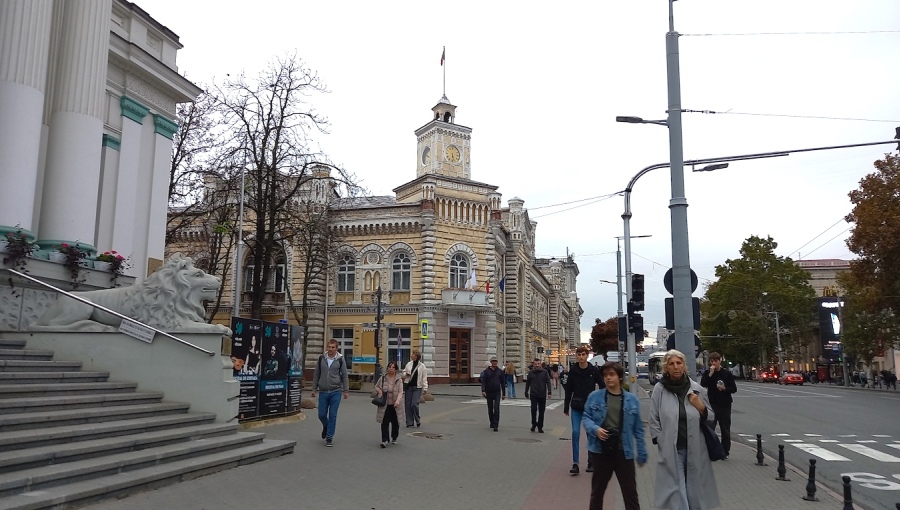
Seven out of ten Romanians support unification with Moldova, according to an INSCOP poll cited by Mediafax, with 71.9% of respondents saying they would vote in favour of a union and 21.4% against it. Another 2.1% said they were undecided, while 3.2% would not vote, and 1.4% did not answer.

The survey also showed that 8.4% of respondents believe unification could take place within the next three years, 13.3% within five years and 29.3% within the next decade or later. At the same time, 34.7% said they believe a union will never happen.

Support for unification is strongest among men aged 30-44 from Bucharest, respondents with higher education and voters of the National Liberal Party (PNL) and reformist Save Romania Union (USR). By contrast, opposition is more visible among women aged 45-59 employed in the public sector and among voters for the far-right Alliance for the Union of Romanians (AUR), many of whom believe unification will never materialise. Interestingly, AUR leader George Simion has been an activist for the unification with Molodva, before setting up AUR.

According to the poll, 67.6% of respondents consider union with Moldova a “historical duty”. Only 25.5% believe Moldovans are a separate people with a distinct language and destiny.

The issue has returned to public debate in recent months amid regional tensions and Moldova’s efforts to advance towards the European Union. Moldovan President Maia Sandu said in January she would vote “yes” in a potential referendum on unification with Romania, citing security concerns linked to Russia.

Romanian President Nicușor Dan recently reiterated that Bucharest’s official position on a possible union remains positive.

Separately, the Romanian Academic Council (CAR), established on March 26 by institutions including the Romanian Academy and the Academy of Sciences of Moldova, proposed on May 8 the launch of a broad process of analysis regarding accelerated rapprochement between the two states.

The council stated that “the time has come for the rapprochement between Romania and the Republic of Moldova to be assumed not only as an affective and identity aspiration, but also as an institutional construction project, developed with rigour, realism and responsibility.”


Bosnia steel shutdown hits railways, port and regional supply chains

Bosnia steel shutdown hits railways, port and regional supply chains
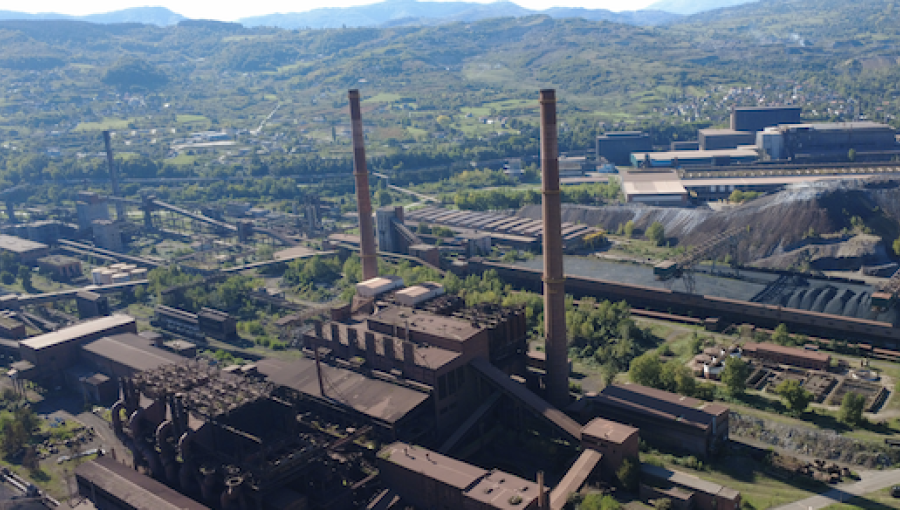
Nova Željezara Zenica completed the suspension of its integrated production process in April. / Nova Željezara Zenica
By Clare Nuttall in Glasgow May 7, 2026

The suspension of steel production at Bosnia’s flagship plant in Zenica is sending shockwaves across the country’s industrial base and into neighbouring Croatia, disrupting rail freight, port operations and regional supply chains in what industry officials warn could become one of the most significant economic ruptures in the Western Balkans in recent years.

Railway operators in both entities of Bosnia & Herzegovina have reported an immediate and severe hit to revenues following the shutdown of core facilities linked to the steel value chain, including the Zenica steelworks, the Lukavac coke plant and the Ljubija iron ore mine near Prijedor. The fallout is already reverberating through logistics networks that for decades depended on the steady flow of raw materials and finished steel products.

The Railways of the Federation of Bosnia and Herzegovina warned before the shutdown that the consequences could be existential. “The cessation of operations at the Steelworks in Zenica would cause very harmful consequences for the Railways of FBiH,” the company said in an appeal to government institutions posted on its website, noting that the loss of the steelworks would put “the business and existence of 2,500 workers… in question.”

The company stressed the scale of dependence: “The survival of Nova Željezara Zenica is also crucial for the survival of Željeznica FBiH, because we used to generate 30% of the total turnover in the transport of goods for this company.”

The ripple effects extend beyond Bosnia’s borders. Croatian port operator Luka Ploče, a key logistics hub for bulk cargo linked to the steel industry, said it expects a decline in volumes following the decision by its Bosnian partner to suspend production. In a regulatory filing, the company said Nova Željezara Zenica — “one of the company's significant business partners” — had halted integral steel production after deeming it economically unviable.

“The company is currently conducting an analysis of the potential impact of the decision on the volume of business cooperation, delivery dynamics and revenue generation in the coming periods,” Luka Ploče said, warning that “the above changes could have an impact on revenues in subsequent reporting periods.” It added that it expects “a reduction in turnover related to the current supply model,” while seeking to mitigate risks by diversifying customers and adjusting business plans.

On April 23, Nova Željezara Zenica completed the suspension of its integrated production process, bringing to an end a production cycle that has defined the city and much of Bosnia’s industrial identity for generations.

“The hardest day for our team: Integral steel production at Nova Željezara Zenica suspended,” the company said in a statement. “Thus ending a decades-long production cycle that was the foundation of the industrial development of Zenica and the wider region.”

Management said the decision was unavoidable after months of mounting losses and failed efforts to secure state support. “In conditions of pronounced uncompetitiveness in the market, where imported steel is significantly cheaper than domestic production, the company could no longer incur additional financial losses,” it said. “The continuation of integrated production was economically unsustainable, and its suspension had become inevitable.”

The company placed particular emphasis on what it described as a failure by authorities to introduce protective measures. “The request for protection of domestic steel production has been underway for six months… Despite this, the Council of Ministers of Bosnia and Herzegovina rejected the proposed regulation on two occasions in March this year, after which concrete and implementable institutional solutions were lacking.”

General manager Ahmed Hamzić was blunt in his criticism. “I still cannot believe that the state did not protect the domestic producer in time and allowed the complete economic system of Bosnia and Herzegovina to be endangered,” he said. “It is unfortunate that the state failed in the most important step.”

Hamzić said the company had even offered to increase state ownership to secure support. “We expressed our readiness to offer an additional ownership share… however, to date, we have not received any official statement or proposal,” he said, adding that last-minute proposals presented through the media came “without consultation as the majority owners of the company.”

Despite the halt, the company insists the plant is not permanently closed. “The suspension of integral production does not mean the closure of the factory,” it said, outlining plans to develop a new business model that could involve restructuring and job cuts.

The shutdown comes amid a broader collapse of Bosnia’s traditional heavy industry base. The RMU Zenica coal mine, which supplied the steelworks, is itself undergoing closure after 144 years of operation due to “extreme financial losses, low productivity, and obsolete, dangerous technology,” affecting hundreds of workers.

At its peak, Bosnia’s metal industry employed around 225,000 workers, according to trade union data, forming the backbone of the country’s manufacturing and export capacity.

The symbolic and economic weight of the Zenica steelworks is difficult to overstate. Founded in the late 19th century, the plant has been a cornerstone of industrial development since 1892, surviving world wars, the breakup of Yugoslavia and the devastation of the 1992-95 conflict.

“There has not yet been a child born in Zenica who has not been fed, directly or indirectly, with the bread of the Ironworks,” union representatives said during May Day protests in the city, according to a statement from the Syndicate of Metalworkers of the Federation of Bosnia and Herzegovina (SMFBiH). “Without the Ironworks there is no industry, without industry there is no state of Bosnia and Herzegovina.”

The scale of public mobilisation reflects the depth of concern. Around 3,000 people took part in May 1 protests organised by the Metalworkers’ Union, bringing together workers, union representatives and citizens from across the country in a show of solidarity.

“We are here to support the workers and the union of Nova Željezara Zenica… Their fight is our fight, we are with them until the end,” the union said in a statement. “Shutting down steel production and the Zenica Steel Plant and losing thousands of jobs is not and will never be an option for us.”

Union leaders framed the crisis as part of a broader struggle for industrial survival and workers’ rights. “There is no house, building, factory, hospital, school… that does not have at least a kilo of Zenica steel built into it,” they said. “And these people have built a part of themselves and their lives into that steel.”

The protests also highlighted the risks of deindustrialisation. “All those who think that one can live only from shopping malls or that budgets fill themselves are mistaken,” the union said, warning that multiple sectors—from energy and construction to transport—are intertwined with the fate of the steelworks.

Railway operators echoed those concerns, describing the situation as a systemic threat. In a joint appeal, industry representatives warned that “11,000 jobs would be directly threatened by the cessation of production… and several dozen indirectly,” urging authorities to act.

“Any postponement and prolongation of the adoption of the Decision on the protection of domestic steel production directly leads to extremely negative consequences for the economy and the railway sector,” acting general director of Republika Srpska Railways Dragan Zelenković said, according to a statement from the company. “Future decisions… are now the only way to survival and sustainability.”

The immediate cause of the shutdown — competition from cheaper imported steel — reflects broader global pressures on energy-intensive industries in Europe, where high input costs and environmental regulations have eroded competitiveness.

But in Bosnia’s case, industry leaders argue that policy failure has compounded these challenges. The absence of protective measures, delays in decision-making and lack of coordinated industrial strategy have left companies exposed, they say.

As supply chains adjust, the long-term implications remain uncertain. Luka Ploče said the extent of the impact will depend on “the further reorganisation of the company's business and the establishment of possible alternative production or logistics solutions.” Rail operators are scrambling to find replacement cargo, but acknowledge that volumes are unlikely to recover quickly.

For Zenica, the shutdown represents not just an economic turning point but a profound social rupture. Generations of workers have defined their lives around the steelworks, often under difficult and dangerous conditions.

“Working at the Ironworks has never been easy or safe,” union representatives said, noting that “seven steelworkers have lost their lives at work since 2007” and many more have suffered illness or injury.

Yet even in the face of closure, calls for revival persist. The union has backed proposals for state intervention and potential restructuring, arguing that the plant could still become “the driver of the reindustrialisation of the entire Federation of BiH”. 

Whether such plans materialise will depend on political will and economic realities. For now, the furnaces in Zenica have gone cold, and with them a central pillar of Bosnia’s industrial economy—leaving railways, ports and thousands of workers grappling with the fallout.

The Iran war exposes fiscal fragility around the world

The Iran war exposes fiscal fragility around the world
A series of disasters, wars and crises have exhausted the budgets of most of the worlds leading economies where fiscal space continues to become tighter. / bne IntelliNews
By Ben Aris in Berlin May 8, 2026

The Iran war has arrived at the worst possible fiscal moment for most of the world's major economies. Governments that spent heavily through Covid, ramped up defence budgets in response to Russia's invasion of Ukraine, and then borrowed again to cushion the energy shock of 2022 are now being asked to absorb a second major energy shock with balance sheets that have never fully recovered from the first.

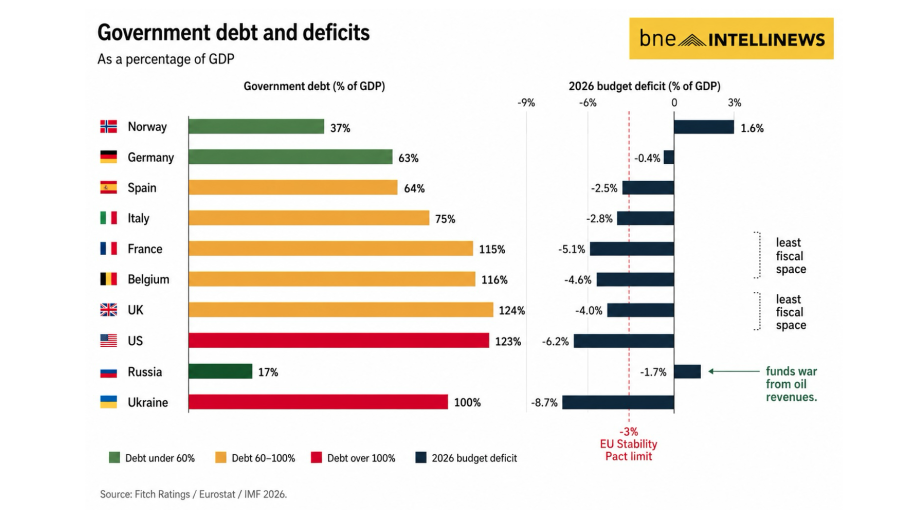
The verdict from a recent Fitch Ratings note is blunt: fiscal space across most of the developed world is limited, and in several major economies it is effectively exhausted.

Ireland, Greece, Portugal, the Netherlands and Scandinavia: The strongest fiscal positions within the EU belong to a counterintuitive group — the countries that were most brutally forced into austerity during the sovereign debt crisis of the early 2010s and have since maintained disciplined fiscal management through successive shocks. They have, in theory, the most room to respond to the current crisis, though Fitch notes that even these governments face pressure to avoid sharp deterioration in their debt and deficit positions. The lesson of a decade of consolidation is a floor of credibility that their peers have not preserved.

Germany: Additional outlays on defence and infrastructure investment will continue under the Merz government's historic €500bn spending programme, financed through the newly suspended debt brake. Fitch notes that further measures would add pressure to the deficit but would likely be offset by savings elsewhere, since extraordinary spending falls under fiscal rules that require compensation. The challenge for Germany is less about financing and more about growth: how the latest energy shock affects an already stagnant industrial economy dependent on cheap gas is the central question. Two consecutive years of GDP contraction before the Iran war have left Berlin with less economic cushion than its fiscal position implies, says Fitch.

Spain: Has been at the forefront of household and business support measures, announcing programmes equivalent to 0.5% of GDP. Fitch places Spain in the category of countries that have run deficits of around 3% in recent years — on the margin of the EU's fiscal rules, but with enough credibility and growth momentum to absorb modest additional measures. Spain's heavy investment in renewables and its relatively lower industrial gas intensity also give it more structural insulation from the energy shock than northern European peers.

Italy: Deficits have been moderating and are approaching 3% of GDP, but unlike Germany or Spain, Italy's combination of high debt and elevated financing costs severely constrains its ability to provide fiscal support. Fitch notes that the Meloni government's strong commitment to fiscal prudence reinforces this constraint rather than fighting it. The main vulnerability is economic: Italy's industrial sector is heavily gas-dependent, and the inflationary impact of the energy shock on an already low-growth economy is the primary credit concern. Targeted measures with offsetting mechanisms are the most likely government response.

Belgium, France and the UK: These three governments share the most exposed fiscal position in the developed world outside of Japan. All three carry deficits above the EU's 3% limit — France at 5.1%, Belgium at 5.2% — and all three carry government debt above 100% of GDP. Fitch identifies them as the governments with the least room to finance additional support measures, with rising financial pressures acting as an important limiting factor particularly in the UK, where gilt market sensitivity to fiscal credibility has been demonstrated painfully in recent years. Modest support programmes with likely offsetting measures are the expected response — not the open-ended transfers that the scale of the energy shock might otherwise justify.

The United States: Washington faces its own version of this fiscal constraint, albeit from a structurally different position. Fitch maintains a Stable Outlook on the United States' AA+ rating and notes that the Iran war alone is unlikely to put pressure on the sovereign, given limited expected downside for the economy from higher defence expenditure in isolation. But the compounding effect of the conflict with an already stretched fiscal picture is significant. The Pentagon has called for an additional $200bn in military funding this year through a supplemental budget request; the administration is seeking nearly $440bn in additional defence spending in the fiscal year 2027 budget, partly offset by cuts to other discretionary spending. Fitch has incorporated only $50bn of each request into its current projections — a signal of significant upside fiscal risk if Congress approves the full amounts. Under an adverse war scenario in which oil prices remain elevated and equity markets deteriorate, Fitch estimates US growth would be reduced by 1.2 percentage points by the fourth quarter of 2026, core CPI inflation could run 1.4 percentage points above the baseline, and the general government deficit could rise well above 8% of GDP — with the debt-to-GDP ratio rising well above Fitch's current end-2027 forecast of 122%.

Asia: Asian emerging markets are collectively the most exposed to a prolonged Hormuz disruption, given their structural dependence on Middle Eastern energy. Fitch identifies India, the Maldives, Pakistan, the Philippines and Thailand as large net fossil fuel importers facing the most direct terms-of-trade deterioration. China is less immediately vulnerable due to its large energy reserves, though it is far from immune. The credit risk channels beyond energy include exchange-rate depreciation, tighter financing conditions and shifts in remittances — all of which compound the direct fiscal impact of higher import bills. The median government debt-to-GDP ratio for Asia-Pacific has risen to 50.5% in 2026 from 37.8% in 2019, and more than 70% of sovereigns in the region still carry higher fiscal deficits than before Covid. Governments have responded unevenly: Pakistan, the Philippines and Thailand have raised fuel prices, sometimes combined with targeted household relief; Indonesia and India have kept prices broadly stable, absorbing the fiscal cost directly.

Malaysia and Mongolia: Stand apart as net energy exporters and are in a stronger structural position than regional peers. But Fitch cautions that even Malaysia — which has recently reformed fuel subsidies — still faces spending pressures from high oil prices and cannot be expected to benefit materially from the conflict at the sovereign credit level.

The common thread running through Fitch's analysis across all three regions is a world in which the fiscal resources to absorb major external shocks have been steadily depleted over five years of consecutive crises — pandemic, energy shock, Ukraine war, now Iran — without a corresponding period of rebuilding. The governments that maintained fiscal prudence through that sequence have options. Those that did not are now discovering the limits of what debt markets will finance.


Argentina's Milei sees disapproval rise to 63% on inflation and Adorni scandal

Argentina's Milei sees disapproval rise to 63% on inflation and Adorni scandal
Javier Milei / World Bank media: CC
By bne IntelliNews May 8, 2026

Argentine President Javier Milei is facing the highest disapproval ratings of his term, with multiple polls placing public rejection of his government between 61% and 65% as inflation rebounds, domestic activity slows and corruption allegations engulf his cabinet chief, Infobae and La Política Online reported.

The Atlas Intel-Bloomberg Latam Pulse survey for May, published on May 4, put disapproval at 63% against approval of 35.5%, the worst reading since Milei took office in December 2023. A separate poll by Zuban Córdoba conducted between April 25 and May 1, with 2,000 respondents, recorded 65% disapproval.

The deterioration has been sharpest among lower-income households, where the Atlas Intel survey found disapproval reached 82.4% among those earning less than ARS630,000 ($560) a month, La Política Online reported on May 7, citing the consultancy. Disapproval among women stood at 74.6%, with only 25.4% expressing a favourable view of the president.

Atlas Intel found 50.3% of respondents named corruption as the country's main problem, ahead of unemployment at 38.5%, inflation at 35.9% and the general economic situation at 32.6%. Some 51% considered there was a high risk of fraud or corruption schemes in the country, the consultancy said.

Inflation has rebounded sharply after a year of disinflation gains. Atlas Intel's inflation index fell from 68.2 in December 2024 to 22.1 in August 2025 but reversed course from September, reaching 31.7 in April 2026.

The Consumer Confidence Index in Argentina stood at -32, the lowest among countries surveyed by Atlas Intel, with the Current Situation sub-index at -48.6 and the Expectations sub-index at -19.5.

Some 27.1% of Argentines said their income was insufficient and they were taking on debt, while 26.6% said they could only just cover monthly expenses, the consultancy said.

Milei has acknowledged the slide. "The social discontent is logical, I didn't look the other way when the 3.4 [inflation reading] arrived and it bothered me too, but we're working to keep bringing inflation down," Milei said in a televised interview on May 7.

The president defended his record on jobs, claiming 130,000 positions had been created and rejecting suggestions that unemployment was rising. Milei said he did not govern based on his image, MendoVoz reported.

The so-called Adorni scandal, involving cabinet chief Manuel Adorni and unexplained growth in his personal assets over two years in government, has driven part of the slide. A Management & Fit poll cited by La Política Online showed Milei's approval fell 10 points after the Adorni case and the Libra cryptocurrency controversy broke.

Political analyst Facundo Londero, presenting Zuban Córdoba findings to FM 89.3, said 40% of those who voted for Milei in the 2023 ballotage now described themselves as disillusioned with the government.

"On the one hand, the material side: purchasing power, employment, the economic situation in general. And on the other, political issues that broke the homogeneous narrative the ruling party had," Londero said, according to FM 89.3.

A judge has suspended 80 articles of Milei's labour reform after a legal challenge by the General Confederation of Labour (CGT), Argentina's largest union federation.

Sectors tied to domestic consumption, including manufacturing, construction and retail, have continued to weaken even as energy, mining and oil-related industries grow, France 24 reported, with Argentine lawmakers debating responses to the deterioration in Congress.


Lula courts Trump with rare earths offer as Brazil seeks tariff reprieve

Lula courts Trump with rare earths offer as Brazil seeks tariff reprieve
"The meeting went very well. Our Representatives are scheduled to get together to discuss certain key elements. Additional meetings will be scheduled over the coming months, as necessary," Trump wrote on Truth Social. / agencia brasilFacebook
By bnl editorial staff May 8, 2026

Brazilian President Luiz Inácio Lula da Silva left Washington on May 7 declaring himself "very, very satisfied" after a three-hour meeting with Donald Trump that he used to propose resolving an escalating trade dispute within 30 days, though deep disagreements on tariffs, organised crime and electoral politics remained visible beneath the surface diplomacy.

The encounter at the White House, the first bilateral meeting between the two leaders on US soil, ran well past its scheduled duration and covered trade, tariffs, critical minerals and security. Trump described it on Truth Social as having gone "very well" with his "very dynamic" counterpart, and said further meetings would be arranged over the coming months. Yet the absence of a joint Oval Office appearance – a format Trump typically relishes – underscored the limits of the rapprochement.

The two sides agreed to establish a bilateral working group, to be led by Brazil's industry and commerce minister, Márcio Elias Rosa, and US trade representative Jamieson Greer. Lula floated a 30-day deadline for the group to draft a proposal addressing the tariff dispute and a Section 301 trade investigation into Brazilian commercial practices covering digital payments, ethanol and allegations of illegal deforestation in timber exports.

"He always thinks we charge too much tax," Lula said of Trump at a press conference at the Brazilian embassy. "Whoever is wrong will give in. If we have to give in, we will. If you have to give in, then you will have to give in."

Rare earths at the centre

Critical minerals emerged as perhaps the most strategically charged item on the agenda. Brazil holds the world's second-largest reserves of rare earth elements — approximately 21mn tonnes, behind only China — and Washington has made supply-chain diversification a priority as it seeks alternative sources ahead of a wider confrontation with Beijing. Lula told reporters he had informed Trump that Brazil is open to investment from any interested party, explicitly declining to exclude China.

"We have no preference. What we want is to share with whoever wants to invest in Brazil," he said. "Americans, Chinese, Germans, Japanese, French, whoever wants to participate with us to help us mine, separate and produce the wealth that these rare earths offer us, they are invited."

Lula also told Trump that Brazil's lower house had approved a new national framework for critical and strategic minerals the day before his arrival, a legislation he said Brazil was treating as a matter of national sovereignty. Brazilian officials have made clear that any minerals partnership must guarantee domestic processing rather than the raw export of ore.

The position reflects a deeper strategic calculation. From Washington's perspective, Brazil's mineral wealth represents a potential lever against China's near-total dominance of rare earth processing, a dominance that remains intact regardless of where ore is mined. From Brasília's side, the minerals card is leverage to be deployed carefully: a bargaining chip in the tariff negotiations, not a gift to be handed over.

A rocky path to détente

The meeting capped a turbulent 12 months in bilateral relations. Last year Trump slapped 50% tariffs on Brazilian goods, among the highest levied on any US trading partner, in retaliation for the prosecution of former far-right president Jair Bolsonaro. A close ally of Trump's, Bolsonaro was subsequently convicted and sentenced to 27 years in prison for his role in an attempted coup following his defeat in the 2022 election.

Trump subsequently reversed most of the levies, partly to ease inflationary pressure on American consumers. A subsequent Supreme Court ruling further dismantled the tariff architecture by striking down levies imposed under emergency powers.

Brazilian products still face an additional 10% tariff due to expire in July. The Section 301 investigation, whose final report is expected around the same time, represents the most consequential near-term risk for Brasília: it could provide the legal basis for a new round of tariffs if the two sides fail to reach a deal.

The limits of a good meeting

The political backdrop in both countries complicates the relationship in ways the meeting’s cordiality could not paper over. The seasoned leftist leader is seeking a fourth term in the election coming up in October, currently running neck and neck in polls with Flávio Bolsonaro, the former president's senator son, who has made close ties to Washington a central plank of his campaign pitch. Congressional setbacks last week, including the lower house overriding Lula's veto of legislation reducing Bolsonaro's potential prison time, and the Senate's rejection of a Supreme Court nominee, had made the Washington visit particularly important domestically.

Yet there is nothing in the May 7 meeting that forecloses Trump from intervening in Brazil's election, whether through vocal support for the Bolsonaro camp or by pursuing a foreign terrorist organisation designation for the PCC and Comando Vermelho criminal factions, a move Brasília strongly opposes as an infringement on sovereignty. And Trump's diplomatic record offers little assurance of permanence: the same administration that welcomed Lula at the White House has demonstrated repeatedly that warm bilateral atmospherics and sharply adversarial actions can coexist, sometimes within days of each other.

The absence of Secretary of State Marco Rubio, in Rome for the Vatican, was incidental, but it did remove from the room a figure associated with the more ideologically Bolsonarist wing of the administration, leaving the field to the economic and trade-deal-seekers on both sides.

"The United States is more important to Brazil than Brazil is to the United States," said Dawisson Belém Lopes, professor of international relations at the Federal University of Minas Gerais, according to the BBC. "So in this case, if there was a draw, it is better for Brazil."

That may be as much as the meeting ultimately delivered: a draw, and a 30-day clock Brasília is hoping will start ticking.