Sunday, August 09, 2026

The new frontyard: Why Latin America has become the playground for imperial and fascist experiments
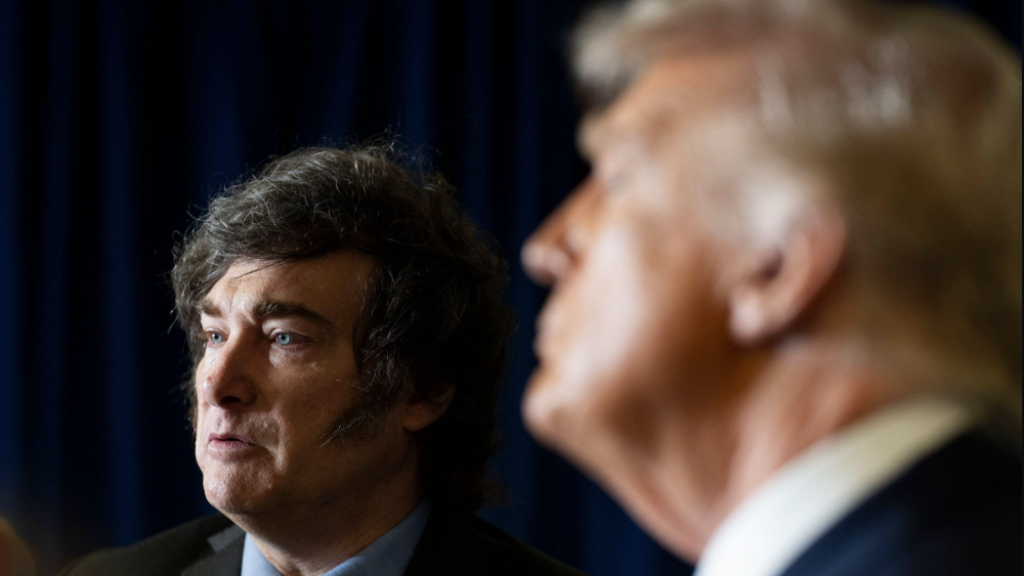

Milei and Trump

First published at Naomi Klein’s Substack.

Latin America is riding a far-right wave, and the political map tells the story in vivid color. Around the turn of the century, the “pink tide” ushered in leftist governments and a “green tide” of feminist movements advanced abortion rights. Recently, however, the tides have shifted: twelve of the last fifteen presidential elections have been won by right-wing candidates. Clearly, the regional canvas is being repainted.

What might an increasingly far-right hemisphere look like? Modeled on Argentine President Javier Milei and Salvadoran President Nayib Bukele, and unfolding in the shadow of Donald Trump and Marco Rubio, it appears violent, chaotic, and yet also coordinated. As illustrated by Rubio’s recent initiatives around the so-called Resurgence of Political Terrorism and the Shield of the Americas, the far right increasingly operates as a sort of “internationalist” project.

With deepening financial, ideological, theological, and political ties, the international far right is better connected, more aggressive, and faster-paced than ever before. Their use of new technologies and fusion with Big Tech proliferates their ideas, while lining their pockets at the same time. Such are the forces recoloring the regional map.

This far-right or “right-wing international” — as Milei himself has called it — is emerging in the cracks of a geopolitical earthquake. We no longer inhabit a bipolar world, as during the Cold War, or a unipolar one, with the U.S. trumpeting itself as world hegemon. We are now witnessing real multipolarity, with China, Russia, the EU, Iran, and others checking U.S. power.

For many, the intensification of regional powers evokes the Monroe Doctrine, the nineteenth-century policy that designated Latin America as the “backyard” of the United States. Hoping to wield greater influence over the Western hemisphere, the Trump administration has leaned into this history, comedically rebranding it the “Donroe Doctrine” and reasserting the idea of the “backyard.” Yet this old metaphor fails to capture just how central Latin America is becoming for the shifting geopolitical order and for the far right itself. Today Latin America is better understood as the “frontyard”: an emergent playground of imperial and fascist experimentation.

Mobilizing in the frontyard, far-right governments are uniting around shared causes and constructing new enemies. Intensified extractivism, financialization, and militarization are their transnational causes. Their “internal enemies,” too, are of an increasingly transnational variety: roaming migrants, Indigenous peoples, feminist and queer subversives, environmentalists, and now, “narco-terrorists”.

This new and latest term, synthesizing the “war on drugs” with the post-9/11 scareword, works simultaneously as an appeal to security and a call for elimination. And as “terrorism” semantically expands to every conceivable adversary, it is becoming clear that internationalism — solidarity in struggles across different territories — is the ultimate target of today’s far-right international. In short, the global right is networked as never before, but any cross-border solidarity on the left is increasingly cast as criminal.

The “anti-terrorism” of the Americas

On July 16, Marco Rubio and Stephen Miller’s long-planned conference on “The Resurgence of Political Terrorism” was convened in Washington, D.C. Delegates from over 60 countries were in attendance to hear the Trump administration preach about the gravest threat to “civilization” and to coordinate police and military in response. In the aftermath of the administration’s cuts of federal programs that monitor far-right violence, the conference was premised on the highly dubious claim that the vast majority of historical and contemporary violence emanates from “the far left.”

“This is an international conference because we are facing an international, a transnational threat,” Rubio declared in his plenary address. “These are not distinct and isolated cells. They are interconnected networks. They do not recognize our borders. They do not believe, in fact, in the nation state itself.”

Like much of Rubio’s speech, Deputy Secretary of State Christopher Landau’s remarks focused on the 1970s, with particular emphasis on the South American organizations Tupamaros and Montoneros, which he designated as terrorist groups. For the reference to Argentina, this is a clear inversion of historical narrative: it disregards the state terrorism perpetrated by the military dictatorship. Instead, it adopts the very language of the genocidaires in its characterization of these political organizations. When Landau celebrates the “defeat” of the left resistance — “it can be defeated because it has been defeated, and we can defeat it again” — he is speaking of a defeat that included the torture and disappearance of thousands of people, acts that have been tried and convicted in Argentina as crimes against humanity.

After the opening plenary, Argentine Foreign Minister Pablo Quirno delivered the luncheon keynote. He assured the audience that Milei’s government will continue to coordinate with the United States to eliminate everything and anything it considers “left-wing terrorism.” “What we are facing,” Quirno warned, “is an enemy that knows no borders and keeps moving, looking for loopholes.”

The US-led initiative against “political terrorism” has been compared to Operation Condor by experts like Argentine federal judge Adrián Grünberg, the president of a tribunal that put these events on trial for crimes against humanity. The first meeting of the CIA-backed Operation, held in 1975 in Pinochet’s Chile, gathered the dictatorships of Argentina, Chile, Uruguay, Paraguay, Bolivia, and Brazil. According to the tribunal, this is where they formalized an agreement “for the purpose of organizing a system of repression, persecution, and annihilation of left-wing political opponents throughout the region.”

Argentine congressman Horacio Pietragalla Corti, who was taken by the military at five months old after his parents were murdered in 1976, and returned to his family in 2003, has formally petitioned for access to public information on the scope of Argentine participation in the U.S. initiative. Yet even before the full truth has come out about this bloody past, the continent now finds itself in the grips of a new, even more ambitious coordinated campaign.

The “Shield” of the Americas

Following the indiscriminate killing of hundreds of “narco-terrorists” at sea and the invasion of Venezuela, the Trump administration launched its key hemispheric initiatives, the Shield of the Americas and the Americas Counter-Cartel Coalition (A3C). With the stated purpose of targeting crime, drug trafficking, migration, and Chinese influence in the hemisphere, these projects represent the most wide-ranging effort to coordinate over a dozen right-wing governments in Latin America and the Caribbean.

At a March roundtable with Milei, Bukele, Ecuadorian President Daniel Noboa, and Chilean President Jose Antonio Kast, among others, Rubio introduced Kristi Noem as Special Envoy to the Shield of the Americas. The former Homeland Security secretary, who just recently had overseen ICE’s “mass deportation” campaign in U.S. cities, declared a shared mission “to go after these narco-terrorists that are destroying our people.”

In detailing the A3C, Pete Hegseth and Stephen Miller echoed the sentiment. This program designates “several cartels and transnational gangs as foreign terrorist organizations” and pledges to “operationalize hard power to defeat these threats to our security and civilization.” This runs parallel to Miller’s domestic work targeting “Antifa” as a terrorist organization, which has already yielded results: extraordinary terrorism-related sentences–at least 50 years in prison each–given to fifteen anti-ICE protesters following their “noise demonstration” outside a Texas detention center to show solidarity with those inside. In the case of A3C, Miller explained that “there is not a criminal justice solution to the cartel problem.” Cartels, he added, are “the ISIS and Al Qaeda of the Western hemisphere, and should be treated just as brutally.”

These are also the grounds on which the U.S. has justified its multilevel attacks on Venezuela and Cuba. Shortly after its “anti-terrorism” conference, the U.S. State Department released a 100-page report titled “Cuba: The Capital of 21st Century Communism.” The neo-McCarthyite reading of Cuban influence seeks to connect international histories of the left from the Black Power and guerilla movements in the 1970s to movements around Black Lives Matter, Antifa and the Democratic Socialists of America today. It concludes that the U.S. now faces three different categories of terroristic threats: “narco-terrorists and international gangs,” “historical Islamist terrorists,” and “violent left-wing extremists, including anarchists and anti-fascists.”

The existentialized war framing of the Shield of the Americas combines Miller’s focus on domestic repression with Rubio’s gambit for hemispheric militarization. Its framework gives new impetus to coordinate against the far right’s long-standing enemies. And now, every enemy the far right wishes to dispense with — Indigenous, transfeminist, environmentalist, and labor movements — is being smeared with the spectral crime of “terrorism.”

The “frontyard” of the Americas

Resonances can be found between the 1970s and today. But it is important to highlight the novelties that characterize the current geopolitical situation. If the U.S. once spoke of the “backyard” to promote itself as a democracy over and above its Latin American neighbors, the “frontyard” better describes an emergent order in which the U.S. and its far-right allies pursue shared projects, make collective statements, and drop the lip service to democracy. Unlike the Cold War order in which Latin American countries needed to be “cleaned up” to join the liberal democracies of the North — through a coup d’etat, if need be–it is now a place where authoritarian exit strategies from liberal democracy are being tested out.

Looking at the concrete processes remaking the regional landscape, the frontyard refers to techno-financial (especially crypto and AI), extractivist (critical minerals and fossil fuels to power them) and militaristic expansionism. Where Pinochet’s Chile was neoliberalism’s workshop in the 1970s, today it is Milei’s Argentina being offered up as a laboratory for capitalism’s next phase.

All of these forces have come together in Peter Thiel’s personal installment in Argentina, where Palantir’s predictive AI technology is being fused with state architecture. His image of the country as a “bunker” or “Plan B” for nuclear catastrophe or other apocalypses reveals the “ End Times Fascism” dimensions of this project, as Naomi Klein and Astra Taylor call it.

Thiel’s is but one of countless examples of new investments in security, with many used to protect mining, logging and fossil fuel projects from social discontent. At the same time, the impoverishment of the population is being rerouted through financial devices. Crypto and “fintech” represent the new infrastructure for exploiting poverty caused by austerity policies, but also shaping perceptions of finance as a site of freedom and proof of individual merit.

With the attacks on Venezuela and Cuba, the electoral interference in Colombia and Peru, and the early signs of manipulation in the October presidential election in Brazil, 2026 marks a turning point. For a region fast becoming a frontyard of fascist experimentation, Milei offers a model. Beyond deepening ties with Trump and greenlighting Israel’s genocide in Gaza, he is now advancing labor, environmental and land reforms which kickstart a new phase of natural and digital extractivism, siphoning new forms of value from the public to private capital. “Argentina invites AI to free itself,” Milei declared in the Financial Times, arguing that AI companies should be given legal personhood and left unregulated. In his vision, Buenos Aires would be to the AI era what Amsterdam was to the age of sail.

In admiration of the Argentine laboratory, Flávio Bolsonaro invited Milei onstage to dance at his July 24th campaign launch in Brazil. This week the new President of Peru, Keiko Fujimori, embraced him in Lima during the transfer of command, just as Bolivian President Rodrigo Paz did at his inauguration last year. After celebrating Fujimori’s opportunity to resurrect her father’s dictatorship, Milei will visit two other aspirational dictators, Daniel Noboa in Ecuador and Abelardo de la Espriella in Colombia. Noboa is rapidly advancing authoritarian measures on multiple fronts, and de la Espriella, who takes power on August 7, campaigned on the message that he will be the Milei-style leader the country needs to “disembowel” the left.

Within the Shield of the Americas, the far-right international, is attacking all forms of global solidarity it deems “terrorism.” The paradox is that its campaigns of persecution and criminalization are premised on a recognition that internationalist and anti-fascist alliances remain worldmaking forces themselves, capable of checking the fascist drive for unlimited power. It’s an important reminder of the latent power of true internationalism.

Verónica Gago is a Researcher at the National Scientific and Technical Research Council (CONICET) in Argentina and a feminist organizer. She is the author of Neoliberalism from Below (Duke University Press 2017) and Feminist International (Verso 2020).

William Callison is an Assistant Professor of Political Science at Hunter College, CUNY. He is co-editor of Mutant Neoliberalism (Fordham 2020) and co-author, with the Zetkin Collective, of The Great Driving Right Show: Cars, Crisis, and the Rise of Fossil Fascism (published by Verso this week).

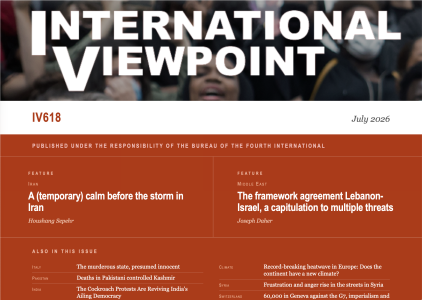

  • International Viewpoint


IVP 618 PDF
July 2026

Wednesday 5 August 2026, by International Viewpoint


The July 2026 issue spans 37 pieces across five continents, with US politics and a summer of climate breakdown dominating the main news section.

Dan La Botz contributes five articles — asking whether AOC could run for president, warning that Trump’s fraud claims and threat to send troops to polling places may presage a coup, dissecting the "progressives’ strategic failure," and tracking Trump’s anti-communism campaign as left opponents are indicted — with a fifth, on the Fourth of July at 250, leading the Features. Joseph Daher files three: on the anger rising in Syria’s streets, Germany’s push to force refugees back to Syria, and the Lebanon–Israel framework agreement he reads as "a capitulation to multiple threats."

An unusually strong climate thread runs through the issue: Daniel Tanuro on "heatwaves and strategy," Edward Chen on Europe’s record-breaking heat, Luigi Pandolfi on the heat "eating away at wages," Israel Dutra on Brazil’s Super El Niño, and Pierre Rousset on China’s "deadly weather events." Latin America again features heavily — Bolivia’s growing popular revolt, Colombia "in the eye of the storm," Venezuela’s independence anniversary and a solidarity statement, Argentina on the Malvinas and the national question, Puerto Rico’s water crisis, and Ana C. Carvalhaes on the region as "a hostage to Trump’s United States." The Middle East is dense too, with Houshang Sepehr on the "temporary calm before the storm" in Iran and two Édouard Soulier pieces on Palestine and Lebanon burning.

Europe is well represented: Stéfanie Prezioso on the Italian state "presumed innocent," Dave Kellaway on Britain’s "king of the north" crowned prime minister, Belgium’s youth mobilisation, and the G7 — 60,000 marching in Geneva against the summit, alongside William Donaura’s analysis of "the imperialist order under Trump’s leadership." Asia and Africa round out the section with Pakistani-controlled Kashmir, India’s "Cockroach Protests," Kenya’s resistance to "green capitalism," and a report from the 7th International Ecosocialist Encounters.

The Features section opens with Benjamin Bürbaumer on "the imperialism of our time," followed by Dan La Botz on the US at 250, a collective interview on defending neighbours and labour rights "against Trump," and Dianne Feeley on the UAW’s "mixed reform results."

News from the FI carries two items: Vitaliy Dudin arguing that "the dismissal of Fedorov is not the main issue — the future of Ukraine is," and the Fourth International Bureau’s call for internationalist solidarity with the Venezuelan people.

P.S.

If you like this article or have found it useful, please consider donating towards the work of International Viewpoint. Simply follow this link: Donate then enter an amount of your choice. One-off donations are very welcome. But regular donations by standing order are also vital to our continuing functioning. See the last paragraph of this article for our bank account details and take out a standing order. Thanks.

The Same Enemy Is Driving Protests Across the Balkans

Saturday 8 August 2026, by Aleksandar Matković


In Serbia, the connivance between politicians and multinational capital has fed a sustained protest movement. Current protests in Albania, resisting a luxury development project backed by Jared Kushner, target a similar cronyish capitalism. [1]

I’ve been following the recent protests in Albania but from a particular angle: as a participant in a similar wave of mass protests in Serbia. In 2024, I got three months of death threats after I published a scholarly article exposing controversial economic data related to a German-backed lithium mining project that threatened to tear up the Serbian countryside. Since some of the threats were written in German and followed a visit by that country’s then Chancellor Olaf Scholz, the case drew international attention. It is still under United Nations investigation and was covered by the Guardian, which helped draw attention to the massive statewide protests and subsequent repression in Serbia at the time. Previously, I was involved in internationalizing Serbia’s lithium struggles, linking activists and local communities from Portugal, Chile, Spain, Germany, and elsewhere with those in Serbia under what became known as the “Jadar Declaration.” It was these international links that triggered the threats in my case.

So, there’s good reason to speak up about what’s happening in Albania after the last month of protests against a destructive luxury resort project backed by Jared Kushner. Surely, not everyone shares this view. Decades of nationalism and war have created deep divisions between Serbia and Albania. Yet there are important similarities. Both governments are currently facing backlash from their citizens over ties to foreign-led development projects. This marks a shift in both countries: citizens are no longer identifying with their own states. Instead, both societies are experiencing a growing divide between citizens and state structures, which repress their own populations in defense of projects led by US and other global elites.

Like Serbia, Albania has experienced brain drain. It lost more than a million citizens through migration during the post-1991 transition to capitalism. Official UN estimates suggest that over 43 percent of the population now lives abroad. Both countries face mounting environmental conflicts, while political opposition is either ineffective or, in Albania’s case, sometimes aligned with extractive industries, while trade unions remain weak. Both countries are also becoming increasing focuses for US capital. Already prior to the Zvërnec luxury resort scheme, Kushner was involved in a real estate project in Serbian capital Belgrade proposing redevelopment of the General Staff Building — a partially destroyed site, until now preserved as a memorial to the 1999 NATO bombing. Plans to transform the site into a luxury development, reportedly linked to the Trump network, provoked public outrage and led to the project’s withdrawal.

Kushner’s trajectory in the Balkans is emblematic of a broader transformation of US hegemony in the region, which some have now dubbed “Trump’s Balkan doctrine.” In Serbia, the United States was the third largest international investor in 2024 and signed a landmark Energy Cooperation Agreement with its government. In May, a previously announced €2.6 billion hydroelectric Đerdap 3 project was even publicized by the US Embassy in Serbia. Similar dynamics appear in Bosnia and Herzegovina, where American investments used to be €6.1 million in 2022. However, this is expected to surge, as the United States has brokered a €1.5 billion deal with Bosnia and Croatia to construct a liquefied natural gas (LNG) pipeline connecting the two countries — a key target for US LNG exports. The company set to do the construction is AAFS Infrastructure and Energy, a Donald Trump–linked US-based enterprise now officially endorsed by the Bosnian state.

The same approach is now changing Albania, where US investment previously rose from approximately $100 million in 2020 to over $300 million in 2023. This is also expected to surge, as the United States seeks to position Albania as an LNG hub through a $6 billion project in cooperation with Greece. Thus, US energy investments are changing the Balkans as a whole.

This is in line with the strategy encoded in the “Western Balkans Democracy and Prosperity Act” passed by the US Congress in October 2025. The same strategy features US attempts at removing Chinese and Russian influence and explains why, subsequently, Serbia’s Russian-owned oil sector has faced sanctions, contributing to supply instability and pressure on the national currency. This reflected a broader strategy of restricting energy flows among China’s partners, from Venezuela to Iran. In this context, the Balkans is now embedded in shifting patterns of US hegemony.

It is only within this context that Kushner’s $1.4 billion Albania project must be understood. And it is not without precedent: Peter Thiel has also expressed intentions to build a Mediterranean city populated by IT specialists and a racially exclusive elite, where capital is explicitly prioritized over democracy and human rights. The expansion of US capital in the region thus signals not only increased investment but also increased power over the Balkan states; a broader Pandora’s box of projects is emerging, some of which are deeply unsettling.

In fact, the Balkans are once again transforming into a site of geopolitical competition between major powers, potentially destabilizing Europe. This is another structural reason why intra-Balkans solidarity will become more widely important.

Citizens of Albania and Serbia are therefore justified in questioning whether their states function as agents of their citizens or as intermediaries for global capital, enforcing its conditions on their populations. The citizens of Bosnia are doing the same. Even though protests in Bosnia are still localized, in past instances they did spread across the country, as in 2014. In all three cases, the Balkan states increasingly appear as vehicles for foreign capital and its fantasy projects while repressing their own citizens.

Beyond the Fragments

Historically, the Balkans have been marked by fragmentation shaped by both national conflicts and competing external influences. These divisions have made the region vulnerable to extractivism. Overcoming them is thus essential if any pan-Balkan strategy — politically or economically speaking — is to emerge in response to what increasingly look like proxy resource conflicts.

Issues such as mining and ecological degradation transcend national borders and create material interests that can potentially be articulated across them without relying on the states that are backing devastating projects. In this sense, we are witnessing an opening in the region. Previously, isolated, nationally bounded movements were unlikely to succeed against transnational forms of power. For Serbia, Bosnia, and other Balkan countries to support Albanian protests is thus not only a moral claim but a strategic necessity.

If the Balkans is to avoid becoming another peripheral zone for elite megaprojects and a proxy for clashes between extractivist superpowers, we need to do more than think in terms of the nation-state. In fact, this also opens up space for rethinking the Balkans itself. Recently, the Regional Alliance to Defend the Nature of the Balkans, a network of over thirty organizations across the region that also includes the Alliance of Ecological Organizations of Serbia, expressed its full support for environmental activists, local communities, and citizens in Albania. There have also been limited instances of cross-border activism between Bosnia and Serbia’s local communities when it comes to the struggle against lithium mining. So, the perspective of integration, one might say, is opening up.

However, the obstacles to deeper society-wide cooperation remain substantial. Bosnia, Serbia, and Albania all have weak opposition forces that are unable to channel this energy or, in some cases, are even opposed to it. If a new political opposition emerges with an alternative vision, and if they can articulate it effectively — which the student movement in Serbia certainly had the potential to do in some regards — such cooperation could reshape the Balkans. At the very least, the current moment may be creating conditions for the Balkans to assume a new role.

Finally, we cannot ignore an old idea. The proposals for Balkan federation were conceived a hundred years ago out of the fear that the region as a whole might be subordinated — like the process that is currently under way. This confronts the Balkans with an alternative. The region may again become a resource colony, as many protesters fear. Or else it can avoid this fate by choosing the path of solidarity and mutual support. To do that, it has to recognize what’s at stake.

6 July 2026

Source: Jacobin

Attached documents

Footnotes

[1] Photo: The pink flamingo is the symbol of the Albanian protest movement. File:Pink Flamingo @ Temaikén.jpg|Pink_Flamingo_@_Temaikén

Baltic Republics Foment Crises With Russia

by | Aug 7, 2026

Historically, one of the greatest dangers to a major power in the international system is letting smaller allies and clients drag that power into an unwise war. Both the United States and leading European powers seem inclined to make that blunder with respect to the Baltic republics. Too many U.S. policymakers have not only tolerated but also facilitated the obsession those “allies” (i.e. protectorates) have exhibited with defeating Russia in Ukraine and weakening their arch adversary overall.

The belligerent behavior of some of NATO’s smallest members creates the prospect of disastrous results in Europe and beyond. A crucial policymaker, Kaja Kallas, is a former prime minister of Estonia and now serves as the European Union’s High Representative for Foreign Affairs and Security Policy and Vice‑President of the European Commission. That does not help matters. Kallas is not only one of Ukraine’s most avid supporters, but is also an outspoken Russophobe on a wide range of issues. Kallas has received strong, vocal support from Dutch-born Ursula von der Leyen, an influential German politician and currently President of the European Commission.

Kallas has repeatedly pressed her EU colleagues as well as NATO officials and policymakers in other European governments to make no concessions to Russia with respect to territorial or other issues involving Ukraine. Any compromises, she contends, would reward Moscow’s aggression, and increase the risk of a much larger war.

The former Estonian leader combines such policy rigidity with an alarming degree of arrogance and overconfidence about Europe’s power. In one speech, Kallas asserted that if NATO simply stayed united on policy, Russia stood no chance of prevailing in Ukraine or of achieving any of its other objectives. Horrific wars have emerged throughout history from far less hubris than she routinely displays with respect to the democratic West’s policy toward Russia.

The centerpiece of the current effort by leaders of the Baltic states to exacerbate tensions with Moscow is a propaganda campaign asserting that the Kremlin is plotting to launch military attacks on vulnerable NATO members in the near future. In mid-July, the presidents of Lithuania and Latvia warned that Russia “may be preparing ‘limited kinetic operations’ against NATO’s eastern-flank infrastructure to test Article 5” – the provision in the North Atlantic Treaty proclaiming that an attack on any Alliance member will be considered an attack on all. Latvian President Edgars Rinkēvičs asserted that “The next few months, or even the next 12 months, will be crucial for Baltic security.”

Predictably, Russian officials dismissed the warnings as cynical cover for NATO’s own military buildup in the Baltic region. There is no question that such a provocative campaign by the Western powers has taken place and continues to do so. Indeed, a sizable buildup of NATO air, naval, and ground forces has been occurring for years. One important move was the re-deployment of U.S. F-22 fighter planes to Estonia from Poland in the spring of 2023. The most significant Russian provocations have been repeated spy plane incursions into the airspace of the Baltic republics and Russia’s other neighbors. Similar maritime incidents have taken place involving Russian naval and civilian vessels. Although Moscow’s moves are foolish and needlessly antagonistic, they are hardly in the same category as the major NATO buildups of troops, warplanes, and naval vessels.

Alarmist warnings from the Baltic governments also are nothing new, so cynical American observers might be tempted to respond to the latest flurry with indifference. However, Poland – a much more significant political and military player than the tiny Baltic countries–has been outlining similar alarming scenarios. There have been numerous warnings in recent weeks by Polish politicians, following multiple media reports that Russia could carry out a limited military or hybrid provocation against Poland in the near future. In late June 2026, a leading Polish outlet called onet.pl reported that U.S. intelligence had alerted its Polish counterparts about the possibility of a Russian attack. Prime Minister Donald Tusk said on July 3 that the warnings should be taken seriously and noted that he had been issuing similar alerts for weeks. “Poland is preparing very intensively for various scenarios,” Tusk said.

The possibility that the chronically anti-Russia U.S. intelligence agencies are helping to foment such paranoia should be a matter of profound concern to Americans who are opposed to having the Ukraine conflict spiral into a full-blown NATO-Russia war. An especially sad development is how Donald Trump, who once justifiably scorned Washington’s entanglement in Ukraine as a folly, now seems firmly committed to perpetuating NATO’s showdown with Moscow. Baltic hardliners undoubtedly take comfort in the Trump administration’s new course.

The U.S. military’s already risky commitment to the Baltic countries is becoming more explicit and uncompromising. At a June 30, 2016, ceremony in Valga, Estonia, the American commander of NATO’s land forces ​in Europe made that intention quite clear. Stating that “You’re [the Alliance’s Baltic members] ready to do more ‌and following words with action, and ‌the United States will be there alongside you,” U.S. General Chris Donahue asserted that “is how deterrence is built: Not with words from a ​podium, but with boots in the mud.” Indeed, NATO is adding a new command headquarters to focus on developments in the Baltics.

With President Trump having effectively capitulated to the NATO hawks, there is an alarming opportunity for anti-Russian zealots in the Baltic republics and elsewhere to push their pro-war agenda. Given Moscow’s egregious behavior toward its neighbors during both the Czarist and communist eras, one can readily understand the hatred that many people in those countries still harbor. But we must not let such poisonous historical memories drive current U.S. policy.

Too many officials in the Baltic states are courting a military conflagration that would consume not only their countries but the United States as well. America does not have any security, economic, or moral interests at stake that even remotely justify incurring such a level of risk. Allowing NATO’s mini-states to drag the United States into a major conflict with Russia – one with possible nuclear implications – would constitute the biggest folly of the post-World War II era.

Dr. Ted Galen Carpenter is a senior fellow at the Randolph Bourne Institute and the Libertarian Institute. He is also a contributing editor to National Security Journal and The American Conservative. He also served in various senior policy positions during a 37-year career at the Cato Institute. Dr. Carpenter is the author of 13 books and more than 1,600 articles on defense, foreign policy and civil liberties issues. His latest book is Unreliable Watchdog: The News Media and U.S. Foreign Policy (2022).