Sunday, August 09, 2026

Source: Mondoweiss

Among many buzzwords in diplo-speak around Palestine is the support for “a demilitarized Palestinian state living side by side in peace next to Israel.” This condition is repeated so often that it goes unnoticed most of the time.

That premise, and its inherent injustice, dysfunctionality, and lack of pragmatism, was highlighted this week by no less an entity than Donald Trump’s Orwellian “Board of Peace.”

On August 1, the Board released the full text of its plan, outlining the latest scheme to create an actual ceasefire in Gaza, begin rebuilding, allow a Palestinian body of technocrats to start assuming some small authority in Gaza, and, above all, to disarm Palestinian armed groups.

It is worth noting, briefly, that such a plan should not have been necessary, since such a plan was supposed to be part of the so-called “ceasefire” that was declared in October 2025. 

This new plan was presented as the second stage of the October plan, ignoring the fact that Israel has not fulfilled any of its obligations in stage one, and in fact, has never stopped killing Palestinians and has gradually occupied more and more of Gaza, pushing the survivors ever closer to the sea.

Palestinian factions reportedly had some very difficult consultations regarding this latest plan. In the end, they decided to accept the plan and put the ball in Israel’s court.

The key to that acceptance was one particular clause in the agreement, which tied Palestinian disarmament to Israeli withdrawal from Gaza, to be accomplished in phases, and stated that the Palestinian weapons would not be destroyed but would be handed over to the Palestinian board of technocrats. 

Those conditions were in the Board’s plan. Article 8 described a “process to decommission and store heavy weapons, military production sites, depots of weapons, and tunnels, shall begin after completing the remaining commitments under Sharm Sheikh Protocol, the entry of NCAG and deployment of ISF.”

The NCAG is the proposed Palestinian technocratic board, and the ISF is the often-discussed “International Stabilization Force” that would handle security in Gaza. The “remaining conditions” that need to be fulfilled refer to Israel’s ongoing attacks on Palestinians and its advance beyond the so-called “Yellow Line,” which splits Gaza in two, with Israel occupying 53% of the territory. It has since advanced well beyond 60% and, by some estimates, is nearing control of 70% of the territory. 

The Board of Peace clause continues: “…This process shall be linked to an Israeli withdrawal, in phases, from the areas under its control in Gaza and the decommissioning of armed militias in accordance with article 10 of this Roadmap. …The Palestinian factions shall take part in this process, and no weapons shall be transferred or handed to Israel or non-Palestinian parties.”

There’s no ambiguity there. All weapons would be held by the Palestinian technocrats, and the handover of weapons was explicitly tied to Israel’s withdrawal, not just from ahead of the Yellow Line—which is immediately required—but, in gradual phases, from all of Gaza.

Hamas and the other Palestinian factions called the American and Israeli bluff by agreeing to this. And, if they expected that it was a bluff, they were proven right very quickly.

Despite the clear wording of the agreement that linked Israeli withdrawal to Palestinian disarmament, Israel refused to accept the agreement, which should have come as no surprise to anyone. Yet almost immediately, the chair of the Board, Nickolay Mladenov, met with Israeli Prime Minister Benjamin Netanyahu and the Board sent out a “clarifying statement” which stated that Israel would only withdraw after the Palestinians had completely disarmed. 

This swift reversal didn’t merely confirm that the Board of Peace is nothing more than a tool for continuing the project of crushing the Palestinians; it doubled down on it.

Palestinian self-defense is the core of the issue

The Board of Peace is a Trump initiative, and there is no more reason to expect it will ever seriously consider Palestinian welfare than there is from any American, much less Israeli, idea. Yet the speed with which the Board reversed itself so completely raises a more fundamental question about international diplomacy on Palestine in general.

Diplomacy around Palestine continues to focus on a two-state solution, and while many advocates for Palestine rightly argue that the two-state solution is not viable, it is necessary to examine some of the assumptions that undergird this failed pursuit.

The formulation for two states has been expressed as two states for two people, with an Israeli state living side by side in peace with a demilitarized Palestinian state. The idea that a Palestinian state would not have the ability to defend itself was long assumed, but officially unstated until U.S. President Bill Clinton described a “non-militarized Palestinian state” in his Clinton Parameters of 2000

Clinton envisioned an international border force that would defend Palestinian borders and deter attack, but this was, of course, never realistic. What international force would actually repel an Israeli force if it decided to invade this hypothetical Palestinian state? The inability of UNIFIL to prevent Israeli infiltration in Southern Lebanon is a case in point. 

As time went on, all allusions to such an international force were simply forgotten. But the idea that a Palestinian state would be demilitarized has endured and become an essential part of the envisioned two-state framework. 

As we can see from the way the Board of Peace and the Trump administration are operating in Gaza, what this notion really means is that Israel and its allies will insist that Palestinians give up the means to resist Israel by force. 

Few ask what Palestinians think of that idea, but when the Palestinian polling firm The People Company for Polling and Social Research asked in June 2026, it found that only 20% of Palestinians accepted the idea of a demilitarized state.

Indeed, when asked about not just this condition, but the sort of package that the two-state solution usually includes (such as Palestinian refugees only being allowed to return to the Palestinian state, with only a token number returning to areas within Israel), 59% were opposed to it, even though 51% still said they were supportive of the idea of a two-state solution in general. 

But the issue is not the two-state solution itself; the real issue that has been exposed again in the past week is the idea that Palestinians, even in a post-genocide, post-occupation world, would be denied the right of self-defense. 

Of course, Palestinians reject this, but no one, even the ostensible Palestinian leadership in the quisling PLO, debates the issue in the diplomatic arena. The notion of a “demilitarized Palestinian state” is repeated often and rarely, if ever, challenged.

It is, in fact, debated even less frequently than the right of return, another condition that it is simply assumed Palestinians will relent on, an assumption made seemingly by everyone except Palestinians themselves, who seem never to be asked about it. 

But the right of return is so fundamental to Palestinian nationalism that many Palestinians have raised so loud a voice that it is more difficult to ignore, though much of the world still earnestly tries.

The issue of self-defense has been less prominent, in part because it is inherently associated with a two-state solution, so opposition to it is often subsumed under opposition to that solution in general. 

The question of the right to resist has become more prominent, however, since October 7, 2023. 

Right of self-defense

October 7 villainized Palestinian resistance even further than it had been in the minds not only of Israel and its western allies, but also in the Arab capitals that had been working to find ways to establish relations with Israel despite Israel’s refusal to compromise at all on its occupation. 

Rather than learn the obvious lesson that occupation and the denial of basic rights inevitably lead to horrific days like October 7, and to even more obscenely horrifying responses like the genocide that has followed, Israel used the event as further proof that Palestinians had to be disarmed. 

The cooperation in the Board of Peace process and the support not only from Europe but also from most of the Arab official leadership demonstrate the success of that effort. 

That is a powerful consensus that either supports or at least acquiesces to the idea that Palestinians must be unable to defend themselves. It goes beyond the argument that October 7 somehow proves that Palestinians are, stereotypically, “too brutal” to be trusted with weapons, even while the far more violent and murderous Israeli government and settlers are never challenged in their “right of self-defense,” no matter how often that “right” is used to aggressively murder innocent civilians.

No, this is a much broader argument that says that Palestinians are so inherently and uniquely violent that they can never truly govern themselves. Even the patronizing “pathway to a Palestinian state” is always conditioned on someone else having both authority and the means of enforcing it above the heads of the Palestinians. 

How can there possibly be any kind of Palestinian self-determination—regardless of whether that is in one state between the river and the sea, two states, a confederation, or any other arrangement—if Palestinians must trust that Israel, which has so brutally dominated, dispossessed, and denied rights to them for so long, will not decide to do so again?

Even before we consider the absurdity of claiming Palestinians must live next to or with their long-term oppressors in that state of naïve faith, there is the fact that self-determination is inseparable from the right and the ability to defend oneself against attack. 

If the vision was to create some sort of magical, pacified region where Israel could no longer pose a threat to the Palestinians, it would be reasonable to argue that Palestinians do likewise. Given the history and the nature of the real world, neither side of that equation is realistic.

Those among Hamas and the other Palestinian factions who argued for calling the American bluff and accepting the initial offer from the Board of Peace recognized all of this, and that is why they insisted that their weapons be handed over gradually and only to other Palestinians. It’s possible they wouldn’t have even agreed to that much if they expected Israel to accept the deal, but they took the risk because, even if Israel surprised them and cooperated with the Board, the Palestinians’ weaponry would remain in Palestinian hands.

That was and is the problem, and not only for Israel. When confronted with that objection, there was no effort to push back on it from the various “Board of Peace” tools of the Trump administration. That’s because Hamas had been correct: this was not about disarming them, which, under certain conditions, they could accept, albeit reluctantly. But this was about disarming Palestinians permanently, which neither Hamas nor most Palestinians will acquiesce to.

It is just one more example of how the Palestinians are expected to accept terms that no one else would ever be confronted with. And it is another example of how international diplomacy—whether originating in Washington, Brussels, or Riyadh—remains in a hopeless quagmire of its own making, endlessly proposing new ways to dehumanize the Palestinians rather than trying to help chart a path to a better future for everyone between the river and the sea. 


This article was originally published by Mondoweiss; please consider supporting the original publication, and read the original version at the link above.


Israel, Hamas and the Question of Disarmament


 August 7, 2026

Another trumpeted achievement, another heralded occasion of momentous significance.  Or it may be nothing of the sort.  US President Donald J. Trump is again on the stage pulling on the strings of history.  This time, attention has shifted to whether Hamas and other armed groups in the Gaza Strip will disarm, something conditional on Israel withdrawing its forces from the war-torn enclave.  And there, we are presented with the first, insoluble problem.

The latest roadmap published by the US-led Board of Peace is intended to advance the rest of Trump’s 20-point peace plan signed by Hamas and Israel in October 2025.  It involves the respective cessation by Israel, Hamas and relevant Palestinian factions of “all military operations in accordance with Sharm Sheikh Protocol and the Peace Plan.”  According to Nickolay Mladenov, chief envoy of the Board, “intense efforts” involving Egypt, Türkiye, Qatar and the US had been brought to bear on “the Palestinian factions in Gaza to agree to a Roadmap on the full implementation of President Trump’s plan, to hand over civilian governance and to decommission their weapons.”

Once approved by the parties, a timetable and the implementation phase will be prepared within a fortnight, to be extended as necessary by the International Verification Committee (IVC).  On completion, the National Committee for the Administration of Gaza (NCAG) is to enter the Strip to assume its responsibilities.  According to the plan, Hamas and the other factions are to yield control over civilian governance and security in Gaza to the National Committee in accordance with Trump’s Comprehensive Peace Plan.  The NCAG is to “enjoy full independence in carrying out its responsibilities and the factions shall not interfere in NCAG affairs during the transitional period, in accordance with UNS Resolution 2803 (2025).”

The NCAG is also tasked with pursuing “a comprehensive audit of the financial and administrative affairs in Gaza, and protect, recover and administer public assets and resources.”  Claims from suppliers, contractors and other parties, up to a total of US$400 million, will be assessed by the Committee, with unresolved financial rights, liabilities or claims addressed “within the context of a wider national process later”.

The Committee will apparently operate “according to the principle of One Authority, One Law, One Weapon”, though the plan, without giving much by way of detail, is clear that “Palestinian laws, relevant international standards and the principles of good governance” shall apply.  Police personnel shall be added to “existing police structures” and “undergo a comprehensive vetting.”  Those not cutting the mustard can still find themselves in civilian employment “consistent with their earlier experience or retire in accordance with Palestinian law.  None of those shall be deprived of their financial rights, particularly due to financial affiliation.”

Once the remaining commitments of the Sharm Sheikh Protocol are completed, along with the entry of NCAG and the International Stabilisation Force (ISF), decommissioning and storing “heavy weapons, military production sites, depots of weapons, and tunnels” will take place, supervised by the authority “in a gradual, sequential and time-bound manner”.  The proviso here is that Israel shall withdraw “in phases, from areas under its control in Gaza” as armed militias are decommissioned.

The weapons of the militias are to be decommissioned and stored under NCAG authority in accordance with a timetable.  Foolishly, and unrealistically, the deal is weakened by the requirement that no one from those militias is to “be integrated in the security and police services.”  Shadows of post-invasion Iraq in 2003, when the US-led forces engaged in an extravagant removal and purging of Baathist personnel, thereby leaving them ripe for future insurrection, are cast.

The ISF is to eventually be deployed in the Strip “to separate the Israeli forces from NCAG-controlled areas.” (At this point, that force will draw upon the reserves of Indonesia, Morocco, Kazakhstan, Kosovo and Albania.)  The force will not be in the business of policing “or missions related to the Palestinian society.” Its role, it would seem, is more one of monitoring compliance with the ceasefire, training the Palestinian police complement, and ensuring the protection and delivery of humanitarian aid and essential supplies into the Strip.  NCAG is to be supported, at its request, in other non-policing missions.  Israeli forces will then complete a phased withdrawal from the Strip in accordance with Trump’s peace plan, “which includes a commitment not to force anyone to leave the Strip.”  From then on, NCAG will handle “internal security incidents.”  At that stage, reconstruction of the enclave, to be supervised by the Board of Peace and NCAG, is to take place.

The plan, as with previous iterations on peace regarding Gaza, remains incurably brittle. Since last year’s October ceasefire, Palestinian deaths have risen to 73,000. (The number stood at 67,000 at the commencement of the ceasefire.)  The slaughtering approach of the Israeli Defense Forces (IDF) towards those clinging to the Strip has been only slightly moderated.  The IDF has also hungrily extended its control to almost 70% of the territory well beyond the Yellow Line stipulated by the ceasefire and destroyed, according to a BBC verify report published last November, upwards of 1,500 buildings.

On August 3, Mladenov met Israeli Prime Minister Benjamin Netanyahu in what he described as a “[l]ong day in Jerusalem”.  This heralded “the start of the hard phase and I have never pretended otherwise.”  From here on, the work would be “slow, grinding and technical”.  During the course of conversations Mladenov is said to have requested a halt to attacks by Israel on the Strip, which he had lamented in a post the previous day.  The weekend following the announcement of the roadmap saw the killing of 25 Palestinians and given the usual justifications: a strike on Deir-al-Balah which left four dead had targeted two Hamas commanders; the strikes on Gaza City and Jabalia had been against “military operatives”.

The Israeli attitude to the latest plans is one of profound and sabotaging scepticism.  Doron Spielman, spokesperson for Netanyahu’s office, stated the position on August 2: “Our assessment is that if we redeploy before Hamas is truly disarmed, it will quickly expand its presence throughout Gaza, rebuild its terrorist infrastructure, once again threaten Israeli communities, and seek to carry another October 7-style attack.”  In statement from the same office released on July 30 is clear: the onus is entirely on Hamas to effectively will itself into impotence and subservience through disarming, “including the removal of the weaponry from Gaza and the complete demilitarization of the Strip as a condition for any process”.

Members of the Israeli cabinet are also pre-empting any move on the part of the ISF to move into Gaza.  An August 3 letter from the patriotically rabid Finance Minister Bezalel Smotrich and Settlements Minister Orit Strock demandedthat Netanyahu convene the security cabinet to bar the entry of ISF troops. The roadmap from the Board of Peace was “dangerous to Israel and completely contradicts the disarming of Hamas and the demilitarization of Gaza.”  The plan should be blocked, and the outline amended by the Peace Council “so that it aligns with the goals of the war and the commitments made to Israel.”  Another peace plan, celebrated by its proponents yet doomed to a stillborn reality.

Binoy Kampmark was a Commonwealth Scholar at Selwyn College, Cambridge. He lectures at RMIT University, Melbourne. Email: bkampmark@gmail.com

No Room for Genocide: Italian Hospitality Against Apartheid and Israeli Crimes


 August 7, 2026


In the summer of 2026, a quiet act of conscience in a Naples hotel room triggered a familiar storm. An Israeli tourist booked a stay at the Decumani Hotel De Charme through Booking.com. She received the standard automated confirmation email. It contained a short paragraph: the property endorsed the “No Room for Genocide” https://bdsmovement.net/news/no-room-for-genocide campaign, respected the freedom and human rights of communities suffering racist, ethnic, and social harm, and warmly welcomed Palestinians, refugees, and all those peacefully resisting oppression in pursuit of their internationally recognized rights.

The tourist canceled. She told Israeli media she no longer felt safe. Within hours the hotel was under attack. Fake bookings flooded the system. Fake negative reviews appeared from people who had never stayed there. Attempts were made to damage the business. The owners were forced to issue public statements clarifying that the message went to every guest regardless of nationality, that they had never refused an Israeli client on the basis of passport or identity, and that they had in fact hosted Israeli guests throughout the previous year. BDS Italia issued a solidarity statement. The campaign of defamation continued.

This is what happens when small Italian hospitality businesses refuse complicity.

“No Room for Genocide” was launched in July 2025 by the Palestinian BDS National Committee (BNC), the largest coalition of Palestinian civil society and the leadership of the global Boycott, Divestment and Sanctions movement. It was quickly taken up with force by BDS Italia and solidarity groups worldwide. The campaign is a direct response to the ongoing genocide in Gaza, Israel’s entrenched system of settler-colonial apartheid, and the illegal occupation and annexation of Palestinian land. It also responds to what the BNC describes as the wilful negligence of third states that continue to offer visa-free entry and safe passage to those implicated in atrocity crimes while failing to uphold their clear obligations under international law.

International law requires states to end all forms of complicity in war crimes, crimes against humanity (including apartheid), and genocide. That includes the duty to deny war criminals passage or haven and, where possible, to prosecute them. With governments largely refusing to act, the BDS movement turned to civil society and to the hospitality sector itself. The campaign’s organizing toolkit invites hotels, B&Bs, agriturismi, restaurants, tour operators, and cultural spaces to take concrete steps: publicly endorse the principle that there is no room for genocide; discourage those credibly linked to war crimes from booking; challenge the complicity of platforms such as Booking.com and Airbnb that list properties in illegal settlements; and demand that states terminate visa-waiver agreements with Israel and institute effective border screenings. Participating businesses can also join the related “Sanctuaries of Peace” initiative, declaring their spaces places of ethical hospitality grounded in human rights rather than neutrality in the face of mass atrocity.

The campaign does not call for the exclusion of Jews or Israelis as such. It targets participation in and support for a regime of systematic violence. That distinction is repeatedly erased by those who respond with accusations of antisemitism, the oldest and most effective weapon used to shield Israel from accountability.

In Naples the same refusal has strong local roots. Nives Monda, owner of Taverna a Santa Chiara and now a recognized local leader within the BDS movement, has become a reference point for the city’s hospitality sector. After her restaurant was targeted in a high-profile confrontation over its public adherence to Spazi Liberi dall’Apartheid Israeliana, she continued to organize and speak out. In a message inviting other businesses and cultural associations to join the campaigns, she stated clearly: “It is our duty to take a stance and do what we can to end all chains of complicity that enable Israel’s genocide in Gaza.” That sense of duty — practical, public, and grounded in everyday work — runs through the Italian network of spaces that have chosen not to remain neutral.

In Tuscany the pattern repeated. In May 2026 an Israeli woman booked an agriturismo, “Le Cantine,” in Poggibonsi. The owner, Pietro Del Zanna, wrote to her before arrival. He stated he was not antisemitic, but he could no longer pretend that nothing was happening in Gaza. He asked her position on the policies of the Netanyahu government. If she disagreed with those policies she was welcome. If she supported them, she knew his view, and he would cancel without penalty. She canceled, publicized the exchange, and filed a complaint. Del Zanna faced online attacks and calls to boycott his business. He also received many messages of solidarity, including from Israelis sickened by their government’s actions.

Nearby, in the Chianti hills, the owner of Villa Moris, a B&B, displayed a Palestinian flag and materials linked to the related campaign of Spazi Liberi dall’Apartheid Israeliana (SPLAI — Spaces Free from Israeli Apartheid). A Swedish couple left a one-star review attacking her as a left-wing pro-Palestinian activist. She replied with a powerful public rebuttal: her Jewish grandfather had lived through the Shoah and descendents of hers had been killed in the holocaust; the values of her household were freedom, democracy, equality, and antifascism; she had joined SPLAI out of those same principles; and she reserved the right to refuse potential war criminals. The review was an attempt to punish political speech and to weaponize Jewish identity against solidarity with Palestine. Her response refused that blackmail and reclaimed the moral ground.

These are not isolated incidents. SPLAI — Spaces Free from Israeli Apartheid — is the Italian expression of the international Apartheid Free Zones campaign, itself inspired by the global movement that helped isolate South African apartheid. Promoted by BDS Italia, it invites commercial, cultural, social, and sporting spaces to declare themselves free of complicity with Israel’s regime of occupation, colonization, and apartheid. Members commit not to purchase or sell products and services of companies, Israeli or international, implicated in violations of Palestinian rights, and not to host or participate in cultural, academic, or sporting events financed or sponsored by Israel or involving its official representatives. By mid-2025 the network had surpassed five hundred adherents across Italy — bars, restaurants, bookshops, ARCI clubs (with national ARCI endorsement), cultural centers, unions, and lodging houses — forming a grassroots infrastructure of everyday refusal. “No Room for Genocide” extends that principle into the intimate space of hospitality. It asks a simple question: must a bed be offered to those who have participated in or actively supported the destruction of Gaza and the ongoing project of Greater Israel?

The tourism industry is not neutral. Platforms that list settlement villas and hotels profit from the dispossession of Palestinians. Airlines and cruise lines that bring settlers and soldiers on leave help sustain the occupation. When Italian owners of modest hotels and farmhouses refuse that economy of complicity, they are attacked with the full force of organized Zionist pressure: coordinated negative reviews, false accusations of discrimination, social-media storms, and economic sabotage. The goal is intimidation. The method is the deliberate conflation of criticism of a state and its military with hatred of a people.

Italy’s government under Giorgia Meloni has offered no protection. On the contrary, it has deepened military and political ties with Israel while criminalizing forms of solidarity at home. In that climate, the courage of small proprietors in Naples, Tuscany, and elsewhere becomes a form of resistance. They are not powerful. They do not control ministries or media. They simply refuse to pretend that genocide is a private matter or that hospitality requires moral blindness.

The broader BDS movement has always insisted that ordinary people and institutions have both the right and the responsibility to withdraw support from systems of oppression. “No Room for Genocide” is that principle applied to the bedroom and the breakfast table. It is non-violent. It is precise. It is grounded in the legal obligation of third parties not to aid or assist in the commission of international crimes. That it provokes such fury is evidence of its effectiveness.

The hotels, BnBs, and agriturismi that have joined are not closing their doors to Jews or to Israelis who reject the policies of their government. They are declaring that there is no room — in their houses, in their businesses, in their ethics, in their understanding of human dignity — for the perpetrators and enablers of genocide and apartheid. The campaign of harassment directed against them is an attempt to reimpose silence and complicity. It will not succeed for as long as people of conscience continue to answer, quietly and firmly: not here.

Michael Leonardi lives in Italy and can be reached at michaeleleonardi@gmail.com

I Couldn’t Stay at the BBC After This

Source: Palestine Depp Dive


Karishma Patel sits down with Ahmed Alnaouq to discuss why she left the BBC after five years as a journalist and newsreader. The conversation offers a rare insider perspective on one of the most consequential debates in journalism today as Karishma shares her journey from aspiring public service journalist to becoming one of the BBC’s rising on-air reporters, before ultimately concluding that she could no longer work within an institution she believes failed to uphold its journalistic principles during Israel’s genocidal war on Gaza. Together, they explore the culture inside mainstream newsrooms, editorial decision-making, political pressure, media ethics, the role of evidence in journalism, and why so many journalists have become disillusioned with legacy media. Karishma also explains why she believes independent journalism is more important than ever and introduces the new Palestine Deep Dive series featuring journalists who left major media organisations over their coverage of Gaza. Palestine Deep Dive reached out to the BBC for reply. A BBC spokesperson said: “The BBC is fully committed to reporting the Israel-Gaza conflict independently, accurately and to the highest standards of journalism. We have covered the conflict impartially and without fear or favour and produced powerful coverage from the region that has shown how the Israeli government and military’s actions have had a devastating human cost on civilians in Gaza.” They also added that coverage across all BBC platforms “included stories of Palestinian victims and testimony from civilians, doctors and aid workers,” and “consistently reflect the historical context through our experienced correspondents, most notably International Editor Jeremy Bowen, and we explore and explain the accusations of genocide and war crimes.” “The BBC, like all international news organisations, is unable to operate within Gaza, but through working with trusted freelance journalists we have kept audiences informed through first-hand testimony and descriptions of what is happening. The BBC has repeatedly called on the Israeli government to allow international journalists into Gaza to work alongside Palestinian journalists.”


This article was originally published by Palestine Depp Dive; please consider supporting the original publication, and read the original version at the link above.


Source: Mondoweiss

Before dawn on Sunday, August 2, the Israeli military struck a pharmaceutical warehouse adjacent to al-Aqsa Martyrs Hospital in Deir al-Balah, central Gaza, in what Palestinian health officials described as the latest step in a systematic campaign to dismantle Gaza’s healthcare system.

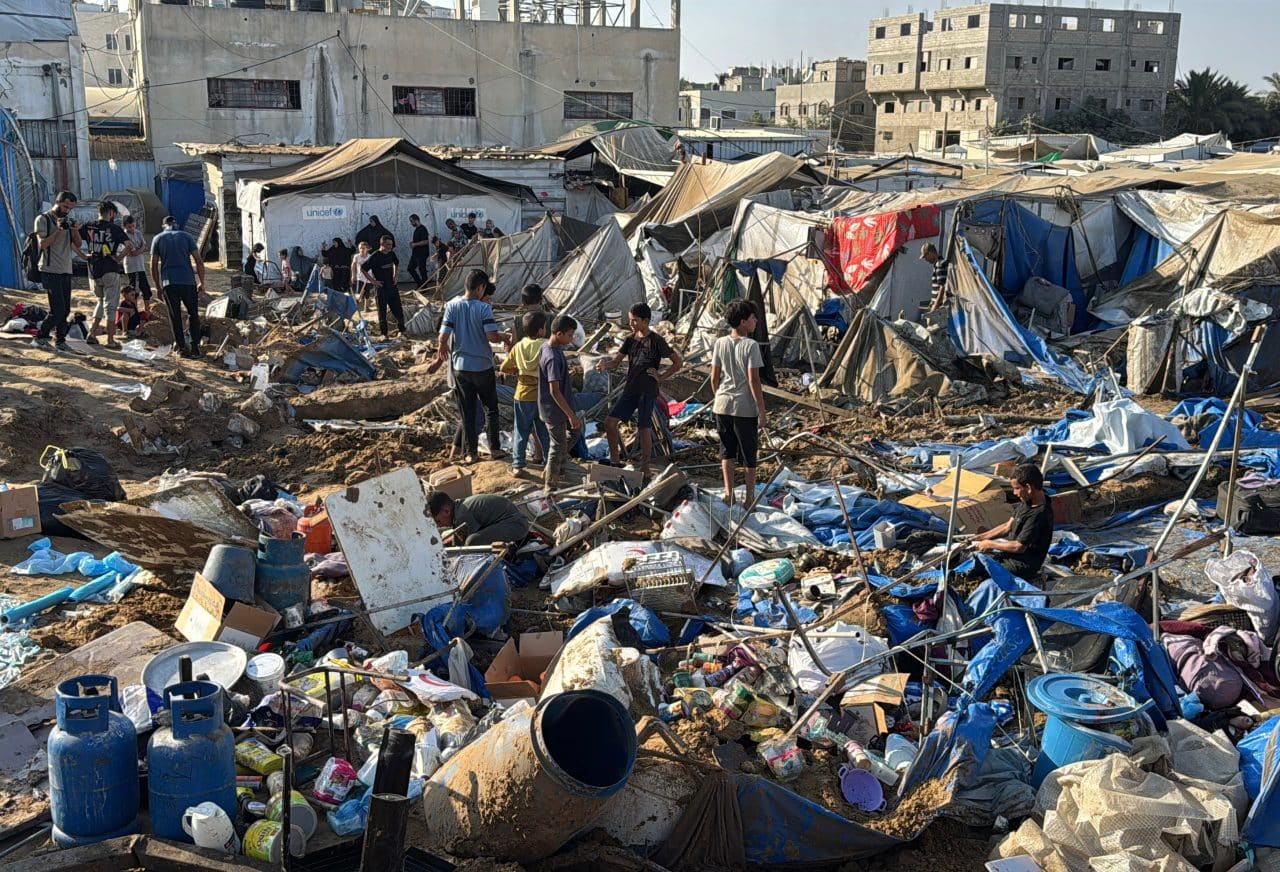
The attack inflicted extensive damage beyond the targeted facility. Two of the hospital’s four medicine warehouses were completely destroyed, while the remaining two sustained severe structural damage, the Gaza Ministry of Health said in a statement. The blast also tore through dozens of tents sheltering displaced families who had sought refuge inside the hospital compound after losing their homes.

According to the Health Ministry, the strike also caused significant damage to a nearby outpatient clinic building and destroyed already critically low stocks of medications and medical supplies.

“The attack came on top of months of restrictions on the entry of medical aid and the continued prevention of thousands of patients from traveling abroad for treatment,” the statement added, accusing Israel’s strikes as “systematic and deliberate.”

Since the beginning of Israel’s genocide in Gaza, the healthcare system in the Strip has been battered by overlapping crises. Medical facilities have come under repeated attack, with hospitals and clinics damaged or destroyed across the Strip. Of the hospitals that once served Gaza’s population, only a small number remain operational and continue to receive patients.

Dr. Khalil al-Daqran, spokesperson for al-Aqsa Martyrs Hospital, said that Sunday’s strike was part of that broader assault on Gaza’s health sector. “The occupation seeks the complete collapse of Gaza’s healthcare system,” he said. “The missiles completely destroyed the warehouse, leaving behind a massive crater and placing large numbers of patients in grave danger.”

According to al-Daqran, the destroyed warehouses contained medicines for patients with chronic illnesses, including kidney disease. With those supplies now destroyed, he warned, many patients face an immediate threat to their lives.

He noted that medicines reaching Gaza’s hospitals are largely supplied through international organizations such as the World Health Organization, but that Israel “shows no regard for international law or international organizations,” citing the destruction of the warehouse as evidence.

‘I watched my father die of cancer. Now it’s my son’s turn’

Six weeks ago, Jihad Abu Hamida, 61, was battling cancer while struggling to survive in Gaza’s collapsing healthcare system. Displaced to the Al-Mawasi area of Khan Younis after his home in the city was destroyed, Abu Hamida never received the treatment he needed to fight the disease. Within six weeks, he died after months of inadequate care, as his family was unable to obtain the medications he required or secure permission for him to leave Gaza for treatment abroad.

His son, Ali Abu Hamida, 41, said the family exhausted every possible avenue, contacting organizations and authorities inside and outside Gaza in an attempt to save his father.

“We fought for him and reached out to everyone we could, but nothing worked,” Ali told Mondoweiss. “My father died before my eyes while waiting for a chance to receive treatment.”

The family’s ordeal did not end with his father’s death.

Ali said his own son, Abdulazziz, 14, suffers from multiple heart and kidney conditions and, before the war, regularly traveled to hospitals in the occupied West Bank and Jerusalem for specialized treatment. Since the outbreak of the war in October 2023, however, he has been unable to continue his medical care. As a result, his condition has steadily deteriorated and has now reached an advanced stage.

“Now I am watching my son die before my eyes, just as I watched my father die,” Ali said.

He said his father died because the treatment he needed was simply unavailable. Today, he watches his son’s health worsen day by day. The child has also developed symptoms of severe psychological trauma brought on by constant fear of bombardment and the inability to continue treatment.

“In every other country, governments and humanitarian organizations care for patients and provide them with the treatment they need so they have a chance to recover,” he said. “Only in Gaza are patients deliberately left to die while the world watches their suffering without offering them any real help.”

“This is the occupation,” Ali added. “This is what it has done to our daily lives. Illnesses that are treatable elsewhere become fatal here because people cannot access basic medical care.”

Stories like those of Ali Abu Hamida are part of what the Gaza Health Ministry calls Israel’s “silent extermination” of patients amid the genocide, according to a statement it issued on Monday.

The Ministry said Israeli restrictions continue to block and severely limit the entry of medicines into Gaza, with incoming supplies falling far below minimum medical needs. Cancer and hematology drugs are among the hardest hit, with shortages reaching 61%, placing oncology patients at “imminent risk of death” due to the interruption of treatment protocols, the Ministry said.

According to the ministry, medicine shortages have reached 47%, while medical consumables shortages stand at 58%. Laboratory testing materials are in critically short supply, with shortages reaching 85%, raising fears that many essential diagnostic and therapeutic services could soon cease altogether.

The ministry said shortages now affect nearly every major area of healthcare. Medicines for maternal and child health are down by 56%; primary healthcare medicines by 55%; kidney disease and dialysis medications by 46%; psychiatric and neurological medicines by 35%; emergency and intensive care drugs by 33%; surgical supplies by 39%; and orthopedic materials by 48%.

It added that severe shortages of laboratory testing supplies are directly undermining physicians’ ability to save lives. Among the most urgently needed are complete blood count (CBC) tests, blood gas analysis, and clinical chemistry tests, all of which are essential for the daily management of critically ill patients in intensive care units and surgical departments.

In another statement, the ministry said, “the crisis facing cancer patients has reached catastrophic levels, with three patients now dying every day because of the absence of specialized treatment.”

Dr. Muhammad Abu Nada, the medical director of the Gaza Cancer Center, warned in a video statement published by the Ministry of Health of an unprecedented deterioration in the condition of cancer patients across the Strip. Approximately 11,000 cancer patients are now at risk due to severe shortages of essential medicines and continued restrictions preventing travel for treatment.

According to Abu Nada, the collapse of specialized cancer care and the absence of essential therapies have resulted in three cancer-related deaths every day. Around 4,000 patients hold official medical referrals for treatment or diagnosis abroad but remain unable to leave Gaza because of border closures.

The destruction of specialized treatment centers, Abu Nada said, has forced physicians to make increasingly drastic clinical decisions. In some breast cancer cases, including patients diagnosed at an early stage, “doctors have had no option but to perform full mastectomies because radiotherapy is unavailable and patients cannot travel abroad to receive treatment.”


This article was originally published by Mondoweiss; please consider supporting the original publication, and read the original version at the link above.Email

Tareq S. Hajjaj is the Mondoweiss Gaza Correspondent, and a member of the Palestinian Writers Union. He studied English Literature at Al-Azhar University in Gaza. He started his career in journalism in 2015 working as a news writer and translator for the local newspaper, Donia al-Watan. He has reported for Elbadi, Middle East Eye, and Al Monitor.