Sunday, August 09, 2026


Source: Democracy Now!

We speak to Dave Zirin, author and sports editor at The Nation, about his new book, The People’s Historian: The Outsized Life of Howard Zinn, chronicling the life and activism of the legendary historian Howard Zinn, author of A People’s History of the United States. For Zinn, says Zirin, “being an academic was always secondary to being in the streets and making history, not just studying history.”


Transcript

This is a rush transcript. Copy may not be in its final form.

AMY GOODMAN: This is Democracy Now!, democracynow.org.

We turn now to the new book The People’s Historian: The Outsized Life of Howard Zinn, written by our next guest, Dave Zirin. The book explores the remarkable life of the late historian, teacher and activist Howard Zinn. He’s best known for writing A People’s History of the United States. First published in 1980, the book has sold more than 4 million copies.

Howard Zinn died in 2010 at the age of 87, but his work is still seen as threatening to many, and by others, by empowering so many. During his first term, President Trump directly attacked Zinn’s work.

PRESIDENT DONALD TRUMP: The left-wing rioting and mayhem are the direct result of decades of left-wing indoctrination in our schools. It’s gone on far too long. Our children are instructed from propaganda tracts, like those of Howard Zinn, that try to make students ashamed of their own history.

AMY GOODMAN: Over the years, professor Howard Zinn appeared on Democracy Now! many times. In 2009, he “talked”: about the importance of teaching students the true history of the country.

HOWARD ZINN: It’s true that people have asked that question again and again. You know, should we tell kids that Columbus, whom they have been told was a great hero, that Columbus mutilated Indians and kidnapped them and killed them in pursuit of gold? Should we tell people that Theodore Roosevelt, who is held up as one of our great presidents, was really a warmonger who loved military exploits and who congratulated an American general who committed a massacre in the Philippines? Should we tell young people that?

And I think the answer is: We should be honest with young people; we should not deceive them. We should be honest about the history of our country. And we should be not only taking down the traditional heroes, like Andrew Jackson and Theodore Roosevelt, but we should be giving young people an alternate set of heroes.

AMY GOODMAN: So, that is the late great historian Howard Zinn.

Dave Zirin joins us now.

Dave, you wrote The People’s Historian: The Outsized Life of Howard Zinn. Everyone knows you as a sportswriter. Why you switch gears for now, if in fact you did? And tell us Howard Zinn’s life story and his impact.

DAVE ZIRIN: Well, I could tell you that in the 1930s, as a teenage union organizer, Howard Zinn played for his union basketball team and used his tall frame as a way to recruit people to the union, but that still doesn’t make this a sports story. That’s as close as we’re going to get.

Howard Zinn’s life was remarkable. It was 70 years-plus of activism, 64 of those years alongside his incredible partner Roslyn Shechter Zinn. And it’s in those 70 years that we have so many lessons for us today and for our struggles. I mean, we’re talking about somebody who in the 1930s, like I said, was a teenage union organizer during the Depression. In the 1940s, he was a bombardier in World War II who hated fascism so much, he signed up to be a bombardier even though he’d never been on a plane. I mean, I get claustrophobic in the middle seat, and he’s there as a bombardier. You know, in the late 1940s, he lived through the Red Scare as a firebrand, 20-something organizer fighting for veterans’ rights in Brooklyn, which is an incredible story which he never told unto himself, which I was able to get documentary information on.

In the 1950s, teaching at Spelman College, a HBCU for women in Atlanta, he taught an incredible generation of women, people like Alice Walker, the author, Marian Wright Edelman, Beverly Guy-Sheftall, women who were the first to graduate from Harvard Law School, and Howard Zinn was their beloved professor. They voted him the professor of the year on campus in their yearbook, which is an incredible little exhibit of the Howard Zinn of that time, 1961. And then he’s forced out of the school because he dared stand up not just for his students’ right to protest Jim Crow in Atlanta, but also their fight against the patriarchy and sexism on their campus. He wrote an article for The Nation magazine, which got wide coverage, the virality of 1950s, that was called “A Finishing School for Pickets,” about the women at Spelman.

Then he goes on from that and becomes one of the adult organizers of one of the vanguard organizations of the civil rights movement, the Student Nonviolent Coordinating Committee. Like, the fact that he was asked to be an adult adviser of people like Stokely Carmichael, soon to be known as Kwame Ture; Bob Moses; Diane Nash; Dorothy Ladner. I mean, they were looking to both Howard Zinn and his partner at the time, Ella Baker, to be the — his work partner — to oversee and help with SNCC. And then he worked alongside folks like James Baldwin and Dick Gregory, like in the heart of Jim Crow. And it wasn’t all roses and flowers, either. I mean, they had comrades die in those streets and in those swamps fighting against Jim Crow.

And then he goes on from that to become a leading figure in the movement against the war in Vietnam, including traveling to North Vietnam, traveling to Hanoi on behalf of the peace movement during the Tet Offensive, during the Tet Offensive, to free POWs.

And he continues being active into the 1980s, into the 1990s and in the 2000s, as you well know, because he loved appearing on Democracy Now! to talk about this, the wars in the Middle East, the endless wars of George W. Bush. He spoke out against something we’re dealing with so strongly today: the growing surveillance state, that we were seeing under the PATRIOT Act and George W. Bush.

So, the lessons of Howard Zinn’s life over 70 years are so important to us. And I would argue the most critical lesson is that he lived through the ups and downs. It wasn’t all pie in the sky. There were tremendous difficulties along the way, particularly during the Red Scare of the late 1940s and early ’50s. And yet he persevered. And he persevered because he wasn’t just an activist. This is what’s so interesting about him to me, is that he was also a trained historian. And we don’t always see trained historians on the frontlines of activism. And frankly, that’s why so many, like, I would call them, centrist or liberal historians are so resentful of him and his work, because he was such a frontline fighter. And for him, being an academic was always secondary to being in the streets and making history, not just studying history.

AMY GOODMAN: I want to go back to a 1997 film, that Oscar-winning film Good Will Hunting, which had this famous scene featuring Robin Williams and Matt Damon.

WILL HUNTING: [played by Matt Damon] You want to read a real history book, read Howard Zinn’s People’s History of the United States. That book will [bleep] knock you on your ass.

SEAN MAGUIRE: [played by Robin Williams] Better than Chomsky’s Manufacturing Consent? You think that’s a good book?

AMY GOODMAN: There it is. And you have a lot from Matt Damon in this book.

DAVE ZIRIN: I was able to interview Matt Damon for the book. He was incredibly generous with his time in talking about Howard Zinn, because, you know, he grew up next door to Howard Zinn and Roslyn Zinn and the Zinn family in Newton, Massachusetts. They practically shared a wall of their duplex, to the point of which Matt Damon talks about his brother hearing Howard Zinn type out A People’s History of the United States on one of those old typewriters.

And Matt Damon told a lot of stories about growing up at Zinn’s knee, barbecues, things of the like. But the story I loved the most was that Howard Zinn was giving their family early drafts of A People’s History of the United States. And at 10 years old, Matt Damon’s mother, Nancy Carlsson-Paige, who’s an incredible education activist, by the way, Nancy Carlsson-Paige read her 10-year-old son the opening chapter of A People’s History of the United States, which is, of course, all about the plunder of Christopher Columbus, the depravity in terms of how he treated Indigenous people in this country. So, 10-year-old Mattie Damon goes to school and does an oral report in class about Christopher Columbus and all of his crimes. And they actually — they called his parents, because they were so concerned that he was coming into school talking about this. And as Damon said to me, he said, “Donald Trump might say that was the beginning of my indoctrination.”

AMY GOODMAN: I want to go back to Howard Zinn on Democracy Now! like 20 years ago.

AMY GOODMAN: Howard Zinn, you called your autobiography You Can’t Be Neutral on a Moving Train. Why?

HOWARD ZINN: Well, it came from — I stole it from myself. That is, I used to say that to my classes at the beginning of every class. I wanted to be honest with them about the fact that they were not entering a class where the teacher would be neutral. It was not going to be a class where the teacher spent a half a year or year with the students, and they would have no idea where the teacher stood on the important issues. This is not going to be a neutral class, I said. I don’t believe in neutrality. I believe neutrality is impossible, because the world is already moving in certain directions. Wars are going on. Children are starving. And to be neutral, to pretend to neutrality, to not take a stand in a situation like that, is to collaborate with whatever is going on, to allow it to happen. I did not want to be a collaborator with what was happening. I wanted to enter into history. I wanted to play a role. I wanted my students to play a role. I wanted us to intercede. I wanted my history to intercede and to take a stand on behalf of peace, on behalf of a racial equality or sexual equality. And so I wanted my students to know that right from the beginning, know you can’t be neutral on a moving train.

AMY GOODMAN: “You can’t be neutral on a moving train.”

DAVE ZIRIN: Incredible.

AMY GOODMAN: And, Dave, how did you come to know Howard Zinn?

DAVE ZIRIN: I came to Howard Zinn because he got my sports writing from a mutual friend, a collaborator of Howard Zinn named Anthony Arnove. And Howard read it, and he asked me if I would write a book for his People’s History series called A People’s History of Sports in the United States. And we got to know each other.

And he asked me if I would travel with him at the end of his life and interview him on stage. I got to tell you, the easiest — as you well know, the easiest interview in the world. You would just say, “Howard Zinn, civil rights movement, your thoughts?” Half an hour later and three different times of people applauding and interrupting him. I would just sit there. I could have had coffee and popcorn, and I would have been as happy as anybody in the crowd. Just a terrific interview.

And I got a — a couple of times, I said to him, when he would tell his stories, “What we need is A People’s History of Howard Zinn, because I think this is very much — of Howard Zinn being of that generation of the 1930s, the Depression generation. You’re always looking at the movements. You’re always looking at the struggle.” So, he would pull his name from the stories and tell them more generally. And I said to him, “We need your stories.” I never thought I’d write it, but now I have.

AMY GOODMAN: And talk about him being a bombardier in World War II —

DAVE ZIRIN: Very powerful for him.

AMY GOODMAN: — and what he then did afterwards — 

DAVE ZIRIN: Absolutely.

AMY GOODMAN: — going to the sites he had bombed.

DAVE ZIRIN: Well, he spoke about when he was a bombardier, about being, quote-unquote, “war crazy,” because they psych you up. They push you to bomb these areas. And then he realized what was happening, and he became a person of peace for the rest of his life.

AMY GOODMAN: Let’s go to Howard Zinn talking about this on Democracy Now!

HOWARD ZINN: And we don’t know how many people we killed or how many people were terribly burned as a result of what we did. But I did it, like most soldiers do, unthinkingly, mechanically, thinking we’re on the right side, they’re on the wrong side, and therefore we can do whatever we want, and it’s OK. And only afterward, only really after the war, did I — when I was reading about Hiroshima from John Hersey and reading the stories of the survivors of Hiroshima and what they went through, only then did I begin to think about the human effects of bombing. Only then did I begin to think about what it meant to human beings on the ground when bombs were dropped on them, because as a bombardier, I was flying at 30,000 feet, six miles high, couldn’t hear screams, couldn’t see blood. And this is modern warfare.

AMY GOODMAN: That was the great historian Howard Zinn, who went to fight fascism, was a bombardier. He bombed occupied France.

DAVE ZIRIN: Yes, and a place called Royan. And he returned there in 1966 to really learn for himself about the damage that he did. He was one of the first bombardiers to drop what they called jellied gasoline, which came to be known as napalm, which burns off the skin, used infamously during the war on Vietnam.

And the thing about Howard and war, which so interesting, is he then spent decades, not with — with no publicity, writing to the Pentagon after 1966, trying to get the truth of what happened in those bombing raids. Did they know they were bombing civilians? Did they know the effects of napalm? And he had a folder. He had a folder in his archives that I found that was all about his correspondence with the Pentagon. And they sent him back letters all the time, too, about what they would and wouldn’t show him. And he had written on that folder, just very, very big — he just wrote, “Never again.”

AMY GOODMAN: As we wrap up, what were you most surprised by in researching your book, The People’s Historian?

DAVE ZIRIN: I was most surprised about his ability to endure the downs, that his life wasn’t just about up, up and struggle, because we hear things. Certainly, people my age hear civil rights movement, antiwar movement, and you think of these things as these mass struggles that are just up, up and away. There were tons of ups and downs along the way. There was a lot of demoralization along the way. But he was able to weather that through his knowledge of history. And I think that’s what our movements so desperately need today, because we need to be able to endure 2026, because, as Howard Zinn said, “You know what? The history is full of surprises, and sometimes we can do the surprising.”

AMY GOODMAN: Well, we want to thank you so much for being with us, Dave Zirin, author of the new book The People’s Historian: The Outsized Life of Howard Zinn. He’s sports editor at The Nation and author of many other books, including A People’s History of Sports in the United States, that he did at the request of Howard Zinn. We’re going to bring you a post-show at democracynow.org. Dave is a sportswriter, and we want to find out the politics of what just happened, the attempted privatization of FIFA. Go to democracynow.org for that. Thank you so much for this book.

DAVE ZIRIN: Thank you, Amy.

AMY GOODMAN: Dave Zirin. Democracy Now! is produced with Mike Burke, Deena Guzder, Anjali Kamat, Messiah Rhodes. I’ll be in Edinburgh next Tuesday and London next Wednesday. Check our website at democracynow.org.

This article was originally published by Democracy Now!; please consider supporting the original publication, and read the original version at the link above.

Pedagogy of the Southern Worker

Source: Scalawag Magazine

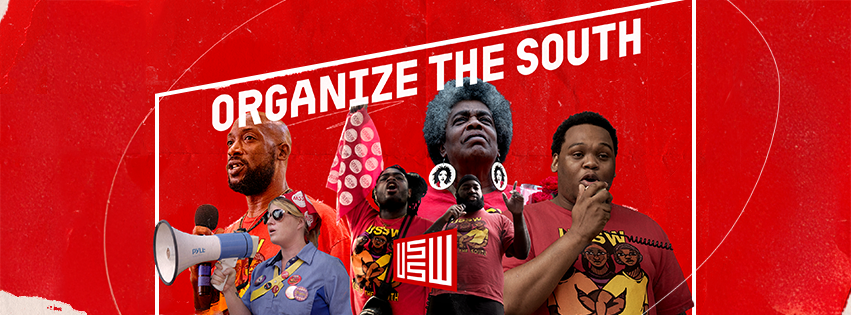
The Union of Southern Service Workers (USSW) is an organization of workers in the low-wage, high-turnover service industry of the U.S. South, with members in North Carolina, South Carolina, Alabama, and Georgia. From the beginning, the union has placed political education at the center of its strategic vision. USSW understands that to transform workplaces and communities, workers must understand the roots of the system that exploits them and develop the skills necessary to fight back. As with any union or community organization, USSW runs campaigns to win concrete, material victories. But the real fruit of the union’s organizing work lies in the constant political formation within an expanding base of dedicated worker militants. Unlike the traditional union model, USSW treats political education not as ancillary training, but as a core component of its method; it is a dimension of the union’s approach that makes victories durable and transforms workers into long-term leaders. 

Having grown up in New York, Tahtebah “Tee” Gonzalez immediately felt the culture shock of working in the U.S. South. At Dunkin’, his pay was just $9 an hour, just barely above minimum wage and a third of Fulton County’s living wage. The conditions of low pay, overwork, and understaffing boiled over when Tee and his coworkers discovered that other workers in the same shopping center would be paid extra to work a busy weekend in downtown Atlanta during the Dragon-Con convention. 

When a USSW organizer visited his store days later, Tee and his coworkers were already agitated and ready to act. Within a week, they had organized a weekend-long strike. The action won them a raise they had once considered impossible. More importantly, it proved to Tee that workers held real power: When they fight together, they can win. 

That breakthrough—shifting from isolated frustration to collective action—was the spark of political consciousness. But in the USSW, the spark does not fade. Tee’s first strike was only the beginning of a longer process of formation, sustained by the union’s model of political education and leadership development. Through Worker Power Schools, collective study, and the discipline of organizing, Tee deepened his understanding of the system that exploits workers and gained the skills to lead others. What began as a fight over wages became a journey of transformation: from an exhausted service worker into a committed leader of a broader struggle for dignity and justice in the South. 

THE ROLE OF POLITICAL EDUCATION IN ORGANIZING 

Workers like Tee have been deeply shaped by the USSW’s political education program, particularly through Worker Power Schools: residential training programs designed to develop leadership, strategic thinking, and organizing skills among members. 

In August 2024, a Worker Power School specifically for Waffle House workers provided a space for analyzing workplace struggles, connecting them to systemic forces, and refining organizing strategies. Through study, discussion, skills training, and collective planning, Waffle House workers from across the South developed the confidence and skills necessary to lead workplace actions, negotiate with management, and build solidarity across locations. 

Two weeks after the 2024 August Worker Power School, spurred on by the connections they made with other workers and the education they engaged in, Waffle House workers from three different locations in Atlanta delivered demand letters to their employers in a coordinated action, marking a bold step in their ongoing fight for fair wages and safer working conditions. This experience solidified their understanding that their power does not come from isolated complaints but from unified, strategic action driven by political education. 

USSW represents a transformative force in labor organizing, particularly within the U.S. South’s politically repressive and union-hostile landscape. By connecting political education with direct action, USSW provides workers with the tools to take control of their workplaces and reshape their communities. Understanding USSW’s pedagogical framework reveals how political education is a foundation for worker-led struggle, drawing from historical movements, radical traditions, and global organizing models to develop strategies that challenge exploitation and build collective power. 

WHY WORKERS NEED A DIFFERENT EDUCATION 

Public education in the United States has been under sustained attack for decades, with particularly devastating consequences for the Southern working class. State legislatures have systematically slashed funding for public schools, forcing districts, especially those in working-class and Black communities, to operate with crumbling infrastructure, overcrowded classrooms, and underpaid teachers. 

This disinvestment has coincided with an aggressive push toward school privatization, charter schools, and voucher programs. The right-wing assault on education has also weaponized curriculum, censoring discussions of slavery, racism, labor history, and gender justice. 

These attacks are strategic. They aim to create a generation of workers unequipped to critically analyze the system or resist exploitation. For many USSW members, their first true political education comes through the union, not the classroom. 

Education, in its dominant form, functions to maintain existing class structures, reinforcing the power of the ruling class while fragmenting workers. In the South, this has meant a curriculum designed to discipline Black workers while erasing their history of resistance. Schools produce a compliant workforce, not critical thinkers or organized leaders within the working class. 

USSW’s pedagogy breaks with this model. It creates a transformative educational process that prepares workers not only to challenge exploitation, but also to govern society in their own interest. The union understands political formation as the ongoing process of turning struggle into analysis, strategy, and leadership. What makes the USSW distinct is that it turns the whole of struggle into a school—on the strike line, in trainings, and in meetings—where workers’ voices carry authority and their participation drives the learning process. 

USSW also operates as a community union, recognizing that workers’ lives extend beyond their workplaces. The concept of “community unionism,” articulated by Beloved Community Center co-founder Reverend Nelson Johnson, reflects this understanding: that the conditions of work and community are inseparable, and so too must be the organizing response. By affirming the fundamental humanity of all people, especially those who have been stripped of dignity, USSW’s pedagogy seeks to restore agency and promote holistic development. 

This approach draws inspiration from the Brazilian educator Paulo Freire, who defined political education as “all efforts of mobilization, organizing, and training that prepare people to exercise the power which they must necessarily conquer.” In USSW, education is never abstract or detached. It is inseparable from organizing, ensuring that every act of study, training, or collective work becomes a practical tool for struggle. 

THE FOUR DIMENSIONS OF USSW’S PEDAGOGICAL METHOD 

USSW’s pedagogy is organized around four interconnected dimensions: study, militant work, practical training, and Soul. Each shapes the learning process and reflects the union’s core values. Together, they ensure that political education is not separate from organizing, but woven into every campaign, school, and meeting. 

1. STUDY 

USSW leaders study history and politics from the standpoint of Southern workers. The relationship between facilitator and participant is dialogic but directive, never neutral. Dialogic education means that learning happens through conversation, questioning, and collective reflection rather than passive absorption. Directive education means that facilitators guide the discussion with clear objectives, ensuring lessons move from personal problems to systemic analysis. 

This practice is not invented from scratch. USSW builds on a long lineage of popular education traditions that link study directly to struggle. Freire, whose literacy campaigns in Brazil taught workers to “perceive social, political, and economic contradictions, and to take action against the oppressive elements of reality,” captures one dimension of what USSW puts into practice.  The Brazilian Landless Workers’ Movement (MST), which continues this tradition, insists that “full human development occurs through the historical process of learning and socialization, intertwined with cultural, ideological, social, and political aspects.”  These global insights resonate deeply in the South, where testimony, storytelling, and collective problem-solving have long been survival tools for Black and working-class communities. 

Closer to home, Myles Horton of Highlander Folk School cautioned that while education must begin with people’s experiences, it cannot end there: “There’s a time when people’s experiences run out.” USSW study sessions follow this principle: they start with lived workplace struggles and move outward to the broader systems that produce them. Workers read aloud from history and political economy texts, wrestle with their meaning together, and then ask how those lessons apply to their own campaigns. The result is not just knowledge but sharper strategy. 

Study in USSW is never abstract; it is always tethered to practice. It equips workers not only to analyze their conditions but to act together to change them. 

2. MILITANT WORK 

USSW aims to reclaim the dignity of labor and develop heightened working-class consciousness by reshaping the meaning of work in its fullness. Every Worker Power School and event requires members to engage in what the union calls “militant work”: cooking, cleaning, childcare, and other shared responsibilities. These tasks are not included as an afterthought or a chore; they are part of the pedagogy itself. 

The category of “work” is understood both in the narrow sense of the labor that employees perform in exchange for a wage, and as the uniquely human act of creation – physical, mental, and cultural. Freire noted that the instructors in his adult literacy programs in Brazil “began with the conviction that the role of man was not only to be in the world, but to engage in relations with the world – that through acts of creation and re-creation, man makes cultural reality and thereby adds to the natural world, which he did not make. We were certain that man’s relation to reality, expressed as a Subject to an object, results in knowledge.”  Militant work also connects to Southern traditions where communal work – whether farming, food preparation, or community childcare – has long sustained working-class life and organizations. 

In USSW, militant work becomes a political exercise when it is structured with the intention to overcome the alienation of workers from their labor. This transformation requires overcoming many dynamics that structure current work conditions, including the separation of manual and intellectual work, as well as the gendered and racialized hierarchies that shape labor exploitation. Historically, women and workers of color have been relegated to the most devalued and underpaid forms of labor, while their contributions have been erased or diminished. Militant work in USSW creates a collective practice that not only affirms the dignity of all labor but also actively works to disrupt the social divisions of labor that capitalism relies upon. 

Militant work in USSW challenges traditional notions of leadership, competition, and workplace hierarchy. Members intentionally restructure how they relate to their “coworkers” during militant work time, ensuring leadership is rooted in accountability rather than top-down authority typical in traditional workplaces. This means actively rejecting the behaviors and attitudes of their bosses and cultivating leadership that fosters mutual respect and shared responsibility. 

A key aspect of this transformation is acknowledging and uplifting often invisible labor – the essential but undervalued tasks such as taking out the trash, doing the dishes, leading childcare efforts, and maintaining communal spaces. These acts of care and maintenance are integral to sustaining the organization and the movement and to making political education processes possible. USSW’s dimension of militant work reinforces the idea that all labor, regardless of visibility or status, has value and contributes to the collective struggle. 

Key elements of militant work in USSW include: 

  • Base Group Responsibilities: Participants take on work necessary for maintaining a functional and organized learning environment, through tasks like cleaning collective spaces, meal preparation, etc. 
  • Cooperative Projects: Community-oriented service; preparing meals, building resource pantries, and maintaining spaces such as the chapter offices as gathering places outside of scheduled events, embodies a vision of labor that serves collective well-being. 

As Studs Terkel wrote in his 1974 book Working, “Most of us are looking for a calling, not a job. Most of us, like the assembly-line worker, have jobs that are too small for our spirit.” USSW’s pedagogical model seeks to expand the meaning of work: work for social uplift rather than profit-making. 

By engaging in militant work, workers develop a new relationship with labor – one that is not defined by competition, coercion, or exploitation, but by cooperation, a sense of purpose, and solidarity. It affirms that work can be an act of humanization rather than alienation. 

3. PRACTICAL TRAINING 

A strong and sustainable movement requires an intentional structure that integrates political education with leadership development, ensuring that workers are both learning and practicing the skills needed to sustain organizing efforts. USSW’s organizing model is designed to ensure that workers are not only participants in struggle but also leaders in shaping the movement. At the core of this structure are Base Groups, which serve as both a site for political education and a vehicle for organizing. Through these groups, workers engage in small group discussions, build relationships, and take on concrete responsibilities that serve an operational role but also strengthen their leadership within the movement. 

In USSW, Base Groups play a critical role in both Worker Power Schools and chapter organizing. In Worker Power Schools, Base Groups include six to eight people and serve as spaces for structured dialogue and reflection, the completion of militant work, and collective accountability. Concretely, this means that a portion of the day during Worker Power Schools is spent within the Base Group to discuss and build on the lessons from the day, identify areas where there are still questions, and relate theoretical lessons to the practical tasks ahead of them when they return home. The Base Groups are also responsible for militant work on a rotating schedule during the school year and for ensuring the participation of each member in the school. 

In USSW chapters, Base Groups act as smaller mobilization units that help maintain engagement between major campaigns and actions, allowing veteran members to remain active while also integrating new members into the organization’s political work. 

Facilitation is especially important. Members are trained to lead discussions, frame debates, and draw out the voices of others. This is where leadership development and political education converge: learning to facilitate means learning to listen, to analyze, and to hold a room together with clarity and purpose. 

Facilitators learn to engage participants in structured dialogue, ask critical questions, and ensure discussions remain orderly and grounded in political clarity. This process helps workers develop confidence, strategic thinking, and discipline – all essential skills for workplace and community organizing. Learning to facilitate also reinforces the principle that education is not something imposed from the outside but a collective and reciprocal process that emerges from within the movement. Every student is a teacher, and every teacher is a student. 

Theresa “TK” Kinard, a Waffle House worker from Georgia, embodies this principle. From speaking up about safety issues at her store to facilitating chapter meetings, TK has used her lived experience to guide discussions and show other workers how to foster courage and skill by example. For TK, facilitating has become a key tool for her development. It has pushed her to think critically about the work, analyze feedback, and engage with it strategically. Each time she facilitates, she sharpens her ability to listen, reflect, and hold space for different perspectives in the room. 

Rather than lecturing or leaning on strict scripting, TK brings authenticity, rapport, and personal expertise to her role as a facilitator. This approach allows her to draw out the voices and opinions of her peers, encouraging them to share their thoughts and insights freely. Through facilitation, TK not only empowers everyone in the room but also herself by strengthening her public speaking skills. USSW’s use of media also extends this train. It is used both as a tool for visibility and a methodology for political education and development. By telling their own stories on their terms, workers practice self-determination, sharpen their analysis, build practical public speaking skills, and develop confidence as leaders. More than representing the union, forward-facing workers represent their communities, their struggles, and their visions for the future. 

Workers speak not just to the media but through it, reaching other discontent workers, challenging harmful stereotypes, and putting faces, names, and voices to some of the most overlooked and underappreciated in our society. Being a spokesperson in USSW isn’t about being polished or media-trained. It is about being honest, clear, and speaking as part of a living, breathing movement, grounded in experience. 

By applying their lived experience to public speaking, workers deepen their political understanding of the world around them. As storytellers, they keep up to date with current events and policy decisions, study history, and prepare intentionally for speaking opportunities. With this ongoing practice, they evolve not only as communicators but as thinkers and organizers capable of analysing power and moving others to act. 

Through leadership development as a pedagogical dimension, USSW creates an organizing structure that is sustainable, democratic, and strategically effective. These structures ensure that workers are not passive participants but architects of their own political education and movement-building. The development of worker-leaders at every level of the organization allows USSW to build a movement that is simultaneously flexible, adaptive, and disciplined. 

4. SOUL 

The final dimension of USSW’s pedagogy is what members call “Soul”: the cultural, emotional, and spiritual force that sustains collective struggle. 

Soul is expressed in many ways. It’s the sound of a Black men’s gospel choir and the Dudley High School drumline at the Worker Power Summit. It’s the rhythm of chants and drumsticks hitting buckets on the strike line. It’s the shared meals cooked by members to feed chapter meetings. It’s the poetry, raps, and posters that workers create to express their vision of a different world. These practices affirm that political education must engage the whole person: mind, body, and spirit. 

USSW’s practice of Soul reflects the Southern traditions it comes from: the spirituals of enslaved people, the testimonies of Black churches, the culture of working-class families who carried history through stories and lyrics. At the same time, it resonates with global movement traditions. The Brazilian Landless Workers’ Movement calls this dimension mística. Mística – a Portuguese word with no precise English translation – refers to the spiritual and cultural force that binds people together in struggle, recognizing that movements require not only strategic planning but also emotional and symbolic sustenance. 

Despite the understanding of the indispensable nature of these moments and practices, there is a natural tendency, particularly in the U.S., to reduce this to chanting slogans and a few spontaneous moments, or worse, deprioritize it in favor of other needs. USSW has incorporated Soul as a very intentional pedagogical dimension to counter this tendency. 

In Greensboro, NC, in February 2025, the member-organized “Worker Fest” showcased this dimension. USSW members performed original spoken word, poetry, songs, and raps. One highlight was a fashion show of upcycled clothing made from old USSW memorabilia, designed by Columbia, SC worker-leader Shae Parker and modeled by members themselves. Set to the song “Are My Hands Clean?” by Sweet Honey in the Rock, the performance offered a sharp critique of both labor exploitation and environmental destruction. Worker Fest also featured a powerful performance by a Black gospel choir that included Nah’Shon Blount, a Duke University housekeeper and USSW leader in Durham, NC. Their voices highlighted the deep interconnections between faith, culture, and the labor movement. 

By intentionally incorporating art, music, and performance, Worker Fest was a concrete demonstration of USSW’s belief that the union is not just about immediate reforms, but also about reclaiming dignity, celebrating identity, and strengthening the collective spirit necessary for sustained struggle.

THE TASK AHEAD: DEVELOPING “THE THINKER, THE WORKER, AND THE DREAMER” 

USSW has shown over the years that political education is not an abstract exercise but a living, breathing process that fuels worker-led struggle. Through study, workers sharpen their analysis. Through militant work, they remake their relationship to labor and leadership. Through practical training, they gain the skills and discipline to guide struggle. And through Soul, they sustain the cultural and spiritual strength to endure. Taken together, these dimensions nurture workers who understand their historical role, see immediate fights in a broader context, and are prepared to act strategically to organize and transform the South. 

At a time when both public education and labor power face systemic dismantling, USSW’s work is an urgent intervention. The defunding of schools, the suppression of radical histories, and the attacks on unions are not isolated crises but deliberate strategies to weaken worker consciousness and power. By insisting on deep, historically grounded, and action-oriented political education, USSW challenges these strategies directly. It ensures that Southern workers are not only resisting exploitation but preparing themselves to govern their own futures. 

The pedagogical model of USSW reflects a fundamental truth: education is inseparable from struggle. Whether through Worker Power Schools, base group organizing, militant work, or the cultural force of Soul, USSW is reclaiming education as a site of empowerment rather than subjugation. This approach does not simply train workers for isolated fights over wages and conditions; it cultivates the vision, discipline, and solidarity required for long-term movement building. 

The history of the Southern working class is a history of resilience, from the Reconstruction-era struggles for land and literacy to the battles of Black labor organizers in the 20th century. USSW stands in this lineage, building on past lessons while forging new paths. Its pedagogy makes possible the development of leaders who do not burn out after a campaign – whether won or lost – but remain rooted in a long horizon of struggle. 

In his 1946 speech “Behold the Land,” W.E.B. DuBois spoke of the South: “Here, if anywhere on earth, is the need for the thinker, the worker, and the dreamer.” In our moment, these are not separate figures but unified aspects of what it means to be fully human in struggle. To think critically, to work collectively, and to dream boldly are all necessary to build a new society. 

The pedagogy of the Southern worker is not just about survival – it’s about transformation. It’s about workers recognizing that they are not just cogs in a machine but the very force that makes the world run. With the right tools, strategies, and political education, they will not only demand a better world; they will build it.

Inez O’Donnell is a communications specialist with USSW, based in Georgia.

Lindsey Krenzler-Ferreira is a political educator with USSW, based in North Carolina.


This article was originally published by Scalawag Magazine; please consider supporting the original publication, and read the original version at the link above.Email


Source: Originally published by Z. Feel free to share widely.

My mom was a single parent. She raised my brother and me, paid every bill on time, and bought a house of her own, breaking into the middle class with hard work and a union job.

She also showed me how to make my own way in the world, and now she’s preparing for a retirement she spent decades earning.

It’s the vaunted American success story. Or at least it used to be. We know all too well that the same mobility and security my mom has achieved are eluding countless others today because of a system stacked in favor of the rich.

Working people struggle to buy groceries, pay utilities, and purchase homes while the wealthy fritter away obscene sums just because they can. Here’s the good news: It isn’t too late to take back what’s ours.

Tripling the percentage of union workers nationwide is exactly what’s needed to reset the scales, rebuild the middle class, and reverse much of the inequality that’s divided America into haves and have-nots.

That’s the key finding of a new study by the Economic Policy Institute (EPI), a think tank in Washington, DC, that’s long worked alongside the United Steelworkers (USW) to deliver justice and opportunities for working people.

The study found that increasing the union membership rate to 30 percent would unleash a new era of collective power, forcing employers to come to the bargaining table and raise median wages by 14.5 percent.

That works out to about $7,700 more annually in a worker’s paycheck, or nearly $270,000 over the course of a 35-year career, enough to weather inflation, take vacations, buy a home, and still sock something away for retirement.

Let’s remember that ordinary Americans create wealth.

But the rich—CEOs, do-nothing shareholders, and the rest of the billionaire class—siphon it away. Ten percent of Americans control nearly 70 percent of the nation’s wealth, and believe me, these aren’t the folks showing up every day to do the tough, important jobs that keep America running.

Reclaiming our fair share of wealth is a first step. But a surge in unionization promises other sweeping gains, as EPI’s study points out.

For example, union members use our collective clout to win better working conditions. We fight discrimination and other unfair treatment on the job because solidarity, the source of our strength, renders an injury to one an injury to all.

We also wield our power to win paid sick leave, quality health care coverage, and other essentials that corporations and their cronies deny to other families.

Access to doctors is a basic need. Yet anti-worker members of Congress in 2025 gave billions in tax cuts to the wealthy, bloating their coffers even more, while simultaneously stripping struggling families of affordable health plans.

It’s within our means to end this kind of injustice once and for all.

A tripling of union membership would force employers to provide health care to many more workers, cutting the ranks of the uninsured by about 25 percent, according to EPI’s estimate. That means millions of people living better and longer.

Just as important, these kinds of changes pave the way to a bigger, stronger middle class with corresponding political power, seized from the rich. This rebalancing is the best way to keep Congress in check, ensuring it focuses on the common good and never again lines the pockets of the wealthy on the backs of everyone else.

Who, apart from the billionaires, would take issue with that?

Record numbers of Americans support unions and want to join one, signaling that the wave championed in the EPI study is already underway.

About 140 sawmill workers in Mississippi joined the USW in June, coming together despite the company’s nasty anti-union campaign to fight for brighter futures. Manufacturing workers, chemical workers, oil workers, library workers, animal rescue workers, and many others also joined our ranks over the past year, eager to realize the union difference.

Which boils down to this: We’re stronger together.

This article was produced by the Independent Media Institute.Email

Roxanne D. Brown is the international president of the United Steelworkers Union (USW).