Saturday, August 22, 2026

‘Bloodthirsty Psychopath’ Ben-Gvir Touts Viewing Booths at Gallows for Palestinians

The vice president of the European Parliament condemned what she described as “a horrific spectacle that turns the death penalty into a show.”


Israeli National Security Minister Itamar Ben-Gvir visits the construction site of a gallows being built to hang Palestinians convicted of killing Israelis, at a secret location in central Israel, on August 18, 2026.
(Photo by Itamar Ben-Gvir/screenshot)


Brett Wilkins
Aug 20, 2026
COMMON DREMS

Still drawing international censure for his genocidal call to kill dozens of Gazans daily, Israeli National Security Minister Itamar Ben-Gvir faced fresh condemnation Thursday after visiting the construction site of a gallows where Palestinians convicted of killing Israelis are set to be hanged to death, with select Israelis gathering as spectators.

Ben-Gvir, leader of the far-right Jewish Power party, posted a video to social media in which he gloats about the construction of gallows, which is being built in an undisclosed location in central Israel.

“I promised to worsen the conditions of terrorists in prisons—we kept it,” Ben-Gvir says in the video. “I promised to pass the Death Penalty for Terrorists law—we did. And now the death row and hanging facility are also starting to take shape.”


The law to which Ben-Gvir referred was passed in March by the Knesset—Israel’s parliament—and took effect the following month. The legislation changes the rules governing Israeli military courts in the illegally occupied West Bank so that the death penalty effectively applies only to Palestinians who kill Israelis.

Far-right Knesset members, including Ben-Gvir, wore noose-shaped lapel pins to show their support for the legislation. Ben-Gvir also handed out sweets to Knesset colleagues after the bill passed its first reading.

Ben-Gvir said the execution site would include viewing booths where victims’ families could watch executions, describing this as something customary in various countries and specifically citing the United States as an example.

“Terrorists deserve only one thing—death by hanging,” said Ben-Gvir, who in 2007 was convicted by an Israeli court of inciting racism and supporting a terrorist organization, whose leader he has openly honored.

Abdullah al-Zaghari, head of the Palestinian Prisoner Society, urged “effective international action” in response to Ben-Gvir’s comments. Al-Zaghari told Anadolu that the minister’s visit to the gallows site was part of the “continued determination of the Israeli occupation system” to codify incitement against Palestinians.

Leftist Israeli Knesset lawmaker Ofer Cassif excoriated Ben-Gvir’s actions.

“This criminal thug—a sympathizer of murderers of Palestinians, a supporter of terror, and a pathological racist—is also hopelessly infantile,” Cassif told The New Arab on Wednesday. “Soon we will oust him from the government, and next, throw him behind bars.”


European Parliament Vice President Pina Picierno accused Ben-Gvir of staging “a horrific spectacle that turns the death penalty into a show.”

The liberal US pro-Israel group J Street asked on X, “Are we supposed to believe, as some in the Jewish establishment would like us to, that Ben-Gvir’s words somehow tell us nothing about the country he helps govern?”

“He is Israel’s national security minister, and he is now celebrating a facility built to execute Palestinians while Jewish extremists are excluded from the law,” the group added. “As the old saying goes: When someone tells you who they are, believe them. When a government gives someone this much power, we have to reckon honestly with the agenda they are pushing.”

Ben-Gvir—who is under sanctions and banned from countries including Australia, Canada, New Zealand, Norway, and the United Kingdom for inciting violence against Palestinians in the West Bank—was still being denounced on Wednesday for advocating the daily mass killing of Palestinians, including civilians, in Gaza amid a nearly three-year war that United Nations experts, human rights groups, a South Africa-led case currently before the International Court of Justice, and many others call a genocide.

Stéphane Dujarric, spokesperson for United Nations Secretary-General António Guterres, said Wednesday—which was World Humanitarian Day—that Ben-Gvir’s “remarks are appalling, they’re outrageous, they’re dehumanizing, they’re dangerous, and we condemn them unequivocally.”

A spokesperson for German Chancellor Friedrich Merz said Wednesday in Berlin that Merz “strongly condemns Minister Ben-Gvir’s inhumane statements, which violate international law—they are unacceptable.”

“As the occupying power, Israel must treat Palestinians with dignity, protect their property, and ensure public administration and humanitarian aid,” the spokesperson added.

French Foreign Minister Jean-Noël Barrot called Ben-Gvir’s remarks “unbearable and inhumane,” adding that “further sanctions could be imposed, and all options are on the table.”

In the United States, actor and activist Mark Ruffalo said Thursday on Bluesky that “Ben-Gvir is a bloodthirsty psychopath, war criminal, and one of Israel’s beloved genocidal leaders.”

“America and the world should be sanctioning, divesting, and boycotting Israel in every way until this apartheid regime falls,” he added.
Fresh Calls for Sanctions as Canadian, European Governments Decry Israel’s E1 Settlement Plan

“If you want to ‘target sanctions at those who participate in illegal settlement expansion,’ you’re going to have to sanction the entire Israeli government, so we look forward to seeing that.”


Israeli Finance Minister Bezalel Smotrich holds a map of an area known as E1 in the occupied West Bank on August 14, 2025.
(Photo by Menahem Kahana/AFP via Getty Images)


Jessica Corbett
Aug 20, 2026
COMMON DREAMS

As the Canadian and several European governments on Thursday denounced Israel’s latest move to divide the illegally occupied West Bank with its E1 settlement project, the critical countries faced fresh calls to actually respond with sanctions.

When the Israeli government last August approved a plan to build 3,401 housing units for settlers in the E1 area east of Jerusalem, Finance Minister Bezalel Smotrich proclaimed that the proposal “buries the idea of a Palestinian state,” a comment that came as his country was nearly two years into a military operation in the Gaza Strip globally condemned as genocide.

Bedouin Palestinians who live in the area and Israeli peace groups are challenging the E1 plan in court, but that didn’t deter the Ministry of Construction and Housing from issuing a tender to build seven residential compounds with 1,234 units on Wednesday. Contractors can submit bids until October 19, a week before Israel’s October 27 parliamentary election. Criticism was swift.

The Israeli watchdog group Peace Now said that “this is a last-minute maneuver that is part of the scorched-earth policy the government is pursuing at the end of its term to secure long years of conflict and bloodshed for Israel. Building in E1 will ruin the possibility of reaching an end to the conflict and a peace arrangement based on two states. The government is trying to sign contracts with contractors before the elections so that it will be much harder for the next government to cancel the construction.”

Sarah Sanbar, acting Israel and Palestine researcher at the US-based organization Human Rights Watch (HRW), stressed that “the E1 project isn’t just housing; it’s erasure of Palestinians, their homes, and their livelihoods... Israel cannot be allowed to alter ‘facts on the ground’ and entrench apartheid with impunity.”

“Behind housing units in E1 are Palestinian families facing displacement. Companies bidding to build those houses are bidding on complicity in a war crime,” Sanbar said. “Other countries have a duty to prevent companies under their jurisdiction from profiting off illegal settlement construction.”


J Street, a liberal Zionist group also based in the United States, called for immediate action from the White House and Congress, which have long given Israel billions of dollars a year in military aid, even as the death tolls have soared in Gaza and the West Bank, where Israel Defense Forces troops are often accused of refusing to stop or even enabling settler violence against Palestinians.

“The E1 project would build an Israeli city in the heart of the West Bank—territory that should form the core of a future Palestinian state. It would also sever East Jerusalem and other major Palestinian population centers from one another, further restricting Palestinian movement,” J Street noted. “Combined with this government’s approval of more than 100 new settlements and its support for hundreds of new outposts across the West Bank, the E1 tender can only be understood as a key part of a systematic effort to undermine the viability of Palestinian statehood.”

The United Kingdom’s foreign secretary, Ed Miliband, on Wednesday put out a lengthy statement declaring the publication of the tender as “an unacceptable and destructive act,” and that “settlement expansion and attempts to create irreversible divisions on the ground threaten peace, security, and the prospects for a viable Palestinian state.”

“Britain will not stand back and accept the destruction of the two-state solution,” he pledged. “In the coming weeks we will set out a comprehensive set of measures to respond to Israeli government policies, protect the viability of the Palestinian state, target sanctions at those who participate in illegal settlement expansion, and support a just and lasting peace for Israelis and Palestinians.”

While Israel’s Foreign Minister Gideon Sa’ar and Minister of National Security Itamar Ben-Gvir responded to Milliband with hostility, Kenneth Roth, a senior fellow at Yale University and former longtime leader of HRW, said it is “nice to see this.”

Welcoming the “strong words from Britain objecting to Israel’s continuing settlement expansion,” Roth wondered, “Will the UK refer these war crimes (Art. 49 of the Fourth Geneva Convention) to the International Criminal Court for prosecution?”


Zarah Sultana, a member of the UK Parliament for Coventry South who co-founded Your Party with former Labour Leader Jeremy Corbyn, responded on social media with a jab at her country’s Labour leadership: “Stop selling them arms then, Ed.”

Rohan Talbot, director of advocacy and campaigns at the British charity Medical Aid for Palestinians, told Miliband, “If you want to ‘target sanctions at those who participate in illegal settlement expansion,’ you’re going to have to sanction the entire Israeli government, so we look forward to seeing that.”

On Thursday, the office of UK Prime Minister Andy Burnham announced that he joined leaders from Canada, France, Germany, Italy, the Netherlands, and Norway for a joint statement slamming the tender for the E1 settlement project as “unacceptable” and all Israeli settlements in the West Bank as illegal under international law, as “reaffirmed by the United Nations Security Council.”

“At a time of grave instability in the West Bank with unprecedented levels of violence by settlers against civilians, and serious restrictions on the Palestinian economy, this decision is even more concerning,” the coalition said, urging the Israeli government to “retract these plans immediately” and businesses to “not consider bidding for construction tenders.”

Businesses considering bids “should be aware of legal and reputational consequences including the risk of involving themselves in serious breaches of international law,” the seven governments said. “We reiterate our commitment to a comprehensive, just and lasting peace based on the two-state solution. We will continue to act in its interest.”


Replying on social media, Canadians for Justice and Peace in the Middle East said that “Israel will not back down from its ‘doomsday’ E1 settlement expansion until there are real consequences. If countries like Canada are serious, they must immediately impose sanctions against any person, organization, or company involved in this war crime.”


Netanyahu Government ‘Actively Enabling’ Deadly Settler Rampages in West Bank: Report

“Settlers shoot, attack, and expel Palestinians from their land, and the state provides the weapons, the legal cover, and the budget to do it.”


Jewish settlers argue with Palestinian farmers harvesting olives in Ramallah, West Bank on October 29, 2025.
(Photo by Issam Rimawi/Anadolu via Getty Images)

Jake Johnson
Aug 20, 2026
COMMON DREAMS

Intensifying violence by government-backed Israeli settlers in the illegally occupied West Bank is fueling the mass displacement and erasure of entire Palestinian communities, according to a report published Thursday by Human Rights Watch.

HRW pointed with alarm to United Nations data showing that the average number of settler attacks per day in the West Bank has risen to the highest level on record as the far-right Israeli government, led by Prime Minister Benjamin Netanyahu, continues to expand settlements in open defiance of international law.

The leading human rights group’s new report estimates that Israeli settler violence against Palestinians in the West Bank has “fully or partially displaced 107 communities,” comprised of nearly 6,000 Palestinians, since January 2023. The escalating displacement in the West Bank comes amid Israel’s ongoing genocidal assault on the Gaza Strip.

“The Israeli government and the settlers share the same goal of maximum land and minimum Palestinians, with the authorities not only failing to stop settler violence, but actively enabling it,” Sarah Sanbar, acting Israel and Palestine researcher at HRW, said in a statement. “Settlers shoot, attack, and expel Palestinians from their land, and the state provides the weapons, the legal cover, and the budget to do it.”

HRW’s report was released days after the Israeli government published a new tender for the construction of more than 1,200 housing units in the West Bank. The anti-occupation group Peace Now noted that the bidding period for companies to build the units closes a week before Israel’s elections.

“Building in E1 will ruin the possibility of reaching an end to the conflict and a peace arrangement based on two states,” said Peace Now. “The government is trying to sign contracts with contractors before the elections so that it will be much harder for the next government to cancel the construction.”

HRW warned that companies seeking a role in constructing the new housing units are “bidding on complicity in a war crime.”

“The impunity Israeli authorities accord settlers stems directly from the free pass Israel’s allies and donors have granted it.”

For its report on settler violence, HRW interviewed 20 witnesses and reviewed video footage of attacks, which have included physical assaults, sexual violence, property destruction, theft, and killings—often carried out alongside Israeli soldiers. HRW noted that Israel’s National Security Ministry has “formed civilian ‘rapid response squads’ in settlements” and given them “special policing powers, uniforms, and weapons.”

“I have known war in this region for all my life, but never like this,” said Um Muhammad Muammar, a 72-year-old resident of Qaryut whose two sons were killed by Israeli settlers. “My sons’ children are now fatherless; their wives are now widows. What more can we say?”

With the support of Israel’s government, settlers have established 65 new outposts in the West Bank this year alone. “Israeli organizations Kerem Navot and PeaceNow reported in July that these outposts currently effectively control more than 1 million dunams (100,000 hectares) of land—approximately 18% of the West Bank—four times what they controlled before the current government took office,” HRW observed.

“The impunity Israeli authorities accord settlers stems directly from the free pass Israel’s allies and donors have granted it,” said Sanbar. “Accountability starts with the settlers committing crimes but doesn’t end there. Israel and the governments that give it a blank check share responsibility and should be held to account.”
‘Should Never Have Been an Option’: Palestine Action Activists Won’t Be Sentenced as Terrorists

“It’s a victory for us, it’s a victory for Palestine, it’s a victory for protesting,” said the mother of one Palestine Action activist.


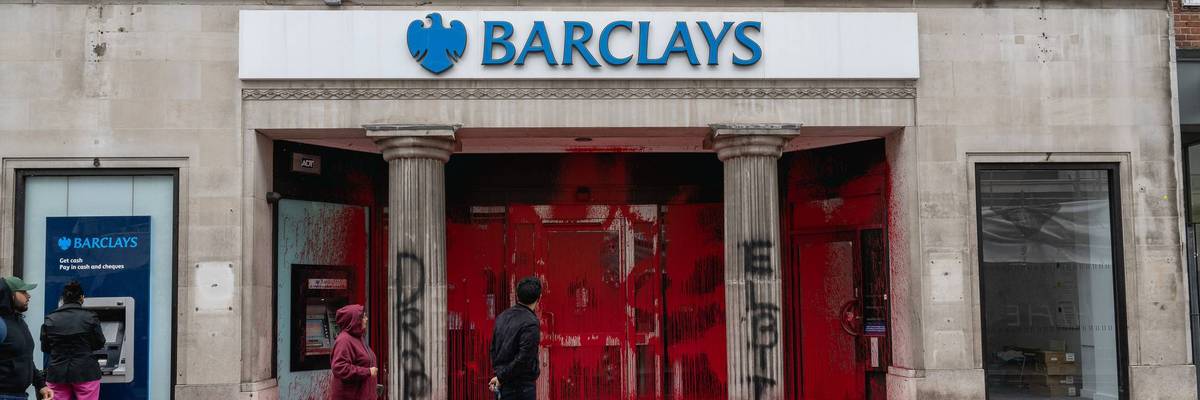
The scene at a Barclays bank after several branches were attacked overnight by supporters of Palestine Action over links to Elbit Systems and the Israeli military on June 10, 2024 in London, England.
(Photo by Guy Smallman/Getty Images)

Brad Reed
Aug 21, 2026
COMMON DREAMS

Five Palestine Action activists who were convicted in June of vandalizing a Barclays bank in the UK will not be sentenced as terrorists.

As reported by Al Jazeera on Friday, Judge Robert Altham determined that the five defendants—Brendon O’Hagan, 28; Amanda Kelly, 31; Hmeera Atiqnisar, 31; Mohammed Malik, 28; and Alma Yaniv, 70—did not commit crimes that rose to the level of terrorism.

Instead, the judge said, they will be sentenced in September for criminal damage to the bank, which will carry significantly shorter prison sentences compared to a terrorism sentencing.

According to The Guardian, attorneys representing the defendants argued that their clients’ Palestine Action membership should not influence a decision to sentence them on terrorism because the group wasn’t proscribed as a terrorist organization until long after the vandalism took place.

The five activists were found guilty two months ago of causing damage exceeding £200,000 to the Barclays bank in Burnley, Lancashire in August 2024. Palestine Action activists across the UK targeted Barclays branches due to its investments in Elbit Systems, and Israeli defense technology firm.

The activists issued a joint statement after the ruling saying they were “extremely relieved” by the outcome, while emphasizing that a terrorism sentence should never have been under consideration.

“This should never have been an option,” they said. “We were on trial for charges of criminal damage, for damaging some windows and spraying red paint on a Barclays branch. At no point during the trial were we, or the jury, informed that, if convicted, we could face being sentenced as terrorists.”

Supporters of the activists erupted in cheers outside the court after hearing the news. Dove Malik, mother of defendant Mohammed Malik, expressed relief in an interview with Al Jazeera.

“It’s a victory for us,” said Malik, “it’s a victory for Palestine, it’s a victory for protesting.”
Congo’s Ebola Outbreak ‘Growing Exponentially,’ Warns UN Official

In just under 100 days, the epidemic has killed over 2,500 people and is “now covering an area that is bigger than France.”


An Ebola outbreak in the Democratic Republic of Congo has killed over 2,500 people, a United Nations official said on August 21, 2026.
(Photo by Josua Mulala Raymond/World Health Organization)

Jessica Corbett
Aug 21, 2026
COMMON DREAMS

It’s been nearly 100 days since authorities in the Democratic Republic of Congo declared the Ebola outbreak and, as a key United Nations humanitarian official said Friday, the disease has now killed over 2,500 people and continues to rapidly spread.

“The Ebola outbreak is growing exponentially,” said the UN’s senior Ebola coordinator, Julien Harneis. “In the last three months, 2,500 people have died, and half of those in the last 20 days.”

“The epidemic is spreading widely,” he continued. “It’s now covering an area that is bigger than France.”

Harneis acknowledged the outbreak’s toll on healthcare providers, with 160 having contracted Ebola—43 of whom have died. He said that “apart from the threat from the virus, healthcare workers and frontline workers have been attacked by youths, ambulances have been burned and stoned, and the healthcare facilities have been attacked.”

“Conditions on the ground are extremely difficult,” the official said, “but we will continue deploying all the humanitarian and medical assistance needed until the job is done.”

“We’re only covered for the next weeks, and very soon funding will run out,” he noted. “Every delay in funding and implementation makes this epidemic more deadly, more difficult to stop and more expensive. So, we need that international support immediately.”

As the outbreak has worsened, US President Donald Trump has faced renewed global criticism for withdrawing from the World Health Organization (WHO), dismantling the US Agency for International Development, and cutting public health funds.


Harneis nodded to those moves on Friday, according to UN News:
Although the United States has contributed $80 million to the DRC government to boost bed capacity and safe burial practices, among other support, cuts to aid work—especially in the last two years—have reduced the capacity of humanitarian organizations by more than 30%, he added.

Despite these challenges, multiple specialist UN agencies continue to work alongside the DRC authorities to push back Ebola. They include the World Health Organization, the World Food Program, the UN Children’s Fund (UNICEF), the UN migration agency (IOM) and partners including Médecins Sans Frontières.

“This epidemic continues to spread, moving faster than the response can keep up,” Dr. Javid Abdelmoneim, international president of Médecins Sans Frontières (MSF), also known as Doctors Without Borders, said in a Friday statement. “Treatment centers remain essential for saving lives, but this response needs more than extra beds.”

“It needs better detection, safe isolation for sick people and their contacts, and support to health workers,” Abdelmoneim said. “People seeking care in existing health facilities also need to be protected from infection. Crucially, the response must be built with communities, not around them.”

Trish Newport, the group’s emergency program manager in Ituri province, said that UN agencies, humanitarian organizations, and the Congolese Ministry of Health “must urgently expand” training and support so that workers and community leaders can “help detect cases early, refer people safely, reinforce infection prevention and control, and protect themselves and others from infection.”


WHO said Thursday that “Ituri province remains the epicenter, but ongoing transmission, spread to new areas, a high case fatality ratio (47%), and increasing infections among healthcare workers indicate that the outbreak remains severe and difficult to control.”

“Imported cases have been reported in Uganda, France, and Germany, demonstrating the potential for international spread, although no sustained transmission has occurred outside the DRC,” the agency continued. “The overall risk remains very high in the DRC, high for neighboring countries, particularly those sharing land borders with the DRC, and low at the regional and global levels, where preparedness and rapid detection measures are helping to prevent wider spread.”

While the DRC infections are being caused by the Bundibugyo virus, the government recently requested a release of Ervebo vaccines from the global stockpile, given that, as WHO explained Thursday, “early laboratory and animal data suggest it may provide some protection.”

The UN agency said that the International Coordinating Group on Vaccine Provision, which manages the stockpile, informed the DRC of an immediate initial release of 70,000 doses, including 50,000 for frontline and health workers, and 20,000 “for a Phase 3 clinical trial to understand the impact of the vaccine on the Bundibugyo virus.”
Trump Claims on Drug Prices Range From ‘Fake’ to ‘Exaggerated’ to ‘Probably Won’t Happen’: Analysis

“Trump’s claim to have lowered drug prices amounts to distortion and stealing credit from past administrations whose policies actually made a difference,” said one expert.


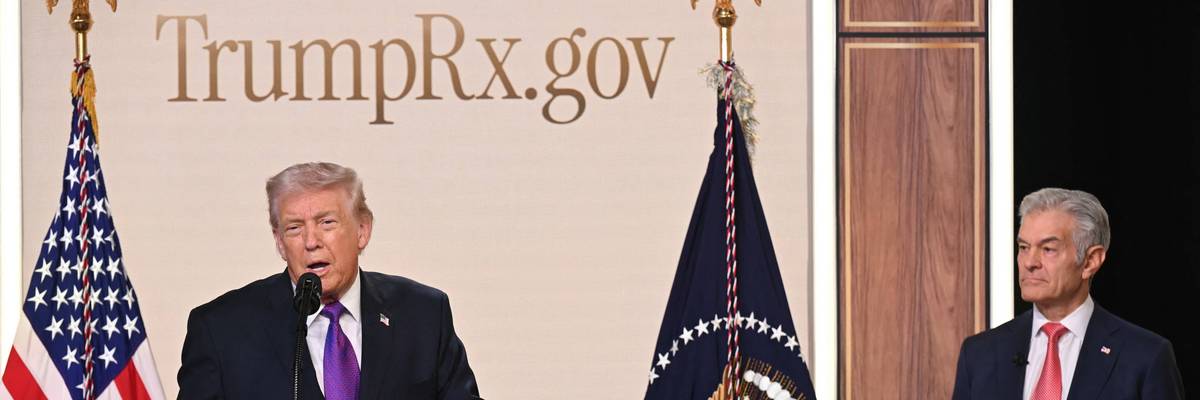
US President Donald Trump speaks about TrumpRx on February 5, 2026.
(Photo by Saul Loeb/AFP via Getty Images)


Jake Johnson
Aug 21, 2026
COMMON DREAMS

A new analysis published Thursday argues that President Donald Trump’s claims about prescription drug price reductions under his administration fall into one of three categories: “fake,” “exaggerated,” or “probably won’t happen.”

The analysis, released by the consumer advocacy group Public Citizen, came after Trump recently—and buffoonishly—tried to take credit for what was described as the largest year-over-year price drop in more than 60 years, even as experts said a Biden-era policy allowing Medicare to directly negotiate the prices of some drugs was likely the most significant driver of those cost reductions. Data from the US Bureau of Labor Statistics indicates that drug prices fell 3.1% last month compared to the previous year, apparently the biggest decline since 1963.

But Public Citizen emphasized that the Trump administration “did not publish the methods they used for their analyses so that their work can be independently verified.”

“For example, because the [Consumer Price Index for Prescription Drugs] is indexed to 1982, the administration would have had to recalculate the index in earlier years to make proper comparisons dating back to the 1960s, and we don’t have information on how this was accomplished,” the group’s analysis notes. “We also don’t know where they started the time cut offs for presidential administrations in their graph comparing Trump’s supposed achievements to other presidents. Team Trump has a history of misleading Americans using CPI-Rx data by for example picking arbitrary baselines that make their achievements look better. Their lofty claims were disproven in the past.”

Public Citizen also took issue with the Trump White House’s assertion that the president’s “most favored nation” (MFN) deals with pharmaceutical companies are responsible for falling drug prices. The group observed that the only element of Trump’s MFN agenda that has been fully launched is TrumpRx, which has not exactly delivered blockbuster savings.

“That’s in part because most Americans have health insurance and will do better purchasing drugs through their insurance plans,” Public Citizen said. “TrumpRx may also cause consumers to overpay on brand drugs, as many of the medicines on the site have cheaper generic competitors available at lower price points.”

The more likely cause of falling drug prices overall, according to Public Citizen, were “the genericization of expensive branded drugs,” the Biden-era Medicare price negotiation program that Trump and congressional Republicans have worked to sabotage, and regulatory changes that took effect in 2024, prior to the start of Trump’s second White House term.

“Trump has three kinds of drug pricing policy: fake, exaggerated, and not-real-yet, probably-won’t-happen,” Peter Maybarduk, access to medicines director for Public Citizen, said in a statement. “Prescription drug corporations are raising the prices of new medicines every year, and the CPI doesn’t even count that cost. It’s more likely that patent cliffs and Medicare price negotiation, which took effect this year and saved billions, drove changes in the CPI.”

“Trump’s claim to have lowered drug prices amounts to distortion and stealing credit from past administrations whose policies actually made a difference,” Maybarduk added.

Last weekend, Trump showcased to reporters a printout of a Washington Post story headlined, “Prescription drug prices record sharpest drop in more than 60 years.”

“I told you that was going to happen,” the president said.

Trump didn’t mention that the Post’s story highlights experts’ view that “a Biden-era policy that requires Medicare to negotiate prices for some popular prescription drugs is more likely to be driving down costs.”

Richard Frank, a senior fellow at the Brookings Institution and professor emeritus of health economics at Harvard University, told the newspaper that “if I was a betting guy on what mattered most, it would be probably stuff around the Inflation Reduction Act,” Democratic legislation that included the Medicare drug price negotiation changes.

Trump’s policies, Frank added, “wouldn’t be where I’d place my money.”

The president’s attempt to take credit for falling drug prices came as his administration actively worked to undermine the price negotiation program that’s helping drive costs down.

A Public Citizen investigation published earlier this month revealed that “a quiet change in policy interpretation” that the Trump administration wants to make permanent allowed AbbVie’s pancreatic enzyme medication Creon to escape Medicare price negotiations for at least another seven years.

“The Trump administration wants to make permanent a costly Medicare mistake, which creates windfalls for AbbVie and other drug corporations by excluding some expensive biologic drugs from negotiations for years,” said Maybarduk. “Medicare price negotiation already is far too generous to drugmakers, which gouge Americans for many years before negotiated prices kick in.”
‘One-Two Punch’: After Attacking Roadless Rule, Trump Targets Off-Road Vehicle Limits

One critic said the administration clearly plans to weaken restrictions requiring “the Forest Service to carefully manage our natural resources and listen to the public, then open the gates to industry and extraction.”


Pristine Boulder Creek flows from the Selway Bitterroot Wilderness toward the Lochsa River in the Clearwater National Forest of northern Idaho.
(Photo by Don and Melinda Crawford/Education Images/Universal Images Group via Getty Images)


Jessica Corbett
Aug 21, 2026
COMMON DREAMS

Still under fire for attacking the Roadless Area Conservation Rule this week, President Donald Trump’s administration provoked a fresh wave of criticism on Friday by targeting another policy meant to protect public lands.

The US Forest Service announced Friday that it was moving forward with a proposed revision to the Travel Management Rule that “simplifies the regulatory requirements to enhance quicker local decision-making and increase access, including for motorized vehicles, e-bikes, and other mobility devices.”

While leaders at the Forest Service and its parent agency, the US Department of Agriculture (USDA), framed the pending changes as progress, Defenders of Wildlife called out the administration for trying to “gut” the rule managing off-road vehicles.

“The USDA’s announcement to gut the Travel Management Rule and the roadless rule in the same week is a one-two punch that together deals a tremendous blow to wildlife,” said Vera Smith, who directs the advocacy group’s national forests and public lands program, in a statement.

“The Travel Management Rule states simply that motorized vehicles must stay on routes and areas designated locally for that use,” Smith said. “The Forest Service issued the rule over 20 years ago to curb damage from unmanaged recreation, reduce user conflict, and protect public safety. Rescinding it now is irresponsible and reckless.”

Hilary Eisen, federal policy director at the organization Wild Montana, was similarly critical, explaining that “the Travel Management Rule is why dirt bikers and snowmobilers can share national forest lands with hikers and backcountry skiers without conflict. It’s why our national forests provide habitat to support thriving wildlife populations. It is built on local decision-making, with a designation process that ensures that no user group gets steamrolled and all our national forest values are protected.”

“Just two days after doubling down on repealing the roadless rule, this announcement makes the administration’s plan obvious: Gut the rules that require the Forest Service to carefully manage our natural resources and listen to the public, then open the gates to industry and extraction,” Eisen warned.

“Forest Service leadership has already shown during the roadless rescission how much it values public input, science, and expert management: not at all,” she added. “Agency leadership has lost the public’s trust, and should expect the public to hold them accountable.”

Agriculture Secretary Brooke Rollins confirmed Tuesday that the administration was working to fully rescind the 2001 roadless rule that blocked road building and commercial logging on about 30% of all national forest land. She attempted to frame it as a move to prevent wildfires, but conservation groups contested her claims.

Josh Hicks, director of conservation campaigns at the Wilderness Society, declared that “opening our backcountry forests to more roads and development, and therefore more ignitions, is... not a wildfire solution, and never will be.”

Criticism of that pending rollback had continued throughout the week, with the Wilderness Society’s senior director of native lands partnerships, Starlyn Miller, calling out the administration’s “failure to engage in meaningful government-to-government consultation with tribal nations,” which she said “undermines tribal sovereignty and federal trust responsibilities.”

“This failure disregards tribes’ deep cultural, historical, and ongoing connections to these roadless lands and the clean water and wildlife they sustain,” said Miller, a Little Shell Chippewa citizen who is of Menominee and Mohican descendant. “We stand with tribal nations and Indigenous communities in defending their freedom to shape and manage forests that are vital to their cultures, identities, and future generations.”

National Congress of American Indians executive director Larry Wright Jr. also spoke out on Friday, saying that “tribal nations possess an inherent and legally recognized relationship with these lands, which remain the foundation of our cultural identities. Attempting to fast-track the removal of the roadless rule circumvents the mandatory government-to-government consultation process required by federal law.”

Wright, who is from the Ponca Tribe of Nebraska, added that “upholding the federal trust responsibility means honoring our treaty rights and ensuring that the protection of sacred sites is recognized as an uncompromisable legal obligation, not an afterthought.”


Conservationists Say Trump Gutting of Roadless Rule Is Corporate Giveaway, Not Wildfire Prevention

Trump has cleared the way for 45 million acres of protected forest to be opened for logging and construction in what one conservation group called the “largest evisceration of public lands protection in American history.”


A waterfall on Baranof Island in Tongass National Forest, Southeast Alaska, USA.
(Photo by Wolfgang Kaehler/LightRocket via Getty Images)


Stephen Prager
Aug 18, 2026
COMMON DREAMS

The Trump administration is moving to reverse a decades-old rule that protected 45 million acres of forest lands from logging and construction, in what the Center for Biological Diversity called the “largest evisceration of public lands protection in American history.”

On Tuesday, Agriculture Secretary Brooke Rollins announced that the US Forest Service had filed a proposed rule to fully rescind the 2001 Roadless Area Conservation Rule, enacted under former President Bill Clinton, which had prevented road building and commercial logging on about 30% of all national forest land.

Rollins described the “roadless rule” as a barrier to government wildfire prevention efforts. “Across the country, we’ve watched preventable conditions—overgrown stands, insect outbreaks, and disease—turn healthy landscapes into tinderboxes,” she said. “For too long, outdated restrictions have kept tens of millions of forested acres off-limits to the very treatments that improve forest health and reduce wildfire risk to our communities.”

But conservation groups argue that the administration’s reversal of the roadless rule has little to do with wildfire prevention and everything to do with opening up protected lands to logging interests and other extractive industries, which have long pushed for the rule to be weakened.

Increasing logging on federal lands has been a major goal of Trump’s second term, and repealing the roadless rule is part of that effort. An executive order signed in March 2025 calling for the “immediate expansion” of timber production said that federal policies had made the country unable to “fully exploit our domestic timber supply.”

In June2025, when the US Department of Agriculture first announced plans to rescind the roadless rule, it said that increasing timber production would be one of the benefits. The USDA said the rule hurt “jobs and economic development” and that repealing it aligned with Trump’s goal to eliminate “barriers that hamper American business and innovation.”


Earthjustice has argued that, contrary to what the administration says, repealing the roadless rule will actually lead to more wildfires, not fewer.

It points to findings from the Forest Service that 9 in 10 wildfires are caused by human activity, including throwing cigarettes out of windows, leaving campfires abandoned, and driving cars on grassy areas, causing them to ignite.

A peer-reviewed study published in January in the journal Fire Ecology by researchers with the Wilderness Society found that fires are about four times as likely to start near a road as in roadless forests.

Another study by the Forest Service in 2020, during the first Trump administration, examined two decades of data and found that roadless forests actually received more fuel-reduction treatments per square kilometer than areas elsewhere in the National Forest System.

“Speculation that eliminating road prohibitions would improve forest health is not supported by nearly 20 years of monitoring data,” the study concluded.

Josh Hicks, director of conservation campaigns at the Wilderness Society, said Tuesday, “Opening our backcountry forests to more roads and development, and therefore more ignitions, is... not a wildfire solution, and never will be.”

While doing little to curb the recent increases in wildfires exacerbated by climate change, conservationists argue that repealing the roadless rule will pose other harms to communities and wildlife across the country.

“Roadless forests supply clean drinking water for tens of millions of Americans, are home to irreplaceable wildlife, and store enormous amounts of carbon,” said Gabrielle Berthel, forest advocate at the Natural Resources Defense Council. “Repealing the Roadless Area Conservation Rule would allow for the fragmentation of some of the last intact forest ecosystems in the country, with irreversible consequences for the communities that rely on these forests and the people who seek out these special places for recreation.”

The Center for Biological Diversity (CBD) noted that these forests serve as habitats for numerous threatened species that risk being disrupted, including American wolverines, Canada lynx, grizzly bears, and northern spotted owls.

Randi Spivak, the public lands policy director at the CBD, emphasized that “these are some of the last truly wild forests left in the country... Once you start bulldozing roads for commercial logging and industrial development, there’s no getting them back.”

More than 625,000 public comments have been submitted to the Forest Service since plans to rescind the roadless rule were announced last June. The USDA will accept public comments on the proposal until September 21, after which the administration is expected to move toward a final rule later this year.

John Roberts Proves Alexander Hamilton Wrong: You Cannot Trust the Judges

The US Supreme Court has become a sinkhole of ideological extremism and corruption thanks to the current Chief Justice and those who have contributed to the overall hollowing out of the judiciary branch.


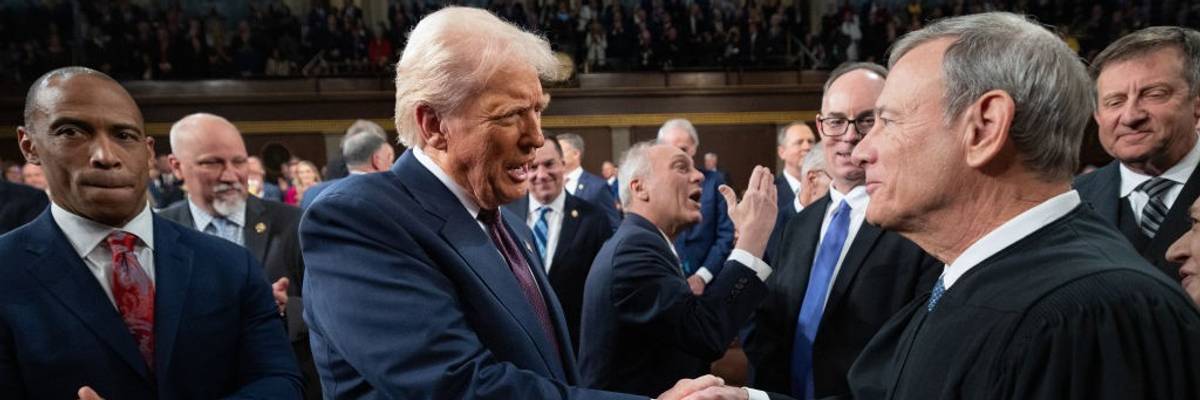
President Donald Trump (L) greets Chief Justice of the United States John G. Roberts, Jr as he arrives to deliver an address to a joint session of Congress at the U.S. Capitol on March 04, 2025 in Washington, DC. President Trump was expected to address Congress on his early achievements of his presidency and his upcoming legislative agenda.
(Photo by Win McNamee/Getty Images)

Bill Blum
Aug 21, 2026
Truthdig


If you want to understand how the Supreme Court became the sinkhole of ideological extremism and corruption it is today under the leadership of Chief Justice John Roberts, you have to go back to the beginning and examine the institution’s own origin story. A good place to start is with the debates on ratification of the Constitution that played out in 1787 and 1788 in what are now known as the Federalist and Anti-Federalist papers, in which the pros and cons of replacing the Articles of Confederation with a new national charter were laid out in passionate detail.

Totaling 85 essays, Alexander Hamilton was the author of 51 of the Federalist Papers; John Jay of New York and James Madison of Virginia penned the remainder. Of the three, Hamilton was the staunchest advocate for creating an independent federal judiciary fortified with the power of “judicial review” that would enable judges to declare acts of Congress and the executive unconstitutional.

Writing under the pseudonym “Publius,” Hamilton outlined the principles of judicial review in Federalist No. 78, explaining:
The interpretation of the laws is the proper and peculiar province of the courts. A constitution is, in fact, and must be regarded by the judges, as a fundamental law. It therefore belongs to them to ascertain its meaning, as well as the meaning of any particular act proceeding from the legislative body.

Hamilton was aware of the potential for overreach, but he believed the federal judiciary would prove “the least dangerous” of the Constitution’s three branches of government. Unlike Congress and the president, he reasoned, the courts would have “no influence over either the sword or purse,” but would possess “only judgment,” rendering them repositories of detached wisdom and impartiality. To put it plainly, his argument was that we could trust the judges.

Hamilton got a lot right about the need for judicial independence, but the faith he placed in the president and the Senate to select and confirm only well-qualified judges was egregiously wrong.

This was a novel and highly controversial idea at the time and remains a subject of contention nearly 240 years later.

Among the earliest dissenters was New York state Judge Robert Yates, a delegate to the 1787 Constitutional Convention. Yates feared that the power of judicial review would result in judicial supremacy, and historians consider him the probable author of several anti-federalist tracts published under the pen name of “Brutus.”

In Anti-Federalist essay No. 14, Brutus rebuked Hamilton, writing that under the new Constitution, the Supreme Court “would be exalted above all other power in the government, and subject to no control.” In No. 15, Brutus added in words that echo eerily to the present that the Supreme Court
[will] have a right, independent of the legislature, to give a construction to the constitution and every part of it, and there is no power provided in this system to correct their construction or do it away. … Men placed in this situation will generally soon feel themselves independent of heaven itself.

Hamilton’s position triumphed, and a Supreme Court equipped with judicial review became official doctrine with the landmark 1803 decision in Marbury v. Madison. But the triumph came with a price. Although it is difficult to imagine an independent court system that lacked authority to invalidate legislative and executive acts, judicial review has proven to be a two-edged sword. It has been wielded at times to advance democratic ideals (Brown v. Board of Education) but at others to thwart, damage and reverse those ideals (Dred Scott v. Sandford, Plessy v. Ferguson, and the cases invalidating key legislative pieces of the early New Deal).

We are in one of the dark periods now. With Roberts at the helm, the Supreme Court has used the power of judicial review to tack hard to the right on a number of fronts: reinterpreting the Second Amendment to include an individual right to bear arms, undermining the legal foundations of union organizing, removing political gerrymandering from the jurisdiction of federal courts, opening election campaigns to unlimited spending by corporations and wealthy individual donors, overturning the right to abortion, endowing the president with immunity for official acts and neutering the Voting Rights Act.

Hamilton got a lot right about the need for judicial independence, but the faith he placed in the president and the Senate to select and confirm only well-qualified judges was egregiously wrong. While he lived long enough to see Supreme Court Justice Samuel Chase impeached by the House of Representatives in 1804 (he died in a duel with Aaron Burr before Chase’s acquittal in the upper chamber), he scarcely could have imagined a court completely dominated by a chief justice who has falsely portrayed himself as an institutionalist committed to calling “balls and strikes,” and a supporting cast of grifters, ideologues and political hacks. He also likely would have been surprised to see how Roberts and his confederates have fulfilled Brutus’ fears by elevating themselves to the status of unaccountable and inscrutable Delphian oracles, who deign to tell the rest of us that they alone get to determine what the Constitution means.

The Roberts court’s rollback of constitutional rights is deeply unpopular, as reflected in recent polling showing that the court faces a legitimacy crisis of its own making. The rollback has sparked renewed calls for structural reforms, ranging from the imposition of term limits to restrictions on the court’s appellate jurisdiction and an expansion of the bench to as many as 13 members. Accomplishing any of these, however, will require Democrats to do three things: stiffen their spines, take back both houses of Congress and win the presidency. Even then, reforms will be difficult to achieve and slow to implement.

In the meantime, we need a theory of constitutional interpretation and reform to rival and ultimately displace the “originalism” that Roberts and his forerunners have deployed to engineer the right’s takeover of the Supreme Court. Fortunately, one such alternative, known as “popular constitutionalism,” already exists and is gaining traction.

As set forth by the legal scholar Larry Kramer in his 2004 book, “The People Themselves: Popular Constitutionalism and Judicial Review,” popular constitutionalism is the idea that “the people” — not as an abstract concept but as actual engaged citizens — are the ultimate source of constitutional meaning rather than the nine unelected black-robed members of the Supreme Court. We may be legally bound by the court’s rulings, but we have the right to criticize them, promote alternative interpretations and take peaceful action to overturn wrongly decided cases through voting, demonstrations, litigation, legislation, impeachment, amendments to the Constitution and a myriad of other means.

As New York Times columnist Jamelle Bouie wrote in June:
Constitutional meaning deals with the shape and structure of our political community. And as much as courts help build our collective constitutional understanding, the question of meaning is as much the purview of the public as it is the job of a jurist. … It is only in the last half-century, in fact, that we have fully conflated legal decision-making with the production of constitutional meaning. The result … is a strong form of judicial supremacy, where the meaning of the Constitution and therefore the structure of our political community are fixed in place by the decisions of a small, cloistered and often self-interested tribunal.

Even Hamilton, the principal proponent of judicial review, conceded in Federalist 78 that his vision for the courts “did not by any means suppose a superiority of the judicial to the legislative power. It only supposes that the power of the people is superior to both. …”

There are a number of examples from the past that illustrate popular constitutionalism in action — the ratification of the 13th, 14th and 15th Amendments, the passage of the Civil Rights Acts of the 1950s and ‘60s, and more recently, the recognition of same-sex marriage, to cite just a few.

This summer, the legal commentators at Slate launched a series of articles and podcasts called By the People to renew this tradition. The series unpacks the history of popular constitutionalism and provides a guide to citizen involvement. After a brief hiatus, the series will resume in the fall, just as the Supreme Court convenes for another harrowing term.

It will take a long time to produce meaningful change, but as we move forward, we should remember that it took the radical right decades of organizing by groups like the Federalist Society and the promotion of originalism to highjack the Supreme Court. With that history in mind, we need to prepare for a marathon, not a sprint. More than anything else, we must be prepared to win.


© 2023 TruthDig

Bill Blum
Bill Blum is a former California administrative law judge. As an attorney prior to becoming a judge, he was one of the state's best-known death-penalty litigators. He is also an award-winning writer and legal journalist, and the author of three popular legal thrillers published by Penguin/Putnam as well as scores of features and book reviews published in a broad array of magazines and newspapers. His non-fiction work has appeared in a wide variety of publications, ranging from Common Dreams and The Nation to the Los Angeles Times, the L.A. Weekly and Los Angeles Magazine.
Full Bio >
'What do you think he meant?' Pentagon insider fears Trump will drop a nuke


Nicole Charky-Chami
August 19, 2026 
RAW STORY

President Donald Trump's hardening stance on Iran has rattled even senior Republican officials and generals in his own Department of Defense, with one calling him "a madman who can't be trusted," according to an insider.

Veteran White House reporter Brian Karem, in a report for Raw America, identified how Trump has been weighing using nuclear weapons against Iran over the past two months.

"One unnamed Pentagon official confided to Raw America that the president’s threat that 'a whole civilization will die tonight, never to be brought back again,' which he posted to his Truth Social early last month, was seen as particularly alarming within the DoD," Karem wrote.

"After what Trump said back in July, everyone should have known this is on the table," the Pentagon official told Raw America. "What do you think he meant by that?"

The comments follow a chilling statement from former Rep. Marjorie Taylor Greene (R-GA). The former Trump MAGA ally claimed in a post on X Sunday that the president discussed the possibility of using nuclear weapons against Iran in recent strategy meetings and called him "pure evil."

Greene argued that Iran was "nowhere near creating a nuclear weapon," and that the U.S. military had "killed their leaders and innocent little children in a school, and Iran has controlled the Strait of Hormuz ever since and punished the region for their part in it."

"And now our government is the one actually discussing lowering the nuclear threshold in order to use nuclear weapons against Iran even though Trump claims he’s won the war like 40 times and says the U.S. controls the [Strait of Hormuz]," Greene wrote.

She described why that was so troubling.

"Trump promised no more foreign wars, but may actually be the one who delivers a nuclear holocaust that would likely drag the entire world into major conflict, economic depression, and mass human suffering we’ve never seen in our lifetimes and maybe throughout history," Greene added.


After Bessent Comments, China Warns US That It Cannot Sanction Iran Out of Existence

A spokesperson for the foreign ministry of China, which receives 80% of Iran’s oil exports, said that going along with Trump’s “economic warfare” will “only lead to escalation that serves no one’s interests.”


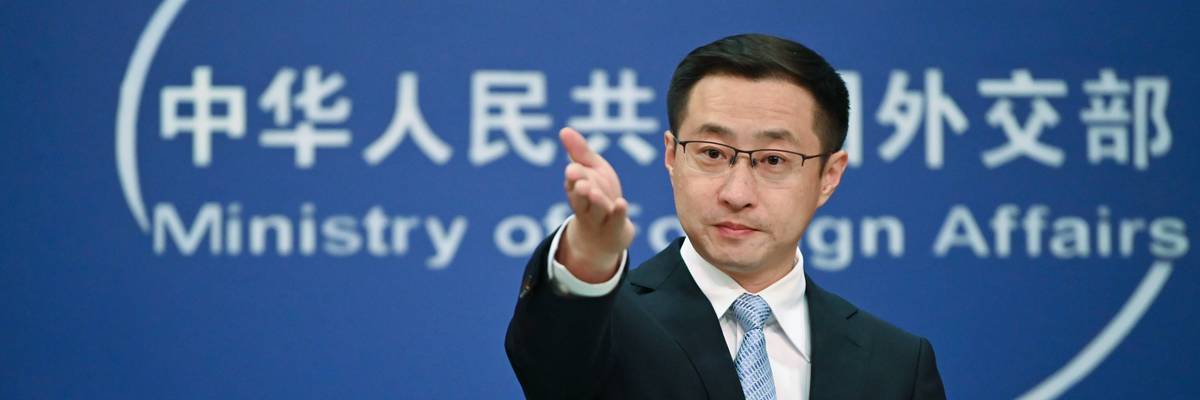
Lin Jian, spokesman for the Chinese Foreign Ministry, speaks at the ministry’s daily briefing  in Beijing.
(Photo by Johannes Neudecker/Picture Alliance via Getty Images)

Stephen Prager
Aug 21, 2026
COMMON DREAMS

The Trump administration is once again threatening to carry out “regime change” in Iran, this time using what President Donald Trump described as “economic warfare” against the nation rather than military might.

But as Treasury Secretary Scott Bessent demands the world play along with efforts to isolate Iran, the second-largest economy, China, is refusing to join the US sanctions campaign.

The Trump administration has failed to use military means to force Iran to open the Strait of Hormuz after it began restricting travel in retaliation for US and Israeli attacks in late February.

On Thursday, Bessent told CNBC that the new approach is to impose the “toughest sanctions in history” on Iran, ramping up a strategy that has inflicted suffering on the Iranian people but failed to force its leaders out of power for nearly 50 years.


Bessent emphasized that it would only work with the help of “all of our allies” carrying out the “greatest coordinated economic isolation in the history of the world.”

He made very explicit the goal of ratcheting up pressure on the regime by inflicting pain on the nation’s 90 million people, by causing “substantial inflation, both food inflation and ordinary inflation in Iran.” He compared the effort to the use of sanctions to strangle the economies of Venezuela and Cuba, which have fueled humanitarian crises in both countries.

Bessent gave an ultimatum that every nation is “either with us or against us,” and warned those who refuse to help with the administration’s effort to “squash the economy” of Iran that the US would “put its full might and force toward enforcing against you.”

He promised that any country that provides a “lifeline” to Iran would itself be sent into “economic oblivion.”

Iran responded to the threats by vowing a fearsome retaliation. “With preparedness across land, sea, air, air defense, and cyberspace, Iran’s armed forces will respond to the enemy’s new threats with crushing, punishing, and devastating responses,” said the chief of staff of Iran’s armed forces, Maj. Gen. Ali Abdollahi.

Iran’s parliament speaker, Mohammad Baqer Ghalibaf, acknowledged that the impact of further sanctions could indeed be devastating.

“We must make plans to deal with the unjust sanctions so that we can overcome them,” he said. “No matter how much military power we have, we won’t survive if people are hungry and we don’t have financial turnover, economic growth, and national production.”

As the US imposes its own blockade on Iran’s oil exports, Bessent called on China to “get with the program.” China buys about 80% of the oil exported from Iran, and Bessent emphasized that half of China’s energy comes from the Persian Gulf.


But Lin Jian, a spokesperson for China’s Ministry of Foreign Affairs, said during a press conference on Friday that China would not cooperate with efforts to isolate Iran.

“China believes that military means, sanctions, and pressure tactics are not the solution. On the contrary, they will only lead to escalation that serves no one’s interests. We call for efforts to solve disputes through dialogue and negotiation,” Lin told an Iranian government broadcaster.

Asked about the potential effects on China’s energy imports from Iran, he reiterated, “China opposes illicit unilateral sanctions that lack basis in international law and UN Security Council mandate.”

The question now is whether Trump will make good on his administration’s threats and retaliate against China. It’s likely easier said than done, as an economic war with the US’s third-largest trading partner could further exacerbate the economic turmoil Trump is seeking to ameliorate before the midterm elections in November.

Danny Citrinowicz, a senior researcher at Israel’s Institute for National Security Studies, suggested that China would be unlikely to surrender easily in that fight.

“China has a strong interest in preserving Iran under the Islamic Republic and maintaining Tehran’s strategic relationship, and growing dependence, on Beijing,” he wrote on social media. “Any economic strategy that assumes China will eventually fall in line with Washington risks being built on a fundamentally flawed premise.”


Shipping traffic through the Strait of Hormuz is still far below prewar levels, with the daily number of ships passing through in the single digits, according to Reuters.

Crude oil prices are still 30% higher than at the start of the war, while US gas prices are still up by more than a dollar per gallon.

But Trump, seemingly unwilling to admit that his campaign there has been anything less than successful, is continuing to claim that the strait is wide open thanks to US military action.

As Gregory Brew, a senior analyst on Iran and oil policy at the Eurasia Group, explained, this has left the administration’s messaging on why exactly it is now pivoting to ruthless economic warfare appear like disjointed doublespeak.

“Bessent and others cannot say what this policy is meant to achieve—reopening the strait—because in the admin’s telling, the strait is already open,” Brew said. “As a result, this return to maximum pressure feels oddly devoid of purpose. The US is inflicting economic pain, felt mostly by Iran’s people, rather than its rulers, for no clear reason.”