Thursday, September 10, 2026

New Spanish-made zinc-air battery design boosts capacity and power by 80%
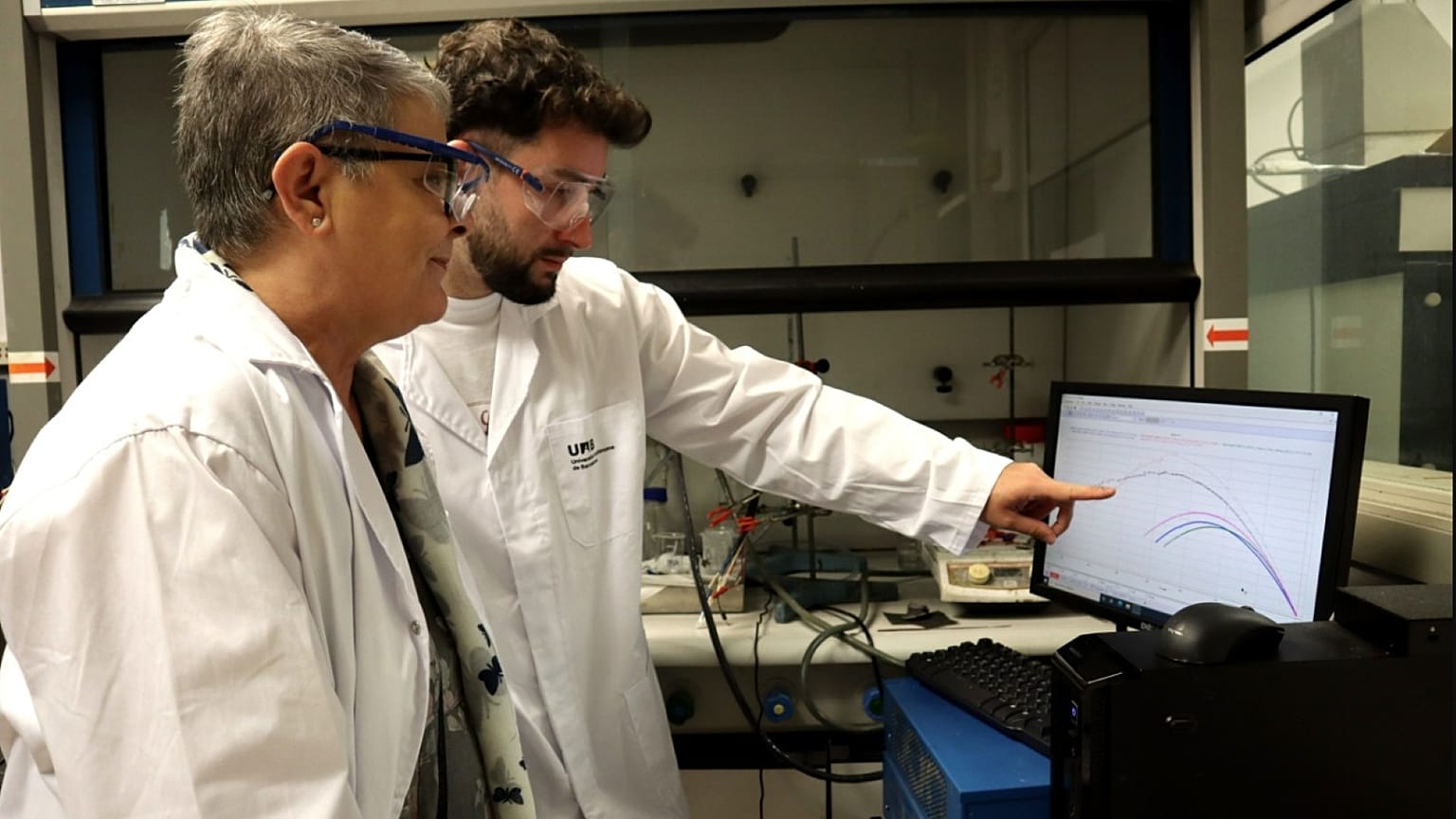
Researchers Nieves Casañ-Pastor and Marc Mosqueda
Copyright CSIC
By Escarlata Sánchez
Published on

A new technology from Barcelona's Institute of Materials Science reduces energy losses and boosts zinc-air battery performance, paving the way for other storage technologies.

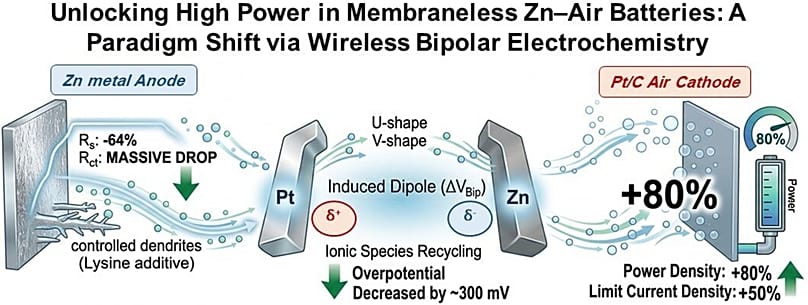
In Spain, researchers at the Institute of Materials Science of Barcelona (ICMAB-CSIC) have developed a new architecture for zinc-air batteries that can boost their power output by up to 80% without altering their core chemistry. The system adds conductive elements inside the battery, which act as wireless bipolar electrodes to facilitate charge transport and lower internal resistance.

The breakthrough opens up a new avenue for designing more efficient, higher-performance batteries. The study, published in the journal "Energy Storage Materials", was carried out in collaboration with the Catalan Institute of Nanoscience and Nanotechnology (ICN2) and the National University of La Plata in Argentina.

According to the researchers, this work and previous studies by the group question the conventional design of batteries and set out a new way of conceiving energy storage systems.

A design principle that rewrites the rules

Batteries generate electricity thanks to the energy difference between the materials in their two electrodes. Charges move from one to the other through the electrolyte, a material that allows ions to flow. Until now, it was assumed that this component had to block the passage of electrons to avoid any risk of a short circuit. The new study challenges this principle.
Zinc-air batteries
Zinc-air batteries Science Direct

The team led by Nieves Casañ-Pastor, a researcher at ICMAB-CSIC, has shown that, under certain conditions, small conductive metal pieces can be placed inside the battery without being connected either to the electrodes or to the external circuit, and that doing so can even improve its performance.

The key lies in the electric field generated between the two electrodes when the battery is operating. The researchers have found that inserting one or more isolated conductive elements between them does not cause a short circuit and can help to improve charge transport.

The electric field polarises the conductive pieces, which accumulate opposite charges at their ends and create new pathways for charge transport. This reduces internal resistance and makes it possible to deliver energy more quickly. "What is remarkable is that these conductors are not wired to anything: they are simply inserted into the system and they produce beneficial effects," Casañ-Pastor explains.

The oxygen challenge, the key to the new design

The research, which forms part of Marc Mosqueda's doctoral thesis, highlights the potential of zinc-air batteries, made from abundant, inexpensive and safe materials but limited by the slow reaction of oxygen.

The new design incorporates wireless bipolar electrodes that reduce internal resistance and speed up energy delivery, allowing power to be increased by up to 80%.

For Casañ-Pastor, the discovery opens up an avenue that could be applied to different storage technologies. The group has already observed similar effects in other systems and will continue to investigate the potential of wireless bipolar electrodes.

Portuguese economist Ricardo Reis dropped by IMF after criticising Trump tariffs

The IMF logo seen on the headquarters building in Washington
Copyright AP Photo

By Catarina Martins
Published on

Ricardo Reis warned that tariffs could drive up prices in the United States and potentially trigger a new wave of inflation.

Portuguese economist Ricardo Reis is reported to have been removed from the race for the post of chief economist at the International Monetary Fund (IMF) after criticising Donald Trump’s tariffs.

According to the Financial Times, which cites three anonymous sources, Ricardo Reis had been lined up for the role, but the IMF is said to have backed away after learning of the economist’s views on US trade policy.

Ricardo Reis, a professor at the London School of Economics, had warned that the tariffs could push up prices in the United States and trigger a new wave of inflation.

Meanwhile, in July, the IMF eventually appointed Silvana Tenreyro to the post, a former Bank of England policymaker and professor at the London School of Economics.

According to sources quoted by the British newspaper, Silvana Tenreyro also believes that tariffs hold back economic growth but is thought to be less critical of the Trump administration than the Portuguese academic.

Ricardo Reis declined to comment on the story or make any statements to the Financial Times.

The case comes against a backdrop of pressure from the Trump administration on economists who are critical of US tariffs.

The IMF refused to comment on the selection process, citing confidentiality, and insisted that the choice had been "rigorous and competitive".


Singapore PM increases his salary by $1.1 million amid first government pay raise in 15 years


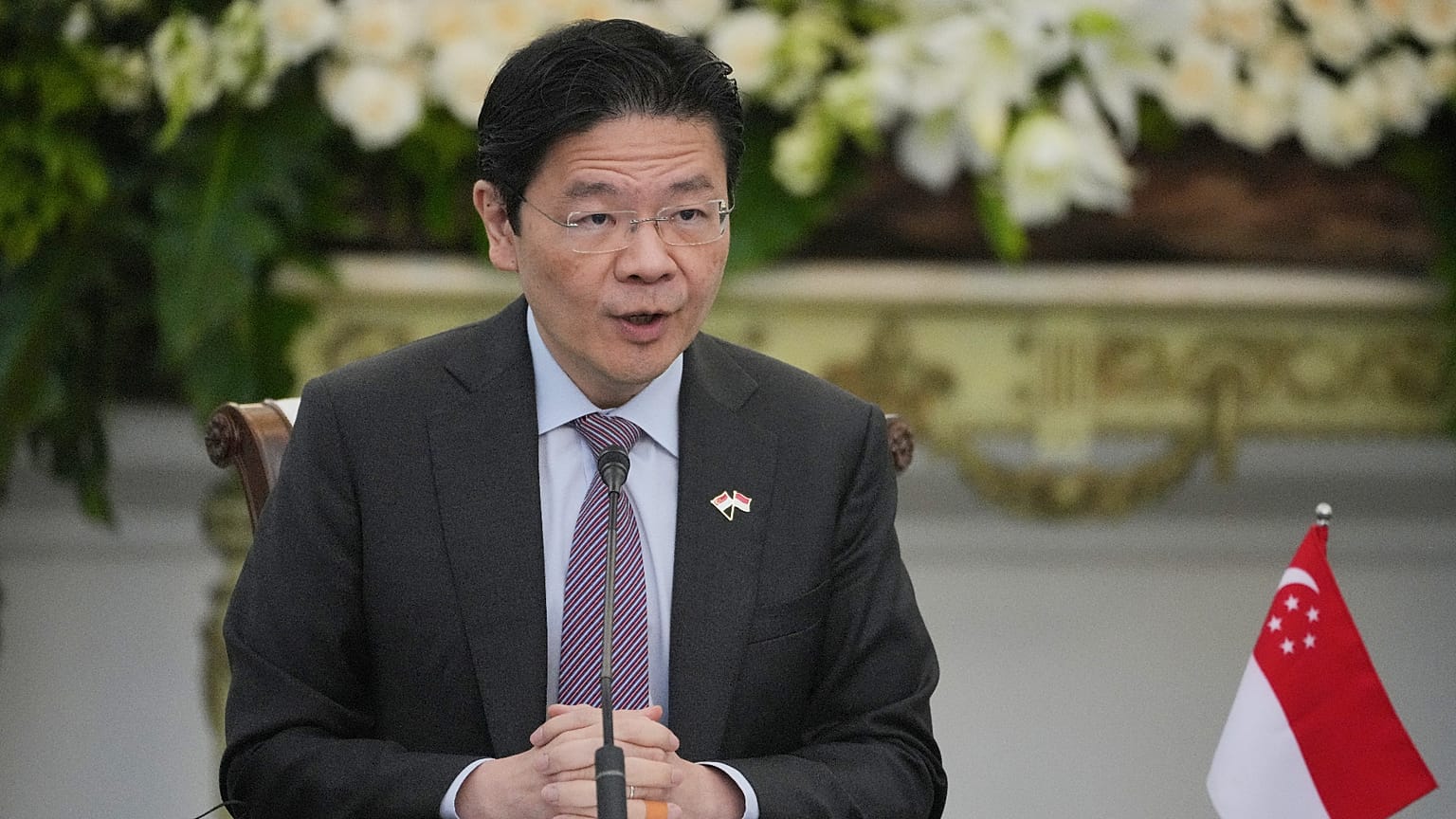
Singapore's Prime Minister Lawrence Wong speaks during a press conference in Jakarta, Indonesia, Monday, 6 July 2026.
Copyright 2026 The Associated Press. All rights reserved.

By Gael Camba
Published on

Prime Minister Lawrence Wong announced the salary increases in parliament on Tuesday, the first for ministers in 15 years. Wong's own benchmark paycheck is set to rise 64 percent to 3.6 million Singapore dollars (€2.4 million) a year.

Singapore’s ministers, already among the world’s highest-paid, are getting a raise for the first time in 15 years, Prime Minister Lawrence Wong said, explaining that the government cannot attract top talent into politics if salaries remain unchanged.

Wong told Parliament on Tuesday that under a revised salary framework, the benchmark annual pay for a minister at the lowest grade will rise to 1.8 million Singapore dollars (€1.2 million), from Sg$1.1 million (€747,564). The prime minister’s benchmark salary will jump to Sg$3.6 million (€2.4 million) from Sg$2.2 million (€1.5 million), he said.

Ministers' pay has long been politically sensitive in the city-state, especially amid cost-of-living concerns and a 2025 median gross monthly income of Sg$5,775 (€3924) for fully employed residents, according to government figures.

The increases were recommended by an independent committee.

Wong said, however, the ministers will not immediately get the full salary increases. They will receive a one-off adjustment of up to 9 percent from October 15, depending on individual circumstances, including performance.

Wong also said he would donate his entire salary increase to charity for the next five years.

Mixed reactions among Singaporeans

Singaporeans expressed mixed reactions on Wednesday over hefty pay raises for political leaders, with some saying the demands of governing justified the bump while others questioned their scale and called for transparency.

May Goh, 69, a retiree from the semiconductor industry, said the ministers deserve the increases. "I think their responsibilities are very high. They are doing a good job so far compared to other countries," she said.

A 32-year-old cybersecurity employee in the business district said she "honestly" thought the increases were fair. "They are basically the CEOs of the political world," she said.

Others were more guarded. The increases are "very steep", said a 26-year-old information technology consultant.

"When you see such a huge salary increase, it puts into perspective, like 'wow that's quite a lot'. We don't even spend that much," he said.

A 69-year-old retiree, while voicing support, said he wanted more transparency with the numbers.

"I wish they were a bit clearer and more transparent about these numbers, including bonuses," he said.


UK police probe Farage's Reform UK party over foreign funding

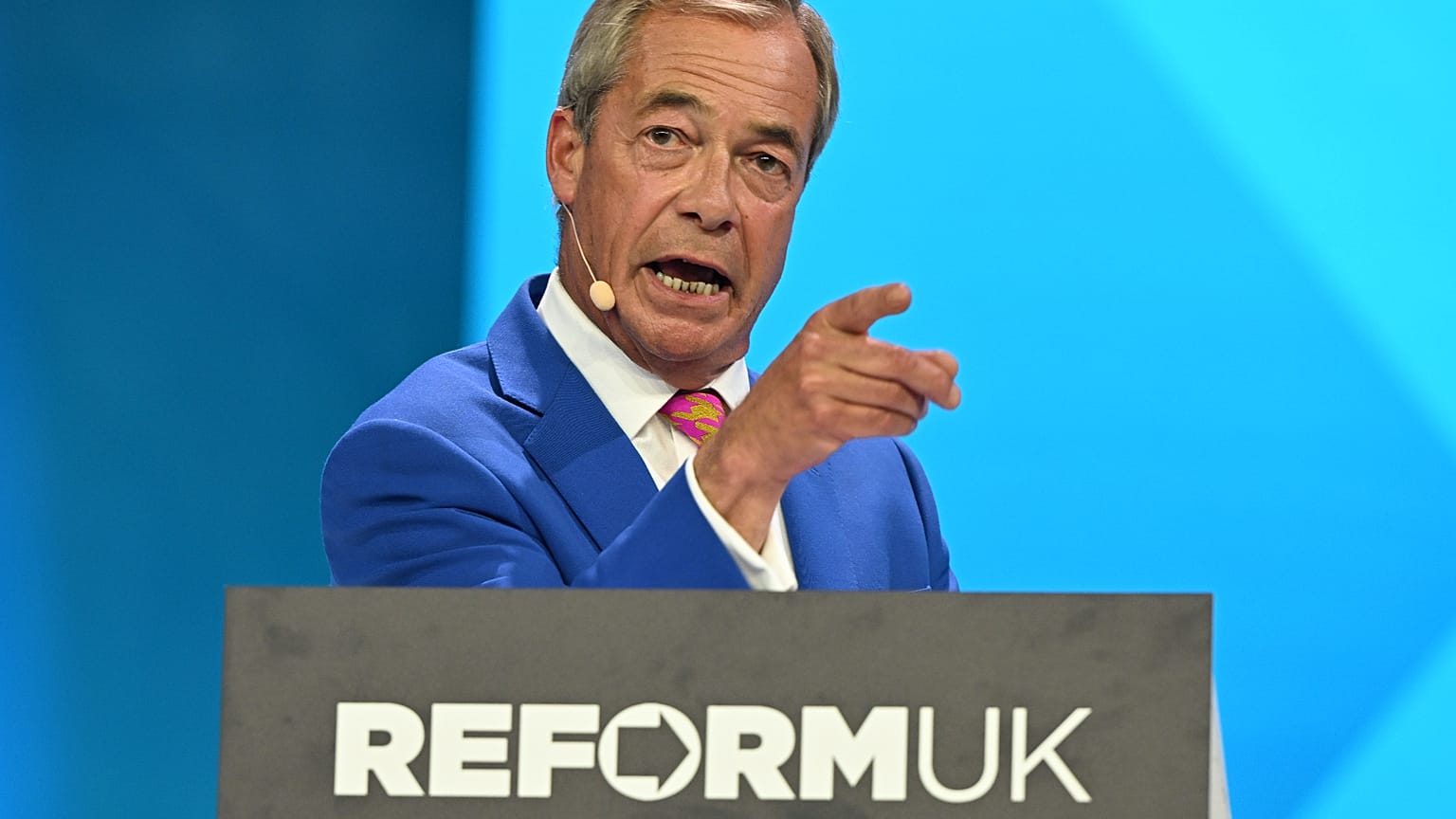
Reform Party Leader Nigel Farage points as he speaks during the Reform party's annual conference at the National Exhibition Centre in Birmingham, England, Friday, 4 Sept. 2026
Copyright Copyright 2026 The Associated Press. All rights reserved.

By Greta Ruffino
Published on

In a speech to the party's conference on Friday, Farage insisted Reform UK hadn't broken any rules or accepted "dodgy money".

British police said Wednesday that they have opened a criminal investigation into allegations that anti-immigration party Reform UK broke rules barring foreign donations.

The allegations emerged from an undercover investigation aired by Channel 4 News.

Under UK law, political parties cannot accept foreign donations.

The Metropolitan Police said that after the broadcast, the force “received a number of reports relating to donations and polling involving a political party.

“Detectives have assessed the information provided and determined that there are potential offenses requiring investigation,” it said.

Reform UK said it “denies any wrongdoing and will fully cooperate with the investigation.”

Following its release, Farage's aide Dan Jukes and Reform's head of policy James Orr stepped down, the party said.

A former Electoral Commission chief executive has told Channel 4 the evidence points to possible criminal offences.

What does the documentary show?

Last week, Channel 4 broadcast an undercover investigation in which two senior Reform UK officials appeared to discuss ways money from an American financier could be channeled through his UK-based son to get around the rules.

The footage showed Jukes discussing a potential £500,000 (€580,000) donation with two men posing as a US financier and his UK-based son, while Farage was present. The supposed son was actually a reporter for investigative group Verbatim, while the man posing as his father was an actor.

Separate footage appeared to show Reform UK policy chief James Orr discussing whether the supposed US donor could fund opinion polls commissioned by the party.

Reform UK already under scrutiny

Reform UK was already facing scrutiny over its funding before the documentary aired. Farage is being investigated by Parliament's standards watchdog over an undeclared gift worth around £5 million (€5.8 million) from a Thailand-based cryptocurrency billionaire in 2024.

Police are also investigating donations made to Reform UK ahead of the 2024 general election by the mother of George Cottrell, a Farage aide who previously served a prison sentence for fraud in the United States.

Police said Wednesday that the potential offenses raised by the TV program “are similar in nature to matters already under investigation by the Met’s Special Enquiry Team relating to donations made to the same political party. As a result, these matters will form part of that ongoing investigation.”


As lifelong homeownership fades, permanent renting becomes the new reality across Europe

Copyright Euronews
By Frances Lopez & Video by Loredana Dumitru
Published on

As lifelong homeownership slips out of reach for a growing share of the population, a new study tracking 39 OECD countries examines how permanent renting is reshaping housing markets—with countries like Switzerland and Denmark leading a global shift toward lifelong tenancy.

Homeownership is becoming harder to achieve across Europe, with renting no longer just a temporary phase but a permanent reality for many households, according to a new study.

The Forever Renter Global Index examined housing data across 39 OECD countries tracking where permanent renting is most common. European nations make up 28 of the 39 countries in the study, meaning 71.8% of the dataset.

This concentration puts European housing under a microscope, tracking critical metrics like renter shares, homeownership rates, rent costs, crowding, and how fast property prices have outpaced local wages since 2015.

The European landscape

Western and Northern European countries lead the index with some of the highest renter shares in the study.

Switzerland records the highest renter share globally at 61.2%, closely followed by Germany where 55.4% of the population rents.

Denmark claims the index's top overall rank with a score of 67.2 out of 100, maintaining a relatively even split of a 47.5% renter share and a 52.2% homeownership rate. Meanwhile in Luxembourg, renters account for just 36.0% of households while homeowners make up 62.3%.

Other Nordic and Western European countries face compounding financial pressures alongside these structural tenancy levels. Finland and Sweden report renter shares of 38.1% and 38.9% respectively, but both contend with severe rent burdens and structural crowding constraints.

In Southern Europe, Portugal maintains a high homeownership rate of 72.1%, with rental properties in short supply, yet suffers from severe wage decoupling where property prices have climbed 48.8% faster than local wages since 2015, driving its price-to-income index to 148.8.

In Central and Eastern Europe, Slovakia and Romania post massive homeownership rates exceeding 92% —with Slovakia at 93.5% and Romania at 92.8% —with renting making up less than 5%.

However, as regional data indicates, this widespread property acquisition frequently masks underlying economic strain, trading high tenant mobility for rigid, multi-generational housing environments.

Source : SD Worx

The hidden cost of ownership

High homeownership rates do not automatically translate to more comfortable living conditions. While Central and Eastern European countries boast ownership rates exceeding 90% —such as Slovakia at 93.5% and Romania at 92.8%—they frequently record severe spatial strains.

Countries such as Latvia and Bulgaria report overcrowding as affecting 30% or more of their populations, with multiple family generations forced to live together under the same roof.

In contrast, renter-heavy nations in Western and Northern Europe offer larger living spaces per household, showing that renting can afford people a more comfortable home than if they bought their own.

The global context

Across Anglosphere markets like the United States, Canada, Australia, and New Zealand, rental populations make up 30-40%, with high costs, mortgage swings, and large down payments delaying homeownership for younger generations.

Further south, in markets like Colombia, renter shares sit high at nearly 41% as rapid urban densification drives a strong rental culture.

Yet elsewhere in the broader Americas, nations like Chile and Costa Rica tilt heavily toward high ownership rates, mirroring cultural priorities seen across Southern and Eastern Europe where family-backed property acquisition remain the primary vehicle for wealth accumulation.

In Chile specifically, a high overall homeownership rate conceals a stark affordability divide; while older generations benefit from historical state-backed property policies, younger urban workers face severe hurdles that trap them in long-term renting because independent home purchases have gone entirely out of reach.


Desogestrel contraceptives: 1.6 million French women warned of tumour risk

France's medicines agency ANSM will inform 1.6 million women using desogestrel-based contraception of an increased risk of meningioma.
Copyright AP Photo

By Nina Borowski with AFP, AP
Published on

The French medicines agency (ANSM) urges women who take desogestrel contraceptives to seek medical advice if they develop suggestive symptoms, such as persistent headaches, visual disturbances or memory loss.

A low risk, but one that affects millions of women. In France, 1.6 million women who have taken a desogestrel-based contraceptive (Antigone, Cerazette, Elfasette and Optimizette...) will receive a letter informing them of an increased risk of developing a meningioma, France's National Agency for Medicines and Health Products Safety (ANSM) announced on Thursday. The health authority stresses, however, that this risk remains "low".

At the same time, around 90,000 doctors who have prescribed these medicines will also be notified.

ANSM recommends that the women concerned consult their doctor if they experience persistent headaches, visual disturbances, muscle weakness, problems with balance or speech, memory loss, or the onset or worsening of epileptic seizures. A brain MRI scan may then be prescribed.

A risk that increases with the length of treatment

Meningioma is a tumour that develops from the meninges, the membranes that surround the brain. Most often benign, it can nonetheless cause significant neurological problems depending on its size and location.

According to a study by the Epi-Phare public interest research group published in 2024, one woman in 67,000 who has taken desogestrel develops a meningioma linked to this contraceptive. After five years of treatment, this proportion rises to one woman in 17,000.

The risk is doubled after seven years of use compared with women who have not taken this contraceptive. However, it disappears one year after stopping treatment. Women over 45, as well as those who have previously taken for more than a year a progestogen regarded as high-risk, are particularly affected.

The risk would nonetheless remain far lower than that associated with other progestogens, such as Androcur, Lutényl, Lutéran, Colprone or Depo Provera, for which monitoring by brain imaging is systematically recommended.

"This risk is low, and bears no comparison with that of Androcur, which was 20 times higher after five years", says Isabelle Yoldjian, ANSM's medical director.

Do not stop contraception without medical advice

ANSM is calling on the women concerned not to stop their contraception without medical advice and is urging them to discuss the issue with their doctor, gynaecologist or midwife at their next consultation.

The health authority also reminds women that any contraception should be reassessed every year with a healthcare professional, depending on each woman's needs and state of health.

Following a request from ANSM, the European Medicines Agency (EMA) this summer approved the addition of the risk of meningioma to the patient information leaflets for these contraceptives.

EU cuts primary student-teacher ratio to 13.3 as decade-long growth falters


By Cristian Caraballo
Published on

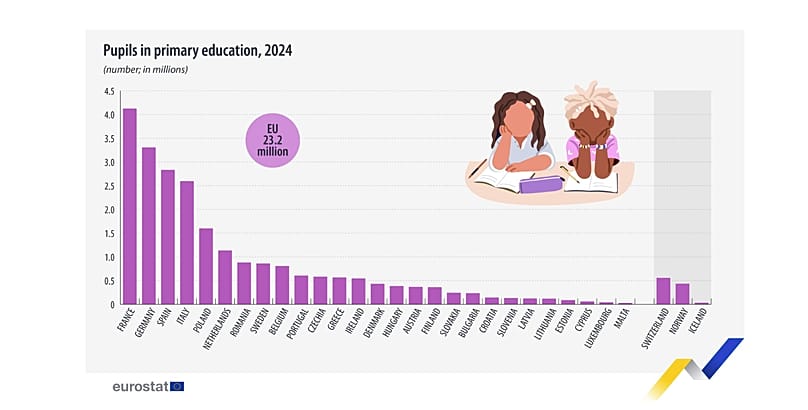
The EU had 23.2 million primary students in 2024, down 0.2% from 2023. Since 2014, numbers have risen by 2.9%, though trends vary widely: Luxembourg and Slovenia grew the most, while Poland, Croatia and Portugal saw major declines.

In 2024, there were 23.2 million primary school students in the European Union, a figure virtually unchanged from the previous year, but the underlying trend has shifted over the past decade: today there are fewer students per teacher than in 2014.

The latest Eurostat data, released to coincide with International Literacy Day, confirm this and not only set out enrolment numbers but also detail how many teachers are in Europe's classrooms, who they are, and what types of schools they work in.

France remains by far the country with the most primary school children: 4.1 million in 2024. It is followed by Germany (3.3 million), Spain (2.8 million) and Italy (2.6 million). At the other end of the scale, Malta has barely 27,537 students; Luxembourg has 43,020, and Cyprus 60,596, figures that depend both on the size of each country and on the age at which children start primary school, which varies from one member state to another.

Compared with last year, overall primary enrolment in the EU fell by 0.2% (35,153 fewer pupils), a small but real drop.

The picture looks different over a longer period: since 2014, pupil numbers have grown by 2.9% (659,086 more), although the trend is highly uneven across countries. Fifteen member states gained pupils over those ten years, and eleven lost them. Luxembourg (+21.4%) and Slovenia (+18.2%) lead the increases; Poland (-25.7%), Croatia (-10.3%), and Portugal (-10.0%) record the largest declines.

Primary school pupils
Primary school pupils Eurostat

The student-teacher ratio in primary schools has fallen since 2014

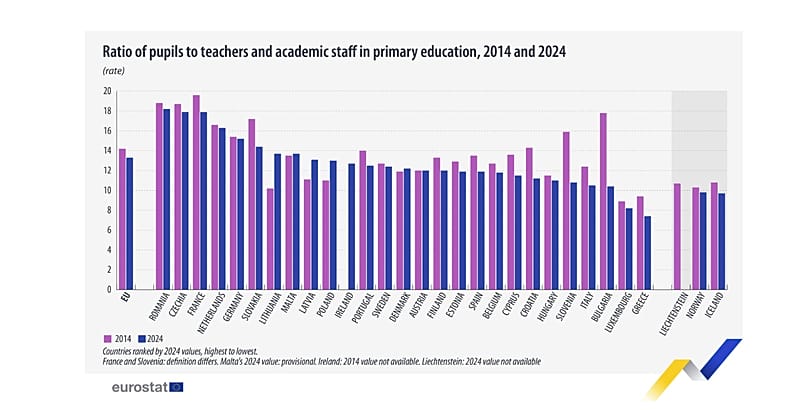
The student-teacher ratio, an indirect measure of teaching resources in an education system, also shows change. In 2024, the EU average was 13.3 pupils per primary teacher, compared with 14.2 a decade earlier. Greece (7.4) and Luxembourg (8.2) are the only countries below 10; at the other end, Germany (15.2), the Netherlands (16.3), Czechia and France (both 17.9) and Romania (18.2) all have more than 15 pupils per teacher.

The downward trend was repeated in 23 of the 27 countries between 2014 and 2024, with Bulgaria (from 17.8 to 10.4) and Slovenia (from 15.9 to 10.8) showing the sharpest drops. Austria is the exception that proves the rule: its ratio did not shift by a single decimal point, stuck at 12.0. The remaining countries saw increases, and Lithuania saw the most marked change, rising from 10.2 to 13.7 pupils per teacher.

Eurostat also sets out, in a broader analysis of the primary phase, how many teachers stand behind those students. In 2024, there were nearly 1.9 million primary teachers in the EU. Germany tops the list with 284,000, followed by Italy (251,000), Spain (248,000) and France (242,000, an incomplete figure as it does not include independent private schools).

Teaching remains an overwhelmingly female profession: 85.6% of primary teachers in the EU are women, compared with 14.4% men. In nine countries, the male share is below 10%; the most extreme case is Lithuania, where only 3.9% of teachers are men. Denmark, at 32.8%, has the highest male presence in primary classrooms, though males remain a minority.

By age, 42.1% of European teachers are between 35 and 49, 38.1% are over 50, and only 19.7% are under 35. Italy (58.2%) and Lithuania (57.3%) have the oldest staff; Malta and Luxembourg, by contrast, have more than double the EU average share of young teachers.

Comparison 2014-2024 of pupil-teacher ratio and academic staff in primary education
Comparison 2014-2024 of pupil-teacher ratio and academic staff in primary education Eurostat

Houthis capture Red Sea port city in push to seize Bab el-Mandeb

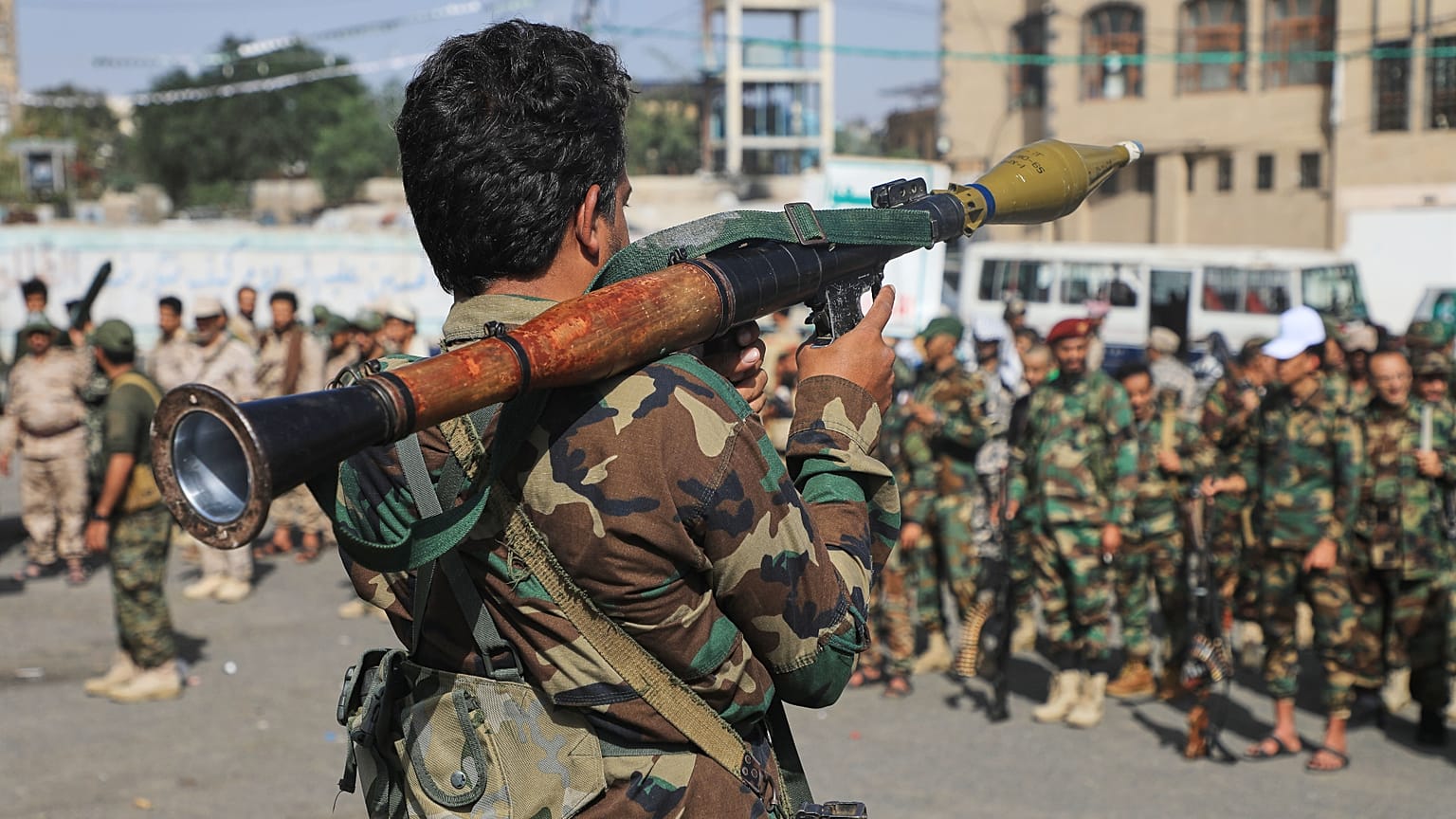
A Houthi fighter carries a rocket-propelled grenade launcher as they march during a mobilisation campaign in Sana'a, 10 September 2026
Copyright AP Photo

By Aleksandar Brezar
Published on

The Houthis' latest offensive is meant to replicate Iran's Hormuz blockade in the Bab el-Mandeb, with Red Sea coastal towns and islands in the crucial waterway among their next military objectives.

Yemen's Houthis seized control of the strategic Red Sea port city of Mokha on Thursday and were advancing towards the Bab al-Mandeb strait, a Yemeni military source said.

Witnesses said they saw Houthi forces entering the city while chanting "death to America, death to Israel".

The city which has been held by Yemen’s internationally recognised government has been under sustained attack since early August, when more than 25 missiles struck it in a matter of days and forced port operations to halt.

The Yemeni government is yet to publicly confirm Mokha has fallen.

The Houthis, who control about one-third of Yemen's territory — albeit the most densely populated parts — are vying to seize and potentially disrupt the narrow waterway which links Asia to Europe via the Red Sea and Suez Canal.

Together with Hormuz, cargo traffic through Bab el-Mandeb accounts for one quarter of daily petroleum and crude shipments, and nearly one-third of the world's maritime trade.

The Houthis have also reportedly consulted with Tehran on imposing a safe passage toll through the strait over the summer, in an apparent plot to further strain global economies.

Yemen's government has repeatedly warned of Houthi plans for taking control of the waterway, whose name in Arabic means "Gate of Tears".

Major-General Sadeq Duwaid, spokesman for the Yemeni government-affiliated National Resistance Forces controlling areas adjacent to the strait, earlier warned that the Houthi siege of Mokha was a key manoeuvre to build operational footing along the Red Sea coast.

"Through their continued attacks on Mokha and its port, the Houthi militia seeks to establish a presence along the shores of the Bab al-Mandeb Strait and transform the area into a situation resembling that of the Strait of Hormuz," Major-General Duwaid said in mid-August.

The coastal town of Dhubab and Perim Island — a rocky volcanic island that sits in the middle of the strait and divides it into two shipping channels — are now considered to be the Houthis' central military objective.

Fighting continues to escalate

Formally known as Ansar Allah, the Houthis launched a large-scale offensive last week against government forces backed by Saudi Arabia.

They also launched attacks on Saudi territory that left dozens wounded, leading Riyadh to respond with daily strikes on Houthi-held territory.

The Houthis reported on Thursday that about 40 airstrikes were launched by Saudi forces in a fresh salvo.

"The Saudi enemy's air force conducted around 40 strikes in recent hours in the governorates of Taiz, Hodeida, Al-Jawf and Marib," Houthi news agency Saba said.

On Wednesday the Saudi-led coalition fighting the Houthis said the group fired ballistic missiles and drones at several cities in southern Saudi Arabia.

The Saudi civil defence issued alerts warning of "potential danger" in two areas, Khamis Mushait and Abha.

Inching towards Bab el-Mandeb

The Houthis came to power in late 2014 after storming Sana'a and seizing the presidential palace and key military sites, forcing Yemen's government into exile.

A UN-brokered truce in April 2022 had largely halted years of active warfare, yet it never resulted in a lasting political settlement.

The group is part of Tehran's so-called Axis of Resistance — a loose network of militant groups in several countries in the region including Hezbollah in Lebanon, Hamas in Gaza and militias in Iraq, all backed, trained and equipped by the IRGC to varying degrees.

While the Houthis do not control the part of Yemen’s coastline along Bab el-Mandeb, they held territory less than 100 kilometres away.

The group triggered a return to hostilities in Yemen's civil war in July, when they let an Iranian plane land in defiance of Saudi control of Yemeni airspace. Riyadh retaliated by striking the airport.

The Saudi-led coalition, which has been fighting the Houthis on the internationally recognised government's behalf since 2015, said it would "take all necessary measures and actions to respond to the sources of the threat and neutralise its danger".

Since last week, the fighting in Yemen has left more than 500 dead, mostly combatants, according to an AFP tally compiled from several sources.

Houthi attacks on oil infrastructure and Saudi tankers have further contributed to a spike in oil prices, which surpassed $100 a barrel on Thursday.

The group previously severely disrupted cargo traffic through the Bab el-Mandeb with their campaign against what they said was Israel-linked shipping during the Israel-Hamas war in Gaza, claiming it was a show of support for Palestinians.