Friday, September 11, 2026


NATO allies successfully thwart Russian undersea cable sabotage operation
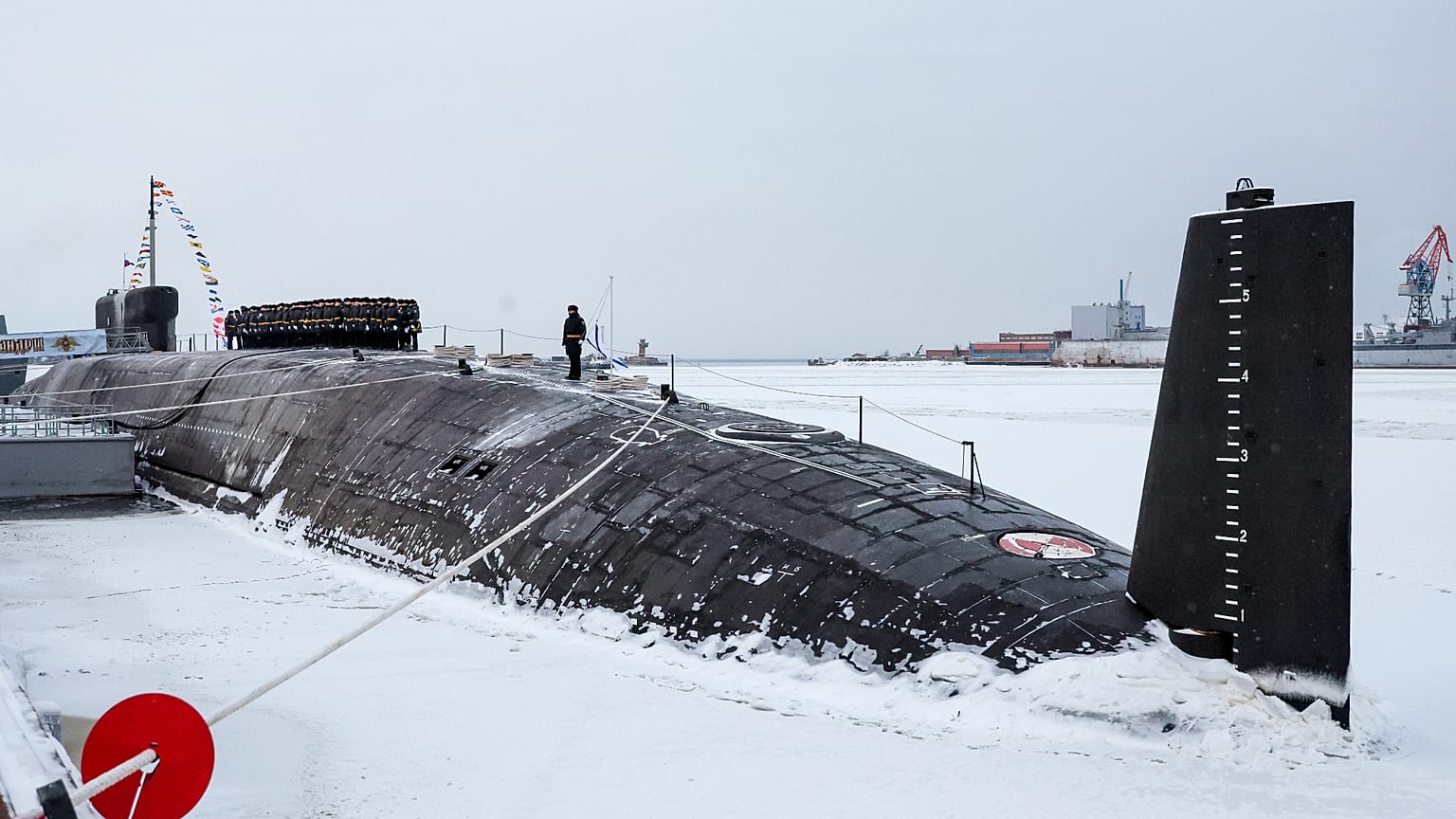
Three Russian submarines were prevented from completing their training in Arctic waters near vital undersea cables.
Copyright Sputnik

By Gael Camba
Published on

Western officials revealed that a joint NATO operation had succeeded in thwarting a secret Russian training exercise to disable critical undersea data cables.

NATO allies have caught Russian submarines training to carry out undersea cable sabotage using a secret weapon that leaves no trace, Reuters has reported citing two Western officials.

This clandestine Russian operation was carried out by the highly secret GUGI, the Russian undersea warfare directorate, in Arctic waters near Norway's Svalbard territories.

Britain said it had tracked and deterred three Russian submarines on an alleged month-long "covert operation" near vital undersea cables and pipelines connecting the Norwegian archipelago.

Following Euronews reporting on the operation that was announced in April, the discovery of the weapon, the location of the operation, and the US involvement have now been disclosed.

This joint operation between the UK, Norway, and the US successfully tracked and diverted Russian vessels before they could complete their exercise.

Secret weapon training

While Russia didn't damage any cables, it carried out this exercise to simulate the deployment of the secret weapon, in the event of a conflict with NATO, officials told Reuters.

They refused to give any details over the weapon or technology used by Russia.

While the confrontations were taking place at sea, UK and Norway officials faced Moscow with their findings in an attempt to deter Russia of using the secret technology.

Targeting essential infrastructure

Undersea fiber-optic cables that are as thick as a garden hose are the main conduit by which almost all of the world's internet traffic is channeled.

They are critical to global internet connectivity and financial transactions, which have increasingly made them targets for disruption of countries' communications.
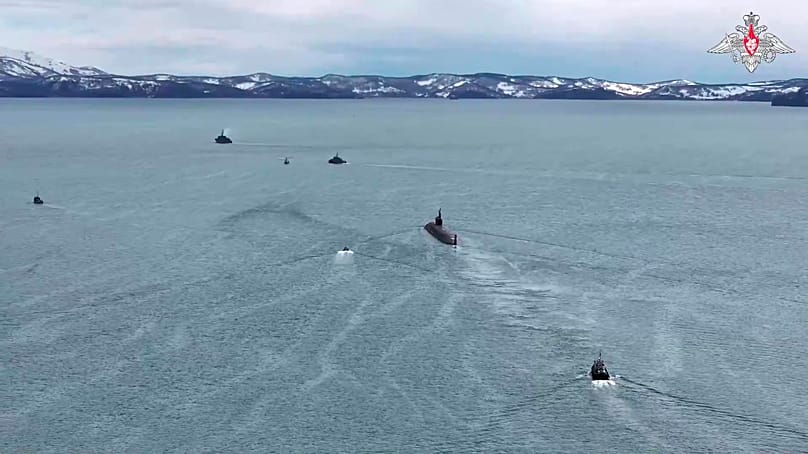
In this image from a video provided by Russian Defense Ministry Press Service on Thursday, 21 May 2026, a Russian nuclear submarine is escorted by boats during drills. Russian Defense Ministry Press Service


Russia's Defence Ministry did not comment on the topic as the Kremlin has consistently denied conducting sabotage in NATO countries.

"Through our joint operation, we ​sent a clear message to Russia that they cannot operate covertly," Norway's Defence Minister Tore Sandvik said to Reuters.

"We have made it unequivocally clear to Russian authorities that any attempt to target our critical infrastructure will be detected and met with consequences," he said. "It is in no ​one's interest to escalate tensions in the High North."

Increasing undersea Russian threat

Since the 2022 destruction of three of the Nord Stream subsea pipelines supplying Germany with Russian, NATO allies shifted their focus to undersea critical infrastructures.

Gradually more ships have been seen mapping undersea elements including pipelines, power cables and telecoms fiber-optic cables since 2023.

While it's not illegal to conduct such surveys in international waters, some experts say it could be preparation for sabotage.

"In the last 25 ⁠years, Europe did two ​things simultaneously. It dramatically expanded the extent to which it relies on seabed infrastructure, and it dramatically shrunk its capacity to protect that infrastructure," Bruce Jones, a senior ​fellow with the Brookings Institution told Reuters. "It's belatedly rebuilding now, in the face of a burgeoning Russian threat."

Contacted by Euronews, NATO refused to discuss specific details of the operation.

REST IN POWER

Emma Bonino dies at 78 after decades of political and human rights activism

Emma Bonino receives an honorary degree from the University of Brussels
Copyright AP Photo

By Stefania De Michele & Euronews
Published on

From the fight for abortion and women's rights to her commitment to Europe and human rights: Emma Bonino's political journey.

Emma Bonino has died aged 78.

The founder of More Europe, a longtime leading figure in Italy's Radical Party and former government minister, passed away after her health deteriorated in recent weeks.

Bonino had recently been admitted to the Santo Spirito hospital in Rome after a respiratory crisis. She arrived in critical condition and was transferred to intensive care so that her condition could be monitored. After an initial improvement, on 10 September, she left the ward and was moved to a private facility.

In 2015, Bonino revealed she had a tumour in her left lung. She underwent treatment for years while remaining active in politics. In 2023, she announced that she had overcome the disease.

In the following years, however, new health problems emerged. In autumn 2024, she was admitted to hospital in Rome for respiratory issues and, in November 2025, she suffered another serious episode that required admission to intensive care. On that occasion, doctors ruled out a recurrence of the cancer, instead identifying a metabolic problem.

A life devoted to Radical Party causes

For more than half a century, Bonino was one of the most recognisable figures in Italian radical politics. From abortion to contraception, from the liberalisation of drugs to the fight against the death penalty, she became closely associated with many of the country's major civil rights campaigns.

Born in Bra, in the province of Cuneo in 1948, she joined the Radical Party as a young woman and in 1976 was elected to the Chamber of Deputies. Even before entering Parliament, in 1975 she had founded the Information Centre on Sterilisation and Abortion (CISA), working to make safe and accessible abortion available in Italy.

Her activism also involved putting herself directly on the line. She deliberately risked arrest to draw attention to the dangerous conditions faced by women who sought illegal abortions. Such campaigns helped make Bonino a leading figure in Italy's feminist and radical movements.

From Italy to Europe

She entered the European Parliament in 1979. From Brussels, she focused in particular on human rights in Eastern Europe and opposition to authoritarian regimes.

In the late 1980s, she supported the Solidarność movement in Poland and was arrested and expelled from the country. In the years that followed, she was also arrested in New York during a campaign for the distribution of sterile syringes, and in Afghanistan, where she was detained by the Taliban after photographing women.

At the same time, her work broadened to major international issues: war crimes in the former Yugoslavia and Rwanda, the fight against the death penalty and the construction of an international criminal justice system. She was also among the supporters of the creation of an International Criminal Court.

From 1994 to 1999, Bonino served as a European Commissioner, with responsibility for humanitarian aid, fisheries and consumer policy. During those years, she followed the crisis in the Balkans closely and spoke out about the responsibilities for, and consequences of, the violence in Bosnia.

Her support for Western military intervention in the Balkans was one of the most controversial choices of her career and brought her into conflict with part of the peace movement.

Throughout the 1990s and 2000s, she continued to work on women's rights, supporting campaigns against female genital mutilation and for the protection of women in Afghanistan while also working for the recognition of the rights of African women.

Minister and key player in Italian politics

Bonino returned to Italy's government in 2006 as minister for International Trade and European Affairs in Romano Prodi's second government. In 2013, she was foreign minister in the government led by Enrico Letta.

Over the course of her career, she was elected seven times to the Chamber of Deputies and twice to the Senate. Her parliamentary experience spanned different political camps, although her political path remained above all linked to the radical, liberal and pro-European area.

In 2017, she was among the driving forces behind the creation of More Europe, a liberal and pro-European political movement that became a party in 2019. Even in her later years, she remained an active voice in public debate on civil rights, Europe, and international affairs.

A radical voice spanning five decades

With her death, Italy loses one of the most influential political figures during the second half of the twentieth century and the first decades of the 21st.

Alongside Marco Pannella, with whom she shared decades of Radical Party campaigns, Bonino brought issues into the streets and political institutions that, when she first championed them, were often still on the fringes of public debate.

Over time, she became an enduring part of Italian political history: combative, divisive for some, but hard to ignore.

From the battles over abortion to the death penalty, from Afghanistan to the Balkans, through to her pro-European commitment, Bonino built a political career around a conviction that never changed: rights are only truly rights if they can be defended even when doing so is uncomfortable.

 Europe’s ‘imagination gap’ risks empowering far right, survey warns


Half of Europeans cannot picture a credible path to a stronger EU, an “imagination gap” that risks ceding the political initiative to nostalgic far‑right forces, according to a major new study by the European Council on Foreign Relations (ECFR).


Issued on: 09/09/2026 - RFI

A supporter waves a European Union flag during an election-night gathering for the yes in Reykjavik, Iceland, Sunday, Aug. 30, 2026. © Marco Di Marco / AP

The report, based on 5,834 AI‑moderated interviews in Britain, France, Germany, Italy, the Netherlands and Poland, plus desk research in 15 EU states, identifies four broad "attitudes".

Catalyst for renewal

Around one in five are "positive", with some seeing crises as a catalyst for renewal; the largest group in most countries, however, is "negative", viewing Europe as being in decline; roughly a third of those questioned are "uncertain", wanting more Europe but doubting that leaders can deliver it; and about a tenth are "disconnected".


ЄС запровадив нові санкції проти Росії © Yves Herman / Reuters

While EU leaders have framed recent shocks — war in Ukraine, energy turmoil and US unpredictability - as Europe's "independence moment" in the EU Commission's 2026 Work Programme, public perception lags behind.

Some 68 per cent describe Europe today in terms of deterioration or "lost normality" versus only 12 per cent speaking of awakening or renewal, according to the ECFR study.

Nearly three-quarters say Europe is coping badly with its biggest challenges, blaming national governments twice as often as EU institutions.
Sources of doubt

The main sources of doubt among the "uncertain" group - the second-largest, at around a third of those questioned - are a perceived slowness in European decision-making; perceived double standards and capitulation to stronger powers; and insecurity over war, dependence on the US, and the rise of the far right.

The authors warn that when people cannot envision a believable tomorrow, they become "receptive to visions that recast the past as the future" — a dynamic, they say, that benefits far-right parties currently leading the polls in several countries.

To counter this, pro-European leaders should harness "future nostalgia": a longing not for a bygone era, but for the feeling that a better future was once within reach.

With Europe increasingly debated through domestic concerns — migration, climate, cost of living — the EU's fate will be decided in national elections, where the "uncertain" hold the balance, the report said.

(With newswires)


EU's largest political group doesn't want confrontation with China

The European Parliament in Strasbourg.
Copyright European Union 2026/EP/Mathieu CUGNOT

By Luca Bertuzzi
Published on

The EU's most influential political family is drafting a paper urging tougher use of trade leverage with China, while maintaining dialogue and avoiding a trade escalation.

The centre-right European People's Party (EPP) is preparing to call for a rebalancing of relations with China that stops short of open confrontation or full decoupling.

In the upcoming paper, senior EPP lawmakers are set to argue for a general rebalancing of economic relations by making fuller use of the bloc's existing economic leverage tools, stopping short of a full escalation, according to the early contents seen by Euronews.

The EPP is the largest and most influential political family at EU level, commanding the largest number of MEPs in the European Parliament and 14 out of the 27 commissioners in the European Commission.

Brussels has grown increasingly worried about the bloc's economic imbalances with Beijing, with a widening trade deficit that EU officials attribute to Chinese industrial overcapacity and generous state subsidies undercutting European competitors.

The EU has set October as the deadline to secure concessions from the Chinese government, after which point the European Commission is ready to impose "harsher measures", according to EU Trade Chief Maroš Šefčovič.

In this context, EPP MEPs sitting on the International Trade Committee are preparing a position paper due to be finalised in mid-October, on the heels of the next European Council summit.

The paper focuses on four main areas: rebalancing trade and investment, export control measures, intellectual property rights, and reform of the World Trade Organisation.

An early version argues for a balanced approach: promoting dialogue with China while more forcefully defending Europe's economic interests, notably by using trade defence instruments more decisively and developing new tools to counter unfair competition.

At the same time, EPP lawmakers insist trade measures should be proportionate and temporary, designed to strengthen the EU's bargaining power rather than lock in permanent protectionism.

The need to diversify supply chains and cut dependency on critical raw materials is also cited as a way to reduce China's economic leverage, notably through the ratification and expansion of free trade agreements with partners such as Mercosur, India, Indonesia and Australia.

The paper also calls for tighter customs enforcement and closer oversight of e-commerce platforms, as the Commission plans a major reform to close the enforcement gaps that let illegal goods into the EU market.

Aviation, semiconductors, pharmaceuticals and biotechnology are flagged as sectors the EU should further develop to cut its economic dependence on Beijing.

What we destroyed 25 years ago
September 10, 2026
ALTERNET

I can’t call it an anniversary, because it’s not something to be celebrated. I can’t describe it as a commemoration, because it’s not something I want to recall or commemorate. Nor do the words eulogy or remembrance or memorial or tribute feel right, because the words don’t convey the trauma and horror.

Perhaps merely the 25th year of observance.

Twenty-five years ago tomorrow, my family and I walked in silence to a Friends meetinghouse a few blocks away from our home in Cambridge, Massachusetts. We’d never been to that meetinghouse before, but it seemed fitting and necessary. We needed to sit in silence with others.


That morning, I’d been scheduled to take a plane from Boston to San Francisco. I remember feeling momentarily irked that it had been canceled because of the attack, as if to tell myself that the world could and should go on as before, as if to pretend I couldn’t have been on one of the planes that went down.

The nation’s coping mechanisms were soon in full flight and fight. George W. Bush had been rushed away from a photo op and whisked onto a plane that went into a secret flight path.


Dick Cheney and Donald Rumsfeld started to plot the fight that would take the lives of some 4,500 American service members and hundreds of thousands of Iraqis, and the detention — inside a network of overseas prisons known as “black sites” — of 119 Muslim men, at least 39 of whom were tortured. About 15 of them remain to this day at the Guantánamo Bay military prison.

Nativism and islamophobia soared in America.

The U.S. Department of Homeland Security (DHS) was established on November 15, 2002, when Bush signed into law the Homeland Security Act, designed to fight terrorism. It officially began operations on March 1, 2003.


ICE was created in 2003 and placed within DHS. Fighting terrorism quickly became the framework by which ICE approached immigration.

Trump’s police state is a direct descendant, along with its ICE agents deployed across the country, detention centers now imprisoning 65,765 people, mass deportations, and surveillance technology — including some 120,000 Flock cameras in 49 states that capture 20 billion license plates a month, along with dents, bumper stickers, and other identifying features.

For the past quarter century, opportunistic politicians and pundits — not the least, Trump — have encouraged Americans to fear Muslims and Islam, a religion practiced by 1.6 billion people around the world.

It is our solemn duty not just to remember what happened 25 years ago but to acknowledge and repudiate the brutality it summoned in America.

Robert Reich is a professor of public policy at Berkeley and former secretary of labor. His writings can be found at https://robertreich.substack.com/.

 9/11 changed the world forever. This is the story of the brutality that followed


It’s been 25 years since 9/11. What lasting imprint did the attacks leave on the global political order?

Season of Wolves argues that the post-9/11 era has been overwhelmingly understood through the language of terrorism and security. Against these state-spoken and media-echoed narratives, Mohammad-Mahmoud Ould Mohamedou reconstructs a deeper history of the last 25 years.

Through a comprehensive recasting of the events of September 11th to the mid-2020s he traces the emergence of a new political order marked by war, racism, propaganda, authoritarianism and technological oppression.

Season of Wolves lays bare the structures and forces that continue to define our times.

 
Find out more...
Mohammad-Mahmoud Ould Mohamedou (1968 – 2024) was a political historian, diplomat and acclaimed public intellectual. His books include a trilogy of the post-9/11 era: Contre-Croisade – Le 11 Septembre et le Retournement du monde, Understanding Al Qaeda and A Theory of ISIS. His writing brought a fresh approach to the studies of extremism, conflict, political violence and peace-building. He was a committed pan-Africanist and pan-Arabist. He worked as Professor of International History at the Graduate Institute of International and Development Studies in Geneva, and served as Mauritania’s youngest foreign minister in 2008.


9/11 name reader calls on Trump to release 'deep state' files mid-ceremony

9/11 family member demands release of documents at Ground Zero (Photo: Screen capture)
Sarah K. Burris
September 11, 2026

Each year during the Sept. 11 remembrances, family members read the names of the nearly 3,000 people killed. And, on the 25th anniversary of the attacks, one of those readings included a demand.

Speaking at Ground Zero, the nephew of Lisa Marie Terry, 42, of Oakland Township, read out his aunt's name to remember her. He then made a demand of President Donald Trump's administration.

"For 25 years, the deep state has hidden the truth about what happened that day 25 years ago," he began. "President Trump, you are our last hope. Release the unredacted files that implicate Saudi Arabia, while what's left of the victims' families are still alive to see it."

The bipartisan 9/11 Commission found that 15 of the 19 hijackers of the planes came from Saudi Arabia. Al-Qaeda leader and 9/11 mastermind Osama bin Laden was also from Saudi Arabia. However, the commission report found no evidence that the Saudi government institution itself officially funded al-Qaeda.


That hasn't been enough for many family members who want to see classified documents they believe implicate the Saudis in funding the attack.

Judge George B. Daniels of the U.S. District Court for the Southern District of New York ruled in 2025 that families presented credible enough information of Saudi involvement to continue with lawsuits from 9/11 family members against the Kingdom of Saudi Arabia.

“Most tellingly,” he wrote at the time, “the drawing of an airplane with equations related to the height and distance of a plane’s flight path, for which [Saudi national with links to 9/11 attackers Omar al-Bayoumi] could not come up with any reasonable explanation, facially connects Bayoumi with knowledge of the 9/11 Attacks.”

The Saudi government attempted to get the charges dismissed at the outset and the judge said that it was clear they tried to downplay the information.

"Although Saudi Arabia attempts to offer seemingly innocent explanations or context, they are either self-contradictory or not strong enough to overcome the inference that KSA had employed Bayoumi and [former Saudi diplomat Fahad al-]Thumairy to assist the hijackers," the judge wrote.

After 25 Years, 9/11 Continues to Shape How America Policies Immigration

For a quarter century, America has treated immigration enforcement as a form of counterterrorism. Yet, instead of making us safer, it has given rise to an increasingly militarized agency that, in the name of protecting ‘the homeland,’ uses its vast surveillance network and policing powers to target and kill innocent people.


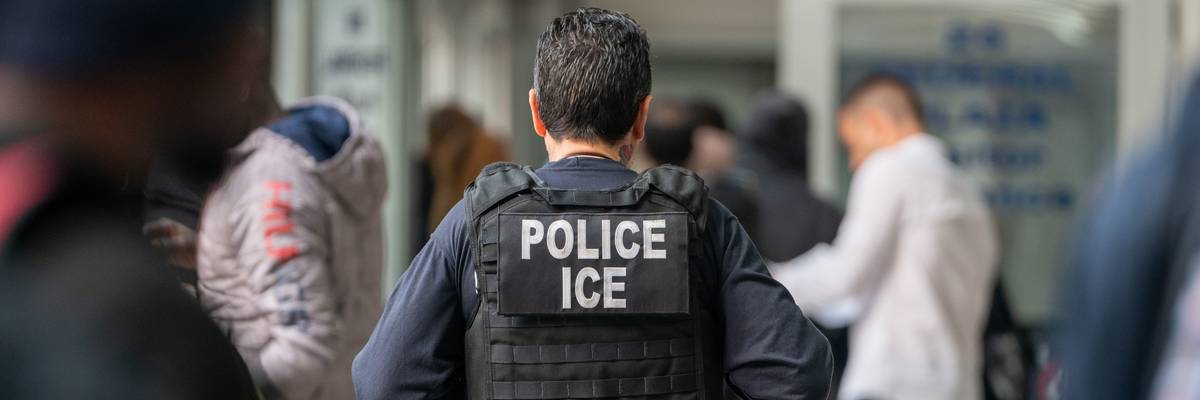
An Immigration and Customs Enforcement agent monitors hundreds of asylum-seekers being processed upon entering the Jacob K. Javits Federal Building on June 6, 2023 in New York City.
(Photo by David Dee Delgado/Getty Images)


Jordan Liz
Sep 11, 2026
Common Dreams


Since the start of its second term, the Trump administration has repeatedly defended Immigration and Customs Enforcement shootings and killings, smeared their victims as “domestic terrorists,” racially profiled people with the Supreme Court’s consent, expanded their biometric and social media surveillance capabilities while also maintaining over a dozen “secret and obscure” watchlists. It is effectively dismantling the Deferred Action for Childhood Arrivals program, tried—and is trying again—to repeal birthright citizenship, paused all immigrant visa applications, and is aggressively pursuing politically motivated visa revocations and denaturalizations, among other extreme measures.

All of this is reflective of the rampant and unfettered xenophobia, Islamophobia, and white nationalism that define the Trump administration. Yet, at same time, we must also acknowledge that Immigration and Custom Enforcement’s (ICE) violence and Trump’s assault on the immigration system is an extension of the national security framework built following the 9/11 attacks.

ICE was established in March 2003 as part of “the single-largest government reorganization since the creation of the Department of Defense.” A key rationale for including ICE within the newly created Department of Homeland Security (DHS) was that the 9/11 hijackers entered the US legally via temporary visas. To keep “the homeland” safe, a more aggressive approach to immigration was thus deemed necessary. As Attorney General John Ashcroft remarked in 2002:
In this new war, our enemy’s platoons infiltrate our borders, quietly blending in with visiting tourists, students, and workers. They move unnoticed through our cities, neighborhoods, and public spaces. They wear no uniforms. Their camouflage is not forest green, but rather it is the color of common street clothing. Their tactics rely on evading recognition at the border and escaping detection within the United States. Their terrorist mission is to defeat America, destroy our values, and kill innocent people.

Going forward, immigration enforcement and control agencies would police and surveil every immigrant as if they were potential terrorists. As the Department of Justice (DOJ) emphasized in 2004, “The primary mission of ICE is to prevent acts of terrorism by targeting the people, money, and materials that support terrorists and criminal activities.”

In the name of counterterrorism, the DOJ launched the National Security Entry-Exit Registration System (NSEERS) in 2002. Under this program, male foreign nationals aged 16 or older from 25 countries—24 of which were majority-Arab and Muslim (the other was North Korea)—were fingerprinted, interviewed, photographed, and required to check in with immigration officials at regular intervals. These regulations applied to both new arrivals and individuals who were already in the US on temporary visas. NSEERS was suspended in 2011 and finally terminated in 2016 by President Barack Obama—it led to no terrorism prosecutions.

Despite its failure, NSEERS, alongside other measures and decades of Republican fearmongering, functioned to normalize the link between immigration enforcement, border control, and counterterrorism. In doing so, it amplified the alleged danger posed by “radical Islamic terrorism,” thus setting the stage for the Trump administration’s relentless attacks on Muslims. This, in turn, served to distract from the far greater and actual domestic terrorism threat posed by white supremacist groups. As a report by the US Senate Committee on Homeland Security & Governmental Affairs noted, “In 2019, DHS publicly acknowledged white supremacist violence as a major threat to national security for the first time, despite being aware internally of the severity of the threat for 10 years.”

In our desperation to prevent another 9/11, we have spent billions building our own homegrown domestic terrorism threat.

The goal of combating terrorism also promoted a demand for more biometric technologies. As Sen. Dianne Feinstein (D-Calif.) noted in 2001, the reason why “a large group of coordinated terrorists [could] operate for more than a year in the United States without being detected” is because “we could not identify them. We did not know they were here. Only if we can identify terrorists planning attacks on the United States do we have a chance of stopping them. And the biometrics technology, the state-of-the-art technology of today, really offers us a very new way to identify potential terrorists.”

To that end, DHS established the US Visitor and Immigrant Status Indicator Technology (US-VISIT) program in 2003 to collect biometric identifiers from foreign nationals and build an electronic check in-check out system. As Undersecretary for Border and Transportation Security at DHS Asa Hutchinson remarked in 2003, “initially, fingerprints and photographs” will be used; however, “as the technology is perfected, additional forms such as facial recognition or iris scans may be used as well.”

Fast forward two decades and now, ICE agents are currently deploying facial recognition software such as Mobile Fortify. In May 2026, ICE awarded a $25.1 million contract to BI2 Technologies to acquire over 1,500 wireless, handheld iris-scanning devices. In its fiscal year 2027 budget request, DHS allocated $7.5 million to develop face-scanning “smart glasses” that would grant agents real-time access to biometric databases.

Now, importantly, none of this should be taken to mean that the pre-9/11 landscape was entirely welcoming to immigrants. The “browning of America” discourse depicted—and continues to depict—immigrants as an existential threat to the nation. Meanwhile immigration policies like the Illegal Immigration Reform and Immigration Responsibility Act (IIRIRA) of 1996 expanded the number of deportable offenses while also introducing expedited removal processes that allowed immigration officers to deport people without a formal hearing.

And yet, there were a few rays of hope. There was broad support for the Development, Relief, and Education for Alien Minors (DREAM) Act, with a Senate hearing scheduled for September 12, 2001. On September 6, 2001, the US and Mexico announced they had reached an agreement on a framework for border and immigration reform that included “respecting the human dignity of all migrants, regardless of their status; recognizing the contribution migrants make to enriching both societies.” At the time, both President George W. Bush and President Vincente Fox “agreed that US-Mexican relations have entered their most promising moment in history.” Then 9/11 happened, and everything changed.

For 25 years, America has treated immigration enforcement as a form of counterterrorism. Yet, instead of making us safer, it has given rise to an increasingly militarized agency that, in the name of protecting “the homeland,” uses its vast surveillance network and policing powers to target and kill innocent people. In our desperation to prevent another 9/11, we have spent billions building our own homegrown domestic terrorism threat.

After 25 years, we must finally recognize that DHS and ICE were never the solution. If we truly wish to make America safer and greater, we must choose to forge a new path—to work toward a world without war, resentment, and violence.


Our work is licensed under Creative Commons (CC BY-NC-ND 3.0). Feel free to republish and share widely.

Jordan Liz
Jordan Liz is an Associate Professor of Philosophy at San José State University. He specializes in issues of race, immigration and the politics of belonging.
Full Bio >
Victims of Our Post-9/11 Wars Deserve Remembrance, Too

Similarities between Reflecting Absence and an earlier German Holocaust “Counter-Monument” prompt reflections on accepting responsibility.


The September 11 memorial is shown.
(Photo by Mitchell Zimmerman)

Mitchell Zimmerman
Sep 11, 2026
Common Dreams

Few who pay their respects today in the hallowed plaza where the Twin Towers once stood will be aware that the September 11 memorial echoes a 1987 Holocaust “counter-memorial” in Kassel, Germany. Like our memorial, the German monument consists of a hollow in the shape of what had once been there, into which water flows.

But the scope of the remembrances evoked by the two memorials are revealingly different.

We Americans want only to recall our innocent dead and to honor them. Unlike the Germans, we spurn acknowledging the evils done in their name that came to be intertwined with our losses, the catastrophe we inflicted on an innocent nation, Iraq.
What We Can Learn From Kassel’s Holocaust Counter-Memorial

In 1939, the Nazis destroyed a 40-foot pyramidal fountain in Kassel, Germany because it had been built by a Jew, the entrepreneur Sigmund Aschrott. The elimination of “the Jews’ Fountain” was soon followed by the elimination of Kassel’s 3,000 Jews themselves.


The Aschrott Fountain (1908–1939) is shown.

Forty-five years later it was proposed to rebuild the fountain. But simply rebuilding the original fountain would have erased the memory of its destruction. So artist Horst Hoheisel designed a new fountain: “a mirror image of the old one, sunk beneath the old place in order to rescue the history of this place as a wound and an open question.”


The Memorial to the Aschrottbrunnen Fountain is shown. 
(Photo by Eistreter, CC BY-SA 4.0)

The September 11 memorial, which is called Reflecting Absence, evokes the missing Twin Towers by revealing their empty foundations. Hoheisel’s earlier Kassel counter-monument is, similarly, an emptiness in the shape of the missing original. “The pyramid will be turned into a funnel into whose darkness water runs down,” Hoheisel says.

“The sunken fountain is an invitation to passersby who stand upon it to search for the memorial in their own heads. For only there is the memorial to be found.”

The underground portion of the Aschrottbrunnen Fountain is shown. (Photo by Horst Hoheisel)

Kassel’s Holocaust memorial is one of many throughout Germany, part of the way the Germans have accepted responsibility for the crimes of the Nazi era. This small, local memorial compels us to think of those who were murdered, but also of those who murdered and those who stood by.

The installation of the Aschrottbrunnen Fountain is shown. 
(Photo by Horst Hoheisel)

We reflect on the small viciousness of destroying “the Jew’s fountain,” and the monstrous barbarity to which this was prelude. The small monument conjures the sadness of loss, and the responsibility of a people for acts that can never be made right.
Can America Accept Responsibility for the Mass Deaths Inflicted in the Name of Our “War on Terrorism”

The murder of thousands of Americans, the crime of September 11, 2001, spawned a larger tragedy for another people. Using the false suggestion of Iraq complicity as one of its pretexts, and treating the 9/11 “war on terrorism” as license for war on Baghdad as well as on Kabul, our government invaded Iraq, overthrew its government, and occupied the country.

In reality, as Bush White House anti-terrorism adviser Richard Clarke confirmed, Iraq was not responsible for 9/11 and our government knew it. “In the weeks immediately after 9/11,” Clarke explained, “the president… instruct[ed] the Pentagon to prepare for the invasion of Iraq... Even though they knew at the time from me, from the FBI, from the CIA, that Iraq had nothing to do with 9/11.”

Knowing that Iraq had nothing to do with the al Qaeda attack did not matter because President George W. Bush’s government had begun targeting Iraq for invasion long before September 11. The very first meeting of Bush’s national security team on January 20, 2001 included a discussion of “military options” for Iraq and overthrowing its government.

It would represent no insult to the memory of the innocents murdered in America, 25 Septembers ago, were we to acknowledge and memorialize the carnage and catastrophe we unleashed in Iraq.

As a delegation from our British allies secretly reported to their government before the invasion, “The intelligence and facts were being fixed around the [Bush] policy” of going to war. “The case [for war] was thin.”

The American invasion, and the resistance and chaotic civil war triggered by the US occupation, likely took between 500,000 and 1 million Iraqi lives. It made refugees of millions more, and inflicted malnutrition, birth defects, and other health disasters on a generation of Iraqi children.

It would represent no insult to the memory of the innocents murdered in America, 25 Septembers ago, were we to acknowledge and memorialize the carnage and catastrophe we unleashed in Iraq.

To America’s 9/11 memorial we should add a wall on which we engrave, in a necessarily small font, the names of however many can be identified of the million Iraqi men, women, and children slain in the wars and sectarian strife our invasion precipitated. And since President Donald Trump has ensnared our nation in another pointless war, another war of aggression based on the excuse of “terrorism,” a Middle East war he has no plan to end, we should inscribe as well the names of the Iranian civilians killed in Trump’s war. The 100 children slain at the beginning of the bombing campaign. The wedding guests bombed in a small Iran town last week. They deserve remembrance, too.

Of course, this is unthinkable and will never happen.

It would be “too political” to acknowledge any connection between the horrors we suffered and the horrors we inflicted. In fact, even the suggestion will be said to “disrespect” our honored dead—as though their memories could be further sullied than they already have been by the evil perpetrated in their names.

Nonetheless, the proposal may be useful. As Hoheisel says: “That’s how a counter-monument works. People get angry, they write letters, but you have a discussion. Out of this void, the history begins to come out.” In America, such a provocation may be the only kind of counter-monument that is permitted.


Our work is licensed under Creative Commons (CC BY-NC-ND 3.0). Feel free to republish and share widely.

Mitchell Zimmerman
Mitchell Zimmerman is an attorney, longtime social activist, and author of the anti-racism thriller "Mississippi Reckoning" (2019).
Full Bio >

9/11 Began a US Reign of Terror in the Middle East—Now It’s Come Home

The so-called “War on Terror” has revealed itself to be a war OF terror, one that is being waged by our own government on foreign soil as well as here in the United States.


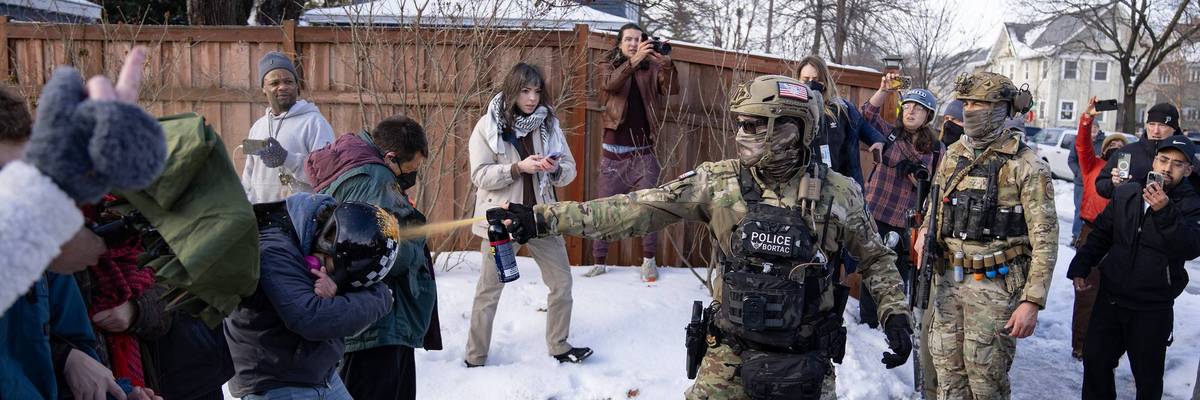
A Border Patrol Tactical Unit agent sprays pepper spray into the face of a protester attempting to block an immigration officer vehicle from leaving the scene where a woman was shot and killed by a federal agent earlier, in Minneapolis, Minnesota on Wednesday, January 7, 2026.
(Photo by Alex Kormann/The Minnesota Star Tribune via Getty Images)

Gerry Condon
Sep 11, 2026
Common Dreams


On September 11, 2001, the world watched as the World Trade Center, the twin towers that represented US global dominance, were struck by hijacked US commercial jetliners and came crashing to the ground. Nearly 3,000 people were killed, from high-powered executive to clerical workers and immigrant kitchen workers. The hijackers were Middle Eastern men, primarily from Saudi Arabia.

Twenty-five years later, many questions remain about how the US military and security establishment could have allowed this to happen. Hardly anybody believes the official 9/11 story, which raises more questions than it answers, and there are many competing theories about who was behind this tragedy. Was this an incredible US security lapse or a highly coordinated false flag? Whatever the case, the neocons in George W. Bush’s administration immediately declared a “war on terrorism,” and put into motion their longstanding designs to conquer seven Muslim countries in the Middle East (as revealed by General Wesley Clark)—Iraq, Syria, Lebanon, Libya, Iran, Somalia, and Sudan. Over the last 25 years, the US has initiated wars against all of these countries, as well as Afghanistan.

US administrations under Presidents George W. Bush, Donald Trump, Barack Obama, and Donald Trump (again) are responsible for creating a hell on Earth throughout the Middle East, resulting in millions of deaths and millions more homeless refugees. Thousands of US soldiers also died in Iraq and Afghanistan, any thousands more carry the physical, mental, and spiritual wounds to this day.

These nations may never fully recover, but Iran still stands. It may be the only Middle Eastern country still strong enough to resist domination by Israel, the US, and the former European colonial powers. That is why it is being frantically targeted by militarists in Israel and the US And that is why the US peace movement must do all we can to end the escalating US on Iran.

Who Are the Real Terrorists?

Under the slogan of “the war on terror,” the US government has carried out an increasing campaign of terror worldwide and against its own people. Torture has been normalized as represented by the extralegal Guantánamo torture prison on occupied Cuban land. The US and NATO provoked Russia into a catastrophic war in Ukraine which they continue to fuel with billions of dollars, arms, and military advisers. Democratic and Republican administrations and Congresses have enabled an ongoing Israeli genocide in Gaza and the West Bank. In January of this year, the US made a brazen attack on Venezuela, kidnapped its president and first lady, and are holding the Venezuelan government hostage while they steal Venezuelan oil. The US has blocked all oil shipments to Cuba, greatly exacerbating the damage done by the 64-year-old US blockade of Cuba, even as they threaten to invade. President Trump and “Secretary of War” Pete Hegseth post “snuff videos” of their blatantly illegal bombing of boats in South American waters, where they have murdered hundreds of fisherman and alleged “narco-terrorists” without any evidence or judicial proceeding.

Trump’s War of Terror Comes Home

The stepped-up US aggression abroad is now being mirrored by state-sponsored terror in these United States. Armed gangs of Immigration and Customs Enforcement (ICE) agents routinely carry out racist attacks on immigrant communities and people of color, no matter their immigration or citizenship status. The mass incarceration of Black men is now matched by mass incarceration of brown men, women, and children in for-profit prisons, where abusive conditions have led to many deaths. White supremacism is out in the open as cruel fascist practices are being normalized. US peace activists and immigrant rights activists are being labeled as terrorists and prosecuted as terrorists for nonviolent resistance to the terror of the state.

Even as the US war on Iran continues and escalates, the Trump administration and Republican Party are openly seeking to undermine the midterm US elections by blatant last-minute gerrymandering of congressional districts, by trying to prevent mail-in voting, by reducing the number of polling places, by threatening to deploy intimidating ICE agents at polling places and even “joking” about canceling the elections altogether. Veterans For Peace has joined with other veterans’ groups and military families in the Veteran Against Fascism coalition to do all we can to defend the elections, for example by providing safe accompaniment to the polls.

The Terror of Nuclear War

Adding to the atmosphere of global terror is the ever-growing threat of nuclear war. Multiple sources have confirmed that the Trump administration has been discussing the possible use of tactical nuclear weapons in its war on Iran. Pentagon war-gaming of the US use of tactical nuclear weapons has consistently resulted in global nuclear war that leads to a nuclear winter in which billions of people would starve to death—those that survived the initial nuclear blasts and radiation illnesses. Seventy-five countries have ratified the UN Treaty on the Prohibition of Nuclear Weapons, which outlaws possessing sharing, transporting, using, or threatening to use nuclear weapons. Nonetheless, the Trump administration has ditched the last remaining nuclear arms treaty with Russia, while it carries out a series of wars that—if not checked—will inevitably lead to nuclear war. In fact, the US is actively planning to wage a war against China that would start with a US nuclear first strike on China. These policies only lead more countries to seek nuclear weapons, directly the opposite of the stated US policy and treaty obligations to seek nuclear non-proliferation and good-faith negotiations to eliminate all nuclear weapons.

The so-called “War on Terror” has revealed itself to be a war OF terror, one that is being waged by our own government on foreign soil as well as here in the United States. On the 25th anniversary of 9/11, we must rededicate ourselves to resisting US wars at home and abroad.


Our work is licensed under Creative Commons (CC BY-NC-ND 3.0). Feel free to republish and share widely.


Gerry Condon
Gerry Condon is a Vietnam-era veteran and former president of Veterans For Peace.
Full Bio >