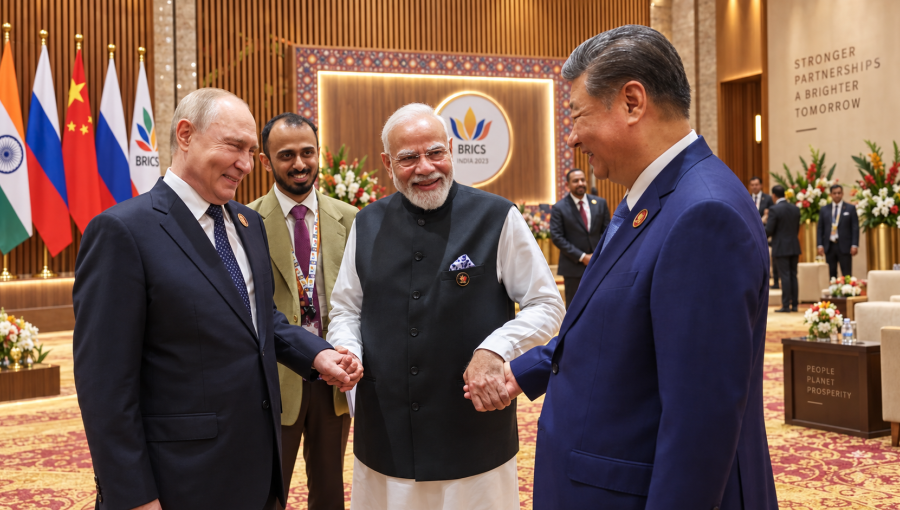
BRICS adopted the New Delhi Declaration unanimously on September 12, an enormous document of over 18,000 words, after negotiations that had to bridge members sitting on opposite sides of a Middle Eastern war.
That the text exists at all is the summit's main achievement. G7 and G20 summits usually result in a short, handcrafted statement that offends no one. This year’s BRICS summit declaration is a long draft on how a new multipolar international order could work. And it remains very much a work in progress.
And the three leading protagonists of this plan are Russian President Vladimir Putin, Indian Prime Minister Narendra Modi, who hosted the event, and Chinese President Xi Jinping who travelled to New Delhi for the first time in seven years to attend the meeting – a significant diplomatic gesture given the military tensions on the Sino-Indian border.
The main thrust of the results of the meeting boiled down to three big messages:
Political: BRICS is increasingly defining itself as the institutional voice of the Global South and pushing for redistribution of power inside the UN, IMF, World Bank, WTO and G20.
Economic: it is slowly constructing a parallel BRICS economic infrastructure — local-currency payments, development finance, guarantees, insurance, commodity trading, supply chains and potentially communications infrastructure — but most of these remain incremental early-stage projects rather than a fully-fledged alternative system.
Technology/industrial: AI, digital infrastructure, critical minerals, energy storage, smart grids, robotics, research networks and industrial policy occupy remarkably large parts of the declaration. BRICS is becoming as much an industrial and technology cooperation bloc as a geopolitical one.
The organisation has come a long way since the idea of the BRICs was coined by Goldman Sach’s head of research as a 1990s equity sales marketing term. Today the emerging BRICS bloc has become a geopolitical force, but it remains a young organisation riven by rivalries – not the least being the Chinese and Indian border dispute.
Kremlin spokesman Dmitry Peskov said last week that differences between the United Arab Emirates and Iran, who have joined the expanded BRICS+ group, were having a "negative impact" on the organisation and were holding up the drafting of a joint declaration. In the end the members found wording that deplores all forms of unprovoked aggression without naming anyone, ANI reported from the summit.
For Vladimir Putin, who arrived in New Delhi with a delegation of more than 300 Russian executives, the meeting delivered what a sanctioned head of state goes to such things for: a stage, a bilateral with his largest remaining customer, and a room in which nobody raised the war.
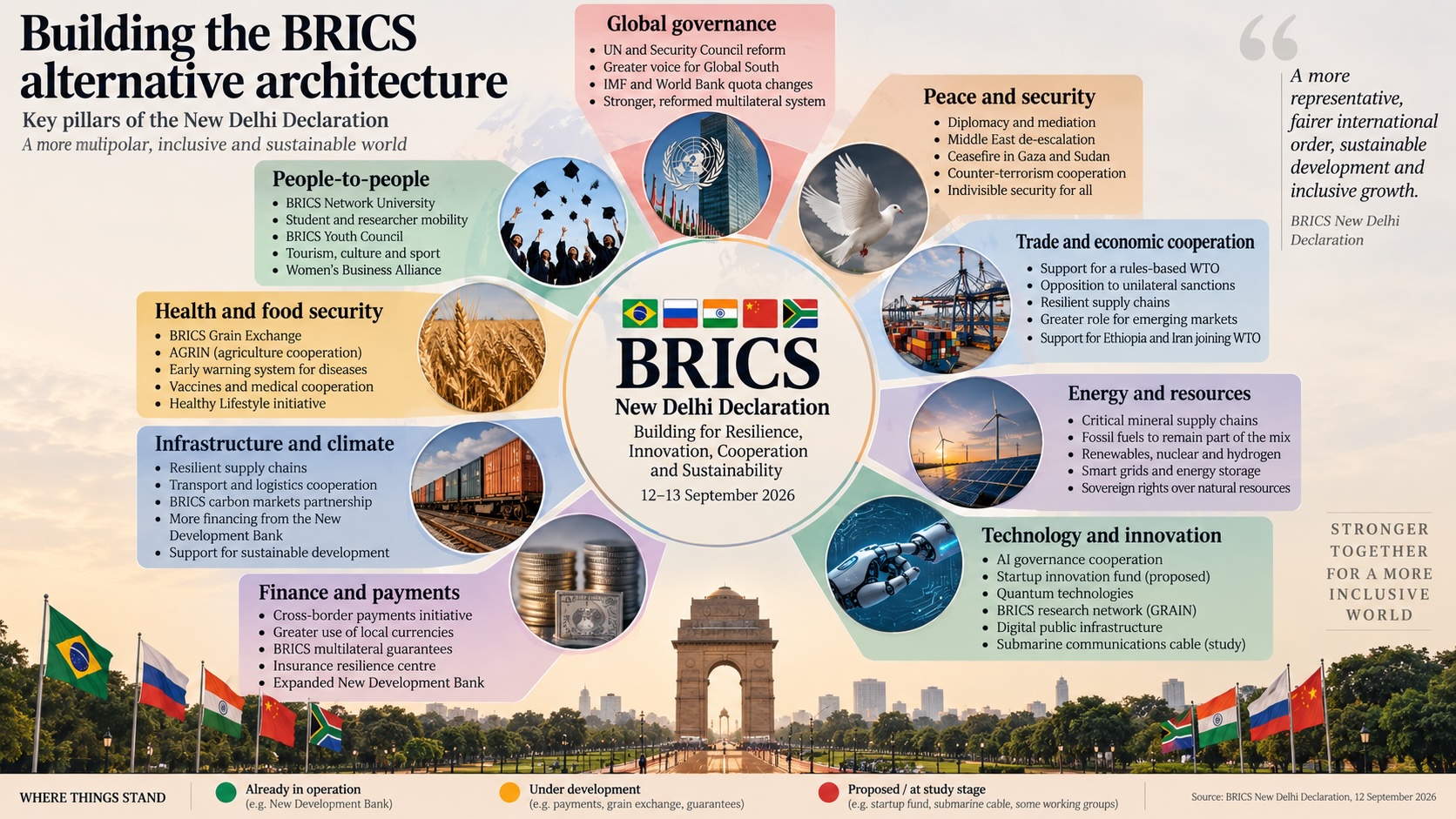
What the declaration says, and what it leaves out
The economic content is aimed squarely at Washington without using its name. The members recorded concern about rising unilateral tariff and non-tariff measures that distort international trade and breach World Trade Organisation rules, and called for reform of the United Nations Security Council to reflect current geopolitical realities. There are three European counties on the UNSC, one Asian, one US but no African or Latam countries present.
On the Middle East the declaration stresses the importance of protecting commercial navigation and the safety of seafarers, which is the closest the group comes to addressing the closure of the Strait of Hormuz and the fighting around Bab el-Mandeb.
Chairman Modi proposed turning ten governance reform proposals into a “BRICS Reform Roadmap” covering representation, responsiveness and rule-making, and described the aim as converting a "pyramid of privilege" into "a platform of partnership".
What the published accounts do not show is any language on Ukraine, which appears to have been ignored completely, although Modi in one public comment to Putin called for the war to ended and a ceasefire declared.
India has spent the year balancing its relationship with Moscow against American pressure over its Russian crude purchases, and at the Shanghai Cooperation Organisation summit in Bishkek on August 31 Modi also told Putin the war needed to end for humanity's sake. But in New Delhi the subject of the four-year old conflict did not make the text.
Putin says EU paying $1,500 for gas
The most quotable economic claim of the summit was Putin's, and it was about Europe rather than about BRICS. He said he does not rule out European gas prices reaching $1,500 per 1,000 cubic metres as a gas crisis in Europe begins to accelerate.
That is a forecast of roughly a doubling from current prices as the EU goes into the heating season with historically low amounts of gas in storage. Dutch TTF was trading around EUR81 per megawatt hour this week, up about 147% on the year, which converts to something in the region of $900 to $950 per 1,000 cubic metres. European storage went into August only 57.1% full, the lowest reading for that date on record, but is supposed to reach a 90% target by November – now impossible.
Kirill Dmitriev, Putin's investment envoy, put the same argument less carefully at the same summit, saying Europeans overpay for gas because of the “stupidity” of EU bureaucrats.
Russia's LNG export revenue rose 18% month on month in August and its pipeline gas revenue rose 25%, even as EU imports of Russian LNG fell 46% to the lowest monthly volume of the war, on the Centre for Research on Energy and Clean Air's figures. Europe is buying less Russian gas and paying Russia more for it. During the four years of war Europe has sent more money to pay for Russian gas than it has to Ukraine’s to support it in its conflict with Russia: €220bn for fossil fuels, compared with roughly €195bn in financial, military and humanitarian support for Ukraine.
Modi-Putin bromance continues
Putin met Modi on September 11 in the afternoon for talks on trade and energy. Indian media said the two would discuss lifting bilateral trade to $100bn by 2030, with cooperation in rail transit, steel, critical minerals, fertilisers and nuclear power. The Kremlin said earlier in the week that a possible sale of Su-57 stealth fighters was also on the agenda and the Indian army are desperate for Russia’s S-400 surface-to-air missile system to protect its northern borders.
A 300-strong Russian executive delegation was there to negotiate supply chains and food security contracts, which is a more accurate description of what the relationship now consists of than any communique. India took EUR4.8bn of Russian fossil fuels in August, 87% of it crude, and has bought 37% of Russia's crude exports since December 2022. And this delegation has an easy source of funding available: New Delhi has been running a $40bn trade deficit with Russia on oil imports, that has been piling up in Indian banks as a rupee mountain. Unable to convert its rupees into dollars, the two presidents have been looking for a way to mobilise this money.
But India is not only Russia's biggest oil customer, it has also become its fuel supplier: Russia imported 120,000 tonnes of petrol from the Vadinar refinery in August, sold by Nayara Energy, in which Rosneft holds 49.13%, because Ukrainian drones have taken out enough Russian refining capacity to make buying back its own crude cheaper than processing it at home.
Who else was in the room
From O’Neill’s original four, the BRICS organisation has now grown to eleven member nations all of which were represented, taking in in Egypt, Ethiopia, Indonesia, Iran and the UAE, with Saudi Arabia listed as a member by BRICS and by India though Riyadh has never publicly confirmed accession.
Putin, Iran's Masoud Pezeshkian and Modi attended in person, with Xi arriving on September 12. Representatives of the African Union, ASEAN, CELAC and Gulf Cooperation Council chairs gave the summit a partner layer beyond the immediate members.
The fault line everyone expected was the Gulf. Iran, Saudi Arabia and the UAE hold sharply different positions on the US and Israeli war on Iran, and BRICS foreign ministers had already failed to agree a joint statement when they met in May.
Putin used the margins for a run of bilaterals: Egypt's Abdel Fattah el-Sisi, whom he invited to a Russia-Africa summit in Moscow, Malaysia's Anwar Ibrahim, South Africa, and the crown prince of Abu Dhabi. He also met the head of the New Development Bank, the group's Shanghai lender, and said Russia supports broadening participation in its work.
Xi Jinping announced that China will take the BRICS chairmanship in 2027 and host the 19th summit.
What the group actually agreed to do
Despite the top level delegations, very little was achieved in concrete tmers. There is a declaration, a reform roadmap proposal, a chairmanship handover to China from India, and a set of bilateral trade targets. There is no announced common currency, no new lending facility of any size, and no mechanism attached to the complaint about unilateral tariffs. And little talk of resolving the running wars.
However, the purpose of the meeting was not to do deals, but continue the process of smoothing off the rough edges of the nascent geopolitical organisation that intends to build a new world order based in the Global South. This was more of a “get to know you” gathering than a nuts and bolts “get down to business” meeting.
It’s going to take some time. Members include two countries at war with each other's allies, one under comprehensive Western sanctions, and several that depend on American market access. With these conflicting tensions the group is not going to reach unanimity on anything, but for now is focused on thrashing out principles they can all agree on.
For Putin, the summit was a big win. Of all the BRICS nations, he is the only one that has definitively and irreparably broke with the old “unipolar” world order and has no choice but to commit to the Global South. His Western adversaries have done all they can to isolate Russia, and the comradery of the a Global South summit where he shares the limelight with the leaders of the two most populous countries in the world is worth its weight in gold. The Russian president spent two days being applauded at a business forum, and that the largest single piece of news to come out of it was his own line about European gas prices.
The summit ran in the same 48 hours in which the European Union failed, for the second time, to renew its sanctions on individual Russians, with the whole list due to lapse on September 15 unless ambassadors agree on September 14. Ukraine fatigue in Europe is building again as the cost of the war boomerang back on the increasingly dysfunctional European economy. As IntelliNews reported, Ukrainian President Volodymyr Zelenskiy is starting to look increasingly desperate as he runs out of men, money and missiles ahead of a widely anticipated brutal Russian missile campaign in an attempt to freeze Ukraine into submission.

No comments:
Post a Comment