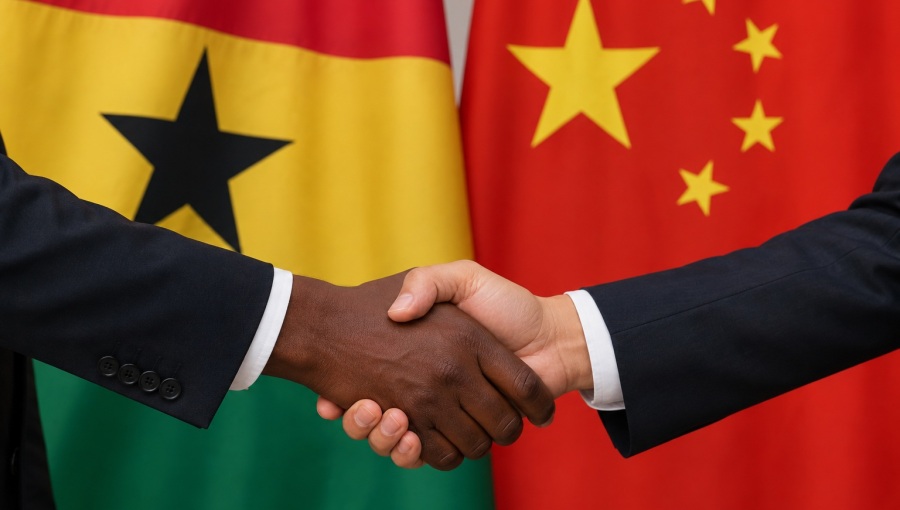
Ghana and China have agreed to strengthen oversight of Chinese mining companies operating in Ghana and deepen geological cooperation as Accra intensifies its campaign against illegal gold mining.
The two sides agreed to deepen cooperation during talks between Ghana’s Ministry of Lands and Natural Resources and China’s Ministry of Natural Resources on the sidelines of the 2026 China Mining Conference in Tianjin, Citi News reported.
The three-part strategy covers enforcement against illegal mining, technical cooperation in geological surveys and mapping, and efforts to attract more responsible Chinese investment into Ghana’s mining sector.
Lands and Natural Resources Minister Emmanuel Armah-Kofi Buah also used the Tianjin conference to seek Chinese investment in domestic mineral processing, technology transfer and infrastructure as Ghana seeks to capture more value from its mineral resources rather than relying primarily on raw-material exports.
Chinese groups already have a significant presence in Ghana’s gold industry. Zijin Mining (HKEX: 2899; SSE: 601899) operates the Akyem mine after acquiring it from Newmont (NYSE: NEM) for $1bn in 2025, while Chifeng Gold (HKEX: 6693; SSE: 600988) owns the Wassa mine and Shandong Gold (HKEX: 1787; SSE: 600547) controls the Cardinal Namdini operation.
The new arrangement is intended to strengthen enforcement against illegal mining, locally known as galamsey, while expanding technical and investment cooperation with China, a major source of mining capital, equipment and technology for Ghana’s minerals industry.
Ghana has intensified its anti-galamsey campaign as environmental damage mounts and public pressure grows over polluted rivers and degraded forest reserves. Buah said in August that 258 suspects had been arrested in operations against illegal mining in forest reserves, while the government estimated that about 8,900 hectares of forest reserves had been completely degraded.
The National Anti-Illegal Mining Operations Secretariat announced a broadened Operation WATER SHIELD campaign in September targeting financiers, facilitators, logistics networks and equipment suppliers supporting illegal mining around rivers and watersheds.
Buah said cooperation with Beijing would create a mechanism for holding Chinese companies and nationals operating in Ghana to higher standards.
“This is very important in how we collaborate on critical areas of the natural resources sector. This includes how to work with them in policing Chinese companies that are working in Ghana to make sure that they meet the highest standards,” he said.
Buah said the arrangement could also allow Chinese authorities to take action against Chinese nationals found to have breached Ghanaian mining laws.
“Those who are found to have broken the law, especially those who engage in illegal mining activities (galamsey), are not only punished in Ghana, but we have a pathway where the Chinese will also police their people who are working in Ghana,” Buah added.
The cooperation comes as Ghana struggles to convert arrests into successful prosecutions, a weakness Buah identified in August as a central problem in the anti-galamsey campaign.
Ghana is seeking to protect gold production and attract fresh investment into lithium and other minerals while curbing unregulated mining that damages forests and waterways and undermines confidence in regulation.
China’s Deputy Minister of Natural Resources Sun Shuxian proposed deeper cooperation in geological surveys, mineral mapping, technological innovation and assessments of Ghana’s critical-mineral potential.
Citi News reported that potential Chinese technical support discussed during the talks included satellite remote sensing and airborne geophysical surveys, which could help close gaps in Ghana’s geological data, particularly in areas that remain poorly mapped.

No comments:
Post a Comment