Friday, September 11, 2026

 Israeli Documentary ‘NAZA’ Exposes ‘System of Killing’ in Gaza From Eyes of Secret Intelligence Unit


The directors of the film—which premiered at the Venice Film Festival—said they “felt the responsibility” to expose insider testimony about Israel’s systematic mass killing of Palestinians.



NAZA co-directors Rachel Szor and Yuval Abraham attend the photo call for their documentary at the 83rd International Venice Film Festival, at Venice Lido on September 10, 2026.
(Photo by Stefano Rellandini/AFP via Getty Images)

Brett Wilkins
Sep 10, 2026
COMMON DREAMS

A documentary film that premiered Thursday at the Venice Film Festival offers a rare inside account of Israel’s US-backed genocide in Gaza, with former members of a secret Israeli intelligence unit describing how they helped transform the mass killing of Palestinian civilians into a routine, bureaucratized affair.

NAZA, directed by Israeli filmmakers Yuval Abraham and Rachel Szor, is based on interviews with 24 Israeli military and intelligence insiders, several of whom served in a secret unit that reported directly to the office of Israeli Prime Minister Benjamin Netanyahu.

“We really are looking at... a system of killing, which is mass killing [and] relies on mass surveillance,” Abraham told reporters in Venice on Thursday. “We felt the responsibility as Israelis to use our position... to bring insider testimony into how the system looks like from the inside... And this is the film that we made.”

Szor said that “a lot of these things are also, it’s important to say... known because they’ve been documented by journalists, Palestinian journalists, in Gaza. It’s footage that has been out there.”

“But I think that we felt that there is still some sort of an importance to take those testimonies and put it in a film in a way that, of course, first of all, it’s different to hear,” she added. “The people who designed and operated those systems talk about it in front of a camera.”

According to the film, one former member bluntly said that the unit’s mission was to “thwart peace.”

However, Abraham and Szor said their purpose was not to expose a handful of rogue soldiers, but to examine the machinery and policies behind the violence.

The documentary’s title refers to an Israeli military acronym used to quantify the civilians expected to be killed in an attack—a chilling bureaucratic shorthand for people often referred to as collateral damage, or, in the so-called “War on Terrorstill being waged by the United States 25 years after the September 11, 2001 attacks, “bugsplat.”

The film’s sources describe artificial intelligence-assisted targeting, mass surveillance, and the hacking of mobile phones to identify alleged Hamas operatives, sometimes despite the known presence of family members and other civilians.

Israeli forces have operated under loosened rules of engagement that effectively permit the killing of an unlimited number of civilians when targeting even a single low-ranking Hamas member. The Israel Defense Forces utilizes cutting-edge AI technology to select targets at a far faster rate than humans alone could, and destroys them with weapons including 1,000- and 2,000-pound bombs—many supplied by the US.

The result has been the killing and wounding of more than 250,000 Palestinians since the Hamas-led attack of October 7, 2023. Most of the victims have been civilians, including more than 21,500 children killed and tens of thousands more disabled or wounded.

Netanyahu and former Israeli Defense Minister Yoav Gallant are wanted by the International Criminal Court in The Hague for alleged crimes against humanity and war crimes in Gaza, including murder and forced starvation. Israel is facing an ongoing genocide case filed by South Africa at the International Court of Justice—also in The Hague—and formally supported by nearly 20 nations.

Abraham and Szor are best known internationally for co-directing with two others the film No Other Land, which chronicled ethnic cleansing of Palestinians from the illegally occupied West Bank by Israeli settlers and soldiers. The film won the 2025 Academy Award for best documentary feature.

NAZA—which reportedly received a 25-minute standing ovation at its Venice premiere—is the sole documentary among the films competing for the festival’s famed Golden Lion. It joins a growing body of recent films about the Gaza genocide.

American Doctor, directed by Poh Si Teng, follows US physicians working inside Gaza hospitals amid Israel’s deliberate destruction of the strip’s medical and healthcare systems.

Last year’s The Voice of Hind Rajab offered a harrowing mix of acted scenes and the actual 70-minute audio recording of a 5-year-old Palestinian girl’s desperate final phone call to Palestine Red Crescent Society personnel amid an Israeli massacre of her family as they were trapped in a car under tank fire.


Gaza documentary ‘NAZA’ wows Venice and breaks standing ovation record

Directors Yuval Abraham and Rachel Szor for the film 'Naza' during the 83rd edition of the Venice Film Festival - 10 September 2026
Copyright AP Photo


By David Mouriquand
Published on


'NAZA', the new documentary by 'No Other Land' filmmakers Yuval Abraham and Rachel Szor, earned a record-breaking 24.5-minute standing ovation following its premiere – the longest-ever ovation recorded at the Venice Film Festival.

The only documentary selected to this year's Venice Film Festival main competition premiered yesterday and has emerged as a serious Golden Lion contender.

NAZA, the new film from Israeli No Other Land directors Yuval Abraham and Rachel Szor, shows “in detail the systems behind Israel’s calculated mass killing of Palestinian civilians in Gaza,” according to its official synopsis.

The 80-minute hot-button doc, shot in secrecy at night on the rooftops of Tel Aviv during the ongoing Gaza war, features interviews with 24 Israeli military intelligence officers, soldiers and whitleblowers. They discuss how Palestinians are targeted – hence the title of the film, a military acronym used offhandedly by Israeli Military Forces referring to the number of civilians expected to be killed in an airstrike in Gaza. It stands for "Nezek Agavi": collateral damage.

The film builds on reporting between 2023 and 2025 published by the Israeli-Palestinian +972 Magazine, the Hebrew-language outlet Local Call, and The Guardian.

NAZA earned a record-breaking 24.5-minute standing ovation following its premiere – the longest-ever ovation recorded at the festival.

Previously, the record was held by Tunisian director Kaouther Ben Hania’s Gaza-set The Voice of Hind Rajab, about the death of a 6-year-old girl killed by Israeli military fire while attempting to flee Gaza City with her family. The film, which premiered last year in Venice and was one of Euronews Culture's Best Movies of 2025, elicited a 22-minute standing ovation.


Rachel Szor and Yuval Abraham for the film 'Naza' during the 83rd edition of the Venice Film Festival - 10 September 2026 AP Photo

Yuval Abraham and Rachel Szor's No Other Land was released in 2024 and followed Israeli settler violence against Palestinian communities in the West Bank. It won the Oscar for Best Documentary.

Speaking at a press conference yesterday, Abraham said: “We just told these officers and soldiers, please describe to us what you did. Of course there were other questions that arose but the principal question was a question of detail - sketch it for us, we want to know how it worked. And sometimes just asking the question, you get answers.”

In an interview with Variety, Abraham added: “As Israelis, we found ourselves wanting to use the kind of position that we have - the access that we have to people in our own society who went into the military - to look at that system as it carried out what all human rights organizations are saying is a genocide.”

NAZA is produced by The Guardian, as well as James Wilson and Jonathan Glazer - the Oscar-winning team behind the film The Zone of Interest.

Considering Venice comes to an end tomorrow and the raptuous reaction to NAZA, the question remains: Will it become only the third documentary to win the Golden Lion, following 2013's Sacro GRA and 2022's All The Beauty and the Bloodshed?

NAZA will screen in Spain at San Sebastián International Film Festival on 23 September and then at New York Film Festival on 26 September. As of writing, no official theatrical release date has been announed, but French distribution company MK2 Films is handling world sales rights.

This year's Golden Lion winner will be announced on Saturday 12 September.


Israeli-made film about use of AI for mass killing in Gaza gets record ovation at Venice premiere


A film documenting Israel's use of artificial intelligence to facilitate the mass killing of Palestinian civilians in the Gaza Strip received a record 25-minute standing ovation at the Venice Film Festival on Thursday. "NAZA" details the brutal Israeli bombardment of the Palestinian territory through anonymous interviews with two dozen whistleblowers from the Israeli military or intelligence services.


Issued on:  11/09/2026 
By: FRANCE 24


Rachel Szor and Yuval Abraham took nearly three years to make their film "NAZA". © Stefano Rellandini, AFP

A chilling new documentary about Israel's AI-powered mass killing of civilians in Gaza from two Oscar-winning Israeli filmmakers received a 25-minute ovation at its premiere at the Venice Film Festival on Thursday.

The audience clapped continuously for Yuval Abraham and Rachel Szor after the screening, an AFP reporter witnessed, setting what is thought to be a new record in Venice after a 23-minute ovation for another film about Gaza last year.

In their film "NAZA", Abraham and Szor used conversations with 24 different Israeli military or intelligence whistleblowers who spoke on condition that their identities be protected.

"We are letting the soldiers and the officers speak about what they did," Abraham told AFP.

"The goal was very simple: we wanted to hear in as much detail as possible, how the systems of killing in Gaza looked like, how they operated."

WATCH MORE  Understanding how Israel uses 'Gospel' AI system in Gaza bombings


The 80-minute film left many audience members stunned, with interviewees describing how they felt like they worked in a killing "factory" or a lethal video game.

"NAZA" draws its name from a euphemism used by Israeli intelligence to indicate the number of civilians that are expected to be killed in an air strike.

It was described as an "urgent gut-punch" by film magazine Screen, while The Hollywood Reporter said it inspired "outrage ...indignity as well. Most certainly disgust, on a profound level, for the current Israeli regime".

Israel's bombardment of Gaza has left around 73,500 Palestinians dead and 174,500 wounded since October 2023, according to Gaza's Hamas-run health ministry, whose figures the United Nations deems reliable.

The pounding of the territory followed an attack on Israel by Hamas militants on October 7, 2023, that resulted in the death of 1,219 people, according to an AFP tally based on official figures.


First-person testimony


The men and women featured in "NAZA", with their voices and faces digitally altered, detail an AI-powered system known as "Lavender" that was used to identify people for assassination.


01:56


"It was done on a mass scale, like a factory," one says, filmed like all of them at night on a roof terrace with an eerily quiet Tel Aviv as the background.

"Lavender" uses data from the mass surveillance of Gaza, where the entire telecommunications network is monitored by Israel, to identify targets based on their phone calls, movements and interactions.

Israel's bombardment of Gaza has left around 73,500 Palestinians dead since October 2023, according to Gaza's Hamas-run health ministry. © Jack Guez, AFP

"The system's parameters are so complex, it's hard to understand," one interviewee, who said he worked on the system, told the filmmakers.

Others describe the systematic destruction of civilian homes, the disregard for war and humanitarian laws, and a "general atmosphere" of "hatred" towards Palestinians.

"We show in our film a targeting system that is, by design, targeting people in civilian spaces, in their ​family homes," Abraham told Reuters. "Sometimes it can be 500 NAZA ... destroying entire villages or entire neighbourhoods."

Intelligence officers described an AI-assisted ‌system that identified targets using data gathered from thousands of hacked mobile phones. They said the phrase "daddy's home" picked up on a child's phone would be enough to trigger an air strike.

"It's like a video game because everything is done remotely," one interviewee involved in identifying targets says at one point.

Another describes it as "insanely fun".

The officers also described the killing of civilians in Israeli-designated no-go zones, including near aid distribution centres. The location of the zones was not disclosed to residents, one officer said: "They ‌have to learn with blood."

The United Nations said last year that more than 400 Palestinians were killed while seeking aid. Israel acknowledged civilians had been harmed at distribution centres and said it had amended its rules of ​engagement.
Gaza films

The result of a nearly three-year investigation, "NAZA" is the only documentary in competition at this year's Venice Film Festival, which wraps up on Saturday.

Ovations can be easily manipulated and are seen as an imperfect measure of a film, but they do give an indication of the impact on festival-goers and critics.

Along with Palestinian peers Basel Adra and Hamdan Ballal, Abraham and Szor won an Oscar in 2025 for their film "No Other Land" about Israeli settler violence in the occupied West Bank.
Their latest movie has been produced by Britain's Jim Wilson with help from Jonathan Glazer – the team behind Auschwitz-set Oscar winner "The Zone of Interest" – as well as Britain's Guardian newspaper.

The war in Gaza retains broad Israeli public support, but Abraham and Szor said they hoped it would encourage Western nations to drop their backing for Israel and apply pressure through sanctions.

Israel caused famine-like conditions due its blockade on supplies last year, according to Palestinian journalists and rights groups. © Eyad Baba, AFP

"Those of us inside Israel and Palestine trying to fight for change, need it," Abraham told AFP. "You are weakening the people inside who are supporting human rights and a political solution by refusing to act."

Israel denies deliberately targeting civilians in Gaza, accusing Hamas of hiding among the population of the densely packed and besieged enclave where around two million people lived before the war.

Last year, "The Voice of Hind Rajab", a docu-drama about the killing of a five-year-old Palestinian girl by Israeli forces, picked up second prize at the festival after receiving a 23-minute standing ovation at its premiere.

Foreign journalists have been prevented from reporting from Gaza since the start of the conflict, except under tightly controlled conditions with the Israeli military.

(FRANCE 24 with AFP and Reuters)


‘Serial Killer Empire’: US Kills 3 in Boat Strike, Bringing Trump Murder Count in ‘Make-Believe War’ to 230

“This is neither ‘peace’ nor ‘strength,’” said one policy expert. “It’s gruesome.”


US President Donald Trump hosts a cabinet meeting in Washington, DC,  with US Secretary of State Marco Rubio, US Secretary of Defense Pete Hegseth, and US Secretary of Commerce Howard Lutnick.
(Photo by Jim Watson/AFP via Getty Images)


Julia Conley
Sep 10, 2026
COMMON DREAMS


US Secretary of State Marco Rubio spoke publicly for the first time Wednesday about a shift in the Pentagon’s boat bombing operations, in which the US in recent days has begun interdicting suspected refueling vessels for drug boats in Ecuador’s territorial waters—but he made clear that the military is also still killing people aboard boats, as it did Wednesday in the latest bombing in the Caribbean.

US Southern Command announced that Joint Task Force Western Hemisphere—the recently rebranded name of the Trump administration’s expanding military operation that it says is aimed at stopping drug trafficking—had executed its latest “lethal kinetic strike” on a boat operating along known “narco-trafficking routes in the Caribbean,” killing three people that the US claimed were “narco-terrorists.

“Confirmed intelligence revealed the vessel’s active involvement in narco-trafficking,” said US Southern Command, releasing no evidence of the boat’s illegal activities.

International legal experts have emphasized that the US is not in an authorized military conflict with drug cartels and that drug trafficking under international law is treated as a crime by law enforcement agencies—not as an act of force that the US can legally respond to with military action.

Officials and military service members involved in the strikes may be liable for war crimes or murder, experts have warned. Some of the at least 230 victims of the boat bombings since last September have been identified, with family members saying they were not even involved in drug trafficking.

Historian Alexander Aviña used the term “serial killer empire” to describe the Trump administration after the latest bombing.

Adam Isacson of the Washington Office on Latin America noted that the announcement by US Southern Command Wednesday night was the first in more than a year of attacks in which the strike order was “not attributed to a person.”


Isacson also pointed out that according to Customs and Border Patrol data, there is little, if any, evidence that bombing boats and killing crew members and passengers in the Caribbean and eastern Pacific Ocean has done anything to stop the flow of drugs into the US.

Outside the US Embassy in Quito, Ecuador, Rubio told reporters Wednesday that as the US also begins conducting joint operations with Ecuador to interdict suspected refueling vessels in the country’s territorial waters, “we have to operate according to their laws.”

In those operations, people aboard the boats have been removed and handed over to Ecuadorian authorities before the US has conducted strikes.

Rubio at one point referred to the lethal boat bombings as operations that took place “earlier, last year,” but also emphasized, “We still blow up ships if need be.”

Brian Finucane of the International Crisis Group said the administration is continuing its campaign of “illegal killing in a make-believe war.”

The latest boat bombing also came as Rubio announced that the US was designating Los Tiguerones, an Ecuadorian gang, as a foreign terrorist organization, empowering the administration to freeze the group’s assets in US financial institutions.

The designation does not give the US the legal authority to carry out military strikes against Los Tiguerones or other gangs the administration has designated as terrorist groups—but a key element of Joint Task Force Western Hemisphere’s expansion in Latin America has been joint military operations, including a US-Ecuadorian joint attack on a dairy farm where officials had claimed drug traffickers were operating.

The new designation “is part of [the administration’s] narrative about a new ‘War on Terror’ against the narcos,” said Finucane.

Glaeldys González Calanche, an analyst with the International Crisis Group, told The New York Times that Los Tiguerones has had diminishing power and influence in Ecuador in recent years and expressed surprise at the designation.

Ecuadorian gangs “operate at the lowest links of the chain” of drug trafficking operations in Latin America, González told the Times. “They provide services, like moving cargo from point A to point B. Ecuadorian groups are not decisive, they aren’t major players.”


‘Deaths Will Continue to Mount,’ Scientist Warns After August and Summer 2026 Set US Heat Records

“It’s unconscionable that the federal government is putting specific industry interests, including fossil fuel companies’ profits, ahead of people’s health and safety.”


The rubble of a burned-out residential home smolders in the Balboa neighborhood of Spokane, Washington, on August 2, 2026.
(Photo by Erick Doxey/AFP via Getty Images)

Jessica Corbett
Sep 09, 2026
COMMON DREAMS

Under US President Donald Trump’s predecessor, government scientists used the release of data about record-breaking temperatures to warn that “we are facing a climate crisis,” but with the Republican climate denier back in the White House, that commentary now comes from outside experts.

The National Oceanic and Atmospheric Administration (NOAA) announced Wednesday that 2026 had the warmest August ever recorded in the contiguous United States. Following a July that broke a Dust Bowl record, August averaged 75.6°F—which was 3.5°F above the 20th-century average—with daytime maximum temperatures averaging 88.6°F.

This year also featured the hottest meteorological summer—June to August—in the 132-year record, with an average temperature of 74.4°F, or 3°F above average, according to NOAA. As CNN reported, “The Dust Bowl summer of 1936 has... long been regarded as the benchmark of hottest summers in the US, but has now been equaled or eclipsed twice in the past five years thanks to the influence of human-caused climate change,” both in 2026 and 2021.

Andrew Dessler, a climate scientist at Texas A&M University, told Agence France-Presse that “it is now time to stop acting surprised that our warming planet keeps getting warmer.”

“This is occurring exactly as forecast by scientists literally decades ago,” he stressed. “The interesting question is not whether we will keep breaking heat records (we will), but whether we’re going to do anything about it or just stand there while the climate train runs us over.”

NOAA said that “record-breaking warmth was widespread across the West, Southwest, southern Rockies, and southwestern Plains, as well as the southern Florida Peninsula. California, Nevada, New Mexico, and Colorado each set records for their warmest August average temperature. California and New Mexico also recorded their warmest average daytime maximum temperatures on record, while average nighttime minimum temperatures were record warm in California, Nevada, Arizona, Utah, New Mexico, and Colorado.”

Beyond the Lower 48, “Alaska’s average temperature during August was 52.4°F, 2.9°F above the 1925-2000 average, ranking in the warmest third of the 102-year record. Alaska’s June-August average temperature was 51.6°F, 1.1°F above average and ranking in the warmest third of the record,” the agency detailed.

“Hawaii’s average temperature during August was 70.8°F, 1.4°F above the 1991-2020 average, ranking as the third-warmest August in the 36-year record,” the agency added. “Hawaii’s June-August average temperature was 69.4°F, 0.8°F above average and ranking in the warmest third of the record. Hawaii’s average temperature during August was 70.8°F, 1.4°F above the 1991-2020 average.”


Marc Alessi, a climate scientist at the Union of Concerned Scientists, said in a statement that “we now live in a completely different climate than the one that existed 50 years ago. Heat records were shattered in all parts of the globe this summer, from the United States to Europe to Asia.”

Alessi pointed to El Niño, the warm phase of a key pattern in the Pacific Ocean. Recent research suggests fossil fuel-driven global heating has intensified El Niños, and experts have said that the currently developing event “may be stronger than anything since our monitoring began” and make 2027 the hottest year humanity has ever endured.

“While the developing super El Niño undoubtedly impacted the summer’s global temperature and heat records, we must recognize that this El Niño is occurring on top of a changed climate from the burning of fossil fuels,” Alessi said. “In other words, we can expect record-breaking summers for generations to come if nations fail to sharply curtail heat-trapping emissions.”

“What’s equally clear is that policymakers—especially in richer, high-emitting countries like the United States—must act urgently to limit climate change impacts and hold the fossil fuel industry accountable for its role in the crisis,” he continued. “Extreme heat and back-to-back heatwaves have taken a deadly toll this summer in the United States and across the world. Without action to reduce global warming emissions and invest in climate resilience measures, heat-related illnesses and deaths will continue to mount.”

Despite the threats currently posed by the global crisis, and expectations that they will only get worse as the world blows past the Paris Agreement’s goal of limiting temperature rise this century to 1.5°C above preindustrial levels, “the Trump administration has attacked and dismantled policies to limit heat-trapping emissions and to prepare for climate disasters,” Alessi noted.

After openly courting Big Oil on the campaign trail, Trump has served fossil fuel industry interests in a range of ways since returning to the White House last year, including by declaring a national energy emergency, waging a war on renewable power projects, and ditching the Paris Agreement, again.

“Failure of the administration and Congress to act has also left workers exposed to killer heat without comprehensive, enforceable heat-health protections,” Alessi said. “It’s unconscionable that the federal government is putting specific industry interests, including fossil fuel companies’ profits, ahead of people’s health and safety.”

NOAA’s new data was released less than two months away from the midterm elections—which which Democrats hope to win back majorities in Congress from Trump’s Republican Party—and as firefighters in Türkiye, host of the next United Nations Climate Change Conference (COP31), battled deadly blazes.

“It is not enough merely to respond to the consequences of the climate crisis. We must eliminate the causes that exacerbate it,” Efe Baysal, Türkiye manager at the global advocacy group 350.org, said Wednesday, calling for a phaseout of fossil fuels. “COP31 is an opportunity for Türkiye to demonstrate true leadership in this direction.”
‘A Wake-Up Call’: Scientists Behind Study on Climate Feedback Loops Demand Global Action

“This research makes clear that the Earth and climate system doesn’t stand still while we debate policy,” said a co-author of the new paper.


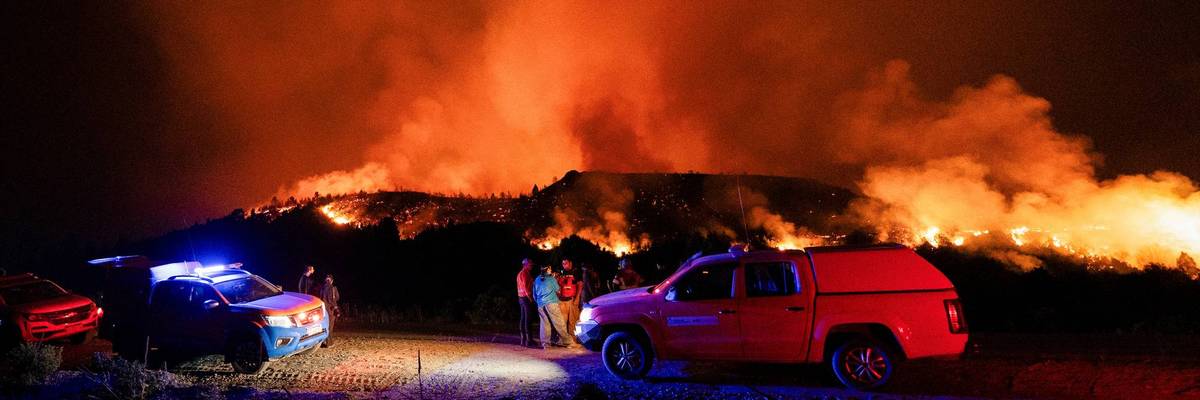
Volunteers and firefighters work to extinguish a forest fire burning in the mountains of the rural area of Epuyen, in the Patagonian region of Chubut province, Argentina, on February 1, 2026.
(Photo by Gonzalo Keogan/AFP via Getty Images)

Jessica Corbett
Sep 10, 2026
COMMON DREAM,S

On the heels of the United States setting new summer heat records and United Nations scientists warning that at least a temporary overshoot of the Paris Agreement’s 1.5°C target can no longer be avoided, researchers on Thursday published an alarming new study on climate feedback loops.

For years, experts have feared that humanity’s continued reliance on fossil fuels that heat the Earth could lead to several “positive” feedback loops—or changes to natural systems that amplify global warming. The scientists behind the new paper in the journal Environmental Research focused on carbon dioxide and methane emissions from inland freshwaters, permafrost thaw, wetlands, and wildfires.

“Continued warming from greenhouse gases emitted from human activities threatens to feed further warming as permafrost, wetlands, and wildfires destabilize and respond by releasing carbon dioxide, methane, and nitrous oxide,” said co-author Ben Poulter, warming-induced emissions program director at Spark Climate Solutions, in a statement.

“This study provides a critical look at the magnitude of the temperature response,” he explained, “and a call to action to accelerate the accounting and monitoring of warming-induced emissions to support pathways that phase out fossil emissions to stabilize the planet’s climate.”

Lead author and Spark research scientist Sam Abernethy noted that “what surprised us was the size of the feedback.”

“We found that natural systems could amplify global warming by 20-30%,” he said. In other words, these natural systems could add an estimated 0.2-0.4ºC of warming this century to any temperature rise tied to human activity.

“This hidden multiplier is missing from the models guiding climate policy, so those models are likely underestimating how much warming is coming—and overestimating how much carbon we can still afford to emit,” Abernethy added.


Permafrost is ground that remains fully frozen for at least two consecutive years, and the scientists who study it “have long warned that thawing soils would become a significant emissions source as the planet warms,” said co-author Christina Schädel, senior research scientist at the Woodwell Climate Research Center.

“This paper shows that permafrost thaw accounts for half of the anticipated warming-induced emissions,” she pointed out. “Warming-induced emissions are already in motion, and they scale with every fraction of a degree. Every little bit of warming we can avert today matters for what the climate looks like in the long term.”

Co-author Robert Jackson, a Stanford University professor and chair of the Global Carbon Project, similarly stressed that “the results are a wake-up call, and it’s imperative that they be included in the next generation of climate policies. Failure to do so will make meeting the world’s climate goals less and less likely.”

The paper’s publication came just two months away from the next United Nations Climate Change Conference (COP31) in Türkiye, where firefighters are currently battling deadly blazes that have fueled calls for the country’s government to fight for rapidly phasing out coal, gas, and oil on a global scale.

“This research makes clear that the Earth and climate system doesn’t stand still while we debate policy,” said Brian Buma, a co-author of the new study and senior climate scientist at Environmental Defense Fund.

“Emissions from permafrost, wetlands, and wildfire could meaningfully erode our remaining time to warming thresholds—and they are unaccounted for in most scenarios,” Buma reiterated. “This means rapid fossil fuel emissions reductions are even more urgent than current projections suggest.”

“The good news,” he added, “is that it’s in our hands—lower emissions now limit how severe these feedbacks become.”
With Türkiye to Host COP31, Wildfires Spark Demand for Fossil Fuel Phaseout

“The climate crisis is here, and the frequency and severity of extreme weather events are increasing day by day,” said 350.org’s Türkiye manager.


Flames and thick smoke rise from a forest fire in Adana, Türkiye, as firefighting efforts continue on September 8, 2026.
(Photo by Eren Bozkurt/Anadolu via Getty Images)

Jessica Corbett
Sep 09, 2026
COMMON DREAMS

Scientists have long warned that the fossil fuel-driven climate crisis means more frequent and destructive wildfires, and blazes raging in Türkiye this week have sparked a fresh call to rapidly phase out planet-heating coal, gas, and oil.

As firefighters battled blazes in three southern Turkish provinces, Efe Baysal, Türkiye manager at the global advocacy group 350.org, pointed out that the country is set to host the next United Nations Climate Change Conference, COP31.

“In November, the world will gather in Antalya for COP31 to discuss the steps that must be taken against the climate crisis,” Baysal said in a Wednesday statement. “Today, however, that same city is battling an uncontrollable wildfire that began in Aksu district of Antalya and spread throughout the region. Reports of fires are also coming in from Adana and Mersin.”

“Our prayers are with those fighting the blazes on the ground to defend life,” he continued. “The wildfires occurring primarily in Antalya demonstrate this truth once again: Rising temperatures create the conditions for fires to start more easily, spread faster, and become more destructive. The climate crisis is here, and the frequency and severity of extreme weather events are increasing day by day.”

Baysal said that “assuming the COP31 presidency, Türkiye’s responsibility is even more crucial. At COP31, Türkiye should aim to produce concrete outcomes to advance the transition away from fossil fuels. To make this leadership credible, Türkiye should announce a timeline for a phaseout of coal without delay.”

“It should initiate a just transition to renewable energy that will reduce our dependence on coal, oil, and gas,” he added. “It is not enough merely to respond to the consequences of the climate crisis. We must eliminate the causes that exacerbate it. COP31 is an opportunity for Türkiye to demonstrate true leadership in this direction.”


Previous UN summits on the planetary crisis have ended in deep disappointment, with critics calling the “empty deal” that came out of COP30 in Brazil last year “a stark reminder that the answers to the climate crisis do not lie inside the climate talks,” and, a year earlier, blasting COP29 in Azerbaijan as “a dumpster fire” and “a big F U to climate justice, to the poorest communities who are on the frontlines of climate breakdown.”

Since those summits, there has been a constant stream of events that have fueled fears of a hotter world—and United Nations scientists are now warning that preventing at least a temporary temperature rise above 1.5°C, relative to preindustrial levels, is not possible, but humanity can still limit the damage by dramatically lowering emissions.

“This summer’s scorching heat, raging wildfires, and deadly floods are a warning of what lies ahead,” UN Secretary-General António Guterres said last week. “We must make the overshoot above 1.5 degrees as small and short as possible.”

The fires in Türkiye have already proven deadly. The Aksu district mayor, Isa Yildirim, said on social media that one person died after suffering a heart attack during the fire there.

That blaze has also caused injuries. Citing the Turkish Anadolu Agency, The Associated Press reported that “two people were hospitalized with injuries to their legs while six others affected by smoke were treated on site.”

As Deutsche Presse-Agentur detailed Wednesday:
Forest fires are common in Turkey in the summer months, fueled by long periods of drought and strong winds.

Cihan Erdönmez, an expert at Istanbul University, said triggers for the fires were often poorly maintained power lines running through forests.

Forestry Minister İbrahim Yumaklı said there had been more than 5,000 forest fires in Turkey in 2025 and 96% of them were directly or indirectly caused by humans.

Meanwhile, 350.org called the current blazes “a reminder that a hotter, drier climate will continue to exact its toll on ordinary people unless leaders act urgently to phase out fossil fuels.”
Union Report Warns Electronic Shelf Labels Could Kill Jobs and Crush Wages

Some states are cracking down on “surveillance pricing.” But a report out from the AFL-CIO suggests that the risk of electronic shelf labels are much broader than just price gouging.


Automated digital display price tags at Petco store, Manhattan, New York
(Photo by Lindsey Nicholson/UCG/Universal Images Group via Getty Images)

Stephen Prager
Sep 09, 2026
COMMON DREAMS

Lawmakers are already raising concerns that electronic shelf labels could be used by grocery chains to jack up prices on shoppers. But the technology could also be used to shrink paychecks and kill jobs, according to a report out Wednesday from the research arm of the AFL-CIO.

The new report examines marketing materials used by electronic shelf label (ESL) companies to sell their products to grocery chains. It finds that they are often billed as a tool allowing retailers to save on labor costs, automate work, and reduce hours for real employees.

“Grocery giants like to claim that electronic shelf labels will free up workers to serve customers directly, but this report shows this is not the case,” said Ademola Oyefeso, the international vice president of the United Food and Commercial Workers International Union (UFCW), which represents over 800,000 grocery industry employees. “Using studies and marketing material from the manufacturers pushing the technology, we know ESLs could actually cost workers and their families billions of dollars in lost income.”

The AFL-CIO Tech Institute, which conducted the report, examined studies from two ESL manufacturers, Pricer and Vusion Group, that examined how their systems were used at specific stores.

The 2022 study by Pricer found that by automating price changes, its system saved one store about 5,200 worker hours annually. Vusion, meanwhile, found in 2024 that its technology saved about 600 hours of work over about six months, or 1,200 annually.

Using data from the US Bureau of Labor Statistics, the AFL-CIO projected that at these rates, were the technology to be adopted at all of the nearly 60,000 grocery stores in the US, it would reduce the number of worker hours annually by anywhere from 71 million to 308 million.

Using hourly wage data, they found that this translated to the loss of between $1.61 billion-$6.97 billion in annual wages and between 44,000-192,000 full-time jobs. That’s anywhere from $608 to $2,633 per employee.

The issue of using ESLs to gouge customers has already become an area of focus for lawmakers in Congress. Earlier this year, Democrats in the US House and Senate introduced legislation to prohibit “surveillance pricing,” which involves targeting individual shoppers with increased prices by analyzing their personal data.

Surveillance pricing has been used in e-commerce to fluctuate prices for individual consumers of everything from grocery delivery to airline tickets. But as facial recognition and other surveillance technologies grow more powerful, fears have grown that ESLs could be used to bring surveillance practices into the physical realm.

“Through our analysis, we found that the implementation of electronic shelf labels are likely going to drive prices even higher. The reason being that these labels are connected to the same algorithmic pricing software that online retailers are already using,” said Sunny Glottmann, the policy and programs manager at the AFL-CIO Tech Institute and co-author of the report.

“Electronic shelf labels create the infrastructure that would make rapid algorithmic price changes easier to implement at scale, and this raises concerns for consumers that are already struggling with grocery costs,” Glottmann said.

At least three states—Connecticut, Maryland, and New Jersey—have banned some forms of surveillance pricing, and other states are also considering a ban.

Unions like the AFL-CIO and UFCW say that legislating only against surveillance pricing is much too narrow, encompassing only a small segment of the dangers posed by ESLs.

“Policymakers should ban ESLs outright, rather than rely on narrower disclosure or dynamic-pricing laws that leave the underlying technology in place,” the AFL-CIO report says, noting New Jersey’s one-year moratorium on the technology as a good starting place.

“When grocery store workers lose income, that means less money to spend at other stores and businesses in the community,” Oyefeso said. “Banning this technology should be a top priority for lawmakers at every level, like New Jersey has done with a moratorium on ESLs and a ban on predatory pricing practices outright. More states should follow suit to protect both shoppers and workers.”

Study: Jobseekers writing their CVs for robots rather than humans

11.09.2026, DPA

Photo: Christin Klose/dpa

Jobseekers are changing their CVs because they believe they might be seen by artificial intelligence (AI) robots rather than humans, according to new research in the UK.

Jobs site CV-Library said its study raised concerns that the race to “beat” AI could be making it harder for candidates to stand out.

Its survey of more than 1,000 candidates and 233 recruiters and employers found that CVs or cover letters were increasingly being targeted at AI robots.

Seven in 10 jobseekers said the trend made it harder for them to stand out, while a similar number of recruiters believed that AI-generated applications made it harder to identify the strongest candidates.

More than a third of recruiters said they were

less confident than a year ago that a CV or application accurately reflected a candidate’s true skills.

"Candidates are becoming so focused on writing for AI that they risk forgetting their real audience – the human making the final hiring decision," Alec Stanwell of CV-Library said.

"AI can help improve an application, but it shouldn’t remove the personality, skills and real-world examples that can make a candidate stand out," Stanwell said.

"For employers, increasingly polished applications mean it’s important to look beyond the CV, using interviews and skills-based assessments to understand what a candidate can do."

Trump EPA Accused of Endangering Public as Study Highlights ‘Hidden Health Costs’ of Data Centers

The Environmental Protection Network listed actions “that could increase pollution-related health risks, weaken protections that would otherwise reduce those risks, or shift more costs onto families and communities.”


Michigan residents rally against the planned $7 billion Stargate data center in Saline on December 1, 2025.
(Photo by Jim West/UCG/Universal Images Group via Getty Images)


Jessica Corbett
Sep 10, 2026
COMMON DREAMS

As President Donald Trump claims that US communities fighting against artificial intelligence data centers are promoting “poverty, crime, and squalor,” a Thursday report details how his administration “is weakening or proposing to weaken pollution and permitting safeguards” for such facilities, to the detriment of public health.

The Environmental Protection Agency’s “mission is to protect human health and the environment,” notes the new report. “Yet Administrator Lee Zeldin has made turning the United States into the ‘AI capital of the world’ a pillar of EPA’s work.”


Trump EPA Urged to Withdraw Rule to Let Data Centers Obtain Pollution Permits in Secret


Green Groups Sue Trump EPA for Approving Toxic Semiconductor Chemicals Amid AI Data Center Boom


The Hidden Health Costs of AI Data Centers”—from the Environmental Protection Network (EPN), which is made up of hundreds of former EPA staffers—documents “at least 30 federal actions since January 2025 that could increase pollution-related health risks, weaken protections that would otherwise reduce those risks, or shift more costs onto families and communities.”

As the document details: “17 of the 30 explicitly cite or target AI or data centers in the action itself or in an agency statement specifically describing or justifying that action. The remaining 13 affect how data centers are powered, what pollution safeguards apply, how projects are approved, or how federal requirements are enforced.”

The report points to the EPA policy that “made it easier for some long-idled facilities to restart without triggering the major air-permitting requirements,” as well as its proposed elimination of federal carbon pollution standards for fossil-fueled power plants and some outstanding state clean-air requirements for areas that failed to meet ozone standards.

The publication also notes the EPA’s extended deadlines for several coal-plant wastewater requirements, newly regulated coal-ash units, the 2024 oil and gas standards, and for states to submit plans to reduce visibility-impairing pollution. The agency further interpreted a policy on nonemergency backup generator use that it framed as a move supporting AI and data centers.

It’s not just the EPA. The US Department of Energy “authorized grid use of backup generation at data centers and other major facilities during emergencies,” the report explains, while the Army Corps of Engineers “expressly named data centers as examples of commercial development covered by” a streamlined water permit.


“No study has yet calculated the combined health effects of these actions, but the direction is clear,” the report says. It cites a study from this year that estimates air pollution related to data centers “could impose roughly $11.7 billion to $20.9 billion in annual public health costs by 2028,” and “contribute to roughly 600,000 asthma symptom cases and 1,300 premature deaths.”

Dan Costa, who spent about 35 years at EPA studying the impact of air pollution on human health and led its national research program on air quality, climate, and energy, said that “the existing health study gives us a picture of the potential health burden under particular data-center growth and emissions scenarios.”

“But it does not estimate the additional health effects of the 30 federal policy actions EPN documents,” he stressed. “That is the analysis EPA should be doing now: Measuring what these sources actually emit, modeling both local and regional air-quality effects, and translating those changes into health impacts.”

In addition to laying out the Trump policies and their risks, the publication highlights how his agenda on AI data centers conflicts with voters’ wishes. An April poll conducted by YouGov for EPN found that:Just 16% of US voters support making the United States the “AI capital of the world” an EPA priority;

69% of voters are highly concerned about fast-tracking data centers without usual safeguards;

85% of voters say Trump should be tougher on corporations that violate environmental laws; and

by an 8-1 margin, voters say the EPA should prioritize people’s health over reducing pollution regulations.

“You would think a build-out of this magnitude would mean more vigilance from EPA: stronger safeguards to make sure companies control their pollution, more science to understand what this scale will bring, and more monitoring,” said Dr. Lynn Goldman, a pediatrician and former EPA assistant administrator. “Instead, EPA and other federal agencies are doing the opposite.”

The EPN report was published amid mounting calls for Congress to rein in artificial intelligence development in the wake of Jacob Coxon, a researcher at Anthropic who previously worked at OpenAI, quitting, and spotlighting fears within the industry that the rapidly advancing technologycould kill us all by the end of the decade.

Sen. Bernie Sanders (I-Vt.) and Rep. Greg Casar (D-Texas) have introduced legislation that would permanently ban the development of “superintelligent” AI until a federal body is created to regulate it—and, according to polling results published on Wednesday by Data for Progress, 68% of likely voters in the United States support that proposal.

Sanders has also partnered with Rep. Alexandria Ocasio-Cortez, (D-NY) for the Artificial Intelligence Data Center Moratorium Act, which would pause construction on the facilities “until strong national safeguards are in place to protect workers, consumers, and communities, defend privacy and civil rights, and ensure these technologies do not harm our environment.”
As Congress Fails to Take Action on AI, AFT and Microsoft Reach ‘First-of-Its-Kind’ Deal to Protect Kids

Teachers, said one union leader, “forged a hard-fought, ironclad privacy agreement... because no one else, including the federal government, has stepped up to do the real work.”


Children do their schoolwork on March 18, 2020 in San Anselmo, California.
(Photo by Ezra Shaw/Getty Images)


Julia Conley
Sep 09, 2026
COMMON DREAMS

The advocacy group Fairplay on Wednesday applauded education union leaders for spearheading efforts to ensure students and teachers in the US are protected by safety and privacy standards as artificial intelligence companies push for their products to be used in schools.

But the organization’s executive director, Josh Golin, emphasized that the American Federation of Teachers (AFT) and United Federation of Teachers (UFT) “should never have been in this position in the first place,” and Congress and states should have already passed legislation to create “industry-wide standards that are enforceable through attorneys general and a private right of action.”

“With our elected leaders failing to live up to their responsibilities, we are left with an agreement that places an unfair burden on schools and doesn’t do enough to keep kids safe,” said Golin.

The deal reached Wednesday was between AFT, UFT, and Microsoft, so it will pertain only to the Silicon Valley giant’s AI products.


It includes 10 “legally enforceable protections,” reported Politico, including a commitment from Microsoft not to use student or teacher data to train AI models, except in narrow “safety and security” circumstances.

Other requirements of the deal include:Microsoft can only collect, process, or store data that is strictly necessary to deliver an educational product;
All covered data, including every prompt, response, file, and AI-generated output, belongs exclusively to the school and students;
All tools support educators and students and do not replace human judgment; and
The company and schools must be transparent with families about how AI is being used.

AFT said the “first-of-its-kind” agreement came after months of painstaking negotiations “in the absence of any meaningful federal and state rules governing artificial intelligence in schools.”

The deal was announced on the same day that Jacob Coxon, a researcher at AI firm Anthropic, resigned in protest of an industry that he said is pushing to build “superhuman systems” without guardrails.

He told The Wall Street Journal he was “worried such systems could spiral out of control and destroy humanity.”

Coxon’s warning intensified calls for Congress to pass legislation to rein in AI, such as Sen. Bernie Sanders’ (I-Vt.) proposed moratorium on AI data centers and his bill, introduced with Rep. Greg Casar (D-Texas), to ban artificial superintelligence.

Bipartisan legislation has also failed to pass.

More than 80% of Americans believe the government is not doing enough to regulate AI, according to one recent NBC poll, and President Donald Trump has joined the industry in pushing to block states from passing their own regulations.

Randi Weingarten, president of AFT, said the unions had “forged a hard-fought, ironclad privacy agreement with real teeth that protects students and families, because no one else, including the federal government, has stepped up to do the real work.”

“We can get angrier and angrier, or we can act decisively; anything less than legally enforceable provisions is simply a wish list,” said Weingarten.

Golin emphasized that the deal “elides the most important question of all: Should student-facing AI products be used in schools at all?”

“There is no evidence that AI products are effective teaching tools for children and growing evidence that they undermine learning and create a number of risks for kids,” said Golin. “That’s why Fairplay and its network of experts are calling on schools to implement a five-year pause on all [generative] AI products until it can be determined whether those products are safe for young people and beneficial to their education.”

“We hope this agreement does not fool schools into thinking that GenAI products are safe and effective for use with schoolchildren or hoodwink policymakers into thinking legislation restricting AI use in schools is not needed,” he added. “It also places the burden on schools to execute and enforce the contract, which they are not in a position to do, and which should be the job of regulators.”