Saturday, September 12, 2026

America After 9/11: 25 Years of Fear, War, Surveillance, and Permanent Emergency

I tell you, freedom and human rights in America are doomed. The U.S. government will lead the American people in  –  and the West in general  –  into an unbearable hell and a choking life.” – Osama bin Laden (October 2001)

GIVE THEM NIGHTMARES.” – President Donald Trump (September 2026)

Days before the 25th anniversary of 9/11, President Trump flooded his Truth Social account with AI-generated fantasies of himself commanding armies of giant, red-eyed robots.

In one, Trump strides through a darkened Washington surrounded by robotic soldiers beneath the words, “THEY WILL NEVER SLEEP AGAIN.” Another declares, “THEY WILL DREAM OF US FOREVER.” A third depicts Trump seated on a mechanical throne, surrounded by an army of robots and the presidential seal, beneath the warning: “GIVE THEM NIGHTMARES.”

Twenty-five years after 9/11, one has to ask: has the nightmare ever really ended?

For a quarter-century, Americans have been governed by fear: fear of terrorists and foreign enemies, fear of domestic extremists and political opponents, fear of the next attack, the next crisis, the next emergency.

That fear has given us endless war, mass surveillance, militarized police, secret courts, indefinite detention, government watchlists, domestic military deployments and an imperial presidency armed with powers that would have been unthinkable before 9/11.

Now the man entrusted with the imperial powers of the modern-day presidency is publicly imagining himself enthroned over robotic armies, raining destruction on his enemies and promising nightmares.

The imagery may be unhinged from reality, but the powers of the presidency are not.

Neither are the questions raised by Trump’s increasingly unhinged public behavior about whether any president – especially one armed with the accumulated powers of the post-9/11 national-security state – is mentally and temperamentally fit to wield them.

That is where America’s two great anniversaries of 2026 collide.

On July 4, America celebrated 250 years since the Declaration of Independence, born from a revolt against King George III and a system in which too much power rested in the hands of one ruler. At its heart was the radical proposition that government derives its just powers from the consent of the people.

On September 11, we mark 25 years since the terrorist attacks that killed nearly 3,000 people, shattered the nation’s sense of security, and set in motion a massive expansion of presidential, military and national-security power.

America began by rebelling against a king.

Two hundred and fifty years later, we have created a presidency with increasingly king-like powers.

And now we must confront an uncomfortable question the Founders understood all too well: what happens when immense power is placed in the hands of someone whose fitness to wield it is itself in question?

To understand how we arrived at this dangerous moment, we have to go back to the moment when fear gave the government permission to begin dismantling the restraints on its power.

That trail leads inevitably back to 9/11.

A quarter-century later, serious questions and suspicions persist about what government officials knew before the attacks, what warnings were ignored, whether more could have been done to prevent them, and whether the American people have ever been given the full story of 9/11.

Those questions deserve scrutiny, but they should not obscure what we know happened next.

Whatever the truth about what the government knew before 9/11, there can be little dispute about what the government did afterward. It used the attacks and the fear they generated to radically expand its powers over the American people.

Twenty-five years after 9/11, the “war on terror” has become a war without end, the emergency has become permanent, the surveillance state has become omnipresent, the police have become militarized, and the presidency has accumulated powers that would have horrified the revolutionaries of 1776.

This is the bitter irony of America at 250.

We declared our independence from a government that subjected its people to standing armies, arbitrary searches, taxation without meaningful representation and the dictates of a ruler who considered himself above the law.

Yet over the course of the past 25 years, in the name of national security, we have resurrected many of those same evils and wrapped them in the American flag.

What did 25 years of surrendering liberty in exchange for security actually buy us?

Not peace. Not security. Not fiscal stability. Not a less intrusive government.

Instead, we got the Patriot Act and mass surveillance; secret courts and government watchlists; indefinite detention and torture; militarized police; endless wars and trillions in debt; and a presidency increasingly untethered from Congress, the courts and constitutional restraint.

And still the government insists it needs more power to keep us safe.

That is the trap.

Twenty-five years later, the emergency never ended – it became the government.

The USA Patriot Act, rushed through Congress just 45 days after the 9/11 attacks, drove a stake through the heart of the Bill of Rights. It dramatically expanded the government’s powers, weakened safeguards against government overreach, and opened the door to far-reaching surveillance of the American people.

What was sold to us as a temporary response to terrorism became the foundation for something much larger.

The lesson we still haven’t learned: mammoth legislation that expands the government’s powers at the citizenry’s expense will not make anyone safer.

Every president since has inherited the machinery of the post-9/11 national-security state. Every president has found new ways to use it. And almost none of the powers claimed in the name of emergency have ever been willingly surrendered.

George W. Bush gave us the Patriot Act, warrantless surveillance, torture, indefinite detention and preemptive war. Barack Obama expanded the drone wars, normalized targeted killings and presided over an increasingly sophisticated surveillance apparatus. Successive administrations embraced secret watchlists, warrantless data collection and sweeping executive authority.

Donald Trump did not create this machinery.

He inherited it.

What makes this moment so dangerous is his willingness to use that machinery aggressively, openly and with little patience for the constitutional restraints that are supposed to prevent presidents from becoming kings.

Nowhere is that more apparent than in the return to preemptive war.

Not content to wage war against Afghanistan after 9/11, the United States invaded Iraq under a preemptive war doctrine that embraced striking threats before they were fully formed.

The consequences were catastrophic: lives lost, trillions squandered, regions destabilized, terrorist movements radicalized, and the constitutional power to decide when the nation goes to war steadily transferred from Congress to the president.

Twenty-five years after 9/11 plunged the United States into a cycle of preemptive war, blowback and permanent emergency, President Trump has launched another preemptive war against Iran without a declaration of war by Congress.

The circle is complete.

9/11 gave us the War on Terror. The War on Terror gave us permanent emergency. Permanent emergency gave us the imperial presidency. And the imperial presidency has given us another war.

The lesson we still haven’t learned: preemptive strikes do not make us safer. They create more enemies, more instability and more blowback.

War has become the permanent business of the American empire.

The military-industrial complex profits. Defense contractors prosper. Politicians posture. Presidents accumulate power.

The American people get the bill.

The post-9/11 wars have cost trillions, killed or displaced millions, and scarred generations of servicemen and women. Every new conflict creates the justification for still more military spending, secrecy, emergency powers and government control.

War abroad has a way of coming home.

After 9/11, the government embraced torture in the name of national security. Abu Ghraib demonstrated what happens when human beings are reduced to enemy combatants and government agents are told the normal rules no longer apply.

That battlefield mindset did not remain overseas.

Local police departments acquired armored vehicles, military weapons, tactical gear and battlefield training. SWAT teams became routine instruments of law enforcement. Military surveillance tools became tools for monitoring ordinary Americans.

Today, ICE increasingly operates like a domestic paramilitary force, carrying out raids, detentions and enforcement operations under a cloak of secrecy and impunity while being equipped with ever more aggressive technologies, from robot dogs to electric shock weapons.

National Guard troops are being normalized as a domestic law-enforcement presence, further eroding the barrier between military and civilian government that laws such as the Posse Comitatus Act were intended to preserve.

The language changed, too.

Citizens became “suspects.” Communities became “threat environments.” Protesters became potential extremists. The homeland became a battlefield.

The lesson we still haven’t learned: the tactics and weapons of war, once deployed abroad, will eventually be used against the citizenry at home.

This is precisely what the Founders feared. James Madison warned that “the means of defence against foreign danger have been always the instruments of tyranny at home.”

We ignored him.

The result is a country in which the dividing line between soldier and police officer, battlefield and neighborhood, foreign enemy and domestic suspect has become dangerously blurred.

The same vicious cycle has played out with surveillance.

The Patriot Act normalized mass surveillance. Technology has since made the machinery exponentially more powerful.

Today, government agencies no longer need someone following you in an unmarked car to create detailed records of where Americans travel, whom they visit and how they live. Your phone tells them. Your car tells them. FLOCK license plate readers tell them. Facial recognition cameras tell them. Your purchases, internet searches, social-media activity, location history and digital communications fill in the rest.

Allowing the government to spy on the citizenry will not eliminate terrorism. It will create a watched, tracked and increasingly submissive society.

Yet the deeper problem is that we stopped insisting that government obey the same laws it imposes on us. Once “national security” became an acceptable excuse for warrantless surveillance, torture, indefinite detention, secret courts and undeclared wars, the exception began swallowing the rule.

Congress surrendered authority. Presidents seized it. Courts deferred. The public became accustomed to government officials acting first and answering questions later.

Now we see the consequences everywhere.

The Supreme Court increasingly arrives too late to stop executive abuses before the damage is done, if it intervenes at all. The president bulldozes through legal and constitutional restraints, creates a crisis or a spectacle, and leaves Congress, the courts and the American people to deal with the wreckage.

The lesson we still haven’t learned: if we stop holding the government accountable to the rule of law, the only laws it will respect will be the ones it can use against us.

This failure transcends political parties.

Republicans cheered executive power under Republican presidents. Democrats cheered it under Democratic presidents. Then both sides expressed shock when those powers were turned against them.

Powers do not remain partisan.

Surveillance powers created to catch terrorists are used against Americans. Emergency powers become tools of ordinary government. Military powers migrate into domestic policing. Executive powers tolerated under one president become precedents for the next.

And once government acquires a weapon, it rarely gives it back.

Trump is merely the latest president to demonstrate the danger of giving any one person such enormous power. He has inherited the machinery of the post-9/11 state and shown how readily it can be turned to the purposes of an increasingly imperial presidency.

We are not merely repeating the mistakes of the past 25 years. We have institutionalized them.

A national-security apparatus powerful enough to track a terrorist can track a political opponent. A president empowered to wage war without Congress can invoke “national security” to bypass constitutional limits at home. A military normalized on American streets can be turned against Americans.

The police state does not care which party controls it.

And therein lies the madness of giving any president such enormous power.

The Founders did not assume that every president would be wise, rational, restrained or benevolent. They divided power precisely because human beings cannot be trusted with too much of it.

A free people cannot make their liberties dependent upon the judgment, temperament or sanity of a single ruler.

Yet for 25 years, under presidents of both parties, we have systematically weakened those restraints while strengthening the presidency.

Now the reckoning has arrived.

Trump’s fitness to exercise the immense powers of his office cannot be separated from the larger question of why any president should possess so much unilateral power in the first place.

The lesson we still haven’t learned: the more power we give the presidency, the more dangerous the presidency becomes when the person occupying it proves unwilling – or unable – to exercise that power with restraint.

That brings us back to the nightmare.

Fear has always been the fuel of the police state.

Keep people frightened enough, divided enough and distrustful enough of one another, and they will beg the government to protect them – even when the price of that protection is their freedom.

That bargain has defined post-9/11 America.

Benjamin Franklin famously warned against trading essential liberty for temporary safety.

We made the trade anyway.

The government seized our freedoms, but the assurance of safety never materialized. Instead, the emergencies multiplied: Terrorism. War. Pandemic. Immigration. Crime. Civil unrest. Political extremism.

Each crisis becomes another justification for government power. Each new power establishes another precedent. Each precedent becomes another weapon waiting for the next president to wield it.

That is what makes the convergence of these two anniversaries so important.

The Declaration of Independence was an indictment of a despot who obstructed the laws, manipulated institutions, maintained standing armies among the people, placed military power above civilian authority and repeatedly violated the rights of those he governed.

Two hundred and fifty years later, those grievances sound uncomfortably familiar.

The uniforms have changed. The technology has changed. The vocabulary has changed. The greed for money and power have not.

Nor have the duties of the citizenry to oppose such tyranny.

If constitutional government is to survive, Congress must reclaim the powers it has surrendered. The courts must stop treating “national security” as a magic phrase capable of making constitutional violations disappear. The machinery of mass surveillance must be dismantled. Domestic militarization must be rolled back. Emergency powers must be temporary, narrow and subject to meaningful oversight.

And the American people must stop allowing fear to dictate the boundaries of their freedom.

Twenty-five years ago, Osama bin Laden predicted that the American government would lead its own people into “an unbearable hell and a choking life.”

Bin Laden did not defeat America. He did not destroy the Constitution.

We are doing that ourselves.

Every time we accept another surveillance program because we’re afraid, the Fourth Amendment dies a little more. Every time we tolerate another war because we’re told it will make us safe, constitutional restraints on war-making die a little more. Every time Congress surrenders power and the courts defer to “national security,” the rule of law dies a little more. Every time we allow the government to turn another American community into a battlefield, the barrier between military force and civilian government dies a little more.

Every time we shrug and tell ourselves that the latest encroachment on liberty is temporary, necessary or would only be used against someone else, the Constitution dies a little more.

As we make clear in Battlefield America: The War on the American People and its fictional counterpart The Erik Blair Diaries, this is how freedom dies in a country that still calls itself free.

Twenty-five years after 9/11, the question is no longer whether terrorism poses the greatest threat to our freedoms. The question is whether the American Police State itself has become the greater threat.

America has spent 250 years proclaiming its freedom and the past 25 years building the machinery with which to extinguish it.

Two anniversaries. One reckoning.

America must decide what it intends to be: a republic governed by the rule of law or an empire governed by permanent war, permanent surveillance and permanent emergency.

We cannot be both.

The choice we make will determine nothing less than the survival of the American experiment in freedom.

Constitutional attorney and author John W. Whitehead is founder and president of the Rutherford Institute. His new book, The Freedom Wars, (TRI Press) is available online at www.amazon.com. Whitehead can be contacted at johnw@rutherford.org. Nisha Whitehead is the Executive Director of The Rutherford Institute. Information about the Rutherford Institute is available at www.rutherford.org.

9/11’s Aftereffect: The Constitutional Accountability Abyss

by | Sep 11, 2026 Antiwar.com

Over the last several weeks in the lead up to the 25th anniversary of al Qaeda’s attack on the U.S., I’ve had American and foreign journalists ask me the same question: how did 9/11 change America?

My answer has generally been some version of this: 9/11 didn’t change us, we allowed it to change us, and in doing so critically damaged our very own political way of life.

We allowed our Arab American and Muslim American fellow citizens to become targets of federal surveillance and to be placed on secret government “watch lists” in the absence of any evidence they’d committed a crime.

We allowed the creation of the most sweeping and invasive surveillance dragnet in American history – first in secret via the National Security Agency’s (NSA) STELLAR WIND program and then openly through the passage of the PATRIOT Act just six weeks after the attacks.

We allowed a previous American president to lead our nation into a war against a country – Iraq – that had nothing to do with al Qaeda’s terrorist atrocities. The drama came complete with a televised presentation of “evidence” to the United Nations Security Council of the continuing threat Saddam Hussein allegedly posed to the region – evidence that turned out to be false.

We allowed those who opposed George W. Bush’s war of choice against Iraq to be targeted by the FBI with surveillance and informant penetration operations that mirrored some of the worst Cold War era tactics employed by J. Edgar Hoover and the organization he led.

We allowed our government to set up secret torture chambers around the world for captured Arab and Muslim men – the CIA’s “rendition, detention, and interrogation” (RDI) program (a.k.a., the torture program). Some, like Khalid Shaik Mohammad (KSM), were directly responsible for the attacks. Others not only had nothing to do with the attacks but no involvement with terrorism at all. And through it all, the U.S. abandoned the very principles of justice under law and due process that it had proclaimed to the world since the trials of German and Japanese war criminals after World War II. That torture program has already damaged the legal case against KSM.

And we allowed the president who authorized these things to get away with all of them and leave office legally unmolested.

I’ve used the phrase “we allowed” because we who are citizens of the Republic cannot escape our responsibility for what George W. Bush did, even if we voted for his opponents in 2000 and 2004.

Yes, there were those who went into the streets to protest the Iraq War and the creation of the Guantanamo prison and its dysfunctional, sham trial system. Those who risked police batons, tasers, and tear gas to raise their voices against unjust wars and the torture of those we captured deserve remembrance and praise. But they were too few in number to alter the course of events because too many of their fellow Americans did not join them when it mattered most.

I witnessed these events from a different angle, that of a senior House staffer working for then-New Jersey Democrat Rush Holt during the final four years of Bush’s presidency. Holt’s repeated efforts to stop runaway surveillance programs from his position on the House Intelligence Committee frequently came to naught because of the refusal of many of his colleagues to join his efforts.

Bush’s authorization of the secret STELLAR WIND mass electronic surveillance program after the 9/11 attacks was a direct violation of the Foreign Intelligence Surveillance Act (FISA) of 1978. It literally represented an impeachable offense, as was his authorization of the CIA’s torture program. And even though multiple impeachment resolutions against Bush or then-Vice President Dick Cheney were introduced, they went nowhere – even though Democrats controlled the House during Bush’s last two years in office.

The fact that not a single House GOP member signed onto any of those resolutions no doubt contributed to the failure to hold Bush accountable for his misconduct in office. It was a posture that stood in stark contrast to the seven House Judiciary Committee Republicans who joined their Democrat colleagues in voting to impeach Richard Nixon for his crimes in office over 30 years earlier.

The degradation of the Congressional ethos of institutionalism and constitutional protection began before 9/11, but the attacks and how we responded to them accelerated the process of political and constitutional decline and the intensification partisan loyalty to the president. Donald Trump did not create this phenomenon, but he and his closest aides have exploited it and pushed it to new depths.

The brutalization of immigrants (legal or otherwise), the legal and political attacks on individuals or entities that oppose Trump’s policies, the expansion of mass surveillance programs, the initiation of multiple illegal military actions – all of this and more has come to pass because of a failure to hold accountable a prior president who engaged in almost identical misconduct in the years after 9/11. Whether that dynamic can be broken and reversed is up to each of us.

Cato senior fellow Patrick G. Eddington is the author of The Triumph of Fear.

On 25th Anniversary of 9/11 Attacks, Condemnation of Global ‘War on Terror’ That Has Killed Millions

“US officials who orchestrated post-9/11 abuses must also be held accountable, and their victims must receive meaningful remedy and reparation.”


A military helicopter flies in front of the Pentagon September 14, 2001 in 
Arlington, Virginia at the impact site where a hijacked airliner crashed into the building.
(Photo by Stephen J. Boitano/Getty Images)


Jake Johnson
Sep 11, 2026
COMMON DREAMS


International human rights campaigners, United Nations experts, journalists, and anti-war activists marked the 25th anniversary of the September 11, 2001 attacks on the US by paying tributes to the thousands of lives lost on that day while condemning what followed: an unparalleled expansion of state surveillance, crackdowns on dissent, arbitrary detention, torture, and catastrophic wars that cost trillions of dollars and millions of lives.

Mourning the lasting impact of “those horrific acts of violence” perpetrated in the US a quarter-century ago, a group of more than 40 UN experts said in a joint statement on Friday that “we equally acknowledge the millions of other victims worldwide of terrorist attacks, excessive counter-terrorism responses, and conflicts in the name of countering terrorism.”

“Too many governments have adopted unnecessary and disproportionate responses that have seriously undermined human rights, civil society, civic space, democracy, and the rule of law,” the experts continued. “Wars of aggression. Unlawful occupations. Countless war crimes and crimes against humanity, and plausible allegations of genocide. Assassinations dressed up as ‘targeted killings.’ Torture disguised as ‘interrogation.’ Transboundary abductions, extraordinary renditions, and transnational repression. Secret detention and enforced disappearances. Unfair military trials and special courts, including at Guantanamo Bay. Toxic residues from conflicts have severely harmed human health.”

The experts argued that global “wars on terror” launched by the US and other nations in the aftermath of the 9/11 attacks have “have stretched foundational rules of international law beyond their breaking point,” “counterproductively fueled terrorism,” and “entrenched cycles of violence.”

Many of those grave abuses continue in the present, the US-based Center for Constitutional Rights emphasized in a statement marking the anniversary of the 9/11 atrocities.

“In the 25 years since September 11, 2001, the sweeping political project the US government undertook in its aftermath has shaped, shattered, or ended millions of lives,” the group said. “Exploiting fear and suffering, the Bush administration launched a limitless ‘war on terror,’ whose stated purpose was all pretext to impose its will on other countries, expand its power beyond constitutional bounds, and target vulnerable communities.”

“Today, because of the lack of accountability for these gross abuses of human rights, Trump can use ‘counterterrorism’ to pursue his authoritarian program,” said CCR.

Nick Turse, a senior reporter at The Intercept, argued the attacks coordinated by Al-Qaeda leader Osama bin Laden in 2001 created a “swirl of toxic policies and governmental overreach” that “opened the door to something beyond bin Laden’s wildest dreams, the rise of an even more effective terrorist who has crippled the US in countless ways and sought to strangle the best of the country: President Donald Trump.”

“Bin Laden’s attacks turned the US government into an engine for the destruction of America, inducing it to implement policies that have devastated the country and immiserated its people,” Turse wrote in a column published Friday. “That includes unrestrained spending while cutting taxes on the rich, closer ties with despotic regimes, the sneak-and-peek warrants and roving wiretaps of the Patriot Act and other domestic surveillance programs, and the ruinous failed forever wars in Afghanistan, Iraq, and elsewhere.”

Those wars, according to Brown University’s Costs of War project, have cost the US federal government upwards of $8 trillion.

“The opportunity costs are staggering,” the project noted. “Many of these funds could have been spent on public health or in sectors that create far more jobs than the defense sector, like education or green energy.”

As for the human toll, the Costs of War project noted in a brief published last week that as of 2023, “an estimated 905,000-940,000 people—including US soldiers, allied security forces, civilians, and militants—have died due to war violence in Iraq, Afghanistan, Pakistan, Syria (in the fight against the Islamic State), Yemen, and elsewhere. At least 408,749—432,093 of those who have died were civilians.”

“Many other people have died indirectly as a result of the wars,” the brief observed. “An estimated 3.6-3.8 million indirect deaths have occurred in post-9/11 war zones.”

Scott Roehm, Amnesty International USA’s chief human rights strategy officer, said Friday that the US government could have responded to the 9/11 attacks “by upholding human rights and the rule of law while pursuing justice and accountability for victims’ families.”

“Instead, it embarked on a campaign of widespread abuses against Muslim, Brown, and Black communities, including arbitrary detentions and mass surveillance in the US; unlawful lethal air strikes abroad; enforced disappearances and torture in Iraq, Afghanistan and at CIA black sites; and the opening of the notorious Guantanamo Bay detention center,” said Roehm. “The choice to engage in torture, then build prosecutions against those alleged to be most responsible for 9/11 on the back of torture-derived evidence, is largely why, 25 years later, there has been neither justice nor finality for victims’ families.”

“The US government must end the last 25 years of abuses,” Roehm added. “US officials who orchestrated post-9/11 abuses must also be held accountable, and their victims must receive meaningful remedy and reparation.”
End Trump Oil Embargo on Cuba With War Powers Vote, Coalition Urges House Democrats

“Cuba is suffering through a man-made economic and humanitarian catastrophe, caused in significant part by deliberate policy choices of the United States.”


A man walks as the Russian oil tanker Anatoly Kolodkin is seen at the oil terminal in the port of Matanzas, Cuba, on March 31, 2026.
(Photo by Yamil Lage/AFP via Getty Images)


Brett Wilkins
Sep 11, 2026
COMMON DREAMS

Dozens of advocacy groups this week urged House Democratic leaders to force a vote on an existing war powers resolution aimed at endingr President Donald Trump’s unauthorized aggression toward Cuba, including his administration’s deadly de facto US oil embargo.

“Cuba is suffering through a man-made economic and humanitarian catastrophe, caused in significant part by deliberate policy choices of the United States,” 45 groups said in a letter dated September 9 to House Minority Leader Hakeem Jeffries (D-NY) and Foreign Affairs and Rules Committee Ranking Members Gregory Meeks (D-NY) and Jim McGovern (D-Mass.).

“Since January 2026, the Trump administration has imposed an oil blockade that has cut off the island from nearly all fuel imports, allowing only a single tanker to dock over the past seven months alongside minor US sales that are wholly insufficient to sustain the country’s economy and basic services,” the letter continues.


“The consequences have been devastating and far-reaching, and the crisis is deepening,” the groups stressed. “Cuba has endured at least six nationwide grid collapses this year—at times leaving over 9h million people without power, with outages stretching well beyond 20 hours in much of the country. Fuel shortages have stalled transportation, disrupted food and water supplies, and pushed a once-renowned universal healthcare system toward collapse and the rationing of care.”

The groups behind the letter—which include American Friends Service Committee, Center for Economic and Policy Research, Demand Progress, Indivisible, National Nurses United, Pax Christi USA, RootsAction, United Church of Christ, and Win Without War—called for an immediate vote on Rep. Nydia Velázquez’s (D-NY) Cuba War Powers Resolution, H.Con.Res. 106.

The privileged resolution—which can be called for a vote without approval from House Speaker Mike Johnson (R-La.)—would direct the removal of US armed forces from hostilities within or against Cuba absent congressional authorization. The measure targets the de facto US oil blockade on Cuba, which proponents argue amounts to unauthorized hostilities against Cuba.

Velázquez’s resolution came amid the Trump administration’s escalating aggression against Cuba, including threats to attack or even invade the island, economic strangulation including the oil embargo and decades-old blockade that critics said were causing the deaths of infants and sick people, and the US Department of Justice indictment of former Cuban President Raúl Castro for his alleged role in the 1996 shoot-down of planes operated by a hostile US-based counterrevolutionary group following repeated warnings that they had violated Cuban airspace.

In April, US senators voted 51-47—with Democratic Sen. John Fetterman of Pennsylvania joining all but two of his Republican colleagues, Sens. Susan Collins of Maine and Rand Paul of Kentucky—to block a war powers resolution introduced in March by Sens. Tim Kaine (D-Va.), Adam Schiff (D-Calif.), and Ruben Gallego (D-Ariz.).

“Despite falling short of the majority, this was among the strongest votes in congressional history against the use of blockades, and one of the most important stands Congress has taken against US economic sanctions toward Cuba in over six decades,” the 45 groups said in their letter. “The House should take a similarly forceful action at this crucial moment.”
‘A Damn Bloodbath’: Unions Decry Layoffs at McClatchy Papers as Local Journalism Takes Another Hit

“We’ve done everything asked of us, and more,” said one fired journalist. “Yet when corporate plans fail, McClatchy executives run and hide while our workers and this community suffer all the consequences.”


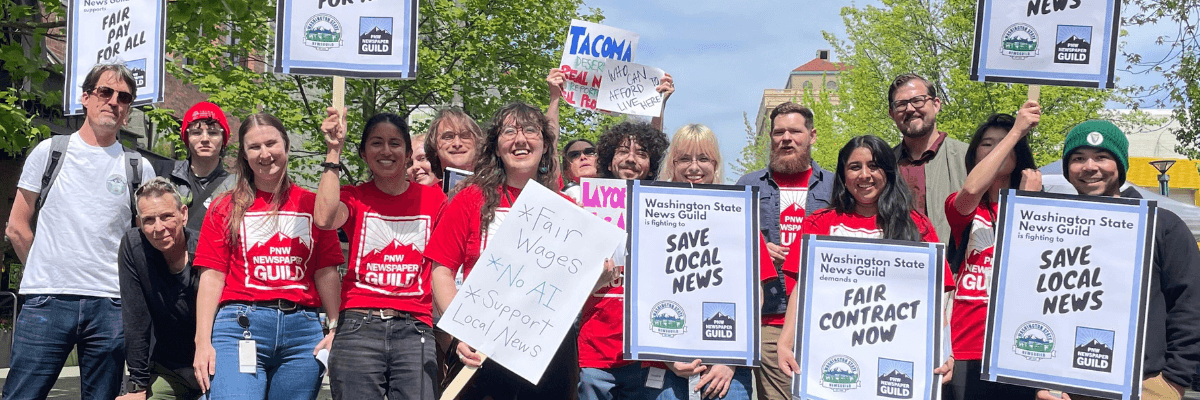
Unionized journalists in Washington state hold signs that say “save local news.”
(Photo by the NewsGuild-CWA)


Jessica Corbett
Sep 11, 2026
COMMON DREAMS

As social media networks filled with posts from journalists “deeply saddened” to reveal they were part of McClatchy’s latest round of “gutting” layoffs this week, newspaper staffers and the unions that represent them highlighted “how local coverage will suffer” because over 90 workers were fired by the hedge fund-controlled publisher.

“I’m part of this bloodbath. After dodging layoffs for my entire 19-year career, I finally caught a stray as the Idaho Statesman gutted 60% of its staff,” said sports writer Michael Lycklama, noting his union membership and six-months severance package.


‘Ugly, Un-American Attack on Our Free Press’: Stars & Stripes Journalists Fired for Saying They Had Independence

“My heart goes out to my coworkers who have poured their blood, sweat, and tears into Idaho,” he wrote. “We’ve done everything asked of us, and more. Yet when corporate plans fail, McClatchy executives run and hide while our workers and this community suffer all the consequences.”

“These layoffs will create holes in our community and leave it poorer,” he stressed. “There are now drastically fewer eyes watching your elected officials. Fewer reporters uncovering shady businesses. And fewer journalists to highlight and celebrate our state’s unsung heroes.”

With at least 90 workers let go across 17 McClatchy publications, the NewsGuild-CWA similarly warned Friday that “the departure of these talented reporters, visual journalists, and writers will immediately leave gaping holes in local coverage for dozens of communities across the United States.”

At least seven reporters were fired from four newsrooms in Washington state: The Bellingham Herald, The News Tribune, The Olympian, and Tri-City Herald. The NewsGuild noted that “Tacoma will no longer have even a single dedicated journalist tracking city hall, Pierce County government, or local schools,” while “the region near the Canadian border lost an environmental watchdog, and the Hispanic community can no longer turn to a Spanish-speaking reporter in Eastern Washington.”


The Pacific Northwest Newspaper Guild, a local representing reporters in Washington and Idaho, highlighted that “these are journalists who investigated local hospitals, served as watchdogs over state and local government, showed up at every high school game, jumped in to cover breaking news like wildfires, covered news in overlooked communities, and monitored development in one of the fastest-growing regions in the country.”

“One of these papers will no longer have a dedicated reporter covering city hall. Another will no longer have anyone dedicated to covering the state capitol,” the union said. “McClatchy has decided that short-term profits for a hedge fund matter more than the well-being of the communities that its newspapers are supposed to serve. That is a model that is destined to fail.”


Employees of multiple California outlets were also impacted. The Fresno Bee lost staffers, as did the Modesto Bee, which laid off 25% of its newsroom. The Sacramento Bee, the city’s “paper of record,” the NewsGuild said, “lost dogged reporters and veteran journalists who worked for decades to serve readers in the capital region.”

Across the country, The Lexington Herald-Leader, “one of two remaining statewide newspapers in Kentucky, laid off half of its Pulitzer-prize-winning newsroom,” the NewsGuild detailed. “Those layoffs include a senior reporter who worked at the Herald-Leader for more than 20 years, all of the paper’s core political team covering the state legislature in Frankfort, the editor of that politics team, the newspaper’s primary city government reporter in Lexington, a longtime high school sports reporter, two University of Kentucky basketball and football reporters, the paper’s only remaining environmentalist reporter in Eastern Kentucky, the paper’s only regional economic development reporter, a photographer, and a video journalist.”


As the union laid out, The State’s cuts included “the only reporter doing environmental coverage for the state of South Carolina, a more than 30-year veteran of the local newsroom; an investigative reporter who was recognized by the SC Press Association for his work on charter schools; the only reporter covering the city of Columbia; the lead reporter on the Darline Graham Senate race; half of our photography team.”

North Carolina breaking news reporter Jeffery Chamer announced on LinkedIn that “I’ve been informed this morning that I was one of eight people being laid off from The Charlotte Observer. I wish I had something uplifting and optimistic to say, but I’m honestly scared and sad right now. In two weeks, we’ll all be unemployed. And that just breaks my heart.”

“I know deep down we’ll all be OK and land on our feet, but for now it all feels terrifying,” he said. “It’s also so shocking to think about the incredible talent the Observer is losing. I love my colleagues. They’re not just incredible reporters, but people too. I will miss them so, so much.”


In Florida, “these layoffs leave the Bradenton Herald with half of its former staff, or only one editor and two reporters,” the NewsGuild pointed out. “There will be no one to report on local government and no professional photographer and videographer to document the news.”

The cuts also hit Florida papers southeast of Bradenton. As the union detailed: “After more than a century of operation, this layoff will leave the Miami Herald without a city hall reporter at the paper’s namesake. It guts the entire writing staff at El Nuevo Herald, our sister paper that has doggedly covered majority-Latino Miami-Dade County in Spanish for decades.”

Longtime former columnist Carl Hiaasen wrote on Facebook that “this is a death blow to the already skeletonized Miami Herald, once one of the country’s top newspapers. I worked there for over 40 [years], and I feel heartsick for the talented journalists who’ve been gutting it out while McClatchy blithely keeps swinging the axe.”

“By the time the company is finished, all the reporters left standing will fit in a phone booth, and millions of readers in South Florida will be forced to scrounge for actual, true local news on the always-reliable internet,” he continued. “It’s tragic, but there’s a lesson here: If you own a newspaper company, don’t sell it to a hedge fund unless you truly don’t give a shit about your readers.”

As The New York Times reported:
McClatchy has newspapers in 14 states. Formerly a family-run business, it was sold to the hedge fund Chatham Asset Management in 2020 after it declared bankruptcy.

The company has gone through rounds of layoffs in recent years. In late 2025, McClatchy closed its breaking-news desk and shut down its Washington, DC, bureau, while carrying out further layoffs across its newspapers.

This week’s layoffs also impacted the Centre Daily Times in Pennsylvania, Missouri’s Kansas City Star, and the Fort Worth Star-Telegram in Texas.

McClatchy leadership said in an internal email that for the past five years, the company has “made a deliberate choice to maintain our investment in local news reporters,” and “consumer revenue declined 41% while local news expenses remained largely flat.”

Thus, “we are reshaping our newsrooms and reducing positions as we align our resources more closely with what our subscribers value,” the company claimed. “We are making these changes because the status quo no longer works.”

Noting that message, Aaron Leibowitz, who left the Miami Herald last month, wrote on social media that “my former colleagues... deserve better than this disingenuous spin from McClatchy’s hedge fund owners. Assuming those revenue figures are accurate, they’re not just the result of consumer choice in a vacuum. They’re also the result of corporate mismanagement.”


Alexandra Duggan is a reporter for the Washington-based Spokesman-Review, which is not a McClatchy outlet—but as journalists across the Pacific Northwest were laid off on Thursday in “a damn bloodbath,” she said on Bluesky that “some are people I’ve worked with, some are calling me crying because their mentors no longer have jobs.”

“Journalism is so needed. Cutting investigative reporters, city reporters… Idaho and Washington will be worse off,” Duggan said. “You might not care about McClatchy, but taking your hatred of hedge funds out on the reporters who are underpaid and just want to write for their communities ain’t it. Those reporters did damn good work, owned by a hedge fund or not. It’s rare you still see people who give a shit, and they did.


Nepal Leaders Call for $20M Climate Justice Payment After Deadly Glacial Floods


Initial observations of the floods found they were caused by glacial collapse, likely a result of the climate crisis.
September 10, 2026

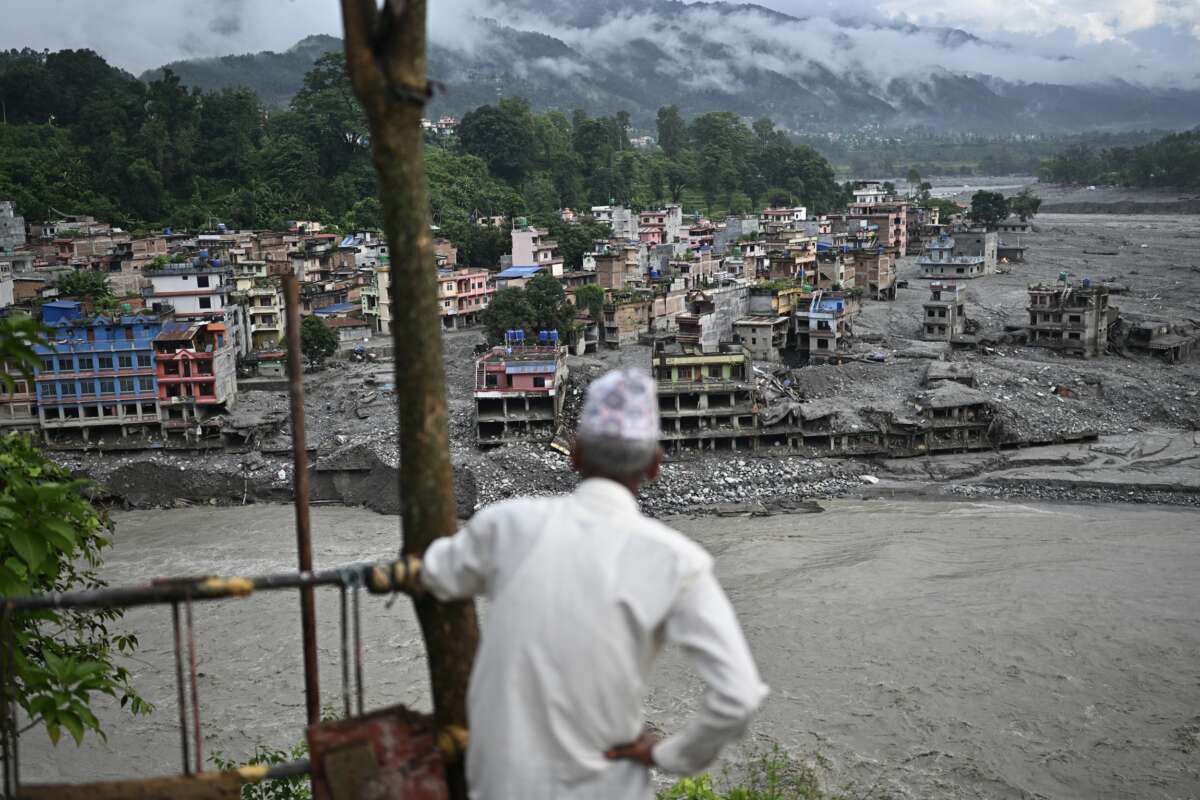
A man looks at the remains in the aftermath of flash floods at Trishuli in Nepal's Nuwakot district on September 7, 2026.Pedro Pardo / AFP via Getty Images

Government leaders from Nepal are calling for climate justice in the wake of devastating glacial floods last month that killed 1,300 people and left thousands more missing.

Preliminary investigations into the flooding determined that the disaster was likely due to glacial collapse, a phenomenon that is becoming more frequent and more likely to occur in the future due to the climate crisis. The impact of this specific collapse, which occurred in August, was so significant that it was initially incorrectly identified as an earthquake, registering a 5.2 rating on the Richter scale.

“We are paying the ultimate price for a global crisis we did not create … Support for Nepal should not be seen from an angle of aid or charity, but should be seen from the perspective of climate justice,” Nepal’s Foreign Minister Shishir Khanal told the AFP news agency.

Speaking to The Guardian, Khanal added:


The global community should not see this as one-off disaster; it should be viewed in the context of the changing climate in the Himalayas. We know it is going to be a recurring scenario that more and more communities, not just in Nepal but around the world, will have to face.


Nepal Floods Demonstrate Threat of Climate-Driven Glacier Collapse
“What happened yesterday is unfortunately the new normal,” one geoscientist said of the devastating floods.


In an address to the country, President Ramchandra Paudel made a similar call for a larger response to the climate crisis.

“I make a heartfelt appeal to the international community not only to listen to the voices of ecologically vulnerable countries, including Nepal, but also to take concrete and effective steps to ensure climate justice for them,” Paudel said.

Around 1,300 people have been documented as killed by the floods, according to recent estimates. Another 5,000 remain missing. The country’s leaders are seeking around $20 million from the global community to help respond to the disaster.

Aakriti Dotel, national network coordinator for the Nepalese Youth for Climate Action, also called for a proactive response from the international community.

The floods are a “painful reminder of the growing climate crisis facing Nepal and the Himalayas,” Dotel said. “As our glaciers melt and extreme weather events become increasingly unpredictable, communities living downstream are bearing the devastating consequences.”

“We mourn the lives lost and the livelihoods affected, and call for urgent global climate action,” Dotel added. “There must be stronger support for vulnerable mountain communities, and accountability from those most responsible for the climate crisis.”

Unfortunately, due to the effects of the climate crisis, disasters like these are more likely to happen in the future, experts say.

What happened to communities in Nepal and the surrounding region “is unfortunately the new normal,” said Jakob Steiner, a geoscientist at the University of Graz in Austria. “It’s going to get worse from here onwards.”
Germany’s Fascist Party Just Won Control of a State Government


The Alternative for Germany party’s victory in the Saxony-Anhalt state election is an ominous coup for the far right.
September 9, 2026

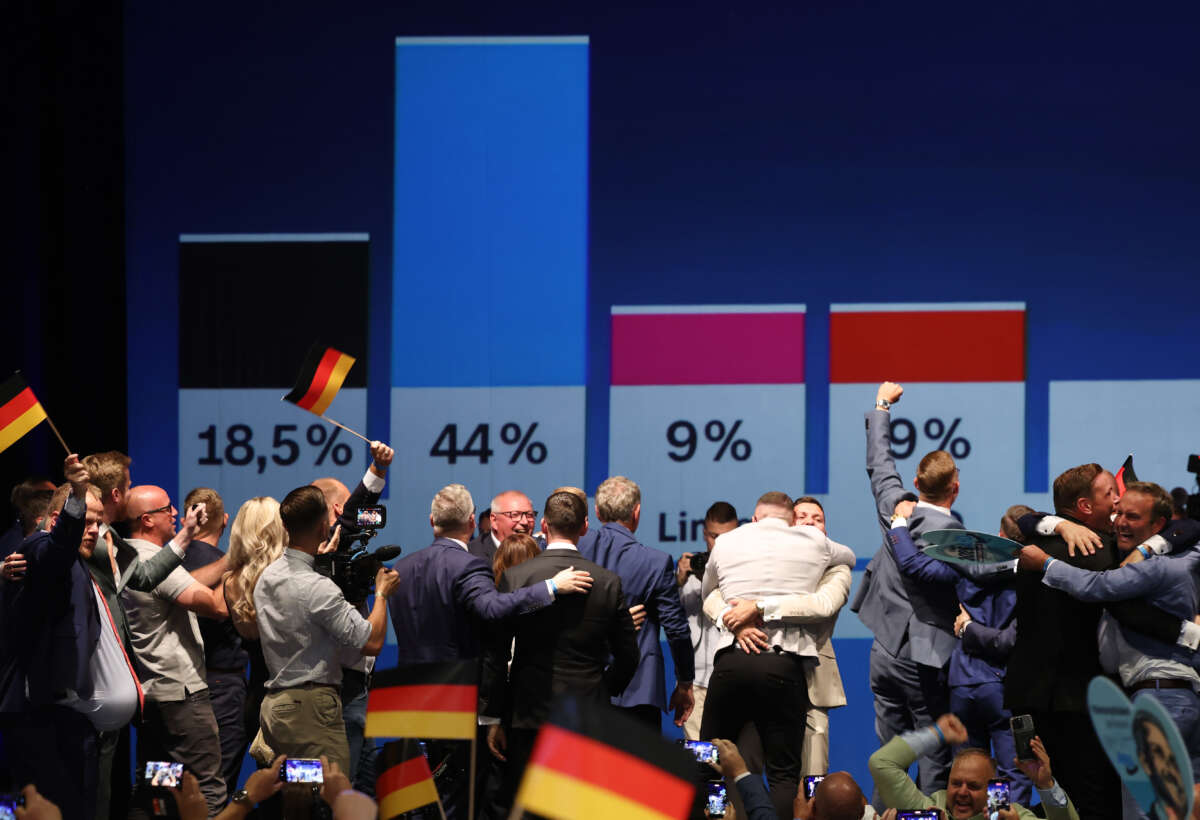
Supporters of the far-right Alternative for Germany (AfD) cheer at the AfD election evening watch party as initial results show the party with 44 percent in Saxony-Anhalt state elections on September 6, 2026, in Magdeburg, Germany.Sean Gallup / Getty Images


The far right Alternative for Germany (AfD) party scored a landslide victory this past Sunday in Germany’s Saxony-Anhalt state election, although it fell short of a majority in its bid to form the first far right state government in the country’s postwar history. It won 43.8 percent of the vote, more than doubling its share of the vote five years ago in the region, while Chancellor Friedrich Merz’s conservative Christian Democratic Union slumped to a historic low of 17.2 percent, down from 37.1 percent in 2021.

This shocking result has been a long time in the making. Neofascist ideology has been creeping into Germany’s mainstream political arena for the past few decades even though the country’s domestic intelligence agency has classified the AfD as an “extremist party” because its leaders have espoused far right rhetoric. Indeed, the party, which has grown rapidly since it was formed in 2013, is not hiding its racism and authoritarianism and has been quite blunt in its rejection of a liberal, pluralistic society.

Neofascist ideology has been creeping into Germany’s mainstream political arena for the past few decades.

Unsurprisingly, AfD leaders are exuberant over their party’s election success in Saxony-Anhalt and seem to think that the tide has finally turned to the point that winning in the next national election with at least 40 percent of the vote is now within reach. Meanwhile, the leaders of Spain and Portugal’s largest far right parties rushed to congratulate the AfD for its victory in Saxony-Ahhalt, as well as Hungary’s former prime minister Viktor Orbán. So did Elon Musk, posting a resounding “Well done!” on his social media platform X in response to a post from AfD’s co-leader Alice Weidel.

How realistic is the prospect that Germany may have a far right federal government by 2029? A recent poll indicates that if national elections were held today, the AfD would indeed emerge victorious with 28 percent of the vote. The reasons for this unsettling development are complex and may go beyond pure economics, although the state of the economy figures prominently into the equation, especially in east Germany, where Saxon-Anhalt is located, and where the AfD is particularly strong.

More than three decades after Germany’s 1990 reunification, there is still a wide gap between east and west. As numerous studies have pointed out, “East Germany is still 20% to 25% poorer than West Germany.” People living in East Germany have realized that convergence under neoliberalism has proved to be a mirage. Under the massive privatization scheme that was launched after 1990 by the government agency Treuhandanstalt, East Germany’s entire state-owned economy was privatized while its industrial base was decimated as thousands of publicly owned enterprises were closed or sold, leading to massive unemployment and triggering a demographic crisis as young and educated people moved westward in search of jobs and better living conditions.

Treuhand’s essential role was to organize the looting of East German industry and public wealth. As Hanna Behrend, a leading academic in the former German Democratic Republic wrote in her edited volume German Unification: The Destruction of an Economy,“Within less than three years, Treuhand destroyed or handed over to West German big business for next to nothing national property to the value of at least several hundred billion Deutschmarks … By 1994 … Treuhand had privatized 13,800 industrial enterprises; a further 3,354 had been closed down.”

This experience with “shock therapy,” which essentially converted East Germany into Berlin’s colony, remains firmly embedded in the collective memory of most East Germans. As Federal Commissioner for East Germany Elizabeth Kaiser has pointed out, many young people in what used to be East Germany see West German culture and lifestyles as deeply foreign to them. People living in small towns and rural regions not only earn “below-average incomes,” they also see their infrastructure continue to collapse while public transportation and medical facilities are “no longer comprehensively guaranteed.” Indeed, as Kim Leonie Kellermann at Ruhr University in Bochum has shown, the mass layoffs that resulted in East Germany because of the Treuhand privatization policies had profound effects on political alienation and mistrust of mainstream parties, “even up to 30 years after unification.”

It is within that context, and with the full realization on the part of many of its citizens that the parties of the establishment offer no hope for the future, that East Germany has become a stronghold of the AfD. Accordingly, the AfD has taken full advantage of the situation by promising a return to a “golden age.” The problem is that the AfD has, instead, a dystopian vision for the future, advancing an agenda that can best be described as “neoliberal fascism.”


The party, which has grown rapidly since it was formed in 2013, is not hiding its racism and authoritarianism.

Ahead of the regional election, the AfD put out a government program for the Saxony-Anhalt region. In the Preamble, the draft government program acknowledges real economic problems facing the region, such as collapsing infrastructure, hospitals and schools closing, the rising cost of living, and dwindling pension benefits, but assigns equal weight to the alleged threat posed by immigration and promises “deportation from minute one!” In addition, it wants to exclude children and adults without a permanent residency from attending schools. It also calls for radical changes in asylum rules, while its solution to the chronic shortage of skilled workers facing the country is to encourage Germans who live abroad to come back.

As the icing on the cake, the AfD calls for a thorough identification with German culture and commitment to the so-called traditional way of life, which includes “the marriage of a man to a woman, from which children are born.” The only thing missing in this section is “Heil Hitler.”

The economic doctrine of the AfD diverges from that of other far right parties on the continent in that it is almost exclusively anti-statist. While the economy as such did not play a major role in the evolution of the party until 2022, it has since taken a more central function. But the policies advocated are highly incoherent and quite contradictory. For instance, the AfD rejects regulation of the economy and advocates huge tax cuts, but at the same time defends the debt break and voted against amending the Basic Law to establish a special fund for infrastructure and climate neutrality in 2025.

Like other far right parties globally, the AfD is staunchly against a green transition, as its position is that climate change is a hoax and an ideological component of “globalism.” With regard to energy, the AfD’s stance is to return to reliance on Russian gas and nuclear power plants.

On the question of war and peace, the AfD is against the war in Ukraine but is by no means an anti-military party. In fact, it has argued in favor of massive increases in the military budget and calls for the return of compulsory military service, which ended in 2011 under former chancellor Angela Merkel.

AfD’s social sensitivities are confined to pensioners, and the party has proposed raising pensions by 70 percent of the last net income. But the idea that this proposal could somehow be financially viable alongside the fiscal impacts of the massive tax cuts, increases in defense spending, and fiscal discipline the party also proposes would simply make most economists throw their hands up in frustration.


The threat of German fascism is back.

After all this, the question is why so many voters across different age groups and economic backgrounds have been drawn to the extremist and impractical policy proposals of the AfD. The state of the economy in East Germany can only partly explain AfD’s support, especially since the party has also made noticeable gains with voters in several western states. The failure of the old political parties, especially of the Social Democrats, who have overwhelmingly lost the trust of the working class, in offering a viable vision for the future could form part of the explanation. In addition, it is quite possible that observers have overestimated the extent to which denazification reached ordinary society. It appears that attachment to ultranationalism remains a strong current among a rather sizable segment of the German population.

On the positive side, nearly half of Germans oppose the far right forming a government in Saxony-Anhalt and protests against the AfD erupted across Germany immediately after the election.

Be that as it may, the victory of the far right in a regional election is a turning point for German politics. The AfD has called for collaboration with other parties and may in fact strike a deal with the Bündnis Sahra Wagenknecht (BSW), a party of authoritarian tendencies that combines left-leaning economic policies with socially conservative views, particularly on immigration. Its founder and leader, Sahra Wagenknecht, appears eager to talk to the AfD about government options in Saxony-Anhalt.

The threat of German fascism is back.


This article is licensed under Creative Commons (CC BY-NC-ND 4.0), and you are free to share and republish under the terms of the license.


C.J. Polychroniou


C.J. Polychroniou is a political scientist/political economist, author and journalist who has taught and worked in numerous universities and research centers in Europe and the United States. Currently, his main research interests are in U.S. politics and the political economy of the United States, European economic integration, globalization, climate change and environmental economics, and the deconstruction of neoliberalism’s politico-economic project. He is a columnist for Global Policy Journal and a regular contributor to Truthout. He has published scores of books, including Marxist Perspectives on Imperialism: A Theoretical Analysis; Perspectives and Issues in International Political Economy (ed.); and Socialism: Crisis and Renewal (ed.), and over 1,000 articles which have appeared in a variety of journals, magazines, newspapers and popular news websites. Many of his publications have been translated into a multitude of languages, including Arabic, Chinese, Croatian, Dutch, French, German, Greek, Italian, Japanese, Portuguese, Russian, Spanish and Turkish. His latest books are Climate Crisis and the Global Green New Deal: The Political Economy of Saving the Planet (with Noam Chomsky and Robert Pollin as primary authors, 2020); The Precipice: Neoliberalism, the Pandemic, and the Urgent Need for Radical Change (an anthology of interviews with Noam Chomsky, 2021); Economics and the Left: Interviews with Progressive Economists (2021); Illegitimate Authority: Facing the Challenges of Our Time (an anthology of interviews with Noam Chomsky, 2023); and A Livable Future Is Possible: Confronting the Threats to Our Survival (an anthology of interviews with Noam Chomsky, 2024).


Germany: regional elections in Sachsen-Anhalt

The AfD just short of an absolute majority


Thursday 10 September 2026, by Helmut Born


On 6 September a new Landtag was elected in Saxony-Anhalt. Saxony-Anhalt is the smallest of the territorial Länder by population, with 2.1 million people. It was clear in advance that there would be considerable changes. At the last Landtag election in 2021 the AfD, which the Saxony-Anhalt domestic intelligence service has classified as confirmed right-wing extremist, took over 20 per cent. In the run-up to this election the standing of the federal government of CDU and SPD reached a low point, as the opinion polls had made foreseeable. Accordingly the task for all the other parties was at least to prevent an absolute majority for the AfD, in percentages as well as in seats. [Image: Composition of the Saxony-Anhalt Landtag following the elections (from left to right): BSW: 5 MPs – Die Linke: 8 MPs – Die Grünen: 8 MPs – SPD: 8 MPs – CDU: 15 MPs – AfD: 39 MPs]

When the first projection was published on the evening of 6 September, showing the AfD on 44.2 per cent, the election-night parties of the other parties fell completely silent. The shock the result produced was too great. It looked altogether different at the AfD, which many people call a Nazi party. The party’s leading figures around the [national] co-chairs Alice Weidel and Tino Chrupalla crowded around the lead candidate Ulrich Siegmund to celebrate together what they called their historic election victory.

The CDU, the large bourgeois party, was punished terribly above all. It lost more than half of its votes and of its deputies. The liberal FDP did not make it into the Landtag at all and goes on wasting away. For the party Die Linke, too, the evening was not a happy one: three weeks before the election it had still been recorded at 13 per cent, and it has now ended up on only 8.4 per cent. The SPD and the Greens, by contrast, were able to improve slightly on their result at the last Landtag election, reaching 9.1 and 8.9 per cent respectively, a little more than Die Linke.

The decisive factor was a massive campaign by influential civil-society organisations which had called for tactical voting, so as to ensure that the SPD and the Greens got back into the Landtag at all. That had been in the balance for a long time. It was certainly a surprise that the Bündnis Sahra Wagenknecht (BSW) also entered the Landtag, which it managed with 5.3 per cent.

In the new Landtag, made up of deputies from six parties, forming a new Land government will not be easy. Since the AfD with 39 of 83 seats did not obtain an absolute majority of the seats, it depends on coalition partners or on support from others. All the other parties have refused to form a government with the AfD. The BSW too rejects a coalition with the AfD. Instead, according to the BSW, an independent minister-president should be elected, who would put a government together and would have to win a majority every time. This model existed in the Netherlands as well, at the election before last, when the party of the racist Geert Wilders narrowly missed an absolute majority and nobody wanted him as prime minister. It remains to be seen whether the AfD will agree to it. The SPD and the Greens have already declared themselves in favour.

For Die Linke this election result was a disappointment. It lost 2.4 per cent against the last Landtag election. The party certainly did not have an easy campaign, since it has a good anchoring only in the cities and its results in the countryside are traditionally poor. That showed again at this election. In the two large cities of Halle and Magdeburg it was able to win three direct mandates. All 38 other constituencies went to the AfD.

The party Die Linke has to become clearer and more radical. Many people simply assign it to a red-green camp together with the SPD and the Greens, which the "vote tactically" campaign also showed. It has to become clear that Die Linke stands for clear opposition to existing conditions, that its representatives are not "politicians" like all the others, that it wants to overcome capitalist class society, and that this will not be achieved in parliament alone. However good its parliamentary demands may be, and however much such measures would noticeably improve people’s lives if they could be realised, there will be no majorities for them in the parliaments. What is needed is a party that is both represented in parliament and that is able to change the social balance of forces through pressure on the street, through anchoring in workplaces and neighbourhoods, and through fostering the self-confidence and self-organisation of those below.

9 September 2026

Translated by International Viewpoint from SoZ.

Fiasco: Trump's contractor confesses to Reflecting Pool train wreck


(Official White House Photo by Daniel Torok/Flickr)

September 11, 2026
ALTERNET


The New York Times reports that the contractor that renovated the Lincoln Memorial Reflecting Pool has told the Trump administration that errors in its own work and flaws in its repair plan, caused the pool’s new blue liner to peel and break loose, not vandalism.

The Times reviewed government documents showing the company took responsibility for the decay and damage to the pool liner, despite the administration’s insistence — and prosecutions —claiming the damage was done by delinquents

“President Trump has repeatedly blamed vandals wielding knives or box cutters for damage to the pool’s ‘American flag blue’ liner, even after the Justice Department dropped charges that it had brought against people accused of vandalizing the national landmark,” reports the Times. “But the documents, which have not previously been reported, make clear that the contractor, Atlantic Industrial Coatings, found problems in both the design and the execution of the renovation. The documents include Atlantic’s reports to the government as well as daily progress updates from the National Park Service over the past two months.”


Atlantic apparently held its own errors liable in an Aug. 14 report, and then provided additional detail on Sept. 2, according to documents.

The Justice Department, which had charged several people with vandalizing the pool in early July, began moving to dismiss the cases on July 31, according to the Times.


In documents, the company blamed “human oversight” in some patches of the renovation, saying workers did not apply enough chemical primer to gel the layers of the liner together. But the bigger problem, the company said, was that the repair plan itself laid out in the contract actually called for the layers of liner to include two chemicals that are incompatible.

“The chemical on top reached a temperature hotter than what the compound underneath could withstand, and the heat caused the bottom layer to blister and come loose, the documents show. The contractor said it had not expected that outcome because it was very uncommon to mix the two products in that way,” reports the Times. “The failure illustrates the consequences of the Trump administration’s rushed effort to renovate the pool this spring. In a hurry to finish the work before the nation’s 250th birthday on July 4, the government bypassed competition and gave Atlantic a no-bid contract to carry out an untested approach designed in part by the general manager of one of Mr. Trump’s golf clubs.”

The Times reports the government has agreed to pay Atlantic $14.7 million for its work, but the contractor has said the pool is under warranty and eligible for additional repair.


Regardless, the Times reports Interior Department spokeswoman Katie Martin appeared to insist vandals were to blame for the damage, saying that they had “repeatedly reached into the pool and ripped at the coating.”

In July, federal prosecutors acted on President Donald Trump’s claims of vandalism and announced the indictment former Olympic canoeist David Hearn for pulling up a piece of the liner, on a felony vandalism charge.

But in a reversal, prosecutors pushed to dismiss the charges against Hearn and three others alleged vandals.


“Jeanine Pirro, the U.S. attorney in Washington, wrote that the Interior Department had misled her staff about the extent to which the damage had stemmed from vandalism rather than a ‘botched installation,’” reports the Times.
WSJ analysis proves it: MAGA is the party of (NATIONAL) socialism


REUTERS/Evan Vucci

September 11, 2026 
ALTERNET

On Friday, a new report by the Wall Street Journal revealed that the MAGA movement has embraced the very “socialist” policies for which President Donald Trump attacks his Democratic opponents. According to the Journal’s chief economic commentator, Greg Ip, MAGA’s “disdain for capitalism and centrism” has it looking more “socialist” by the day.

Ip raises the example of Vice President JD Vance, who dismissed Milton Friedman during an interview in June as irrelevant “in a world where globalized liberalism has become the sort of status quo of American elites." This sort of statement is a far cry from traditional free market Republican economics. According to Ip, such thinking tracks with the “Horseshoe theory,” in which “the similarities between communism and fascism” begin to overlap to the point where they are almost indistinguishable. Like the “communists” and Democratic socialists the president so often rants about, writes Ip, Trump, Vance, and other MAGA figures “disdain free markets and globalization while embracing big, coercive government" and "are obsessed with identity."

According to Ip, these ideas began to shape the Republican Party in 2016 “with Trump’s populist takeover of the Republican Party. ‘Trump has re-educated, or mis-educated a lot of Republican voters into thinking everything is rigged. It’s how Bernie Sanders thinks about the economy,’ said Andy Laperriere, policy analyst at Piper Sandler. ‘The foreigners, the big companies, the system, whatever, is ripping us off.’ Laperriere noted that many ideas that originated on the left now command considerable backing from Republicans. Limiting drug increases to the rate of inflation, banning large investors from buying single-family homes, raising the federal minimum wage to $15 and capping credit-card interest rates at 10 percent all command support of around 70 percent or more, according to polls.”


Ip argues that Trump and Senator Bernie Sanders (D-VT) – long the standard bearer for American socialist politics – “have a lot in common.” Ip writes that “Sanders wanted to nationalize oil companies in the 1970s and proposes 50 percent state ownership of AI companies now. Trump used to call for seizing Middle Eastern oil or being paid to defend it, and just grabbed control of a chunk of Venezuela’s reserves. He has taken stakes in numerous companies and discussed doing the same with AI.”

And when it comes to moving MAGA’s identity away from the broader tolerance typical of centrism, says Ip, “Vance has gone further than Trump in arguing that religion and national origin, not an idea, are the basis of American identity. ‘We cannot rebuild Western civilization, we cannot rebuild the United States of America or Europe, by letting millions and millions of unvetted illegal migrants come into our country,’ he told a conservative audience in early 2025. Vance has also led the charge against Republican economic orthodoxy.”


While MAGA may be increasingly socialist, Ip argues that it will never merge with Democratic socialists because “they may agree that identity matters, but disagree vehemently on why.” Most of the president’s policies simply don’t resonate beyond MAGA. As Ip notes, “Outside of his core base, support for Trump’s handling of the economy and immigration have plummeted.”


MAGA’s deathgrip on Gen Z was severely overstated: report


Attendees pray during AmericaFest, the first Turning Point USA summit since the death of Charlie Kirk, in Phoenix, Arizona, U.S. December 20, 2025. REUTERS
September 10, 2026 
ALTERNET


There’s been plenty of attention on Gen Z voters since they swung right in 2024, but apparently assumptions were a little too premature, says Gen Z culture analyst Rachel Janfaza. They’re not the “red-pilled MAGA hardliners” they were sold to be.

“In 2020, as Gen Z voters came of age, the culture war was at its peak and it felt like every candidate, race and issue was a reflection of our values,” wrote Janfaza. “But today, young voters’ concerns are more material and far less ideological. There’s a common set of issues unifying Gen Zers across the political spectrum: the cost of living, inflation, AI, war, corruption.”

To get a sense of how young voters — including 8.5 million potential first-time voters — are feeling about the 2026 midterm elections, Janfaza and company spoke to them in a series of focus groups. And what interviews with 70 young people aged 17 to 33 in 28 states and Washington D.C. revealed was that they were not MAGA’s future as earlier reported.


“They care a lot less about being woke and a lot more about being able to get a job and pay their rent — let alone buy a home. And they’re looking for candidates who get that,” said Janfaza. “Gen Z voters really just want their politicians to be good, honest people, who work hard for their community and country. That means tackling the cost of living, working on government programs like SNAP and WIC, embracing social policies when it comes to healthcare, jobs, education, and regulating AI. It’s not that complicated. And it’s party agnostic.”

The generation doesn’t identify easily with the two political parties, but they certainly don’t identify with MAGA. In fact, according to interviews, when young voters support socialist candidates or say they favor socialism writ large, it’s really because they feel the status quo isn’t working.


“Life feels totally unaffordable, but young people believe that it doesn’t have to be this way. They want the government to provide Americans with a social safety net and endorse policies like universal or at least affordable health care, affordable housing, a higher minimum wage, affordable education, paid family leave, taxes on corporations, etc.,” Janfaza said.

And unlike other movements rotted in the past or worse, Gen Z appears to have “a hunger for forward looking policies.”

Call it “Hopemaxxing,” said Janfaza, but it means Gen Z wants to hear what a candidate’s plan is to fix the status quo, rather than preserve it. And don’t bother coming at them with the intent to “just blame the other side,” they say. This generation is “looking for candidates to inspire.”

Want to know how New York Mayor Zohran Mamdani cut inroads with the generation? He talked “pothole politics,” complete with on-the-ground repair policies for infrastructure and other endeavors.

And while MAGA isn’t about to benefit from this particular state of mind, Janfaza said Democrats shouldn’t rest easy on their laurels either. This is a results-minded generation.

“How people vote in the midterms will be all about the cost of living, but if young people don’t believe that any of the candidates can make a difference, they may not even show up,” she said.